Rating: 4.3/5
Kerr Temp-Bond Review: Temporary Cement Performance and Uses
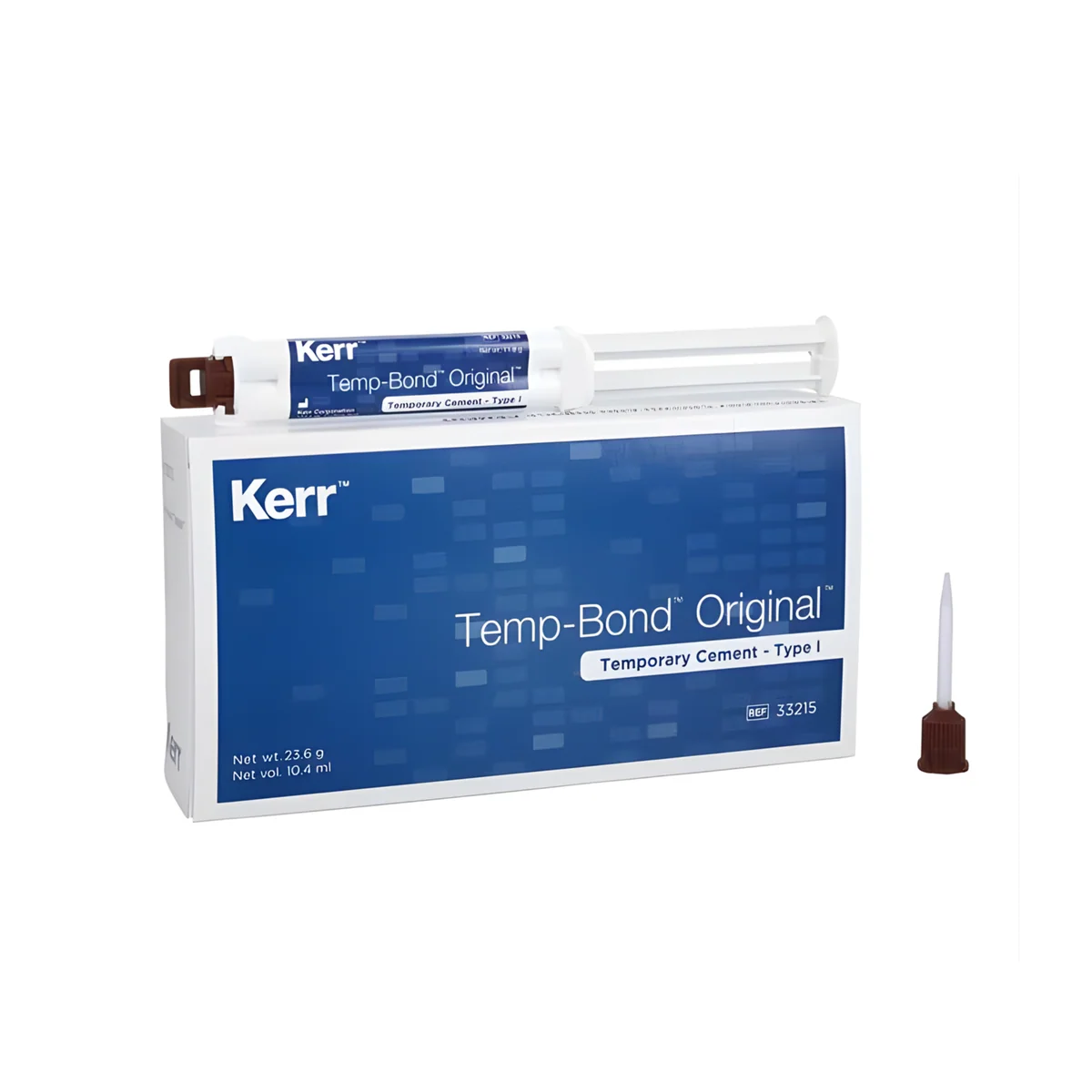
This Temp-Bond review looks at the Kerr Temp-Bond family in 2026, 65 years after the original zinc oxide eugenol paste launched in 1961. It compares that paste with its two newer...
Reviewed by Mantas Petraitis
Pros
- Predictable retention with clean removal on demand
- Eugenol, non-eugenol and clear resin formulas from one brand
- Tube, Unidose and automix delivery options
- Validated modifier for softening the set up to 25% by volume
- Thin film and good seal with low postoperative sensitivity
- Strong independent evaluation data for Temp-Bond NE
Cons
- Sticky paste before set that smears on tissue and instruments
- Tube base can harden early after cap cross-contamination
- Automix working time of about one minute is tight for multi-unit cases
- Unmodified NE can grip tall parallel preps too firmly
- No published radiopacity value for the zinc oxide pastes
- Clear costs more per case and contains triclosan and methacrylates
This Temp-Bond review looks at the Kerr Temp-Bond family in 2026, 65 years after the original zinc oxide eugenol paste launched in 1961. It compares that paste with its two newer siblings on handling, retention, removal, and resin compatibility, and every clinical claim is tied to a published source.
TL;DR
Temp-Bond NE suits most practices that lute definitive crowns with resin cement.
Temp-Bond Original keeps its role in trial cementation and in cases headed for glass ionomer.
Temp-Bond Clear hides cement lines under thin anterior provisionals and costs more per case.
Aluminum oxide air abrasion before final cementation protects the bond more than the choice of formula.
What Is Kerr Temp-Bond
Kerr Temp-Bond is a family of provisional luting cements made by Kerr Dental. Kerr markets it for cementing temporary crowns and bridges and for trial cementing definitive restorations. The range now covers two zinc oxide pastes and one resin, each built for a different restorative workflow.
Temp-Bond Original
Temp-Bond Original is a two-paste, self-curing zinc oxide eugenol (ZOE) cement. Kerr's European product page lists its indications as temporary crowns, bridges, or splints, plus trial cementation of permanent restorations. The base and accelerator mix at a mass ratio of 3.4 to 1, which in practice means two equal stripes on the pad.
Eugenol chelates zinc oxide to form zinc eugenolate, a brittle matrix that holds a shell in place and fractures cleanly when the provisional is lifted. Clinicians who trained on it tend to recognize the consistency immediately. It flows into a well-adapted acrylic shell without trapping air, and it seats with a thin film.
Temp-Bond NE
Kerr released Temp-Bond NE in 1989, first as an option for patients allergic to eugenol. The non-eugenol paste keeps the zinc oxide base, and Kerr states that it does not inhibit the polymerization of permanent resin cements or acrylic temporaries. Handling is close to the original, with a base-to-accelerator ratio of 3.5 to 1.
Temp-Bond NE has the strongest independent track record in the range. In a Dental Advisor evaluation, 26 consultants used it to cement more than 900 temporary restorations, and the product earned a 92% clinical rating. Kerr lists it as a recipient of the Dental Advisor 2024 Preferred Product Award.
Temp-Bond Clear
Temp-Bond Clear with Triclosan is the outlier. The FDA cleared it in February 2006 under 510(k) K053565 as a dual-cured, eugenol-free, resin-based cement that is flexible and transparent once cured. The submission relied on bench testing, so the antimicrobial value of the triclosan has not been shown clinically.
Kerr sells Clear only in an automix syringe of 6 g with 10 mixing tips. It self-cures in under 5 minutes 30 seconds, and a curing light sets the margins on demand.
Delivery Formats And Pack Sizes
Format choice affects cost per case, cross-contamination risk, working time, and shelf life. The table below uses Kerr's EU pack configurations, and part numbers differ in the US market.
Format | Available for | Pack contents | Practical fit |
|---|---|---|---|
Tubes | Original, NE | 50 g base, 15 g accelerator, mixing pad (Original intro pack adds 13 g modifier) | Lowest cost per case and full control of the mix |
Unidose | Original, NE | 50 single-use pouches of 2.4 g | Single-patient hygiene and a fixed ratio |
Automix syringe | Original, NE, Clear | Original and NE: 2 syringes plus 20 tips. Clear: 1 syringe of 6 g plus 10 tips | Fastest delivery with no hand mixing |
Chairside Handling And Clinical Performance
Most of what separates a smooth provisional phase from a recementation visit happens in the first ten minutes after mixing. This section covers timing, retention, seal, cleanup, and storage, using Kerr's published data and independent evaluator feedback.
Working And Setting Times
Kerr's instructions for use give working and setting times measured from the start of mixing at room temperature, with ideal conditions defined as 21–25 °C (70–77 °F).
Product and format | Working time | Set time |
|---|---|---|
Original or NE, tubes | At least 1 min 30 s | No more than 7 min |
Original or NE, automix | At least 1 min | No more than 7 min |
Clear, automix | More than 1 min | Under 5 min 30 s, or immediate with light cure |
The automix syringes trade about 30 seconds of working time for speed. That matters on a four-unit provisional bridge loaded by an assistant at the far end of the operatory. Intraoral set is faster than bench set, and Dental Advisor recorded about 4 minutes in the mouth for Temp-Bond NE.
Retention Under Function
Retention from Temp-Bond is moderate and repeatable. A well-adapted bis-acryl shell on a 4 mm molar preparation with 6 to 10 degrees of total taper stays put for the usual two to four weeks between preparation and delivery. Dental Advisor's consultants described Temp-Bond NE as strong enough while still easy to remove.
Preparation geometry controls retention far more than cement chemistry. A short clinical crown, an over-tapered prep, or a provisional with a rocking intaglio will loosen with any temporary cement. Patients with bruxism also load provisionals hard, and they are the group most likely to call with a crown in hand.
Temp-Bond NE sets firmer than the original paste, and Dental Advisor notes a relatively hard set. On tall, near-parallel preps, that extra grip makes removal harder, and the modifier is the fix.
Seal And Postoperative Sensitivity
Both zinc oxide pastes wet the intaglio well and seat with a thin film, and that limits fluid movement across freshly cut dentin. Kerr claims the cement seals the restoration and prevents seepage, with minimal sensitivity to cold and heat.
When a patient reports thermal sensitivity under a Temp-Bond provisional, the cause is usually an open margin or a high contact. Check the margin with an explorer first. A dentin desensitizer such as Glu/Sense applied before seating helps on deep preparations close to the pulp.
Removal And Excess Cleanup
Cleanup is the part of Temp-Bond use that most clinicians complain about. Before set, the zinc oxide paste smears on explorers and gingiva, and Dental Advisor consultants called it a little sticky and hard to clean off instruments and soft tissue. After set, it chips away in brittle flakes with a scaler.
Waiting for the full set before touching the excess solves most of the mess. A thin wipe of petrolatum on the outside of the shell and the adjacent papilla stops the paste from bonding to tissue. Interproximal excess under a provisional bridge connector needs floss threaded through and pulled out to the side.
Temp-Bond Clear behaves differently. A one- to two-second tack cure turns the excess into a rubbery gel that peels off in a single piece. It leaves no white residue against translucent anterior shells.
Getting the provisional off at the delivery visit is easier with a dedicated tool. A dedicated crown remover such as TempOff lowers the risk of cracking a thin acrylic shell.
Radiographic Visibility
Kerr does not publish a radiopacity value for the zinc oxide Temp-Bond pastes. A bitewing X-ray should not be the only check for retained subgingival cement. Floss and a sharp explorer under magnification catch more residue than a radiograph, especially around implant restorations.
Storage And Shelf Life
Kerr's instructions call for storage at room temperature and warn against inverting caps on the tubes, because cross-contamination hardens the paste early. Dental Advisor consultants reported the base hardening in the tube. Unidose pouches and automix syringes avoid that problem, which is one reason many offices have moved away from tubes.
Temp-Bond NE Vs Temp-Bond: Which Formula Fits The Case
The Temp-Bond NE vs Temp-Bond decision comes down to the definitive cement planned for the case. Both pastes handle almost identically, and the chemistry only matters at the final appointment.
Feature | Temp-Bond Original | Temp-Bond NE | Temp-Bond Clear |
|---|---|---|---|
Chemistry | Zinc oxide eugenol | Zinc oxide, carboxylic acids | Resin with triclosan |
Cure | Self-cure | Self-cure | Dual cure |
Eugenol | Yes | May contain trace amounts | No |
Resin cement compatibility | Residue can affect polymerization | Kerr states no inhibition | Eugenol-free |
Appearance | Opaque white | Opaque off-white | Transparent |
Formats | Tube, Unidose, automix | Tube, Unidose, automix | Automix only |
Best fit | Trial cementation, conventional final cements | Resin-cemented and bonded restorations | Anterior esthetic provisionals |
What The Bond Strength Research Shows
Eugenol is a phenolic free-radical scavenger, so residue in dentin can slow the polymerization of resin cements and adhesives. The laboratory literature on how much this matters clinically is mixed, and the details change the advice.
A 2020 meta-analysis in Applied Sciences pooled coronal dentin studies and found that residual eugenol lowered resin bond strength by a mean of 5.79 MPa. Bayindir and colleagues reported lower retention for resin-cemented crowns on composite cores pretreated with eugenol cement, along with softer composite surfaces.
Timing changes the picture. In a 2011 Operative Dentistry study, 24 hours of eugenol exposure reduced the shear bond strength of a self-etch adhesive, and bond strength recovered one week after the material was removed. A self-adhesive resin cement showed no loss from eugenol remnants in a 2014 study in Acta Odontologica Scandinavica, while the self-etching Panavia F 2.0 system did.
A 2023 systematic review in Clinical Oral Investigations moves the focus away from eugenol altogether. Under delayed dentin sealing, temporary cementation of any type lowered bond strength. Immediate dentin sealing canceled the effect, and aluminum oxide abrasion restored bond strength better than hand instruments alone. Non-eugenol zinc oxide and resin-based temporary cements also performed worse than polycarboxylate and calcium hydroxide in that analysis.
When Temp-Bond NE Makes Sense
Temp-Bond NE is the safer default for any case that ends with adhesive cementation. Typical examples include feldspathic veneers, lithium disilicate crowns luted with RelyX resin cement or Panavia V5, bonded onlays, and zirconia luted with a self-adhesive cement such as Kulzer iCEM Universal Plus.
Resin-cemented crowns, onlays and veneers
Bis-acryl or acrylic provisionals that may need a chairside reline
Patients who report sensitivity to clove products
Offices that want one temporary cement on every tray
When Temp-Bond Original Still Earns Its Place
Temp-Bond Original remains useful when the final cement is conventional. One in vitro study found that ZOE lowered the shear bond strength of a resin cement and left a resin-modified glass ionomer unaffected. Offices that seat metal-ceramic crowns with resin-modified glass ionomer or zinc phosphate lose nothing with the original paste.
Trial cementation of metal-ceramic and full-cast restorations
Cases planned for glass ionomer or zinc phosphate luting
Clinicians who prefer the handling of the classic ZOE paste
Provisionals left in place for only a few days before conventional cementation
Where Temp-Bond Clear Fits
Temp-Bond Clear targets an esthetic problem. Opaque zinc oxide cement can show through a thin anterior shell as a chalky band at the cervical third, and patients in a smile makeover notice it in photos. A transparent resin removes that issue and adds a light-cured margin for faster cleanup.
Clear costs more per case and comes only in automix. Most offices keep it for anterior provisionals and veneer try-ins, with a reliable curing light on hand for the tack cure. Kerr's own Demi Plus curing light covers the same job.
Indications And Contraindications
Kerr Temp-Bond is a short-term luting agent. Kerr's instructions do not list it as a definitive cement or a pulp capping material.
Labeled Indications
The instructions for use list temporary crowns, bridges, inlays, onlays, and splints, with trial cementation added for Temp-Bond Original. Splint stabilization pairs well with a fiber-reinforced design such as Ribbond when mobile teeth need a provisional hold.
Provisional crowns and bridges in PMMA, bis-acryl, milled or printed resin
Provisional inlays and onlays
Splints for temporary stabilization
Trial cementation of definitive restorations with Temp-Bond Original
Off-Label Uses Seen In Practice
Many clinicians use Temp-Bond on retrievable cement-retained implant crowns, often with the modifier. Excess cement around an implant abutment is a well-documented trigger for peri-implant inflammation, so a minimal load and extraoral excess removal on a copy abutment are worth the extra step.
Long-term provisionals in full-mouth rehabilitation are another common use. Temporary cements wash out over months, so recementation belongs in the dental treatment plan from the start, with visits scheduled every few months rather than added after the first debond.
Contraindications And Warnings
The contraindications are short and worth reading in full before using the product on a new patient.
Temp-Bond Original should not be used in patients with a known eugenol allergy
Temp-Bond NE may contain trace amounts of eugenol
Neither paste should contact pulp tissue
Automix tips and Unidose pouches are for single-patient use
For a patient with a documented severe eugenol allergy, a resin-based eugenol-free cement such as Temp-Bond Clear is the more defensible choice. Clear contains methacrylates and triclosan, so check the current safety data sheet when a patient or staff member reports acrylate sensitivity. Near-exposures belong under a proper pulp protection material such as Biodentine before any provisional goes on.
How To Use Temp-Bond Cement Step By Step
Kerr's technique fits on one page. Most failures with TempBond cement come from overloading the shell or cleaning up too early, and the steps below follow the instructions for use with chairside detail added.
Dispensing And Mixing
Each format has its own preparation step before the cement reaches the shell.
Tubes: dispense equal lengths of base and accelerator, about 1 cm each for a single crown, and mix for 30 seconds
Unidose: cut the pouch on the dotted line, express it onto the pad, and mix for 30 seconds
Automix: bleed the syringe before attaching a tip, lock the tip with a quarter turn, and dispense straight into the shell
Recap each tube with its own cap to keep the base from hardening
Seating The Provisional
Good isolation makes the rest of the appointment easier. A cordless system such as DryShield or cotton rolls with a saliva ejector keep the prep dry, and an astringent retraction paste controls sulcular bleeding at subgingival margins.
Clean the prep with water and dry it lightly without desiccating the dentin
Wipe a thin film of petrolatum on the outer surface of the shell
Coat the axial walls and margins of the intaglio with a thin layer
Seat with firm pressure and confirm the margins are closed
Let the cement reach a full set before touching the excess
Remove excess with a scaler and pull floss out to the side
Check occlusion and show the patient how to floss the area
Adjusting Retention With The Modifier
The Temp-Bond modifier is white petrolatum. Kerr allows up to 25% by volume in either zinc oxide paste to soften the set, and the right amount depends on the prep.
Clinical situation | Modifier | Reason |
|---|---|---|
Short or over-tapered prep, long-span bridge | None | Maximum retention |
Average single crown with good taper | None to about 10% | Balanced hold and removal |
Tall parallel preps, multiple abutments, retrievable implant crowns | Up to 25% | Easier, less traumatic removal |
Trial cementation of a definitive crown | About 20–25% | Protects the restoration during removal |
Blend the modifier into the mixed paste until the color is uniform. The Temp-Bond Original standard pack ships without modifier, and the introductory pack includes a 13 g tube.
Removing The Provisional And Cleaning The Prep
The final appointment decides whether the provisional cement helped or hurt the definitive bond. Remove the bulk of the cement with a hand scaler or an ultrasonic scaler such as the Cavitron 300, then treat the dentin.
The 2023 Clinical Oral Investigations review found that air abrasion with aluminum oxide restored bond strength after temporary cementation and outperformed hand instruments alone. Pumice slightly reduced bond strength in that analysis. After abrasion, follow the adhesive protocol for the chosen system, for example, Clearfil Universal Bond Quick 2 or Kerr OptiBond.
Practices that capture the prep with an intraoral scanner after removing the provisional should clean the residue first, since flakes of cement at the margin show up in the scan. The intraoral scanner comparison matrix helps when that workflow is still being set up.
Kerr Temp-Bond Alternatives
Several competitors sit in the same class as Kerr Temp-Bond, and the differences show up mostly in set speed and cleanup feel. No high-quality clinical trial shows any of them outperforming Temp-Bond on routine provisionals.
Product | Chemistry | How it compares |
|---|---|---|
RelyX Temp NE (Solventum) | Zinc oxide, non-eugenol | Closest rival to Temp-Bond NE, with a 3 min 30 s intraoral set in Dental Advisor testing |
TempoCem NE (DMG) | Zinc oxide, non-eugenol | 1 min working time, 4–5 min intraoral set, film thickness of 20 µm or less |
Integrity TempGrip (Dentsply Sirona) | Resin, eugenol-free | Resin-based alternative to Temp-Bond Clear |
The cement is only half of a provisional. A well-fitting shell does much of the retention work, and our J-Temp temporary resin review covers one provisional crown material in detail. For patients waiting on an anterior implant, a removable dental flipper can avoid a cemented provisional altogether.
Bottom Line
Kerr Temp-Bond remains one of the most dependable provisional cement families available to general dentists and prosthodontists. Its formulas cover both conventional and adhesive workflows, plus anterior esthetic cases, and the handling is familiar enough that a new assistant learns it in a day.
For a practice choosing one product, Temp-Bond NE is the sensible pick. It removes the eugenol variable before resin cementation and carries a 92% clinical rating from an evaluation of more than 900 restorations. Keep the modifier on hand for tall preparations and retrievable implant work.
The research on provisional cement and resin bonding points to a habit more than a product. Residue from any temporary cement lowers bond strength under delayed dentin sealing, and aluminum oxide air abrasion recovers it better than hand scaling. Practices that adopt immediate dentin sealing see the smallest effect of all.
Temp-Bond Original and Temp-Bond Clear fill narrower roles. The first suits trial cementation and conventional luting, and the second suits anterior cases where a white cement line would spoil the provisional.
Verdict
<p>Kerr Temp-Bond has been on dental trays since 1961. It seats fully and holds a well-made provisional through two to four weeks of chewing, then lets go when the definitive crown arrives. Dental Advisor's 26 consultants placed more than 900 provisionals with Temp-Bond NE and rated it 92%, which is about as much independent field data as any temporary cement has.</p><p>Temp-Bond NE is the right default for most practices in 2026, because most definitive crowns are now luted or bonded with resin. Thorough mechanical cleaning is still required before bonding, since the 2023 systematic review found reduced bond strength after non-eugenol zinc oxide cements too.</p><p>Temp-Bond Original belongs in offices that still trial-cement metal-ceramic work or lute with glass ionomer. Temp-Bond Clear is worth its higher price on anterior provisionals where opaque cement would show.</p><p>The weak points are about handling. The paste smears before it sets, and tubes harden early when caps get swapped. Petrolatum on the shell and patience before cleanup solve the first problem, and Unidose or automix delivery solves the second.</p>
Frequently Asked Questions
What is Kerr Temp-Bond used for?
Kerr Temp-Bond cements temporary crowns, bridges, inlays, onlays and splints. Temp-Bond Original is also used for trial cementation of definitive restorations before final luting.
What is the difference between Temp-Bond NE and Temp-Bond?
Temp-Bond Original contains eugenol. Temp-Bond NE replaces eugenol with carboxylic acids, so Kerr states it does not inhibit the polymerization of resin cements or acrylic temporaries. Both pastes share the same working and setting times.
Does eugenol in temp bond cement weaken resin cement bonds?
Laboratory studies show a reduction in bond strength after eugenol exposure, with a pooled mean loss of 5.79 MPa in one meta-analysis. The effect fades after about a week in several studies, and thorough mechanical cleaning reduces it further.
How long does Temp-Bond hold a temporary crown?
Temp-Bond is designed for the usual provisional period of two to four weeks. It can hold longer, but temporary cements wash out over months, so long-term provisionals need periodic recementation.
How much modifier should be added to Temp-Bond?
Kerr allows up to 25% white petrolatum by volume. Use none on short or tapered preps and move toward 25% for tall preparations, implant crowns and trial cementation.
Is Temp-Bond NE completely eugenol-free?
Kerr's instructions state that Temp-Bond NE may contain trace amounts of eugenol. A resin-based cement such as Temp-Bond Clear is the safer choice for a patient with a confirmed severe eugenol allergy.
Can Temp-Bond be used on implant crowns?
Many clinicians use it, often with the modifier, on retrievable cement-retained implant crowns. Use a minimal amount, remove excess outside the mouth on a copy abutment where possible and check the margins carefully.
Why does Temp-Bond harden in the tube?
Swapping caps between the base and accelerator tubes contaminates the paste and starts the setting reaction. Store tubes at room temperature and recap each with its own cap, or switch to Unidose or automix.
How should Temp-Bond residue be removed before final cementation?
Remove the bulk with a hand or ultrasonic scaler, then air-abrade the dentin with aluminum oxide where the adhesive protocol allows. A 2023 systematic review found this restored bond strength better than hand instruments alone.