Rating: 4.2/5
Biodentine Review: The All-In-One Bioactive Dentine
Biodentine is a calcium silicate-based bioactive dental material manufactured by Septodont that has fundamentally changed how clinicians approach damaged dentine. Available since...
Reviewed by Agnes Markovic
Pros
- All-in-one versatility covering restorative and endodontic indications with a single material
- Excellent biocompatibility with no mutagenic, irritant, or sensitising potential
- True bioactivity that induces hydroxyapatite formation, promotes healing, and stimulates reactionary dentine genesis
- Fast setting time of 10–12 minutes compared to 2–4 hours for MTA
- No bismuth oxide means minimal risk of tooth discoloration
- Natural micromechanical anchorage without surface conditioning or bonding agents
- Compressive strength and flexural modulus comparable to natural dentine
- Zero polymerisation shrinkage due to resin-free formulation
- Bio Bulk-Fill capability for single-step cavity filling from pulp to crown
- Extensive peer-reviewed evidence base with hundreds of published studies
Cons
- Cannot serve as a final aesthetic enamel restoration, requires composite or indirect overlay
- Limited working time can be challenging in complex clinical scenarios
- Setting time of 10–12 minutes may still feel long for paediatric patients
- Higher cost per capsule compared to conventional materials like glass ionomer or calcium hydroxide
- Water-based chemistry results in lower initial bond strength with overlying resin composite
- Original capsule format requires a triturator, although Biodentine XP addresses this
- Very long-term clinical data (beyond 10 years) is still limited
- Slight colour difference from natural tooth structure may be visible in some situations
Biodentine is a calcium silicate-based bioactive dental material manufactured by Septodont that has fundamentally changed how clinicians approach damaged dentine. Available since 2009, this all-in-one dentine substitute is designed for use wherever dentine is compromised, covering both restorative and endodontic indications in a single material system.
The material combines therapeutic bioactivity with restorative-grade mechanical properties, allowing dental professionals to treat everything from deep carious lesions and pulp exposures to root perforations and apexification procedures. Unlike traditional approaches that require multiple materials for different layers of a restoration, Biodentine can fill a cavity from pulp to crown in one step using the Bio Bulk-Fill technique.
This review examines Biodentine’s composition, clinical evidence, practical advantages, limitations, and real-world performance to help dental professionals make an informed decision about whether this material belongs in their operatory.
What Is Biodentine and How Does It Work?
Understanding the science behind Biodentine helps explain why this material performs so differently from conventional cements and liners. The formulation is built on Septodont’s patented Active Biosilicate Technology, which ensures an exceptionally high purity of tricalcium silicate, the material’s principal bioactive component.
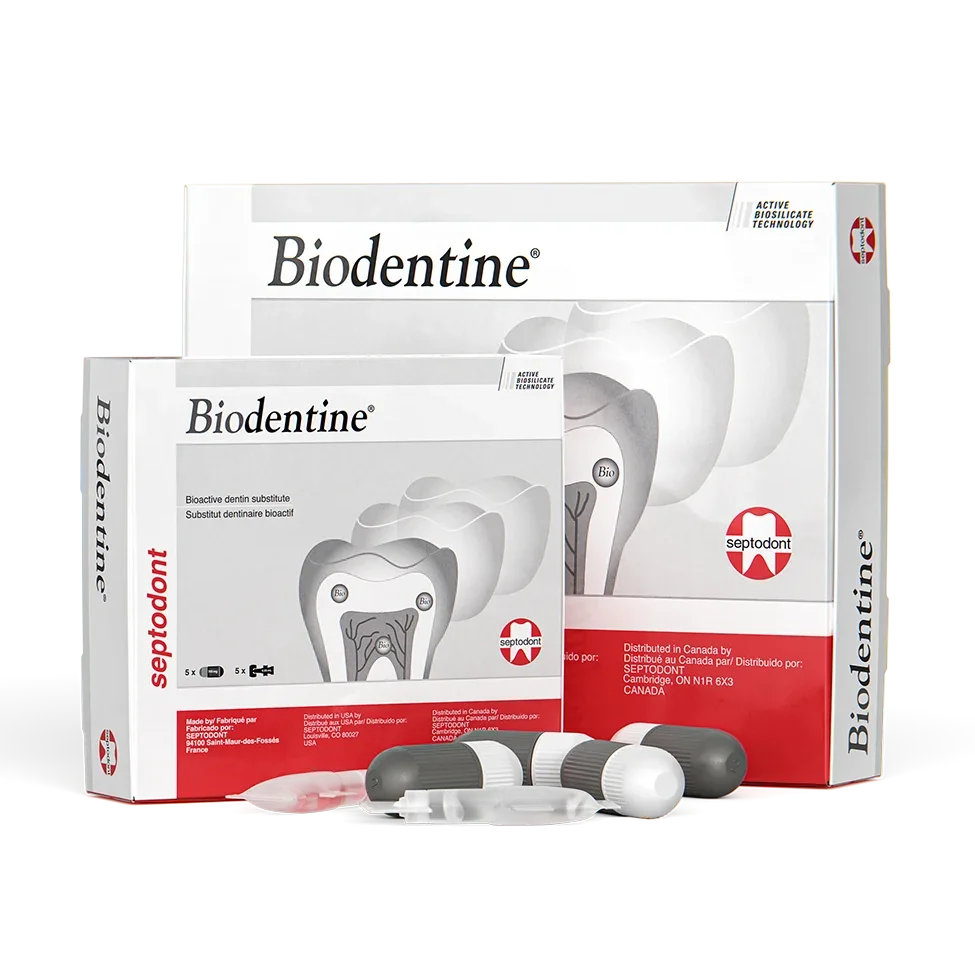
Biodentine is supplied as a powder-liquid system in single-dose capsules. The powder contains tricalcium silicate as the main core material, dicalcium silicate for long-term strength, calcium carbonate as a filler, zirconium oxide for radiopacity, and iron oxide for colour. The liquid component contains calcium chloride (an accelerator), a hydrosoluble polymer (a water-reducing agent), and water.
When mixed, the tricalcium silicate reacts with water to produce calcium silicate hydrate gel and calcium hydroxide. This reaction creates a highly alkaline environment that is inherently unfavourable for bacterial growth. The calcium ions released during setting stimulate dentine repair and promote hydroxyapatite formation at the material-tissue interface, which is the foundation of the material’s bioactive behaviour.
Importantly, Biodentine does not contain bismuth oxide. This is a deliberate formulation choice that significantly reduces the risk of tooth discoloration, a well-documented drawback of MTA-based products that use bismuth oxide as their radiopacifier.
Key Properties That Matter in Clinical Practice
The clinical relevance of any dental material ultimately comes down to how its properties translate into predictable patient outcomes. Biodentine’s properties have been evaluated extensively in laboratory and clinical studies, and several characteristics stand out as particularly significant for everyday practice.
Biocompatibility and Bioactivity
Biodentine is classified as a fully biocompatible medical device with no mutagenic, irritant, or sensitising potential. When placed in direct contact with vital pulp tissue, the material is well tolerated and actively promotes healing. It induces hydroxyapatite formation, supports angiogenesis and osteogenesis, and stimulates reactionary dentine genesis for pulp vitality preservation. This bioactive behaviour sets Biodentine apart from passive restorative materials that simply fill space without engaging in biological repair.
Mechanical Strength
Biodentine achieves a compressive strength comparable to natural sound dentine, and this strength continues to increase over time after initial placement. The flexural modulus is also equivalent to natural dentine, meaning the material distributes occlusal stress in a pattern similar to the tooth structure it replaces. These properties are critical when using the Bio Bulk-Fill approach, where Biodentine may occupy a large portion of the restored cavity.
Sealing Ability and Dimensional Stability
The material develops a natural micromechanical anchorage with tooth structure without requiring surface conditioning, etching, or bonding agents. This self-adhesive property contributes to excellent marginal sealing, minimal microleakage, and elimination of post-operative sensitivity. The resin-free formulation ensures zero polymerisation shrinkage and long-lasting dimensional stability, creating a tight seal that remains reliable over time.
Setting Time and Handling
The total working time from mixing to final set is approximately 10 to 12 minutes. The capsule format allows mixing with a standard triturator or amalgamator, producing a paste-like consistency that is placed with a spatula or applicator. No layering or light curing is needed, which simplifies the clinical workflow considerably.
Clinical Indications and Applications
Biodentine’s versatility across both crown and root indications is what truly earns it the all-in-one designation. The material is suitable for a broad range of clinical scenarios that would traditionally require different products.
Crown Applications
Temporary enamel restoration for up to six months while planning the definitive composite or indirect restoration
Permanent dentine restoration beneath composite or indirect restorations
Deep or large carious lesions where proximity to the pulp demands a biocompatible, bioactive base
Deep cervical or radicular lesions
Direct pulp capping when exposure occurs during caries excavation or mechanical preparation
Indirect pulp capping as a protective liner that stimulates reactionary dentine formation
Pulpotomy in both primary and permanent teeth, including cases with signs of irreversible pulpitis
Root Applications
Root and furcation perforation repair
Internal and external resorption management
Apexification as an apical plug for immature non-vital teeth
Retrograde surgical filling during endodontic microsurgery
The Bio Bulk-Fill Procedure Explained
The Bio Bulk-Fill technique is one of the most clinically significant protocols enabled by Biodentine’s combined therapeutic and restorative capabilities. This approach allows the entire cavity to be filled with Biodentine alone, from the pulp floor to the tooth surface, using a single material in a single step.
No layering, multiple material systems, or light curing is required. The final enamel restoration can be placed in the same session or deferred to a second appointment performed any time between two weeks and six months later. This protocol was developed based on recommendations from an international panel of dental practitioner experts convened by Septodont in 2023.
The clinical benefits are straightforward: fewer materials to stock, fewer technique-sensitive steps, reduced chair time, and fewer appointments for the patient. For practices looking to streamline deep caries management while maintaining biological outcomes, the Bio Bulk-Fill approach represents a meaningful workflow improvement.
Biodentine vs. MTA: A Clinical Comparison
Mineral trioxide aggregate (MTA) has been the gold standard bioactive endodontic material since the 1990s. Biodentine was developed specifically to address MTA’s known limitations while retaining its biological strengths. For clinicians choosing between these two dental materials, the practical differences are significant.
Property | Biodentine | MTA |
Setting time | 10–12 minutes | 2–4 hours |
Handling | Easy capsule mixing | Difficult, requires careful manipulation |
Discoloration | Minimal (no bismuth oxide) | Significant (especially grey MTA) |
Compressive strength | Comparable to dentine, increases over time | Lower, may decrease over time |
Bulk restoration use | Yes, Bio Bulk-Fill capable | Not recommended |
Cost per application | Generally lower | Generally higher |
Biocompatibility | Excellent | Excellent |
Bioactivity | Promotes hydroxyapatite, healing | Promotes hydroxyapatite, healing |
Pulp capping success | 82–93% at 1–3 years | 84–96% at 1–3 years |
Surface conditioning | Not required | Not required |
Multiple systematic reviews have concluded that Biodentine and MTA demonstrate comparable clinical success rates across shared indications (Kaur et al., 2017). However, Biodentine consistently outperforms MTA on practical measures including handling ease, setting speed, discoloration risk, and versatility as a bulk restorative. A 2025 meta-analysis found that Biodentine showed a lower failure rate and marginally better calcific bridge formation, although these differences did not reach statistical significance.
Biodentine vs. Calcium Hydroxide
Calcium hydroxide was the traditional gold standard for pulp capping for several decades. While biocompatible and capable of stimulating dentine bridge formation, calcium hydroxide has well-documented clinical limitations that Biodentine directly addresses.
Calcium hydroxide is susceptible to dissolution over time, has limited mechanical strength, and produces dentine bridges that are frequently porous with tunnel defects. These characteristics can compromise the long-term seal and leave the pulp vulnerable to bacterial contamination.
Clinical studies have shown that Biodentine produces more uniform, thick, and continuous reparative dentine bridges compared to calcium hydroxide (Nowicka et al., 2015). One randomised clinical trial in young permanent teeth reported 100% success for Biodentine versus 86.36% for calcium hydroxide at follow-up (Brizuela et al., 2017). The material’s superior mechanical properties and sealing ability provide a more reliable foundation for the overlying restoration.
Clinical Evidence and Published Success Rates
Biodentine has accumulated a substantial body of peer-reviewed evidence since its launch. The data supports its use across multiple indications with favourable short-term and medium-term outcomes.
Direct Pulp Capping Results
Published studies report overall success rates for Biodentine direct pulp capping ranging from approximately 80% to over 92%, depending on follow-up duration and patient demographics. Patient age is a significant prognostic factor: success rates reach approximately 90.9% in patients younger than 40 years compared with 73.8% in patients aged 40 and older (Lipski et al., 2018). A three-year prospective randomised trial found success rates of 91.7% for Biodentine and 96.0% for MTA, with no statistically significant difference (Awawdeh et al., 2018).
Pulpotomy Outcomes
Research on full pulpotomy with Biodentine in permanent teeth with symptoms of irreversible pulpitis reported 98.4% success at six months and 100% at 12 months (Brizuela & Daley, StatPearls 2024). A systematic review and meta-analysis evaluating Biodentine for vital pulp therapy in young permanent teeth found an overall radiographic success rate of approximately 93.87%, comparable to other bioceramic materials, with a significantly lower discoloration rate compared to MTA (Tang et al., 2025).
Apexification Evidence
In a randomised clinical trial comparing Biodentine and MTA as apical plugs in immature permanent molars, both materials demonstrated comparable periapical healing at 12 months. Biodentine cases showed apical calcified barrier formation that was not observed in the MTA group (Abuelniel et al., 2022).
Primary Teeth
A comprehensive systematic review of randomised controlled trials found comparable success rates between Biodentine and MTA for pulpotomy in primary teeth. Given Biodentine’s practical advantages, it has been identified as a suitable preferred alternative in the paediatric patient population.
Biodentine XP: The Next-Generation Delivery System
Septodont developed Biodentine XP to address the most common criticism of the original product, the mixing and delivery workflow. The XP version uses the same composition and delivers identical clinical efficacy, biocompatibility, and bioactivity. The innovation is entirely in the delivery system.
Biodentine XP comes in all-in-one syringe-like cartridges containing both powder and liquid. These are mixed in 30 seconds with a dedicated high-speed mixer and dispensed directly into the tooth using an applicator gun with an orientable nozzle. Two cartridge volumes are available: XP 200 for smaller procedures and XP 500 for larger restorations.
Clinical evaluators have consistently praised the system for eliminating guesswork, improving consistency, and simplifying the workflow. The cartridges have a 24-month shelf life when stored at 5°C to 25°C. Biodentine XP is suitable for both primary teeth (children aged 2 and older) and permanent teeth.
Bottom Line
Biodentine is a genuine all-in-one bioactive dentine substitute that simplifies clinical workflows without compromising biological outcomes. The material delivers predictable results for pulp capping, pulpotomy, dentine restoration, perforation repair, and apexification, backed by a robust body of peer-reviewed evidence. Its advantages over MTA in setting time, handling, and discoloration risk, combined with comparable clinical success rates, make it a material that belongs in every modern dental practice.
Verdict
<p>Biodentine has earned a reputation as one of the most versatile bioactive materials available in modern dentistry. With more than 15 years on the market and hundreds of peer-reviewed publications, the evidence consistently supports its effectiveness across restorative and endodontic indications.</p><p>The material’s ability to function as both a pulp therapeutic agent and a structural dentine replacement simplifies inventory management and treatment planning. The Bio Bulk-Fill approach has meaningfully changed how deep carious lesions are managed in practices that adopt it, reducing the number of materials, steps, and appointments required. Post-operative sensitivity is minimal, and vitality outcomes align with published clinical data.</p><p>The introduction of Biodentine XP has resolved the most common practical objection to the original product. The new cartridge mixing and delivery system is faster, more consistent, and substantially more convenient. Clinicians who previously avoided Biodentine due to handling concerns should revisit the product in its XP format.</p><p>Biodentine is not a final aesthetic restoration, and the 10- to 12-minute setting time can still feel long in paediatric or time-pressured settings. However, these are known trade-offs that most practitioners accept given the material’s biological and mechanical advantages. For general dentists and specialists alike, Biodentine is a material that delivers on its claims and has the clinical evidence to support routine use.</p>
Frequently Asked Questions
What is Biodentine used for in dentistry?
Biodentine is a bioactive dentine substitute indicated for direct and indirect pulp capping, pulpotomy, permanent dentine restoration, temporary enamel restoration (up to 6 months), deep carious lesion management, root and furcation perforation repair, resorption management, apexification, and retrograde surgical filling. It covers both crown and root applications in a single material.
How does Biodentine compare to MTA?
Biodentine and MTA share similar bioactive and biocompatible properties with comparable clinical success rates. Biodentine offers practical advantages including a setting time of 10–12 minutes (versus 2–4 hours for MTA), easier handling, lower discoloration risk, and the ability to serve as a bulk restorative material. Systematic reviews have found no statistically significant difference in clinical outcomes between the two.
Can Biodentine be placed directly on exposed pulp?
Yes. Biodentine’s high-purity tricalcium silicate composition and medical-grade biocompatibility make it well tolerated when placed directly on vital pulp tissue. Clinical studies confirm that the material promotes quality reparative dentine bridge formation and creates a favourable environment for pulp healing.
What is the setting time of Biodentine?
The total working time from mixing to final set is approximately 10 to 12 minutes. This is significantly faster than MTA, which typically requires 2 to 4 hours. The calcium chloride accelerator in the liquid component enables this clinically practical setting time.
Is Biodentine safe for use in children?
Yes. Biodentine is suitable for primary teeth of children aged 2 and older, as well as permanent teeth. Systematic reviews have confirmed its effectiveness for pulpotomy in primary teeth with success rates comparable to MTA.
What is the Bio Bulk-Fill procedure?
Bio Bulk-Fill is a clinical technique where the entire cavity is filled with Biodentine alone, from pulp to crown, in a single step. No layering, multiple materials, or light curing is required. The final enamel restoration can be placed in the same session or at a follow-up appointment between 2 weeks and 6 months later.
Does Biodentine cause tooth discoloration?
Biodentine carries a significantly lower risk of tooth discoloration compared to MTA. This is because the formulation uses zirconium oxide as its radiopacifier instead of bismuth oxide, the compound primarily responsible for staining in MTA products.
What is the difference between Biodentine and Biodentine XP?
Both products share the same composition and clinical efficacy. The difference is in preparation and delivery. Original Biodentine uses separate powder capsules and liquid mixed with a triturator. Biodentine XP uses all-in-one cartridges mixed in 30 seconds with a dedicated mixer and dispensed directly with an applicator gun.
Does Biodentine require bonding agents?
No. Biodentine develops natural micromechanical anchorage with tooth structure and does not require surface conditioning, etching, or adhesive bonding. This self-adhesive property contributes to excellent sealing and eliminates a technique-sensitive step.
What is the success rate for Biodentine pulp capping?
Published clinical studies report success rates ranging from approximately 80% to over 92%, depending on study design and patient age. Success rates are higher in patients younger than 40 (approximately 90.9%) compared with older patients (approximately 73.8%). Three-year data shows Biodentine achieves outcomes comparable to MTA.