Rating: 4.7/5
BioRoot Flow: A Complete Review
Bioceramic root canal sealers have fundamentally changed how dental professionals approach obturation. Traditional epoxy-resin sealers like AH Plus served the profession well for...
Reviewed by Agnes Markovic
Pros
- Premixed, ready-to-use syringe eliminates mixing variability and saves chairside time
- 91% two-year clinical success rate from a multicenter randomized controlled trial (OPTIFILL)
- Compatible with cold, warm, and single-cone obturation techniques
- Bioactive properties including sustained calcium ion release and hydroxyapatite formation
- Alkaline pH (8.5 to 11.5) creates an environment that inhibits bacterial growth
- Resin-free and eugenol-free formulation avoids cytotoxicity and composite interference concerns
- No shrinkage upon setting, maintaining dentin-sealer-gutta-percha interface integrity
- Working time exceeding 60 minutes for complex, multi-rooted cases
- Bendable 21-gauge tips for precise delivery in posterior and difficult-to-access canals
- High radiopacity via zirconium oxide without risk of tooth discoloration
- Hydrophilic formulation that penetrates accessory canals and tubules without compaction
- Excellent retreatability, with removal to working length in less than 10 minutes
- Anti-inflammatory effects on periodontal ligament cells (demonstrated in vitro)
- Pure tricalcium silicate via ABS Technology eliminates aluminate and heavy metal impurities
- Favorable tissue response with minimal reported post-operative patient discomfort
Cons
- Viscosity may feel too fluid for some clinicians, particularly in wide canals
- Some in vitro studies show reduced gingival fibroblast viability at 24 to 48 hours of direct contact
- Potential genotoxicity concerns in direct-contact lab assays, though clinical relevance remains uncertain
- Higher solubility in citric acid compared to BioRoot RCS, which may affect long-term stability in certain conditions
- Requires moisture for setting, meaning excessively dry canals may slow the process
- Limited long-term clinical data beyond two years, as the product was launched in 2022
- Higher initial cost compared to traditional zinc oxide eugenol sealers
- 24-month shelf life requires inventory planning for low-volume endodontic practices
- Cannot be used as a standalone filling material, as it requires gutta-percha points
Bioceramic root canal sealers have fundamentally changed how dental professionals approach obturation. Traditional epoxy-resin sealers like AH Plus served the profession well for decades, but growing clinical evidence now supports calcium silicate-based materials that do more than fill a canal. They actively promote periapical healing, inhibit bacterial growth, and form a genuine chemical bond with dentin. BioRoot Flow, manufactured by Septodont, is one of the most talked-about entries in this category, and for good reason.
This review examines BioRoot Flow from every angle that matters to a practicing clinician: composition, mechanism of action, clinical evidence, handling characteristics, cost considerations, and real-world feedback from dentists and endodontists who have used it. Whether the goal is to evaluate a new sealer for a specialty endodontic practice or to explore bioceramic obturation as a general dentist, this guide provides the information needed to make a confident, evidence-based decision.
The endodontic materials market has seen rapid innovation in recent years. Calcium silicate-based sealers have moved from niche curiosity to mainstream clinical adoption, driven by a growing body of peer-reviewed research demonstrating superior biocompatibility, antimicrobial properties, and the ability to promote genuine tissue regeneration at the root apex. BioRoot Flow sits at the forefront of this shift, combining Septodont’s decades of bioceramic research with a delivery system designed for the demands of modern clinical workflow. Understanding how this product performs, and where it fits relative to alternatives like AH Plus, TotalFill BC Sealer, and AH Plus Bioceramic Sealer, is essential for any clinician making informed obturation decisions in 2026.
What Is BioRoot Flow?
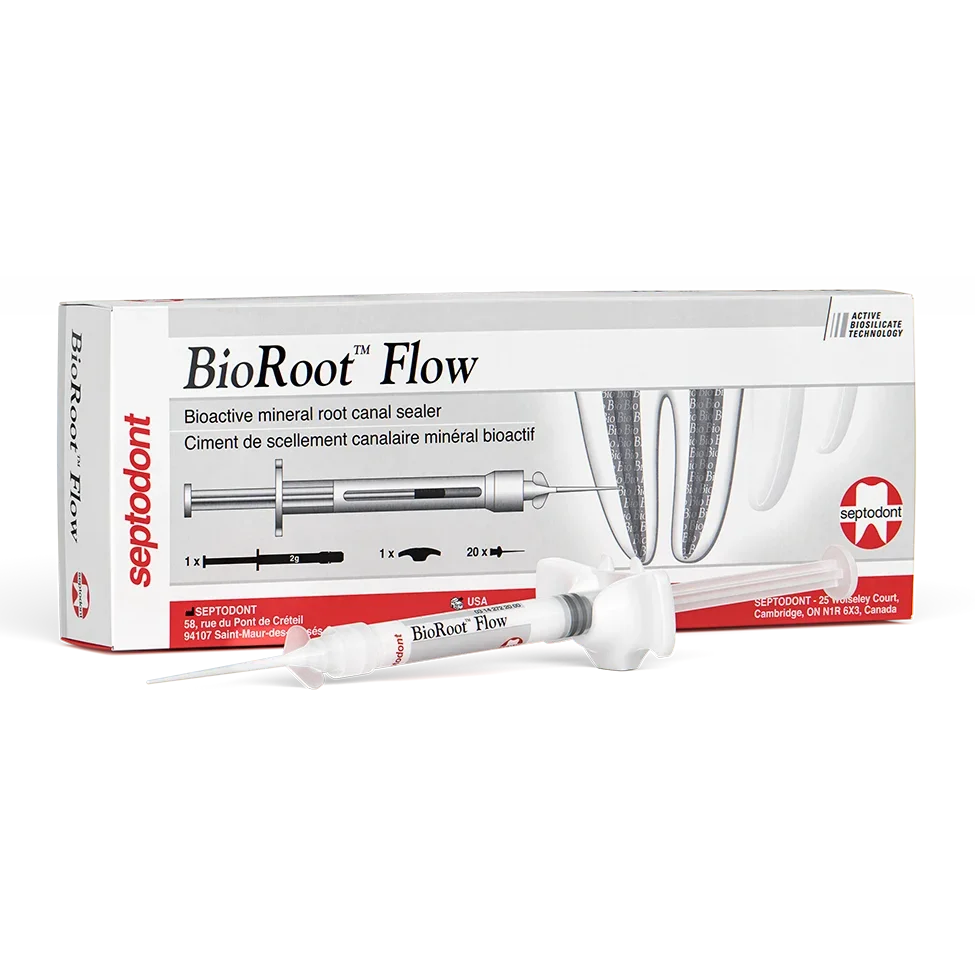
BioRoot Flow is a permanent, biocompatible, premixed bioceramic root canal sealer designed for use with gutta-percha points. It was launched in 2022 as the successor to BioRoot RCS, a powder-and-liquid calcium silicate sealer that Septodont introduced in 2016. The most significant upgrade is the delivery format: BioRoot Flow arrives in a ready-to-use 2-gram syringe with 20 bendable intra-oral tips, eliminating the need for chairside mixing entirely.
The product is built on Septodont’s proprietary Active BioSilicate (ABS) Technology, a patented manufacturing process that produces medical-grade tricalcium silicate free of the aluminate and sulfate impurities found in Portland-cement-derived bioceramics. This matters clinically because the purity of the calcium silicate directly influences bioactivity, calcium ion release, and the absence of potentially harmful trace elements. For dental professionals building a comprehensive dental treatment plan that includes endodontic therapy, understanding the materials available for obturation is an essential part of delivering predictable outcomes.
BioRoot Flow is indicated for permanent root canal filling in combination with gutta-percha points in cases involving inflamed or necrotic pulp, as well as following retreatment procedures. It can be used in anterior teeth, premolars, and molars, including multi-rooted teeth with complex canal anatomy. The material is classified as a mineral-based, bioactive, radiopaque root canal sealer and is available through major dental distributors including Henry Schein, Benco Dental, and Patterson Dental. Septodont manufactures the product in France and distributes it globally, with a strong distribution network across the United States, Europe, and Asia.
BioRoot Flow Product Specifications
The following table summarizes the key specifications that dental professionals should know before incorporating BioRoot Flow into their obturation protocol.
Specification | Details |
Product name | BioRoot Flow |
Manufacturer | Septodont (Saint-Maur-des-Fossés, France) |
Category | Bioceramic root canal sealer |
Item number | 01E0510 |
Packaging | 1 x 2g syringe, 1 finger grip, 20 intra-oral tips |
Formulation | Premixed, ready-to-use |
Active ingredient | Tricalcium silicate (C3S) |
Technology | Active BioSilicate (ABS) Technology |
Radiopacifier | 7 |
Working time | > 60 minutes |
pH range | 8.5 to 11.5 (alkaline) |
Flowability | 23 mm (ISO 6876:2012 compliant) |
Obturation compatibility | Cold, warm, and single-cone techniques |
Resin/eugenol content | None (resin-free, eugenol-free) |
Shelf life | 24 months |
Applications per syringe | Approximately 15 to 20 |
Approximate retail price | $77 to $131 per 2g syringe (varies by distributor) |
BioRoot Flow Composition and Active BioSilicate Technology
According to Septodont’s official product page, BioRoot Flow is composed of tricalcium silicate, propylene glycol, povidone, calcium carbonate, Aerosil (fumed silica), zirconium oxide, acrylamide/sodium acryloyldimethyltaurate copolymer, isohexadecane, and polysorbate. The formulation is entirely free of epoxy resin, eugenol, and methacrylate monomers, all of which appear in traditional sealers and carry varying degrees of cytotoxicity risk.
Tricalcium silicate (C3S) is the primary active ingredient. It is responsible for the hydraulic setting reaction, calcium hydroxide release, and the subsequent bioactive behavior that distinguishes bioceramic sealers from their resin-based counterparts. Zirconium oxide serves as the radiopacifier, providing the radiographic visibility needed to evaluate obturation quality without interfering with the hydration reaction.
What Makes ABS Technology Different
ABS Technology is Septodont’s proprietary manufacturing process, developed over a 10-year research period. Most bioceramic dental materials on the market rely on commercially available Portland cement as a calcium silicate source. Septodont takes a different approach, synthesizing tricalcium silicate from pure raw materials under controlled conditions. According to Septodont’s ABS Technology overview, this process eliminates trace elements, particularly aluminum and heavy metals, that are inherent in Portland-cement-derived formulations.
This distinction carries real clinical weight. Published research on Portland-cement-based materials has shown that trace amounts of aluminum can leach into surrounding tissues. Animal studies have detected aluminum from implanted MTA Angelus and similar materials in plasma, liver, and brain tissue, with potential implications for oxidative stress (Camilleri, 2020). BioRoot Flow, as a pure tricalcium silicate product manufactured via ABS Technology, does not contain tricalcium aluminate and avoids these concerns.
Independent testing has shown that the BioRoot product line releases approximately double the calcium ions of EndoSequence BC Sealer and roughly ten times the calcium ions released by MTA Fillapex under identical conditions. Since calcium ion release is the driver of biomineralization, antimicrobial alkalinity, and hard tissue regeneration, this higher purity directly translates to enhanced clinical performance.
The practical significance of ABS Technology becomes clear when examining the material’s behavior over time inside the root canal. The high concentration of tricalcium silicate means that BioRoot Flow continues to release calcium hydroxide well after initial setting, maintaining an alkaline environment that suppresses bacterial recolonization. This sustained ion release also drives the formation of a mineral interaction zone (MIZ) at the interface between the sealer and the dentin wall, creating a true chemical bond rather than the purely mechanical interlocking achieved by resin-based sealers. The MIZ has been extensively documented in research on ABS Technology materials and is considered one of the key mechanisms behind the long-term stability of the bioceramic seal.
How BioRoot Flow Works
Understanding the mechanism of action helps clinicians appreciate why bioceramic sealers behave differently from resin-based materials in the root canal environment.
Hydraulic Setting and Hydrophilic Behavior
When BioRoot Flow contacts moisture, whether from residual canal fluid, dentinal fluid, or periapical tissue, the tricalcium silicate undergoes a hydration reaction. This reaction produces calcium silicate hydrate (C-S-H) gel, which provides mechanical strength and adhesion, along with calcium hydroxide (Ca(OH)₂), the bioactive component responsible for the material’s therapeutic properties.
This moisture-dependent setting mechanism is a practical advantage in root canal obturation. Complete dryness is virtually impossible to achieve inside a root canal, and resin-based sealers can be compromised by residual moisture. BioRoot Flow turns this limitation into a benefit, actively utilizing canal moisture for its setting process. The hydrophilic nature also helps the sealer penetrate into accessory canals and dentinal tubules without requiring compaction.
Bioactivity, Mineralization, and the Biological Seal
The calcium hydroxide released during setting creates a sustained alkaline environment with a pH between 8.5 and 11.5. This elevated pH inhibits bacterial survival and triggers the precipitation of calcium phosphate at the material-tissue interface, leading to hydroxyapatite formation. Research published in Clinical Oral Investigations (Sanz et al., 2024) confirmed that BioRoot Flow promotes mineralized nodule formation on human periodontal ligament stem cells, supporting the concept of a true biological seal.
Anti-Inflammatory and Regenerative Properties
A 2024 study published in the Journal of Endodontics (López-García et al.) found that BioRoot Flow enhances cell differentiation by promoting expression of genes related to bone and cementum formation. The material also demonstrated anti-inflammatory potential by reducing pro-inflammatory cytokines IL-6 and IL-8. As explained in a recent article by Septodont India, these properties contribute to a paradigm shift from passive canal filling to active periapical tissue healing.
Clinical Evidence Supporting BioRoot Flow
Clinical evidence is the most important factor when evaluating any endodontic material. BioRoot Flow has accumulated a meaningful body of research in a relatively short time.
The OPTIFILL Multicenter Randomized Controlled Trial
The strongest clinical evidence for BioRoot Flow comes from the OPTIFILL trial (ClinicalTrials.gov: NCT04757753), a multicenter randomized controlled study involving 160 patients. Professor Stéphane Simon presented the results at the Pulp Summit, reporting a 91% clinical success rate after two years of follow-up. According to coverage from FairsOnline, the multicenter and randomized design places these results at a higher level of evidence than typical single-center or retrospective sealer studies.
Systematic reviews of primary non-surgical root canal treatment generally report success rates in the range of 82% to 90%. The OPTIFILL trial’s 91% result therefore exceeds the average found in the broader endodontic literature. The trial also compared BioRoot Flow directly to BioRoot RCS, with the Flow group achieving 91.0% efficacy versus 90.4% for RCS, confirming that the premixed syringe format does not compromise clinical outcomes.
In Vitro Biocompatibility and Bioactivity
A 2024 comparative study in Clinical Oral Investigations (Sanz et al.) evaluated BioRoot Flow alongside AH Plus Bioceramic Sealer on human periodontal ligament stem cells. The authors described it as the first study to elucidate the biological properties and immunomodulatory potential of BioRoot Flow, with results supporting its use in root canal treatment.
Retreatability and Physicochemical Properties
A 2024 laboratory study in Clinical Oral Investigations (Bilvinaitė et al.) assessed how BioRoot Flow responds to citric acid and EDTA irrigating solutions. The findings showed that BioRoot Flow was significantly more soluble than BioRoot RCS in all citric acid concentrations, which has favorable implications for retreatability. Septodont’s internal data indicates BioRoot Flow can be removed to working length in less than 10 minutes during retreatment.
A Note on Cytotoxicity
A 2024 study in Scientific Reports (Zielińska et al.) found that BioRoot Flow reduced human gingival fibroblast viability after 24 and 48 hours of direct contact, and raised potential genotoxicity concerns. These findings should be interpreted carefully: in vitro cytotoxicity assays use direct cell-to-sealer contact conditions that do not replicate the clinical setting, where the sealer is largely confined within the root canal and contacts periapical tissue only at the apical foramen. Long-term in vivo studies and the positive OPTIFILL clinical trial results provide a more clinically relevant picture.
BioRoot Flow vs. BioRoot RCS: What Changed
Clinicians familiar with BioRoot RCS will want to understand exactly how BioRoot Flow differs. While both products share the same ABS Technology foundation, the differences in clinical handling are significant.
Feature | BioRoot RCS | BioRoot Flow |
Format | Powder + liquid (manual mixing) | Premixed syringe (ready to use) |
Introduced | 2016 | 2022 |
Mixing required | Yes (60 seconds) | No |
Delivery | Lentulo spiral or paper point | Direct syringe with bendable tips |
Working time | > 10 minutes | > 60 minutes |
Obturation | Cold techniques only | Cold, warm, and single-cone |
Retreatability | Good | Excellent (higher CA solubility) |
2-year success | 90.4% (OPTIFILL) | 91.0% (OPTIFILL) |
The elimination of chairside mixing removes a source of variability and saves time during every obturation procedure. The extended working time of over 60 minutes is particularly valuable for multi-rooted molars with complex anatomy, where the 10-minute window offered by BioRoot RCS could create unnecessary pressure. The compatibility with both warm and cold obturation techniques gives clinicians complete freedom to use their preferred method, whereas BioRoot RCS was limited to cold techniques because heat could evaporate water from the sealer and alter its setting behavior.
How to Use BioRoot Flow: Step-by-Step Clinical Guide
The obturation workflow with BioRoot Flow is straightforward, making it accessible for both endodontists and general dentists performing root canal procedures.
Complete canal preparation and irrigation. Follow standard chemo-mechanical preparation with final irrigation using sodium hypochlorite and EDTA.
Fit the master gutta-percha cone to working length and verify with a radiograph if needed.
Attach a bendable tip to the BioRoot Flow syringe. Pre-bend the 21-gauge tip to the desired angle for posterior access.
Express the sealer directly into the prepared canal. Use the calibration markings on the syringe barrel to control volume. A small amount is sufficient because the sealer’s hydrophilic properties allow it to spread through accessory canals and tubules.
Insert the gutta-percha cone slowly to working length. The cone pushes the sealer apically and laterally.
Complete obturation using warm vertical compaction, cold lateral condensation, or single-cone hydraulic condensation.
Take a verification radiograph. BioRoot Flow’s high radiopacity ensures clear visualization of the fill.
Clinical Tips From Practicing Dentists
Peer evaluations from clinicians published in Dental Product Shopper and Dental Advisor highlight several practical tips for getting the best results with BioRoot Flow:
Measure the tip length and place a slight bend at working length to track tip position relative to the apex
Use a paper point or master cone to carry sealer deeper into the canal when additional penetration is needed
The sealer sets well enough to allow prefabricated post-and-core placement in the same visit
When injecting sealer, apply steady, controlled pressure to avoid overfilling
For difficult-to-access canals and patients with limited opening, the bendable tip and syringe delivery system are especially beneficial, according to multiple evaluating clinicians
BioRoot Flow Compared to Other Endodontic Sealers
Choosing a root canal sealer involves weighing multiple factors. The following comparisons help contextualize where BioRoot Flow fits in the current market.
BioRoot Flow vs. AH Plus (Epoxy-Resin Sealer)
AH Plus by Dentsply Sirona has been the gold standard reference sealer for decades. It offers excellent sealing and dimensional stability, but it is an epoxy-resin-based material without bioactive properties. AH Plus does not release calcium ions, does not promote hydroxyapatite formation, and does not create an antimicrobial alkaline environment. Its resin components, including bisphenol A diglycidyl ether, contribute to initial cytotoxicity before full polymerization. BioRoot Flow offers true bioactivity and a resin-free composition while delivering comparable or superior clinical success rates based on available data.
Another practical consideration is retreatability. Resin-based sealers can be difficult to remove during retreatment, often requiring significant rotary instrumentation. BioRoot Flow’s higher solubility in citric acid solutions makes retreatment more predictable and less time-consuming, which is an important factor for endodontists who regularly handle referred retreatment cases.
BioRoot Flow vs. TotalFill BC Sealer
TotalFill BC Sealer (formerly EndoSequence BC Sealer) by FKG is another widely used premixed bioceramic sealer. Flow comparison studies have shown TotalFill tends to have a slightly higher flow rate. However, BioRoot Flow’s ABS Technology provides a key differentiator in terms of purity, and the OPTIFILL multicenter trial data gives BioRoot Flow a distinct advantage in level of clinical evidence.
TotalFill BC Sealer is also a premixed, moisture-curing bioceramic, so the handling characteristics are broadly similar. The primary differences lie in the calcium silicate source (Septodont’s synthetic tricalcium silicate versus commercially derived formulations), the strength of the supporting clinical trial data, and pricing, which varies by distributor and region. Clinicians who value the highest level of published clinical evidence may find BioRoot Flow’s OPTIFILL trial data compelling. For a broader perspective on dental equipment decisions and how to evaluate product claims, independent review sources can provide helpful context.
BioRoot Flow vs. AH Plus Bioceramic Sealer
Dentsply Sirona’s AH Plus Bioceramic Sealer combines calcium silicate with a different formulation approach. Comparative in vitro studies on hPDLSCs have evaluated both materials, with results supporting both for root canal use. The choice between them may depend on clinician preference, handling characteristics, and the strength of each product’s clinical evidence base over time.
Both BioRoot Flow and AH Plus Bioceramic Sealer represent the current generation of premixed bioceramic sealers, and both are viable options for clinicians transitioning away from traditional resin-based obturation. The key differentiating factors will continue to emerge as longer-term clinical data accumulates for both products. At present, BioRoot Flow’s advantage lies in the OPTIFILL multicenter trial, which provides a higher level of evidence than is currently available for AH Plus Bioceramic Sealer.
Bottom Line
BioRoot Flow has earned a place among the leading bioceramic root canal sealers available today. The combination of a premixed syringe format, compatibility with all obturation techniques, a 91% two-year clinical success rate from a multicenter randomized trial, and genuine bioactive properties makes it a compelling choice for both endodontists and general dentists. The material is not without limitations, including some in vitro cytotoxicity findings and a relatively short market history, but the overall risk-benefit profile is strong. For practices looking to transition from resin-based sealers to bioceramics, or for those already using BioRoot RCS and seeking a more convenient format, BioRoot Flow is a well-supported, evidence-backed option.
The shift toward bioceramic obturation reflects a broader trend in dentistry: materials that interact favorably with living tissue, rather than simply filling space. BioRoot Flow embodies this philosophy. Its ability to promote periapical healing through calcium ion release, hydroxyapatite formation, and anti-inflammatory effects on periodontal ligament cells goes well beyond what traditional resin-based sealers can offer. For clinicians who want to incorporate the latest evidence-based materials into their root canal obturation protocols, BioRoot Flow represents a mature, well-researched, and clinically validated choice.
Verdict
<p>BioRoot Flow represents a meaningful evolution in endodontic obturation materials. The premixed syringe delivery eliminates the inconsistency and time cost of chairside mixing, and the working time of over 60 minutes removes time pressure during complex multi-canal treatments. In clinical use, the material flows predictably into canal anatomy, adheres tightly to both dentin and gutta-percha, and provides consistent radiographic density that makes evaluation straightforward.</p><p>The 91% two-year success rate from the OPTIFILL multicenter randomized trial is the strongest piece of evidence in its favor. This is not anecdotal feedback or marketing data, it is a rigorously designed clinical study that exceeds published benchmarks for primary endodontic treatment outcomes. The bioactive properties, including sustained calcium ion release, alkaline pH, and demonstrated anti-inflammatory effects on periodontal ligament cells, position BioRoot Flow as more than a passive filling material.</p><p>For endodontists, BioRoot Flow is a strong addition to the armamentarium. For general practitioners performing root canals, its forgiving handling and technique versatility make quality obturation more accessible. The cost per application is reasonable, and the two-year shelf life is practical for practices with moderate endodontic volume. The one area for improvement is viscosity, as some clinicians find it slightly too fluid in larger canals. Overall, BioRoot Flow earns a strong recommendation as a modern, evidence-backed bioceramic root canal sealer.</p>
Frequently Asked Questions
Can BioRoot Flow be used with warm obturation techniques?
Yes. Unlike BioRoot RCS, which was limited to cold techniques, BioRoot Flow is designed for use with cold lateral condensation, warm vertical compaction, and single-cone hydraulic condensation. The formulation tolerates the heat applied during warm obturation without compromising its setting reaction or physical properties.
What is the working time of BioRoot Flow?
BioRoot Flow offers a working time exceeding 60 minutes, giving clinicians ample time for complex multi-rooted molars. This is a substantial improvement over BioRoot RCS, which had a working time of approximately 10 minutes.
How many applications does one syringe provide?
A single 2-gram syringe provides approximately 15 to 20 applications, depending on canal anatomy and volume used per tooth. The syringe features calibration markings to help monitor usage, making per-tooth cost management straightforward.
Is BioRoot Flow radiopaque?
Yes. BioRoot Flow contains zirconium oxide as a radiopacifier, providing high visibility on periapical radiographs. Zirconium oxide was specifically chosen over bismuth oxide to avoid the tooth discoloration associated with bismuth-containing materials.
Does BioRoot Flow contain resin or eugenol?
No. BioRoot Flow is completely resin-free and eugenol-free. This avoids the cytotoxicity associated with resin components and the interference with resin-based composite restorations that eugenol-containing sealers can cause.
Can BioRoot Flow be used for retreatment cases?
Yes. BioRoot Flow is indicated for both primary treatment and retreatment. Laboratory studies show it is significantly more soluble than BioRoot RCS in citric acid solutions, and it can typically be removed to working length in less than 10 minutes.
Does BioRoot Flow shrink upon setting?
No. The pure mineral formulation does not shrink during setting. The material slightly expands as part of its hydraulic reaction, helping maintain the integrity of the dentin-sealer-gutta-percha interface and contributing to a hermetic seal.
How does the alkaline pH affect bacterial growth?
BioRoot Flow maintains a pH between 8.5 and 11.5 through sustained calcium hydroxide release. This alkaline environment inhibits survival and proliferation of most endodontic pathogens while supporting hydroxyapatite precipitation and periapical tissue healing.
What is the shelf life, and how should it be stored?
BioRoot Flow has a 24-month shelf life and should be stored at room temperature. Because it is premixed, there is no risk of component degradation that can occur with separate powder-liquid systems. Practices with lower endodontic volume should plan purchasing accordingly.
How much does BioRoot Flow cost per tooth?
With a retail price range of approximately $77 to $131 per 2-gram syringe and 15 to 20 applications per syringe, the per-tooth cost is roughly $4 to $9. Many distributors, including Henry Schein and Benco Dental, offer buy-one-get-one promotions that reduce the effective cost further.
Does BioRoot Flow cause tooth discoloration?
No. Unlike some sealers that use bismuth oxide as a radiopacifier, BioRoot Flow uses zirconium oxide, which does not cause tooth discoloration. This is a meaningful advantage in anterior teeth where esthetic concerns are paramount. Clinicians who have experienced staining issues with bismuth-containing materials will appreciate this formulation choice.
Is BioRoot Flow compatible with prefabricated post placement in the same visit?
Yes. According to clinician feedback published in Dental Product Shopper, BioRoot Flow sets adequately to allow prefabricated post-and-core placement during the same appointment. The material’s eugenol-free composition also means it will not interfere with the polymerization of resin-based post cements, which is a common concern with eugenol-containing sealers. This compatibility streamlines the restorative workflow and reduces the number of patient visits needed to complete treatment.