Rating: 4.6/5
Septodont BioRoot RCS Review
Root canal treatment outcomes depend heavily on the sealer placed between gutta-percha and the dentin wall. When that sealer fails, bacteria re-enter the canal, periapical lesions...
Reviewed by Agnes Markovic
Pros
- True bioactivity with hydroxyapatite formation and sustained calcium ion release
- Excellent biocompatibility confirmed across multiple human cell types
- Zero polymerization shrinkage due to resin-free, monomer-free formulation
- Strong antimicrobial properties from sustained high pH (11 to 12)
- Hydrophilic setting mechanism that works with residual canal moisture
- No tooth discoloration, suitable for anterior teeth
- Significantly reduced postoperative pain compared to AH Plus and Tubli-Seal
- Simplified cold obturation technique, no heat carriers required
- Eugenol-free, compatible with all adhesive bonding systems
- High radiopacity (5 mm Al) for clear radiographic assessment
- Promotes periapical healing through inflammatory modulation
- Long shelf life of at least five years
Cons
- Requires manual powder-liquid mixing (BioRoot Flow now offers a pre-mixed alternative)
- Higher solubility and water sorption compared to epoxy resin-based sealers
- Retreatment may take slightly longer than with AH Plus
- Lower push-out bond strength compared to AH Plus
- Less extensive long-term clinical data than AH Plus, though growing rapidly
- Higher per-application cost than some traditional sealers
- Film thickness may exceed ISO 6876 specification in narrow canals
- Sensitive to powder-liquid ratio, requiring careful adherence to mixing instructions
Root canal treatment outcomes depend heavily on the sealer placed between gutta-percha and the dentin wall. When that sealer fails, bacteria re-enter the canal, periapical lesions persist, and patients return for retreatment. Septodont BioRoot RCS is a bioceramic root canal sealer that uses Active Biosilicate Technology to address many of the shortcomings associated with traditional epoxy resin and zinc oxide-eugenol formulations.
This review breaks down every aspect of BioRoot RCS that matters to dental professionals, from its calcium silicate composition and bioactive mechanism to real clinical trial data, practical handling tips, and a clear list of strengths and weaknesses. The goal is to help clinicians decide whether this mineral-based sealer belongs in their endodontic armamentarium.
What Is Septodont BioRoot RCS?
Before evaluating any dental material, understanding its composition and intended use is essential.
BioRoot RCS is a mineral-based, bioactive permanent root canal sealer manufactured by Septodont, the same company behind Biodentine. The product is supplied as a two-component system consisting of a powder and an aqueous liquid that are mixed chairside before placement.
The powder contains tricalcium silicate (the primary reactive phase), zirconium oxide (the radiopacifier), and povidone (a hydrophilic polymer that improves wettability). The liquid is composed of calcium chloride, which accelerates setting, and polycarboxylate, a water-reducing agent. The formulation is completely free of resin, monomer, and eugenol.
BioRoot RCS is indicated for permanent root canal obturation of mature permanent teeth using cold techniques, specifically single cone placement or cold lateral condensation. The material crystallizes as it sets, forming a chemical bond with dentin and creating a tight seal with gutta-percha.
How BioRoot RCS Works
The clinical performance of BioRoot RCS stems from a specific sequence of chemical reactions that take place inside the root canal after placement.
When the powder contacts the aqueous liquid and the residual moisture present in the canal, a hydration reaction begins. This reaction produces calcium silicate hydrate (C-S-H) gel, which gives the material its structural integrity, and calcium hydroxide, which creates a strongly alkaline environment with a pH of 11 to 12. This high pH is directly responsible for the material’s antimicrobial effect, making the canal environment hostile to surviving bacteria.
The second phase involves a precipitation reaction. Calcium ions released from the sealer interact with phosphate ions in the periapical tissue fluid, resulting in hydroxyapatite crystal deposition at the sealer-dentin interface. Research published in the International Endodontic Journal confirmed that BioRoot RCS demonstrates the highest calcium ion release among tested sealers at 721 ppm within three hours, along with confirmed apatite-forming ability after 28 days in simulated body fluid (Siboni et al., 2017, PubMed).
The hydrophilic nature of BioRoot RCS is a practical advantage. Unlike resin-based sealers that degrade in the presence of moisture, this material uses canal moisture to drive its setting reaction. The sealer flows into dentinal tubules and lateral canals during hydration, achieving a comprehensive three-dimensional seal even when a perfectly dry canal is difficult to achieve clinically.
Key Clinical Benefits of BioRoot RCS
The following clinical advantages have been documented through laboratory studies, in vivo research, and randomized controlled trials.
Bioactivity and Periapical Healing
BioRoot RCS goes beyond passive space-filling. The material actively stimulates tissue repair at the molecular level. Studies on human periodontal ligament fibroblasts demonstrate that BioRoot RCS modulates the inflammatory response, reducing pro-inflammatory cytokine secretion (interleukin-6) while promoting the release of transforming growth factor beta 1 (TGF-β1), a key mediator of tissue regeneration (Camps et al., 2015, PubMed). A 12-month observational study using BioRoot RCS with hydraulic condensation reported significant improvement in periapical index (PAI) scores, with results consistent with longer-term data showing stable healing at two to four years (MDPI, 2025).
Reduced Postoperative Pain
Patient comfort after root canal treatment is a major concern for every clinician. A randomized controlled trial published in BMC Oral Health compared BioRoot RCS, AH Plus, and Tubli-Seal in 63 patients with necrotic pulps and apical periodontitis. BioRoot RCS produced the lowest mean pain score at 24 hours (4.73 on a visual analog scale, compared to 11.57 for AH Plus and 17.94 for Tubli-Seal). None of the BioRoot RCS patients reported any pain after 72 hours (PMC, 2022).
Excellent Biocompatibility
Any material left permanently in contact with periapical tissues must demonstrate low toxicity across multiple cell types. In vivo studies confirm that BioRoot RCS exhibits rapid recovery of inflammation comparable to controls, indicating acceptable tissue tolerance. Cytotoxicity testing on human osteoblasts shows BioRoot RCS is substantially less toxic than AH Plus, particularly in the freshly mixed state, and far less toxic than zinc oxide-eugenol sealers. Studies on dental pulp stem cells demonstrate that BioRoot RCS supports cell viability and promotes mineralized nodule formation, a marker of genuine bioactivity.
Antimicrobial Properties
Eliminating residual bacteria is essential for long-term endodontic success. The sustained release of calcium hydroxide creates a high pH environment (11 to 12) that disrupts bacterial cell membranes and enzymatic activity. This antimicrobial effect extends well beyond initial placement, providing ongoing protection against reinfection. The alkalizing activity of BioRoot RCS has been measured as significantly higher than that of MTA-based and calcium hydroxide-based sealers.
Zero Shrinkage and Dimensional Stability
Polymerization shrinkage is a known limitation of resin-based sealers such as AH Plus. Because BioRoot RCS contains no resin or monomer, it does not undergo polymerization shrinkage. The hydraulic setting mechanism actually produces slight expansion as the material hydrates and crystallizes. This dimensional stability helps maintain a void-free obturation over the long term, reducing the risk of microleakage at the sealer-dentin and sealer-gutta-percha interfaces.
No Tooth Discoloration
Aesthetics matter, especially when treating anterior teeth. BioRoot RCS uses zirconium oxide as its radiopacifier instead of bismuth oxide, which has been linked to tooth discoloration in other bioceramic materials. This formulation choice ensures that the sealer will not stain tooth structure, making it appropriate for any tooth in the arch.
Outstanding Adhesion and Sealing Ability
A root canal sealer is only as effective as the seal it creates between gutta-percha and the canal wall.
BioRoot RCS crystallizes during setting, forming a chemical bond with dentin rather than relying solely on mechanical retention. SEM studies have consistently demonstrated that this sealer produces the least gap formation at the sealer-dentin interface when compared to MTA Fillapex, Sealapex, and zinc oxide-eugenol alternatives. The tight interface extends across the cervical, middle, and apical thirds of the canal.
Push-out bond strength testing reveals that BioRoot RCS achieves higher retention values than AH 26 when the smear layer has been removed, indicating a strong chemical interaction with exposed dentin. The material’s flowability allows it to penetrate lateral canals and accessory anatomy, creating a comprehensive three-dimensional fill that leaves fewer voids than many competing sealers.
Eugenol-Free and Compatible With Adhesive Restorations
The restorative phase that follows endodontic treatment is just as important as the obturation itself. Because BioRoot RCS is completely eugenol-free, it does not interfere with the polymerization of resin composites or adhesive systems. Clinicians can proceed directly to placing fiber posts, resin composite cores, or bonded restorations without waiting for eugenol to dissipate. This compatibility streamlines the restorative workflow and reduces the number of appointments needed to complete a case.
High Radiopacity for Reliable Assessment
Radiographic assessment is the primary method for evaluating obturation quality at the time of treatment and during follow-up. BioRoot RCS provides radiopacity equivalent to 5 mm of aluminum, which exceeds the ISO 6876 minimum requirement. This level of radiopacity ensures that the fill is clearly distinguishable from surrounding anatomical structures on periapical radiographs, allowing clinicians to identify voids, assess apical extension, and evaluate periapical healing with confidence.
How to Use BioRoot RCS: Mixing and Placement
Correct preparation and placement are critical for achieving optimal results with any root canal sealer.
Step-by-Step Mixing Protocol
BioRoot RCS is mixed chairside using a simple powder-liquid protocol. Place one level spoonful of powder onto a mixing pad using the provided measuring spoon. Add five drops of the liquid from a single-dose pipette. Mix with a spatula for approximately 60 seconds until a homogeneous paste is obtained. Use the paste immediately after mixing to take advantage of its optimal flowability.
The powder-liquid ratio must be followed precisely. Using too little liquid results in a thick mix with reduced flowability and potentially incomplete canal coverage. Using too much liquid thins the paste and can compromise setting time and mechanical properties. The single-dose pipettes help maintain consistency by delivering a standardized volume of liquid for each application.
Working and Setting Times
BioRoot RCS offers working and setting times that are well suited to clinical practice. The working time exceeds 10 minutes, providing ample time for sealer placement, cone fitting, and radiographic verification. The setting time is less than four hours, with the hydraulic reaction driven partly by the residual moisture in the canal.
Obturation Technique
BioRoot RCS is designed exclusively for cold obturation techniques. The recommended approach involves applying the mixed sealer to the canal walls using a lentulo spiral or a coated master gutta-percha cone. Seat the master cone to working length and add accessory cones with lateral condensation as needed. Clinical evidence has demonstrated that a single cone technique with BioRoot RCS achieves success rates comparable to warm vertical condensation with AH Plus, validating this simplified approach.
The sealer’s hydrophilic nature means it actively uses canal moisture to enhance its flow and setting, which is particularly advantageous in cases where residual periapical exudate or persistent moisture makes achieving a completely dry canal difficult.
Packaging and Storage
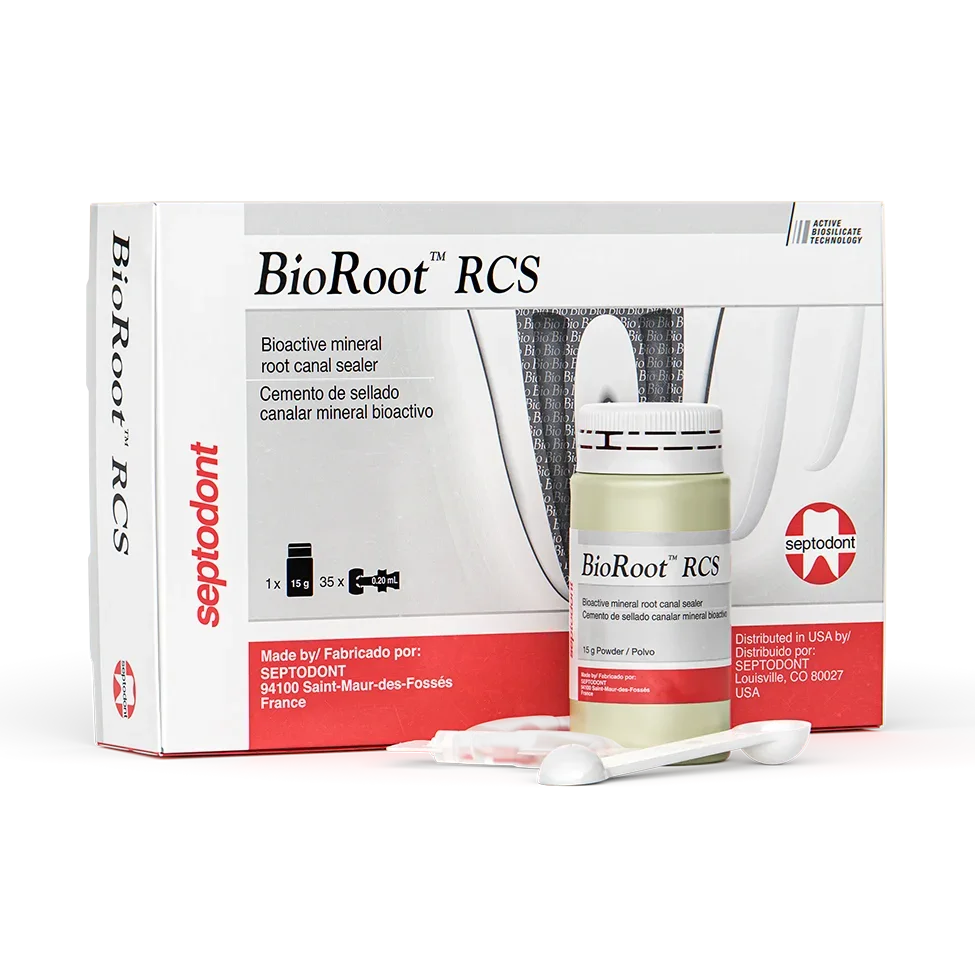
Each standard kit provides 35 applications, consisting of a 15g powder bottle, 35 single-dose liquid pipettes (0.20 mL each), and one measuring spoon. The product has a shelf life of at least five years when stored between 5°C and 30°C and protected from moisture. Keeping the powder container tightly sealed between uses is important for maintaining material consistency.
Indications and Contraindications
Understanding the approved use cases and limitations of BioRoot RCS helps clinicians select patients appropriately.
Indications
BioRoot RCS is indicated for the permanent root canal obturation of mature permanent teeth. It is appropriate for both primary root canal treatments and retreatment cases where the previously placed filling material has been fully removed. The sealer can be used in single-rooted and multi-rooted teeth with cold single cone or cold lateral condensation techniques.
Contraindications
BioRoot RCS is contraindicated in patients with known hypersensitivity to any of its components. It should not be used in immature or temporary (deciduous) teeth. The product is not intended for use as a direct pulp capping material, repair cement, or root-end filling material. Septodont’s Biodentine is the recommended product for those applications.
BioRoot RCS vs. AH Plus vs. MTA Fillapex vs. Tubli-Seal
Understanding how BioRoot RCS compares to the most commonly used endodontic sealers helps clinicians make an evidence-based decision.
Feature | BioRoot RCS | AH Plus | MTA Fillapex | Tubli-Seal |
Chemistry | Calcium silicate (mineral) | Epoxy resin | Calcium silicate + salicylate resin | Zinc oxide-eugenol |
Resin content | None | Resin-based | Contains resin | None |
Shrinkage | Zero (slight expansion) | Polymerization shrinkage | Polymerization shrinkage | Minimal |
Bioactivity | High (apatite formation) | None | Moderate | None |
Biocompatibility | Excellent | Moderate | Moderate | Low |
Antimicrobial effect | Strong (high pH) | Limited | Moderate | Moderate |
Tooth staining risk | None | Possible | Possible | None |
Radiopacity | 5 mm Al | 6.9 mm Al | 3.8 mm Al | 4.7 mm Al |
Setting time | < 4 hours | 8–12 hours | Variable | < 1 hour |
Technique | Cold only | Warm or cold | Warm or cold | Cold |
Eugenol | Free | Free | Free | Contains eugenol |
Post-op pain (24 h) | Lowest (VAS 4.73) | Moderate (VAS 11.57) | Variable | Highest (VAS 17.94) |
AH Plus remains a well-established sealer with extensive long-term clinical data and strong mechanical retention. However, BioRoot RCS offers clear biological advantages, including superior biocompatibility, genuine bioactivity, and significantly less postoperative discomfort. Clinicians who prioritize healing outcomes and patient comfort may find BioRoot RCS to be the stronger choice.
Key Takeaways From the Comparison
Several patterns emerge from the comparison table that are worth highlighting for clinical decision-making.
AH Plus offers the highest radiopacity and strongest push-out bond strength among these four sealers, which explains its long-standing popularity. However, its epoxy resin chemistry means it is cytotoxic when freshly mixed, undergoes polymerization shrinkage, and provides no bioactive benefit. Clinicians who have built their obturation protocols around warm vertical condensation with AH Plus achieve excellent results, and decades of clinical data support this approach.
BioRoot RCS occupies a distinct niche. Its calcium silicate chemistry delivers genuine bioactivity, verified through apatite formation and calcium ion release, and it achieves this without the cytotoxicity associated with resin-based materials. The postoperative pain data from randomized controlled trials is particularly compelling: patients treated with BioRoot RCS reported roughly 60% less pain at 24 hours compared to AH Plus and more than 70% less than Tubli-Seal.
Tubli-Seal and other zinc oxide-eugenol sealers remain the least expensive option but carry the highest cytotoxicity and the most postoperative discomfort. Their eugenol content also makes them incompatible with resin-based adhesive systems, which limits restorative options. For practices performing modern adhesive dentistry, this incompatibility alone may be reason to transition away from ZOE-based sealers.
MTA Fillapex offers some bioactive properties but contains a salicylate resin component that introduces the shrinkage and setting variability issues associated with resin-based sealers. Its radiopacity falls below BioRoot RCS, and biocompatibility studies show moderate results compared to BioRoot RCS’s excellent profile.
Retreatability of BioRoot RCS
The ability to retreat a previously filled canal is an important consideration when selecting any sealer. A micro-CT study comparing BioRoot RCS and AH Plus found that canals filled with BioRoot RCS retained significantly less filling material after retreatment with rotary instruments (Alsubait et al., PubMed). Passive ultrasonic irrigation further reduced residual material in both groups. Retreatment of BioRoot RCS does take slightly longer procedurally, and clinicians may benefit from using citric acid solutions at 10% to 20% concentrations as solvents, which have been shown to effectively dissolve calcium silicate-based sealers.
What Does the Research Say?
The peer-reviewed evidence base for BioRoot RCS has expanded considerably since the product was introduced.
Physico-chemical testing: BioRoot RCS demonstrates the highest calcium ion release and strongest alkalizing activity among sealers tested, with confirmed apatite-forming ability. Radiopacity meets clinical requirements at 5.2 mm Al. Higher porosity and water sorption compared to epoxy resin sealers are consistent with its hydraulic chemistry.
Biocompatibility: In vivo testing shows rapid inflammation recovery comparable to control groups. In vitro studies on multiple human cell lines confirm low cytotoxicity, especially when compared to freshly mixed AH Plus.
Sealing ability: SEM studies consistently show that BioRoot RCS produces less gap formation at the sealer-dentin interface than MTA Fillapex, Sealapex, and zinc oxide-eugenol sealers. Push-out bond strength testing demonstrates higher retention than AH 26 when the smear layer is removed.
Clinical outcomes: Randomized controlled trials and observational studies confirm reduced postoperative pain and improved periapical healing, with results remaining stable at follow-up periods extending to four years. A multicentric RCT also confirmed non-inferiority of the newer injectable BioRoot Flow compared to the original hand-mixed BioRoot RCS at 24 months.
Regenerative potential: Studies on dental pulp stem cells have shown that BioRoot RCS supports cell viability and promotes mineralized nodule formation at levels comparable to other premium calcium silicate sealers. The material also stimulates angiogenic and osteogenic growth factors in periodontal ligament cells, contributing to its capacity to support periapical tissue regeneration rather than simply sealing off a space.
Lateral canal filling: An in vitro study evaluating sealer penetration into simulated lateral canals found that BioRoot RCS was particularly effective at filling coronal lateral canals, achieving penetration rates above 83%. All sealers tested showed good ability to fill apical lateral canals, but BioRoot RCS was the only one that performed well in both locations.
Where BioRoot RCS Fits in Endodontic Treatment Planning
Successful endodontic therapy requires more than selecting the right sealer. A comprehensive dental treatment plan should account for pulp diagnosis, periapical status, root canal anatomy, and the intended coronal restoration before obturation begins. BioRoot RCS fits naturally into treatment plans that prioritize biologically driven outcomes, particularly in cases involving periapical pathology where healing support from the sealer is clinically meaningful.
Because BioRoot RCS is eugenol-free, it integrates smoothly into workflows that include adhesive restorations such as fiber posts and resin composite cores. There is no need to wait before bonding procedures, which simplifies the restorative sequence and reduces the number of patient visits.
The simplified cold obturation technique also has implications for treatment planning efficiency. Warm vertical condensation requires additional equipment, adds procedural time, and introduces technique variables that can affect outcomes. The ability to achieve comparable clinical success with a cold single cone technique using BioRoot RCS allows clinicians to allocate chair time more efficiently, particularly in busy general practices where endodontic treatments compete with other procedures for scheduling.
Cases involving teeth with periapical lesions may particularly benefit from BioRoot RCS, given the clinical trial data showing superior healing outcomes compared to both resin-based and ZOE sealers. When treatment planning retreatments of previously failed root canal therapies, the bioactive and antimicrobial properties of BioRoot RCS add a layer of biological support that complements thorough cleaning and shaping.
Bottom Line
Septodont BioRoot RCS is a bioceramic root canal sealer that delivers genuine bioactivity, proven antimicrobial properties, and reduced postoperative pain in a simplified cold obturation workflow. The clinical evidence supports its use as a primary sealer for both routine cases and complex endodontic treatments involving periapical pathology. While AH Plus retains advantages in mechanical bond strength and long-term data volume, BioRoot RCS offers biological benefits that directly support healing outcomes and patient comfort. For dental professionals looking to move beyond passive obturation and toward a biologically driven approach, BioRoot RCS is a strong and well-supported choice.
Verdict
<p>BioRoot RCS represents a meaningful evolution in endodontic sealer technology that addresses several well-documented limitations of older formulations.</p><p>The combination of genuine bioactivity, excellent biocompatibility, zero shrinkage, and strong antimicrobial properties sets BioRoot RCS apart from both epoxy resin-based and zinc oxide-eugenol sealers. Clinical trial data showing reduced postoperative pain and improved periapical healing adds weight to the laboratory findings. These are not theoretical advantages. They translate to tangible differences in the patient experience and in treatment prognosis.</p><p>The simplified cold obturation technique is another practical benefit. Achieving reliable results with a single cone approach eliminates the need for heated pluggers and reduces the technique sensitivity associated with warm vertical condensation. For busy practices, that means shorter chair time and a more efficient workflow without compromising outcomes.</p><p>There are trade-offs to acknowledge. AH Plus still offers stronger push-out bond strength, lower solubility, and a deeper pool of long-term clinical data spanning decades. Clinicians who are deeply experienced with AH Plus and achieving excellent results may not see an immediate reason to switch. The manual mixing step, while simple, adds an extra moment to the workflow compared to pre-mixed alternatives (though Septodont’s BioRoot Flow now addresses this).</p><p>For practitioners who want a sealer that actively supports healing rather than simply filling space, BioRoot RCS earns a strong recommendation. The growing evidence base, combined with Septodont’s track record in calcium silicate materials, gives clinicians solid reason to make this their primary root canal sealer.</p>
Frequently Asked Questions
What is Septodont BioRoot RCS?
BioRoot RCS is a bioactive, mineral-based, permanent root canal sealer manufactured by Septodont. It uses Active Biosilicate Technology and is formulated with tricalcium silicate, zirconium oxide, and povidone. The sealer is designed for permanent canal obturation in mature teeth using cold obturation techniques.
Is BioRoot RCS better than AH Plus?
BioRoot RCS offers superior bioactivity, biocompatibility, zero shrinkage, and lower postoperative pain. AH Plus provides stronger push-out bond strength, lower solubility, and more extensive long-term clinical data. The better choice depends on clinical priorities, though BioRoot RCS provides clear biological advantages.
Does BioRoot RCS cause tooth discoloration?
No. BioRoot RCS uses zirconium oxide as its radiopacifier, which does not stain tooth structure. This makes it suitable for anterior teeth where aesthetics are a priority.
Can BioRoot RCS be used with warm obturation techniques?
BioRoot RCS is designed exclusively for cold obturation techniques, including single cone placement and cold lateral condensation. Warm techniques are not recommended because thermal degradation of the calcium silicate hydrate could compromise material properties.
Is BioRoot RCS retreatable?
Yes. Standard endodontic retreatment protocols with rotary files can remove BioRoot RCS. Micro-CT studies show less residual material remains compared to AH Plus, though the retreatment process may take slightly longer. Passive ultrasonic irrigation and citric acid solutions can aid in removal.
What is the difference between BioRoot RCS and BioRoot Flow?
BioRoot RCS is a hand-mixed powder-and-liquid formulation, while BioRoot Flow is a newer pre-mixed, injectable version supplied in a syringe. A multicentric randomized controlled trial confirmed equivalent efficacy and safety between the two formulations at 24 months.
How many applications does one box of BioRoot RCS provide?
Each standard kit contains 35 applications, consisting of a 15g powder bottle, 35 single-dose liquid pipettes (0.20 mL each), and one measuring spoon.
Is BioRoot RCS biocompatible?
Yes. Multiple in vitro and in vivo studies have confirmed its biocompatibility. BioRoot RCS demonstrates low cytotoxicity across human periodontal ligament cells, dental pulp stem cells, and osteoblasts, with rapid inflammation recovery in animal models.
Does BioRoot RCS have antimicrobial properties?
Yes. The sustained release of calcium hydroxide raises the local pH to 11 to 12, creating an environment that inhibits the growth and survival of most endodontic pathogens.
Is BioRoot RCS compatible with adhesive restorations?
Yes. The eugenol-free formulation is fully compatible with all adhesive bonding systems. There is no waiting period before placing resin composite restorations, fiber posts, or other bonded structures.
What is the shelf life of BioRoot RCS?
The product has a shelf life of at least five years when stored between 5°C and 30°C and protected from moisture.
Does BioRoot RCS contain any common allergens?
None of the ingredients are an evident source of iodine or gluten. The product is contraindicated in patients with known hypersensitivity to any of its components.
What clinical evidence supports BioRoot RCS?
BioRoot RCS is supported by a growing body of peer-reviewed research, including randomized controlled trials, in vitro biocompatibility studies, micro-CT retreatment analyses, SEM sealing ability assessments, and observational clinical studies with follow-up periods extending to four years.
Can BioRoot RCS be used for retreatment cases?
Yes. BioRoot RCS is appropriate for both primary root canal treatments and retreatment cases where the previous filling material has been fully removed.