Rating: 4.6/5
ProTaper Ultimate: Problems And Solutions For Dentists
The ProTaper Ultimate rotary file system represents the fifth generation of the world's most recognized endodontic shaping system. Since the original ProTaper launch in 2001, this...
Reviewed by Mantas Petraitis
Pros
- 30% higher flexibility compared to ProTaper Gold F2 enables treatment of more challenging anatomies
- 30% higher cyclic fatigue resistance reduces file separation risk
- Simplified sequence with fewer files (Slider replaces ProGlider, single Shaper replaces S1+S2)
- 32% faster glide path and shaping compared to ProGlider + ProTaper Gold
- K-file free in the majority of cases streamlines workflow
- Minimally invasive body preserves pericervical dentin for long-term tooth strength
- Uniform motor settings (400 RPM) across all files eliminate program changes
- Less apical debris extrusion than ProTaper Gold may reduce postoperative complications
- Superior unwinding resistance provides additional safety margin
- Multi-wire technology optimizes each file for its specific clinical function
- Easy transition for ProTaper Gold users due to similar philosophy and technique
Cons
- Higher cost per file compared to ProTaper Gold increases per-case expenses
- Lower torsional strength than ProTaper Gold (trade-off for enhanced flexibility)
- Less extensive independent research compared to ProTaper Gold (newer system)
- Learning curve for practitioners new to ProTaper systems
- Single-patient use recommendation increases consumable costs
- Not suitable for extreme curvatures without supplemental hand file preparation
- Requires torque-controlled motor for proper operation
- May not represent sufficient improvement for satisfied ProTaper Gold users to justify inventory change
The ProTaper Ultimate rotary file system represents the fifth generation of the world's most recognized endodontic shaping system. Since the original ProTaper launch in 2001, this system has evolved through ProTaper Universal in 2006 and ProTaper Gold in 2014, with each iteration bringing technological advancements that have shaped modern endodontic practice. According to Dentsply Sirona, ProTaper systems have saved more than 200 million teeth worldwide, with over 1,200 scientific articles documenting their clinical performance.
ProTaper Ultimate was designed by the original ProTaper team of Drs. Cliff Ruddle, John West, and Pierre Machtou with a clear objective – to create a system that shapes root canals more safely, efficiently, and minimally invasively than ever before. The system introduces a simplified three-file core sequence consisting of the Slider, Shaper, and Finishers, combined with purpose-specific heat treatment technology that optimizes each file for its clinical role. This represents a significant paradigm shift from previous generations, allowing clinicians to initiate the glide path directly with the Slider in the majority of cases without requiring hand file negotiation first.
This comprehensive review examines the clinical performance of ProTaper Ultimate, provides detailed technique guidance, addresses common problems with evidence-based solutions, and offers practical recommendations for dentists considering this system for their endodontic practice.
ProTaper Ultimate System Overview And Specifications
Understanding the technical foundation of ProTaper Ultimate is essential for maximizing its clinical benefits. The system builds upon the proven ProTaper philosophy while introducing innovations in metallurgy, file design, and workflow simplification that address the evolving demands of contemporary endodontic practice.
Design Philosophy: Minimally Invasive Endodontics
ProTaper Ultimate embraces a minimally invasive approach that balances preservation of tooth structure with the need for thorough disinfection. The system achieves this through a reduced maximum flute diameter (MFD) of 1.0mm compared to the 1.2mm MFD of previous ProTaper generations. This narrower design preserves more pericervical dentin, which is critical for the long-term structural integrity and fracture resistance of endodontically treated teeth.
Despite the slimmer body preparation, ProTaper Ultimate maintains the iconic "Deep Shape" concept that has defined ProTaper systems. The Finisher files create increased apical taper (F1: 7%, F2: 8%, F3: 9%) that facilitates superior irrigation dynamics and debris removal in the apical third. Research published in the European Endodontic Journal confirms that this design produces improved cleaning efficacy while minimizing unnecessary dentin removal in the coronal and middle thirds.
Core File Sequence And Specifications
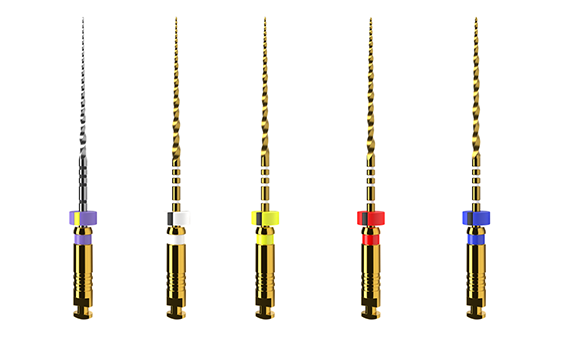
The ProTaper Ultimate core sequence consists of five files that handle the vast majority of clinical cases:
Slider (Purple)
ISO size: 016
Taper: .002 variable
Metallurgy: M-wire
Function: Creates the glide path and negotiates canals to working length
Shaper (White)
ISO size: 020
Taper: .004 variable
Metallurgy: Gold heat treatment
Function: Shapes the coronal two-thirds of the canal
Finisher F1 (Yellow)
ISO size: 020
Taper: .007 variable
Metallurgy: Gold heat treatment
Function: Creates apical deep shape in smaller canals
Finisher F2 (Red)
ISO size: 025
Taper: .008 variable
Metallurgy: Gold heat treatment
Function: Standard finishing for most canals
Finisher F3 (Blue)
ISO size: 030
Taper: .009 variable
Metallurgy: Gold heat treatment
Function: Finishing for larger canals
Auxiliary Files
ProTaper Ultimate includes three auxiliary files for specific clinical situations:
SX: Auxiliary shaping file for coronal pre-enlargement and relocating canals away from external root concavities
FX (ISO 035/.012v): Blue heat treatment, for larger canals with sufficient tooth structure
FXL (ISO 050/.010v): Blue heat treatment, for very large canals such as maxillary central incisors or palatal roots
All files are available in 21mm, 25mm, and 31mm working lengths and operate at uniform motor settings of 400 RPM with 4-5.2 Ncm torque.
Multi-Wire Metallurgy Technology
ProTaper Ultimate utilizes purpose-specific heat treatment technology based on each file's clinical role. The Slider employs M-wire for enhanced negotiation capability and flexibility during glide path establishment. The Shaper and core Finishers (F1, F2, F3) receive Gold heat treatment, which provides superior flexibility and resistance to cyclic fatigue. The auxiliary Finishers (FX and FXL) utilize Blue heat treatment optimized for larger canal preparations.
According to research published in Materials, ProTaper Ultimate instruments exhibit a complete R-phase crystallographic arrangement at room temperature, which significantly contributes to their superior flexibility and torsional strength compared to conventional and other heat-treated NiTi systems.
Clinical Performance Advantages
ProTaper Ultimate offers measurable improvements over its predecessor systems, supported by laboratory research and clinical studies. These advantages translate directly to enhanced patient safety, improved procedural efficiency, and more predictable treatment outcomes.
Enhanced Flexibility
Flexibility is critical for navigating curved and complex canal anatomies while minimizing the risk of procedural errors. Manufacturer data from Dentsply Sirona indicates that ProTaper Ultimate F1 demonstrates 13% higher flexibility compared to ProTaper Gold F1, while ProTaper Ultimate F2 shows 30% higher flexibility than its ProTaper Gold counterpart. This increased flexibility allows clinicians to treat more severely curved or narrow canals than previously possible.
The enhanced flexibility results from the combination of reduced maximum flute diameter, purpose-specific heat treatment, and the unique parallelogram cross-section with alternating offset machining. Research comparing ProTaper Ultimate to five multifile systems confirmed that ProTaper Ultimate demonstrates a high angle of rotation and low maximum bending load, reflecting superior flexibility that effectively compensates for torque stresses and minimizes canal transportation.
Superior Cyclic Fatigue Resistance
Cyclic fatigue is the primary cause of rotary file separation in curved canals, making fatigue resistance a critical safety consideration. ProTaper Ultimate demonstrates significantly improved performance in this area. The F1 file shows 75% higher cyclic fatigue resistance compared to ProTaper Gold F1, while the F2 file demonstrates 30% higher resistance than ProTaper Gold F2.
A study published in the Journal of Functional Biomaterials evaluated the cyclic fatigue performance of ProTaper Ultimate compared to ProTaper Gold and found statistically significant improvements in time to failure. The research demonstrated that ProTaper Ultimate files show life expectancies from 30% to 550% higher than comparable files when tested in canals with a 90° angle and 3mm radius of curvature.
Simplified And Faster Sequence
One of the most clinically significant advantages of ProTaper Ultimate is its streamlined workflow. The system is 32% faster for glide path establishment and shaping compared to the ProGlider plus ProTaper Gold sequence up to F2. This efficiency gain results from several design innovations:
The Slider can initiate the glide path directly in most cases, eliminating the need for K-file negotiation
A single Shaper replaces the S1 and S2 files from previous generations
Uniform motor settings (400 RPM, 4-5.2 Ncm) across all files eliminate the need for program changes
User studies conducted by Dentsply Sirona found that 95% of dentists reported that the ProTaper Ultimate Slider provides a smooth, reproducible pathway to the apical terminus, with 63% of cases requiring no K-file at all.
Reduced Apical Debris Extrusion
Apical debris extrusion during instrumentation can contribute to postoperative pain and interappointment flare-ups. Research published in the European Endodontic Journal found that ProTaper Ultimate extrudes significantly less debris apically (2.35±0.65 mg) compared to ProTaper Gold (3.25±0.47 mg). The researchers attributed this improvement to design modifications in the apical 3mm, including changes in cross-section geometry that provide better debris evacuation.
Recommended Technique And Protocol
Successful use of ProTaper Ultimate requires understanding the system's unique design philosophy and adopting appropriate clinical techniques. The following protocol represents best practices based on manufacturer recommendations and expert guidance.
Pre-Instrumentation: Adopting The New Mindset
ProTaper Ultimate introduces a paradigm shift in endodontic shaping philosophy. The traditional mindset of "always explore and secure the canal with a K-file prior to introducing any nickel-titanium shaping file" has evolved. According to Dr. Reid Pullen in Endodontic Practice US, the new approach states that once canals are located, clinicians can move directly to the ProTaper Ultimate Slider in simple to medium difficulty cases.
Before beginning instrumentation, clinicians should review multiple horizontally angulated radiographs to assess canal width, length, and curvature. Prepare an access cavity that enables easy identification of each canal orifice and provides straight-line access to the canal system.
Slider Technique
The Slider is the first instrument in the ProTaper Ultimate sequence and serves to create a reproducible pathway to the apical terminus while simultaneously shaping an open glide path.
Step-by-step protocol:
In the presence of lubricant (EDTA gel), select the Slider and passively follow the canal
Use 4-5 gentle engagement/disengagement movements (in-and-out motion)
If the Slider advances to estimated working length, the glide path is established
Remove the Slider, irrigate with sodium hypochlorite, and recapitulate with a #10 K-file
If the Slider encounters a "brick wall" and will not advance, remove it and negotiate to working length with a #08 or #10 K-file
Once the hand file reaches working length, return to the Slider to complete the glide path
Dr. John West emphasizes that the index finger is "the most dangerous finger in all rotary or reciprocation shaping because it wants to do something, and that something is to push." Pushing leads to breakage, blocks, ledges, transportation, and perforations. Instead, cradle the handpiece in the webbing between the thumb and index finger, and simply let the weight of the handpiece enable the file to advance. The mantra is "let it run" – never push.
Shaper Technique
The Shaper is a single file that replaces the S1 and S2 files from ProTaper Gold, simplifying the workflow while maintaining excellent cutting efficiency.
Step-by-step protocol:
After the Slider has established the glide path, select the Shaper
Employ the same gentle technique of 4-5 engagement/disengagements (pass #1)
Remove the Shaper, irrigate with sodium hypochlorite, and recapitulate with a #10 K-file
Continue with pass #2 until the Shaper reaches working length
The Shaper typically advances to working length within 1-2 passes after the Slider
The Shaper's primary function is to shape the coronal two-thirds of the canal. Its enhanced cutting efficiency and debris-hauling capability in the coronal portion provide easy and safe access to the apical third for the Finishers.
Finisher Technique
The Finishers create the characteristic ProTaper Deep Shape in the apical third while maintaining a minimally invasive body preparation.
F1 (Yellow) protocol:
After the Shaper reaches working length, select Finisher F1
Passively follow the canal to working length in one or more passes
Remove and inspect the apical flutes
When the flutes are loaded with dentinal debris, the preparation is complete
If the flutes are relatively clean, the canal requires further enlargement
F2 (Red) and F3 (Blue) protocol:
If F1 flutes are not loaded with debris, advance to F2
Use the same passive technique to working length
Inspect flutes – loaded flutes indicate adequate preparation
If F2 is loose at length and flutes are clean, proceed to F3
In most non-large canals, preparation is complete with F2
Common Problems And Clinical Solutions
Even with the enhanced safety features of ProTaper Ultimate, clinical challenges can occur. Understanding common problems and their solutions enables clinicians to manage difficult situations effectively.
Problem: Slider Does Not Advance To Working Length
Causes: Severely calcified or sclerotic canals, abrupt canal curvatures, coronal restrictions limiting file progression, debris accumulation blocking the pathway
Solutions:
Do not force the Slider if resistance is encountered. Remove the file immediately and evaluate the situation. For calcified canals, apply EDTA chelating agent and negotiate to working length with a pre-curved #08 or #10 K-file using a watch-winding motion. Once the hand file reaches working length, return to the Slider to complete the glide path establishment.
For coronal restrictions, use the SX auxiliary file to pre-enlarge the canal orifice and improve straight-line access. This reduces deflection forces on subsequent files and facilitates Slider advancement.
Problem: File Separation
Causes: Excessive apical pressure (pushing instead of allowing passive advancement), failure to recognize and respond to resistance, reuse beyond recommended life, severe apical curvatures, failure to inspect files between uses
Solutions:
Prevention is the most effective strategy. Master the "let it run" principle – never push with the index finger. Use a light pencil grip and allow the weight of the handpiece to advance the file. If resistance is encountered, withdraw immediately and recapitulate before continuing.
Inspect file flutes after every canal for signs of distortion, unwinding, or damage. Any file showing visible changes should be discarded immediately. Single-patient use is recommended for maximum safety.
Dr. West recommends cradling the handpiece in the webbing between the thumb and index finger rather than gripping it actively. The watchwords are "restraint, restraint, restraint." Take your time – the canal is not going anywhere unless you make it do so through improper technique.
Problem: Canal Ledging
Causes: Excessive apical pressure during instrumentation, skipping sequence steps, inadequate coronal preparation creating file deflection, working in calcified canals without proper negotiation
Solutions:
ProTaper Ultimate's enhanced flexibility significantly reduces the risk of ledging compared to previous generations. However, if a ledge is suspected, stop rotary instrumentation immediately. Return to small hand files (#08 or #10) with pre-curved tips and attempt to bypass the ledge using a watch-winding motion with copious EDTA lubrication. Work patiently – ledge bypass may take 10-15 minutes.
To prevent ledging, ensure adequate coronal preparation with the SX file when needed, maintain the sequence order without skipping files, and use the passive "let it run" technique consistently.
Problem: Canal Transportation
Causes: Aggressive instrumentation in curved canals, over-enlargement with finishing files, excessive brushing motion in the apical third
Solutions:
Research published in BMC Oral Health confirms that heat-treated NiTi systems like ProTaper Ultimate minimize transportation compared to conventional instruments. Allow files to passively follow the canal anatomy without forcing a direction. Limit touch-and-brush sequences in the apical portion to 2-3 times maximum. Use the appropriate finishing file size based on hand file gauging.
Problem: Canal Blockage
Causes: Inadequate irrigation between files, insufficient recapitulation with hand files, debris accumulation in the apical third
Solutions:
Prevention through meticulous irrigation and recapitulation is essential. Irrigate copiously with sodium hypochlorite after removing every file. Recapitulate with a #10 K-file to working length after each instrument to maintain patency.
If blockage occurs, do not force rotary files through the obstruction. Attempt to re-establish patency with a #08 or #10 K-file using gentle watch-winding motion with EDTA. Reconfirm working length with an apex locator once patency is re-established.
Problem: Poor Cone Fit
Causes: Inconsistent preparation, debris remaining in canal, using non-matched gutta-percha cones
Solutions:
ProTaper Ultimate produces consistent shapes when proper technique is employed, enabling predictable cone fit with matched gutta-percha points. Verify that dentin debris is present in the apical flutes of the finishing file to confirm adequate preparation. Perform final irrigation and dry the canal thoroughly before attempting cone fit. Use ProTaper Ultimate matched gutta-percha cones for optimal fit.
ProTaper Ultimate Compared To Other Systems
ProTaper Ultimate Vs ProTaper Gold
ProTaper Ultimate represents a direct evolution from ProTaper Gold with significant improvements:
Sequence simplification:
ProTaper Ultimate uses Slider + Shaper vs ProGlider + S1 + S2 for ProTaper Gold
32% faster glide path and shaping to F2 completion
Uniform motor settings (400 RPM) vs variable settings
Performance improvements:
30% higher flexibility (F2 comparison)
30% higher cyclic fatigue resistance (F2 comparison)
Less apical debris extrusion
Superior unwinding resistance
A randomized clinical trial found no significant difference in postoperative pain between ProTaper Ultimate and ProTaper Gold, confirming both systems can be safely used.
ProTaper Ultimate Vs WaveOne Gold
ProTaper Ultimate uses rotary continuous rotation with a multiple-file sequence for controlled shaping, while WaveOne Gold uses reciprocating motion with a single-file system for potentially faster straightforward cases. Choice depends on clinician preference and case complexity.
ProTaper Ultimate Vs TruNatomy
TruNatomy offers even narrower preparations for maximum dentin preservation, while ProTaper Ultimate maintains Deep Shape for better apical disinfection. BMC Oral Health research found TruNatomy maintains canal curvature better in S-shaped canals.
Expert Clinical Tips
The index finger wants to push, which leads to breakage, blocks, ledges, and transportation
Cradle the handpiece in the webbing of your hand
Repeat the mantra "let it run" – never push
The watchwords are "restraint, restraint, restraint"
Technique Pearls
Examine flutes for dentinal debris to confirm shaping completion
If the Slider does not slide after a few passes, return to K-files 6, 8, or 10
Use outward brushing motion in canals with irregular cross-sections
Apply light inward pecking motion to progressively advance toward working length
Use SX for furcation protection and coronal pre-enlargement
Bottom Line
ProTaper Ultimate represents a meaningful evolution in the ProTaper family, offering tangible improvements in flexibility, cyclic fatigue resistance, and workflow efficiency compared to ProTaper Gold. The simplified three-file core sequence (Slider, Shaper, Finisher) reduces instrumentation time by 32% while the multi-wire metallurgy optimizes each file for its specific clinical role. Research confirms superior performance in laboratory testing, and clinical trials demonstrate equivalent safety and patient outcomes compared to the established ProTaper Gold system.
Success with ProTaper Ultimate depends on mastering the fundamental principle of passive file advancement – let the file run, never push. Most clinical problems can be prevented through proper technique, adequate irrigation, and consistent recapitulation. When challenges arise, the troubleshooting approaches outlined in this review provide evidence-based solutions.
Verdict
<p>ProTaper Ultimate delivers meaningful improvements over ProTaper Gold with enhanced flexibility, superior fatigue resistance, and a simplified sequence that reduces chair time without compromising preparation quality. The evidence supports its safety and effectiveness, with clinical trials confirming equivalent patient outcomes compared to the established ProTaper Gold system. The easy transition for existing ProTaper users makes adoption straightforward. For clinicians committed to evidence-based endodontic practice and seeking the most current technology, ProTaper Ultimate represents a worthwhile investment.</p><p><strong>Recommended for:</strong></p><ul class="list-disc pl-4 space-y-1"><li><p>Practitioners performing frequent endodontic procedures who value efficiency</p></li><li><p>Clinicians seeking a simplified, streamlined workflow</p></li><li><p>Those treating complex anatomies requiring enhanced flexibility</p></li><li><p>ProTaper Gold users looking to upgrade to the latest technology</p></li><li><p>Practitioners building their first rotary file inventory</p></li></ul><p><strong>Consider alternatives if:</strong></p><ul class="list-disc pl-4 space-y-1"><li><p>Currently satisfied with ProTaper Gold performance and results</p></li><li><p>Prefer single-file reciprocating systems for maximum speed</p></li><li><p>Budget constraints make the higher per-file cost prohibitive</p></li></ul><p></p>
Frequently Asked Questions
What is the difference between ProTaper Ultimate and ProTaper Gold?
ProTaper Ultimate offers a simplified sequence (Slider + Shaper vs ProGlider + S1 + S2), 30% higher flexibility and cyclic fatigue resistance in the F2 file, uniform motor settings (400 RPM across all files), a narrower body design (1.0mm vs 1.2mm MFD), and multi-wire metallurgy technology. The system is 32% faster for glide path and shaping while maintaining the same Deep Shape philosophy.
How many files are in the ProTaper Ultimate core sequence?
The core sequence consists of five files: Slider (purple), Shaper (white), and Finishers F1 (yellow), F2 (red), and F3 (blue). Most routine cases require only the Slider, Shaper, and one or two Finishers. Three auxiliary files (SX, FX, FXL) are available for specific clinical situations.
Can I use ProTaper Ultimate without establishing a glide path with K-files?
Yes, in the majority of cases. The Slider is designed to initiate the glide path directly after canal location. User studies found that 63% of cases required no K-file. However, if the Slider encounters significant resistance, negotiation with a #08 or #10 K-file is recommended before continuing.
What speed and torque settings should I use for ProTaper Ultimate?
All ProTaper Ultimate files operate at the same settings: 400 RPM with 4-5.2 Ncm torque. This uniformity simplifies workflow compared to previous generations that required different settings for different files.
Is ProTaper Ultimate suitable for severely curved canals?
ProTaper Ultimate demonstrates 30% higher flexibility than ProTaper Gold, making it well-suited for curved canals. Research confirms it effectively compensates for torque stresses and minimizes canal transportation. However, for severe curvatures, proper technique (never pushing) and potential hand file preparation in the apical portion are essential.
How do I know when the canal preparation is complete?
Examine the apical flutes of the finishing file after use. When the flutes are loaded with dentinal debris, the file has engaged sufficient dentin to create adequate shape. If flutes appear relatively clean, advance to the next size finisher. The corresponding gutta-percha cone should demonstrate tug-back at working length.
What causes file separation and how do I prevent it?
File separation most commonly results from excessive apical pressure (pushing), failure to recognize resistance, and use in severe curvatures. Prevention requires mastering the "let it run" principle, using a light grip, inspecting files between uses, and following the recommended sequence without skipping files.
Should I upgrade from ProTaper Gold to ProTaper Ultimate?
Clinicians satisfied with ProTaper Gold performance may not need to upgrade immediately, as both systems produce excellent clinical outcomes. However, ProTaper Ultimate offers meaningful improvements in flexibility, fatigue resistance, and workflow efficiency that benefit practitioners performing frequent endodontics or treating complex anatomies.
What is the deep shape concept in ProTaper Ultimate?
Deep Shape refers to the increased apical taper (F1: 7%, F2: 8%, F3: 9%) that characterizes ProTaper preparations. This design improves irrigation dynamics and debris removal in the apical third while the narrower body preserves coronal and middle third dentin.
Can ProTaper Ultimate and ProTaper Gold gutta-percha points be interchanged?
While the apical preparation sizes are similar, ProTaper Ultimate gutta-percha points are injection-molded to precisely match the specific geometry of ProTaper Ultimate preparations. For optimal cone fit and obturation, using the matched ProTaper Ultimate gutta-percha points is recommended.