Rating: 4.6/5
Dentsply Sirona Palodent V3 Review
Class II composite restorations are among the most commonly performed procedures in general dentistry, yet they remain one of the most technique-sensitive. According to a...
Reviewed by Mantas Petraitis
Pros
- Predictable, tight proximal contacts in virtually all Class II scenarios
- Five matrix band sizes (3.5–7.5 mm) covering shallow premolars to deep molar cavities
- WedgeGuard protects adjacent teeth during preparation and converts into a wedge in one step
- NiTi rings outlast stainless steel alternatives and maintain consistent separation force
- EZ Coat PTFE-coated bands make removal easier and prevent composite from sticking
- Stackable rings and wedges for versatility in complex and multi-surface cases
- Pin Tweezers with built-in ball burnisher reduce instrument changes during the procedure
- Tight gingival seal from wave-design wedges minimizes flash and reduces finishing time
- Widely adopted in dental schools and supported with manufacturer training resources
- Compatible with all posterior restorative materials, including bulk-fill composites
Cons
- Higher cost than generic sectional matrix systems and some competitors
- Moderate learning curve for clinicians transitioning from Tofflemire systems
- Not ideal for missing adjacent teeth, severely misaligned teeth, or extensive cusp replacement (better served by Palodent 360 or similar)
- Ring and forceps can be bulky in patients with limited mouth opening
- Standard wedges may require supplemental techniques for deep subgingival margins
- NiTi rings contain nickel, requiring awareness of potential nickel sensitivity in rare cases
- Counterfeit products sold on secondary marketplaces may not fit correctly with genuine components
Class II composite restorations are among the most commonly performed procedures in general dentistry, yet they remain one of the most technique-sensitive. According to a DentalTown poll, roughly 70% of clinicians consider contact creation the most challenging part of any Class II restoration. Poor proximal contacts can cascade into food impaction, gingival inflammation, periodontal bone loss, and recurrent caries. The Dentsply Sirona Palodent V3 sectional matrix system was engineered to solve these exact problems, and it has become a go-to choice for dental professionals worldwide.
This review examines each component of the Palodent V3 in detail, walks through the clinical workflow, evaluates the pros and cons, and answers the questions dentists ask most often before investing in this system.
What Is the Dentsply Sirona Palodent V3?
The Palodent V3 is a sectional matrix system built for direct-placement Class II composite restorations. Understanding what makes it different from older matrix technology requires a closer look at the design philosophy behind sectional systems.
Unlike circumferential (Tofflemire-style) matrix bands that wrap entirely around a tooth, sectional matrices cover only the proximal wall being restored. This produces naturally convex proximal contours instead of the flat or concave profiles that circumferential bands tend to create. The Palodent V3 eliminates the bulky retainer that obstructs the operating field and reduces the compressive forces on the tooth that make tight contact creation difficult with traditional systems.
Manufactured by Dentsply Sirona, one of the world’s largest dental products companies, the Palodent V3 is the direct successor to the original Palodent Plus system. The V3 designation reflects iterative improvements to band geometry, wedge design, and ring engineering based on extensive clinical feedback. The system is indicated for MO (mesial-occlusal), DO (distal-occlusal), and MOD (mesial-occlusal-distal) posterior restorations.
Tens of thousands of clinicians use the system globally, including in dental schools, making it one of the most widely adopted sectional matrix solutions on the market. It sits alongside the Palodent 360 circumferential matrix, which covers scenarios such as missing cusps, missing adjacent teeth, and core build-ups.
The Six Core Components of the Palodent V3 System
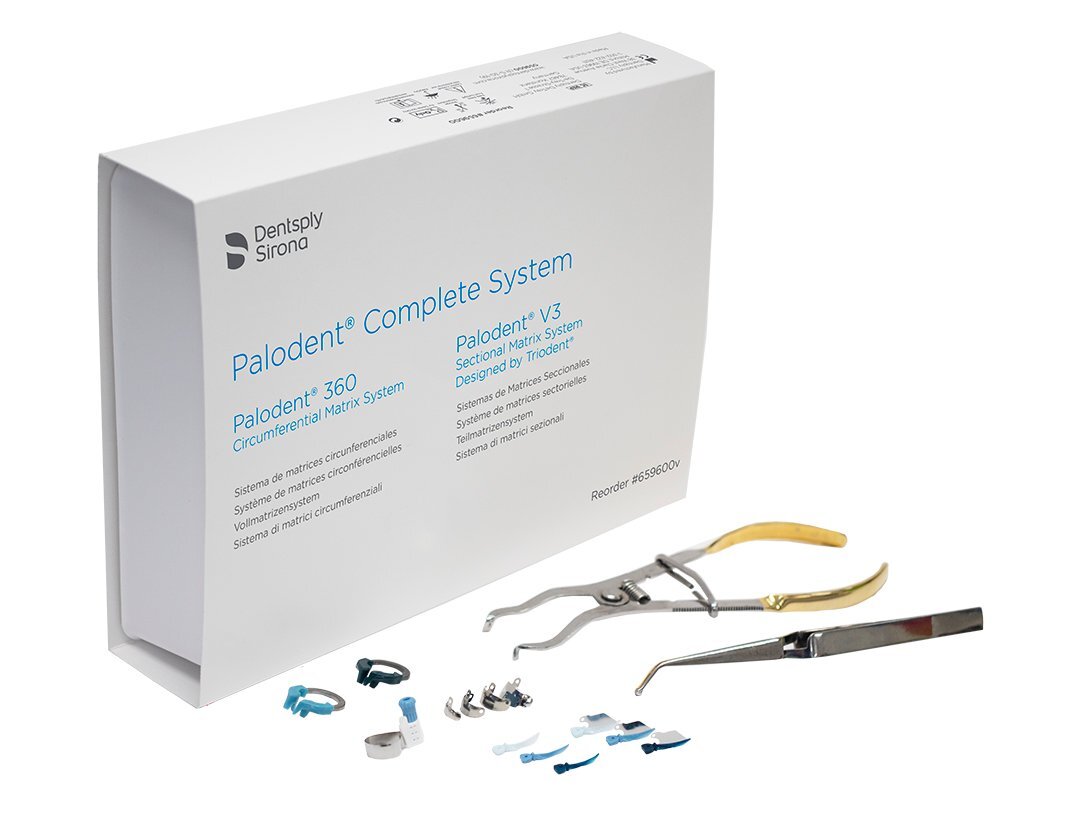
Every element of the Palodent V3 was designed to work independently and as part of an integrated system. The six components include retaining rings, matrix bands, wedges, the WedgeGuard, dedicated forceps, and pin tweezers.
Nickel-Titanium Retaining Rings
The retaining rings form the foundation of the separation mechanism. Made from nickel-titanium (NiTi) alloy, they deliver outstanding spring strength, shape memory, and a consistent separation force that outlasts traditional stainless steel rings.
Two sizes are available. The Universal Ring is sized for larger molars, while the Narrow Ring has tines positioned closer together for premolars and smaller molars. Both ring types feature glass-fiber-reinforced plastic tines with a V-shape contoured to accommodate the Palodent V3 wedge. The ring sits directly over the wedge, pressing the matrix band against the tooth for a tight, predictable proximal contact. The rings are stackable, which means clinicians can place multiple rings for simultaneous restoration of mesial and distal surfaces in MOD cases.
Anatomically Shaped Matrix Bands
The matrix bands are pre-contoured, sectional bands available in five color-coded sizes: 3.5 mm, 4.5 mm, 5.5 mm, 6.5 mm, and 7.5 mm. This range covers clinical situations from shallow premolar preparations to deep molar cavities with missing cusps.
Each band features a pronounced marginal ridge built into the contour, shaping composite into a natural anatomic form during packing. A gingival apron extends and curves to cover the gingival-axial corner, reducing gaps and preventing composite flash. A top tab aids insertion and a side tab aids removal, with both tabs having pin-holes for the Pin Tweezers.
The Palodent V3 also offers EZ Coat matrices, which add a micro-thin, non-stick PTFE (polytetrafluoroethylene) coating. This coating prevents bonding agent or composite resin from sticking to the band surface, making removal cleaner and reducing the risk of pulling composite out during band removal. The EZ Coat bands also feature significantly greater horizontal curvature for improved anatomical accuracy (Dentsply Sirona).
Adaptive, Self-Guiding Wedges
The anatomically shaped wedges come in three sizes: small, medium, and large. Their flexible wave design compresses on entry into the interproximal space and flares upon exit, creating an effective seal at the gingival margin.
A hollow underside allows placement of a second wedge from the opposite side (buccal or lingual) to improve the gingival seal in wider embrasures. The wedges are also stackable, with two wedges stacking vertically for added adaptation when a single wedge cannot achieve a complete seal. Each wedge has a pin-hole compatible with the Pin Tweezers for precise placement.
WedgeGuard: Integrated Interproximal Protection
The WedgeGuard is one of the most clinically valuable innovations in the system. It functions as both an interproximal guard and a wedge, placed before cavity preparation begins to protect the adjacent tooth from bur damage.
Research cited by Dentsply Sirona indicates that in more than 70% of Class II restorations, the clinician inadvertently nicks the adjacent tooth with the bur during preparation (Christensen, 2012). This iatrogenic damage roughens the enamel surface and creates conditions for bacterial colonization. The WedgeGuard’s metal shield physically blocks the bur, allowing faster, more confident cavity preparation. After the prep is complete, the guard detaches and the wedge stays in place, eliminating the need for re-wedging.
WedgeGuards come in three sizes (small, medium, large) and are indicated for use adjacent to Class II, Class III, veneer, and crown preparations.
Ring Forceps
The dedicated Palodent V3 Forceps feature a locking function and angled grip arms designed to hold the ring securely during placement and removal. Built-in grooves allow clinicians to reset the NiTi rings when they become slightly closed over time.
Pin Tweezers
The Pin Tweezers have a pin-in-tip design that positively grips the pin-holes in matrix bands, wedges, and WedgeGuards. A naturally closed position minimizes the risk of dropping components, and a built-in ball burnisher at the tip allows clinicians to burnish the band against the adjacent tooth for improved contact tightness without switching instruments.
Step-by-Step Clinical Workflow
Getting the best results from the Palodent V3 depends on following a consistent placement sequence. The workflow below combines the manufacturer’s recommended technique with practical tips from experienced clinicians.
Place the WedgeGuard. Using the Pin Tweezers, insert a WedgeGuard firmly from the lingual or buccal side. The shield should face the neighboring tooth.
Prepare the cavity. With the shield protecting the adjacent tooth, cut the Class II cavity preparation more confidently and efficiently.
Detach the guard. Support the wedge with a mirror or dental instrument and use the Pin Tweezers to detach the shield. The wedge remains in place.
Place the matrix band. Select the appropriate size (3.5–7.5 mm), grip the top tab with Pin Tweezers, and position the band against the prepared proximal wall. The gingival apron should extend below the gingival margin.
Place the retaining ring. Position the Palodent V3 Ring (Universal or Narrow) on top of the wedge using the Forceps. The V-shaped tines should straddle the wedge.
Restore. Check the gingival seal, apply adhesive, place composite in increments or use a bulk-fill material like SDR, light-cure, and finish. For more on integrating matrix systems into a broader dental treatment plan, treatment planning software can help streamline sequencing across multiple restorations.
Remove components. Remove the ring first, then the matrix band (side tab), and finally the wedge.
Matrix Band Size Selection Guide
Choosing the correct matrix band height is essential for achieving optimal contour and proximal contact. The table below summarizes the five available sizes and their general clinical indications.
Size | Type | Recommended Use | Availability |
3.5 mm | Standard & EZ Coat | Shallow premolar preps | Refill packs of 50 |
4.5 mm | Standard & EZ Coat | Standard premolars | Refill packs of 50 |
5.5 mm | Standard & EZ Coat | Most molars (most used) | Refill packs of 50/90 |
6.5 mm | Standard & EZ Coat | Larger molar preps | Refill packs of 50 |
7.5 mm | Standard & EZ Coat | Deep molar/missing cusp | Refill packs of 50 |
Palodent V3 vs. Tofflemire: Why Sectional Matrices Win for Composite
The Tofflemire circumferential matrix retainer was developed in 1946 for amalgam placement. Understanding its limitations with modern composite materials explains why sectional systems like the Palodent V3 have become the standard of care.
A circumferential band wraps entirely around the tooth and applies uniform tension, producing a flat proximal wall rather than the naturally convex contour needed for physiologic contact. The result is often an open contact or a flat contact that leads to food impaction. A systematic review published in Cureus confirmed that sectional matrix band systems are superior to circumferential systems for achieving optimal proximal contacts in Class II composite restorations.
An in-vitro study published in BMC Oral Health comparing the Palodent V3 sectional matrix with the Palodent 360 circumferential matrix found that the sectional system produced higher contact tightness and more anatomically correct proximal surface geometry, with reduced concavity area, shallower depth, and greater radius of curvature.
Another advantage of the sectional design is improved visualization. The Tofflemire retainer’s bulky frame blocks the clinician’s line of sight and can interfere with rubber dam placement, saliva ejectors, and other isolation devices. The Palodent V3’s low-profile ring and compact band leave the operative field largely unobstructed, allowing better visual confirmation of adaptation, gingival seal integrity, and composite placement quality.
The separation mechanism also differs fundamentally. A Tofflemire retainer wedges teeth apart using a tightening screw that applies static, non-adaptive force. The Palodent V3 NiTi ring, on the other hand, exerts dynamic, elastic separation force that continuously adapts as composite is packed against the matrix. This elastic memory produces more consistent contact tightness across different clinical scenarios and reduces the risk of over-separation that can lead to postoperative sensitivity.
How the Palodent V3 Compares to Competing Systems
The sectional matrix market has three dominant players: the Garrison Composi-Tight 3D system, the Triodent V3 Ring system, and the Palodent V3. Each has strengths, and many clinicians keep more than one system in their operatory.
The Garrison Composi-Tight uses stainless steel G-Rings encased in plastic with silicone faces that provide good interproximal penetration and matrix adaptation. The soft silicone face of the G-Ring penetrates the interproximal area well and adapts the matrix band closely, minimizing proximal flash. The Triodent V3 Ring and Palodent V3 share a design heritage, both using NiTi rings with V-shaped plastic tines. According to a clinical overview in Oral Health Group, these three systems represent the market leaders for restoring Class II restorations.
The Palodent V3 differentiates itself through its integrated WedgeGuard, the EZ Coat non-stick PTFE matrix bands, the comprehensive five-size band range (3.5–7.5 mm), and purpose-built Pin Tweezers and Forceps. For clinicians seeking a fully integrated, single-manufacturer system, the Palodent V3 remains one of the most complete solutions available.
One practical consideration when choosing between systems is cross-compatibility. The Palodent V3 components are designed to work as a closed ecosystem, meaning the rings, bands, wedges, and instruments are optimized for each other. Mixing Palodent V3 rings with another manufacturer’s bands or wedges may produce suboptimal results. Clinicians who prefer to mix and match components across brands should test combinations carefully before adopting them for routine clinical use.
What Does the Research Say About Sectional Matrix Systems?
Dentists evaluating the Palodent V3 benefit from a growing body of peer-reviewed evidence supporting sectional matrix systems for Class II composite restorations.
A systematic review examining the effectiveness of circumferential versus sectional matrix systems in achieving optimum proximal contact, published in Cureus, concluded that sectional matrix band systems produced significantly tighter proximal contacts than circumferential alternatives. The review also noted that operator satisfaction was comparable between the two systems, but the sectional matrix was rated easier to use overall.
A randomized controlled clinical trial published in BMC Oral Health evaluated proximal contact tightness over 12 months using the Palodent Plus sectional matrix system (the predecessor to the V3). The study found that contact tightness was highest immediately after restoration and gradually decreased over time, eventually reaching a level comparable to natural interproximal contacts. This gradual normalization is considered a positive outcome, as excessively tight contacts can cause discomfort and pressure symptoms.
The study also tested the Palodent system in combination with transparent contact forming instruments (Trimax, Perform, and Contact Pro). Results showed that combining the Palodent matrix with a contact forming instrument achieved greater contact tightness than using the matrix alone, a finding that may interest clinicians who want to maximize contact quality in difficult cases.
Advanced Clinical Tips for the Palodent V3
Experienced Palodent V3 users have developed a number of techniques that improve outcomes in challenging clinical scenarios. The following tips address the most common problem areas.
Improving the Gingival Seal
The gingival seal is the most technique-sensitive aspect of any Class II composite restoration. For a tighter seal, place a smaller or same-size wedge underneath the primary wedge from the opposite direction. Another effective technique is to pack a small amount of PTFE (Teflon) tape into any area that needs additional sealing. In cases involving deep mesial concavities, often encountered on upper premolars, leaving an instrument wedged against the margin during the initial composite increments can maintain the seal, though this requires careful layered placement (Bauer Smiles).
Handling Multiple Restorations
When restoring adjacent interproximal surfaces simultaneously, multiple rings can be used. If rings placed in the same direction conflict spatially, simply reversing one ring typically resolves the issue. For truly adjacent restorations, completing one restoration fully before beginning the second reduces the likelihood of a light contact. After the first restoration is finished, burnish the metal band against the cured composite with the ball burnisher on the Pin Tweezers before removing the band. This creates a smoother contact surface and reduces the chance of needing to adjust the contact later.
Pairing With SDR Bulk-Fill Composite
Dentsply Sirona recommends pairing the Palodent V3 with their SDR (Smart Dentin Replacement) bulk-fill flowable composite. SDR has up to 60% less polymerization stress than conventional composites, allowing bulk-fill increments of up to 4 mm. Its self-leveling, flowable consistency provides full cavity adaptation without the need for hand instrument manipulation. Combining the Palodent V3’s predictable contact creation with SDR’s simplified layering technique can significantly reduce total chair time. Clinicians interested in curing light performance should also ensure their light source is adequate for bulk-fill depths.
Selecting the Right Ring Size
Choosing between the Universal and Narrow ring is straightforward in most cases. The Narrow Ring is intended for premolars and small molars, while the Universal Ring is designed for larger molars. However, experienced clinicians note that using the Narrow Ring on a larger tooth can actually increase separation force because the tines are closer together and exert more focused pressure. This can be a useful technique when additional separation is needed to overcome a particularly tight contact. It is worth experimenting with both ring sizes during initial adoption to find the approach that works best for the specific tooth being restored.
Managing Isolation Alongside the Palodent V3
Proper isolation is critical for any adhesive restoration. The Palodent V3’s compact design is compatible with both rubber dam and alternative isolation systems. When using rubber dam, the ring and wedge can be placed over the dam without modification in most cases. Clinicians using mouthpiece-style isolators should position the Palodent V3 components first and then adapt the isolator around them, as the reverse sequence can make ring placement difficult.
Who Should Use the Palodent V3?
The Palodent V3 is not a one-size-fits-all recommendation. Certain practice profiles and clinical philosophies benefit more from this system than others.
General practitioners who perform Class II composite restorations on a daily basis will see the largest return on investment. The time saved in finishing, the reduction in open-contact remakes, and the WedgeGuard’s protection of adjacent teeth add up to measurable efficiency gains over hundreds of restorations per year. Practices that have already committed to adhesive, composite-focused restorative dentistry will find the system aligns naturally with their clinical philosophy.
Dental students and recent graduates benefit from adopting the Palodent V3 early. Many dental schools already teach with this system, and building proficiency during training translates directly into clinical confidence in private practice. The structured workflow and integrated components remove much of the guesswork associated with matrix selection, particularly for clinicians who have not yet developed a strong tactile sense for contact creation.
Practices that predominantly place amalgam restorations, perform mostly single-surface (Class I) work, or handle a very low volume of Class II procedures may find the Palodent V3’s cost difficult to justify. In those cases, a less expensive sectional matrix system or even a well-adapted Tofflemire may be sufficient.
Available Kit Configurations
Dentsply Sirona offers the Palodent V3 in several kit configurations to match different practice needs and budgets. All individual components are also available as refill packs.
Starter Kit: 20 matrices (5 x 4.5 mm and 15 x 5.5 mm), 15 wedges (5 each of small, medium, large), 5 medium WedgeGuards, 2 Universal Rings, 1 Forceps, 1 Pin Tweezers. Enough for approximately 10–15 restorations.
Intro Kit: 100 matrices (25 each in 3.5, 4.5, 5.5, 6.5 mm), 75 wedges (25 each size), 30 WedgeGuards (10 each size), 1 Universal Ring, 1 Narrow Ring, 1 Forceps, 1 Pin Tweezers.
Complete System Kit: Combines the Palodent V3 sectional matrix system with the Palodent 360 circumferential matrix system, covering all Class II clinical scenarios including missing cusps and core build-ups.
Bottom Line
The Dentsply Sirona Palodent V3 is one of the most reliable and well-engineered sectional matrix systems available to dental professionals today. Its greatest clinical strength is predictability. Once the placement sequence is mastered, the system consistently delivers tight, anatomically accurate proximal contacts with minimal finishing requirements, a benefit that compounds across hundreds of restorations per year.
The WedgeGuard alone justifies serious consideration, as it simultaneously protects the adjacent tooth and eliminates a separate wedging step. The NiTi rings outperform stainless steel alternatives in longevity and consistent separation force. The five-size band range means clinicians will rarely encounter a situation without an appropriate fit. The EZ Coat bands are a welcome upgrade for anyone who has struggled with composite sticking to conventional matrices during removal.
The system is not inexpensive, and clinicians who perform a high volume of Class II restorations will feel the consumable costs. The learning curve, while moderate, is real, so plan for several cases when transitioning from a circumferential system. For the vast majority of Class II composite restorations, the Palodent V3 delivers outcomes that justify its investment and has earned its place as a clinical standard.
Verdict
<p>The Palodent V3 consistently earns high marks from restorative-focused practitioners, and for good reason. The system’s integrated workflow, from WedgeGuard-protected preparation through NiTi ring separation to clean EZ Coat band removal, addresses every friction point in Class II composite placement.</p><p>Clinicians report that the most immediate improvement after adopting the system is the reduction in time spent on finishing. Because the pre-contoured bands and ring separation produce anatomically accurate contours from the start, there is less contouring, polishing, and re-doing needed after the composite is cured. The WedgeGuard measurably speeds up preparation, and the EZ Coat bands solve the frustrating problem of composite pulling away during matrix removal.</p><p>The cost is the most commonly cited drawback. Consumable bands, wedges, and WedgeGuards are not inexpensive, and practices with high Class II volume will notice the line item. However, when factoring in the time saved per restoration, the reduction in remakes due to open contacts, and the prevention of iatrogenic damage, the value proposition becomes clear.</p><p>For any practice that regularly places Class II composite restorations, the Palodent V3 deserves a place in the operatory. The system is well supported, backed by peer-reviewed evidence, and broadly adopted in both private practice and academic settings. It represents a meaningful upgrade over circumferential matrix techniques and stands shoulder to shoulder with the best sectional matrix systems on the market.</p>
Frequently Asked Questions
What is the Palodent V3 used for?
The Dentsply Sirona Palodent V3 is a sectional matrix system used for placing Class II (two-surface and three-surface) direct composite restorations in the posterior region. It facilitates the creation of tight, anatomically accurate proximal contacts and natural contours. The WedgeGuard component is also indicated for protecting adjacent tooth surfaces during Class II, Class III, veneer, and crown preparations.
Is the Palodent V3 the same as Palodent Plus?
The Palodent V3 is the successor and rebrand of the Palodent Plus system. In some international markets the product continues to be marketed as Palodent Plus, while in others it is sold under the V3 designation. The core design principles and component architecture are the same, with the V3 incorporating improvements to band geometry, wedge flexibility, and the addition of the EZ Coat matrix option.
What sizes do the Palodent V3 matrix bands come in?
Palodent V3 matrix bands are available in five sizes: 3.5 mm, 4.5 mm, 5.5 mm, 6.5 mm, and 7.5 mm. Both standard and EZ Coat (PTFE-coated) versions are available in all five sizes. The 5.5 mm band is the most commonly used size for standard molar restorations.
Can the Palodent V3 rings be sterilized and reused?
The NiTi retaining rings, forceps, and Pin Tweezers are reusable instruments that should be sterilized between patients according to standard infection control protocols. The matrix bands, wedges, and WedgeGuards are single-use, disposable components.
Can the system handle MOD (three-surface) restorations?
The Palodent V3 rings are stackable, allowing clinicians to place two rings (one mesially and one distally) to restore both proximal surfaces simultaneously. If the rings conflict spatially, reversing the direction of one ring typically resolves the issue.
What is the WedgeGuard and is it necessary?
The WedgeGuard is a combination interproximal guard and wedge placed before preparation to protect the adjacent tooth from bur damage. After prep, the guard portion detaches and the wedge remains in place. While it is optional, the WedgeGuard is highly recommended because it reduces iatrogenic damage and saves the step of removing and re-placing a wedge after the prep.
How does the Palodent V3 compare to the Garrison Composi-Tight system?
Both are premium sectional matrix systems and market leaders. The Palodent V3 uses NiTi rings (versus Garrison’s stainless steel G-Rings with silicone faces), offers the WedgeGuard for adjacent tooth protection, provides EZ Coat non-stick matrix bands, and has a wider range of band sizes. The Garrison system is well regarded for its ring penetration into the interproximal area and matrix adaptation. Many experienced clinicians maintain both systems and choose based on the specific clinical situation.
Is the Palodent V3 compatible with bulk-fill composites?
Dentsply Sirona specifically recommends pairing the Palodent V3 with their SDR bulk-fill flowable composite. The system is compatible with all posterior restorative materials, including conventional composites, other bulk-fill brands, and amalgam.
How can open contacts be prevented with the Palodent V3?
Open contacts most commonly result from insufficient ring separation force, incorrect band size selection, or premature ring removal. To achieve tight contacts, select the appropriate ring size (Narrow for premolars, Universal for molars), use the Pin Tweezers to burnish the band against the adjacent tooth before ring placement, verify the ring is properly seated over the wedge, and avoid removing the ring before the final composite increment is fully cured.
Where can the Palodent V3 be purchased?
The Palodent V3 is available through authorized dental supply distributors worldwide, including Henry Schein, Patterson Dental, and Benco Dental. Purchasing from authorized distributors is recommended, as counterfeit products have been reported on secondary marketplaces.