Rating: 4.4/5
Kerr Dental Demi Plus Curing Light Review
The curing light is one of the most used instruments in any restorative operatory. Every composite placement, sealant application, and adhesive bond depends on reliable,...
Reviewed by Agnes Markovic
Pros
- The following advantages consistently stand out across independent evaluations and practitioner feedback.
- True five-second cure for A3 and lighter shades, reducing chairside curing time for routine restorations
- Exceptional battery life with up to 500 five-second activations per charge, supporting three to four days of clinical use
- Lightweight at 5.5 ounces, reducing hand and wrist fatigue during long clinical sessions
- PLS technology delivers high energy while maintaining cool operating temperatures for patient comfort
- Durable Valox resin housing that resists impact, chemicals, and temperature extremes
- Wide light guide compatibility from 2 mm to 13 mm, all autoclavable
- Included 8 mm Turbo Extended Light Guide with 28% additional reach for posterior access
- Whisper-quiet fan operation
- Three-year warranty on handpiece and charger
- Corrosion-resistant gold and zinc-coated charger contacts
- Preset timer modes (5, 10, 20 seconds) with automatic last-setting recall
- Universal power supply (100–240V) for international use
Cons
- Narrow wavelength range (450–470 nm) limits compatibility with TPO and Ivocerin-based materials
- Audible timer tones reported as excessively loud with no volume control option
- Premium price point compared to budget LED curing lights
- No built-in radiometer for on-demand power output verification
- Single-wavelength design may require a supplementary curing light for practices using diverse material systems
- 8 mm LED attachment tip is non-autoclavable, requiring barrier protection
The curing light is one of the most used instruments in any restorative operatory. Every composite placement, sealant application, and adhesive bond depends on reliable, consistent photopolymerization. When curing performance falls short, the consequences show up weeks or months later as debonds, post-operative sensitivity, or premature restoration failure.
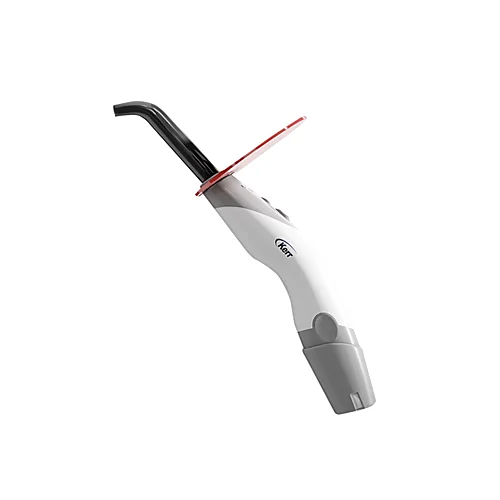
The Kerr Demi Plus LED Curing Light System, sometimes searched as the Kerr Dental Demi Pro, is one of the most widely adopted curing lights in general dentistry. Built on Kerr’s Demetron technology platform, the Demi Plus combines Periodic Level Shifting (PLS) output, a lightweight cordless handpiece, and extended battery life into a package designed for all-day clinical use.
This review provides an evidence-based assessment of the Kerr Demi Plus, covering its technology, specifications, clinical performance, ergonomics, maintenance, and overall value.
Choosing a curing light is not a decision most dentists make often. A quality unit lasts years, and the wrong choice affects every composite restoration placed during that time. Incomplete polymerization from an underpowered or poorly designed light leads to reduced physical properties in the cured material, compromised marginal adaptation, and a higher risk of secondary caries. The financial impact compounds as failed restorations return for replacement, eroding both profitability and patient trust.
What Is the Kerr Demi Plus?
The Kerr Demi Plus is a cordless LED curing light system designed for the polymerization of light-cured dental materials. It is manufactured by Kerr Dental, a division of Envista Holdings with decades of heritage in light curing innovation through the Demetron brand.
The unit operates at a baseline intensity of 1,100 mW/cm², periodically shifting to a peak output of 1,330 mW/cm² through its proprietary PLS technology. The emission wavelength falls within the 450 to 470 nm range, which is tuned to activate camphorquinone (CQ), the most common photoinitiator used in resin-based composites and adhesives. The Demi Plus ships with an 8 mm Turbo Extended Light Guide and accepts the full range of Demetron interchangeable light guides, from 2 mm micro tips to 13 mm wide-field guides.
How PLS Technology Works
Periodic Level Shifting is the defining technology behind the Kerr Demi Plus. Understanding how it delivers energy to light-cured materials is essential for evaluating its clinical relevance.
Unlike conventional LED curing lights that sustain a constant intensity throughout the curing cycle, the PLS system dynamically shifts output multiple times per second. According to Kerr’s technical documentation (via Henry Schein), the unit pulses from its baseline of 1,100 mW/cm² to a peak of 1,330 mW/cm² for approximately one-quarter of each one-second exposure. The cumulative effect is that total energy delivered per cycle exceeds what the baseline number alone would suggest.
This approach offers two clinical advantages. First, it enables a true five-second cure for composite shades A3 and lighter, reducing chairside curing time for the majority of routine direct restorations. Second, the periodic shifting pattern helps manage heat generation. The light does not sustain peak intensity continuously, which keeps thermal load on both the LED array and the tooth structure under control.
From a workflow perspective, a five-second cure represents a meaningful time saving when multiplied across multiple increments per restoration and several restorations per day. A posterior Class II composite placed in four increments, for example, saves 20 seconds of curing time per restoration compared to a 10-second protocol. Over the course of a full day with eight or more composite cases, the accumulated time savings are significant enough to affect scheduling.
Thermal Management and Patient Comfort
Heat generation during light curing is a legitimate clinical concern, especially when working near the pulp in deep preparations. The Demi Plus addresses this with a dual-approach thermal management system.
The unit incorporates a whisper-quiet internal fan combined with proprietary heat dissipation engineering. In independent evaluations cited on Universadent, clinical consultants rated patient comfort as very good, with no reports of excessive heat during curing procedures. The thermal control system also prevents the automatic shutdowns that affect competing curing lights when internal temperatures exceed safe thresholds, allowing uninterrupted clinical use throughout the day.
Technical Specifications
The table below summarizes the key technical parameters dental professionals should evaluate when considering the Kerr Demi Plus.
Specification | Details |
Product name | Kerr Demi Plus LED Light Curing System |
Manufacturer | Kerr Dental (Envista Holdings) |
Technology | Demetron PLS (Periodic Level Shifting) |
Light source | LED |
Baseline output | 1,100 mW/cm² |
Peak output | 1,330 mW/cm² |
Wavelength | 450–470 nm |
Curing modes | 5, 10, and 20-second presets |
Battery | Lithium-ion, user-replaceable |
Battery life | Up to 500 five-second cures per charge |
Handpiece weight | 5.5 oz (155 g) including battery |
Handpiece dimensions | 9.25 in × 1.2 in (23.5 cm × 2.9 cm) |
Charger dimensions | 6.0 in × 4.63 in (16.0 cm × 11.1 cm) |
Included light guide | 8 mm Turbo Extended (60° angle) |
Compatible guides | All Demetron guides, 2 mm through 13 mm |
Housing material | Valox® resin (thermoplastic polyester) |
Power supply | 100–240V AC, 47–63 Hz |
Warranty | 3 years (1 year on battery) |
Sources: Kerr Dental, Dental City, DentalWorld US, Dentstore EU, Atlas Resell Management
Design, Ergonomics, and Build Quality
How a curing light feels in the hand matters just as much as how it performs on paper. Dentists who place multiple restorations daily need a device that does not contribute to musculoskeletal strain over a full schedule.
Handpiece Design
The Demi Plus features a hybrid design that sits between a traditional pen-style and a pistol-grip curing light. A slight angle in the handle allows multiple holding positions, adapting to different clinical scenarios without requiring an awkward grip change. Whether curing an anterior Class III or working on a distal posterior surface, the handpiece accommodates both approaches comfortably.
At 5.5 ounces (155 grams) with the battery installed, the Demi Plus weighs approximately half as much as its predecessor, the L.E. Demetron 2. For practitioners performing many restorations per day, this weight reduction translates directly into less fatigue over the course of a clinical session.
Valox Resin Housing
The exterior shell is made from Valox resin, a high-performance thermoplastic polyester developed by SABIC. Valox offers impact resistance, chemical resistance to common dental disinfectants, and the ability to withstand temperature extremes encountered in clinical environments. The upgraded closed housing design simplifies cleaning between patients, as there are fewer crevices where contaminants can accumulate.
In practice, this material choice means the Demi Plus can survive the inevitable drops, bumps, and daily exposure to glutaraldehyde-based or quaternary ammonium disinfectants without cracking, discoloring, or developing surface degradation. Older curing lights with more traditional plastic housings often showed visible wear within the first year of clinical use, something the Valox construction specifically addresses.
Extended Turbo Light Guide
The included 8 mm Turbo Extended Light Guide provides 28% additional reach compared to standard guides. This extended reach is particularly valuable for posterior restorations where access is limited, especially in patients with restricted mouth opening or when curing distal surfaces on second molars.
All Demetron light guides are autoclavable, which supports robust infection control protocols. For practices evaluating dental sterilization equipment and reprocessing workflows, the ability to autoclave rather than simply surface-disinfect light guides adds a meaningful layer of sterility assurance.
Battery Performance and Charging
Battery life is a critical factor in any cordless dental instrument. A curing light that runs out of charge mid-procedure is more than an inconvenience, it disrupts clinical workflow and can compromise patient care.
The Demi Plus uses a lithium-ion battery that supports up to 500 five-second curing activations, or approximately 300 ten-second cycles, on a single charge. In clinical use, this translates to roughly three to four full working days of uninterrupted operation.
The charging system uses a positive-contact design with gold and zinc-coated terminals to resist corrosion from disinfectant exposure. The charger base provides a snug, precise fit, and the charging station accommodates two handpieces. According to independent evaluators cited on Universadent, most consultants docked the unit between patients and reported that the battery never fully discharged during a working day. Battery life and charging time were rated as excellent.
The lithium-ion cell does not suffer from memory effect, so partial charging does not degrade long-term capacity. The battery is user-replaceable, and Kerr offers a separate one-year battery warranty. Replacement packs are available through authorized distributors.
Clinical Performance and Independent Evaluations
Manufacturer specifications tell part of the story, but independent clinical data adds the credibility dental professionals need before committing to a purchase.
Curing Effectiveness
Independent consultants rated the Demi Plus’s ability to cure a variety of dental materials as excellent. The PLS technology delivers sufficient energy for thorough polymerization of mainstream composites, flowables, adhesives, and sealants within the stated curing times. The five-second mode is validated for A3 shade and lighter composites, while darker or more opaque materials require 10 or 20-second cycles per the material manufacturer’s instructions.
Practitioner Satisfaction
In evaluations compiled on Universadent, roughly 36% of consulting dentists rated the Demi Plus as better than their existing curing light, while 46% rated it as equivalent. Notably, 73% said they would switch to the Demi Plus, and 91% would recommend it to a colleague. These numbers indicate strong clinical acceptance, though they also suggest the Demi Plus may not represent a dramatic leap over other premium curing lights already in use.
Noise Level
One recurring point of feedback across evaluations is the audible timer tone. Nearly all consultants reported that the five-second interval beeps were too loud. No volume control is available, and Kerr has not addressed this in a firmware or hardware update. For practitioners working in open-plan operatories or treating anxious patients, this is worth noting.
Wavelength Compatibility: What Dental Professionals Should Know
Material compatibility is one of the most important factors in curing light selection. Not every LED curing light works equally well with every composite system.
The Demi Plus emits light in the 450 to 470 nm range, which is specifically tuned to activate camphorquinone, the most widely used photoinitiator in resin-based dental materials. The vast majority of commercially available composites, including popular systems like Tokuyama Omnichroma, use CQ as their primary initiator, making the Demi Plus broadly compatible.
However, some newer materials incorporate alternative photoinitiators such as TPO (trimethylbenzoyl-diphenylphosphine oxide) or Ivocerin, which have peak absorption around 380 to 410 nm. The Demi Plus’s narrower wavelength band may not provide optimal activation for these materials. Practitioners who frequently use alternative-initiator composites should verify compatibility or consider a polywave curing light as a supplement. For a deeper look at composite material considerations, the Omnichroma review on Dental Reviewed covers photoinitiator compatibility in detail.
Kerr Demi Plus vs. Kerr Demi Ultra
Kerr’s current curing light lineup includes both the Demi Plus and the newer Demi Ultra. Both are built on Demetron technology and share the same wavelength range and PLS energy management, but they differ in power source and several design elements.
The Demi Ultra replaces the lithium-ion battery with an ultracapacitor. While the battery-powered Demi Plus delivers hundreds of curing cycles on a single charge, the ultracapacitor-powered Demi Ultra provides approximately 25 ten-second cures before needing to recharge. The trade-off is speed: the Demi Ultra reaches full charge in roughly 40 seconds, making it effectively always available.
The Demi Ultra also introduces C.U.R.E. technology (Curing Uniformity and Reduced Energy), a built-in radiometer with LED indicators, two-button operation with silent mode, and a fully sealed, fan-free design. For practitioners who want to eliminate battery management entirely, the Demi Ultra offers a compelling upgrade path.
Feature | Demi Plus | Demi Ultra |
Power source | Lithium-ion battery | Ultracapacitor |
Cycles per charge | Up to 500 (5-sec) | ~25 (10-sec) |
Recharge time | Hours (full charge) | ~40 seconds |
Built-in radiometer | No | Yes |
Fan | Whisper-quiet fan | Fan-free, sealed |
Silent mode | No | Yes |
Weight | 5.5 oz | 6.5 oz |
Maintenance, Infection Control, and Longevity
Proper maintenance of the Kerr Demi Plus is straightforward, and following manufacturer guidelines helps ensure reliable long-term performance. A neglected curing light loses output over time, often without the practitioner realizing it, which can lead to a gradual decline in restoration quality.
The handpiece exterior should be disinfected between patients using a wipe containing less than 20% alcohol. The closed housing minimizes crevices where debris and fluids can accumulate. Kerr also offers single-use protective plastic sleeves (DEMI-250) designed to cover the handpiece during procedures. These barriers add a secondary layer of infection control while still allowing full access to the curing button and timer controls.
Light guides should be inspected regularly for tip contamination, discoloration, or physical damage, as any of these reduce effective light output reaching the restoration. Even a thin layer of cured composite residue on the guide tip can reduce irradiance significantly. Contaminated or damaged guides should be replaced promptly. All Demetron guides are designed for standard autoclave sterilization.
The lithium-ion battery does not suffer from memory effect, but it will gradually lose capacity over many charge cycles. The user-replaceable design means a fresh battery can be installed without sending the unit in for service.
Who Should Consider the Kerr Demi Plus?
The Demi Plus is well-suited for a specific set of practice profiles. Understanding whether it aligns with a given workflow helps avoid buyer’s remorse.
General practitioners who perform a high volume of direct composite restorations and need a curing light that delivers consistent results throughout the day
Dentists transitioning from halogen curing lights who want the benefits of LED technology, including faster cure times, cordless convenience, and longer service life
Multi-operatory practices that need several curing lights and benefit from the dual-socket charging station and interchangeable battery system
Dental schools and residency programs that require durable equipment capable of withstanding heavy daily use
Practitioners who frequently use bulk-fill composites with alternative photoinitiators, or who require broadband wavelength coverage, may find the Demi Plus limiting and should consider polywave alternatives. For those setting up a new practice and weighing equipment options, the new dental practice checklist on Dental Reviewed covers the full equipment selection process.
What to Look for When Choosing a Dental Curing Light
The curing light market includes dozens of options across a wide price range. Evaluating any unit, including the Demi Plus, against a consistent set of criteria helps ensure the right fit for a given practice.
Light Output and Energy Delivery
The minimum recommended intensity for adequate composite curing is generally considered to be 400 mW/cm², but higher-output units like the Demi Plus (1,100–1,330 mW/cm²) enable significantly faster cycle times. Raw intensity alone does not tell the full story. Beam profile uniformity, total energy delivered (intensity multiplied by time), and wavelength match to the material’s photoinitiator all affect actual curing effectiveness.
Ergonomics and Weight
For practitioners performing multiple restorations per day, handpiece weight and balance directly affect comfort and precision. A curing light that causes hand fatigue after a few hours can compromise clinical outcomes for later patients. The Demi Plus’s 5.5-ounce weight sets a strong benchmark in this category.
Battery vs. Ultracapacitor
Lithium-ion batteries (as in the Demi Plus) offer longer runtime per charge but eventually degrade and need replacement. Ultracapacitors (as in the Demi Ultra) offer near-infinite cycle life but shorter runtime between charges. The choice depends on practice workflow and personal preference.
Wavelength Coverage
Single-wavelength (monowave) curing lights are optimized for CQ-based materials. Polywave or broadband units cover a wider spectral range to accommodate alternative photoinitiators. Practitioners should inventory the materials they use and verify wavelength compatibility before purchasing.
Durability and Warranty
Dental curing lights endure demanding conditions: repeated drops, chemical exposure, autoclave sterilization of components, and heavy daily use. A robust housing, reliable internals, and a strong warranty all matter. The Demi Plus’s Valox shell and three-year warranty compare favorably to competitors.
Bottom Line
The Kerr Demi Plus remains one of the most respected and widely adopted LED curing lights in dentistry. The combination of proven PLS technology, outstanding battery performance, lightweight ergonomic design, and durable Valox construction makes it a compelling choice for dental professionals who demand consistency from their equipment. While the single-wavelength output and lack of a built-in radiometer are real limitations, they are trade-offs rather than deal-breakers for the majority of general practitioners. The Demi Plus does what it was designed to do, and it does it reliably, day after day, across thousands of curing cycles.
Dental professionals who are evaluating the Demi Plus should weigh the material systems used in their practice, the volume of restorations placed daily, and whether a monowave or polywave light better fits their clinical needs. For practices that primarily use CQ-initiated composites and value equipment that lasts without requiring constant attention, the Demi Plus remains an excellent investment.
Verdict
<p>The Kerr Demi Plus is a thoughtfully engineered curing light that delivers on its core promise: fast, reliable, and consistent polymerization of light-cured dental materials in a cordless, lightweight form factor.</p><p>The PLS technology genuinely enables shorter curing times for lighter-shade composites, and the thermal management system allows practitioners to work through a full schedule of restorations without the frustrating automatic shutdowns that affect less sophisticated units. Battery life is outstanding. The positive-contact charging system is both convenient and durable. The hybrid grip adapts to different clinical scenarios, and the extensive Demetron light guide library offers flexibility that most competitors cannot match.</p><p>The primary limitation is the narrow wavelength band (450–470 nm). This means the Demi Plus is not a polywave curing light, and practices that routinely use materials with alternative photoinitiators should factor this into the purchasing decision. The loud timer tones remain an unresolved annoyance, and the lack of a built-in radiometer means practitioners need a separate device for periodic output verification.</p><p>Overall, the Kerr Demi Plus represents a mature, well-refined curing light backed by decades of Demetron heritage. For general practices prioritizing reliability, ergonomics, and all-day clinical performance, it remains a solid investment.</p>
Frequently Asked Questions
What is the curing time for the Kerr Demi Plus?
The unit offers preset modes of 5, 10, and 20 seconds. The five-second mode is validated for composite shades A3 and lighter. Darker and more opaque materials should be cured for 10 or 20 seconds following the composite manufacturer’s instructions.
What is PLS technology?
PLS stands for Periodic Level Shifting. It shifts the light output from a baseline of 1,100 mW/cm² to a peak of 1,330 mW/cm² multiple times during each curing cycle. This delivers higher total energy while managing heat generation to keep the unit cool and comfortable for patients.
How long does the battery last?
On a full charge, the lithium-ion battery supports up to 500 five-second curing activations or approximately 300 ten-second cycles. In clinical use, this is typically three to four full working days.
Can the handpiece be autoclaved?
The handpiece itself is not designed for autoclaving. All Demetron interchangeable light guides are fully autoclavable. Kerr recommends wiping the handpiece with a disinfectant containing less than 20% alcohol and using single-use barrier sleeves.
What light guides are compatible?
The Demi Plus accepts all Demetron interchangeable light guides ranging from 2 mm to 13 mm. This allows practitioners to select the optimal tip diameter for specific applications, from orthodontic bracket bonding to bulk composite curing.
Does the Demi Plus have a built-in radiometer?
No. Practitioners should use a separate handheld dental radiometer to periodically verify light output. The Demi Ultra model does include a built-in radiometer.
Is the Demi Plus compatible with all dental composites?
The Demi Plus is optimized for materials using camphorquinone (CQ) as the photoinitiator, which covers the vast majority of commercially available composites, flowables, adhesives, and sealants. Materials using TPO or Ivocerin photoinitiators may not be fully activated within the 450–470 nm wavelength range.
What warranty does the Demi Plus come with?
Kerr provides a three-year warranty covering the handpiece and charger, plus a one-year warranty on the lithium-ion battery.
Where can dental professionals purchase the Kerr Demi Plus?
The Demi Plus is available through authorized dental supply distributors including Henry Schein, Patterson Dental, and Darby Dental, along with numerous regional and online suppliers. Pricing varies by distributor. Kerr periodically offers promotional bundles. For help evaluating dental supply alternatives, Dental Reviewed compares the leading distributors.
Can the battery be replaced?
Yes. The lithium-ion battery pack is user-replaceable. Replacement batteries are available through authorized Kerr distributors. Keeping a spare charged battery on hand ensures uninterrupted clinical use.
How does the Demi Plus compare to other premium curing lights?
The Demi Plus competes with units such as the 3M Elipar DeepCure-S, the Ivoclar Bluephase PowerCure, and the Ultradent Valo Grand. Each has different strengths: the Elipar offers higher peak intensity, the Bluephase provides polywave broadband output, and the Valo features a wide lens design. The Demi Plus’s competitive advantages are its PLS technology, exceptional battery life, lightweight design, and the extensive Demetron light guide ecosystem.