Rating: 4.6/5
Omnichroma Review: A Complete Guide for Dental Professionals
For years, shade selection has been one of the most time-consuming steps in direct restorative dentistry. Matching a composite to the surrounding tooth often means cycling through...
Reviewed by Agnes Markovic
Pros
- Universal shade matching – covers all 16 VITA classical shades from A1 to D4 with a single composite, eliminating shade-selection errors and guesswork
- Significant inventory reduction – replaces dozens of shade-specific syringes, reducing waste from expired materials and simplifying ordering
- Post-bleaching adaptability – structural color tracks with the changing tooth shade after whitening, so restorations do not need replacement
- Exceptional polishability – spherical fillers achieve 89% gloss within 30 seconds, delivering long-lasting surface smoothness
- Bis-GMA-free formulation – UDMA/TEGDMA monomer system addresses clinician and patient concerns about bisphenol A exposure
- Low polymerization shrinkage – all family members demonstrate low shrinkage relative to their categories, reducing post-operative sensitivity risk
- Versatile product range – sculptable, flowable, and bulk fill options cover virtually every direct restorative scenario
- Industry-leading bulk fill strength – Omnichroma Flow Bulk delivers 414 MPa compressive strength, the highest reported among commercially available bulk fill composites
- Superior stain resistance – absence of pigments and strong filler-resin adhesion result in excellent long-term color stability
- Low cytotoxicity – in vitro studies demonstrate a favorable biological profile, suitable for restorations positioned close to gingival tissue
Cons
- Pre-cure appearance requires trust – the opaque white color before curing creates an initial learning curve and may cause hesitation during the first several cases
- Limited control in complex esthetic layering – highly demanding anterior cases requiring nuanced translucency and characterization may still benefit from a multi-shade system
- Potential translucency issues in shallow preparations – some clinicians report that the material can appear slightly too translucent in very shallow fillings, allowing the underlying substrate to influence the result
- Shorter working time – several independent evaluations note that Omnichroma sets more quickly than some clinicians prefer, particularly in warm conditions
- Blocker adds complexity – cases requiring Omnichroma Blocker introduce an additional step and require judgment about layer thickness, partially offsetting the system’s simplicity
- Stickier consistency – some practitioners find the material stickier than their preferred conventional composites, requiring instrument wetting or technique adjustment
- Tends toward monochromatic results – the single-shade approach produces uniform color, which can occasionally be noticeable in highly polychromatic natural dentitions
- Original formulation limited to 2mm increments – the sculptable Omnichroma still requires standard layering, and the bulk fill variant is available only in flowable consistency
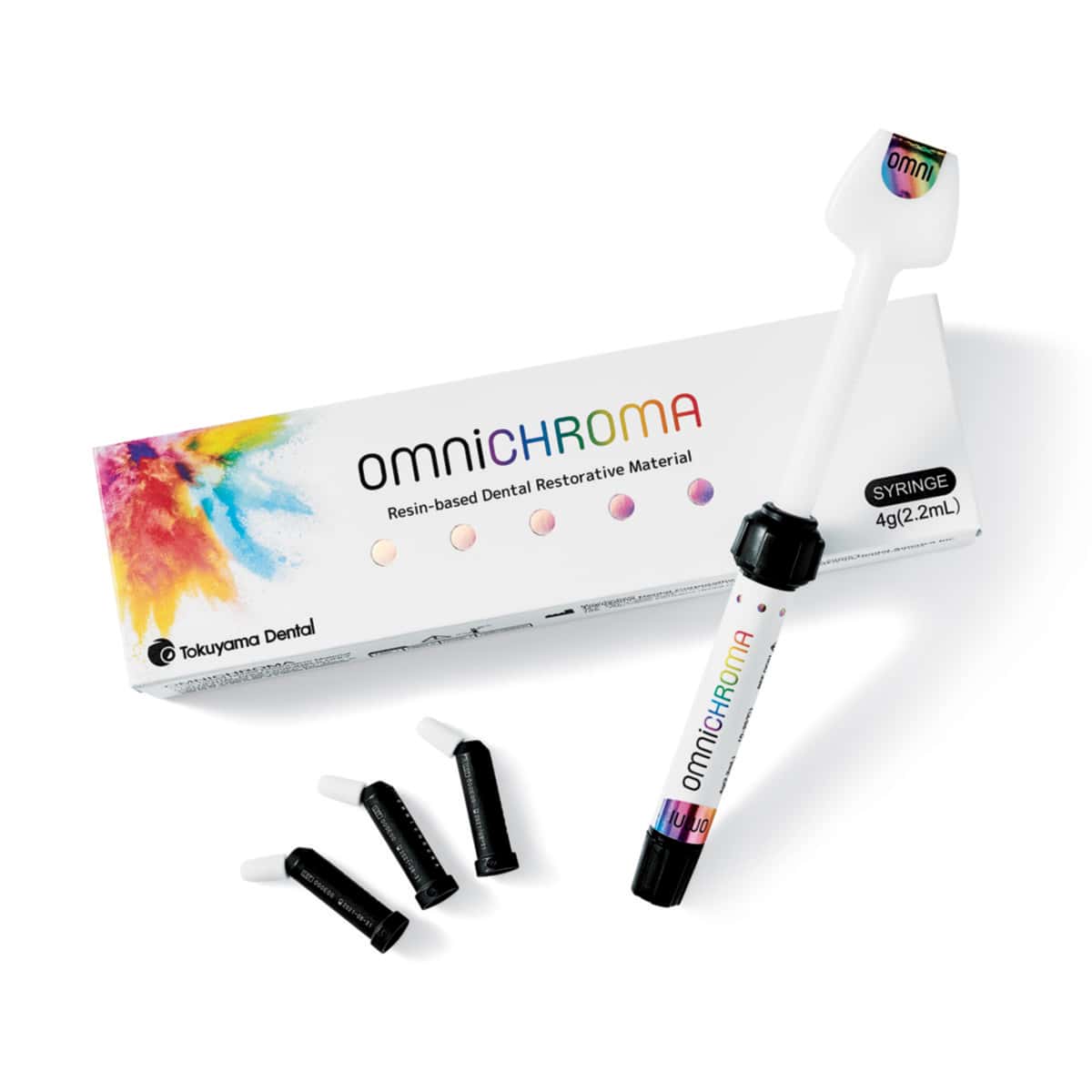
For years, shade selection has been one of the most time-consuming steps in direct restorative dentistry. Matching a composite to the surrounding tooth often means cycling through shade tabs, second-guessing the result under different lighting, and stocking dozens of syringes that expire before they are ever used. Omnichroma, manufactured by Tokuyama Dental, was designed to eliminate that entire process. It is the first composite system built around a single shade that adapts to every tooth color from A1 to D4, and the technology behind it represents a genuine departure from how dental composites have worked for decades.
This review examines the full Omnichroma product family, including the original sculptable Omnichroma composite, Omnichroma Flow, and Omnichroma Flow Bulk (commonly searched as Omnichroma Bulk Fill or Omnichroma Bulk Flow). It covers the science, the clinical performance, the practical advantages and drawbacks, and the real-world feedback from dental professionals who use these materials daily. Whether a practice is considering its first order or evaluating whether to expand from the original paste to the newer flowable and bulk fill variants, this guide provides the detail needed to make a confident decision.
How Does Omnichroma Work?
Understanding how Omnichroma works starts with a concept borrowed from nature. The iridescent wings of morpho butterflies and the vivid feathers of peacocks do not get their color from pigments. Instead, their color comes from microscopic physical structures that interact with light. Tokuyama’s research team applied this same principle, known as structural color, to a dental composite for the first time.
Conventional composites rely on chemical pigments (red and yellow dyes) blended into the resin matrix to approximate tooth shades. Each shade must be separately formulated, which is why most practices stock 15 to 30 composite variants. The Tokuyama Omnichroma composite takes a fundamentally different approach: it contains no pigments or dyes whatsoever. Instead, color is generated through the physical structure of the filler particles themselves, using what Tokuyama calls Smart Chromatic Technology.
The Role of 260nm Spherical Fillers
At the core of Smart Chromatic Technology are uniformly sized supra-nano spherical filler particles measuring exactly 260 nanometers in diameter. These fillers are composed of silicon dioxide (SiO₂) and zirconium dioxide (ZrO₂), and they are manufactured using Tokuyama’s patented Sub-Micro-Pearl-Technology. The process uses a Sol-Gel method to progressively coat spherical fillers in an organic solution over several weeks until they reach the precise 260nm dimension.
When ambient light passes through the cured composite, these uniformly sized spherical particles refract and diffract the light to generate the red-to-yellow color range that characterizes all natural human tooth shades. This generated structural color then combines with reflected light from the surrounding tooth structure in an additive color-mixing process, producing a restoration that visually blends with the adjacent dentition regardless of the specific VITA shade.
Pre-Cure vs. Post-Cure Appearance
One of the most common questions from clinicians trying Omnichroma for the first time concerns the opaque white appearance of the uncured material. This is an intentional design choice. The white, uncured composite provides high contrast against the tooth surface, making it straightforward to identify margins, contour the restoration, and confirm complete adaptation to cavity walls.
After light curing, the refractive index of the resin matrix shifts (from approximately 1.47 before curing to 1.52 after, according to published spectrophotometric data), and the structural color mechanism activates. The result is a cured restoration that blends into the surrounding tooth, delivering the chameleon effect that has made Omnichroma popular across general practices worldwide.
Shade Adaptation After Bleaching
Because Omnichroma relies on structural color rather than fixed pigments, the composite continues to adapt to the surrounding tooth shade over time. If a patient undergoes professional whitening after receiving an Omnichroma restoration, the composite tracks with the lighter tooth color. Multiple in vitro studies have demonstrated that the measurable color difference between Omnichroma and surrounding tooth structure actually decreases following bleaching, eliminating the need for restoration replacement that conventional pigmented composites often require.
The Complete Omnichroma Product Family
Tokuyama has expanded the Omnichroma line into a comprehensive system that covers virtually every direct restorative scenario. Each variant shares the same 260nm spherical filler technology and Bis-GMA-free formulation while offering distinct handling characteristics suited to different clinical needs.
Omnichroma (Original Sculptable Composite)
The flagship Tokuyama Omnichroma composite is a light-cured, radiopaque, sculptable universal material. Its filler loading is 79% by weight (68% by volume), and its monomer system is UDMA/TEGDMA, making it free from Bis-GMA and bisphenol A-related monomers. The recommended depth of cure is the standard 2mm per increment. It is indicated for all classes of direct anterior and posterior restorations, direct bonded composite veneers, diastema closures, and porcelain or composite repairs.
Clinicians consistently describe the handling as creamy and sculptable, with reliable adaptation to cavity walls. The material is available in both syringe and pre-loaded tip (PLT/compule) formats, with the PLT format favored for its convenience in high-volume practices.
Omnichroma Flow
Omnichroma Flow (also referred to as Omnichroma flowable) extends Smart Chromatic Technology into a low-viscosity formulation. The Tokuyama Omnichroma Flow composite has a viscosity comparable to other commercially available medium-flow composites, with a compressive strength of 397 MPa (higher than most flowables on the market) and flexural strength of 111 MPa. Its depth of cure is 2mm per increment.
Omnichroma Flow demonstrates exceptionally low staining in coffee-immersion testing and reaches high-gloss polish levels within 30 seconds, outpacing many competing flowable products. It is particularly valued for its ability to adapt intimately to cavity walls, reducing void risk and ensuring thorough margin coverage in all classes of direct restorations.
Omnichroma Flow Bulk (Omnichroma Bulk Fill)
The newest addition to the family, Omnichroma Flow Bulk (commonly searched as Omnichroma Bulk Fill or Omnichroma Bulk Flow), addresses the workflow limitation of the 2mm increment requirement. This low-viscosity, light-cured composite can be placed in increments of up to 3.5mm without requiring a separate capping layer.
Omnichroma Flow Bulk contains 69% filler by weight (55% by volume) and delivers a compressive strength of 414 MPa, reported to be the highest among commercially available bulk fill composites. Flexural strength is 120 MPa. Like the rest of the family, it is Bis-GMA-free. For clinicians who had adopted bulk-fill workflows with other products and found returning to 2mm increments with the original Omnichroma to be cumbersome, this variant directly solves that efficiency concern.
Omnichroma Blocker and Blocker Flow
Tokuyama also offers supplementary products, Omnichroma Blocker and Omnichroma Blocker Flow, designed for use alongside the primary Omnichroma materials. These opaque, universal-shade materials serve as lingual layers to prevent shade-matching interference in extensive Class III and IV restorations where minimal surrounding tooth structure is present. They also mask staining, dark dentin, or highly opaque teeth. Approximately 1mm of Blocker material is typically sufficient to prevent the darkness of the oral cavity from showing through the translucent primary composite.
Product Comparison at a Glance
The table below summarizes the key specifications across the three primary Omnichroma composites, making it easy to identify which variant best fits a given clinical situation.
Property | Omnichroma | Omnichroma Flow | Omnichroma Flow Bulk |
Viscosity | Sculptable paste | Low (flowable) | Low (flowable) |
Filler loading | 79 wt% / 68 vol% | 69 wt% / 55 vol% | 69 wt% / 55 vol% |
Depth of cure | 2mm | 2mm | 3.5mm |
Compressive strength | High | 397 MPa | 414 MPa |
Flexural strength | High | 111 MPa | 120 MPa |
Capping layer needed | N/A | N/A | No |
Bis-GMA free | Yes | Yes | Yes |
Indications | Class I–V, veneers, repairs | Class I–V, all direct | Class I–V, all direct |
Shelf life | 3 years | 3 years | 3 years |
Clinical Performance and Material Properties
Material specifications only tell part of the story. The sections below examine how each Omnichroma product performs in clinical conditions, drawing on independent evaluations, peer-reviewed research, and practitioner feedback. For a broader perspective on how dental equipment and materials are evaluated, Dental Reviewed’s equipment guide provides useful context.
Shade-Matching Performance
A study conducted at the University of Texas evaluated the Visual Color Adjustment Potential (CAP-V) of five different composite materials. Of all the composites tested, Omnichroma demonstrated the best shade adaptation effect, with the lowest measurable shade difference between the restoration and surrounding tooth substance across the A1–D4 range.
However, nuance matters. An in vitro study published in PMC using simulated Class I cavities found that Omnichroma’s shade-matching performance improved when the surrounding tooth shade was less chromatic and when cavity preparations were wider. In very narrow or deep preparations with highly chromatic surrounding dentin, the structural color effect may be somewhat less pronounced. This aligns with clinical experience: many practitioners report outstanding results in Class III, V, and broad Class II restorations, with more variable outcomes in some posterior scenarios involving very dark remaining tooth structure.
Mechanical Strength
The original Omnichroma’s filler loading of 79% by weight provides competitive compressive strength and wear resistance. Research conducted at Oregon Health and Science University confirmed the material’s load-bearing capacity, attributing it to the unique spherical filler structure and composition. The uniform spherical shape creates a smaller surface area for abrasion compared to irregularly ground glass particles found in most conventional composites, resulting in an excellent balance between composite wear resistance and gentleness toward opposing natural teeth.
Polishability
Polishability is one of the most consistently praised characteristics across all Omnichroma formulations. The spherical filler particles create mirror-smooth surfaces that reflect light uniformly, achieving 89% gloss within 30 seconds of polishing. Multiple independent evaluations support this claim. The high initial gloss is also maintained over time, as spherical fillers resist plucking and surface degradation more effectively than irregular particles.
Polymerization Shrinkage
All members of the Omnichroma family demonstrate low polymerization shrinkage relative to their respective material categories. Omnichroma Flow Bulk, despite being a flowable material, achieves shrinkage levels only slightly higher than sculptable composites, thanks to its high filler content (69% by weight is substantial for a flow material) and the spherical nature of the fillers. Low polymerization shrinkage reduces the risk of post-operative sensitivity, marginal gaps, and secondary caries.
Stain Resistance and Biocompatibility
Coffee-immersion testing has shown that Omnichroma and Omnichroma Flow exhibit the lowest staining levels among comparable commercially available composites. The strong bond between spherical filler particles and the resin matrix, combined with the absence of pigments that could degrade over time, contributes to long-term color stability. On the biocompatibility front, in vitro cytotoxicity studies evaluating single-shade composites on human gingival fibroblast cells found that Omnichroma demonstrated a favorable biological profile with low cytotoxic effects, making it a suitable choice for restorations close to the gingiva.
Clinical Applications and Technique Tips
Omnichroma is indicated for a broad range of direct restorative procedures. The guidance below covers the most common clinical scenarios and practical considerations for each. For practices looking to streamline their overall clinical workflow and equipment selection, the technique simplification offered by a single-shade system can be a meaningful operational improvement.
Anterior Restorations
Omnichroma has gained particular acclaim for anterior work, where esthetic demands are highest. For Class III, IV, and V restorations with adequate surrounding tooth structure, the chameleon effect typically produces results that clinicians describe as nearly invisible. The material’s sculptability (in the original formulation) allows for detailed anatomy reproduction, while its polishability delivers the surface luster patients expect in the smile zone.
For extensive Class IV restorations where significant tooth structure is missing, or in highly polychromatic dentitions, Omnichroma Blocker should be used as a lingual layer. Some experienced esthetic practitioners note that the most demanding layered anterior cases may still benefit from a multi-shade approach when maximum artistic control is required. For the vast majority of anterior situations encountered in general practice, however, Omnichroma delivers reliable and predictable esthetics.
Posterior Restorations
In posterior applications, the Omnichroma family delivers both esthetics and function. The high compressive strength of the original sculptable formulation handles stress-bearing Class I and II restorations well. For clinicians who prefer a bulk-fill workflow, Omnichroma Flow Bulk provides the convenience of 3.5mm placement with the highest compressive strength in its category (414 MPa).
When dark remaining dentin could show through (such as teeth with extensive caries removal), applying a thin layer of Omnichroma Blocker Flow over the darkest areas before placing the primary material significantly improves the final esthetic outcome.
Pediatric Dentistry
The simplicity of a single-shade system makes Omnichroma especially attractive in pediatric dentistry, where reducing chair time is critical for patient cooperation and comfort. The material matches both primary and permanent teeth with the same composite, which simplifies inventory management for pediatric-focused practices considerably. Eliminating the shade-selection step also removes a potential source of anxiety for younger patients who may not tolerate extended chair time well.
Veneers and Diastema Closures
Direct bonded composite veneers and diastema closures are among the indicated uses for Omnichroma. The shade-matching ability simplifies what can otherwise be a technically demanding esthetic procedure. The key consideration is ensuring adequate composite thickness over the tooth surface, as very thin veneers may not develop the full chameleon effect due to insufficient material depth for the structural color mechanism to activate completely. In cases requiring a more opaque base layer, Omnichroma Blocker provides the foundation needed for predictable color adaptation.
Porcelain and Composite Repairs
Omnichroma is well-suited for chairside repairs of existing porcelain or composite restorations. Matching the shade of an aged or stained restoration alongside the natural tooth is particularly challenging with conventional multi-shade systems, and a single-shade composite that adapts to whatever structures are adjacent eliminates much of that difficulty. For a general overview of restorative instruments used alongside composites, Dental Reviewed’s dental equipment guide covers the full range of operatory tools.
Practical Integration Into Your Practice
Adopting a new composite system raises practical questions beyond clinical performance. The sections below cover the operational details that matter for a smooth transition, from bonding compatibility to cost analysis.
Transition Strategy
Most dental professionals who have successfully adopted Omnichroma recommend a gradual transition rather than an immediate replacement of all existing composites. A practical approach is to begin using Omnichroma for straightforward Class I, II, and V restorations where shade matching is relatively forgiving, then progressively expand to anterior cases as confidence with the material grows. Many practitioners report that after approximately two to three months of use, they find themselves reaching for Omnichroma as their default material for the vast majority of cases.
Keeping one or two syringes of a preferred conventional multi-shade composite on hand during the transition period provides a safety net for the rare case where a multi-shade layering approach feels more appropriate. Over time, most clinicians find that those backup syringes are needed less and less frequently.
Bonding System Compatibility
Omnichroma is compatible with any bonding system designed for use with resin composites. Tokuyama recommends their own Tokuyama Universal Bond, a two-component self-cured adhesive that supports self-etch, total-etch, and selective-etch techniques, but clinicians can continue using their existing preferred bonding agents without compatibility concerns.
Storage and Shelf Life
All Omnichroma products carry a three-year shelf life from the date of manufacture. Store materials in a cool, dark space between 0°C and 25°C (32°F–77°F) for optimal performance. The inventory simplification that comes with a single-shade system means material is consumed faster, further reducing the likelihood of waste from expiration.
Polishing and Finishing
Any standard composite polishing kit works well with Omnichroma. The spherical filler particles respond quickly, achieving high-gloss levels in minimal time. For best results, follow your usual finishing and polishing sequence. The rapid polish time (high gloss within 30 seconds) means less chair time per restoration, an incremental efficiency gain that accumulates across a busy schedule.
Cost Considerations
Per-unit pricing is comparable to premium conventional composites, but the total cost of ownership is typically lower because of the dramatic reduction in inventory waste. Practices that previously stocked 15–30 shades, many of which expired before complete use, find that consolidating to a single system yields meaningful savings over time. Tokuyama frequently offers promotional pricing through major dental suppliers, including buy-and-get-free deals that further improve cost efficiency.
Bottom Line
Omnichroma represents one of the most meaningful material innovations in direct restorative dentistry in recent years. The structural color technology is sound, the clinical results are well-documented across peer-reviewed journals, and the practical benefits to practice efficiency are tangible and measurable. The expanded product family, covering sculptable, flowable, and bulk fill applications, means a single system can address the vast majority of direct restorative needs.
No composite is perfect for every clinical situation, and the most demanding esthetic layering cases may still call for a multi-shade approach. For everything else, the combination of simplicity, reliability, versatility, and strong physical properties makes Omnichroma a compelling choice as the primary composite system in any modern dental practice.
Verdict
<p>Omnichroma delivers on its core promise. The shade-matching technology works reliably across the vast majority of clinical scenarios, and the mechanical properties compete with established premium composites across every meaningful metric. Where the product truly distinguishes itself is in its cumulative impact on practice efficiency. Eliminating the shade-selection step saves measurable chair time per restoration, and the dramatic reduction in composite inventory means less material waste from expiration and lower stocking costs. For a general practice placing hundreds of direct restorations per year, those savings are significant.</p><p>The learning curve is real but short. Clinicians accustomed to seeing the final shade at the time of placement need to trust the process during the first few cases, and the opaque white uncured appearance can be initially disconcerting. Complex, highly polychromatic anterior restorations in the smile zone may still warrant a traditional multi-shade layering technique for maximum control, and some practitioners find the working time slightly shorter and the consistency stickier than their preferred conventional composites.</p><p>Those are manageable trade-offs weighed against the overall clinical package. The expanded product range, from the original sculptable to the flowable and bulk fill variants, means Omnichroma can now serve as the primary composite system for virtually any direct restorative situation. For dental professionals seeking a reliable, evidence-backed, and genuinely time-saving composite system, Omnichroma earns a strong recommendation.</p>
Frequently Asked Questions
Is omnichroma suitable for both anterior and posterior restorations?
Yes. All Omnichroma variants, including the original sculptable composite, Omnichroma Flow, and Omnichroma Flow Bulk, are indicated for both anterior and posterior direct restorations across all cavity classes (I through V). The original formulation’s high filler loading (79% by weight) provides the compressive strength required for stress-bearing posterior restorations, while its polishability and esthetics meet the demands of the anterior smile zone.
How does omnichroma differ from conventional shade-matching composites?
Conventional composites use chemical pigments (dyes) added to the resin to approximate tooth color, requiring a different product for each shade. Omnichroma generates color through its physical structure: uniformly sized 260nm spherical filler particles interact with light to produce the red-to-yellow color range found in all natural teeth. This structural color blends with reflected light from the surrounding tooth, creating a match from A1 to D4 without any pigments.
Does omnichroma contain Bis-GMA or bisphenol A?
No. The entire Omnichroma product family uses a UDMA/TEGDMA monomer system and is free from Bis-GMA and bisphenol A-related monomers. This is an important consideration for patients and clinicians concerned about potential estrogenic effects associated with bisphenol A derivatives in dental materials.
What bonding agent should be used with omnichroma?
Omnichroma is compatible with any bonding system designed for use with resin composites. Tokuyama recommends their own Tokuyama Universal Bond, but clinicians may continue using their existing preferred bonding agents without any compatibility issues.
What is the depth of cure for each omnichroma product?
The original sculptable Omnichroma and Omnichroma Flow both have a recommended depth of cure of 2mm per increment. Omnichroma Flow Bulk can be placed in increments of up to 3.5mm and does not require a separate capping layer.
Is omnichroma blocker needed for every case?
No. Omnichroma Blocker is a supplementary material needed only in specific situations: extensive Class III or IV restorations with minimal surrounding tooth structure, cases with dark or stained dentin that could show through, or when reconstructing a highly opaque tooth. For the majority of routine restorations, Omnichroma alone delivers excellent results without the Blocker.
Will omnichroma restorations still match after teeth whitening?
Yes. Because Omnichroma uses structural color rather than fixed pigments, the composite adapts to changes in the surrounding tooth shade. After professional bleaching, the restoration tracks with the lighter tooth color. Multiple spectrophotometric studies support this, showing decreased color differences between Omnichroma restorations and surrounding tooth structure after whitening procedures.
What is the shelf life of omnichroma products?
All Omnichroma products have a shelf life of three years from the date of manufacture and should be stored between 0°C and 25°C in a cool, dark environment.
Is omnichroma flow bulk a paste or a flowable material?
Omnichroma Flow Bulk is a low-viscosity (flowable) material, not a sculptable paste. It is designed for efficient bulk placement in 3.5mm increments with excellent cavity adaptation. Clinicians who prefer a packable consistency for posterior restorations can use the original sculptable Omnichroma for the final occlusal layer.
How does omnichroma compare to other single-shade composites?
Several manufacturers have introduced single-shade or reduced-shade composites since Omnichroma’s launch. Omnichroma was the first to market with structural color technology, and independent studies (including the University of Texas CAP-V evaluation) have demonstrated superior shade adaptation compared to other tested materials. It also differentiates through its comprehensive product range (sculptable, flowable, and bulk fill), Bis-GMA-free formulation, and extensive clinical track record dating back to 2018. For more dental product reviews covering other materials and equipment, Dental Reviewed offers independent evaluations across all major categories.
Can omnichroma be used for indirect restorations?
Omnichroma is indicated for direct restorations only and is not designed for indirect applications such as inlays, onlays, or crowns. Omnichroma Blocker Flow can, however, be used to block out cavity undercuts before fabricating indirect restorations.
Why does omnichroma look white before it is cured?
The opaque white appearance before curing is a deliberate design feature that provides high visibility during placement, making it easier to identify margins, contour the restoration, and confirm complete adaptation. After light curing, the refractive index of the resin changes, activating the structural color mechanism and producing the characteristic shade match with the surrounding tooth.