Rating: 3.8/5
ZenSeal Pro Review
Root canal obturation is one of the most technique-sensitive steps in endodontic therapy, and the sealer chosen to complete it directly influences long-term treatment outcomes....
Reviewed by Agnes Markovic
Pros
- Reduces material waste by 33.5% vs. other high-flow bioceramic sealers
- Averages 57 canals per 1.5 g syringe, approximately 19% more than comparators
- Potential annual savings of over $1,500 per practice
- Flexible, trimmable ZenSave Tips improve access in complex anatomies
- Compatible with single-cone, cold lateral, warm vertical, and carrier-based techniques
- Formally verified heat compatibility for warm vertical obturation
- pH greater than 11 creates an antibacterial post-obturation environment
- Zero shrinkage on setting maintains seal integrity over time
- Radiopaque for clear post-obturation radiographic assessment
- Biocompatible calcium silicate chemistry with hydroxyapatite-forming potential
- Premixed, ready-to-use – no chairside mixing or proportioning required
- Builds on predecessor's 96% independent clinical rating (The Dental Advisor, 27 evaluators)
- Backed by Kerr Dental's 135-year brand heritage and global distribution network
Cons
- High flowability requires careful technique to avoid sealer extrusion beyond the apex
- Not ideal for warm vertical obturation unless using the specific ZenSave Tips
- Pricing requires professional distributor login – not publicly listed
- Longer setting time than most resin-based sealers (inherent to calcium silicate chemistry)
- Chemical bonding to dentin makes retreatment significantly more demanding
- Long-term clinical outcome data specific to ZenSeal Pro is still accumulating (launched April 2026)
- Not soluble in standard organic solvents used for sealer removal during retreatment
Root canal obturation is one of the most technique-sensitive steps in endodontic therapy, and the sealer chosen to complete it directly influences long-term treatment outcomes. Bioceramic sealers have gained significant traction over the past decade, owing to their hydrophilic setting chemistry, zero shrinkage, and well-documented biocompatibility. Kerr Dental, a company with more than 135 years of history in dental materials, launched ZenSeal Pro with ZenSave Tips in April 2026, positioning it as the most efficient bioceramic sealer in its product family to date.
This review examines ZenSeal Pro from a clinical standpoint, covering its formulation, delivery system, technique compatibility, material properties, and economic value for dental practices. It is intended for general dentists and endodontists who are evaluating their options in the bioceramic sealer category.
ZenSeal Pro at a Glance
The table below summarizes the key specifications for ZenSeal Pro with ZenSave Tips as released by Kerr Dental in April 2026.
Specification | Details |
Product name | ZenSeal Pro with ZenSave Tips |
Manufacturer | Kerr Dental (Envista Holdings Corporation), Brea, CA |
Material class | Premixed bioceramic (calcium silicate-based) root canal sealer |
Base chemistry | Tricalcium silicate, dicalcium silicate, radiopacity agent in hydrophilic matrix |
Syringe size | 1.5 g |
Canals per syringe | Average of 57 (vs. approximately 48 with comparator systems) |
Waste reduction | 33.5% less material waste vs. other high-flow bioceramic sealers |
pH | Greater than 11 |
Shrinkage | Zero shrinkage on setting |
Radiopacity | Yes |
Technique compatibility | Single-cone, cold lateral condensation, warm vertical compaction, carrier-based |
Heat compatibility | Verified via design and heat-compatibility testing |
Estimated annual savings | Over $1,500 per practice switching from comparator system |
Available through | Henry Schein Dental, Patterson Dental, Safco Dental Supply, DHP Supply |
Background: Why Bioceramic Sealers Matter in Endodontics
Successful root canal therapy depends on three pillars: thorough chemomechanical debridement, effective irrigation, and a three-dimensional, hermetic obturation. The sealer plays a critical role in the third pillar, filling the gaps between gutta-percha and the canal walls, obliterating lateral canals, and establishing a seal that resists microleakage over time.
Traditional sealers – zinc oxide-eugenol formulations, resin-based materials, and glass ionomer cements – each carry trade-offs in biocompatibility, solubility, and long-term sealing stability. Calcium silicate-based bioceramic sealers emerged as a fourth-generation alternative, drawing on the chemistry first validated in mineral trioxide aggregate (MTA). Research published in PubMed Central and systematic reviews in the Journal of Endodontics confirm that calcium silicate-based sealers consistently produce periapical healing outcomes comparable to or better than conventional epoxy resin sealers, with superior biocompatibility profiles.[1]
A 2025 observational study published in MDPI Dentistry Journal on 66 treated teeth found that hydraulic condensation with a calcium silicate sealer produced periapical healing in the majority of cases at both 6-month and 12-month follow-up, with multi-year data from other groups extending that evidence base to three and four years.[2]
Kerr Dental entered the bioceramic sealer market in 2023 with ZenSeal, its first calcium silicate-based root canal sealer. ZenSeal Pro, launched in April 2026, is a direct evolution of that product, engineered with a redesigned delivery tip to reduce material waste and expand technique compatibility.
Formulation and Material Science
ZenSeal Pro is built on a calcium silicate matrix consisting of tricalcium silicate (Ca3SiO5) and dicalcium silicate (Ca2SiO4), suspended in a hydrophilic medium together with a radiopacity agent. This is the same class of chemistry that underpins MTA and a growing family of bioceramic-based endodontic materials currently studied in the peer-reviewed literature.
Hydrophilic Setting Reaction
When ZenSeal Pro contacts moisture in the canal environment, it undergoes a hydration reaction that produces calcium silicate hydrate (C-S-H) gel and calcium hydroxide (Ca(OH)2). The calcium hydroxide component raises the local pH to above 11, creating an alkaline environment that is hostile to most endodontic pathogens, including Enterococcus faecalis. The C-S-H gel interacts with phosphate ions present in periapical tissue fluid to precipitate hydroxyapatite crystals, which integrate with the dentinal wall and provide a chemically active seal.
This hydrophilic behavior is a clinical advantage over epoxy resin sealers, which require a dry canal for optimal adhesion. A 2024 narrative review in Dentistry Journal (MDPI) comparing epoxy and calcium silicate-based sealers notes that calcium silicate-based sealers are preferred in vital or non-vital multi-visit cases, teeth with internal root resorption, open apices, and teeth with iatrogenic aberrations, specifically because their chemistry is compatible with moisture and supports biological healing.[3]
Zero Shrinkage and Seal Integrity
ZenSeal Pro expands very slightly during setting before returning to net zero shrinkage. This characteristic is mechanically significant: a sealer that shrinks on setting creates gaps at the sealer-dentin interface that can harbor residual bacteria or allow reinfection. The zero-shrinkage property ensures that the seal established at obturation is maintained long-term, without introducing internal stress on the remaining coronal or radicular tooth structure.
Radiopacity
A dedicated radiopacity agent is incorporated into the hydrophilic matrix, providing sufficient contrast on both conventional digital periapical radiographs and cone beam CT. Adequate radiopacity is a mandatory requirement under ISO 6876 for root canal sealers. Clinical evaluators of the predecessor ZenSeal product through The Dental Advisor specifically noted excellent flow characteristics and radiopacity across 204 total uses, with a composite clinical rating of 96%.
ZenSave Tips: The Delivery System Innovation
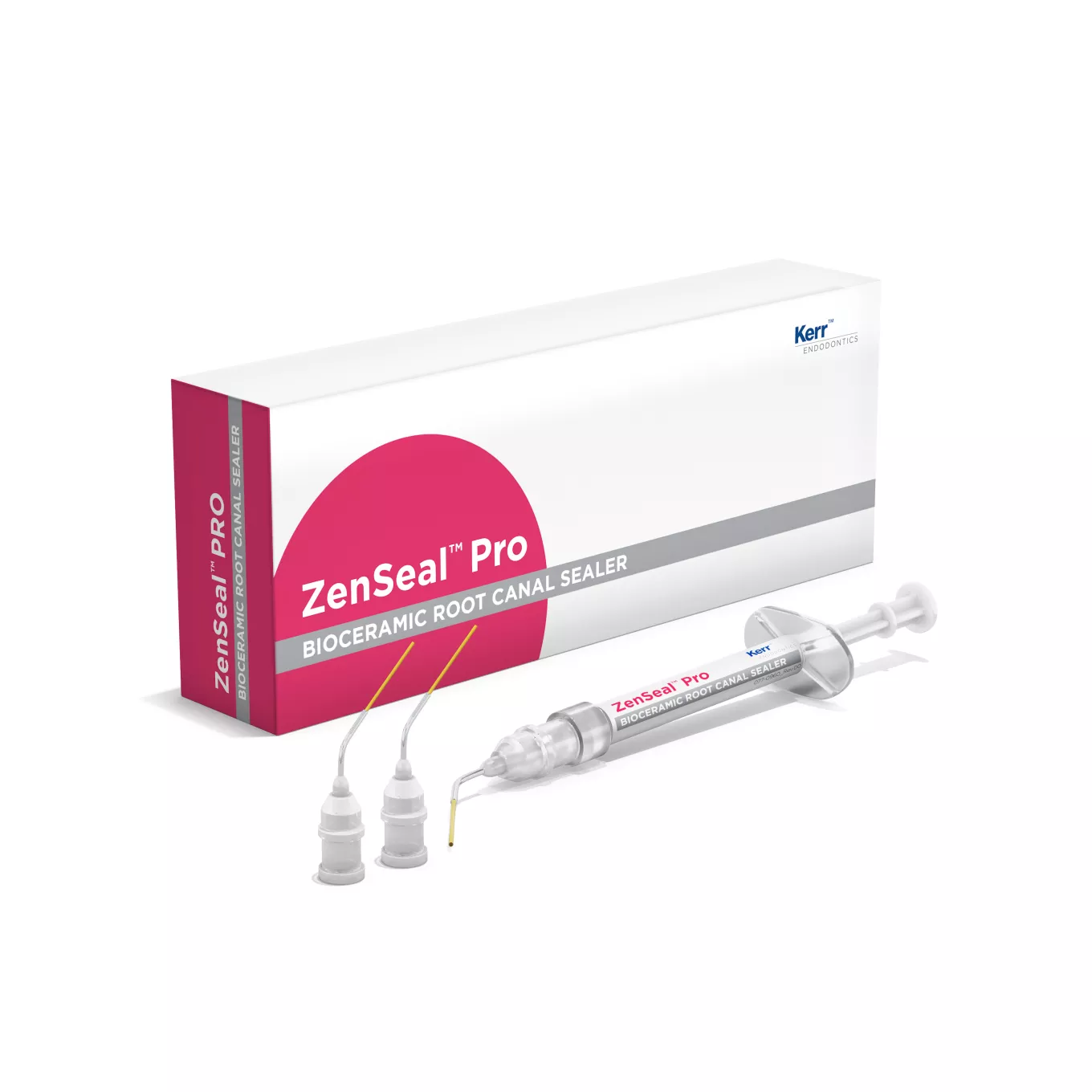
The most distinctive feature separating ZenSeal Pro from its predecessor is the inclusion of ZenSave Tips – a proprietary, low-waste delivery tip engineered to address one of the most consistently reported frustrations with high-flow bioceramic sealers: the volume of material that remains trapped in the tip rather than reaching the canal.
Waste reduction and per-syringe yield
According to Kerr Dental's published data released alongside the April 2026 product launch (Kerr Dental via ACCESS Newswire), ZenSave Tips reduce material waste by 33.5% compared to other high-flow bioceramic sealers. This translates to an average of 57 canals treated per 1.5 g syringe, compared with approximately 48 canals from comparator systems – a per-syringe efficiency gain of nearly 19%. For practices switching from the comparator product, Kerr estimates annual savings of over $1,500.[4]
"ZenSeal Pro with ZenSave Tips gives me confidence that more of the sealer is reaching the canal rather than staying in the tip. In challenging anatomies, the flexibility and trimmability of the ZenSave Tips, combined with the sealer's flow and radiopacity, allow me to work efficiently while staying in control of the obturation outcome." – Dr. Rico Short, Endodontist (Kerr Dental, 2026) |
Flexible and trimmable tip design
ZenSave Tips are constructed to be both flexible and trimmable, allowing clinicians to customize tip length and angulation before delivery. This addresses a practical limitation in mandibular molars, maxillary second molars, and posterior teeth where canal orifices are at awkward angles relative to the syringe barrel. The flexible tip conforms to the access cavity without requiring repositioning of the syringe, and trimming the tip to a shorter length reduces dead-space volume, contributing to the overall waste reduction.
Technique Compatibility: Single-Sealer Versatility
One of the strongest clinical arguments in favor of ZenSeal Pro is its positioning as a single-sealer solution across the four major obturation techniques used in modern endodontic practice. Historically, some bioceramic sealers have been associated primarily with the single-cone technique, which has limited adoption among practitioners committed to thermoplastic workflows. ZenSeal Pro addresses that limitation directly.
Single-cone technique
ZenSeal Pro is fully optimized for single-cone obturation, the most widely adopted technique among general dentists and endodontists using nickel-titanium rotary systems with matched-taper gutta-percha cones. The sealer's high flowability (ZenSeal's product page documents 23.5 mm of flowability) enables penetration into accessory canals, fins, and anastomoses that gutta-percha alone cannot fill.
Cold lateral condensation
ZenSeal Pro's syringe delivery and viscosity profile are compatible with traditional lateral condensation, providing adequate working time for incremental placement of accessory cones without premature setting.
Warm vertical compaction
Warm vertical obturation compatibility is arguably ZenSeal Pro's most significant technical advancement over earlier bioceramic sealers. Kerr Dental reports that ZenSeal Pro has undergone design verification and heat-compatibility testing confirming that the sealer maintains performance integrity under the thermal conditions generated during warm vertical compaction. This is explicitly noted in the April 2026 product launch announcement and represents a meaningful differentiation from bioceramic sealers for which no formal heat-compatibility data has been published.
Carrier-based obturation
ZenSeal Pro is also compatible with thermoplasticized gutta-percha carrier systems, completing its coverage of all four major obturation techniques. Practices using carrier-based workflows can adopt ZenSeal Pro without changing their primary obturation approach.
Clinical Performance and Evidence Base
ZenSeal Pro is a new product, launched in April 2026, so long-term outcome data specific to this formulation is still accumulating. However, several lines of evidence support its expected clinical performance.
Predecessor clinical rating
The original ZenSeal was evaluated by 27 independent clinical evaluators through a formal evaluation program at The Dental Advisor, accumulating 204 total uses and achieving a 96% clinical rating. Evaluators highlighted excellent flow characteristics and radiopacity, with the minimal-waste tip noted for clean delivery. ZenSeal Pro builds directly on this formulation with an upgraded delivery system and extended technique compatibility.[5]
Bioceramic sealer evidence base
Calcium silicate-based sealers as a class have been studied extensively. A 2025 study in Bioengineering (MDPI) assessing 100 patients found that 90% of those treated with bioceramic sealers showed periapical healing at six months, compared with 75% in a group treated with conventional sealers. The bioceramic group also demonstrated superior radiographic seal quality and lower post-operative pain scores.[6]
A comprehensive University of New England review on endodontic sealers, accessible through DUNE (UNE academic repository), found that tricalcium silicate-based sealers showed the lowest relative microleakage among all sealer classes assessed – including epoxy resin, ZOE, glass ionomer, and silicone – when compared against AH Plus as a reference.[7]
Retreatability considerations
One area where calcium silicate sealers present a clinical challenge is retreatment. A 2025 peer-reviewed study published in PeerJ on bioceramic sealer retreatability confirms that the chemical bonding of these materials to dentin complicates removal compared to conventional sealers, requiring specific nickel-titanium file systems and, in some cases, ultrasonic activation. This does not preclude their use, but it should be incorporated into treatment planning discussions and patient counseling.[8]
When planning endodontic care for patients where future retreatment is a realistic possibility, integrating these material considerations into a structured dental treatment plan can support better-informed clinical and patient communication decisions.
ZenSeal Pro vs. Competing Bioceramic Sealers
The bioceramic sealer market has expanded considerably since EndoSequence BC Sealer introduced the category to widespread clinical adoption. Most competitors share the same foundational calcium silicate chemistry. Key differentiators across products include flowability, delivery system design, waste per application, technique compatibility, radiopacity, and price per canal.
ZenSeal Pro stands out on the following dimensions relative to the broader competitive field:
Waste efficiency: ZenSave Tips reduce material waste by 33.5% vs. other high-flow bioceramic sealers – the most quantifiable competitive differentiator.
Warm vertical compatibility: Formally verified through heat-compatibility testing, distinguishing ZenSeal Pro from competitors that lack published thermal performance data.
Tip design: Flexible, trimmable construction improves access in posteriors and anatomically challenging cases where fixed-angle standard tips can limit precise placement.
Brand infrastructure: Kerr's 135-year history, global distribution network, and Envista Holdings support provide institutional reliability and long-term product availability confidence.
Clinical track record: The 96% clinical rating of the predecessor ZenSeal, via The Dental Advisor's independent evaluator panel, provides an externally validated evidence base.
Where ZenSeal Pro shares the same limitations as the broader bioceramic sealer category:
High flowability increases the risk of apical extrusion if delivery technique is not controlled.
Chemical bonding to dentin makes retreatment more demanding than with eugenol-based or epoxy resin sealers.
Setting times are longer than resin-based sealers, an inherent property of calcium silicate chemistry.
Bottom Line
ZenSeal Pro with ZenSave Tips is a clinically meaningful upgrade to an already well-regarded bioceramic sealer family. The core calcium silicate chemistry that earned the predecessor ZenSeal a 96% independent clinical rating remains intact, and the redesigned ZenSave tip system solves a real, documented problem – excessive material waste in high-flow bioceramic sealer delivery. The numbers are straightforward: 33.5% less waste per syringe, an average of 57 canals treated per 1.5 g unit versus approximately 48 with comparable products, and a potential annual cost saving of over $1,500 per practice.
The formal heat-compatibility verification for warm vertical obturation removes a meaningful barrier that had kept some thermoplastic technique advocates from committing to a bioceramic sealer. Combined with confirmed compatibility across single-cone, cold lateral, and carrier-based workflows, ZenSeal Pro functions as a genuine single-sealer solution that simplifies inventory management without asking practitioners to change their obturation approach.
Two areas require clinical attention. First, the high flowability that makes this sealer excel at filling complex anatomy also demands controlled delivery technique to avoid apical extrusion, particularly in teeth with open apices or significant resorptive defects. Second, retreatment of bioceramic-obturated teeth is more technically demanding than retreatment of conventionally sealed teeth, and this should be communicated to patients and incorporated into treatment planning accordingly.
For high-volume endodontic practices and general dental offices that perform root canal therapy regularly, ZenSeal Pro earns a clear recommendation as a primary bioceramic sealer. The value proposition is well-supported, the clinical foundation is strong, and the delivery system improvement is practical and meaningful.
Verdict
<p>ZenSeal Pro with ZenSave Tips represents a clinically substantive advancement in bioceramic sealer delivery, grounded in a well-established calcium silicate formulation and refined through a purposeful redesign of the delivery system. The predecessor ZenSeal achieved a 96% clinical rating across 204 independent evaluations, and ZenSeal Pro preserves that material foundation while addressing the most frequently cited limitation of high-flow bioceramic sealers: the disproportionate volume of material retained in the tip rather than expressed into the canal. The resulting 33.5% reduction in waste and per-syringe yield of approximately 57 canals are quantified outcomes with direct practice-economic implications. Its hydrophilic setting mechanism, pH exceeding 11, zero net shrinkage, and hydroxyapatite formation at the sealer-dentin interface collectively satisfy the core requirements of an ideal endodontic sealer, while formally verified heat compatibility for warm vertical compaction, combined with confirmed performance across single-cone, cold lateral condensation, and carrier-based workflows, positions it as a single-sealer solution across the full range of obturation techniques. Two considerations warrant clinical attention, both class-level characteristics shared across bioceramic sealers rather than deficiencies specific to this product: the high flowability requires disciplined control of delivery pressure to minimize apical extrusion risk, and the chemical adhesion to dentinal walls increases retreatment complexity relative to conventional materials, which should be incorporated into pre-treatment assessment and informed consent protocols. On the totality of clinical, material, and economic evidence currently available, ZenSeal Pro merits consideration as a primary bioceramic obturation material for both endodontic specialty and general dental practice settings.</p>
Frequently Asked Questions
Is ZenSeal Pro the same product as ZenSeal or ZenSeal Plus?
ZenSeal Pro is the newest member of Kerr Dental's ZenSeal product family, launched in April 2026. It uses the same calcium silicate bioceramic chemistry as the original ZenSeal and ZenSeal Plus, but it is differentiated by the inclusion of ZenSave Tips, which reduce material waste by 33.5% compared to other high-flow bioceramic sealers. Clinicians who have used ZenSeal Plus and valued its performance can consider ZenSeal Pro a direct upgrade with improved delivery efficiency and formally verified warm vertical compatibility.
How does ZenSeal Pro perform in warm vertical obturation?
Kerr Dental reports that ZenSeal Pro has undergone specific design verification and heat-compatibility testing confirming its performance under warm vertical compaction conditions. This distinguishes it from several earlier bioceramic sealers that lacked published data on thermal behavior. When using ZenSeal Pro for warm vertical workflows, the manufacturer recommends using the provided ZenSave Tips, which have been specifically tested for heat compatibility, rather than substituting third-party tips.
How many canals can be treated from a single 1.5 g syringe?
According to Kerr Dental's product launch data, ZenSeal Pro with ZenSave Tips averages 57 canals per 1.5 g syringe, compared with approximately 48 canals from comparable bioceramic sealer systems. This represents an efficiency gain of approximately 19% per syringe. For high-volume practices, this difference compounds significantly and is estimated to generate annual savings of over $1,500 for practices switching from the comparator system.
Does ZenSeal Pro require a dry canal?
No. Unlike epoxy resin sealers that require a dry canal for optimal adhesion, ZenSeal Pro's calcium silicate chemistry is hydrophilic. The setting reaction actually uses residual moisture in the canal environment. Clinicians should dry the canal with paper points to remove gross moisture, but over-drying is not necessary and not recommended. This is one of the clinical advantages of the bioceramic chemistry in cases where achieving complete dryness is difficult.
What is the pH of ZenSeal Pro and why does it matter clinically?
ZenSeal Pro has a pH greater than 11. This alkaline environment is hostile to many endodontic pathogens. The calcium hydroxide produced during the hydration setting reaction is responsible for the elevated pH. Beyond its antibacterial properties, the calcium hydroxide interacts with phosphate ions in periapical tissue fluid to precipitate hydroxyapatite, contributing to the chemical seal at the dentinal wall and supporting periapical tissue healing.
How difficult is retreatment if a ZenSeal Pro-obturated tooth needs revision?
Retreatment of teeth obturated with bioceramic sealers is more technically demanding than retreatment with zinc oxide-eugenol or epoxy resin sealers. Calcium silicate sealers form a chemical bond with dentinal walls and with gutta-percha, and they do not dissolve readily in standard organic solvents such as chloroform or eucalyptol. A 2025 study published in PeerJ confirms that bioceramic sealers complicate retreatment procedures. Retreatment is achievable with appropriate instrumentation and extended procedure time, but practitioners should incorporate this information into patient counseling and treatment planning, particularly for younger patients or teeth with a higher retreatment probability.
Can ZenSeal Pro be used in teeth with open apices or significant apical resorption?
Particular caution is warranted when using any high-flow bioceramic sealer in teeth with open apices, wide canal diameters, or significant apical resorption. The flowability that makes ZenSeal Pro effective in standard canals also increases the risk of sealer extrusion in these anatomical situations. In open-apex cases, placing a fast-setting bioceramic apical barrier, such as MTA or a comparable material, before completing obturation is a standard approach that reduces this risk. Delivery pressure should be minimized and sealer application should be conservative.
Where can ZenSeal Pro be purchased?
ZenSeal Pro is available through major North American dental distributors including Henry Schein Dental, Patterson Dental, Safco Dental Supply, and DHP Supply. Pricing requires a professional login with verified dental license credentials, which is standard practice for dental supply procurement. Practitioners can also visit kerrdental.com to request a product demonstration or locate regional distributors.