Rating: 3.8/5
Vitapex Review
Few endodontic materials have earned the loyalty that Vitapex commands in pediatric operatories. This premixed calcium hydroxide iodoform paste has become a default choice for...
Reviewed by Mantas Petraitis
Pros
- Premixed and ready to use, with no mixing, no working-time pressure, and no batch-to-batch inconsistency
- Outstanding delivery system, with long flexible disposable tips that reach the apical third, consistently the highest-rated feature in independent clinical evaluation
- Highly radiopaque, making fill quality and subsequent resorption straightforward to assess radiographically
- Dual antimicrobial mechanism combining immediate alkalinity with sustained bacteriostatic activity from slow iodine release
- Neutralizes residual bacterial endotoxin rather than simply sealing bacteria within the canal
- Never sets, so every clinical decision made with the material remains fully reversible
- Resorbs from periapical tissues within one week to two months, with documented bone regeneration
- Resolves acute furcation and periapical pathology faster than zinc oxide eugenol in the early postoperative period
- Saves meaningful chair time in pediatric cases where cooperation is the limiting factor
- Covers a broad indication set from a single syringe, including pulpectomy, dressing, apexification, and trauma management
Cons
- Weaker long-term outcomes, with 18-month success rates for iodoform pastes falling well below zinc oxide eugenol and Endoflas in meta-analysis
- Resorbs from within the canal, which can leave voids in teeth still years away from exfoliation
- Provides no mechanical seal and no structural reinforcement
- Viscous consistency requires firm controlled pressure, the most frequently reported handling complaint
- Contraindicated in iodine allergy, with documented reactions requiring material removal
- Carries discoloration potential relevant to esthetic restorations on anterior primary teeth
- Iodoform can irritate periapical tissue, which argues against routine extrusion
- Associated with dentin weakening during extended apexification protocols
- Unsuitable as a definitive obturant in mature permanent teeth
- Requires light-protected storage
Few endodontic materials have earned the loyalty that Vitapex commands in pediatric operatories. This premixed calcium hydroxide iodoform paste has become a default choice for obturating primary teeth, largely because it removes almost every friction point from a procedure performed on a patient who does not want to be there. There is no mixing, no working time to manage, and no material that hardens before the clinician is satisfied with the fill.
The evidence base, however, has moved. Studies from the late 1990s and early 2000s showed Vitapex outperforming zinc oxide eugenol on short-horizon endpoints. Longer trials and a major meta-analysis published since have complicated that conclusion in ways that matter for everyday material selection. A product can be excellent at the job it was engineered for and still be the wrong first choice for a specific tooth in a specific patient.
This review examines what Vitapex is at a chemical level, where the clinical data supports it, where the data does not, how to handle it chairside, how it compares against Metapex, Endoflas, zinc oxide eugenol, and calcium silicate alternatives, and whether it deserves a permanent place in a modern material inventory.
Vitapex At A Glance
The table below summarizes the product specifications that matter most when evaluating Vitapex against competing obturation materials. Clinicians should confirm current kit contents with their distributor, since packaging configurations occasionally change.
Attribute | Detail |
|---|---|
Product type | Premixed, non-setting calcium hydroxide and iodoform root canal paste |
Manufacturer | Neo Dental Chemical Products Co., Ltd. (Japan) |
Composition | Iodoform 40.4%, calcium hydroxide 30.3%, silicone oil 22.4%, inert components approximately 6.9% |
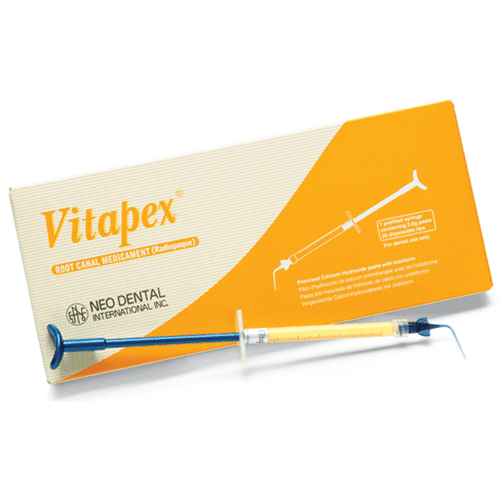
Presentation | Soft yellow paste in a graduated Luer-lock polypropylene syringe |
Standard kit | 2 g syringe with 20 disposable tips. Intro kit contains 0.5 g with 3 tips |
Setting behavior | Does not set, remains soft and removable indefinitely |
Radiopacity | High, driven by the iodoform fraction |
Resorbability | Clears from periapical tissues, typically within one week to two months |
Core indications | Primary tooth pulpectomy, intracanal medicament, apexification, exudation control, root resorption, traumatic injury |
Removal | Sodium hypochlorite irrigation with light hand filing |
Storage | Dark environment at room temperature |
What Is Vitapex?
Vitapex is a radiopaque endodontic paste that combines calcium hydroxide and iodoform in a silicone oil vehicle, supplied premixed in a syringe with disposable delivery tips. Manufactured in Japan by Neo Dental Chemical Products and distributed internationally, it has been in clinical use for decades and holds FDA registration as a root canal filling material. Understanding the ratio of its three active fractions explains almost everything about its clinical behavior.
Composition Of Vitapex
The composition of Vitapex is consistent across manufacturer documentation and the peer-reviewed literature, which is unusual and helpful in a category where formulations sometimes shift without notice. The published figures are iodoform 40.4%, calcium hydroxide 30.3%, and silicone oil 22.4%, with the remaining fraction made up of inert components.
That ratio places Vitapex firmly in the iodoform-dominant category of pediatric obturation materials. The distinction matters, because the largest systematic reviews in this field group materials precisely along that line, separating pure calcium hydroxide and iodoform pastes from zinc oxide eugenol formulations and from hybrid materials that combine both chemistries.
How Calcium Hydroxide Works
Calcium hydroxide is the biologic engine of the paste. It dissociates into calcium and hydroxyl ions in an aqueous environment, driving local pH into the strongly alkaline range and producing several useful effects at once.
The hydroxyl ions are directly antimicrobial against most endodontic flora. They also hydrolyze the lipid portion of bacterial lipopolysaccharide, neutralizing residual endotoxin left behind after instrumentation, which is a meaningful advantage over materials that simply entomb bacteria without inactivating their byproducts. The alkaline environment additionally favors hard tissue deposition, which underpins the long-standing use of calcium hydroxide in apexification and apical barrier formation.
Radiolabeled tracer studies using calcium-45 tagged calcium hydroxide within Vitapex demonstrated that the calcium component migrates into bone tissue through the bloodstream, with a portion excreted through the digestive tract. Comparative work published in a rat subcutaneous implantation model found that Vitapex generated substantially larger calcium-rich and phosphorus-rich calcified regions than a newer calcium silicate intracanal medicament, with both hydroxyapatite and calcite detectable at the material and tissue interface. Where apical hard tissue induction is the treatment goal, that finding counts in the material's favor.
The limitation is that calcium hydroxide activity is finite. Once hydroxyl ions are consumed and buffered by surrounding tissue, the remaining paste functions as a placeholder rather than an active medicament. That pharmacological reality is the argument for planned replacement during extended dressing protocols.
How Iodoform Works
Iodoform, or triiodomethane, is the largest single fraction in the formulation and performs two distinct jobs. It slowly liberates free iodine, giving the paste sustained bacteriostatic activity that persists after the calcium hydroxide alkalinity has decayed. That persistence is genuinely useful in primary molars, where ribbon-shaped canals, accessory anatomy, and physiologic resorption make complete mechanical disinfection unrealistic regardless of the nickel titanium file system selected.
Iodoform is also the source of Vitapex's radiopacity. Clinicians can verify fill quality on a postoperative radiograph without ambiguity and can track resorption at every recall. That radiographic legibility is one of the quieter reasons the material retains such loyalty.
Iodoform carries a documented downside profile that the safety section addresses in detail, including periapical irritation, effects on cementum, coronal discoloration, and allergic potential in iodine-sensitive patients.
Why The Silicone Oil Vehicle Matters
The silicone oil carrier defines how Vitapex behaves in the hand and in the canal. It is non-aqueous, does not evaporate, and does not set, so the paste stays soft indefinitely.
Three clinical consequences follow. The oil ensures the paste wets canal walls, including irregularities that files never contact. The material remains fully retrievable, so no clinical decision made with Vitapex is irreversible, which is reassuring when a tooth's prognosis is uncertain at the time of treatment. Extruded material resorbs rather than persisting as a foreign body, and case documentation in the pediatric literature records extruded Vitapex clearing within one to two weeks through macrophage-mediated resorption, with subsequent bone regeneration.
The trade-off is equally direct. A non-setting paste provides no mechanical seal and no structural reinforcement, and its persistence inside the canal is limited. Those properties suit a tooth destined to exfoliate. They are a genuine constraint everywhere else.
Clinical Indications For Vitapex
The manufacturer and independent evaluators list a broad indication set. The list below is ordered by how strongly each application is supported by both published evidence and practical clinical experience, which is a more useful ranking than the order found on packaging.
Pulpectomy and root canal filling of primary teeth, the flagship application
Intracanal medicament between appointments in permanent teeth
Apexification and apical hard tissue formation in immature permanent teeth
Apexogenesis support in vital immature teeth
Management of inflammatory root resorption
Traumatic dental injuries in the mixed dentition requiring extended dressing
Exudation control in canals that will not dry
Adjunctive use in perforation management
Vital pulpotomy in deciduous teeth
An honest reading of that list positions Vitapex as a pediatric and interim material with a secondary role as a permanent tooth dressing. Clinicians run into difficulty when the phrase "permanent root canal filling material" on the packaging is read as authorization for definitive obturation of mature permanent teeth. Vitapex does not substitute for gutta-percha with a modern bioceramic sealer, and it does not substitute for a calcium silicate apical plug. Building the indication into a documented, phased dental treatment plan helps ensure the material is matched to the biological timeline of the tooth rather than to habit.
Vitapex In Primary Tooth Pulpectomy: Step By Step
Vitapex's usability is its strongest attribute, and independent evaluation reflects that. In various clinical assessments, consultants used the material across 200 clinical situations and returned a 92% rating, with the delivery system singled out for praise. The protocol below reflects standard practice for single-visit pulpectomy in a primary molar.
Case Selection And Isolation
Material choice matters less than case selection, a point the meta-analytic literature makes repeatedly. Pulpectomy success is significantly better in teeth without preoperative pathologic root resorption, and a tooth with substantial resorption is a poor candidate regardless of what fills the canal.
Confirm the tooth is restorable and that adequate root structure remains. Place a rubber dam or a comparable isolation system before access. Isolation protects the airway from a paste with a pronounced iodine flavor and keeps the operative field clean enough for predictable delivery.
Instrumentation And Irrigation
Establish straight-line access, remove pulp tissue, and instrument conservatively. Primary root canals are thin-walled, frequently curved, and often have a physiologically resorbing apex, so aggressive shaping offers no benefit and introduces real perforation risk.
Rotary preparation is significantly faster than manual instrumentation without any documented penalty in success rate, which makes a pediatric sequence run on a contemporary rotary file system a sensible efficiency gain when patient cooperation is the limiting factor. Irrigate with dilute sodium hypochlorite under careful volume control, avoid pressure irrigation given the open apex and thin furcal floor, and finish with saline. Dry thoroughly with paper points.
Delivery And Radiographic Verification
Attach a disposable tip to the Luer-lock syringe and insert it to within roughly 2 to 3 mm of working length. Express the paste with steady light pressure while withdrawing the tip, filling from apical to coronal. Backfilling in this direction avoids voids and prevents the pressure spike that drives extrusion.
Take a postoperative radiograph and look for a homogeneous radiopaque column ending at or just short of the radiographic apex. Slight extrusion is not a treatment failure, since the paste resorbs, though gross extrusion remains an avoidable technique error.
Final Restoration
Place a stainless steel crown or an equivalent full-coverage restoration in the same visit. A non-setting paste beneath a leaking temporary restoration is a reliable route to reinfection, and the coronal seal contributes at least as much to long-term success as the obturation itself. Parents managing caries in the primary dentition should be counseled that the crown is part of the treatment rather than an optional extra.
Vitapex As An Intracanal Medicament In Permanent Teeth
Vitapex performs a different job in the permanent dentition, and the protocol changes accordingly. Its value here rests on disinfection, exudate control, and symptom management rather than on definitive obturation.
Express the paste to length, then seal with a well-adapted temporary restoration. Recall intervals should follow the treatment objective. Routine interappointment disinfection generally calls for 7 to 14 days. Apexification requires considerably longer dressing periods with planned replacement.
Removal at the subsequent visit uses copious sodium hypochlorite irrigation with light hand filing. Because the material has never set, retrieval is markedly easier than with a conventional aqueous calcium hydroxide paste that has desiccated inside the canal. Many clinicians value Vitapex specifically for a symptomatic tooth, where the combination of alkalinity and iodine appears to contribute to postoperative comfort during the interval between appointments.
Handling Pitfalls And How To Avoid Them
Vitapex is forgiving, though a handful of recurring problems account for most of the frustration clinicians report with the material. Anticipating them takes very little effort.
Viscosity is the most common criticism raised by clinical evaluators, and the paste requires firm, steady thumb pressure rather than a sudden push. Warming the syringe briefly in the hand improves flow
Tip binding converts expression pressure directly into apical extrusion, so the tip should never be wedged into the canal
Iodoform residue left on chamber dentin contributes to crown discoloration, which is irrelevant beneath a stainless steel crown and very relevant beneath an esthetic restoration on an anterior primary tooth
Storage in a dark environment matters, because iodoform is light-sensitive
Delivery tips are single-use items, and the syringe should be capped between cases
What The Clinical Evidence Shows
This is where a Vitapex review has to be careful, because the conclusion depends substantially on which follow-up interval the reader is looking at. Both bodies of evidence are methodologically sound, and both are measuring something real.
Early Studies Favoring Vitapex
Research through the late 1980s and into the mid-2000s was strongly positive. An evaluation of iodoform paste in infected primary teeth reported that 43 of 45 treated teeth showed no clinical or radiographic signs of failure.
A clinical evaluation of Vitapex in primary tooth root canal therapy concluded that the single-session technique was supported by high clinical and radiographic success. The authors identified the paste's principal advantages as resorption from apical tissues within one week to two months, apparent harmlessness to the developing permanent tooth germ, radiopacity, non-setting consistency, and ease of insertion and removal.
A direct comparison against zinc oxide eugenol in necrotic primary teeth, with follow-up at 3 months and again at 10 to 16 months, reported overall success of 100% for Vitapex against 78.5% for zinc oxide eugenol. A randomized study published in Pediatric Dentistry in 2008 examined 54 mandibular primary molars treated with single-visit pulpectomy and a stainless steel crown, with blinded assessment. Zinc oxide eugenol recorded 48% success at 6 months and 85% at 12 months, against 78% and 89% for Vitapex. The 6-month difference reached statistical significance, and the 12-month difference did not.
That last detail is the hinge on which the entire evidence picture turns. The authors concluded that Vitapex resolved furcation pathology faster than zinc oxide eugenol at 6 months, while the two materials produced similar results at 12 months. The measured advantage was speed of resolution rather than superior endpoint success.
Longer Follow-Up Changes The Picture
An 18-month randomized controlled trial of 160 primary molars compared a mixed primary root canal filling containing zinc oxide eugenol, iodoform, and calcium hydroxide against zinc oxide eugenol alone and against Vitapex. The mixed paste and zinc oxide eugenol groups both recorded 100% success at 6 and 12 months. Vitapex showed 100% clinical and 94.5% radiographic success at 6 months, then declined to 80.4% clinical and 60.7% radiographic at 12 months, and to 71.4% clinical and 53.6% radiographic at 18 months. The comparator materials finished at 96.2% and 92.2% clinically.
A systematic review and meta-analysis of nonvital pulp therapy for primary teeth published in 2020 reached a consistent conclusion. Success with zinc oxide eugenol and with Endoflas did not differ statistically from Vitapex or Metapex at 18 months, though the absolute figures diverged sharply. Endoflas and zinc oxide eugenol remained near 90%, against 71% or less for pure iodoform pastes. Network analysis rated Endoflas and zinc oxide eugenol above iodoform alone, and the authors supported those two materials over iodoform pulpectomies at the 18-month mark.
A separate systematic review comparing calcium hydroxide and iodoform against zinc oxide eugenol concluded that zinc oxide eugenol, or zinc oxide eugenol combined with iodoform and calcium hydroxide, appears to be the material of choice when primary teeth are not nearing exfoliation. The same authors noted that higher-quality long-term randomized trials are still required before the question can be considered settled.
Interpreting The Conflict
The mechanism behind the divergence is straightforward. Rapid resorbability, which is Vitapex's defining virtue in the periapical tissues, becomes a liability inside a canal that needs to stay filled for years. Documented cases show intracanal Vitapex resorbing completely from primary canals within months, in some instances with the tooth remaining asymptomatic and free of pathosis. An empty canal, however, is an unsealed canal. If the coronal restoration leaks or the tooth remains years from exfoliation, that void represents a reinfection risk that a slower-resorbing material would not create.
The practical synthesis is a conditional recommendation. Vitapex performs excellently when the interval between treatment and exfoliation is short, when rapid resolution of acute furcal or periapical pathology is the priority, and when the tooth carries a well-sealed full-coverage restoration. It performs less well as a long-term obturant in a young primary molar with several years of service ahead of it.
Evidence In Permanent Teeth And Apexification
The permanent tooth literature is thinner and more heterogeneous. Clinical series report effective rates in the mid-80s to low-90s percent for Vitapex-based apexification of immature necrotic teeth, broadly comparable to other calcium hydroxide preparations, with continued root-end development documented for calcium hydroxide and iodoform pastes as a class.
The significant caveat concerns structure rather than efficacy. Prolonged intracanal calcium hydroxide exposure is associated with weakening of radicular dentin. A systematic review and network meta-analysis published in the Journal of Endodontics summarized retrospective evidence including a four-year study that reported a high incidence of cervical root fractures in immature teeth undergoing calcium hydroxide apexification with dressing durations ranging from 3 to 54 months, alongside a separate series in which 32% of apexification cases ended in root fracture, either spontaneously or following minor trauma. Laboratory findings on this question are not unanimous. However, the clinical signal has been strong enough that traditional long-term calcium hydroxide apexification has largely given way to single-visit calcium silicate apical plugs and, where appropriate, regenerative endodontic protocols.
That evidence repositions Vitapex rather than eliminating it. As a short-term to medium-term dressing for disinfection, exudate control, and symptom management, it remains highly serviceable. As a multi-year apexification protocol, it now sits second in line.
How Vitapex Compares To Other Obturation Materials
Material selection in pediatric endodontics involves trade-offs between antimicrobial performance, resorption rate, retrievability, and cost. The table below compares the main options, and the sections that follow examine the comparisons clinicians ask about most often.
Material | Composition | Sets | Resorption | Best suited to |
|---|---|---|---|---|
Vitapex | Calcium hydroxide, iodoform, silicone oil | No | Fast | Primary pulpectomy near exfoliation, interim dressing, exudate control |
Metapex | Calcium hydroxide, iodoform, silicone oil | No | Fast | Same indications, frequently the lower-cost option |
DiaPex Plus | Calcium hydroxide, iodoform, premixed | No | Fast | Same indications |
Endoflas | Zinc oxide eugenol, iodoform, calcium hydroxide, barium sulfate | Yes | Selective | Primary pulpectomy where longevity matters |
Zinc oxide eugenol | Zinc oxide, eugenol | Yes | Slow and unpredictable | Primary pulpectomy on a budget |
Calcium silicate materials | Tricalcium silicate formulations | Yes | No | Apical plugs, perforation repair, pulp capping |
Vitapex Versus Metapex
This is the most common purchasing question in the category, and the honest answer is that clinical differences are marginal. Both products are premixed calcium hydroxide and iodoform pastes carried in silicone oil, delivered from a syringe with disposable tips, with near-identical indications and comparable outcomes in head-to-head apexification studies.
Metapex ships in a slightly larger 2.2 g syringe and often lands at a lower price point. Selection should rest on cost, distributor relationship, and tip preference rather than on an expectation of a performance gap. The same logic applies to DiaPex Plus, which occupies the same formulation space.
Vitapex Versus Zinc Oxide Eugenol
Zinc oxide eugenol is cheaper, requires mixing, sets hard, and resorbs slowly and unpredictably, occasionally persisting in the alveolus after the primary tooth has exfoliated. Vitapex is faster to place and resolves acute pathology sooner.
On 18-month endpoints, the meta-analytic evidence favors zinc oxide eugenol. Many clinicians resolve the tension pragmatically, matching material to timeline: Vitapex for teeth within roughly 18 to 24 months of exfoliation, and zinc oxide eugenol or Endoflas for teeth with a longer service life remaining.
Vitapex Versus Endoflas
Endoflas is arguably the strongest performer in the current primary tooth literature, combining the antimicrobial contributions of iodoform and calcium hydroxide with the durability of a zinc oxide eugenol base. Extruded excess is reported to resorb while the intracanal portion persists, which addresses the central weakness of pure iodoform pastes.
The trade-offs are real. Endoflas sets require mixing and are more difficult to retreat. A practice with a heavily pediatric case mix, obturating many primary molars with years of service remaining, should consider stocking both materials rather than choosing between them, an approach that fits naturally into a structured dental material selection framework.
Vitapex Versus Calcium Silicate Materials
Calcium silicate cements occupy a different role entirely. Products such as Biodentine set hard, do not resorb, and serve as apical plugs, perforation repair materials, and dentin substitutes rather than as canal-filling pastes.
Where an immature permanent tooth requires definitive apical closure, a single-visit calcium silicate plug now represents the more predictable approach and avoids the dentin-weakening risk associated with extended calcium hydroxide dressing. Vitapex retains a supporting role in those cases as the disinfecting dressing placed before the plug.
Safety, Contraindications, And Complications
Vitapex carries a good general safety record. Extruded material resorbs, and the paste has not been shown to damage developing permanent tooth germs. Several specific risks nevertheless warrant attention and documentation.
Iodine allergy represents the one absolute contraindication. Iodoform releases free iodine, and a case report published in the Saudi Endodontic Journal describes a patient who developed an urticarial rash and shortness of breath after an iodoform-containing calcium hydroxide paste was placed as an intracanal medication. Symptoms persisted through repeated emergency department visits despite steroids and antihistamines, resolved only after the intracanal material was removed, and skin prick testing subsequently confirmed iodine allergy. Screening for iodine sensitivity before use takes seconds and should be recorded in the chart.
Additional considerations include the following.
Thyroid disease or planned radioiodine investigation warrants caution and physician consultation, since the material contains iodine
Iodoform has been reported to irritate periapical tissue and to cause cemental necrosis in some studies, which argues against habitual over-extrusion even though the paste resorbs
Coronal discoloration is documented with iodoform-containing pastes and is relevant for anterior primary teeth restored with translucent materials
Prolonged calcium hydroxide dressing correlates with cervical root fracture in immature permanent teeth, so dressing duration should be purposeful and no longer than the treatment goal requires
Delivery under pressure near an open apex or a thin furcal floor risks displacement toward the mandibular canal or maxillary sinus
The paste provides no long-term seal and should not serve as a definitive obturant in mature permanent teeth
Cost, Kits, And Practice Economics
Most major dental distributors stock Vitapex, and it is available in several configurations. The Regular Kit contains a 2 g graduated syringe with 20 disposable tips. A smaller Intro Kit with 0.5 g and three tips allows clinicians to trial the material before committing. Refill syringes and tip packs, commonly supplied in packs of 40, are sold separately.
Pricing varies considerably by region and distributor, and a 2 g kit typically sits in a modest double-digit range in US dollars. Clinicians should verify current figures with their supplier, since dental consumable pricing fluctuates and alternative distribution channels sometimes deliver meaningful savings on identical stock.
The more relevant number for practice management is cost per case rather than kit price. A 2 g syringe fills a substantial number of primary molars, and amortized across cases the material cost per pulpectomy is small relative to chair time, the stainless steel crown, and the behavior management overhead involved in treating a young child. Practices reviewing their procurement processes generally find that consumables of this type are a poor place to economize.
Where Vitapex genuinely earns its premium is time. There is no mixing, no spatula, no glass slab, and no working-time anxiety. In a pediatric operatory where cooperation rather than clinical skill is the constraint, removing two or three minutes from the obturation step has real value that a per-gram cost comparison will never capture.
Bottom Line
Vitapex remains one of the most usable endodontic materials available. Its handling, radiopacity, retrievability, and biological activity are all genuinely strong, and the 92% consultant rating from independent clinical evaluation reflects a product that performs as described at the chairside.
What has changed is the profession's understanding of its limits. The material's defining property, resorbability, functions as a benefit in the periapical tissues and as a liability inside the canal of a tooth that still has years to serve. The 18-month evidence is clear enough that selection between Vitapex, Endoflas, and zinc oxide eugenol should follow time to exfoliation rather than habit. Stock it, screen for iodine allergy, and match it to the indication.
Verdict
<p>Vitapex is a very good material that has quietly been asked to do a job slightly larger than its design intent. Judged against what it was engineered for, a fast, radiopaque, resorbable, non-setting paste that can be delivered to length in seconds and removed just as easily, it is close to exemplary. The delivery system is the best in its class, the antimicrobial profile is sound, the radiopacity makes verification unambiguous, and the fact that it never hardens means no decision taken with this material is irreversible. That last property is consistently underrated. Forgiving materials have particular value when the patient is five years old, and the diagnosis was reached under time pressure.</p><p>The honest caveat concerns longevity. The 18-month data are not flattering, and a meta-analysis placing iodoform pastes at or below 71% success against roughly 90% for zinc oxide eugenol and Endoflas is a finding no clinician should file away unread. Rapid resorption in a primary molar with three years left to serve leaves a void where a seal should be.</p><p>The verdict is therefore conditional rather than categorical. Vitapex deserves a place in the material inventory, reserved for teeth close to exfoliation, for acute furcal or periapical pathology where rapid resolution matters, and for interappointment dressing in permanent teeth. Endoflas or zinc oxide eugenol should be selected for primary molars with years of service ahead. Every patient should be screened for iodine allergy first. Used with that discrimination, Vitapex earns its place on the tray. Used as a universal default, it will disappoint at the 18-month recall.</p>
Frequently Asked Questions
What exactly is Vitapex made of?
Iodoform accounts for 40.4%, calcium hydroxide for 30.3%, and silicone oil for 22.4%, with the remaining fraction made up of inert components. Iodoform provides sustained antimicrobial activity and radiopacity, calcium hydroxide provides alkalinity and hard tissue induction, and the silicone oil functions as a non-setting vehicle that ensures the paste coats canal walls and remains removable.
Does Vitapex set or harden?
No. It remains a soft paste indefinitely, which is intentional. The non-setting consistency keeps the calcium hydroxide chemically available and means the material can always be irrigated and filed out.
How is Vitapex removed from a canal?
Copious sodium hypochlorite irrigation with light hand filing. Because the paste never sets, removal is considerably easier than with an aqueous calcium hydroxide preparation that has desiccated inside the canal.
Is Vitapex suitable as a permanent root canal filling in adult teeth?
Not as a standalone definitive obturant. It is resorbable and non-setting, so it provides no lasting seal. Appropriate use is as an interappointment medicament or interim fill, followed by definitive obturation with gutta-percha and a sealer or an appropriate calcium silicate material.
What happens if Vitapex is extruded beyond the apex?
Extruded material is resorbed by the periapical tissues, with case documentation showing clearance in as little as one to two weeks through macrophage activity, followed by bone regeneration. Minor extrusion is generally well tolerated, though iodoform can irritate periapical tissue, so extrusion should not be treated as routine.
Will Vitapex harm the developing permanent tooth germ?
The clinical literature reports it as apparently harmless to permanent successors, which is one of the principal reasons for its use in primary teeth. Gross over-extrusion near a developing follicle nevertheless represents poor technique regardless of the material's safety profile.
Is there a real difference between Vitapex and Metapex?
Clinically, very little. Both are premixed calcium hydroxide and iodoform pastes in silicone oil with near-identical composition, indications, and outcomes. Metapex comes in a 2.2 g syringe and is often priced lower, so the decision usually rests on cost and availability.
Should Vitapex or Endoflas be used for primary molar pulpectomy?
The answer depends on time to exfoliation. Endoflas performs better on 18-month endpoints and is the stronger choice for teeth with years of service remaining. Vitapex is preferable where rapid resolution of acute pathology matters, where exfoliation is near, or where retrievability is a priority.
Why do older studies favor Vitapex over zinc oxide eugenol while newer meta-analyses do not?
Follow-up duration explains the discrepancy. Early comparisons ran to roughly 12 months, an interval at which Vitapex genuinely outperforms zinc oxide eugenol on speed of pathology resolution. Extending the horizon to 18 months shows Vitapex radiographic success declining markedly while zinc oxide eugenol and Endoflas hold near 90%.
Can Vitapex be used for apexification?
Yes, and it induces apical hard tissue effectively, with comparative laboratory work showing substantial calcium salt and hydroxyapatite formation. Prolonged calcium hydroxide dressing is nevertheless associated with dentin weakening and elevated cervical root fracture risk, so single-visit calcium silicate apical plugs and regenerative protocols are now generally preferred for definitive apexification.
How long can Vitapex remain in a canal as a dressing?
Roughly 7 to 14 days for routine interappointment disinfection. Longer durations apply to apexification, though these should be planned deliberately with periodic replacement and kept as short as the treatment objective allows.
Are there absolute contraindications to Vitapex?
Known iodine allergy. A published case report describes urticaria and dyspnea following placement of an iodoform-containing intracanal medicament, resolving only after removal, with iodine allergy later confirmed through skin prick testing. Additional caution applies in thyroid disease.
Does Vitapex stain teeth?
Iodoform-containing pastes are associated with discoloration. Thorough cleaning of the pulp chamber before restoration reduces the risk. Beneath a stainless steel crown the issue is immaterial, while an anterior primary tooth restored esthetically may warrant an alternative material.
What do the kits contain and how should Vitapex be stored?
The Regular Kit contains a 2 g graduated syringe with 20 disposable tips, and an Intro Kit with 0.5 g and three tips is available for trialling the material. Refill syringes and tip packs are sold separately. Storage should be in a dark environment at room temperature, capped between uses, with tips discarded after a single use.
Is Vitapex compatible with gutta-percha and conventional sealers?
It can be used alongside gutta-percha in appropriate cases, functioning as an adjunct rather than a replacement for a definitive obturation system. Residual paste should be removed thoroughly before final obturation to avoid compromising sealer adaptation.