Rating: 4.1/5
Ribbond Review: A Complete Guide to Dental Fiber Reinforcement
Ribbond is a bondable reinforcement ribbon made from ultra-high molecular weight polyethylene (UHMWPE) fibers, engineered to prevent fracture failures in dental composites and...
Reviewed by Mantas Petraitis
Pros
- Unsurpassed fracture toughness among dental fiber reinforcements, backed by over three decades of clinical use and published research
- Patented leno weave provides multi-directional reinforcement and prevents fraying or unraveling during manipulation
- Cold gas-plasma treatment ensures thorough chemical bonding to any composite resin system without restricting clinicians to a single brand
- Translucent and virtually colorless once embedded, delivering aesthetics far superior to metal-based alternatives
- Translucency permits light-cured composite polymerization through the ribbon, simplifying layering techniques
- Biocompatible UHMWPE fibers pose no risk if accidentally exposed or cut with a rotary instrument during clinical procedures
- Versatile across multiple disciplines including periodontics, prosthodontics, orthodontics, endodontics, restorative dentistry, and pediatric dentistry
- Indefinite shelf life eliminates waste from expired material and reduces inventory management burden
- Economical per-case cost, with starter kits yielding 25 to 80+ cases depending on the application
- Clinical evidence supports longevity, with a 90.2% survival rate over 97 months reported for endodontic post-and-core applications
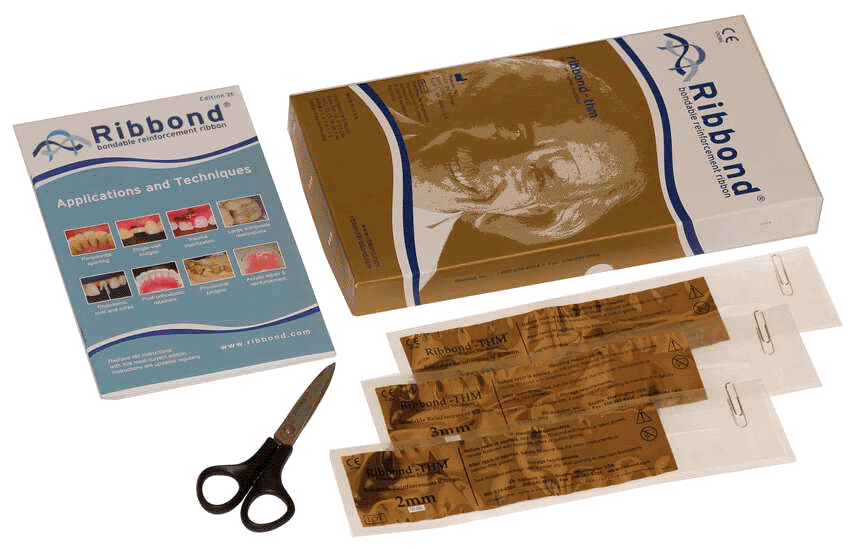
- Well-designed starter kits include all necessary accessories including special cutting scissors
Cons
- Requires special scissors to cut, adding to the initial kit cost and creating a workflow interruption if scissors are misplaced
- Modest learning curve for proper wetting, adapting, and lamination techniques, particularly for clinicians unfamiliar with fiber reinforcement
- Fiber-reinforced composite bridges are generally considered short- to medium-term restorations, with five-year survival rates of 73% to 93% depending on study conditions
- Ribbond does not polish well, requiring adequate composite coverage and careful finishing to avoid cutting into exposed fibers
- The manufacturer recommends specific unfilled bonding resins for wetting, and using the wrong type can compromise mechanical performance
- Available only to licensed dental professionals, which may create minor ordering logistics for smaller or newer practices
- Per-unit cost is higher than some glass fiber alternatives, though the per-case cost is competitive when factoring in the number of cases per kit
Ribbond is a bondable reinforcement ribbon made from ultra-high molecular weight polyethylene (UHMWPE) fibers, engineered to prevent fracture failures in dental composites and acrylics. Since its introduction in 1992, Ribbond has become the most widely referenced dental fiber reinforcement in published literature and clinical education. This review examines the product’s material science, clinical applications, available variants, and real-world performance data to help dental professionals decide whether Ribbond belongs in their restorative armamentarium.
Developed by Dr. David N. Rudo, Ribbond was created to fill a gap in restorative dentistry: the need for a reinforcement material that was simultaneously strong, bondable, easy to adapt, and capable of delivering predictable long-term clinical results. Over more than three decades, the product has evolved into a system that includes multiple thickness variants, dedicated instruments, and a growing evidence base spanning periodontics, prosthodontics, endodontics, orthodontics, and pediatric dentistry.
What Is Ribbond and How Does It Work?
Ribbond is a translucent, biocompatible fiber reinforcement ribbon designed to be embedded within composite resin or acrylic restorations. Understanding how it works requires a closer look at the material composition, the proprietary weave technology, and the surface treatment that makes it uniquely bondable to dental resins.
The fibers in Ribbond are composed of ultra-high molecular weight polyethylene, the same class of material used in bulletproof vests and in the construction of artificial hip and knee joints. These fibers have an elasticity coefficient of approximately 117 GPa and a tensile strength of about 3 GPa, giving them exceptional resistance to stretch, distortion, and impact loading. Published research indicates that Ribbond fibers exhibit an impact strength five times higher than that of iron. These mechanical properties make the material substantially tougher than fiberglass alternatives and resilient enough that specially manufactured scissors are required to cut the ribbon.
What distinguishes Ribbond from other fiber reinforcements is its patented cross-link lock-stitch leno weave. This construction reinforces multi-directionally, transferring functional forces throughout the fiber network without concentrating stress back into the surrounding resin. In practical terms, this means the restoration distributes occlusal and lateral forces more evenly, which reduces the likelihood of a catastrophic fracture at any single point. The leno weave also gives the ribbon outstanding manageability during clinical placement. Unlike loosely braided fibers or unidirectional bundles, Ribbond does not unravel, fray, or spring back when cut or shaped. It has virtually no memory, allowing clinicians to tuck the ribbon deep into interproximal contacts and closely adapt it to the contours of teeth and dental arches without the material rebounding away from the prepared surfaces.
Before packaging, Ribbond fibers undergo a proprietary cold gas-plasma treatment. This process reduces surface tension and enhances the chemical bond between the polyethylene fibers and the surrounding composite resin. Scanning electron microscopy (SEM) analysis at 110,000x magnification has demonstrated complete resin incorporation into Ribbond’s fibers with a notable absence of voids, confirming that the fibers become a fully integrated, load-bearing component of the finished restoration rather than a passive insert sitting within the resin matrix.
The resulting material is translucent, practically colorless, and disappears within the composite or acrylic once embedded. This translucency also allows light-cured composites to polymerize through the ribbon, simplifying layering techniques and reducing the risk of under-cured resin around the reinforcement. For clinicians accustomed to working with opaque metal reinforcements, the visual disappearance of Ribbond within the restoration represents a meaningful aesthetic advantage that patients will notice and appreciate.
Ribbond Product Variants: Ultra, THM, and Original
Ribbond is available in three product versions, each optimized for different clinical priorities. Selecting the right variant depends on whether the primary concern is minimal bulk, balanced performance, or maximum breaking strength. All three versions share the same UHMWPE fiber composition, gas-plasma bondability treatment, and patented leno weave construction.
Ribbond Ultra
Introduced in 2013, Ribbond Ultra is the thinnest fiber reinforcement ribbon in the product line at just 0.12 mm. It offers the highest flexural modulus and greater peak load capacity compared to both Ribbond THM and the Original. Because it lays flatter against tooth surfaces, it creates a thinner bond line and produces an exceptionally smooth final restoration that patients find comfortable. Ribbond Ultra is available in widths of 1 mm (orthodontic retainers), 2 mm, 3 mm, and 4 mm. For clinicians prioritizing minimal profile in periodontal splints, retainers, or directly bonded anterior bridges, this is the recommended choice. The ultra-thin profile also means less composite is needed to cover the ribbon, which reduces overall restoration bulk and improves tongue-side comfort for the patient.
Ribbond THM
Ribbond THM (Thinner, Higher Modulus) was introduced in 2001 and measures 0.18 mm in thickness. It strikes a practical balance between the ultra-thin profile of Ribbond Ultra and the greater bulk of the Original. The THM version creates a smoother tongue-side surface, covers more easily with composite, and shows less fiber visibility than the Original. It is available in widths of 1 mm, 2 mm, 3 mm, 4 mm, and 7 mm, making it the most versatile variant across splinting, bridge, endodontic, and acrylic applications. The 7 mm width is particularly useful for reinforcing removable prostheses and wider span bridges where broader fiber coverage is needed.
Original Ribbond
The Original Ribbond, introduced in 1991, is the thickest variant at 0.35 mm. It remains the preferred choice when maximum final breaking strength outweighs the need for a thin profile. Typical applications include long-span provisional bridges, composite bridges designed for extended service, and reinforcement of removable acrylic prostheses such as complete dentures and partial dentures. While the thicker profile requires more composite coverage and results in a slightly bulkier restoration, the trade-off is a higher ultimate breaking strength that can be critical in high-stress, load-bearing applications.
Clinical Applications of Ribbond in Dentistry
The versatility of Ribbond is one of its strongest selling points for dental practices. A single product can address clinical needs across periodontics, prosthodontics, orthodontics, endodontics, restorative dentistry, pediatric dentistry, and emergency trauma care. The sections below provide a detailed breakdown of each major application, including relevant clinical evidence and technique considerations.
Periodontal Splinting
Ribbond is perhaps best known for the fabrication of periodontal splints. For patients with teeth exhibiting mobility due to periodontal bone loss, a Ribbond splint stabilizes the affected teeth by bonding the ribbon to their lingual surfaces using standard composite bonding protocols.
The resulting splint is strong, highly bondable, and far more aesthetic than traditional metal wire splints. A Ribbond periodontal splint also takes less chair time, is less bulky, smoother to the tongue, and exceptionally failure resistant. The technique involves measuring the teeth with dental floss, cutting the Ribbond to length, preparing the lingual surfaces for bonding, wetting the Ribbond with unfilled bonding adhesive, and adapting the ribbon into the interproximal contacts one tooth at a time. An optional vinyl polysiloxane block-out can stabilize the teeth during construction and simplify cleanup.
For maxillary splints, the manufacturer recommends bonding the Ribbond into a small groove prepared on the facial surface. If desired, the splint can be buried in a channel cut at the level of interproximal contacts, which maximizes longevity, aesthetics, and comfort. A single starter kit containing three 22 cm lengths of 2 mm Ribbond provides enough material for approximately 18 to 20 canine-to-canine periodontal splints, representing strong per-case economy.
Single-Visit Fiber-Reinforced Composite Bridges
When a patient loses a single anterior tooth and needs an immediate aesthetic solution, Ribbond enables the construction of a directly bonded, chairside bridge completed in a single appointment without laboratory involvement. The Ribbond framework spans the abutment teeth and supports a composite pontic that replaces the missing tooth. This approach is commonly used as a long-term provisional while awaiting implant placement, or as a definitive restoration in cases where implant surgery is not feasible.
The bridge fabrication technique involves preparing the abutment teeth for bonding, placing a thin layer of composite, wetting the Ribbond with bonding resin, and spanning it from one abutment to the other. For long-term bridges, a second layer of Ribbond is placed in the pontic section of the framework. For provisional bridges, a single layer is typically sufficient.
Clinical evidence for this application is encouraging. Studies on polyethylene fiber-reinforced composite fixed partial dentures have reported functional survival rates of approximately 95% over 4.3 years in certain populations. Broader literature on fiber-reinforced composite bridges reports five-year survival rates ranging from approximately 73% to 93%, depending on study design, framework type, and patient factors. The most common complications are debonding and fracture, both of which are typically reparable rather than requiring complete replacement. This repairability is a significant practical advantage, because a debonded Ribbond bridge can often be re-bonded chairside rather than fabricated from scratch.
One starter kit provides enough Ribbond for roughly 25 to 30 single-pontic, three-unit bridges, making the per-case material cost very economical compared to laboratory-fabricated alternatives.
Fiber-Reinforced Composite Restorations
Incorporating Ribbond into direct composite restorations can significantly improve fracture resistance, particularly in posterior teeth with large MOD (mesial-occlusal-distal) cavity preparations. Published research has confirmed that Ribbond has a positive effect on the fracture strength of endodontically treated molar teeth with MOD preparations. The ribbon is placed at the base of the cavity before composite layering, creating an internally reinforced restoration that better resists the catastrophic fractures common in large direct restorations.
Ribbond also helps mitigate the harmful effects of C-factor in deep cavity preparations. The fiber reinforcement reduces polymerization shrinkage against the tooth walls, which can decrease gap formation, microleakage, and post-operative sensitivity. For practices that regularly manage heavily broken-down posterior teeth with direct composite rather than full-coverage crowns, Ribbond provides an additional safeguard against failure. A single kit yields material for 50 to 80 composite restorations.
This type of conservative restorative approach fits well into a comprehensive dental treatment plan for patients who need alternatives to more invasive indirect restorations. Rather than defaulting to a crown on every endodontically treated molar, the clinician can use Ribbond-reinforced composite as a first-line option in appropriately selected cases.
Orthodontic Retainers
Ribbond offers a 1 mm Orthodontic variant designed specifically for fixed lingual retainers. Using a technique similar to periodontal splinting, the clinician bonds the Ribbond into the interproximal contacts using composite resin. The finished retainer is nearly invisible, low in bulk, and aesthetically superior to traditional bonded metal wire retainers.
An important note for clinicians new to this approach: the Ribbond retainer is indicated for cases with half mobility or less and must be bonded into contacts, not used like a wire. Unlike a metal wire retainer that sits passively against the lingual surfaces, the Ribbond retainer derives its retention from intimate contact and bonding at each interproximal area. Clinicians should review the manufacturer’s technique guide before attempting their first case to avoid the most common placement errors.
The aesthetic advantage over metal retainers is substantial. Because the Ribbond disappears within the composite, patients see no metal when they look at their teeth, which is a common concern following orthodontic treatment. The retainer is also smoother and less likely to cause tongue irritation compared to twisted wire alternatives.
Trauma Stabilization
In dental emergencies involving avulsed or luxated teeth from sports injuries, falls, or accidents, Ribbond provides a rapid and effective method of stabilization. The resulting splint is thin, smooth, comfortable, and non-irritating to injured soft tissues, which is especially important when the patient’s lip or gingiva is already traumatized. The splint allows proper occlusal function during the healing period and can be placed in minutes with standard bonding protocols.
The technique involves gently repositioning the injured tooth, measuring the required Ribbond length with dental floss, preparing the adjacent teeth for bonding, and wetting the Ribbond with unfilled bonding adhesive before placement. The finished trauma splint should extend approximately three-quarters of the distance across the abutment teeth at the level of interproximal contacts. After light curing and finishing, the clinician should check occlusion and polish the composite, taking care not to cut into the Ribbond fibers.
Endodontic Post and Core Buildups
Ribbond fiber has emerged as a compelling alternative to traditional prefabricated fiber posts for the restoration of endodontically treated teeth. The Ribbond is adapted directly within the root canal space, wet with bonding resin, and then built up with composite core material. This approach is particularly useful in cases with non-standard canal morphology where prefabricated posts may not achieve an ideal fit.
Clinical studies report a 90.2% survival rate over 97 months (approximately eight years) for teeth restored with Ribbond fiber-reinforced post-and-core buildups. This is a strong long-term survival rate that compares favorably with traditional post systems.
Ribbond is particularly valuable in cases with flared root canals, where the C-factor in the dowel space can reach extremely high levels, potentially contributing to marginal leakage with prefabricated systems. In these situations, Ribbond functions as a shock absorber, preventing strain energy buildup and stress concentration that could lead to cracks or catastrophic failure. Because Ribbond adapts to internal canal morphology without requiring further enlargement, it preserves remaining dentin, a significant advantage over post systems that necessitate additional tooth structure removal. This conservation of tooth structure is a foundational principle in modern restorative dentistry and aligns with the broader trend toward minimally invasive approaches.
Acrylic and Bis-Acryl Provisional Bridges
In prosthodontic workflows, Ribbond can be embedded within acrylic or bis-acryl provisional bridges to prevent the midline fractures and connector failures that commonly plague long-span temporary restorations. Laboratories and chairside clinicians incorporate the ribbon during fabrication, creating a provisional that can withstand functional forces throughout extended treatment timelines for implant or fixed prosthodontic cases. The Original Ribbond (0.35 mm), with its higher ultimate breaking strength, is typically the preferred variant for this application. Ribbond bonds to both composite and acrylic, giving clinicians material flexibility based on their preferred provisional fabrication technique.
Pediatric Dentistry Applications
Ribbond has found growing use in pediatric dentistry, where versatility, aesthetics, and ease of use are especially important for treating young patients. Published case reports have documented successful applications including fixed space maintainers, fixed partial dentures for children with nursing bottle caries, endodontic posts, and splinting of traumatized teeth. The biocompatible and translucent nature of the material makes it well-suited for pediatric populations where both aesthetics and comfort directly influence treatment compliance. A key advantage over metal-based space maintainers is the ability to fabricate the appliance chairside in a single visit, reducing the number of appointments required for young patients who may have limited tolerance for extended dental treatment.
How to Use Ribbond: General Technique Principles
While each clinical application has its own specific protocol, several general technique principles apply across all Ribbond procedures. Following these guidelines helps ensure optimal mechanical performance and clinical longevity.
The first principle is proper isolation and surface preparation. The bonding surfaces must be clean, acid-etched, and coated with a thin layer of bonding adhesive before Ribbond placement. Standard composite bonding protocols apply, and any contamination of the prepared surface will compromise adhesion and long-term performance.
The second principle is correct wetting of the Ribbond. Before placement, the cut piece of Ribbond should be placed on a contaminant-free surface and wet with an unfilled bonding adhesive or composite sealant. The resin should be gently massaged into the fibers with an instrument, and excess should be blotted off. The manufacturer specifically recommends Cosmedent Complete Unfilled Resin (blue bottle only) and emphasizes that the red bottle should not be used with Ribbond. Using a filled adhesive can impair resin infiltration into the fiber network.
The third principle is close adaptation. Ribbond must be laminated closely against the tooth surfaces to achieve optimal strength. A fiber-reinforced composite is strong when the fiber is closely adapted but prone to cohesive failure when the fiber is not intimately contacting the underlying tooth structure. This is analogous to the well-established principle that a porcelain veneer gains its strength from close adaptation and bonding to the underlying tooth. Inaccurate fiber placement results in voids or excessive composite on the tensile side of the fibers, which creates weak points prone to fracturing.
The fourth principle involves finishing. After curing, excess composite should be removed and the restoration polished with composite-resin polishing paste. Clinicians should take care not to cut into the Ribbond fibers during finishing, because while exposed polyethylene fibers are biocompatible, the surface quality of the restoration will be compromised if the fibers are disrupted.
Ribbond vs. Other Dental Fiber Reinforcements
Several competing fiber reinforcement products are available on the market, including glass fiber systems such as everStick and EverX from GC Corporation. Understanding the key differences helps clinicians select the right material for each clinical situation.
Ribbond uses woven UHMWPE fibers in a patented leno weave, providing multi-directional reinforcement and excellent handling. Glass fiber systems often use pre-impregnated unidirectional fibers, which reinforce along only one axis. This directional limitation means that glass fiber systems provide maximum strength against forces perpendicular to the fiber orientation but offer less resistance to forces acting in other directions. Ribbond’s woven construction distributes forces more evenly regardless of the direction of loading.
In an in vitro comparison of fracture resistance in MOD-restored molars, one study found that EverStick glass fiber showed the highest fracture resistance, followed by FibraFill Dentin and Ribbond, though the differences between FibraFill, Ribbond, and EverStick were not statistically significant. Another comprehensive review noted that both polyethylene and glass fibers can effectively reduce microleakage and improve fracture performance, with each type offering distinct advantages depending on the clinical scenario. It is important to note that laboratory fracture testing under controlled axial loading does not fully replicate the complex, multi-directional force environment of the oral cavity, where Ribbond’s multi-directional reinforcement and superior manageability may confer additional practical advantages.
One clinically significant differentiator is biocompatibility in the event of accidental exposure. If Ribbond is cut with a rotary instrument during adjustment or removal, the resultant polyethylene particles pose no biocompatibility risk to the patient. Fiberglass particles can be irritating to soft tissues. Ribbond also holds a clear advantage in manageability, as its leno weave prevents fraying and provides virtually no memory, allowing accurate adaptation to tooth contours and dental arch anatomy.
Shelf Life and Storage Considerations
One often-overlooked advantage of Ribbond is its indefinite shelf life. Unlike many dental materials that expire within one to three years of purchase, Ribbond fibers do not degrade over time when stored in their sealed protective packaging. This eliminates the waste and cost associated with expired inventory, a particularly meaningful benefit for practices that use fiber reinforcement intermittently rather than daily. Clinicians can keep Ribbond in stock knowing that it will be ready for use whenever a case presents, whether that is the following week or three years later.
The product should be stored in a clean, dry environment away from contaminants. The Ribbond should only be removed from its protective plastic sleeve with cotton pliers, and care should be taken to avoid touching the fiber with gloved hands, because oils or contaminants can compromise the gas-plasma surface treatment and reduce bondability.
Bottom Line
Ribbond remains the benchmark dental fiber reinforcement for clinical practice. Its patented leno weave, gas-plasma treated UHMWPE fibers, and broad composite compatibility make it uniquely versatile across restorative, prosthodontic, periodontic, orthodontic, endodontic, and pediatric applications. The product line offers options for every clinical scenario, from the ultra-thin Ribbond Ultra for splints and retainers to the Original for heavy-duty provisional reinforcement.
While fiber-reinforced composite restorations are best understood as short- to medium-term solutions in certain applications, the ability to repair most common complications extends their effective service life considerably. Combined with an indefinite shelf life, low per-case cost, and a track record dating to 1992, Ribbond earns its place in any dental operatory focused on conservative, predictable, and aesthetic treatment outcomes.
Verdict
<p>Ribbond has earned consistently high marks from dental professionals who have evaluated it in clinical settings. In a published evaluation by <a target="_blank" rel="noopener noreferrer nofollow" class="text-primary underline hover:text-primary/80" href="https://www.dentalproductshopper.com/surgical-products/splints-accessories/ribbond-bondable-reinforcement-ribbon/evaluation"><u>Dental Product Shopper</u></a>, overall satisfaction was rated as excellent by the majority of evaluators, with the remainder rating it as very good or good. Ten out of eleven dentists indicated they would purchase the product, and all eleven said they would recommend it to colleagues. Evaluators described it as a unique and well-designed material with clear, easily understood instructions. One New York-based evaluator noted that the kit is the most complete of its kind and that having all necessary accessories in one box is a significant practical advantage.</p><p>From a clinical workflow perspective, the greatest strength of Ribbond is its genuine versatility paired with reliable handling. A single box can serve a practice across periodontal splinting, single-visit bridges, trauma stabilization, fiber-reinforced composites, and orthodontic retention. Few dental materials cover this breadth of application. The product’s indefinite shelf life eliminates waste from expired inventory, and the per-case cost is very reasonable given that a single starter kit yields 25 or more cases. The learning curve is modest for any clinician comfortable with standard composite bonding techniques, and the manufacturer’s instructional videos and technique guides are thorough and well-produced. For any practice that regularly encounters mobile teeth, missing anterior teeth, large composite restorations, or retention cases, Ribbond deserves strong consideration as a first-line fiber reinforcement material.</p>
Frequently Asked Questions
What is Ribbond made of?
Ribbond is made from ultra-high molecular weight polyethylene (UHMWPE) fibers that undergo a proprietary cold gas-plasma treatment to enhance bondability. The ribbon is constructed using a patented cross-link lock-stitch leno weave that provides multi-directional reinforcement and prevents unraveling during clinical manipulation.
What are the main clinical applications of Ribbond?
Ribbond is used for periodontal splinting, single-visit directly bonded composite bridges, fiber-reinforced composite restorations, fixed post-orthodontic retainers, trauma stabilization of avulsed or luxated teeth, endodontic post-and-core buildups, reinforcement of acrylic and bis-acryl provisional bridges, and various pediatric applications including fixed space maintainers.
How long does a Ribbond restoration last?
Longevity depends on the application, clinical technique, and patient factors. Published data report a 90.2% survival rate over 97 months for Ribbond-reinforced endodontic post-and-core buildups. For fiber-reinforced composite bridges, five-year survival rates of 73% to 93% have been reported. The Ribbond material itself has an indefinite shelf life in its sealed packaging.
Which Ribbond variant should a clinician choose?
Ribbond Ultra (0.12 mm) is best for periodontal splints, orthodontic retainers, directly bonded bridges, and composite restorations requiring minimal bulk. Ribbond THM (0.18 mm) is an excellent all-purpose fiber suitable for the same applications with slightly more body. Original Ribbond (0.35 mm) is recommended when maximum breaking strength is the priority, such as in provisional bridges and denture reinforcement.
Can Ribbond be used with any composite system?
Yes. Ribbond is compatible with any composite resin system. For wetting the ribbon before placement, the manufacturer recommends using an unfilled bonding adhesive or composite sealant. Specific product recommendations include Cosmedent Complete Unfilled Resin (blue bottle only). Using a filled adhesive can impair fiber infiltration and reduce the restoration’s mechanical performance.
Is Ribbond biocompatible?
Yes. Ribbond is made from the same UHMWPE used in artificial hip and knee joint construction, with an extensive biocompatibility track record. Unlike fiberglass reinforcements, if Ribbond is cut with a rotary instrument during adjustment or removal, the released polyethylene particles do not pose a biocompatibility risk to the patient.
Does Ribbond require special instruments?
Yes. Ribbond fibers are too tough to cut with standard clinical scissors. Every starter kit includes a pair of special, autoclavable stainless steel scissors designed specifically for cutting the ribbon. Replacement scissors are available for separate purchase from the manufacturer.
How does Ribbond compare to glass fiber reinforcements like EverStick?
Ribbond uses woven UHMWPE fibers in a patented leno weave, providing multi-directional reinforcement and superior handling. Glass fiber systems like EverStick often use unidirectional fibers that reinforce along a single axis. Some in vitro studies show comparable or slightly higher fracture resistance for glass fibers under specific loading conditions, but Ribbond’s multi-directional weave, handling characteristics, and biocompatibility profile are significant clinical advantages. For more on glass fiber composites, see the EverX review on Dental Reviewed.
How much material comes in a Ribbond starter kit?
Starter kits include three 22 cm lengths of Ribbond (66 cm total) along with the special cutting scissors. This yields approximately 25 to 30 single-pontic bridges, 18 to 20 canine-to-canine periodontal splints, or 50 to 80 composite restorations, depending on the application.
Where can dental professionals purchase Ribbond?
Ribbond is available through authorized dental supply distributors and directly from the manufacturer at store.ribbond.com. Federal law in the United States requires that purchasers be licensed dental professionals. The manufacturer can be reached at 800-624-4554 for ordering assistance.
Can Ribbond be removed or replaced?
Yes. If a Ribbond splint, retainer, or bridge needs to be removed, it can be sectioned with a rotary instrument. Because the material is polyethylene rather than fiberglass, the particles generated during removal are biologically inert and do not pose a risk to the patient. A new Ribbond restoration can then be placed using standard bonding protocols.
Does Ribbond have regulatory approval?
In the European Union, Ribbond is approved to be placed on or within enamel. In the United States, it is classified as a dental device available for professional use. Clinicians practicing outside these markets should verify the specific regulatory status in their jurisdiction.