Rating: 3.9/5
GC Fuji IX (GC Fuji 9) Review: Properties, Uses, and Clinical Data
GC Fuji IX, also called GC Fuji 9, is a self-curing glass ionomer cement. GC Corporation has sold it since 1995, backing more than 300 million restorations worldwide. This review...
Reviewed by Agnes Markovic
Pros
- True chemical bond to enamel and dentin eliminates separate etching and bonding steps
- Sustained, rechargeable fluoride release provides ongoing caries protection at the restoration margin
- Packable, non-sticky consistency offers intuitive, amalgam-like handling
- Can be bulk-filled in a single increment, even for larger preparations
- Self-curing mechanism removes the need for a light-curing unit
- Superior moisture tolerance compared to composite resin, ideal when perfect isolation is not achievable
- Tooth-like coefficient of thermal expansion helps maintain a stable marginal seal
- Radiopaque for clear visibility on dental radiographs
- Biocompatible and well tolerated, including in patients with metal sensitivities
- Extensive clinical evidence base spanning 300+ million restorations worldwide
- Three product variants (GP, GP FAST, GP EXTRA) address different workflow preferences
- Validated for ART procedures in community-based and resource-limited settings
- Cost-effective compared to composite resin systems, especially when no separate bonding agents are required
- Minimal postoperative sensitivity reported consistently across clinical evaluations
Cons
- Not recommended for high-stress-bearing restorations in permanent teeth due to lower fracture resistance compared to composite and amalgam
- Aesthetics are acceptable but inferior to composite resin, limiting suitability for visible anterior restorations
- Moisture sensitivity during the initial setting phase requires immediate application of a protective coating
- Limited shade range compared to composite resin systems, though GP EXTRA has expanded the options
- Material can feel sticky during the initial mixing phase, though handling improves as setting begins
- Applying protective coating twice during the procedure adds extra steps that some practitioners find time-consuming
- Achieving a high-gloss polish is more difficult compared to composite resin
- Working time and setting time are temperature-sensitive, with warmer environments shortening the available time
GC Fuji IX, also called GC Fuji 9, is a self-curing glass ionomer cement. GC Corporation has sold it since 1995, backing more than 300 million restorations worldwide. This review covers its properties, uses, fluoride release, and its role in a dental treatment plan.
TL;DR
GC Fuji IX (GC Fuji 9) bonds chemically to enamel and dentin, skipping etch and bond steps.
It releases fluoride continuously and recharges from toothpaste and professional fluoride treatments.
Dentists reach for it most in pediatric fillings, root surface caries, and ART restorations.
Composite resin still wins on looks and load-bearing strength in permanent posterior teeth.
What Is GC Fuji IX?
GC Fuji IX GP stands for Glass Polyalkenoate. GC Corporation in Tokyo makes this self-curing, radiopaque, packable glass ionomer cement. It holds FDA 510(k) clearance under K951555 and sits under GMDN code 16704.
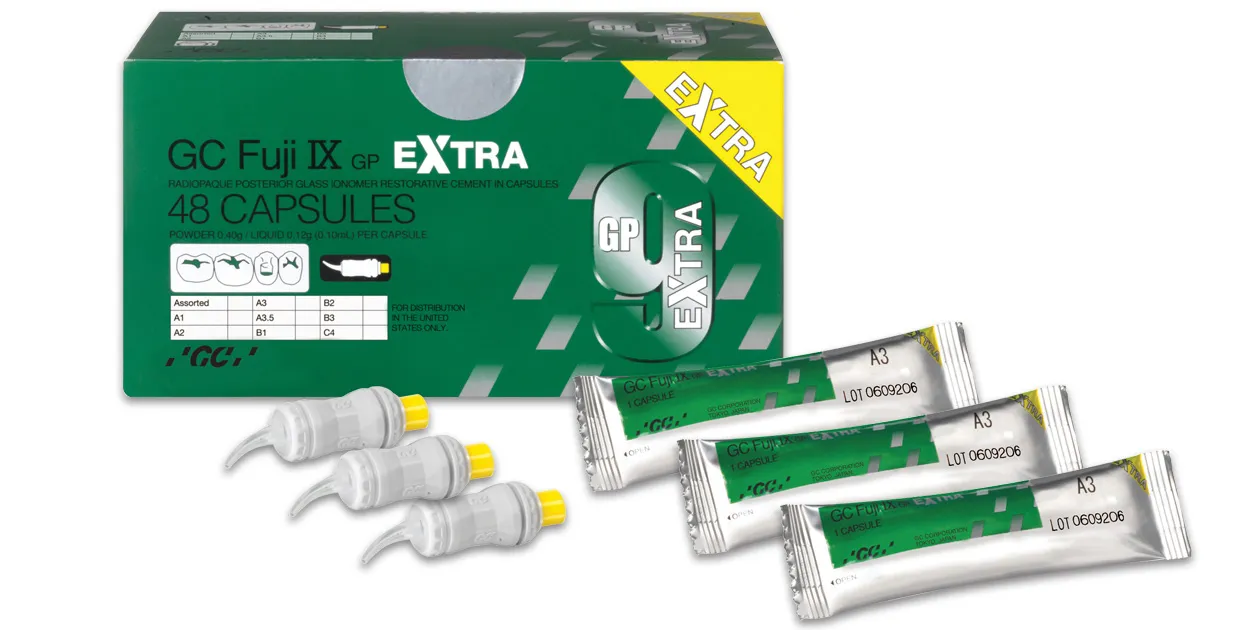
Composite resins bond through etching and adhesive layers. GC Fuji IX instead forms a true chemical bond with enamel and dentin through ion exchange. Polyalkenoic acid in the liquid reacts with calcium and phosphate ions at the tooth surface, forming a durable, bacteria-resistant seal. This removes the need for separate etch and bond steps and simplifies the workflow. GC Fuji IX ships in hand-mix powder and liquid kits, pre-dosed capsules, and mini packs. Shades follow the Vita guide and include A1, A2, A3, A3.5, B2, B3, and C4.
Wilson and Kent first described glass ionomer cements in 1972. Early versions had poor handling, low strength, and heavy moisture sensitivity. GC Fuji IX addressed those problems with a refined powder-to-liquid ratio and finer glass filler particles. The result is a dense, condensable material that handles much like amalgam. GC Corporation also makes other restoratives worth knowing, including the fiber-reinforced EverX composite.
Technical Specifications and Physical Properties
Understanding the mechanical benchmarks of GC Fuji IX helps practitioners make evidence-based decisions about where this material fits within their restorative protocol. The table below summarizes the key properties as reported by GC Corporation and independent laboratory studies.
Property | GC Fuji IX GP / GP FAST |
Compressive strength (24 hr) | 220 MPa (GP) / 268 MPa (GP FAST) |
Diametral tensile strength (24 hr) | 22 MPa / 23 MPa |
Adhesion to enamel (bovine) | 5.9 MPa / 6.9 MPa |
Adhesion to dentin (bovine) | 4.4 MPa / 5.8 MPa |
Solubility in water | 0.02% |
Solubility in lactic acid | 0.21% |
Surface hardness (Vickers) | 74 HV |
Working time (at 23°C) | 2 min (GP) / 1 min 15 sec (GP FAST) |
Finishing time from start of mix | 6 min (GP) / 3 min (GP FAST) |
Radiopacity | Yes |
Powder/liquid ratio (hand-mix) | 0.35 g / 0.10 g |
Storage temperature | 4–25°C (39–77°F) |
Shelf life | 3 years from date of manufacture |
The compressive strength of 220 MPa (GP) to 268 MPa (GP FAST) places GC Fuji IX well above most conventional glass ionomer cements. Independent research published in Dental Materials has confirmed that GC Fuji IX and Ketac Molar Easymix (3M) both achieve significantly higher early and late compressive strength values compared to other conventional glass ionomer products tested under the same conditions. A separate comparative study published in the Journal of Conservative Dentistry found no statistically significant difference in compressive strength between GC Fuji IX and EQUIA Forte, reinforcing the material’s competitive positioning within the high-viscosity glass ionomer category.
Wear resistance is another standout metric. GC Corporation reports that wear resistance is 60% higher than that of conventional glass ionomers. In laboratory wear testing published in the Journal of Clinical and Diagnostic Research, GC Fuji IX demonstrated the lowest material loss among the glass ionomer cements tested against dental ceramic antagonists, suggesting favorable long-term durability in posterior restorations. The low solubility values in both water (0.02%) and lactic acid (0.21%) further support the long-term stability of the restoration in the oral environment.
Key Features That Set GC Fuji IX Apart
Several core features distinguish GC Fuji IX from other restorative materials and from competing glass ionomer cements on the market. Each of these features contributes to the material’s clinical reliability and widespread adoption.
Chemical Bonding to Tooth Structure
GC Fuji IX forms an ionic bond with both enamel and dentin through a polyalkenoic acid–mediated ion exchange at the tooth surface. This eliminates the technique-sensitive etch-and-bond protocol required for composite resins, reduces the risk of postoperative sensitivity, and creates a tight marginal seal that has been shown to resist microleakage in both in vitro and in vivo studies. The chemical bond matures over time as ion exchange continues, meaning the interfacial adhesion actually improves in the weeks and months following placement.
Packable, Non-Sticky Consistency
The material was specifically designed to mimic the handling characteristics of amalgam. Its dough-like consistency can be condensed into the cavity, shaped with metal instruments, and bulk-filled in a single increment. The non-sticky formulation prevents the material from pulling away from cavity walls or adhering to instruments during placement, a frustration that plagued many earlier-generation glass ionomer formulations. For practitioners who routinely place amalgam restorations, the transition to GC Fuji IX requires minimal adjustment in technique.
Sustained, Rechargeable Fluoride Release
Fluoride release is one of the most studied properties of GC Fuji IX.
A study in the Dental Materials Journal compared GC Fuji IX, Fuji VII, Fuji IX Extra, Fuji II LC, Dyract Extra, and Beautifil. All four glass ionomer products released more fluoride than the compomer and giomer groups. Researchers measured release during week one and again on days 14 and 21, confirming release well past the first burst.
Research in Materials (MDPI) found that brushing with high-fluoride toothpaste and applying fluoride varnish both raised later fluoride release from GC Fuji IX. This confirms the material’s recharge mechanism. Patients who use a strong fluoride toothpaste and get regular professional treatments gain extra fluoride release at every GC Fuji IX site in the mouth.
A review in MDPI Dentistry Journal found glass ionomer materials release fluoride longer and in higher amounts than resin-based options, and acidic conditions raised ion diffusion further. Since the area around active decay is acidic, GC Fuji IX releases more fluoride right where it is needed most.
Thermal Compatibility With Natural Teeth
The coefficient of thermal expansion of GC Fuji IX closely matches that of natural tooth structure. This means the restoration expands and contracts at a similar rate to the surrounding tooth when exposed to temperature changes from hot and cold foods, helping maintain a stable marginal seal and reducing the risk of microleakage over time. Materials with a mismatched coefficient of thermal expansion can create gap formation at the tooth-restoration interface as cycles of expansion and contraction accumulate, leading to marginal breakdown and eventual secondary caries.
Radiopacity for Clinical Monitoring
GC Fuji IX is radiopaque, which means it appears clearly on dental radiographs. This allows practitioners to differentiate the restoration from underlying tooth structure and to detect secondary caries, marginal gaps, or restoration fractures during routine radiographic examinations. Radiopacity is an important practical feature that is sometimes absent in competing glass ionomer products.
Clinical Indications and Recommended Uses
GC Fuji IX carries a broad range of approved clinical indications that make it a versatile workhorse in general, pediatric, and geriatric dental practices. The following list reflects the manufacturer’s documented indications for use.
Class I and Class II restorations in deciduous teeth
Non-load-bearing Class I and Class II restorations in permanent teeth
Class V and root surface restorations, including cervical erosion and abfraction lesions
Core build-up material under crowns, onlays, and other indirect restorations
Base or liner material in the sandwich laminate technique (placed beneath composite resin)
Intermediate restorative material (IRM) for durable temporary restorations
Long-term temporary restorations when definitive treatment must be delayed
For indirect work that needs a permanent bond, see our review of resin cement options.
Pediatric Dentistry Applications
GC Fuji IX suits pediatric patients well. Children are often uncooperative, which makes moisture control hard.
Its moisture tolerance, self-adhesive bond, and fluoride release make it a strong pick when full isolation is not possible. GC Fuji IX has wide validation for the Atraumatic Restorative Treatment (ART) technique, a minimally invasive approach that removes carious dentin with hand instruments only.
A randomized trial in the Journal of the Indian Society of Pedodontics and Preventive Dentistry found GC Fuji IX ART restorations in primary molars held acceptable success rates over three years, supporting ART use in areas with high caries rates and limited dental access. For clinicians handling a pediatric cavity filling, GC Fuji IX offers a fast, low-stress option.
Geriatric Dentistry Applications
Root surface caries is one of the most prevalent dental problems in older adults, and it poses unique restorative challenges due to the location and morphology of these lesions. Many geriatric patients take medications that cause xerostomia (dry mouth), dramatically increasing caries risk across all tooth surfaces. The sustained fluoride release from GC Fuji IX provides ongoing protection at the restoration site, while the simplified, rapid placement technique helps minimize treatment time for patients who may have difficulty tolerating lengthy dental procedures. The material’s chemical bond to both enamel and dentin is particularly advantageous for root surface restorations, where the restorative surface is predominantly cementum and dentin rather than enamel.
The Sandwich Laminate Technique
The sandwich laminate technique places GC Fuji IX as a first layer against dentin, then adds a composite resin overlay on top for better looks and wear resistance.
This pairs the fluoride release and chemical bond of GC Fuji IX with the strength and shade-matching of composite resin. The result draws on strengths from both material classes.
Step-by-Step Application Technique
Achieving optimal clinical outcomes with GC Fuji IX depends on following proper technique. These steps reflect the manufacturer’s current instructions for use.
Cavity Preparation and Conditioning
Prepare the tooth using standard techniques. Extensive mechanical retention is not necessary because GC Fuji IX bonds chemically. Apply GC Cavity Conditioner (10% polyacrylic acid) for 10 seconds or GC Dentin Conditioner (20% polyacrylic acid) for 20 seconds to the prepared bonding surfaces. Rinse thoroughly with water and dry by gently blotting with a cotton pellet or a light air stream. Do not desiccate the tooth surface. The ideal prepared surface should appear moist and glistening, as overdrying can compromise the quality of the chemical bond. For pulp capping, use calcium hydroxide before proceeding with the glass ionomer placement.
Mixing and Placement
For capsule delivery, tap the capsule to loosen the powder, depress the plunger to break the internal seal, mix in an amalgamator for 10 seconds, insert into the capsule applier, click twice to prime, and begin dispensing within 10 seconds. For hand mixing, divide the powder into two equal portions, incorporate the first portion into all the liquid for 10 seconds, then add the remaining powder and mix for 15 to 20 seconds until a smooth, homogeneous consistency is achieved. Transfer the material into the preparation using a syringe or suitable instrument, taking care to avoid introducing air bubbles. Working time is 2 minutes from the start of mixing at 23°C (73.4°F). Higher ambient temperatures will shorten the available working time.
Finishing and Protection
When set, immediately apply GC Fuji Varnish (blow dry), GC Fuji Coat LC (light cure), or G-Coat Plus (do not air blow) to protect against moisture contamination and dehydration. Final finishing with water spray can begin 6 minutes after the start of mixing for GP, or 3 minutes for GP FAST. Apply a final coat of protective varnish or coating after finishing and polishing. Instruct the patient not to apply biting pressure for approximately one hour. The protective coating step is essential, as premature moisture exposure or dehydration during the initial maturation phase can compromise the physical properties of the set material.
Fluoride Release and Caries Protection
The anticariogenic properties of GC Fuji IX are among its most clinically valuable attributes, and the fluoride release profile has been extensively studied in the peer-reviewed literature.
A study published in the Dental Materials Journal (PMC) compared the fluoride release of GC Fuji IX, Fuji VII, Fuji IX Extra, Fuji II LC, Dyract Extra (compomer), and Beautifil (giomer). The results showed that all four glass ionomer products released significantly more fluoride than the compomer and giomer groups, with the glass ionomer matrix playing the dominant role in determining fluoride-releasing capacity. The study measured fluoride release during the first week and on days 14 and 21, confirming sustained release well beyond the initial burst phase.
Additional research published in Materials (MDPI) confirmed that brushing with higher-concentration fluoride toothpaste and applying fluoride varnish both enhanced subsequent fluoride release from GC Fuji IX specimens, validating the material’s fluoride recharge mechanism. This creates a dynamic fluoride reservoir at the restoration site that provides ongoing, renewable caries protection. The clinical implication is that patients who use fluoride toothpaste and receive regular professional fluoride treatments will benefit from enhanced fluoride release at every GC Fuji IX restoration site in their mouth.
A systematic review published in MDPI Dentistry Journal further confirmed that glass ionomer–based materials demonstrate more durable and higher fluoride release compared to resin-based alternatives, with acidic conditions enhancing ion diffusion. This is clinically relevant because the oral environment around an active caries lesion is acidic, meaning GC Fuji IX releases more fluoride exactly when and where it is most needed.
GC Fuji IX Product Family: GP vs. GP FAST vs. GP EXTRA
GC has developed three main variants of GC Fuji IX to address different clinical needs and workflow preferences. All three share the same core glass ionomer chemistry but differ in setting times, mechanical properties, and aesthetic qualities.
Feature | GP (Original) | GP FAST | GP EXTRA |
Working time | 2 min | 1 min 15 sec | 1 min 15 sec |
Finishing time | 6 min | 3 min | 2.5 min |
Compressive strength | 220 MPa | 268 MPa | Enhanced |
Translucency | Standard | Standard | Improved |
Fluoride release | High | High | Enhanced |
Shade B1 available | No | No | Yes |
The GP EXTRA variant represents the most significant evolution in the product line. According to a clinical evaluation published by The Dental Advisor, 29 consultants evaluated GC Fuji IX GP EXTRA in more than 450 restorations and awarded it a 93% clinical rating. Ninety percent of consultants indicated they would choose GP EXTRA over amalgam, composite, or compomer for pediatric and geriatric patients. The absence of postoperative sensitivity was the highest-rated clinical attribute across all evaluators.
The GP EXTRA formulation contains a next-generation glass filler that delivers improved translucency, enhanced fluoride release, greater reactivity, and a faster setting reaction compared to the GP and GP FAST variants. The improved optical properties enabled GC to introduce a lighter shade (B1), which is particularly useful for pediatric patients with lighter primary teeth and for adult patients who have undergone whitening procedures. Consultants noted that the increased translucency allowed them to use GP EXTRA in the anterior region with acceptable aesthetic results, expanding the clinical versatility of the product line.
How GC Fuji IX Compares to Competing Glass Ionomers
GC Fuji IX competes directly with other high-viscosity glass ionomer restoratives on the market. Understanding how they compare helps practitioners select the right product for each clinical scenario. For a broader look at how restorative materials fit into practice decisions, the equipment reviews section on Dental Reviewed covers evaluations of related clinical tools and systems.
Criterion | GC Fuji IX | Ketac Molar (3M) | Riva Self Cure (SDI) | ChemFil Rock (Dentsply) |
Compressive strength | 220–268 MPa | Comparable | Comparable | High |
Wear resistance | Excellent | Good | Good | Good |
Fluoride release | High, rechargeable | Moderate | Moderate | Moderate |
ART validation | Extensive | Yes | Yes | Limited |
Track record | 300M+ restorations | Well established | Growing | Established |
A comparative study published in the South African Dental Journal tested GC Fuji IX alongside Riva Self Cure, Ketac Universal, and Ketac Molar Easymix in both hand-mix and capsule formats. The study confirmed that all four products had similar compressive strength and surface hardness profiles according to manufacturer data, while also noting that capsule-mixed versions tended to produce more consistent results due to standardized powder-to-liquid ratios.
GC Fuji IX holds a clear lead in clinical track record. More than 300 million restorations and hundreds of published studies back it over three decades. Practitioners weighing options across material classes can also review general guidance on how to choose dental materials. For deep, pulp-adjacent cases, some clinicians reach instead for Biodentine, a bioactive dentin substitute.
Clinical Evidence and Long-Term Performance
The published evidence supporting GC Fuji IX spans laboratory studies, randomized clinical trials, and retrospective analyses conducted over three decades. The following highlights summarize the most clinically relevant findings.
A retrospective, practice-based clinical evaluation published in the British Dental Journal examined GC Fuji IX restorations that had been in service for more than five years in load-bearing cavities, providing real-world performance data under normal clinical conditions. The study offered valuable evidence that GC Fuji IX can deliver durable service even in posterior situations, although the material is officially recommended for non-load-bearing areas in permanent teeth.
In randomized clinical trials comparing GC Fuji IX with GC Fuji II LC (a resin-modified glass ionomer), a study published on ResearchGate concluded that both Type IX and Type II glass ionomer cements demonstrated exceptional clinical efficacy and longevity, with no statistically significant differences in performance between the two formulations. This finding is clinically significant because it suggests that the simpler, self-curing GC Fuji IX can achieve outcomes comparable to the light-cured, resin-modified GC Fuji II LC, while offering a less technique-sensitive placement protocol.
Microleakage research from the Journal of Indian Society of Pedodontics and Preventive Dentistry compared the marginal seal of GC Fuji IX GP, GC Fuji VII, and Dyract in both deciduous and permanent teeth. The study confirmed that GC Fuji IX provides a reliable marginal seal, with the material’s chemical bonding mechanism and thermal expansion compatibility contributing to favorable performance. The authors noted that GC Fuji IX contains fluoride, adheres to tooth structure without requiring an additional bonding system, has adequate strength, and can be finished and polished in a single visit.
A compressive strength study published in PMC (National Library of Medicine) compared GC Fuji IX GP Fast with GC Fuji II LC and found no significant differences in compressive strength between the self-curing and light-curing materials, suggesting that the manufacturer’s specific chemical composition had a greater influence on mechanical performance than the polymerization mechanism itself.
Bottom Line
GC Fuji IX remains one of the most dependable glass ionomer restorative cements available to dental professionals. Over three decades of clinical service, it has consistently delivered predictable results across a wide range of indications. Its combination of self-adhesion, sustained fluoride release, packable handling, and extensive clinical validation makes it a material that belongs in every restorative-focused dental practice.
The material excels in pediatric and geriatric applications, root surface restorations, ART procedures, and any clinical situation where moisture control is challenging. It is not intended to replace composite resin in high-stress posterior restorations or in anterior zones demanding premium aesthetics, and practitioners should respect those boundaries. When used within its recommended indications, GC Fuji IX delivers a level of clinical reliability that few materials in its category can match.
The evolution from GP to GP FAST to GP EXTRA demonstrates GC Corporation’s ongoing commitment to improving the product in response to practitioner feedback. The GP EXTRA variant, with its faster set, enhanced translucency, and improved fluoride release, represents a meaningful step forward. With a 93% clinical rating from The Dental Advisor and endorsement from 90% of consultants who would choose it over amalgam, composite, or compomer for pediatric and geriatric cases, GC Fuji IX has clearly earned its position as the gold standard in glass ionomer restorative dentistry.
Verdict
<p>GC Fuji IX has earned its reputation as a dependable, evidence-backed glass ionomer restorative over three decades of clinical service. For pediatric restorations, geriatric root surface caries, ART procedures, and any case where moisture control is a challenge, this material delivers predictable results with minimal technique sensitivity. The chemical bond to tooth structure, sustained fluoride release, and packable handling make daily use straightforward and efficient.</p><p>Practitioners should recognize that GC Fuji IX is not a universal posterior restorative. It does not match composite resin in aesthetics or tensile strength, and it should not be the first choice for high-stress-bearing restorations in permanent teeth. Within its recommended indications, however, few glass ionomers on the market offer the same combination of clinical reliability, published evidence, and global track record. The GP EXTRA variant, with its faster set and improved translucency, makes the product line even more attractive for practices looking to streamline chair time without sacrificing quality.</p><p>For dental professionals who have not revisited GC Fuji IX recently, the current product family is worth a fresh look. A 93% clinical rating from The Dental Advisor and endorsement from 90% of evaluating consultants confirm that this material continues to perform at the level its reputation suggests.</p>
Frequently Asked Questions
What is GC Fuji IX used for in dentistry?
GC Fuji IX is a self-curing glass ionomer restorative cement used for Class I and Class II restorations in primary teeth, non-load-bearing Class I and Class II restorations in permanent teeth, Class V and root surface restorations, core build-ups, base or liner applications in the sandwich technique, intermediate restorative material, and long-term temporary restorations.
Does GC Fuji IX require etching and bonding?
No. GC Fuji IX chemically bonds to both enamel and dentin through an ion-exchange mechanism. The manufacturer recommends applying GC Cavity Conditioner or GC Dentin Conditioner before placement to clean the surface and optimize bonding, but this is a simple conditioning step rather than a traditional acid etch and bond protocol.
Can GC Fuji IX be used in load-bearing posterior restorations?
GC Fuji IX is recommended for non-load-bearing areas in permanent teeth. In deciduous teeth, it can be used in all posterior restorations regardless of loading. For heavily loaded posterior restorations in permanent teeth, composite resin or amalgam remains the preferred choice.
What is the difference between GC Fuji IX GP, GP FAST, and GP EXTRA?
All three variants share the same core glass ionomer chemistry. GP is the original with a 6-minute finishing time. GP FAST reduces finishing to 3 minutes and achieves a higher compressive strength of 268 MPa. GP EXTRA is the fastest-setting version at 2.5 minutes, with improved translucency, enhanced fluoride release, and an expanded shade range including B1.
How long do GC Fuji IX restorations last?
Longevity depends on restoration size, location, patient oral hygiene, dietary habits, and occlusal forces. Clinical studies have demonstrated successful outcomes over several years. A retrospective evaluation published in the British Dental Journal examined restorations in service for more than five years. For optimal longevity, proper placement technique, appropriate protective coating, and patient compliance are essential.
Is GC Fuji IX suitable for the ART technique?
Yes. GC Fuji IX has been extensively validated for use in the Atraumatic Restorative Treatment technique. Its self-adhesive properties, moisture tolerance, fluoride release, and packable consistency make it well suited for this minimally invasive approach. Multiple randomized clinical trials have demonstrated acceptable success rates in primary molars over three or more years.
What protective coating should be applied after placing GC Fuji IX?
The manufacturer recommends GC Fuji Varnish (blow dry), GC Fuji Coat LC (light cure), or G-Coat Plus (do not air blow) immediately after placement and again after finishing and polishing. This prevents moisture contamination and dehydration during the critical early maturation phase of the setting reaction.
How does GC Fuji IX compare to composite resin?
GC Fuji IX offers simpler placement (no etch, bond, or light curing required), greater moisture tolerance, sustained fluoride release, and chemical bonding to tooth structure. Composite resin offers superior aesthetics, higher tensile and fracture strength, and better performance in high-stress-bearing areas. The two materials are complementary and are often used together in the sandwich laminate technique.
Is GC Fuji IX safe for patients with metal allergies?
Yes. GC Fuji IX is a metal-free, biocompatible material. It does not contain mercury, silver, or other metals found in amalgam and is suitable for patients who prefer or require non-metallic restorative options.
How should GC Fuji IX be stored?
Store at 4–25°C (39–77°F). Do not shake or invert the liquid bottle. Hold the bottle vertically during dispensing and squeeze gently. Close bottles tightly after use. Capsules should remain in their individual foil envelopes in a cool, dark place. Shelf life is 3 years from the date of manufacture.
Is GC Fuji IX the same as GC Fuji 9?
Yes. GC Fuji 9 is simply how people search for or type GC Fuji IX, using the number 9 instead of the Roman numeral IX. Both terms point to the same GC Corporation product.