Rating: 3.8/5
Septodont OraVerse Review
Few post-operative experiences frustrate dental patients as reliably as the two to five hours of residual numbness that follow a routine restoration or a periodontal maintenance...
Reviewed by Mantas Petraitis
Pros
- First and only dedicated dental anesthesia reversal agent, a category-defining, evidence-backed solution to a long-standing patient complaint.
- Roughly halves soft-tissue numbness time, with controlled trials showing median recovery of normal lip sensation and function accelerated by about 50% to 62%.
- Familiar format and technique, using a standard 1.7 mL dental cartridge and the same injection sites and technique, with essentially no learning curve and no capital equipment.
- Simple, intuitive dosing, with a one-to-one cartridge match to the local anesthetic given, easy to teach and hard to get wrong.
- Does not disturb the anesthesia already relied on, since it is given only at the end of treatment and does not meaningfully alter lidocaine or epinephrine pharmacokinetics.
- Favorable, mostly mild safety profile, with injection-site pain the most common event and core-trial events largely mild and resolved within 48 hours.
- Strong safety value in vulnerable groups, particularly for reducing self-injury risk in eligible children, special-needs patients, and the elderly.
- Practice differentiation, since it can enhance patient experience, satisfaction, and word-of-mouth.
Cons
- Requires a second injection, which some patients dislike even when brief.
- Adds cost, so the product cost and any added patient charge must be justified against a comfort benefit rather than a clinical necessity.
- Not instantaneous, since it accelerates recovery without eliminating numbness immediately, which makes expectation-setting essential.
- Cardiovascular caution is warranted, given the potential for tachycardia and arrhythmia with an alpha-adrenergic blocker.
- Pediatric limits apply, with the agent not recommended under 6 years of age or under 15 kg and dosing weight-capped where used.
- Soft-tissue only, since it reverses lip and tongue anesthesia rather than pulpal anesthesia, so it is purely a post-procedure comfort measure.
- Elective rather than essential, so many practices reasonably choose not to stock it.
- Best avoided when post-op pain is expected, which makes it a poor choice for procedures likely to be painful once sensation returns.
Few post-operative experiences frustrate dental patients as reliably as the two to five hours of residual numbness that follow a routine restoration or a periodontal maintenance visit. The tooth work is finished, the patient feels fine, yet the lip and tongue remain frozen. That lingering numbness produces slurred speech, difficulty eating and drinking, a drooping smile, drooling, and, in children and special-needs patients, a real risk of accidental soft-tissue trauma. For decades, this residual soft-tissue anesthesia was accepted as the unavoidable tail end of every anesthetic appointment.
Septodont OraVerse was designed to change that. Marketed as the first and only pharmacological local anesthesia reversal agent developed specifically for dentistry, OraVerse (the branded formulation of phentolamine mesylate) accelerates the return to normal sensation and function after procedures that used a local anesthetic containing a vasoconstrictor. In practical terms, it aims to cut the still-numb window roughly in half.
This review is written for dental professionals, general dentists, periodontists, pediatric dentists, hygienists, and practice owners, who want a straight, evidence-based read on what OraVerse does, how it is dosed and administered, what the clinical trials showed, where the safety boundaries sit, and whether it earns a place in the operatory. The sections below cover the mechanism, the data, the practicalities, a candid pros-and-cons breakdown, a practitioner verdict, and a detailed FAQ.
What Is Septodont OraVerse?
OraVerse is an injectable local anesthesia reversal agent whose active ingredient is phentolamine mesylate, a non-selective alpha-adrenergic antagonist. Understanding what it targets, and what it deliberately leaves alone, is the starting point for any evaluation.
The product is supplied and distributed by Septodont, a company already familiar to most clinicians through its dental local anesthetics and endodontic products. OraVerse received U.S. Food and Drug Administration approval in 2008, originally developed and launched by Novalar Pharmaceuticals before the brand moved under the Septodont umbrella, making it the first agent indicated specifically to reverse the soft-tissue effects of dental local anesthesia.
The key conceptual point for any clinician is that OraVerse does not affect the pulpal anesthesia relied on to complete a procedure. It is administered after treatment, once profound anesthesia of the teeth and hard tissues is no longer needed. Its target is the residual numbness of the lip, tongue, and associated soft tissues, the part of the anesthetic experience the patient neither wants nor benefits from once the appointment ends.
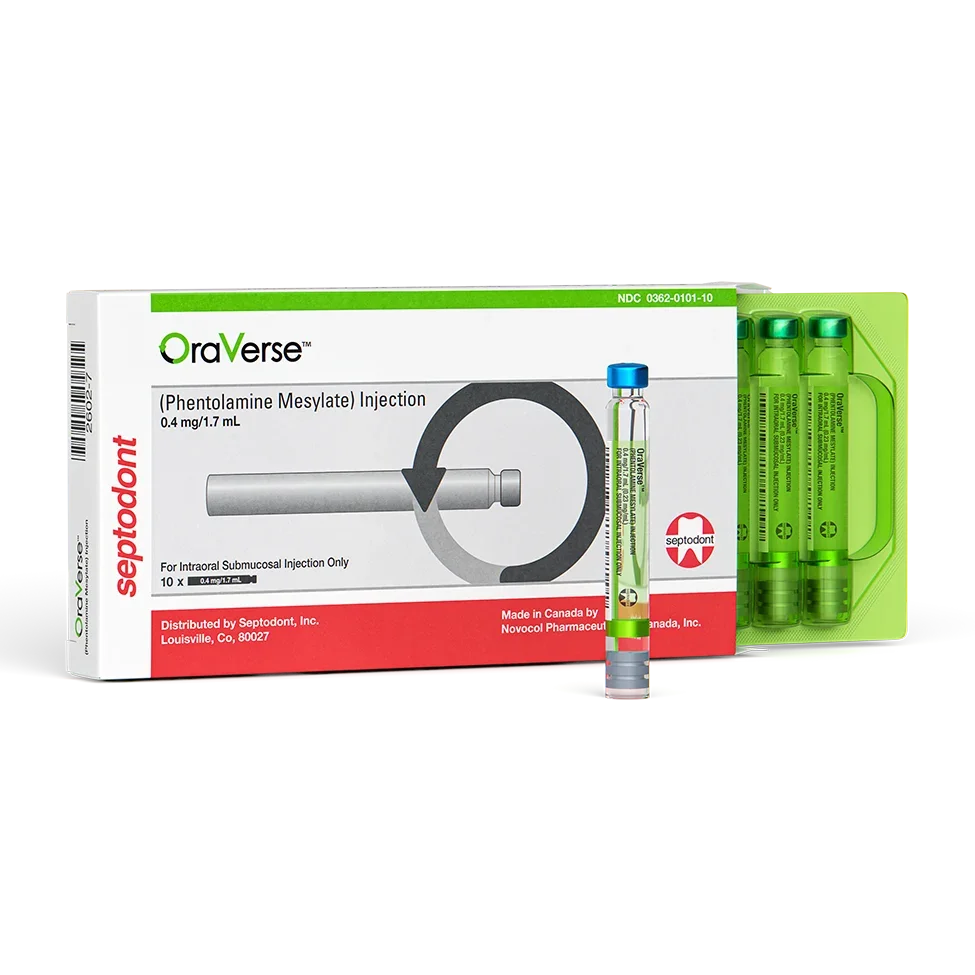
Each OraVerse dose comes in a standard 1.7 mL dental cartridge containing 0.4 mg of phentolamine mesylate, delivered as a clear, colorless, sterile, preservative-free, isotonic solution. Because it uses the same cartridge format and injection technique as everyday local anesthetics, there is essentially no new hardware or unfamiliar workflow to learn, a significant part of its practical appeal.
The Clinical Problem OraVerse Addresses
To appreciate the product, it helps to name the problem precisely. When a dentist administers a local anesthetic such as lidocaine, articaine, mepivacaine, or prilocaine, typically formulated with epinephrine as a vasoconstrictor, the vasoconstrictor deliberately restricts local blood flow. During restorative and periodontal work, that reduced blood flow prolongs anesthetic contact with the nerve, deepens the block, and lowers systemic uptake, which is exactly what is wanted during the procedure.
The downside is that the same reduced blood flow slows clearance of the anesthetic once the procedure is done. The result is prolonged soft-tissue anesthesia that commonly outlasts the clinical need by two to five hours. During that window, patients experience:
Functional deficits, including difficulty speaking clearly, eating, and drinking, plus drooling and an asymmetric or drooping smile.
Perceptual distress, meaning the unsettling sensation of a numb, foreign-feeling lip and tongue, which many patients dislike more than the injection itself.
Safety risk, such as accidental biting, chewing, or thermal injury to anesthetized lips, cheeks, and tongue, a particular concern in pediatric patients, patients with cognitive or physical disabilities, and the elderly.
Scheduling and social friction, affecting patients who cannot return to work presentations, meetings, meals, or normal speech immediately after an appointment.
OraVerse targets precisely this interval. Reversing the vasoconstriction that traps the anesthetic in the tissue speeds the body’s own clearance and shortens the numb tail.
How OraVerse Works
The mechanism is elegant in its simplicity, and it explains both the efficacy and the safety cautions discussed later. Two elements matter for the clinician, the pharmacologic action itself and the way that action interacts with the anesthetic already placed.
Mechanism Of Action
Phentolamine mesylate produces a competitive, relatively short-duration alpha-adrenergic blockade. Injected into vascular smooth muscle, that blockade counteracts the epinephrine-driven vasoconstriction produced by the local anesthetic formulation, resulting in local vasodilation. According to the FDA prescribing information, animal data showed that OraVerse increased blood flow in the submucosal tissue of the dog after an intraoral injection of 2% lidocaine with 1:100,000 epinephrine.
With the blood vessels reopened, local blood flow at the injection site increases, and greater blood flow means faster redistribution and systemic removal of the residual anesthetic, which in turn shortens the duration of soft-tissue numbness. Phentolamine reaches peak plasma concentrations roughly 10 to 20 minutes after submucosal injection, consistent with the rapid onset of its reversal effect.
Effect On Anesthetic Pharmacokinetics
A reasonable clinical concern is whether reversing the vasoconstriction disturbs the pharmacokinetics of the anesthetic that was just relied on. The data are reassuring on this point.
OraVerse is intended to reverse soft-tissue anesthesia produced by any local anesthetic that contains a vasoconstrictor. In the pivotal trials, four leading anesthetics with vasoconstrictors were used, and in real-world practice studies lidocaine with epinephrine and articaine with epinephrine were the most common. Pharmacokinetic study data indicated that OraVerse administration did not meaningfully alter the AUC and Cmax of lidocaine and did not affect the pharmacokinetics of epinephrine. The agent accelerates clearance without producing an anesthetic cliff that would be clinically problematic. Full pharmacology detail is available through DailyMed.
Composition, Presentation, And Storage
OraVerse is packaged in a format designed to slot seamlessly into an existing dental setup, which keeps adoption simple and inexpensive. The composition and the storage requirements are summarized below.
Active ingredient: phentolamine mesylate, 0.4 mg per 1.7 mL cartridge.
Solution characteristics: clear, colorless, sterile, non-pyrogenic, isotonic, and preservative-free.
Presentation: standard glass dental cartridges, supplied in cartons, commonly a 10-cartridge blister pack with each cartridge individually compartmentalized, with larger cartons also available.
Delivery: administered with the same aspirating syringe, needle, and technique used for the original local anesthetic.
Storage and handling points worth reinforcing with staff include the following:
Store at controlled room temperature, 20–25 °C (68–77 °F), with brief excursions permitted between 15–30 °C (59–86 °F).
Protect from direct heat and light, and do not allow the product to freeze.
Disinfect the cartridge cap before use by wiping with 91% isopropyl alcohol or 70% ethyl alcohol, avoiding denatured alcohols that can damage the rubber components.
Inspect every cartridge before use, and do not administer if there is particulate matter, discoloration, cracked glass, protruding plungers, or any other visible defect.
Because the format matches a standard carpule, there is no additional device cost, no capital equipment, and no separate disposal stream beyond the normal sharps protocol.
Indications And Approved Use
OraVerse is indicated for the reversal of soft-tissue anesthesia, that is, anesthesia of the lip and tongue, and the associated functional deficits that result from an intraoral submucosal injection of a local anesthetic containing a vasoconstrictor. It is indicated to accelerate the return to normal sensation and function following restorative and periodontal maintenance procedures.
Several boundaries of the indication deserve emphasis, because they define appropriate case selection:
It reverses soft-tissue anesthesia while leaving pulpal anesthesia unaffected. The reversal of local anesthetic effects on the teeth, mandible, and maxilla was not assessed in the pivotal studies, so OraVerse should be given only once profound pulpal anesthesia is no longer required, essentially at the very end of the appointment.
It requires a vasoconstrictor to have been used. The mechanism depends on reversing vasoconstriction, so the agent is intended for anesthetics formulated with a vasoconstrictor such as epinephrine.
Age and weight limits apply. The original FDA indication covers patients aged 3 years and older, while updated labeling language has, in places, advised against use in children under 6 years of age or weighing less than 15 kg (33 lbs). Clinicians should always follow the current prescribing information for their market.
Dosing And Administration
One of the most clinician-friendly features of OraVerse is that dosing is straightforward and pegged directly to the amount of local anesthetic administered. The recommended dose is based on the number of cartridges of local anesthetic with vasoconstrictor that were given, using a simple one-to-one cartridge ratio in adults and adolescents.
Local anesthetic administered | Recommended OraVerse dose |
Half a cartridge | Half a cartridge (0.2 mg) |
One cartridge | One cartridge (0.4 mg) |
Two cartridges | Two cartridges (0.8 mg) |
Administration Principles
The delivery of OraVerse mirrors ordinary local anesthetic technique, which is why staff training is quick. A few principles keep administration consistent across a team.
Give OraVerse at the end of the dental procedure, when there is no longer any need for pulpal or gingival anesthesia.
Administer using the same location or locations and the same technique, infiltration or block injection, that were used for the original local anesthetic.
Follow standard aspiration and injection protocol, since the technique is identical to placing local anesthetic.
Pediatric Dosing Considerations
Children are among the patients most likely to benefit, and also the group where dosing caps matter most. The OraVerse dosage guidance sets clear pediatric limits.
In pediatric patients weighing 15–30 kg, the maximum recommended dose is half a cartridge (0.2 mg).
A dose greater than one cartridge (0.4 mg) has not been studied in children under 4 years of age.
OraVerse is not recommended for the youngest and smallest children, with updated labeling advising against use under 6 years of age or under 15 kg. Confirm the threshold against the current label.
Clinical Evidence And Efficacy
The approval and marketing of OraVerse rest on a coherent body of controlled clinical evidence. The core efficacy claim, bringing patients back to normal roughly twice as fast, is supported by multicenter, double-blinded, randomized, controlled trials that used a sham injection as the control. The published safety and efficacy summary details the results across adult, adolescent, and pediatric groups.
Adult And Adolescent Trials
Two Phase 3 studies enrolled a combined 484 adolescents and adults undergoing restorative or periodontal maintenance procedures after receiving one of four leading vasoconstrictor-containing anesthetics. The primary endpoint was time to normal lip sensation, measured by patient-reported responses to lip palpation, with secondary endpoints covering perceived and observed function, sensation, and appearance. The reported results were consistent and clinically meaningful.
Upper lip median time to recovery of normal sensation was about 50 minutes with OraVerse versus roughly 133 minutes for control, a reduction of about 82.5 minutes, near 62%.
Lower lip median recovery was about 70 minutes versus roughly 155 minutes for control, a reduction of about 85 minutes, near 55%.
Tongue sensation median recovery was reduced by roughly 65 minutes, near 52%.
Normal function after mandibular procedures recovered about 60 minutes sooner, near a 50% reduction, and after maxillary procedures about 45 minutes sooner, near 43%.
Pediatric Trial
A Phase 2 pediatric study enrolled 152 patients aged 4–11 who received 2% lidocaine with 1:100,000 epinephrine, dosed at a one-to-one cartridge ratio and weight-capped. Among the 115 children aged 6–11 who were trainable in the lip-palpation assessment method, for mandibular and maxillary procedures combined, the median time to normal lip sensation was reduced by about 75 minutes, near 56%, roughly 60 minutes with OraVerse versus 135 minutes for control. In this trial, OraVerse showed no effect on adverse events, pain, post-treatment analgesic use, vital signs, or oral cavity measures relative to control.
Real-World Practice Data
Beyond the registration trials, an in-practice evaluation captured data from 51 dentists reporting on roughly 390 patients aged 4 to 90, across nearly 400 procedures split between mandible and maxilla. Median times to return to normal after injection were on the order of 60 minutes for lip sensation, about 57.5 minutes for tongue sensation, and about 60 minutes for oral function, with an injection-site adverse reaction reported in about 4.9% of patients. Practitioner feedback in published evaluations indicated that a majority felt the product addressed a real patient need and met expectations, and a meaningful share viewed it as a practice differentiator.
The efficacy signal is consistent across sites, endpoints, and age groups. OraVerse reliably shortens the soft-tissue numbness window, typically halving it. The magnitude, recovering an hour or more of normal function and sensation, is clinically and experientially significant for patients, even though the effect is not instantaneous. Expectations should be set accordingly, since OraVerse accelerates recovery rather than switching numbness off at once.
Safety Profile And Contraindications
Phentolamine has a long clinical history in non-dental settings, and at the low intraoral doses used in OraVerse its safety profile in dentistry has been favorable. The adverse-reaction pattern, the warnings, and the contraindications are outlined below.
Adverse Reactions
The most common adverse reaction attributable to OraVerse, at an incidence of 5% or greater and above control, is injection-site pain. In clinical trials, the most frequently reported adverse events for OraVerse versus control were broadly comparable, including post-procedural pain at about 6% versus 6%, injection-site pain at about 5% versus 4%, tachycardia at about 5% versus 6%, bradycardia at about 2% versus 0.3%, and headache at about 3% versus 4%. The majority of adverse reactions in the pivotal program were mild and resolved within 48 hours, with no serious adverse reactions and no discontinuations attributable to adverse events reported in the core trials.
Warnings And Cardiovascular Precautions
The most clinically important caution relates to the cardiovascular system. Because phentolamine is an alpha-adrenergic blocker, tachycardia and cardiac arrhythmias may occur with its use, as with other agents in the class. Following parenteral use of phentolamine in non-dental indications, myocardial infarction and cerebrovascular spasm and occlusion have been reported, usually in association with marked hypotensive, shock-like states. Although such events are uncommon with OraVerse at dental doses, clinicians should remain alert to signs and symptoms of tachycardia and arrhythmia, particularly in patients with a history of cardiovascular disease.
Contraindications
The prescribing information lists hypersensitivity to the active substance or to any ingredient in the formulation as a contraindication. Manufacturer professional FAQ materials have described OraVerse as having no formal contraindications beyond this, while still emphasizing appropriate patient selection and clinical judgment. The definitive source in every case is the current, market-specific label.
A frequent clinical question is whether reversing numbness faster means the patient will feel more post-operative pain. In the trials, the effect of OraVerse on pain and post-treatment analgesic use was similar to control, which is consistent with the indication, since restorative and periodontal maintenance procedures are generally not associated with significant post-procedural pain. OraVerse should be reserved for such cases and used with judgment where meaningful post-operative pain is anticipated.
Special Populations
The value of OraVerse, and the cautions around it, shift with the patient in the chair. Four groups warrant specific comment.
Pediatric patients benefit most from reduced risk of accidental lip, cheek, and tongue trauma from prolonged numbness. Use is bounded, however, with updated labeling advising against use under 6 years of age or under 15 kg, and dosing weight-capped at half a cartridge (0.2 mg) in children 15–30 kg. The lip-palpation efficacy data are strongest in children old enough to self-assess, roughly 6–11 years.
Pregnant and lactating patients were excluded from the pivotal studies, and OraVerse has historically carried Pregnancy Category C, reflecting the absence of adequate, well-controlled studies in pregnancy. Use should follow current label guidance and individualized risk-benefit judgment.
Cardiovascular patients warrant extra vigilance given the alpha-blocking, potentially arrhythmogenic profile of phentolamine. This is the population where the judgment about whether faster reversal justifies any incremental risk matters most.
Elderly patients gain reduced fall and injury risk from a numb, uncoordinated perioral region, yet they also more frequently carry cardiovascular comorbidity, so the same cautions apply.
Integrating OraVerse Into Clinical Practice
The operational appeal of OraVerse is that it demands almost nothing new from the clinical team. There is no capital equipment, no separate device, and no novel technique, since it is delivered through the same syringe, needle, and injection approach already used every day. Integration comes down to a few decisions.
Workflow And Case Selection
Administer at the very end of the appointment, after all restorative or periodontal work is complete and pulpal anesthesia is no longer needed. Match the OraVerse cartridge count to the local anesthetic count, within studied and pediatric limits, using the same site and technique. Case selection then determines where the agent adds real value.
It fits best where fast return to normal function genuinely matters or reduces risk, such as professionals with speaking engagements or client meetings after their appointment, patients returning to work or important events, patients who must eat or take medication on schedule, children and special-needs patients at risk of self-injury, and elderly patients.
It fits least where meaningful post-operative pain is expected, or where cardiovascular caution outweighs the convenience of faster reversal.
Patient Communication
Because OraVerse typically involves a second injection and often a modest additional charge, transparency matters. Discussing the option while building the dental treatment plan, with a simple line such as, when the work is finished a reversal injection can bring the numbness down in about half the usual time, positions it as a value-add rather than an upsell. Market research cited by the manufacturer suggests a large majority of patients are interested in a product like OraVerse even knowing that a second injection and a possible extra charge are involved. Set realistic expectations, since recovery is faster rather than immediate.
Cost And Practice Considerations
OraVerse sits in an interesting commercial position, since it is an elective, comfort and safety oriented add-on rather than a clinical necessity. Its return on investment is therefore less about clinical outcomes and more about patient experience, differentiation, and, in some practices, incremental revenue. Practices comparing chairside options can review related tools and workflows through practice management resources.
Per-cartridge cost versus per-patient charge should be modeled, so the practice can decide whether the patient charge covers product cost with a reasonable experience-driven margin, or whether the agent is better offered as a complimentary courtesy for select patients such as pediatric safety cases.
Differentiation can be real, since a faster return to normal is a genuine talking point that reinforces a patient-centered brand in competitive markets.
Scheduling and chair economics are affected only modestly, since OraVerse is given at the end, though it can improve satisfaction scores and reduce post-op complaint calls about numbness.
Adoption is legitimately optional, since the underlying issue is discomfort and inconvenience rather than a health outcome. Many excellent practices never use it, while others make it a signature offering.
OraVerse Compared With Letting Anesthesia Wear Off
The realistic comparator for OraVerse is not another reversal drug, since it remains the first and only agent in its category, but rather the default of letting the anesthesia wear off naturally. Framing the choice that way clarifies the trade-off.
Doing nothing costs nothing, adds no second injection, and carries no incremental pharmacologic risk, yet leaves the patient with two to five hours of numbness, functional impairment, and, in vulnerable groups, self-injury risk.
Using OraVerse adds a second injection, a small cost, and a minor, generally mild adverse-event profile, mostly injection-site pain with cardiovascular caution in at-risk patients, in exchange for roughly halving the numb window and restoring normal function about an hour or more sooner.
For most healthy adults undergoing routine restorative or periodontal maintenance care with no significant post-op pain expected, that trade is favorable when the patient values a fast return to normal. For patients where numbness poses a genuine safety risk, such as young children, special-needs patients, and some elderly patients, the value proposition is strongest.
Bottom Line
Septodont OraVerse is the first and only dental local anesthesia reversal agent, and the evidence supports its central promise of returning patients to normal roughly twice as fast. It is low-friction to adopt, simple to dose, and reassuring on safety at dental doses, with clear cardiovascular and pediatric cautions. Treated as a selective, patient-centered enhancement rather than a universal default, and paired with transparent patient communication, it earns a place in most practices for the cases where fast recovery and reduced self-injury risk matter most.
Verdict
<p>OraVerse solves a real, universally recognized problem, the frustrating hours of post-appointment numbness, with a clever, well-evidenced mechanism and almost no operational friction. The clinical data are consistent and credible, since across adult, adolescent, and pediatric trials the agent reliably cuts the soft-tissue anesthesia window by roughly half, returning normal sensation and function an hour or more sooner. Because it uses a standard cartridge, a familiar technique, and a simple one-to-one dose match, any practice can adopt it without new equipment or meaningful retraining. The safety profile at dental doses is reassuring, dominated by mild injection-site pain, with sensible cardiovascular caution in at-risk patients. The honest caveat is that OraVerse remains a quality-of-life and safety enhancement rather than a clinical necessity. It requires a second injection, adds cost, and never makes numbness vanish instantly. Its value is highest where fast return to normal genuinely matters, for professionals heading back to work, patients with post-appointment commitments, and especially children, special-needs, and elderly patients at risk of biting a numb lip. For those cases, the risk-benefit calculus is clearly favorable. The overall verdict is a well-designed, evidence-backed, low-friction product that earns a place in most practices as a selective, patient-centered option, used thoughtfully rather than universally.</p>
Frequently Asked Questions
What is Septodont OraVerse used for?
OraVerse (phentolamine mesylate) is used to reverse soft-tissue anesthesia, meaning numbness of the lip and tongue, and the associated functional deficits after dental procedures that used a local anesthetic containing a vasoconstrictor. It accelerates the return to normal sensation and function following restorative and periodontal maintenance procedures.
How does OraVerse work?
Its active ingredient, phentolamine mesylate, is an alpha-adrenergic blocker that produces local vasodilation, counteracting the vasoconstriction caused by the epinephrine in the local anesthetic. Restored blood flow speeds the clearance of the residual anesthetic, which shortens the numbness.
How much faster do patients recover?
In controlled trials, OraVerse roughly halved recovery time, with median return of normal upper-lip sensation of about 50 minutes versus roughly 133 minutes for control, and lower lip about 70 minutes versus roughly 155 minutes. Function and tongue sensation recovered similarly faster, generally an hour or more sooner.
Does OraVerse reduce anesthesia during the procedure?
No. It is given only at the end of the appointment, once pulpal and gingival anesthesia are no longer needed. It targets residual soft-tissue numbness and does not interfere with the anesthesia used to complete treatment.
How is OraVerse dosed?
Dosing is based on the number of vasoconstrictor-containing local anesthetic cartridges given, at a one-to-one ratio in adults and adolescents. Half a cartridge of anesthetic calls for half a cartridge (0.2 mg) of OraVerse, one cartridge calls for one cartridge (0.4 mg), and two cartridges call for two cartridges (0.8 mg). Pediatric dosing is weight-capped.
Can OraVerse be used in children?
Yes, within limits. Updated labeling advises against use in children under 6 years of age or weighing less than 15 kg (33 lbs), with a maximum of half a cartridge (0.2 mg) in children 15 to 30 kg. Always follow the current prescribing information. It is especially valued for reducing self-injury risk from numbness in eligible pediatric patients.
Are there contraindications or major side effects?
The prescribing information lists hypersensitivity to the drug or its ingredients as a contraindication. The most common adverse event is injection-site pain, and most adverse events in trials were mild and resolved within 48 hours. As an alpha-blocker, phentolamine warrants cardiovascular caution, given the potential for tachycardia and arrhythmia, particularly in patients with a history of cardiovascular disease.
Will patients have more pain if the numbness wears off faster?
In clinical trials, pain and post-treatment analgesic use were similar to control. This reflects the indication, since restorative and periodontal maintenance procedures are generally not associated with significant post-op pain. OraVerse should be avoided when meaningful post-operative pain is expected.
Does OraVerse affect the local anesthetic pharmacokinetics?
There is no clinically meaningful effect. Study data indicated that OraVerse did not meaningfully alter lidocaine AUC and Cmax and did not affect epinephrine pharmacokinetics.
Is OraVerse worth adding to my practice?
For most practices, yes, as a selective, patient-centered option rather than a universal default. It is low-friction to adopt, evidence-backed, and valuable where fast return to normal matters or where numbness poses a safety risk. Because it is elective and adds a second injection and cost, it should be used with good case selection and clear patient communication.
How is OraVerse stored?
Store at controlled room temperature, 20 to 25 °C (68 to 77 °F), protected from direct heat and light, and never frozen. Inspect each cartridge before use and discard any showing discoloration, particulate matter, cracks, or defects.