Rating: 4.3/5
BRILLIANT Bulk Fill Flow Review
TL;DRBRILLIANT Bulk Fill Flow cures 4 mm increments in 20 seconds and needs no capping layer, removing a step from routine posterior restorations.One adaptive Multi Shade handles...
Reviewed by Agnes Markovic
Pros
- Genuine single-step posterior workflow, with the Type 1 classification removing the mandatory capping layer from most routine cases
- Excellent adaptation into deep boxes, undercuts, and line angles without condensation instruments or void risk
- Inventory drops to one syringe, cutting shade selection errors and expiry-driven waste
- Transparent manufacturer documentation covering filler content by weight and volume, particle size range, ISO classification, and explicit irradiance requirements
- Broad indication set spanning lining, fissure sealing, undercut blocking, composite and ceramic repair, and luting of light-transmissible restorations
- Integrates predictably with BRILLIANT EverGlow and EverGlow Flow through shared filler technology
- Competitive price point against established alternatives in the category
Cons
- Key performance figures are unpublished, with no volumetric shrinkage percentage, shrinkage stress value, or flexural strength figure in the public Instructions for Use
- No independent clinical trial data exists for this specific product
- Hard dependence on curing light output, confirmed during testing when a sub-900 mW/cm2 unit left a 4 mm increment undercured at the base
- Filler volume of 38.5 percent sits below sculptable bulk-fills, so heavy-load cases still benefit from a capping layer
- Single shade limits esthetic scope, showing visibly in large MODs with thin remaining walls and unsuitable for anterior work
- Isolation is a formal contraindication rather than a recommendation
- Eugenol incompatibility requires attention to temporization protocols
- One packaging option only, with no bulk economy pack or unit-dose capsule delivery
TL;DR
BRILLIANT Bulk Fill Flow cures 4 mm increments in 20 seconds and needs no capping layer, removing a step from routine posterior restorations.
One adaptive Multi Shade handles most posterior cases and cuts composite inventory to a single syringe.
The 4 mm claim depends on a curing light delivering at least 1000 mW/cm2, so verify output with a radiometer before changing protocol.
COLTENE publishes no shrinkage or flexural strength figures, and no independent clinical trial covers this product yet.
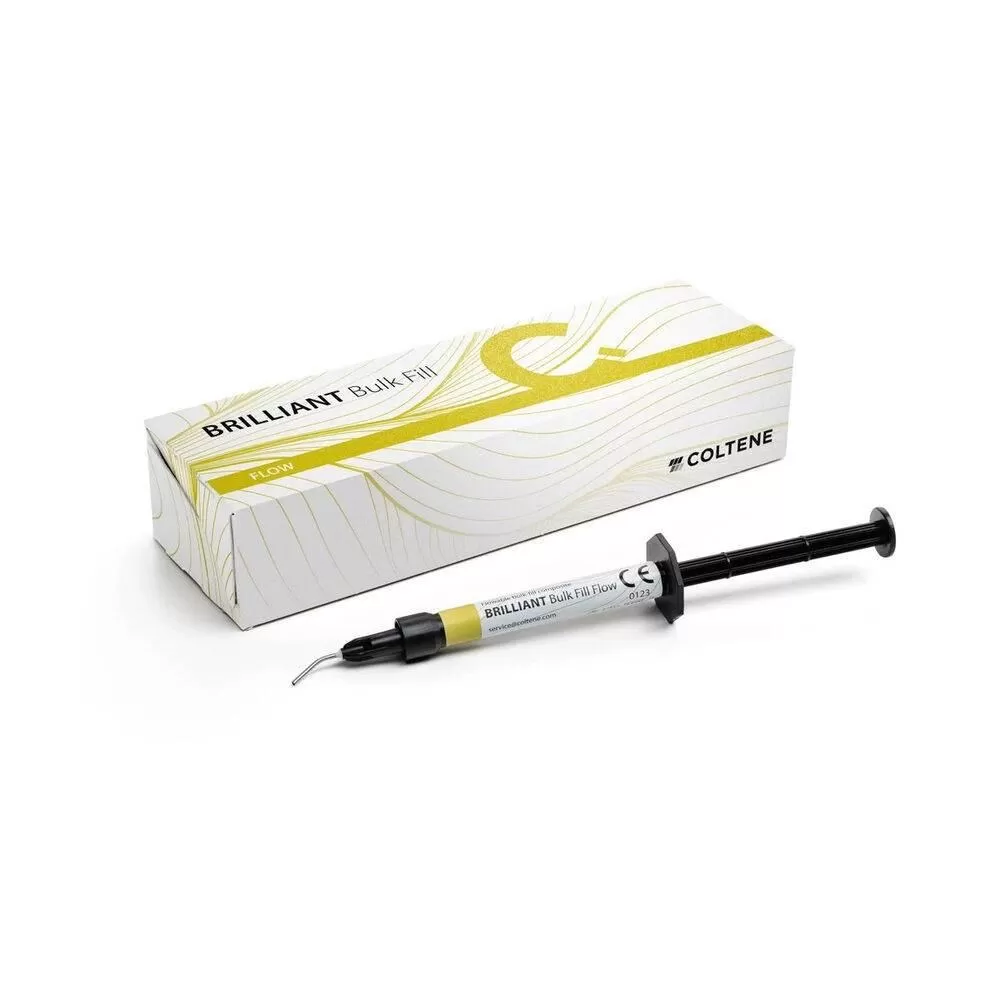
BRILLIANT Bulk Fill Flow is COLTENE’s flowable bulk-fill composite for posterior work. The material promises 4 mm increments cured in 20 seconds, one adaptive shade for most cases, and no capping layer. This review covers the manufacturer data, the published evidence on flowable bulk-fills, and how the material behaved during four weeks of chairside use.
What BRILLIANT Bulk Fill Flow Is
The material sits in COLTENE’s BRILLIANT restorative family alongside BRILLIANT EverGlow and EverGlow Flow, sharing the same filler technology across all three. That shared chemistry is the practical reason the products layer together without an interface problem. Anyone building a restorative dentistry protocol around a single manufacturer will find this consistency useful.
COLTENE describes it as a flowable, radiopaque, light-curing composite for permanent filling therapy. The published Instructions for Use list a broader indication set than the marketing suggests:
Direct fillings of all cavity classes
Cavity lining
Fissure sealing
Blocking out undercuts
Shape corrections to improve esthetics
Repairs of ceramic and composite restorations
Adhesive luting of restorations where light can penetrate
Luting of retainers
The classification that matters clinically is ISO 4049 Type 1, Class 2, Group 1. Type 1 designates a material approved for restorations involving occlusal surfaces. Many flowables carry Type 2, meaning the manufacturer does not warrant them under occlusal load. That single designation is the formal basis for everything COLTENE claims about skipping the capping layer.
Technical Specifications At A Glance
Attribute | Specification |
|---|---|
Manufacturer | Coltene/Whaledent AG, Altstatten, Switzerland (COLTENE Group) |
Material class | Flowable, radiopaque, light-curing resin composite for permanent restorations |
Standard | ISO 4049 Type 1, Class 2, Group 1 |
Shade system | One adaptive Multi Shade with chameleon effect |
Maximum increment | 4 mm |
Curing, direct restorations | 20 seconds at 1000 mW/cm2 or higher |
Curing, luting indirect work | 40 seconds per surface at 800 mW/cm2 or higher |
Curing wavelength | 450 to 490 nm |
Inorganic filler by weight | 56 percent |
Inorganic filler by volume | 38.5 percent |
Filler particle size range | 0.02 to 5.0 micrometers |
Composition | Methacrylates, dental glass, amorphous silica, bonded nanoparticles |
Capping layer | Not required, optional for esthetics |
Packaging | 2.3 g syringe with application needles, REF 60033280 |
Storage | 4 to 23 degrees C, protected from heat and light |
Typical US price | Roughly 57 to 71 dollars per syringe |
Composition And Filler Technology
Filler content drives most of what a composite does in the mouth, and it deserves close reading whenever a clinician is choosing dental materials for a restorative protocol.
BRILLIANT Bulk Fill Flow carries 56 percent inorganic filler by weight and 38.5 percent by volume, with particles spanning 0.02 to 5.0 micrometers. That range covers true nanoscale particles through to conventional microhybrid glass.
Volume percentage predicts clinical behavior better than weight, and 38.5 percent is normal for a flowable rather than an outlier. Sculptable bulk-fill composites usually sit between 55 and 65 percent by volume. Conventional flowables land in the low forties. A lower filler volume means a higher resin fraction, which tends toward greater polymerization shrinkage and a lower elastic modulus.
COLTENE markets the material on low shrinkage and high flexural strength. The ISO 4049 Type 1 designation supports the strength claim. The public Instructions for Use publish no volumetric shrinkage percentage, no shrinkage stress value in MPa, and no flexural strength figure. Those three numbers form the entire basis of comparison in this category, so their absence is worth noting. Ask a COLTENE representative for the full technical data sheet before standardizing a practice on the material.
For context on what normal looks like, a 2023 systematic review of contemporary flowable bulk-fill composites screened 684 articles and included 53. Degree of conversion across the included materials ranged from 19.41 to 93.71 percent. Polymerization shrinkage varied between 1.26 and 10.45 percent. Most studies reported shrinkage stress between 2 and 3 MPa, and flexural strength above 80 MPa for the majority of materials. The authors concluded that flowable bulk-fills meet the requirements for posterior bulk-fill restoration, while calling for clinical studies under real working conditions.
A tenfold spread in reported shrinkage across one product category tells you that the bulk-fill flowable label is a marketing bracket rather than a performance guarantee. Individual product data matters more than the category name.
The Instructions for Use also disclose that the material contains nanomaterials in bonded particle form. This is routine disclosure for nanofilled composites under European medical device regulation and raises no safety concern in bonded form.
The Multi Shade Approach
COLTENE supplies this composite as a single adaptive shade. There is no A2, no A3.5, no dentin or enamel variant, and no shade guide to consult before placement.
The chameleon effect behind that decision is a real optical phenomenon. A material whose translucency and refractive index sit close to natural dentin picks up color from adjacent tooth structure through lateral light transmission, which blurs the margin visually. The narrower the margin and the more surrounding tooth structure remains, the better the blend.
Where The Single Shade Works
Posterior restorations surrounded on most sides by tooth structure are the intended target, and the operational gain is real. Shade selection disappears from the workflow. Inventory drops from six or eight syringes to one, which reduces expiry-driven waste in a low-volume practice. Nobody loads the wrong shade.
Where The Single Shade Stops Working
Large MOD preparations with minimal remaining buccal and lingual wall will show the restoration. Anterior work will show it more. Markedly bleached or heavily chromatic dentition falls outside the blending range entirely. COLTENE’s own answer for those cases is a capping layer of BRILLIANT EverGlow in a matched shade. Practices already running a single-shade material such as Omnichroma will recognize both the appeal and the limits of the approach.
One ordering note. Several third-party dental retailers describe this product as offering three translucency levels. That copy appears to have been carried across from BRILLIANT EverGlow. The COLTENE catalog is unambiguous that BRILLIANT Bulk Fill Flow ships as one Multi Shade.
Depth Of Cure And Curing Light Requirements
The 4 mm figure gets the marketing attention. The irradiance requirement attached to it deserves more.
COLTENE specifies increments up to 4 mm cured for 20 seconds at 1000 mW/cm2 or higher, using blue light between 450 and 490 nm. Full details appear on the official product page.
Plenty of curing lights in daily service fall short of 1000 mW/cm2. Older single-emitter LEDs, units with degraded batteries, resin-fouled or scratched light guides, and any light held at an unavoidable working distance over a second molar all lose output fast. Irradiance drops with the square of distance, so a unit reading 1200 mW/cm2 against a radiometer at zero distance may deliver considerably less at the floor of a deep distal box. The warning signs of a failing unit are covered in more depth in this guide on when to upgrade dental LED curing lights.
A review of light-curing resin composites in Frontiers in Dental Medicine makes the underlying point plainly: bulk-fill composites are defined as those with a depth of cure of 4 mm or greater, and insufficient light penetration leaves the lower portion of a restoration soft and uncured. The American Dental Association resource on dental curing lights covers verification methods in a clinical setting.
If a light cannot reliably reach 1000 mW/cm2 at the material surface in the actual clinical position, the workable options are to reduce increments to 2 mm, extend exposure time, or replace the unit. Placing a full 4 mm increment under an underperforming light produces unreacted monomer against dentin, reduced mechanical properties, and elevated risk of postoperative sensitivity.
Two protocol details from the Instructions for Use are easy to miss. Deeper cavities are still layered, so a 6 mm preparation takes two increments cured separately. The oxygen inhibition layer between increments must be left intact, because that layer is what bonds one increment to the next. Wiping it with a cotton pellet or a blast of air compromises interlayer adhesion.
A study published in Dentistry Journal on curing mode and layering found that lower curing intensities around 1200 mW/cm2 may outperform very high intensities in terms of material shrinkage, and that the number of layers did not significantly affect cuspal deflection for the composite tested. More output is not automatically better.
The No Capping Layer Claim Examined
This is the differentiator, so it warrants scrutiny rather than acceptance.
Most flowable bulk-fills are designed as base materials. SDR flow+, Filtek Bulk Fill Flowable, and Venus Bulk Flow all require an overlying sculptable composite on occlusal surfaces, because their lower filler loading and modulus make them good stress-absorbing bases and poor occlusal surfaces.
COLTENE positions this material differently, citing high abrasion resistance and internal comparative testing in which BRILLIANT Bulk Fill Flow showed the lowest abrasion-related material loss among the products tested. The ISO 4049 Type 1 classification supports that position structurally.
Three reservations remain worth holding.
The abrasion comparison is manufacturer-conducted, and neither the comparator materials nor the test methodology appear in public-facing documents.
Abrasion resistance addresses wear alone. Fracture toughness and elastic modulus govern behavior under cuspal loading and go unaddressed by an abrasion claim.
No independent long-term clinical trial covers this specific product, which is normal for a material of this vintage but leaves the evidence base resting on manufacturer testing plus category-level inference.
The in vitro literature offers a relevant caution. Research comparing flowable and sculptable bulk-fill composites in MOD preparations found that sculptable bulk-fills achieved better marginal adaptation than flowable versions, with lower polymerization shrinkage and shrinkage stress contributing to the difference.
A workable clinical position: in small to moderate Class I and Class II preparations, on a non-terminal tooth, in a patient without significant parafunction, the single-step approach holds up and the time saving is real. In large MODs, on terminal abutments, or in confirmed bruxism cases, capping with BRILLIANT EverGlow costs about ninety seconds and buys a higher-modulus occlusal surface. Treat the no-capping indication as a legitimate default for routine cases rather than a universal instruction.
Chairside Evaluation
A four-week evaluation was run across routine posterior restorations in general practice, covering Class I and Class II preparations in premolars and molars, two fissure sealant cases, and one composite repair. The notes below reflect handling observations rather than controlled measurement.
Handling And Placement
Viscosity is the standout. The material runs readily off the application needle and self-adapts into line angles and the floor of a deep distal box without any condensation instrument. One upper right first molar with an MO preparation and a distal box extending close to the gingival floor filled cleanly in a single 4 mm increment, with no visible voids on the postoperative bitewing. That preparation would normally take two increments of a sculptable material and a fair amount of packing.
Working approximally, the flowable consistency makes matrix adaptation more important, not less. A sectional system such as the Palodent V3 and a firmly seated wedge kept the material contained. Cases where the wedge was seated loosely produced a small gingival excess that needed cleanup at finishing.
Plunger recoil matters. Failing to pull back the plunger after dispensing leaves material creeping onto the marginal ridge for several seconds afterward. This became routine after the first two cases.
The material is light sensitive, and this is noticeable in practice rather than theoretical. Leaving a dispensed increment exposed under a bright overhead light while adjusting a matrix produced a slightly skinned surface on one occasion. Dimming or swinging the operatory light away during placement solved it.
Curing And Finishing
Two curing lights were used across the evaluation. A recently calibrated LED unit reading above 1400 mW/cm2 produced consistently firm 4 mm increments that resisted a sharp explorer at the margins. An older unit in a second operatory, which measured just under 900 mW/cm2 on a radiometer, left the base of one 4 mm increment noticeably soft when tested on an extracted tooth. The remainder of that operatory’s cases were completed in 2 mm layers until the light was replaced. This single observation is the most practically useful finding of the whole evaluation.
Finishing behaved like a well-filled flowable. The material took a serviceable occlusal polish with standard rotary polishers, though it needed a slightly longer sequence than a sculptable composite to lose its surface sheen irregularity. Occlusal anatomy has to be shaped after curing, because the material self-levels and will not hold carved fissures before polymerization.
Shade Blending And Patient Response
Blending performed as described in Class I and small Class II cases. In a lower left second premolar occlusal restoration the margin was difficult to locate visually at the two-week review. In one large MOD on an upper first molar with thin remaining walls, the restoration read slightly lighter than the surrounding tooth under daylight, visible when the patient smiled widely. That case would have benefited from an EverGlow capping layer.
Patient feedback was uneventful, which is the desired outcome. No postoperative sensitivity was reported at the one-week check in any case cured with the calibrated light. One patient, a hygienist herself, commented on the shorter appointment and asked why the filling had taken half the usual chair time. Explaining the single-increment workflow during case presentation turned out to be an easy conversation, and it slots neatly into how a dental treatment plan is presented when patients are weighing time commitment alongside cost.
Clinical Workflow Step By Step
The sequence below follows the manufacturer protocol, with the practical notes that emerged during the evaluation.
Clean the tooth and adjacent teeth with a brush and a fluoride-free prophy paste, because fluoride residue interferes with etching and bonding.
Isolate the field. COLTENE states that adequate isolation is absolutely necessary and recommends rubber dam. Inability to isolate during application and curing is a formal contraindication.
Place a thin matrix band for approximal work and fix it proximally with an interdental wedge. Sectional matrix systems like the Palodent V3 handle the flowable consistency well.
Prepare conservatively following adhesive principles. Beveled enamel margins increase bonded surface area and improve marginal seal, which fits the wider minimally invasive dentistry approach.
Apply pulp protection in regions close to the pulp. Calcium silicate materials such as Biodentine are a common choice for deep preparations.
Apply the adhesive system according to its own instructions. The material is not adhesive-specific, though staying within one manufacturer chemistry is defensible.
Dispense directly into the cavity through the mounted application needle. Pull back the plunger after each dispense.
Cure for 20 seconds at 1000 mW/cm2 or higher, maximum 4 mm per increment, layering deeper cavities and preserving the inhibition layer between them.
Shape and polish with appropriate rotary instruments and polishers, then fluoridate all surfaces after completion.
For luting indirect restorations the protocol changes to 40 seconds per surface at 800 mW/cm2 or higher, with every accessible surface treated individually. Light must be able to penetrate the restoration, which rules out opaque or thick indirect work.
Indications, Contraindications, And Interactions
The Instructions for Use flag several clinical cautions that belong in any operatory protocol using this material.
Contraindications
Two absolute contraindications apply: known allergy to any component of the material, and any situation where the application field cannot be isolated during application and curing. Practices working routinely without reliable isolation should treat the second as a genuine constraint rather than a preference.
Material Interactions
Eugenol and oil of cloves may inhibit polymerization, so zinc-oxide-eugenol cements should be avoided in combination with this composite. This matters more than it first appears. A tooth that has carried a ZOE temporary needs thorough mechanical cleaning before bonding, and residual eugenol in dentinal tubules is a recognized cause of unexplained bond failure. Eugenol-free temporary materials such as J-Temp avoid the problem entirely.
Cationic mouth rinses, plaque disclosing agents, and chlorhexidine may discolor the restoration over time. Patients on long-term chlorhexidine rinse regimens for periodontal maintenance should be told to expect it.
Handling And Hygiene
Application needles are single use. The syringe cannot be autoclaved or processed in a washer-disinfector, so a disposable barrier sleeve is recommended, and any syringe with suspected contamination should be discarded. Store between 4 and 23 degrees C, away from heat and direct sun, closing syringes immediately after use. Refrigerated material should reach room temperature before use for consistent viscosity.
Fissure Sealing And Other Uses
Fissure sealing is a listed indication, and the flowable viscosity suits it. Whether this material beats a dedicated sealant on cost depends on case volume, though it does consolidate inventory. The evidence base supporting dental sealants for adults applies equally to sealants placed with a flowable composite.
How It Compares To Other Bulk Fill Options
The category is crowded, and honest positioning depends on what the alternative is designed to do.
Against Flowable Base Materials
SDR flow+, Filtek Bulk Fill Flowable, and Venus Bulk Flow are indicated as bases requiring a sculptable capping layer. The Type 1 classification and the elimination of that mandatory layer is what separates BRILLIANT Bulk Fill Flow from them. If the single-step workflow holds up in a given practice, the per-restoration time saving is something those materials cannot match. Practices that intend to cap regardless will find the established base materials carry deeper published track records.
Against Sculptable Bulk Fill Composites
Filtek One Bulk Fill, Tetric PowerFill, and x-tra fil adapt less easily but carry higher filler loading, higher modulus, and better carvable anatomy. For a large MOD on a molar in a heavy occlusion, a sculptable material remains the more conservative choice.
Against COLTENE Fill-Up!
Fill-Up! is a dual-curing, medium-viscosity bulk composite placed in a single step. Dual cure is the meaningful distinction. For very deep preparations where light penetration is questionable, Fill-Up! removes the dependence on curing light performance entirely. BRILLIANT Bulk Fill Flow offers better handling and better esthetics where light access is adequate. Practices already using COLTENE endodontic products such as HyFlex EDM files or the CanalPro Jeni motor may find consolidating restorative purchasing with the same manufacturer simplifies ordering.
Cost And Practice Economics
Pricing sits in the middle of the category, and the economics extend past the sticker price.
A 2.3 g syringe runs roughly 57 to 71 dollars at US retail, varying by distributor and promotion. COLTENE runs frequent buy-one-get-one offers on this line, so confirming current pricing with a supplier is worthwhile before ordering. Practices reviewing their wider dental procurement practices will find single-shade materials simplify the reorder calculation considerably.
The inventory effect is where the real saving sits. Replacing six or eight shade-specific syringes with one removes both the carrying cost and the waste from expired shades that see little use. Chair time is the other factor. Eliminating a capping layer and shade selection saves a few minutes per restoration, which compounds across a full restorative day. Those minutes affect practice profitability more directly than the material cost itself, particularly when set against the typical cost of a filling in the US market.
Bottom Line
BRILLIANT Bulk Fill Flow earns a place in general practice for routine posterior restorations. The inventory simplification is a real operational benefit, adaptation into difficult preparations is excellent, and removing the mandatory capping layer saves measurable chair time.
The material is not universal, and COLTENE does not claim otherwise. It depends on a curing light that performs to specification, it depends on proper isolation, and its esthetic ceiling ends around the premolars. Absent shrinkage figures and absent independent clinical data mean the case for it rests on manufacturer testing plus reasonable inference.
For a clinician who tests curing lights, uses rubber dam, and knows when to reach for a capping layer, this is a straightforward recommendation.
Verdict
<p>BRILLIANT Bulk Fill Flow is a well-engineered, honestly specified material that does what a busy general practice needs from a posterior flowable, provided two conditions are met.</p><p>The first condition is the curing light. The 4 mm claim depends entirely on delivering at least 1000 mW/cm2 at the material surface, and a meaningful share of lights in daily service do not. The chairside evaluation confirmed this directly, with a sub-900 mW/cm2 unit leaving the base of a 4 mm increment soft on an extracted tooth. Buying this material without a radiometer and a monthly light-check protocol means buying a promise the practice cannot cash. COLTENE is more transparent about the irradiance requirement than several competitors, which counts in its favor.</p><p>The second condition is knowing where the single shade stops working. In Class I and moderate Class II preparations the chameleon effect performed well enough that margins were hard to locate at review. In a large MOD with thin remaining walls it read visibly lighter in daylight. Cap those cases with EverGlow.</p><p>The strongest points in its favor are the ISO 4049 Type 1 classification and the genuine elimination of the capping layer, which saves real chair time rather than notional time. The weakest point is documentation. Published shrinkage and flexural strength figures are absent from the public Instructions for Use, and no independent clinical data exists yet.</p>
Frequently Asked Questions
Can BRILLIANT Bulk Fill Flow really be placed without a capping layer?
Yes, within limits. COLTENE indicates it for occlusal surface restorations without a covering layer, supported by ISO 4049 Type 1 classification and manufacturer abrasion testing. For small to moderate Class I and Class II preparations in patients without significant parafunction, the single-step approach is well supported. Large MODs, terminal abutments, and confirmed bruxists are better served by capping with BRILLIANT EverGlow, which COLTENE explicitly permits.
What curing light does it need?
Any blue-light unit between 450 and 490 nm delivering at least 1000 mW/cm2 for direct restorations. Verify that figure with a dental radiometer at the actual clinical working distance rather than trusting the manufacturer headline number. A light that cannot reach 1000 mW/cm2 in position means reducing increments to 2 mm, extending exposure time, or replacing the unit.
How thick can a single increment be?
Four millimeters maximum, cured for 20 seconds. Deeper cavities are filled in successive 4 mm increments cured individually, and the oxygen inhibition layer between increments must stay intact for interlayer bonding.
Is the material radiopaque?
Yes. Radiopacity allows radiographic differentiation from recurrent caries and assessment of marginal adaptation and overhangs on follow-up bitewings.
How many shades are available?
One. The material ships as a single adaptive Multi Shade relying on a chameleon effect. Third-party retailer listings occasionally mention three translucency levels, which describes BRILLIANT EverGlow rather than this product.
Can it be used for anterior restorations?
It is indicated for all cavity classes, so technically yes. The single shade will not deliver acceptable esthetics in visible anterior work. Use a dedicated esthetic composite anteriorly, or place this material as a base under a layered anterior composite.
Which bonding agent works with it?
Any adhesive system applied according to its own instructions. COLTENE recommends its own bonding agents, and staying within one manufacturer chemistry has some merit, though the material is not adhesive-specific.
What is the filler content?
Fifty-six percent by weight and 38.5 percent by volume, with inorganic filler particles from 0.02 to 5.0 micrometers. The composition is methacrylate-based with dental glass and amorphous silica, including bonded nanoparticles.
Can it be used as a core build-up material?
It is indicated for blocking out undercuts and cavity lining, not marketed as a dedicated core build-up material. Substantial core build-ups call for a purpose-designed material with higher filler loading and dual-cure chemistry. COLTENE Fill-Up! is the more suitable option within their own range where light access is limited.
Does it work for pediatric restorations?
The Instructions for Use state the material is suitable for all patient groups. Flowable viscosity and short curing time suit shorter attention spans, though isolation remains a formal requirement that can be harder to achieve in young children. Standard considerations for pediatric cavity filling apply.
How should it be stored?
Between 4 and 23 degrees C, protected from heat and direct sunlight, with syringes closed immediately after use and extreme temperature fluctuation avoided. Refrigerated material should reach room temperature before use so viscosity stays consistent.
Can the syringe be sterilized between patients?
No. The syringe cannot be autoclaved or processed in a washer-disinfector, so a disposable barrier sleeve is the recommended approach. Dispose of any syringe with suspected or identified contamination. Application needles are single use.
Are there material interactions to watch for?
Three. Eugenol and oil of cloves may inhibit polymerization, so zinc-oxide-eugenol cements should be avoided and cavities cleaned thoroughly after ZOE temporaries. Cationic mouth rinses, plaque disclosing agents, and chlorhexidine may cause discoloration. Known methacrylate allergy is a contraindication.
Is rubber dam mandatory?
COLTENE states that adequate isolation is absolutely necessary and recommends rubber dam, listing inability to isolate during application and curing as a formal contraindication. Practices without reliable isolation should treat this as a real constraint on using the material.
How does it compare to SDR flow+ or Filtek Bulk Fill Flowable?
Those materials are indicated as bases requiring a sculptable capping layer on occlusal surfaces. The Type 1 classification permitting use without capping is the main differentiator here. The trade-off is that SDR and Filtek carry longer published track records, so clinicians intending to cap regardless may reasonably prefer either.
Is there independent clinical evidence for this specific material?
Not currently. The available evidence combines manufacturer testing with the broader in vitro literature on flowable bulk-fill composites as a class. That literature is generally supportive of the category for posterior use while noting wide variation between individual products. Weigh this the same way you would for any recently introduced restorative material.