Biodentine: Composition, Properties, and Clinical Use
Biodentine is a calcium silicate-based bioactive dentin substitute made by Septodont and introduced in 2011. It replaces damaged dentin in both the crown and the root, supports...
Written by Marcus Hale
Read time: 9 min read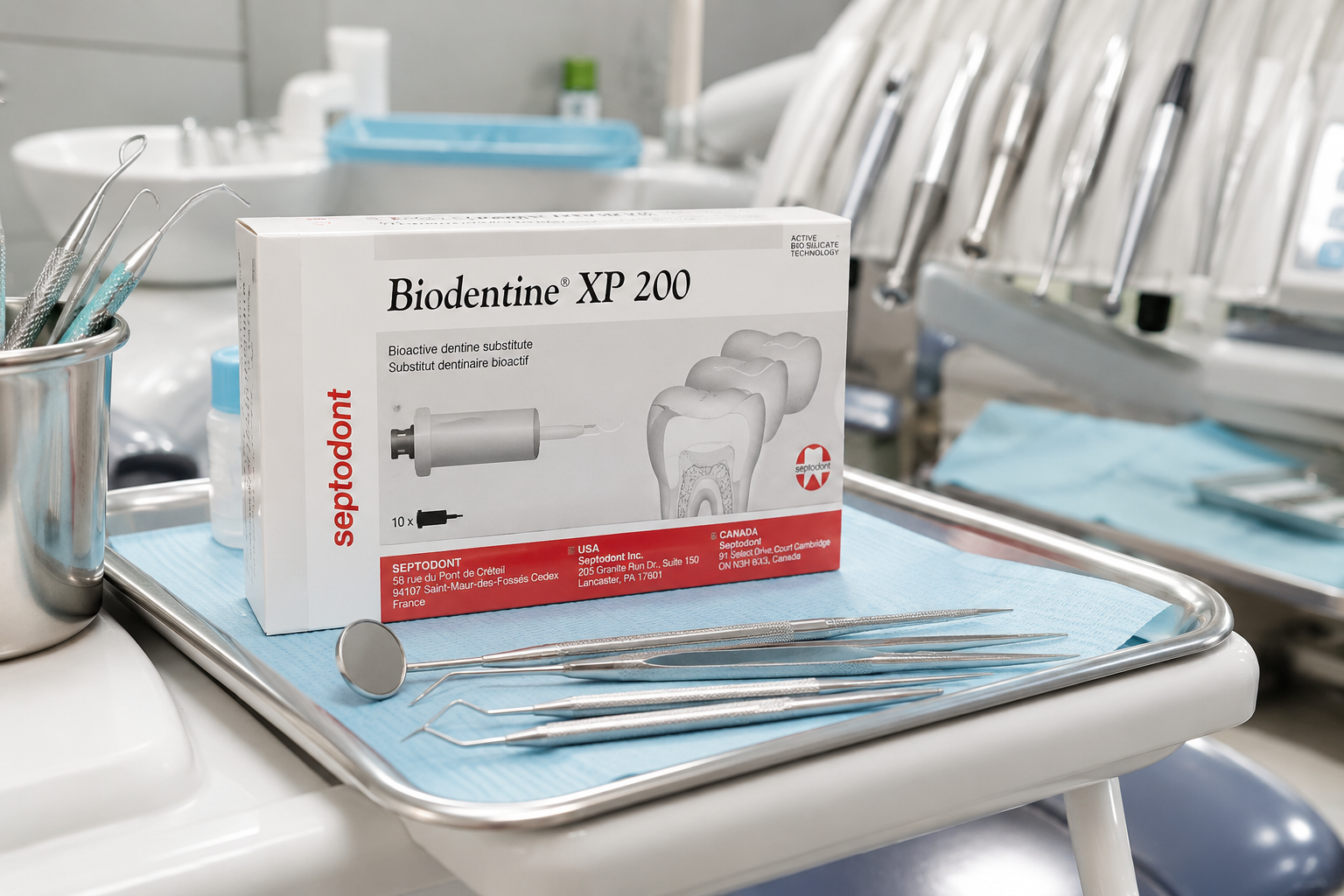
Biodentine is a calcium silicate-based bioactive dentin substitute made by Septodont and introduced in 2011. It replaces damaged dentin in both the crown and the root, supports vital pulp, and seals the tooth against bacteria. This guide covers its composition, properties, manipulation, clinical uses, and where dental professionals buy it.
TL;DR
Biodentine is a tricalcium silicate cement, with a powder that is about 80% tricalcium silicate, used as a dentin replacement for pulp capping, pulpotomy, perforation repair, apexification, and deep restorations.
Clinicians choose it because it releases calcium and hydroxyl ions, forms hydroxyapatite at the dentin interface, stimulates reparative dentin, and sets in roughly 9 to 12 minutes with no separate liner needed.
Mixing uses a capsule plus five drops of liquid triturated for about 30 seconds, while the newer Biodentine XP cartridge mixes in 30 seconds and dispenses straight into the cavity.
Licensed clinicians buy it from Septodont and authorized US distributors in XP 200 and XP 500 cartridge volumes.
What Is Biodentine?
Biodentine is a two-component, calcium silicate-based cement that functions as a bioactive dentin substitute. Septodont launched the material in 2011 as an answer to the handling problems and discoloration seen with earlier calcium silicate cements. The term advanced dentin substitute describes its role well: it is placed wherever dentin is damaged, from a deep cavity floor near the pulp to a perforation in the root, and it bonds to tooth structure through mineral crystal growth rather than an adhesive.
Unlike mineral trioxide aggregate (MTA), Biodentine contains no bismuth oxide, which is the ingredient that delays setting and stains tooth structure in some MTA formulations. The powder is roughly 80.1% highly purified tricalcium silicate. That purity, combined with a controlled liquid, gives the material its fast set and predictable behavior. For a broader view of where it sits among other options, dental teams can review this guide on how to choose dental materials.
Biodentine dental applications span two zones. In the crown, it serves as a temporary enamel substitute and a permanent dentin substitute under a final restoration. In the root, it repairs perforations and resorptions and seals root ends. This dual role is one reason the material appears so often in lists of common examples of dental procedures for restorative and endodontic work.
Biodentine Composition
Biodentine composition splits into a powder in a capsule and a liquid in a single-dose pipette. The powder supplies the reactive cement and the radiopacifier, and the liquid drives and controls the setting reaction. Mixing the two creates a calcium silicate hydrate gel plus calcium hydroxide, which is the source of the material's ion release.
Component | Location | Function |
Tricalcium silicate | Powder | Main reactive cement, about 80% of the powder, drives setting and strength |
Dicalcium silicate | Powder | Secondary reactive phase that supports the set |
Calcium carbonate and oxide | Powder | Filler that helps regulate the reaction |
Zirconium oxide | Powder | Radiopacifier for X-ray visibility, biocompatible |
Iron oxide | Powder | Shade or coloring agent |
Calcium chloride | Liquid | Setting accelerator, shortens set time and reduces cracking |
Hydrosoluble polymer | Liquid | A water-reducing agent that improves handling |
The choice of zirconium oxide over bismuth oxide matters in practice. It keeps the material biocompatible and avoids the gray staining linked to bismuth, although it also gives Biodentine lower radiopacity than some MTA products, which the StatPearls authors note can make it harder to read on a radiograph.
Biodentine Properties
Biodentine properties combine mechanical strength close to natural dentin with active biological behavior. The setting reaction releases calcium and hydroxyl ions, raises local pH, and forms hydroxyapatite crystals where the material meets dentin. Those crystals fill the dentin tubules and tighten the seal at the interface.
Documented characteristics include:
Fast initial set of about 9 to 12 minutes, with the full set commonly reached at 12 to 15 minutes
Microleakage similar to resin-modified glass ionomer cement in open sandwich restorations
Push out bond strength higher than ProRoot MTA and MTA Plus in furcation perforation repair, with blood contamination not reducing that bond
High calcium ion release compared with calcium hydroxide cement, MTA, and resin-modified calcium silicate
Low porosity in a moist environment and good marginal adaptation
Lower radiopacity than several MTA products, a recognized limitation
The biological side is what separates Biodentine from inert liners. Calcium and silicon ions reach the adjacent dentin and pulp, stimulate pulp cell differentiation, and promote a reparative dentin bridge. The alkaline environment also forms a thin protective zone that shields deeper pulp cells. These effects make the material a fit for minimally invasive dentistry, where the goal is to keep the pulp alive instead of moving straight to root canal treatment.
Biodentine Advantages
Biodentine advantages cluster around three practical wins for the clinician and the patient. First, it works as both the pulp dressing and the dentin replacement, so a single material fills the cavity from the pulp floor upward. Second, its sealing ability reduces postoperative sensitivity and bacterial percolation. Third, its biocompatibility supports healing rather than irritating tissue.
Single material for capping and restoration, fewer steps than a liner, plus a separate base
Strong seal that lowers postoperative sensitivity
No etching or bonding needed before placement
No bismuth oxide, so less risk of tooth discoloration than some MTA formulas
Bond strength that holds up even with blood contamination during perforation repair
Biodentine in Dentistry: Clinical Applications
Biodentine in dentistry covers a wide set of indications across the crown and root. Septodont and the clinical literature support the same core list, which makes it a flexible material to keep in stock. Many of these procedures appear in any overview of restorative dentistry and endodontics.
What are the clinical applications of Biodentine in dentistry? The recognized uses are:
Direct and indirect pulp capping
Pulpotomy in primary and permanent teeth
Repair of root and furcation perforations
Treatment of internal and external resorption
Apexification of immature roots
Retrograde or root end filling in apical surgery
Permanent dentin replacement under a final restoration in deep or large cavities
Evidence backs several of these. The StatPearls review reports that a 2018 study of full pulpotomy with Biodentine in adult teeth with signs of irreversible pulpitis reached 98.4% clinical and radiographic success at six months and 100% clinical success at twelve months. In furcation perforation repair in an animal model, Biodentine matched MTA on radiographic healing while extruding less material into the periodontal tissues and producing better cementum repair scores. Patients weighing this conservative path against full endodontic care often have questions about managing discomfort from root canal treatment, since vital pulp therapy aims to avoid that route when the pulp can still recover.
Comparison With Traditional Dental Cements for Root Repair
A common question is how Biodentine compares with older root repair materials. The table below summarizes the practical differences that drive material selection for perforation repair and pulp capping.
Property | Biodentine | MTA | Calcium hydroxide |
Initial set time | About 9 to 12 minutes | Several hours | Fast but soft |
Discoloration risk | Low, no bismuth oxide | Possible with bismuth oxide types | Low |
Mechanical strength | Close to dentin | High but slow to develop | Low, dissolves over time |
Sealing ability | High, forms hydroxyapatite | High | Moderate, degrades |
Handling | Easier, sets fast | Sandy, technique sensitive | Simple |
Calcium hydroxide remains cheap and biocompatible, but it dissolves and loses its seal over time, which can let bacteria back in. MTA seals well and has a long track record, yet its multi-hour set and gritty handling slow treatment, and some versions stain. Biodentine sits between them on cost while matching MTA on many outcomes and beating it on set time and, in furcation studies, on bond strength.
Biodentine in Pediatric Dentistry
Biodentine in pediatric dentistry has grown as clinicians look for a safer alternative to formocresol for primary molar pulpotomy. The material is cleared for primary teeth in children aged two and up under its instructions for use, and its biocompatibility makes it well-suited to developing teeth.
A 2019 randomized controlled trial cited in the StatPearls review compared Biodentine with formocresol for pulpotomy in primary molars over twelve months and found high success rates for both. Biodentine carried a practical edge: it serves as the pulp dressing and the restorative material in one step, while formocresol still needs a separate filling in the pulp chamber and raises long-standing concerns about toxic and carcinogenic risk. In young permanent teeth with immature roots, Biodentine has also held high success rates for keeping the pulp vital. Parents researching treatment for a child's cavity often start with general reading, such as pediatric cavity filling before a pulp therapy visit, and a pediatric flare-up may overlap with the signs a child needs emergency dental care.
Biodentine Manipulation, Mixing, and Hand Mixing
Biodentine manipulation follows a defined protocol that protects the material's stated properties. Correct biodentine mixing produces a smooth, creamy paste that adapts to the cavity and sets on schedule. Getting the liquid volume and trituration time right is the single biggest factor in consistent results.
Standard capsule protocol:
Tap the capsule on a hard surface to settle the powder
Add five drops of the liquid from the single-dose pipette into the capsule
Close the capsule and triturate in an amalgamator for about 30 seconds
Collect the paste and place it within the working time, before the set begins
On the topic of biodentine hand mixing, the manufacturer's protocol calls for mechanical trituration with an amalgamator for the classic capsule, not free-hand spatulation, because hand mixing makes it hard to control the powder-to-liquid ratio and the homogeneity that the physical properties depend on. The newer Biodentine XP cartridge is even stricter: Septodont states it must be mixed only with the dedicated Biodentine XP Mixer and dispensed with the Biodentine Gun, or the technical specifications are not guaranteed. Clinicians who want to broaden their material skill set can pair this with a wider look at dental equipment for students and chairside workflow basics.
How to Apply Biodentine for Pulp Capping
How to apply Biodentine for pulp capping in dental treatments comes down to a clean field, hemostasis, and a generous layer that seals the exposure. The sequence below reflects standard direct pulp capping practice with the capsule system.
Isolate the tooth, ideally with a rubber dam, and remove caries to expose sound dentin
Control bleeding at the exposure with a sterile cotton pellet and saline or sodium hypochlorite until hemostasis is achieved
Mix the capsule as described above to a creamy consistency
Place Biodentine directly over the exposure and adjacent dentin, with no separate liner
Allow the initial set, then place the final restoration; for the capsule, it can be restored in the same visit, while Biodentine XP requires a composite restoration within six months
Saliva and blood contamination can delay the set, so isolation is not optional. The full case from diagnosis through final restoration should be documented in a written dental treatment plan, which also helps the patient understand the staged approach. Clinicians documenting these visits can review how to prepare a dental treatment plan for a phased format.
Biodentine MSDS and Safety Handling
The Biodentine MSDS, now called the Safety Data Sheet, covers handling, storage, and exposure guidance for the material. The set powder is alkaline during the reaction, so clinicians avoid skin and eye contact with the freshly mixed paste and follow standard personal protective equipment practice. Cartridges are stored at 5 to 25 degrees Celsius in a dry place and carry a 24-month shelf life from manufacture. The current Safety Data Sheet is published by Septodont and authorized distributors, and the version on file should always be the one matched to the product lot in use.
Biodentine XP: XP 200 and XP 500 Cartridges
Biodentine XP is the next-generation delivery system from Septodont. It keeps the same calcium silicate chemistry but moves from a capsule and amalgamator to an all-in-one cartridge that holds both powder and liquid. The cartridge mixes in a high-speed mixer with one button press in 30 seconds, then loads into a dispenser gun for direct placement from the pulp to the top of the cavity, an approach Septodont calls Bio Bulk Fill.
The line comes in two cartridge volumes. Biodentine XP 200 holds the smaller fill volume for routine deep cavities, while Biodentine XP 500 holds the larger volume for bigger restorations or multiple sites. The clinician picks the volume based on cavity depth and how much material the case needs. Both share a working time of roughly six minutes for shaping with hand instruments, and the final enamel restoration with composite should follow within six months.
Feature | Biodentine capsule | Biodentine XP |
Mixing | 5 drops liquid, amalgamator 30 sec | High speed XP Mixer, 30 sec |
Placement | Spatula or carrier | Direct from dispenser gun |
Volumes | Single capsule | XP 200 and XP 500 cartridges |
Shelf life | Per lot, see SDS | 24 months from manufacture |
Where to Buy Biodentine and Who Makes It
Where can I buy Biodentine dental repair material online is a frequent search, and the answer depends on whether the buyer is a licensed professional. Biodentine is a professional dental product, so authorized distributors typically sell it to verified dental practices and clinicians rather than to the general public.
Which companies manufacture Biodentine products for dental procedures has a single answer: Septodont developed and manufactures Biodentine and Biodentine XP. Where can dental professionals purchase this specific restorative material? It comes down to Septodont directly and its authorized US dental supply partners.
Before ordering, clinicians can read this independent Biodentine review for pros, cons, and clinical evidence, and compare it with related Septodont calcium silicate products in the BioRoot Flow review and the Septodont BioRoot RCS review. Practices can also compare suppliers, and pricing can also be reviewed for broader dental supply company options before placing an order.
Cost of Procedures Using Modern Pulp Capping Agents
The cost of dental procedures using modern biocompatible pulp capping agents reflects two parts: the material itself and the procedure around it. The material is a small share of the total. A capsule or XP cartridge of Biodentine has a modest per-use cost, while the procedure fee depends on the tooth, the complexity, and the region.
A direct pulp cap is usually billed as an addition to a restoration, so the patient often sees the cap fee plus the filling fee. For context on the restorative side, patients can review typical ranges in this guide on how much a filling costs. When vital pulp therapy is not possible, and the tooth needs full endodontic care, the cost rises sharply, which is covered in this breakdown of root canal treatment cost. Choosing a conservative pulp capping or pulpotomy approach with Biodentine can preserve the natural tooth and avoid the higher cost of a root canal and crown when the pulp is still able to heal. This is general information, not financial advice, and exact fees should come from the treating office.
Finding a Dentist Who Uses Advanced Pulp Therapy Materials
Finding a dentist near me who utilizes advanced pulp therapy materials is best answered by asking the office directly. Patients can call and ask whether the practice performs vital pulp therapy and uses calcium silicate materials such as Biodentine or MTA for pulp capping and pulpotomy, since not every general office offers these conservative procedures.
Endodontists and pediatric dentists are the most likely to keep these materials on hand. When comparing offices, the same criteria that apply to any provider search apply here, and this guide on how to choose a dentist helps frame the right questions about technique, materials, and experience.
Bottom Line
Biodentine gives clinicians a single calcium silicate material that caps the pulp, replaces dentin, and repairs the root, with a fast set, a strong seal, and active stimulation of reparative dentin. Its tricalcium silicate base, ion release, and lack of bismuth oxide explain why it has displaced calcium hydroxide in many cases and competes closely with MTA. The capsule suits classic placement, while Biodentine XP 200 and XP 500 cartridges speed up deep cavity work through direct dispensing. Practitioners source it from Septodont and authorized US distributors, and select it case by case alongside other materials in the modern restorative toolkit.
Frequently Asked Questions
What is this advanced dentin substitute used for in dentistry?
It is used for direct and indirect pulp capping, pulpotomy in primary and permanent teeth, root and furcation perforation repair, internal and external resorption, apexification, retrograde root end fillings, and permanent dentin replacement under a final restoration in deep cavities.
How to apply Biodentine for pulp capping in dental treatments?
Isolate the tooth, remove caries, and achieve hemostasis at the exposure. Mix the capsule to a creamy paste, place it directly over the exposure and surrounding dentin with no separate liner, let it reach initial set, then restore. The capsule can often be restored on the same visit, while Biodentine XP needs a composite restoration within six months.
Where can I buy Biodentine dental repair material online?
Licensed clinicians buy it through Septodont and authorized US dental distributors. It is a professional product, so distributors usually verify dental credentials before sale rather than selling to the public.
What are the clinical applications of Biodentine in dentistry?
The recognized applications are pulp capping, pulpotomy, perforation repair, resorption repair, apexification, retrograde filling, and dentin replacement in deep restorations, covering both the crown and the root of the tooth.
What is the difference between Biodentine XP 200 and XP 500?
Both use the same chemistry and delivery system. XP 200 is the smaller cartridge volume for routine deep cavities, and XP 500 is the larger volume for bigger restorations or multiple sites. The clinician chooses based on cavity depth and material needed.
Can Biodentine be hand-mixed?
No. The capsule is designed for mechanical trituration in an amalgamator, and the Biodentine XP cartridge must be mixed only with the dedicated XP Mixer. Free-hand mixing makes it hard to control the powder-to-liquid ratio and can compromise the stated physical properties.