Rating: 4.2/5
Premier MultiMatch Flow Chameleon Review
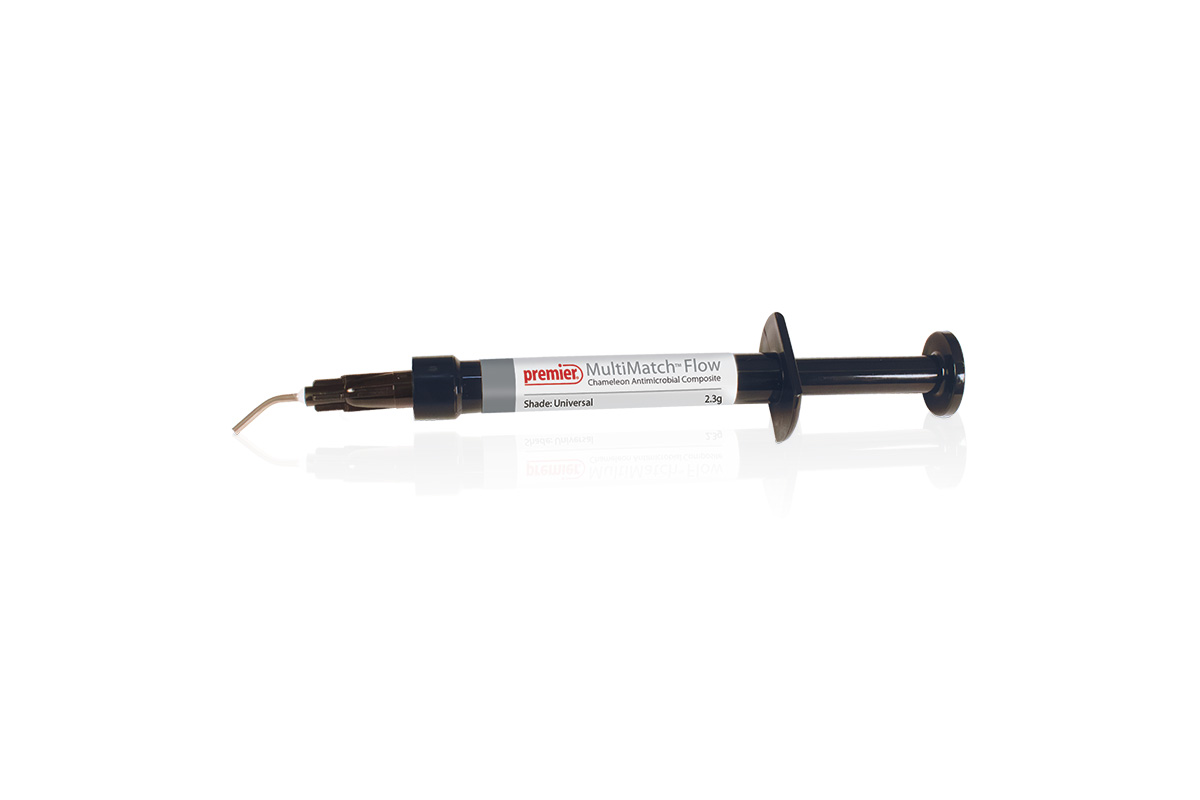
Premier MultiMatch Flow Chameleon is a single-shade flowable nano-hybrid composite with an antiseptic reservoir built into its filler. Premier Dental released it to US...
Pros
- One flowable combines a universal shade with a released antimicrobial.
- Octenidine diffuses past the surface, with dead bacteria seen on adjacent dentin in vitro.
- Sponsored testing showed about five times less dentin demineralization than a matched control.
- Flexural strength of 115 MPa is high for a flowable.
- Water sorption of 3.9 µg/mm³ bodes well for color stability if confirmed independently.
- Radiopacity of 179% aluminum makes radiographic follow-up easy.
- A 10-second cure per increment suits modern LED lights.
- FDA-cleared indications span restorations, liners, sealing, splinting, repairs, and aligner retention.
Cons
- No clinical trial yet shows fewer recurrent caries in patients.
- All antimicrobial data are short-term and come from Premier or Premier-sponsored studies.
- The decades-long protection claim rests on one month of release data.
- One shade struggles with bleach shades, large Class IV work, dark substrates, and high-value anterior cases.
- Premier offers no blocker or opaquer shade in the line.
- Price per gram sits at the premium end of flowables.
- Self-leveling viscosity limits freehand anatomy.
- Filler loading by weight and volume is not published.
Premier MultiMatch Flow Chameleon is a single-shade flowable nano-hybrid composite with an antiseptic reservoir built into its filler. Premier Dental released it to US distributors in May 2026. This review weighs the laboratory data, handling, indications, and cost against what clinicians need from a daily-use flowable.
TL;DR
Premier MultiMatch Flow Chameleon pairs one universal shade with BioArmor, a slow-release octenidine reservoir inside the filler.
Premier-sponsored in vitro testing recorded about five times less dentin demineralization than the same composite without BioArmor.
The material reports 115 MPa flexural strength and 3.9 µg/mm³ water sorption, both strong figures for a flowable.
No clinical trial yet links it to fewer recurrent caries, so start with Class V, preventive resin, and aligner attachment cases.
Product Overview: What MultiMatch Flow Is
MultiMatch Flow is a low-viscosity, light-cured, radiopaque flowable composite from Premier Dental Products Company, a Plymouth Meeting, Pennsylvania manufacturer better known for Traxodent and Triple Tray than for resin chemistry. The instructions for use state that the material is made in Israel using technology developed with BJM Laboratories.
Premier announced the product on May 4, 2026, according to the launch release published by Decisions in Dentistry. It sits in a new restorative family alongside MultiMatch Universal, a sculptable paste sold in three shades, and StackFlow, a thixotropic injectable composite. Of the three, MultiMatch Flow is the only one carrying the BioArmor additive.
The pitch is two products in one syringe. A universal chameleon shade removes shade selection from routine flowable work, and the antimicrobial additive is meant to reduce bacteria and demineralization where restorations most often fail, at the margin.
Key Specifications
The figures below come from Premier's IFU and product page, current as of October 2026.
Attribute | Detail |
|---|---|
Material class | Low-viscosity, light-cured, radiopaque flowable nano-hybrid composite |
Shade | One universal EZ-Blend chameleon shade for VITA classical A1–D4 |
Antimicrobial additive | BioArmor mesoporous silica loaded with octenidine dihydrochloride |
Maximum increment | 2 mm |
Cure, LED 1000–1500 mW/cm² | 10 seconds per increment |
Cure, LED below 1000 or halogen above 1000 mW/cm² | 20 seconds per increment |
Curing wavelength | 400–500 nm |
Filler particle size | Below 6 µm |
Storage | 10–24 °C (50–75 °F) |
Shelf life | 24 months from manufacture |
Standard pack, REF 3005230 | 2 × 2.3 g syringes and 20 applicator tips |
How BioArmor Antimicrobial Technology Works
Most resin composites are biologically inert once cured. They seal a preparation and then rely entirely on the bond and the patient's hygiene to keep the margin healthy. A 2015 systematic review in the Journal of Dentistry found secondary caries to be the most common biological reason posterior composites fail, often appearing three years or more after placement. BioArmor is Premier's attempt to give the restoration a role in that fight.
The Mesoporous Silica Reservoir
BioArmor particles are spherical silica with an average diameter near 450 nm and internal pores of 1–2 nm, according to Premier's BioArmor white paper. The pores hold octenidine dihydrochloride (OCT), and the IFU caps the additive at under 5% of the composite by weight.
Release is slow. Premier reports that about 0.02% of the OCT payload leaves the particles over one month, with 99.98% still in reserve. The company projects that the reservoir would last for decades, which is an extrapolation from 30 days of release data and should be read that way.
The design has a mechanical logic worth noting. Antimicrobial fillers that dissolve or leach heavily can leave voids and weaken the resin over time. A silica carrier that stays put while releasing a tiny fraction of its load should protect the composite's strength, and the published property figures, covered below, are consistent with that.
Why Octenidine Instead Of Chlorhexidine
Octenidine is a bis-cationic antiseptic with a long record in European wound and mucosal antisepsis, summarized in a 2010 review in Skin Pharmacology and Physiology. Its positive charge binds negatively charged microbial membranes, which then lose integrity and leak their contents.
Dentists know the trade-offs of chlorhexidine in dentistry well, including brown staining and a two-week ceiling on routine rinse use. Premier positions OCT as gentler on oral tissues, with no reported acquired microbial resistance and activity across pH 2.5 to 10.4. Cariogenic plaque routinely drops below pH 5.5 after a sugar exposure, so an agent that keeps working in acid is the relevant property for a restorative margin.
In vitro, Premier lists six organisms the material acts on, drawn from the multispecies biofilm used in its testing. They are Streptococcus mutans, Streptococcus oralis, Actinomyces naeslundii, Veillonella dispar, Fusobacterium nucleatum, and Candida albicans.
What The Laboratory Evidence Shows
Three sets of laboratory data support the BioArmor claims, and Premier generated or sponsored all of them. The results are encouraging and the study designs are sensible. Clinicians should still weigh them as early evidence for a material launched in 2026.
Bacterial Viability On The Restoration Surface
In Premier's white paper, extracted human teeth were restored with MultiMatch Flow or a commercial composite with no antimicrobial, then held in a Streptococcus mutans biofilm fermenter at 37 °C for 24 hours. Confocal microscopy recorded a live-to-dead bacteria ratio of 1.8 ± 0.5 on MultiMatch Flow against 6.1 ± 1.4 on the control, with three samples per group and p < 0.05.
The images also showed dead bacteria on the dentin next to the restoration. That detail matters more than the headline ratio, because it suggests OCT diffuses past the composite surface into adjacent tooth structure, where recurrent lesions start.
A second study, run at Temple University and sponsored by Premier, compared MultiMatch Flow with Nobio Infinix, Pulpdent ACTIVA BioACTIVE, and Solventum Filtek Supreme Flowable. Premier's restorative brochure reports the lowest live-to-dead ratio for MultiMatch Flow, near 1.4, with the comparators between about 2.3 and 3.3.
Dentin Demineralization In The Zurich Biofilm Model
The demineralization study is the stronger of the two designs. Dentin blocks from intact extracted third molars were restored using 3M Scotchbond Universal, then exposed for seven days to a six-species cariogenic biofilm in the Zurich model, with nutrients added every 24 hours.
Micro-CT measured an average demineralized volume of 0.09 mm³ next to MultiMatch Flow and 0.49 mm³ next to the same composite without BioArmor. Premier markets this as five times better, and the arithmetic supports the claim. Using the same base material as the control is a strength of the design, since it isolates BioArmor as the variable.
What The Evidence Does Not Yet Show
Every study above ran for seven days or less with small samples. None had been published in a peer-reviewed journal as of October 2026. No data yet show fewer recurrent caries or longer restoration survival in patients.
The broader field is thin too. A Cochrane review of antibacterial agents in composite restorations found no randomized trials that met its inclusion criteria, which means the clinical benefit of any antimicrobial composite remains unproven. MultiMatch Flow's FDA-cleared claim stays narrow for that reason. It reduces bacteria and demineralization at the material surface, and the device carries no caries treatment claim.
EZ-Blend Shade Matching In Practice
MultiMatch Flow ships in one shade that Premier says blends across all 16 VITA classical shades from A1 to D4. The chameleon effect relies on translucency and light scattering, so the restoration borrows color from the cavity walls around it. Pigments make up less than 0.2% of the composite by weight, according to the IFU.
Where The Single Shade Blends Well
Blending works best when tooth structure surrounds the restoration on most sides. Small Class I preparations, preventive resin restorations, sealants, and cervical lesions fit that profile.
Cervical work deserves a specific mention. Noncarious lesions such as abfraction sit at the cementoenamel junction, where dentin is more chromatic and enamel thins out. A self-leveling single shade that picks up the surrounding hue suits those shallow, wide lesions, and the antimicrobial additive sits right where gingival plaque collects.
Clinicians already familiar with a single-shade composite such as Omnichroma will find the same rules apply here. Wider preparations blend better than narrow ones, and the effect weakens next to highly saturated teeth.
Where It Needs Help
The chameleon effect has limits that no single shade escapes. Large Class IV restorations have little surrounding tooth to borrow from. Dark dentin and metal shadows can show through translucent resin.
Premier sells no blocker or opaquer shade for MultiMatch Flow. The IFU lists veneering of discolored anterior teeth as an indication, so cases with heavy discoloration will need an opaque layer from another system first. Bleach shades fall outside the A1–D4 claim as well.
Premier's own literature concedes the trade-off. Its brochure argues that the three-shade MultiMatch Universal paste gives a more natural result than a single-shade composite, which places the one-shade flowable firmly in the small, well-surrounded preparations where flowables do most of their work.
Physical Properties And What They Mean Chairside
Premier publishes a comparison table against two unnamed flowables. All values are listed as data on file, and test methods are not given on the product page.
Property | MultiMatch Flow | Competitor Flow A | Competitor Flow B |
|---|---|---|---|
Shades to cover 16 VITA shades | 1 | 1 | 5 |
Flexural strength (MPa) | 115 | 92 | 103 |
Compressive strength (MPa) | 282 | 196 | 280 |
Water sorption (µg/mm³) | 3.9 | 15.9 | 14 |
Water solubility (µg/mm³) | 0.7 | 0.5 | 1.3 |
Radiopacity (% Al) | 179 | 99 | 249 |
Polymerization shrinkage (%) | 3.0 | 3.1 | 4.8 |
Shear bond strength to enamel (MPa) | 50 | 42 | 29 |
Shear bond strength to dentin (MPa) | 37 | 32 | 23 |
Flexural strength of 115 MPa clears the ISO 4049 minimum of 80 MPa for materials used on occlusal surfaces with room to spare. That figure supports the Class I and II indications, though most clinicians will still cap a flowable with a packable composite under heavy load.
Water sorption is the standout number. ISO 4049 allows up to 40 µg/mm³, and many flowables land between 15 and 30. A figure of 3.9 would predict good color stability and slow hydrolytic breakdown, and it is also the result that most needs independent replication.
Shrinkage of 3.0% is typical for a flowable. The 2 mm increment rule in the IFU exists for that reason, and skipping it to save time trades away marginal integrity.
Radiopacity of 179% aluminum sits well above enamel, so recurrent lesions and voids under the restoration should be readable on bitewings. Bond strength figures depend heavily on the adhesive used, and Premier does not name the one behind its 50 MPa enamel result.
Handling, Placement, And Curing
MultiMatch Flow behaves like a true low-viscosity flowable. It self-levels after placement and runs into line angles and narrow margins with little instrument work.
Viscosity And Adaptation
Self-leveling is the right behavior for liners, Class V lesions, pit and fissure work, and aligner attachment wells. It works against freehand anatomy and vertical builds, where a material needs to hold its shape until cured. Premier's StackFlow covers that second role, so practices that want both behaviors may end up stocking both.
The syringe holds 2.3 g, which is on the small side. High-volume practices will reorder often. The small fill does limit waste at expiry for offices that place few flowables.
Curing Protocol
The IFU sets curing by light output. LED units delivering 1000–1500 mW/cm² need 10 seconds per 2 mm increment. LEDs below 1000 mW/cm² and halogen units above 1000 mW/cm² need 20 seconds.
Those times assume the stated output reaches the restoration. Light guides scratch and batteries lose capacity over time. Irradiance also drops sharply with distance, so a periodic radiometer check belongs in the maintenance schedule. Signs that a unit has slipped are covered in this guide on when to upgrade dental LED curing lights. The American Dental Association's curing light resource explains verification in more depth.
Syringe, Tips, And Infection Control
Tips screw onto the syringe and are single use. Premier's brochure lists 20-gauge tips in both the standard pack and the 100-tip refill, while the current IFU lists the refill as 18 gauge, so confirm with the dealer if fine-tip control matters.
The IFU calls for a plastic barrier sleeve on the syringe for every patient, followed by a disinfecting wipe after removal. Practices updating their protocols can cross-check against this infection control in dentistry guide.
Clinical Indications And Best-Fit Cases
The FDA-cleared indication list is broad. It covers Class I–V direct restorations, bases and liners, veneering of discolored anterior teeth, splinting of mobile teeth, extended pit and fissure sealing, repair of composite and ceramic veneers, and retention of thermoplastic aligners.
Some of those uses suit the material far better than others. The table ranks them.
Use case | Fit | Reasoning |
|---|---|---|
Class V and root-surface lesions | Excellent | Plaque-retentive margins, self-leveling adaptation, simple cervical shade match |
Small Class I and preventive resin restorations | Excellent | Well-surrounded preparations blend best, and occlusal biofilm is the target |
Liner under posterior composite | Very good | Adapts to the pulpal floor and gingival box, with high radiopacity |
Aligner attachments and retention buttons | Very good | Plaque collects around attachments for months during treatment |
Extended pit and fissure sealing | Very good | Flows into fissures and adds an antimicrobial surface |
Composite or ceramic veneer repair | Good | Useful in caries-prone patients, though blending depends on the old restoration |
Splinting mobile teeth | Good | Adequate strength, so check flexibility needs for the splint design |
Large Class II and heavy occlusal load | Use with care | Cleared, but capping with a packable composite remains prudent |
Class IV and discolored anterior veneers | Use with care | Little tooth to borrow color from and no blocker shade |
Sealant use draws on the same evidence base that supports dental sealants for adults, with an antimicrobial surface added. For orthodontic offices, attachments for clear aligners stay in place for months, and plaque around them is a familiar cause of white-spot lesions.
High-caries-risk adults deserve particular attention. Patients with dry mouth from medication or head and neck radiotherapy often struggle with cervical and root caries, and those cases sit squarely in this material's best-fit list. Supportive care for those patients is covered in this guide to saliva substitutes for xerostomia.
Contraindications And Cautions
The IFU lists two formal contraindications. The first is known allergy to any component, and Bis-GMA is the base monomer. The second is any case where isolation or correct bonding cannot be achieved.
The IFU adds several warnings. Eugenol-based liners inhibit curing and must not be used underneath. The material is not indicated for direct pulp capping. Increments must not exceed 2 mm, and cure times must not be shortened.
Step-By-Step Clinical Technique
The sequence below follows the manufacturer's IFU, with practical notes added. Premier recommends a rubber dam for isolation, and the conservative preparation principles of minimally invasive dentistry suit the small preparations where this material performs best.
Bring refrigerated syringes to room temperature, since cold flowable adapts less well.
Clean the tooth of plaque, stain, debris, and any old restorative material.
Isolate the field and complete the preparation.
Place a non-eugenol liner in deep areas if pulp protection is needed.
Apply a light-cured adhesive following its manufacturer's instructions.
Fit a new tip and barrier sleeve, then bleed a small amount onto a pad to clear air.
Inject in increments of 2 mm or less, keeping the tip inside the material to avoid bubbles.
Cure each increment for 10 or 20 seconds according to light output, with the guide close and perpendicular.
Cap high-load posterior restorations with a packable composite where appropriate.
Adjust occlusion and polish with fine diamonds or carbides followed by discs or cups.
Discard the tip and sleeve, wipe the syringe with disinfectant, and store it capped below 24 °C.
For aligner attachments, etch and bond the enamel as usual, fill the template wells with MultiMatch Flow, seat the template, and cure through it. Self-leveling fills the wells cleanly, and one shade removes a decision per patient.
How MultiMatch Flow Compares With Other Flowables
MultiMatch Flow sits where universal-shade flowables and active restoratives overlap. The comparison below uses each manufacturer's public positioning, so check current spec sheets before ordering.
Product | Shade approach | Active technology | Main difference |
|---|---|---|---|
Premier MultiMatch Flow | One chameleon shade | Octenidine released from mesoporous silica | Pairs one-shade simplicity with a released antimicrobial |
Nobio Infinix Flowable | Multiple shades | Quaternary ammonium silica bound in the matrix | Antimicrobial acts mainly on contact at the surface |
Pulpdent ACTIVA BioACTIVE | Limited shade range | Calcium, phosphate, and fluoride ion release | Targets remineralization with a different resin chemistry |
Solventum Filtek Supreme Flowable | Multiple VITA shades | None | Long clinical record and wide shade range |
Tokuyama Omnichroma Flow | One structural-color shade | None | Established single-shade flowable with years of use |
MultiMatch Flow is the only widely available flowable here that combines one shade with a released antimicrobial. Its published strength and sorption figures compare well, and it led the sponsored Temple study on bacterial viability.
The competitors keep two advantages. Filtek and Omnichroma Flow have years of in-mouth use and independent research behind them, and multi-shade systems handle bleach shades and demanding anterior work more predictably. Ion-releasing materials such as ACTIVA pursue remineralization, a different mechanism suited to a different clinical goal.
Practices weighing flowable bulk-fill options for deeper posterior work can compare a material built for that job in this BRILLIANT Bulk Fill Flow review. This framework for choosing dental materials helps structure the decision across categories.
Cost And Practice Economics
Premier lists the Standard Pack of two 2.3 g syringes and 20 tips at $158.99, and a 100-tip refill at $44.99, on its product page in October 2026. Dealer and contract pricing varies.
That works out to about $34.56 per gram and $0.45 per refill tip. A small Class V or preventive resin restoration using 0.1–0.2 g carries a material cost of roughly $3.50 to $7 plus a tip, depending on preparation size and waste.
The per-gram price sits at the premium end of flowables. The offsets come from carrying one syringe instead of several shades, removing the shade-selection step, and offering high-risk patients a material with a specific protective rationale. This guide on the cost of a filling puts the material cost in the context of typical US fees.
Documentation matters with a new material. Recording the restorative material in each dental treatment plan makes it straightforward to audit outcomes later, such as recurrent caries rates on MultiMatch Flow restorations against older flowables in the same practice. Teams standardizing supplies can also use these best practices for dental procurement to judge whether the premium earns its place.
Bottom Line
Premier MultiMatch Flow Chameleon is the first widely available flowable to combine a universal chameleon shade with an antiseptic that releases from the filler. It suits practices that treat a steady stream of high-caries-risk patients, where restorations tend to fail at the margin years after placement. Octenidine diffusing into the biofilm around those margins gives the material a clinical rationale that a standard flowable lacks.
The strongest use cases are Class V and root-surface lesions, small preventive resin restorations, liners under posterior composite, and attachments for clear aligners. Each one involves a small, well-surrounded preparation or a plaque-retentive site, which is where the single shade blends best and the antimicrobial additive has the most to do. A flexural strength of 115 MPa and water sorption of 3.9 µg/mm³ support routine posterior use under a packable cap.
The evidence needs to be read for what it is. Premier's Zurich biofilm study recorded 0.09 mm³ of demineralized dentin next to MultiMatch Flow against 0.49 mm³ next to the same composite without BioArmor, after seven days. That result is sponsored and unpublished, and no trial has yet tracked recurrent caries in patients. Patient conversations should stay within the cleared claim of reduced bacteria and demineralization at the material surface.
For a first order, one Standard Pack at $158.99 covers roughly 25 to 45 small cervical and preventive restorations, enough to judge handling and shade match in a given operatory. Keep a multi-shade system with a blocker for large anterior restorations and discolored teeth, since Premier offers no opaque shade in this line. Recording which restorations used MultiMatch Flow, and checking their margins at each recall, gives the practice its own outcome data while independent studies catch up.
Verdict
<p>Premier MultiMatch Flow Chameleon earns a recommendation for a defined set of cases. The rationale is clinically sound. Recurrent caries at the margin remains the leading biological cause of composite failure, and a flowable that releases a broad-spectrum antiseptic into the surrounding biofilm addresses that problem directly.</p><p>The supporting data are well designed for laboratory work. The Zurich model study tested human dentin bonded with a commercial adhesive under a six-species cariogenic biofilm, and it compared the material against its own base formula without BioArmor. A fivefold reduction in demineralized volume under those conditions is a meaningful result.</p><p>The limits are equally clear. Every antimicrobial figure comes from Premier or a Premier-sponsored study lasting a week or less, and no patient outcome data exist yet.</p><p>The best-fit cases are cervical lesions, preventive resin restorations, liners, sealants, and aligner attachments in high-caries-risk patients. Large anterior restorations and discolored teeth still call for a multi-shade system with a blocker. Independent clinical follow-up through 2027 and beyond will decide whether this material moves from a sensible choice to a standard one.</p>
Frequently Asked Questions
What is Premier MultiMatch Flow Chameleon?
It is a light-cured, radiopaque, low-viscosity flowable nano-hybrid composite from Premier Dental. It comes in one universal chameleon shade and contains BioArmor, an additive that slowly releases the antiseptic octenidine dihydrochloride.
How does BioArmor reduce bacteria?
BioArmor particles are porous silica spheres about 450 nm across that hold octenidine in 1–2 nm pores. Octenidine diffuses into nearby biofilm, binds to microbial cell membranes, and causes the cells to break down.
Is octenidine safe in the mouth?
Octenidine has a long record in wound and mucosal antisepsis in Europe and appears in some European mouth rinses. The IFU contraindicates the composite only for patients with known allergy to any of its components.
Does MultiMatch Flow prevent recurrent caries?
That has not been shown in patients. In vitro studies recorded fewer live bacteria and about five times less dentin demineralization than a control, and the FDA-cleared claim is limited to reducing bacteria and demineralization at the material surface.
Can one shade match every tooth?
Premier states the single shade blends across VITA classical A1–D4. Blending works best in small, well-surrounded preparations, while bleach shades and large Class IV restorations may need another material or an opaque base.
What curing time does MultiMatch Flow need?
Cure each 2 mm increment for 10 seconds with an LED at 1000–1500 mW/cm². Use 20 seconds with an LED below 1000 mW/cm² or a halogen unit above 1000 mW/cm², with light in the 400–500 nm range.
Is a bonding agent required?
Yes. The IFU requires a light-cured adhesive before placement, applied according to the adhesive manufacturer's instructions.
Can it be used as a liner under packable composite?
Yes. Base and liner use is an FDA-cleared indication. Avoid eugenol-based materials underneath, since eugenol inhibits curing.
Does it work for aligner attachments?
Yes. Retention of thermoplastic aligners is a cleared indication, and the self-leveling flow fills template wells cleanly.
Can MultiMatch Flow be used for direct pulp capping?
No. The IFU states it is not indicated for direct pulp capping.
How should it be stored?
Store syringes capped in their original packaging at 10–24 °C (50–75 °F), away from light and heat. Shelf life is 24 months from manufacture, and refrigerated syringes should reach room temperature before use.
How much does MultiMatch Flow cost?
Premier lists the Standard Pack at $158.99 and a 100-tip refill at $44.99 as of October 2026. Dealer pricing varies.
Where is MultiMatch Flow made?
The IFU states it is made in Israel with technology developed with BJM Laboratories and distributed by Premier Dental of Plymouth Meeting, Pennsylvania.