Rating: 4.7/5
J-Temp™ Temporary Resin Review
Temporary restorative materials are essential to everyday clinical dentistry, yet many practices still rely on a patchwork of single-use products that clutter supply cabinets and...
Reviewed by Mantas Petraitis
Pros
- Four clinical indications in one product
- Light-cured for on-demand, rapid polymerization
- Self-leveling, flowable consistency for reliable seal
- Radiopaque for verified complete removal
- Distinctive purple color aids placement and removal
- Cures void-free in moist environments
- No bonding agent or adhesive needed
- Less than 5% polymerization shrinkage
- Pre-mixed syringe eliminates mixing and waste
- Minimal oxygen inhibition layer, compatible with walking bleach
- Consolidates inventory and reduces expired product waste
- Designed by a practicing clinician for real clinical needs
Cons
- Not designed for permanent or long-term restorations
- Purple color may require brief patient explanation
- Introduced in 2023, less long-term data than legacy materials
- Requires a curing light (not suitable without one)
- 1.2 mL syringe volume may deplete quickly in high-volume practices
- Removal requires rotary instrumentation with a bur
- Single color option only (not tooth-colored)
- Clinicians accustomed to putty temporaries may need a brief adjustment period
Temporary restorative materials are essential to everyday clinical dentistry, yet many practices still rely on a patchwork of single-use products that clutter supply cabinets and expire before they are fully consumed. J-Temp™ Temporary Resin, manufactured by Ultradent Products, Inc., was developed to address that exact problem. This article reviews the product’s composition, clinical indications, handling characteristics, practitioner feedback, and overall value for dental professionals evaluating whether J-Temp temporary resin deserves a place in their operatory.
Whether a practice focuses on general dentistry, endodontics, prosthodontics, or orthodontics, temporary materials are part of the daily clinical routine. The challenge has always been finding a single product that performs reliably across different procedures without the expense and waste of stocking multiple specialized materials. J-Temp temporary resin was designed from the ground up to be that product, and this review examines whether it delivers on that promise.
What Is J-Temp™ Temporary Resin?
J-Temp temporary resin is a radiopaque, light-cured, flowable, methacrylate-based resin developed by Dr. Jaleena Fischer-Jessop, Ultradent’s Vice President of Clinical Affairs. According to Ultradent’s product page, the material provides a durable yet temporary solution across four distinct clinical indications, effectively replacing multiple single-purpose products with one syringe. It was commercially launched in 2023 and has gained rapid adoption in general, endodontic, prosthodontic, and orthodontic settings.
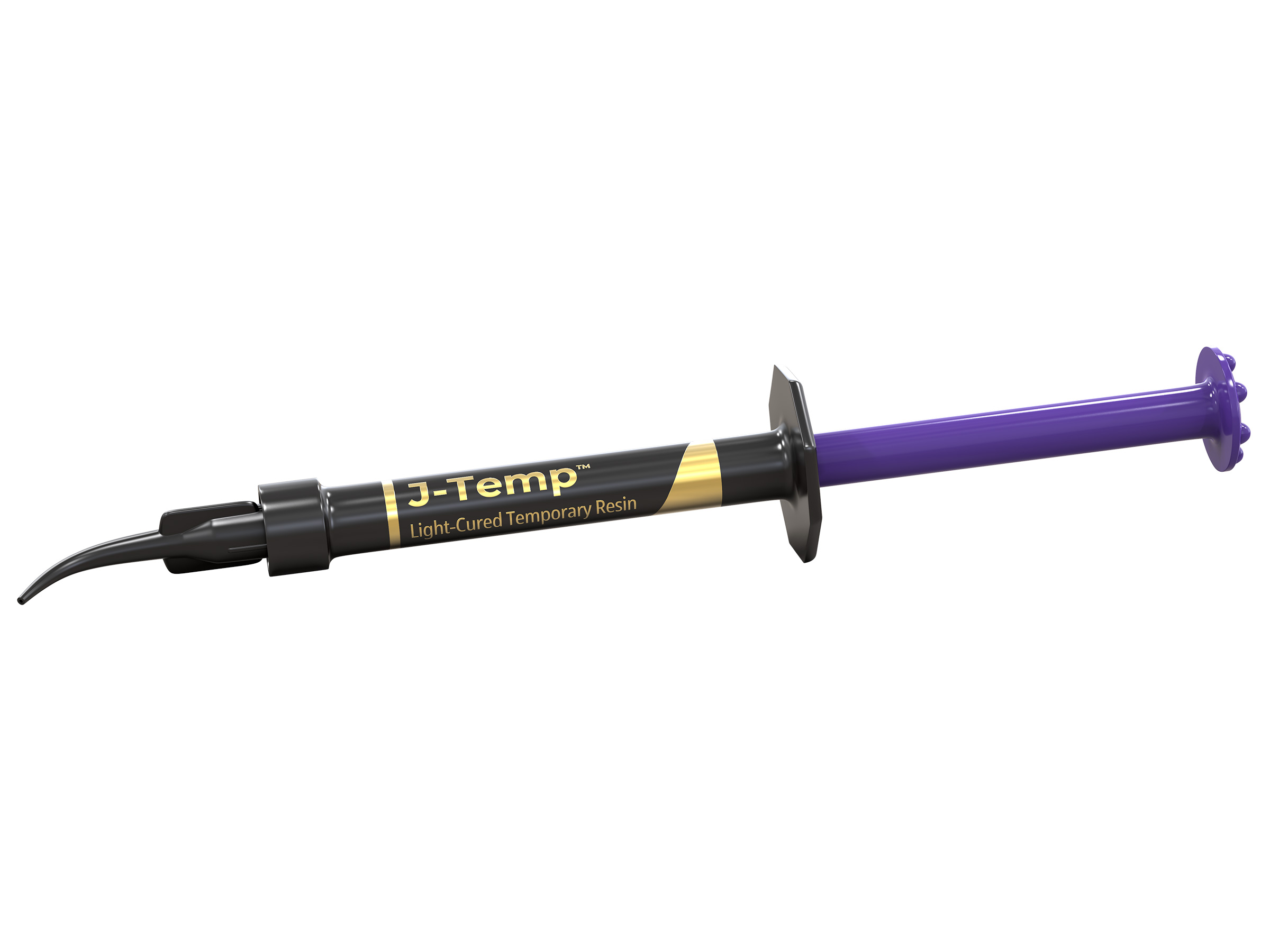
The product is supplied as a pre-mixed syringe (1.2 mL per syringe, sold in kits of four with 20 Black Mini™ Tips) and features a distinctive light purple color. That color choice is deliberate, allowing clinicians to differentiate the temporary material from natural enamel and dentin during placement, adjustment, and removal. The purple shade also serves as a subtle visual cue for patients, reminding them that a temporary restoration is in place and a follow-up appointment is needed.
The Development Story Behind J-Temp
The origin of J-Temp traces back to a specific clinical frustration. According to an interview published on the Ultradent blog, Dr. Fischer-Jessop was performing a root canal on a maxillary molar when she encountered a mesiolingual cusp fractured below the gingival margin. Achieving proper isolation before irrigating the canals proved extremely difficult, and she realized she needed a material that could remain stable in that position until the final buildup and restoration could be placed. Standard composite bonding was impractical in a subgingival, contaminated field, and existing temporary materials lacked the structural integrity to support a rubber dam clamp in that scenario.
That single clinical moment became the catalyst for developing a product that could address not just one indication, but an entire range of temporary material needs. The more Dr. Fischer-Jessop experimented with the formulation across different procedures, the more she recognized its potential as a multi-purpose chairside solution. The product eventually evolved to cover four distinct clinical indications, each validated through real-world testing before the 2023 commercial launch.
The development philosophy reflects a broader trend in dental product design, where clinician-innovators create materials based on firsthand experience with the gaps in existing product lines. Ultradent Products, founded more than four decades ago by Dr. Dan Fischer (Dr. Fischer-Jessop’s father), has a history of clinician-driven product development that started with Astringedent™ hemostatic and continues with J-Temp temporary resin.
Key Features and Material Properties
Before evaluating any dental material for clinical adoption, understanding its core technical properties is essential. The following features define J-Temp temporary resin and distinguish it from competing temporary products.
Light-Cured Polymerization
Unlike chemically cured temporaries that require mixing and impose a fixed set time, J-Temp polymerizes on demand with a standard dental curing light. This gives the clinician full working time to position and adapt the material before initiating the cure. Once cured, the restoration reaches working strength immediately, allowing prompt occlusal adjustment and patient dismissal. For practices that already rely on light-curing technology for composite placement, J-Temp integrates seamlessly into existing workflows. A comprehensive overview of curing lights and related dental equipment can help clinicians evaluate compatibility with their current armamentarium.
Flowable, Self-Leveling Consistency
The viscosity of J-Temp has been engineered to strike a practical balance. It is fluid enough to flow through the syringe tip and conform to preparation walls, yet viscous enough that it will not run or slump out of a cavity. The self-leveling characteristic ensures even material distribution across the preparation floor, creating a uniform seal without extensive manual condensation. This property is particularly valuable when filling deep endodontic access cavities or complex preparation geometries.
Low Polymerization Shrinkage (Less Than 5%)
Polymerization shrinkage in resin-based materials can lead to open margins, microleakage, and compromised seal integrity. J-Temp temporary resin exhibits less than 5% shrinkage volume upon curing. While this figure falls within the expected range for flowable resins, it is notably low for a temporary material and contributes to reliable marginal adaptation throughout the restoration’s service life.
Radiopacity
J-Temp appears clearly on dental radiographs, which allows clinicians to verify the material’s presence, assess marginal adaptation, and confirm complete removal before placing a definitive restoration. This feature addresses a common concern with radiolucent temporary materials, where residual fragments can go undetected and compromise the fit of the final prosthesis.
Moisture Tolerance
Achieving a perfectly dry field is not always feasible, especially in endodontic and subgingival scenarios. J-Temp cures void-free even in a moist environment, which expands its clinical utility to situations where absolute isolation is impractical. This characteristic makes it particularly useful for emergency temporization and cases involving active hemorrhage or saliva contamination.
No Adhesive Required
J-Temp achieves mechanical retention through self-leveling adaptation to the tooth’s internal anatomy, eliminating the need for a separate etching, priming, or bonding step. This simplifies the placement protocol, reduces material costs, and removes the potential for technique-sensitive adhesive failures.
Clinical Indications: Four Solutions in One Syringe
The standout feature of J-Temp temporary resin is its multi-indication approval. Rather than stocking separate materials for each clinical scenario, practitioners can incorporate a single product into their dental treatment plan workflow across four distinct applications.
Temporary Restorations
J-Temp serves as a temporary restorative in endodontic access closures during root canal therapy, interim restorations for inlay and onlay preparations awaiting lab fabrication, cusp buildups for structurally compromised teeth, and sealing bleaching agents during the walking bleach (internal whitening) technique. Clinicians report that J-Temp temporaries remain intact between appointments far more reliably than traditional chemically cured alternatives that tend to soften, wash out, or fracture under occlusal loading.
Splinting Between Implant Copings
When taking impressions for implant-supported prostheses, impression material can pull implant copings toward one another as it sets, leading to framework distortion. J-Temp can be applied as a rigid splint between copings (or with the floss-supported technique) to stabilize their positions during the impression. The cured resin prevents movement and helps ensure a dimensionally accurate result.
Isolation Clamping Structure and Irrigant Barrier
When too much tooth structure has been lost to support a rubber dam clamp, J-Temp provides a quick method to build up the deficient area. The cured resin creates a stable platform for clamp placement while simultaneously acting as a barrier to endodontic irrigants such as sodium hypochlorite. This dual function addresses a common clinical frustration with a single material application.
Bite Ramps and Temporary Occlusal Buildups
In orthodontic treatment, bite ramps are used to disclude posterior teeth and facilitate anterior tooth movement. In occlusal rehabilitation, temporary buildups allow clinicians to trial a new vertical dimension of occlusion. Both applications subject the material to significant masticatory forces, and J-Temp’s formulation provides adequate shear strength for these demanding situations.
Handling and Clinical Workflow
Practical handling characteristics often determine whether a product becomes a daily go-to or sits unused on a shelf. J-Temp’s workflow has been designed around chairside efficiency.
Placement involves dispensing the material from the syringe through the attached tip directly into the preparation. The flowable consistency adapts naturally to the tooth’s anatomy, and the self-leveling property reduces the need for manual condensation. After positioning, the material is light-cured, and occlusal adjustment follows immediately with a high-speed handpiece and finishing burs.
Removal at the definitive treatment appointment is performed with a standard diamond or carbide bur. The purple color provides a clear visual boundary between temporary material and natural tooth structure, preventing over-preparation and ensuring no residual material remains. A post-removal radiograph offers additional confirmation of complete removal.
Storage is straightforward. J-Temp is supplied in light-protected syringes to prevent premature polymerization and should be stored at room temperature, away from direct light sources. The pre-mixed syringe format eliminates the waste, mess, and material variability that can occur with multi-component systems that require chairside mixing. Each syringe provides multiple applications, making the four-syringe kit format an efficient inventory solution for practices of all sizes.
What Dental Professionals Are Saying
Real-world clinician feedback provides valuable insight beyond manufacturer specifications. According to an evaluation published by Dental Product Shopper, J-Temp received a rating of 4.5 out of 5 based on multi-week clinical testing by multiple evaluators.
Dr. James M. Wright, a general and cosmetic dentist who trained at Marquette University School of Dentistry, shared his experience in a clinical tips feature on the Ultradent blog. He noted that J-Temp is ideal for provisionalizing chipped teeth before crown impressions, sealing root canal access cavities, building up tooth structure for rubber dam clamping, and sealing internal bleaching agents. He described the light-cured setting and flowable delivery as a meaningful improvement over older temporaries that require mixing and extended wait times.
Several evaluators highlighted J-Temp’s performance in emergency scenarios. One clinician placed J-Temp on a fractured lingual cusp of an upper bicuspid immediately before the patient left on a trip. When the patient returned, the temporary was fully intact with no sensitivity, and a full-coverage crown was completed without complication.
Multiple practitioners noted that J-Temp significantly reduced chair time compared to chemically cured alternatives. The consensus was that the material’s multi-indication capability eliminated the need to reach for several different products during a single appointment. As reported by Dentistry Today, J-Temp was engineered to offer four solutions in one syringe, and practitioner experience has largely confirmed that promise.
Additional evaluator feedback reinforces the product’s clinical reliability. One practitioner described J-Temp as filling a gap in her materials that she had not previously recognized, noting that she found herself reaching for it in multiple clinical situations throughout the day. Another evaluator highlighted the product’s performance during internal bleaching procedures, describing J-Temp as a quick and dependable method for sealing bleaching material within the pulp chamber between appointments.
The product’s purple color drew consistent praise from evaluators. Clinicians noted that the shade was subtle enough to avoid alarming patients, yet distinct enough to make identification during removal straightforward. One evaluator observed that the purple fades to a lighter, more subtle shade after light curing, which further reduces any aesthetic concern during the temporary period. The color also helps the clinician identify the exact margin between temporary material and tooth structure, reducing the risk of leaving residual material or over-preparing the tooth during removal.
How J-Temp Compares to Traditional Temporary Materials
Evaluating J-Temp in the context of existing options helps clarify its position in the temporary materials landscape.
Compared to chemically cured cements like IRM and Cavit, J-Temp offers faster set times (on-demand light curing vs. waiting for chemical set), a pre-mixed format that eliminates mixing steps, better resistance to washout in the oral environment, and full radiopacity for post-operative verification. Traditional chemically cured materials remain widely used, but their limitations in durability, handling, and imaging visibility are well documented. IRM requires mixing, has a fixed working and setting time, and can be technique-sensitive. Cavit is easier to place but tends to expand slightly during setting and may not provide the structural integrity needed for larger access cavities or multi-surface temporizations.
Compared to putty-type temporaries, J-Temp provides superior structural durability after curing, a more reliable marginal seal, and lower risk of displacement under masticatory forces. Putty-type materials are popular for endodontic access closures because of their ease of placement, but they can soften in the oral environment, lose their seal over time, and are susceptible to washout. Multiple clinicians have reported fewer emergency calls about lost or degraded temporaries after switching to J-Temp from putty-based products. The cured resin structure of J-Temp offers a meaningful step up in mechanical performance compared to materials that remain partially compressible after placement.
Compared to maintaining an inventory of multiple single-indication products, J-Temp consolidates four clinical functions into one material, resulting in reduced inventory management overhead, lower risk of product expiration and waste, and simplified ordering and storage. For practices developing a dental practice business plan or evaluating operational costs, this consolidation offers measurable savings.
Practical Tips for Getting the Best Results
The following recommendations are drawn from manufacturer guidance and published clinician experience.
Use the Black Mini Tip for most applications, switching to the Micro 20-gauge tip for tight interproximal access
Allow the self-leveling property to work before curing, resisting the urge to over-manipulate the material
Check and adjust occlusion immediately after curing, using a high-speed handpiece
Brief patients on the light purple color, explaining that it is a deliberate design feature and a reminder to return for definitive treatment
Take a post-removal radiograph to confirm complete removal, especially before indirect restoration placement
Keep J-Temp on hand for emergency patients presenting with fractured teeth or lost restorations, where its rapid placement and immediate cure are especially valuable
Who Should Consider Adding J-Temp to Their Practice?
J-Temp temporary resin is designed for a broad range of dental professionals and practice settings. Understanding which clinicians stand to benefit most can help guide the purchasing decision.
General Dentists
General practitioners will find J-Temp valuable for everyday temporary restorations, including endodontic access closures, inlay and onlay temporization, and cusp buildups on structurally compromised teeth. The product’s versatility means fewer items to stock, less expired inventory to discard, and a more streamlined operatory workflow. For solo practitioners or small group practices where supply cabinet space is limited, consolidating four products into one represents a practical advantage.
Endodontists
Endodontists will appreciate J-Temp’s reliable seal over root canal access cavities, its ability to cure in moist conditions (a frequent challenge in endodontic procedures), and its radiopacity for post-operative verification. The fact that J-Temp does not require adhesive bonding is a particular advantage in the endodontic setting, where the focus is on efficient, reliable temporization rather than complex adhesive protocols. Emergency calls about failed temporaries between appointments are a well-known source of patient anxiety and practice disruption, and J-Temp’s cured resin seal has been reported to reduce the incidence of these callbacks.
Prosthodontists and Implantologists
Clinicians involved in implant-supported prosthetics will benefit from J-Temp’s application as a splinting agent for impression copings. Impression accuracy is the foundation of a well-fitting prosthetic framework, and even minor coping movement during the impression process can compromise the final result. J-Temp’s rigidity after curing provides a reliable stabilization method that integrates easily into existing impression protocols.
Orthodontists and Occlusal Rehabilitation Specialists
Orthodontists use bite ramps to disclude posterior teeth and facilitate anterior tooth movement, while clinicians performing occlusal rehabilitation use temporary buildups to trial a new vertical dimension. Both applications subject the material to repeated, significant masticatory forces. J-Temp’s shear strength is adequate for these demands, and its removability ensures that modifications can be taken down cleanly when no longer needed. Practices that maintain detailed dental equipment inventories will appreciate the simplification that comes from consolidating these temporary material needs into a single product.
Product Specifications
The table below summarizes key technical and packaging details for quick reference.
Product name | J-Temp™ Temporary Resin |
Manufacturer | Ultradent Products, Inc. |
Material type | Methacrylate-based resin (flowable, temporary) |
Curing mechanism | Light-cured (visible light polymerization) |
Radiopacity | Yes |
Shrinkage volume | Less than 5% |
Color | Light purple |
Viscosity | Flowable, self-leveling |
Kit contents | 4 x 1.2 mL syringes, 20 Black Mini™ Tips |
Adhesive required | No |
Moisture tolerance | Cures void-free in moist conditions |
Oxygen inhibition | Minimal (compatible with peroxide bleaching agents) |
Developer | Dr. Jaleena Fischer-Jessop |
Bottom Line
J-Temp™ Temporary Resin delivers on its core promise of replacing multiple temporary materials with a single, well-engineered product. Its combination of light-cured on-demand setting, flowable self-leveling consistency, radiopacity, moisture tolerance, and distinctive purple identification color makes it a genuinely versatile chairside tool. Clinicians who have integrated J-Temp into their workflows consistently report reduced chair time, simplified inventory, and improved temporary seal durability compared to the chemically cured and putty-type products it replaces.
The product is not without limitations. It is strictly a temporary material and should never be used for definitive restorations. The purple color, while clinically useful, may require a brief patient explanation. As a product introduced in 2023, it has less long-term clinical data than legacy temporary materials. That said, the available practitioner feedback and independent evaluations are consistently positive. For dental professionals looking to reduce product clutter, improve workflow efficiency, and maintain reliable temporary restorations across endodontic, prosthodontic, orthodontic, and general practice applications, J-Temp temporary resin is a strong candidate for adoption. More dental equipment reviews are available for practitioners evaluating other clinical products alongside J-Temp.
Verdict
<p>J-Temp™ Temporary Resin earns a strong recommendation for dental professionals across specialties. The material’s four-indication versatility is its defining advantage, consolidating temporary restorations, implant coping splinting, isolation support, and bite ramp fabrication into one product. The light-cured setting mechanism eliminates the unpredictable wait times of chemically cured alternatives, while the flowable, self-leveling consistency produces a reliable seal with minimal technique sensitivity.</p><p>From a clinical identification standpoint, the combination of a distinctive purple color and full radiopacity provides dual-pathway verification (visual and radiographic) that all temporary material has been removed before definitive restoration placement. This level of traceability is uncommon among temporary materials and represents a meaningful patient safety benefit.</p><p>The handling is intuitive, the syringe delivery is precise, and the no-adhesive placement protocol keeps things simple. Practitioners who have used J-Temp report fewer emergency callbacks about failed temporaries, faster appointment turnaround, and lower material waste compared to managing multiple single-indication products. The product addresses real, everyday clinical frustrations rather than solving a problem that does not exist. For these reasons, J-Temp temporary resin has earned its place as a recommended addition to the modern dental practice’s armamentarium.</p>
Frequently Asked Questions
What is J-Temp temporary resin made of?
J-Temp is a methacrylate-based resin system. It is a flowable, light-cured, radiopaque temporary material formulated for multiple clinical applications. The specific composition is proprietary to Ultradent Products, Inc.
What clinical indications does J-Temp have?
J-Temp is approved for four indications: temporary restorations (endodontic access closures, inlay/onlay temporization, cusp buildups, internal bleaching seals), splinting between implant copings during impressions, providing structure for isolation clamping and serving as a barrier to endodontic irrigants, and creating bite ramps and temporary occlusal buildups for orthodontic and rehabilitation purposes.
Does J-Temp need a bonding agent?
No. J-Temp achieves retention through mechanical adaptation to the preparation’s internal anatomy. No etching, priming, or bonding step is required.
How is J-Temp removed at the follow-up appointment?
The cured material is removed using a standard diamond or carbide bur in a high-speed handpiece. The purple color provides a clear visual guide for identifying the boundary between temporary material and tooth structure. A radiograph can confirm complete removal thanks to the material’s radiopacity.
Can J-Temp be placed in a moist environment?
Yes. J-Temp is formulated to cure void-free even when moisture is present, making it suitable for endodontic access closures, subgingival applications, and other scenarios where absolute dryness is difficult to achieve.
Is J-Temp visible on X-rays?
Yes. J-Temp is radiopaque, appearing as a clearly defined opacity on dental radiographs. This allows the clinician to verify placement, assess margins, and confirm complete removal before definitive restoration.
Why is J-Temp purple?
The light purple color serves two functions. It allows clinicians to differentiate temporary material from natural tooth structure during placement and removal, and it acts as a visual reminder to patients that the restoration is temporary and a follow-up visit is needed.
How long does J-Temp last in the mouth?
J-Temp is a temporary material, and its longevity depends on the clinical application, occlusal loading, and oral hygiene. It is designed to remain in place until the definitive treatment appointment. Clinicians report that J-Temp maintains its seal and structural integrity more reliably than many traditional temporary materials.
What is included in the J-Temp syringe kit?
The standard kit contains four 1.2 mL syringes of J-Temp temporary resin and 20 Black Mini™ Tips for controlled delivery.
Can J-Temp be used with internal bleaching?
Yes. J-Temp exhibits minimal oxygen inhibition, meaning it is not significantly degraded by peroxide-based bleaching agents. This makes it suitable for sealing bleaching material within the pulp chamber during the walking bleach technique.
Who developed J-Temp?
J-Temp was developed by Dr. Jaleena Fischer-Jessop, Ultradent’s Vice President of Clinical Affairs. The product was created to address real clinical needs she encountered in her own practice, specifically the inefficiency of stocking multiple single-indication temporary materials.
Is J-Temp a permanent restorative material?
No. J-Temp is strictly a temporary material. It should not be used as a substitute for definitive direct or indirect restorations. Patients should always be scheduled for follow-up treatment within an appropriate timeframe.