Rating: 4.6/5
VALO Grand Curing Light Review
The VALO curing light family from Ultradent is a fixture in US restorative practices, and the VALO Grand is its large-lens model. Ultradent launched it in 2016 as a cordless light...
Reviewed by Agnes Markovic
Pros
- The 12 mm lens covers a full molar and most Class II preparations in one exposure.
- Broadband 385–515 nm output cures camphorquinone and alternative photoinitiators.
- Three power modes range from 1000 mW/cm² for deep preparations to 3200 mW/cm² for three-second sealants.
- A collimated, even beam keeps useful irradiance at clinical distances.
- The 11 mm head gives good posterior access despite the larger lens.
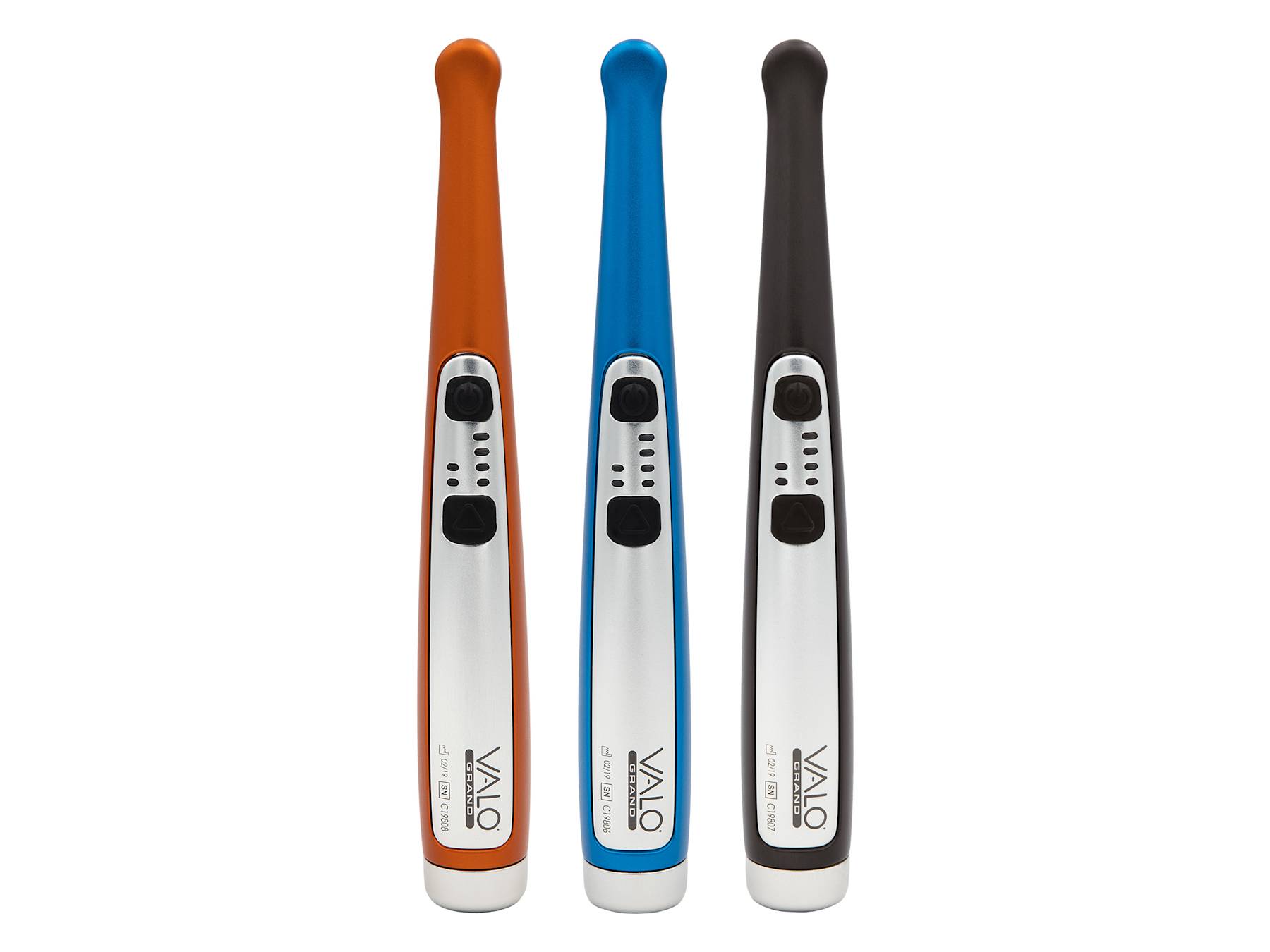
- The milled aluminum body and tempered glass lens resist drops and wear.
- Top and underside buttons make activation easy in every quadrant.
- Cordless output stays constant as the batteries discharge.
- A 5-year warranty covers the light.
Cons
- The cordless kit lists at about $1,750 in the US.
- At about 190 g with batteries, it feels heavier than pen-style lights.
- It has no white or black diagnostic light modes.
- Cordless cells need swapping about once a week, and the warranty excludes batteries.
- Some common disinfectants, including CaviCide products, can corrode or discolor the body.
- The larger head can feel crowded in pediatric and small-mouth cases.
- Ultradent sells the light only as a kit.
The VALO curing light family from Ultradent is a fixture in US restorative practices, and the VALO Grand is its large-lens model. Ultradent launched it in 2016 as a cordless light and added a corded version in 2019, per a user report on Ultradent's European blog. This review covers specs, clinical handling, maintenance, and value for buyers.
TL;DR
The VALO Grand covers a 10 mm molar in one exposure with its 12 mm lens.
Its 385–515 nm broadband LED polymerizes camphorquinone and alternative photoinitiators such as TPO.
Ultradent sells corded and cordless versions and backs both with a 5-year warranty.
Clinicians who want white and black diagnostic light should compare it with the VALO X curing light.
VALO Grand At A Glance
The VALO Grand is a broadband LED wand light with a 12 mm lens and three curing modes, sold in corded and cordless versions. It keeps the output and spectrum of the standard VALO curing light and enlarges the lens footprint by about 50%, according to Ultradent's product page. The table below lists the published specifications.
Specification | VALO Grand |
|---|---|
Light source | Custom multiwavelength LED array |
Wavelength range | 385–515 nm |
Lens | 12 mm tempered glass |
Head height | 11 mm |
Standard Power | 1000 mW/cm² |
High Power Plus | 1600 mW/cm² |
Xtra Power | 3200 mW/cm² |
Body | CNC-milled unibody aerospace-grade aluminum |
Activation | Buttons on the top and underside of the wand |
Power | Corded (100–240 V supply) or cordless (two rechargeable lithium iron phosphate batteries) |
Warranty | 5 years, excluding batteries, chargers, adapters, and lenses |
US list price | $1,749.99 for the cordless kit on Ultradent's store (September 2026) |
Some older Ultradent documents still describe the middle setting as High Power at 1400 mW/cm². The current page lists High Power Plus at 1600 mW/cm². Buyers looking at an older or secondhand unit should read the instructions for use for that exact model, since suggested exposure times differ between the two versions.
Design And Ergonomics
The VALO Grand fits a 12 mm lens into a head that stands 11 mm tall. That pairing is the main reason clinicians choose it over the standard VALO curing light, because the larger footprint costs very little posterior access.
A Wand Body With The LEDs In The Head
Most LED curing lights still use a pistol grip with a fiber-optic light guide bent at the tip. Every VALO light places the LED array directly behind the lens in the head of a straight, slim wand. No light guide sits in the path to crack or chip, and no light guide loses transmission as it ages.
The wand shape also changes the grip. Many operators hold it like a pen for anterior work and switch to a palm grasp for molars, with a finger resting on adjacent teeth. The shallow head lets the lens sit flat over a lower second molar in patients who cannot open wide.
Clinicians moving from a gun-style light usually need about a week to settle into the wand grip. The common early mistake is holding the wand too far back, which lets the head tilt off the occlusal plane. Choking up on the body and resting the ring finger on the arch fixes it quickly.
Why A 12 mm Lens Changes Posterior Work
A lower first molar measures roughly 10 to 11 mm mesiodistally. A lens smaller than the preparation forces the operator to step the light across the tooth in overlapping exposures, and every gap between steps leaves an under-cured zone. Ultradent states that the Grand's footprint can cure the entire surface of a Class II posterior preparation in one exposure.
Fewer repositioning steps also give the lens fewer chances to drift. Drift during exposure is one of the most common causes of under-curing reported in the light-curing literature.
Build Quality And Heat Management
Ultradent machines each VALO Grand from a single bar of hardened aerospace-grade aluminum at its facility in South Jordan, Utah. The metal body survives drops that would crack a plastic housing. It also works as a heat sink that draws heat away from the LEDs, which helps protect output over years of use.
Two Activation Buttons
The standard VALO has one button on top. The Grand adds a second button on the underside of the wand, so the operator can trigger a cure with an index finger or a thumb. Right-handed clinicians working in the lower right or upper left quadrant can activate the light without rotating the wand in their hand.
Weight And Hand Fatigue
The cordless Grand weighs about 190 g with batteries, which is heavier than pen-style lights. Operators with smaller hands sometimes notice the wand diameter late in a long restorative block. Teams that already track posture and grip strain through a dental ergonomics program should include the curing light in that review, along with loupes and chair position.
Curing Modes And Light Output
The VALO Grand offers three modes, from 1000 to 3200 mW/cm². The right mode depends on the energy a material needs and on how close the preparation sits to the pulp.
Mode | Irradiance | Typical clinical use |
|---|---|---|
Standard Power | 1000 mW/cm² | Adhesives, deep preparations, increments near the pulp |
High Power Plus | 1600 mW/cm² | Routine posterior composite with shorter exposures |
Xtra Power | 3200 mW/cm² | Sealants, bracket bonding, tack curing, patients who cannot stay still |
Radiant Exposure Matters More Than Peak Irradiance
A composite needs a set radiant exposure, measured in J/cm², to reach adequate conversion. Radiant exposure equals irradiance multiplied by time, so 1000 mW/cm² for 10 seconds delivers about 10 J/cm². Ultradent's FAQ gives an example in which a 10-second Standard cure drops to about 4 seconds in the higher mode.
Reciprocity between intensity and time does not hold for every material. Some composites convert less completely under very short, very intense exposures. The composite manufacturer's instructions come first, with Ultradent's suggested curing times card as a starting reference.
In daily use, most general dentists settle on High Power Plus for composite layers and switch down to Standard for bonding agents and preparations close to the pulp. Xtra Power tends to stay reserved for sealants, bracket bases, and tack cures. Clinicians who default to Xtra Power for everything often report more post-operative sensitivity complaints on deep restorations, so the middle mode ends up as the workhorse.
When Xtra Power Makes Sense
Xtra Power emulates plasma arc intensity without the bulbs or the cabinet. Ultradent reports that it cures UltraSeal XT plus sealant in three seconds. That speed helps with sealants on young patients and with orthodontic brackets, where isolation can fail within seconds.
Deep restorations near the pulp are a poor fit for this mode. Heat and polymerization stress both rise with intensity, and Standard or High Power Plus leaves more margin in those cases.
Heat, Shrinkage Stress, And Pulp Safety
Ultradent notes that a composite shrinks by the amount its formulation dictates, while the rate of shrinkage and the resulting stress rise with intensity. Its guidance centers on increments of 2 mm or less. It also suggests curing fewer tooth surfaces at once and pausing a second or two between cures.
Every curing light raises temperature through the emitted energy and the exothermic set of the resin. Ultradent cites in vitro data showing no damaging pulp chamber temperature rise in Xtra Power mode on its VALO Grand page. It still recommends several shorter cycles over one long cycle, with air from the triplex syringe during and after exposure.
Clinical Performance
The clinical strength of this VALO curing light comes from a broadband spectrum delivered through a collimated, even beam. Those properties decide how much energy reaches the floor of a proximal box, which matters more than the number printed on the box.
Broadband Spectrum From 385 to 515 nm
Camphorquinone absorbs most strongly near 468 nm, a range every blue LED reaches. Many esthetic composites also contain TPO (near 385 nm), PPD (near 393 nm), or Ivocerin (near 408 nm), and a narrow-band blue LED can leave those initiators under-activated.
The VALO dental curing light combines violet and blue LEDs across 385–515 nm. An independent study by André and colleagues in Operative Dentistry measured emission spectra and posterior tip access across several light-curing units, including the VALO curing light. For practices that stock composites from several manufacturers, including universal-shade materials such as Omnichroma, a broadband light removes the need to check each product's initiator system. Our guide to choosing dental materials covers that selection process in more detail.
Beam Collimation At Clinical Distances
In a deep Class II box, the gingival floor can sit 5 to 8 mm from the lens once cusp height and the matrix band are counted. A beam that spreads quickly loses much of its irradiance over that distance.
Ultradent designed the Grand's optics to keep the beam collimated across the full 12 mm lens, so intensity holds up better as the distance grows.
Depth Of Cure And Bulk-Fill Composites
Depth of cure depends more on the composite than on the light. Shade and opacity both change how far light penetrates. Ultradent recommends 2 mm increments for conventional composites in every mode, and bulk-fill materials should follow the composite manufacturer's stated time and irradiance for 4 to 5 mm layers.
Output On A Draining Battery
A common concern with cordless lights is output that fades as the battery drains. Ultradent states that the Ultradent VALO cordless design keeps intensity constant until the batteries need replacing. When the light signals low battery, swapping cells right away remains the safest habit.
Chairside Assessment: How The VALO Grand Handles In Practice
Specifications only go so far with a curing light. The notes below reflect how the VALO Grand behaves across the procedures a general practice runs every week, and where clinicians tend to form strong opinions about it after the first month.
Class II Composites
This is where the Grand earns its price. On a mesio-occlusal preparation in a lower first molar, the 12 mm lens covers the whole occlusal outline from one position, so the operator stops shuffling the light between the mesial box and the distal fossa. With a rubber dam and a wedged sectional matrix in place, the head sits over the tooth without pushing the clamp or the cheek.
The proximal box still needs extra attention. The metal band shadows the gingival floor, and no lens size changes that. Experienced clinicians add a buccal and a lingual cure once the band comes off, and the Grand's flat head makes those angled cures easy to seat against the tooth.
Sealants And Pediatric Work
Xtra Power changes sealant appointments with children. A three-second cure fits inside the window a restless six-year-old gives, and that short exposure often saves a re-isolation. The large head is the drawback here. In a small mouth, the lens can crowd the lower second primary molar, and some pediatric teams keep a standard VALO in the same room for that reason.
Veneers And Indirect Cementation
For resin cement under thin veneers, the broadband output and the large lens cover a central incisor facially in one pass. Clinicians usually tack each unit for a second or two in Xtra Power, clean excess cement, then complete the cure in Standard mode from facial and lingual. Thicker lithium disilicate crowns need noticeably longer exposures, and most operators double the cement manufacturer's minimum time through ceramic.
Orthodontic Brackets
Orthodontic teams value the Grand for speed on bracket bases, where one short exposure per bracket keeps a full-arch bond moving. The wide lens can spill light onto neighboring brackets. That rarely causes harm, but it can prematurely set adhesive on a bracket that still needs repositioning, so assistants learn to cure one tooth at a time.
What Patients Notice
Most patients do not notice the curing light at all. The exception is warmth on the lip or cheek during Xtra Power or long Standard cures in the posterior. A stream of air from the assistant stops the complaint almost every time. Patients with anxiety respond well to shorter cure times, because each exposure feels like one less step in a long appointment.
What The Dental Team Notices
Assistants tend to like the motion sensor more than dentists expect. The light wakes on its last mode when lifted, so nobody re-selects High Power Plus between patients. The most common complaint from the team concerns weight. After three or four posterior restorations in a row, the wand feels heavier than a pen-style light, especially for clinicians with smaller hands.
Where The VALO Grand Falls Short
No light suits every operatory, and the Grand has limits that experienced users point out quickly. None of them rule it out, but each one affects a specific type of practice.
Access to the distal of upper second molars in patients with a tight cheek remains awkward, because the larger head leaves less room to angle. The lack of diagnostic light means clinicians who want transillumination or fluorescence checks still need a separate device. Cordless owners who forget to rotate batteries will eventually hit a low-battery warning mid-procedure, which is avoidable but still disruptive.
The disinfectant issue deserves a firm warning. Many practices wipe every surface with the same product, and Ultradent's own guidance says CaviCide products corroded and discolored VALO bodies. A practice that ignores that advice will likely see a dull, pitted finish within a year or two, with no warranty coverage for it.
Who The VALO Grand Suits Best
The Grand fits practices where posterior composites make up a large share of daily production. General dentists placing several Class II restorations a day will see the clearest return, because the lens saves repositioning on every tooth.
Practices built around anterior cosmetic work or pediatric care should weigh the standard VALO or the VALO XS first. Clinicians who want one device for curing and diagnostics should trial the VALO X curing light before ordering the Grand.
Corded Vs Ultradent VALO Cordless
The cordless VALO Grand suits a light that moves between operatories, and the corded model suits a light that stays on one unit. Output, spectrum, and lens are identical in both versions.
Factor | VALO Grand Cordless | VALO Grand Corded |
|---|---|---|
Power source | Two rechargeable lithium iron phosphate batteries | Medical-grade 100–240 V supply |
Batteries in kit | Four, plus a charger | None needed |
Runtime per charge | About 400 cure cycles, or about one week on average | Unlimited |
Battery lifespan | 1,000–2,000 charge cycles | Not applicable |
Storage | Countertop, drawer, or stand | Standard dental unit bracket or included mount |
Sleep mode | Motion sensor wakes the light on its last setting | Not applicable |
Living With The Cordless Model
The Ultradent VALO cordless kit ships with four batteries, so one pair charges while the other pair runs the light. Most practices swap cells at the start of each week or when the light warns of low charge. Ultradent's chargers accept only VALO-branded rechargeable batteries, and the warranty excludes batteries and chargers.
If the light reports low battery with freshly charged cells, Ultradent suggests removing and refastening the back cap, then trying another known-good pair. Poor contact at the cap causes this more often than failed cells do.
A simple habit prevents most battery trouble. Many offices mark the two battery pairs with a colored dot and swap them every Monday morning, whatever the charge indicator says. The light then never runs low during a long afternoon of restorative work.
When The Corded Model Fits Better
The corded VALO Grand removes the charging routine and the replacement cells. It rests in a standard unit bracket like a handpiece. The cable adds a surface to wrap and disinfect, and it can drape across the patient's chest.
For a high-volume restorative chair where the light never leaves the unit, corded is the simpler choice. Practices planning a new build can map bracket and outlet positions during operatory design, before cabinetry locks in the layout.
VALO Grand Vs VALO X Curing Light And The Original VALO Light
The VALO Grand sits between the original VALO light and the newer VALO X curing light. Ultradent has since added the VALO XG with an 11.7 mm lens and the VALO XS with a 9.7 mm lens to the X family, according to the VALO X product page.
Feature | Original VALO | VALO Grand | VALO X |
|---|---|---|---|
Lens | Smaller, about 50% less footprint than the Grand | 12 mm | 12.5 mm |
Curing modes | Standard, High, Xtra | Standard, High Power Plus, Xtra | Standard, Xtra |
Diagnostic light | None | None | White light and black light |
Controls | One button | Top and underside buttons | Buttons plus accelerometer mode switching |
Power | Corded or cordless models | Corded or cordless models | One light that runs on a cord adapter or batteries |
Warranty | Per Ultradent terms | 5 years | 5 years |
VALO Grand Vs The Original VALO Light
Ultradent confirms that the Grand and the standard VALO Cordless share power output and wavelength. The Grand adds the 50% larger footprint and the second button. Practices focused on posterior composites benefit most from the larger lens. Pediatric and orthodontic teams that work in small mouths may find the standard VALO light easier to place, especially for pediatric fillings.
VALO Grand Vs VALO X
The VALO X curing light is a full redesign with a 12.5 mm lens and 12 LEDs. Eight LEDs handle curing and four white LEDs handle diagnostics. White light helps with shade matching, and black light helps locate fluorescent composite remnants at the margins. The light wakes when lifted, and a forward drum-tap or side-to-side wave changes modes.
The VALO X drops the middle power mode and offers Standard and Xtra only. Clinicians who built their protocols around High Power Plus on the Grand will need to rework their exposure times. Some operators like the motion controls, and others prefer the Grand's two plain buttons.
Choosing Between Them
The decision usually comes down to diagnostic features and budget. The list below matches each model to a practice profile.
Choose the VALO Grand for a large-lens broadband light with three power levels and simple button controls.
Choose the VALO X curing light for diagnostic light modes, five accessory lenses, and one light that switches between corded and cordless use.
The standard VALO or the VALO XS fits pediatric and anterior-heavy practices, where a smaller head matters more than full-molar coverage.
Ultradent also makes the Gemini EVO diode laser, and practices already on Ultradent service contracts sometimes bundle equipment purchases for better pricing.
Infection Control And Maintenance
The VALO Grand tolerates years of daily handling, but Ultradent's warranty excludes damage from the wrong disinfectant. A written protocol protects the light and the practice. Our infection control guide covers the wider operatory workflow.
Barrier Sleeves
A VALO-specific barrier sleeve belongs on the light for every patient. The sleeves are cut for the wand and sit flat against the glass. A loose bag or cling film can wrinkle over the lens and scatter light. Soares and colleagues in the Journal of Dentistry measured how infection control barriers change the output of a multi-peak curing light, and fitted barriers performed best.
Approved Disinfectants
Ultradent recommends isopropyl alcohol, ethyl alcohol-based cleaners, or another non-bleach, non-abrasive disinfectant, and it names Lysol Brand III Disinfectant Spray. After repeated reports of corrosion and discoloration on VALO bodies, Ultradent stopped recommending CaviCide products for the light. Cleaning damage is not covered by the warranty, so the team should confirm which wipe sits next to the curing light holder.
Lens Care And Radiometer Checks
Cured resin and scratches on the lens are common reasons for low output. A daily lens check at the start of the session catches most problems. Resin build-up comes off with a plastic instrument or an approved cleaner, never a metal scaler.
The most common contaminant is bonding agent flicked onto the lens while it hovers over the preparation. It cures into a thin haze that the eye misses under the operatory light. Holding the lens up to a window or white light at the start of each day makes that haze obvious.
LED output declines slowly enough that the eye misses it. Monthly radiometer readings, logged on the same device and taken through a clean sleeve, show change over time. Our article on when to upgrade dental LED curing lights lists the warning signs that point to a replacement.
Warranty And Durability
Ultradent backs the VALO Grand with a 5-year limited warranty from the purchase date. It covers materials and workmanship for the original purchaser with proof of purchase. The framework in assessing device reliability helps practices compare that coverage against other lights.
Technique Tips For The VALO Dental Curing Light
A VALO dental curing light delivers its rated energy only when the lens sits close, flat, and steady over the target. The habits below matter more than mode selection. The ADA's curing light resource covers the same principles along with blue-light eye protection.
Place the lens as close to the restoration as possible and keep it parallel to the surface being cured.
Seat and aim the light before pressing the button, so no exposure time is lost to movement.
Watch the lens through an orange shield or filtered loupe inserts for the full exposure.
Rest a finger on the adjacent teeth to steady the wand.
Cure the proximal box again from buccal and lingual after the metal matrix comes off.
Keep conventional composite increments at 2 mm or less and follow bulk-fill instructions exactly.
Split long exposures into two shorter cycles and use air from the triplex syringe.
Keep the beam off gingiva and mucosa, particularly in Xtra Power.
Extend exposure when curing resin cement through porcelain or lithium disilicate restorations.
Longer exposure through ceramic matters for porcelain veneers, where thicker or more opaque shades absorb more light. For provisional work, light-cured temporary materials such as J-Temp also rely on the same close, steady positioning.
Pricing And Value
Ultradent lists the VALO Grand cordless kit, its large-lens VALO curing light, at $1,749.99 on its US store as of September 2026. Dealer pricing, promotions, and regional taxes change the final figure.
What Ships In The Kit
The cordless kit typically includes the light, four rechargeable batteries, a charger, an orange protective shield, a holder, and a starter pack of barrier sleeves. The corded kit includes the international power supply and a mounting bracket. Ultradent does not currently sell the light outside a kit.
Running Costs
Ongoing costs stay modest. Barrier sleeves cost about $26 per pack on Ultradent's US store. Cordless owners replace batteries every few years, and accessory lenses are optional. No bulbs or light guides need replacing.
Buying Advice
Ultradent and dental dealers run trade-in offers and bundle deals around trade shows and year-end. Unusually cheap marketplace listings deserve caution, because counterfeit VALO-style lights exist and the warranty applies only to the original purchaser. Our used dental equipment buying guide explains what to check on a secondhand light, and new practices can slot the purchase into an essential equipment checklist.
Cost Per Restoration
A light that lasts five to ten years and supports hundreds of restorations a month adds a very small cost to each composite. Practices that itemize chairside costs in each dental treatment plan can see that figure next to the fee. The patient-facing side of the same math appears in the Dental Reviewed guide to filling costs.
Bottom Line
The VALO Grand pairs a 12 mm lens with a 385–515 nm broadband spectrum, in a milled aluminum wand that still clears second molars. Among current VALO curing light models, it remains the simplest large-lens option, and it suits general practices that place posterior composites daily.
Its weak points are specific. The wand feels heavy late in a long restorative block, and upper second molars in tight cheeks stay awkward. Practices that want diagnostic light, accessory lenses, or one light that runs corded and cordless should test the VALO X curing light before ordering.
Whichever VALO light a practice chooses, results depend on the team using it well. Close and steady positioning, clean lenses, fitted sleeves, and monthly radiometer checks decide how well each restoration cures.
Verdict
<p>The VALO Grand is the light to buy for a <a target="_blank" rel="noopener noreferrer nofollow" class="text-primary underline hover:text-primary/80" href="https://dentalreviewed.com/blog/what-is-restorative-dentistry"><u>restorative dentistry</u></a> practice that lives on posterior composites. Its 12 mm lens is the single feature that justifies choosing it over the standard VALO curing light.</p><p>Chairside, the difference shows up on every Class II. One lens position covers a full molar, so the operator stops stepping a small tip across the tooth and guessing at the overlaps. The 11 mm head still reaches lower second molars in patients who open poorly. High Power Plus becomes the everyday setting for most general dentists, with Standard kept for adhesives and deep preparations.</p><p>The aluminum body tolerates drops and years of wiping, and the 5-year warranty backs that up. The Ultradent VALO cordless version is the better pick for most offices, since one light can move between rooms.</p><p>The weight becomes noticeable late in a long restorative block. Upper second molars in tight cheeks stay awkward. Clinicians who want a diagnostic light should look at the VALO X curing light instead, and every team needs to keep CaviCide away from the finish.</p><p>For a general dentist placing several posterior composites a day, the VALO Grand is a confident recommendation and a light most practices will keep for close to a decade.</p>
Frequently Asked Questions
What is the difference between the VALO Grand and the standard VALO curing light?
Both share power output, modes, wavelength range, and the wand design. The VALO Grand has a 12 mm lens with a footprint about 50% larger, plus a second activation button on the underside.
What wavelength does the VALO dental curing light emit?
The VALO Grand emits broadband light from 385 to 515 nm through violet and blue LEDs. This range covers camphorquinone and alternative photoinitiators such as TPO and PPD.
What curing modes does the VALO Grand offer?
Standard Power runs at 1000 mW/cm², High Power Plus at 1600 mW/cm², and Xtra Power at 3200 mW/cm². Older units list High Power at 1400 mW/cm², so the model's instructions for use should be checked.
How long does the Ultradent VALO cordless battery last?
A charged pair lasts about 400 cure cycles, or roughly a week of average use. Each battery can be recharged 1,000 to 2,000 times, and the kit includes four batteries so one pair charges while the other runs the light.
Does output drop as the battery runs down?
Ultradent states that intensity stays the same as the charge fades. Aging batteries need charging more often, and cells should be swapped as soon as the light signals low battery.
Is Xtra Power mode safe for the pulp?
Ultradent cites in vitro testing that showed no damaging pulp chamber temperature rise in Xtra Power mode. Heat still rises, so clinicians should split cures near the pulp into shorter cycles and cool the tooth with air.
How should the VALO Grand be disinfected?
A VALO barrier sleeve goes on for every patient. Afterward, the light can be wiped with isopropyl alcohol, ethyl alcohol-based cleaners, or another non-bleach, non-abrasive disinfectant. Ultradent advises against CaviCide products.
Is the VALO X curing light better than the VALO Grand?
The VALO X adds a 12.5 mm lens, white and black diagnostic light, accessory lenses, and switchable corded or cordless power. The Grand keeps three curing modes and simpler button controls. Both carry a 5-year warranty.
Can the VALO Grand cure resin cement under ceramic restorations?
Yes. Ultradent states that its output penetrates porcelain and cures the underlying resin cement. Thicker or more opaque ceramics need longer exposures from several surfaces.
How often should a VALO light be checked with a radiometer?
Monthly checks work well for most practices. Readings should come from the same radiometer through a clean barrier sleeve, and the log should track change over time.
What does the VALO Grand warranty cover?
The 5-year limited warranty covers defects in materials and workmanship for the original purchaser. Batteries, chargers, adapters, and lenses are excluded.