Rating: 4.3/5
Gemini EVO™ Laser Review
Gemini EVO™ Laser: What Dental Professionals Need to KnowLaser dentistry continues to reshape how dental professionals approach soft tissue procedures, and the Gemini EVO™ from...
Reviewed by Marcus Hale
Pros
- 100W peak super-pulsed power for faster, cleaner incisions
- Dual-wavelength (810 nm + 980 nm) with three selectable modes
- Three PBM adapters included for immediate photobiomodulation use
- Reduced thermal damage and less post-operative patient discomfort
- Pre-initiated tips allow setup in under one minute
- Wi-Fi connectivity with OTA updates and remote technical support
- Intuitive guided touch interface with 16 preset procedures
- Compact (2.8 lbs), portable design with cordless battery operation
- Dashboard tracks usage statistics and ROI
- Tips compatible with original Gemini for easy transition
Cons
- Higher upfront investment than basic single-wavelength diode lasers
- Soft tissue only, cannot be used for hard tissue procedures
- Disposable tips represent an ongoing consumable cost
- Battery life may require monitoring during heavy-use days
- Some procedures may still be faster with a traditional scalpel
- Dashboard features require initial setup and a brief learning curve
- State regulations may require additional training or certification
- Average power capped at 2.0 watts across all modes
- Two-year base warranty is standard, not exceptional for premium equipment
- No built-in camera or imaging capability
Gemini EVO™ Laser: What Dental Professionals Need to Know
Laser dentistry continues to reshape how dental professionals approach soft tissue procedures, and the Gemini EVO™ from Ultradent Products is one of the most talked-about diode lasers on the market. Released in 2022 as the successor to the original Gemini 810 + 980 (the first dual-wavelength soft tissue diode laser sold in the United States), the Gemini EVO combines 100 watts of peak super-pulsed power with dual-wavelength technology, Wi-Fi connectivity, and integrated photobiomodulation (PBM) capability.
This review examines whether the Gemini EVO delivers enough clinical value, usability, and return on investment to justify its place in a modern operatory. The evaluation draws on manufacturer specifications from Ultradent Products, published clinical feedback from practicing dentists, and product evaluations from Dental Product Shopper. For a broader overview of how dental lasers work and how different laser types compare, see our comprehensive dental lasers guide.
Overview: What Is the Gemini EVO™ Laser?
Understanding where the Gemini EVO fits within the broader landscape of soft tissue diode lasers helps dental professionals evaluate whether this system aligns with their clinical needs and practice goals.
The Gemini EVO™ is a Class IV soft tissue diode laser manufactured by Ultradent Products, Inc., a South Jordan, Utah-based developer of dental materials and equipment. The laser operates at two wavelengths (810 nm and 980 nm) that can be used individually or combined, giving clinicians three distinct modes in a single device. Ultradent positions the Gemini EVO as an upgrade to the original Gemini 810 + 980, which launched in 2015 and earned strong adoption across general and periodontal practices.
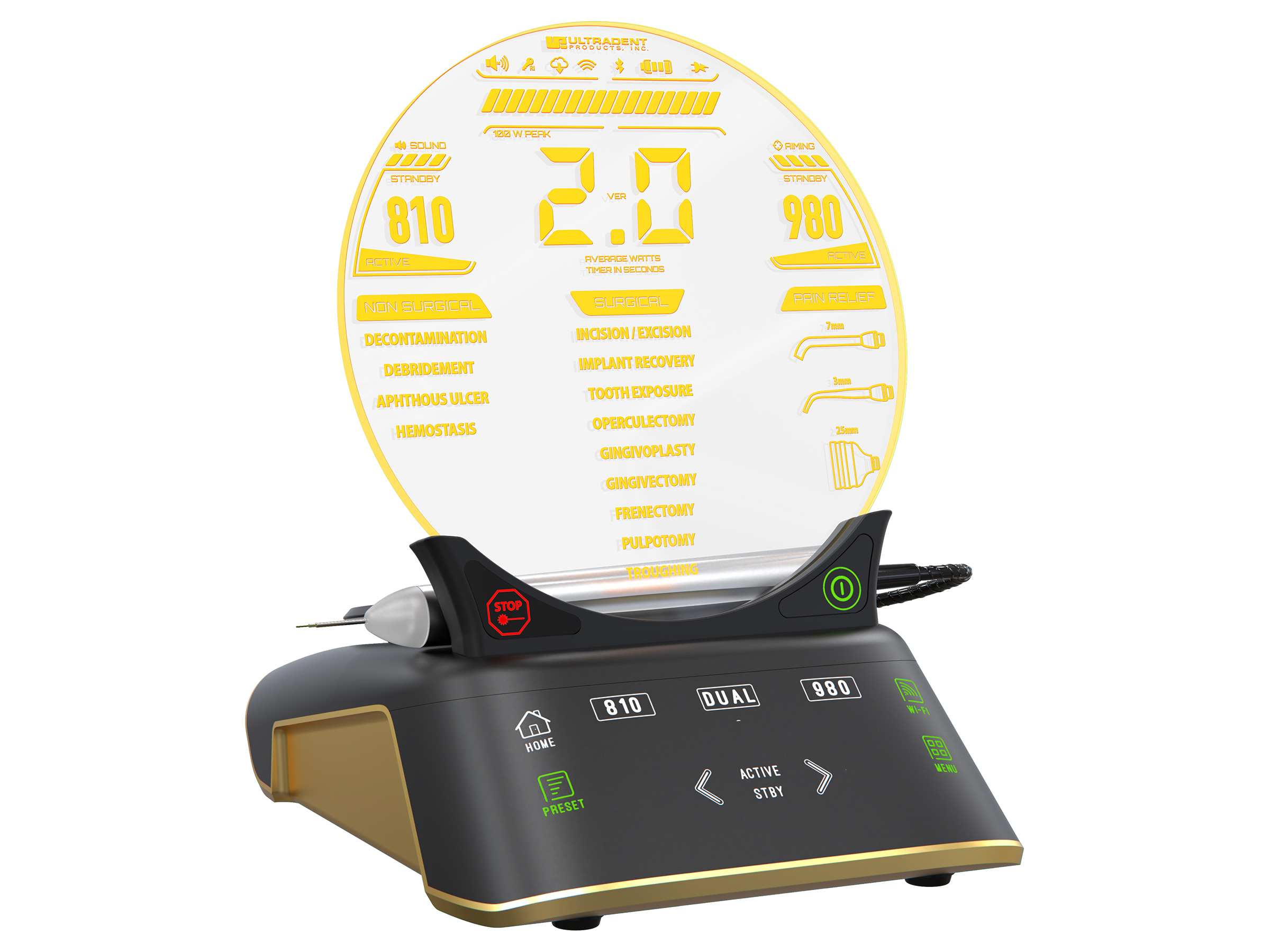
The most notable upgrade is the jump from 20 watts to 100 watts of peak super-pulsed power, a fivefold increase that enables faster cutting, reduced heat buildup, and cleaner incisions. The Gemini EVO also introduces Wi-Fi connectivity, a mobile dashboard for tracking usage and ROI, 16 pre-programmed procedure settings, and three PBM adapters included in every kit. The unit weighs just 2.8 pounds and runs on a rechargeable lithium-ion battery, making it easy to move between operatories throughout the day.
The standard Gemini EVO kit includes the laser unit, a wireless Bluetooth foot pedal, three pairs of protective eyewear, ten pre-initiated disposable fiber tips (5 mm), a DC power supply, and three PBM adapters in 3 mm, 7 mm, and 25 mm sizes. The laser comes with a two-year warranty (extendable) and ships with complimentary access to Ultradent’s online laser training program, which provides five continuing education credits upon completion.
Technical Specifications
A thorough understanding of a laser’s technical profile is essential before committing to a purchase. The table below summarizes the Gemini EVO’s published specifications, sourced from Ultradent’s official documentation.
Gemini EVO™ 810 + 980 – Complete Specifications | |
Classification | Class IV laser device |
Wavelengths | 810 nm ± 10 nm, 980 nm ± 10 nm, Dual mode (50/50) |
Peak power | Up to 100 watts (super-pulsed) |
Max. average power | 2.0 watts ± 20% (all modes) |
Power range | 0.1 to 2.0 watts average |
Pulse frequency | 20–800 Hz |
Pulse width | 0.05 ms |
Duty cycle | 0.1%–4% |
Aiming beam | 650 ± 10 nm, 2 mW max |
Unit dimensions | 7.5” L × 5.7” W × 8.2” H |
Weight | 2.8 lbs (1.2 kg) |
Battery | 14.4V rechargeable lithium-ion |
Connectivity | Bluetooth 2.4 GHz, Wi-Fi 2.4 GHz (WPA2) |
Preset procedures | 16 (divided into 3 categories) |
Tips included | 10 × 5 mm pre-initiated disposable fiber tips |
PBM adapters | 3 mm, 7 mm, 25 mm |
Warranty | Two years (extendable) |
Compliance | IEC 60601-1, IEC 60825-1, 21 CFR 1040.10/11 |
The combination of high peak power with a very low duty cycle (0.1% to 4%) is central to the Gemini EVO’s clinical performance. Each pulse lasts just 0.05 milliseconds, delivering concentrated energy that vaporizes tissue efficiently while allowing surrounding tissue to cool between pulses. This super-pulsed delivery mechanism is what allows the Gemini EVO to achieve faster cutting speeds without generating excessive thermal damage.
Dual-Wavelength Technology: How 810 nm and 980 nm Work Together
The dual-wavelength architecture is the defining feature that separates the Gemini EVO from most competing diode lasers. Understanding how each wavelength interacts with tissue helps explain why clinicians value the flexibility that three modes provide.
Surgical diode lasers cut soft tissue by heating molecules to vaporization temperatures between 100 and 150 degrees Celsius. The primary tissue chromophores, including hemoglobin, melanin, and water, absorb laser energy at different rates depending on the wavelength. The 810 nm wavelength is optimally absorbed by melanin and hemoglobin, which makes it highly effective for coagulation and procedures involving pigmented or vascular tissue. The 980 nm wavelength targets water molecules most efficiently, making it the stronger option for clean ablation and cutting.
When both wavelengths combine in dual mode, the beam delivers a 50/50 blend that targets multiple chromophores at once. Clinicians get both effective hemostasis and efficient cutting in a single pass, which eliminates the compromise that single-wavelength devices require. In practical terms, this means an 810 nm selection for a highly vascularized gingivectomy, a 980 nm selection when speed and ablation are the priority (such as during a frenectomy), and dual mode for the majority of everyday procedures like crown lengthening, troughing for impressions, and sulcular debridement.
100 Watts of Peak Super-Pulsed Power: What It Actually Means
The 100-watt peak power figure is the most prominent specification in Ultradent’s marketing, and for good reason. However, it is important for dental professionals to understand the difference between peak power and average power before evaluating this claim.
Unlike continuous-wave lasers that emit a steady stream of energy, the Gemini EVO fires in extremely short pulses, each lasting 0.05 milliseconds, at frequencies between 20 and 800 Hz. During each pulse, energy delivery reaches up to 100 watts. Because the duty cycle stays between 0.1% and 4%, the laser is off for the vast majority of each cycle, and the maximum average power remains at 2.0 watts across all modes.
The clinical advantage of this approach is significant. Each pulse delivers a concentrated burst that vaporizes tissue at the contact point with minimal energy diffusion into surrounding structures. The intervals between pulses, known as the thermal relaxation period, allow adjacent tissue to cool before the next pulse arrives. The result is faster cutting, cleaner incision margins, less charring, and reduced post-operative discomfort compared to continuous-wave diode lasers operating at the same average power level. Practitioners who have used both the original Gemini and the EVO consistently report that procedures requiring multiple passes on the older unit can often be completed in a single pass with the EVO.
Clinical Applications
The Gemini EVO™ laser is FDA-cleared for a broad range of soft tissue procedures, making it a versatile tool across multiple clinical categories. The following sections outline the most common applications that dental professionals use this laser for in daily practice.
Soft Tissue Surgery
Soft tissue surgical procedures represent the primary use case for the Gemini EVO in most dental practices.
Gingivectomy and gum contouring: the Gemini EVO produces clean incisions with immediate hemostasis, making it well suited for both therapeutic and cosmetic gingival reshaping, crown lengthening, and smile design procedures.
Frenectomy: laser frenectomies with the Gemini EVO tend to produce less bleeding, less post-operative discomfort, and faster healing compared to traditional scalpel techniques, and sutures are typically unnecessary.
Excisional and incisional biopsy: the laser enables clean excision of soft tissue lesions while providing hemostasis, preserving tissue architecture for histopathological evaluation.
Troughing for crown and bridge: multiple clinicians have reported replacing retraction cord entirely with the Gemini EVO, achieving improved tissue management for both traditional and digital impression workflows.
Operculectomy: precise removal of the gum flap overlying a partially erupted tooth is straightforward with the Gemini EVO’s focused cutting capability.
Periodontal Therapy
Periodontal applications represent a growing use case for the Gemini EVO, particularly in hygiene-focused practices. When integrated into a comprehensive dental treatment plan, laser-assisted periodontal therapy can improve clinical outcomes and enhance the patient experience.
Laser bacterial reduction (LBR): reduces bacterial loads in the periodontal pocket prior to scaling and root planing, improving overall treatment effectiveness for patients with periodontal disease.
Sulcular debridement: removes diseased, infected, inflamed, and necrosed soft tissue within the periodontal pocket, which helps improve clinical indices including gingival index, bleeding index, probe depth, and attachment levels.
Laser-assisted periodontal therapy (LAPT): combines laser debridement with traditional scaling and root planing for a more thorough approach to managing moderate-to-advanced periodontal disease.
Lesion Treatment and Photobiomodulation
The Gemini EVO also addresses lesion management and non-pharmacological pain relief, two areas of increasing interest in contemporary dental practice.
Aphthous ulcer (canker sore) treatment: direct laser application provides rapid pain relief and accelerates healing of aphthous ulcers, with patients often reporting immediate improvement.
Herpetic lesion treatment: cold sores respond well to laser application, and early treatment can reduce both the severity and duration of outbreaks.
Photobiomodulation (PBM) therapy: using the included adapters, clinicians can deliver low-level light therapy for temporary pain relief, inflammation reduction, and accelerated tissue healing (discussed in detail below).
Photobiomodulation (PBM) Therapy
Photobiomodulation is one of the most forward-looking capabilities built into the Gemini EVO, and the inclusion of three PBM adapters with every unit demonstrates Ultradent’s commitment to making this modality accessible from day one.
PBM therapy, sometimes called low-level laser therapy (LLLT), uses specific wavelengths and energy densities to stimulate biological processes at the cellular level. Documented therapeutic effects include improved local circulation, enhanced oxygenation, increased enzyme activity, reduced inflammation, and accelerated tissue healing. The Gemini EVO ships with three PBM adapters designed for different treatment areas: a 3 mm adapter for highly targeted areas such as around the lips, a 7 mm adapter for localized treatments like individual aphthous or herpetic ulcers, and a 25 mm adapter for larger zones such as the TMJ region or broad post-surgical areas.
The laser simplifies PBM delivery by presetting the correct energy density for each adapter. Clinicians select the appropriate tip and treatment time, and the Gemini EVO handles the rest. A PBM treatment calculator on the mobile dashboard further supports proper dosing. Practitioners have reported using PBM therapy to reduce post-operative pain, manage TMJ discomfort, accelerate healing after extractions and surgical procedures, and decrease reliance on narcotic prescriptions for post-procedural pain.
User Experience, Interface, and Connectivity
Clinical performance is only part of the equation when evaluating a dental laser. Day-to-day usability, setup efficiency, and connectivity features all influence whether a laser becomes a central part of the practice workflow or collects dust in a cabinet.
Guided Touch Interface and Preset Procedures
The Gemini EVO features a guided touch interface that walks users through procedure selection step by step. With 16 preset procedures divided into three categories, clinicians can select the correct settings quickly, even during their first few weeks with the device. Voice confirmation provides audible feedback as settings are selected, reducing the risk of user error during setup.
Pre-Initiated Tips and Setup Speed
Setup time is minimal thanks to pre-initiated disposable fiber tips that are ready to use out of the package. Practitioners report that the laser can be set up and firing in under one minute. The tips are also backward-compatible with the original Gemini 810 + 980, which simplifies inventory management for practices that own both models.
Wireless Foot Pedal With Haptic Feedback
The Bluetooth-connected wireless foot pedal eliminates cord clutter in the operatory. Built-in haptic technology delivers a tactile vibration when the laser is firing, giving operators physical confirmation that complements the aiming beam and voice indicators. This multi-sensory feedback is especially useful during delicate procedures where the clinician’s eyes remain focused on the surgical site.
Wi-Fi Dashboard and ROI Tracking
The Gemini EVO is Wi-Fi enabled, allowing for over-the-air software updates and remote troubleshooting without sending the unit back to the manufacturer. The companion Gemini EVO Dashboard (accessible via mobile app) provides usage statistics, procedure reports, and the ability to input procedure fees for real-time ROI tracking, a practical feature for practice owners who want to quantify the laser’s financial contribution.
Education, Training, and Safety
Adopting a new laser system involves more than unboxing the hardware. Training requirements, safety protocols, and state-level regulations all affect how quickly a practice can integrate the Gemini EVO into its clinical workflow.
Ultradent provides complimentary online laser dentistry training with every Gemini EVO purchase, including five continuing education (CE) credits and step-by-step procedural instruction from leading laser educators. For clinicians who want advanced training, GLOH Education and the Academy of Laser Dentistry offer comprehensive certification programs. Each state has different regulations for how lasers may be used by dentists and hygienists, so checking with the state dental board before integrating the Gemini EVO into clinical practice is essential.
Three pairs of protective eyewear are included in the kit. Ultradent also offers Ease-In-Shields, protective loupe inserts that slide behind magnification loupes for hands-free eye protection during laser procedures. The Gemini EVO complies with IEC 60601-1 (medical electrical equipment safety), IEC 60825-1 (laser safety), and 21 CFR 1040.10/11 (FDA laser performance standards).
Gemini EVO™ vs. Original Gemini 810 + 980
Practices that already own the original Gemini may be weighing whether the upgrade justifies the investment. The comparison below highlights the most clinically and operationally significant differences between the two models.
Feature | Original Gemini | Gemini EVO™ |
Peak power | 20 watts | 100 watts (5× increase) |
Preset procedures | 19–21 (varies by mode) | 16 (3 categories) |
Wi-Fi connectivity | No | Yes (OTA updates, support) |
Dashboard / ROI tracking | No | Yes (mobile app) |
PBM adapters included | Optional (sold separately) | Yes (3 mm, 7 mm, 25 mm) |
Haptic feedback | No | Yes (foot pedal + handpiece) |
Tip compatibility | Gemini tips | Same Gemini tips |
Warranty | Two years | Two years (extendable) |
The tip compatibility between models is a practical detail that reduces transition costs, and the fivefold increase in peak power represents the most clinically impactful upgrade. Practices that rely heavily on PBM therapy will also benefit from the included adapters and built-in treatment calculator.
Return on Investment
Evaluating a dental laser’s financial impact requires looking beyond the sticker price. For practices that are building or updating their dental practice business plan, understanding the revenue potential and cost structure of the Gemini EVO helps build a realistic financial projection.
The most direct revenue opportunity comes from performing procedures in-house that might otherwise be referred to a specialist. Frenectomies, biopsies, crown lengthening, and advanced periodontal therapy all represent billable procedures that generate immediate income. Beyond procedure revenue, the Gemini EVO contributes to practice differentiation through improved patient experience, including less pain, less bleeding, faster healing, and fewer post-operative complications compared to scalpel-based approaches.
The dashboard’s ROI tracking feature allows clinicians to input their procedure fees and monitor laser-generated revenue over time. For hygiene departments, the Gemini EVO adds value through laser bacterial reduction, sulcular debridement, and PBM-based pain management. When hygienists are laser-certified, the device can be utilized throughout the day across multiple operatories. For a broader perspective on equipping a practice with the right tools, explore our dental equipment guide.
Who Should Consider the Gemini EVO™ Laser?
The Gemini EVO is well suited for a broad range of dental professionals, but certain practice profiles stand to benefit the most from this particular system.
General practitioners adding laser capability: the intuitive interface, preset procedures, and complimentary training lower the entry barrier for clinicians who are new to laser dentistry.
Periodontists and hygiene-focused practices: the periodontal applications, including laser bacterial reduction, sulcular debridement, and PBM therapy, make the Gemini EVO especially valuable for practices with a strong perio program.
Multi-operatory practices: at 2.8 pounds with cordless operation, the Gemini EVO moves easily between treatment rooms, maximizing daily utilization.
Patient-comfort-focused practices: the ability to perform many procedures without anesthesia, combined with reduced bleeding and faster healing, supports a patient-centric practice philosophy.
Existing Gemini owners upgrading: the fivefold power increase, Wi-Fi connectivity, dashboard, and included PBM adapters represent meaningful clinical and operational improvements.
Practices that focus exclusively on hard tissue procedures or already own a higher-powered erbium laser for all-tissue applications may find less immediate value in the Gemini EVO, since its capabilities are limited to soft tissue and PBM. However, even in those settings, the Gemini EVO can serve as a dedicated soft tissue complement that allows the erbium laser to be reserved for hard tissue work. For practices building out a new office and evaluating their complete equipment needs, our new dental practice checklist provides a framework for prioritizing equipment purchases alongside the Gemini EVO.
Bottom Line
The Gemini EVO™ laser is a well-engineered soft tissue diode laser that delivers meaningful improvements over its predecessor in the areas that matter most to practicing clinicians: cutting speed, incision quality, thermal management, and everyday usability. The fivefold increase in peak super-pulsed power (from 20 watts to 100 watts) is the headline upgrade, and it translates to tangible clinical gains rather than serving as a marketing-only specification. Procedures that previously required multiple passes on the original Gemini can often be completed in a single pass with the EVO, and the reduced heat generation results in cleaner margins with less charring.
The dual-wavelength architecture remains the Gemini EVO’s core differentiator in the diode laser market. Having access to three wavelength modes (810 nm, 980 nm, and dual) in a single compact device eliminates the compromise that single-wavelength lasers impose. Clinicians can match the wavelength to the clinical objective without switching equipment, which saves time and simplifies decision-making across a full day of varied procedures.
Where the Gemini EVO falls short is in the areas common to all soft tissue diode lasers. It cannot cut hard tissue, the ongoing cost of disposable tips adds to the total cost of ownership, and the two-year base warranty is adequate but not exceptional for a premium device. The upfront investment is also higher than what basic single-wavelength alternatives command. For practices that need hard tissue capability, a separate erbium laser system will still be required.
That said, the overall package, including the included PBM adapters, Wi-Fi connectivity, mobile dashboard with ROI tracking, complimentary training, and backward-compatible tips, makes the Gemini EVO a complete system rather than a standalone cutting instrument. For practices committed to integrating laser dentistry into their daily clinical and hygiene workflows, the Gemini EVO represents a sound long-term investment.
Verdict
<p>The Gemini EVO™ laser earns a strong recommendation for dental professionals seeking a reliable, versatile, and high-performance soft tissue diode laser. The 100-watt peak super-pulsed power delivers noticeably faster, cleaner cutting with less thermal damage than previous-generation devices. The dual-wavelength system proves its worth across a wide range of procedures, from gingivectomies and frenectomies to laser-assisted periodontal therapy and photobiomodulation treatments. Switching between 810 nm, 980 nm, and dual mode without changing equipment simplifies clinical decision-making throughout the day.</p><p>The user experience is well executed. The guided touch interface with voice confirmation, pre-initiated tips, adjustable illumination, and wireless foot pedal with haptic feedback all contribute to a system that is powerful yet approachable. The Wi-Fi-enabled dashboard adds a layer of practice management intelligence that most competing diode lasers do not offer. For clinicians who are new to laser dentistry, the included PBM adapters, free training resources, and intuitive preset procedures lower the adoption barrier significantly. For experienced laser users, the upgrade in power and connectivity over the original Gemini is substantial enough to justify the investment.</p><p>The Gemini EVO is not the least expensive diode laser on the market, and it remains a soft tissue device only. However, the combination of clinical capability, ease of use, manufacturer support, built-in ROI tracking, and included accessories makes it a sound investment for any practice that is serious about making laser dentistry a core part of its daily workflow.</p>
Frequently Asked Questions
What wavelengths does the Gemini EVO laser use?
The Gemini EVO operates at 810 nm and 980 nm. These wavelengths can be used individually (810 nm for coagulation, 980 nm for ablation) or combined in a dual-wavelength mode for balanced cutting and hemostasis. This gives clinicians three modes in a single device.
How much more powerful is the Gemini EVO compared to the original Gemini?
The Gemini EVO delivers 100 watts of peak super-pulsed power, which is five times the 20-watt peak power of the original Gemini 810 + 980. The maximum average power for both models remains at 2.0 watts. The higher peak power, combined with super-pulsed delivery, enables faster cutting with less thermal damage.
Can the Gemini EVO cut hard tissue like enamel or bone?
No. The Gemini EVO is a soft tissue diode laser designed exclusively for soft tissue surgical procedures and photobiomodulation therapy. Practices that need hard tissue capability should consider erbium lasers, which operate at wavelengths that interact with hydroxyapatite and water in calcified structures.
What procedures is the Gemini EVO FDA-cleared for?
The Gemini EVO is cleared for a wide range of soft tissue procedures including gingivectomy, frenectomy, operculectomy, biopsy, crown lengthening, sulcular debridement, laser bacterial reduction, troughing for crown and bridge, and the treatment of aphthous and herpetic ulcers. It also supports photobiomodulation therapy for pain management.
What is photobiomodulation, and how does the Gemini EVO support it?
Photobiomodulation (PBM) is a form of low-level light therapy that stimulates cellular processes including circulation, oxygenation, and enzyme activity. The Gemini EVO includes three PBM adapters (3 mm, 7 mm, 25 mm) and preset PBM protocols that simplify treatment delivery. PBM can be used for temporary pain relief, inflammation reduction, and accelerated tissue healing.
Does Ultradent provide training with the Gemini EVO?
Yes. Ultradent provides complimentary online training with every Gemini EVO purchase, including five CE credits and procedural instruction from leading laser educators. State-specific regulations for laser use by dentists and hygienists vary, so practitioners should verify their local requirements.
Are the fiber tips compatible with the original Gemini laser?
Yes. The Gemini EVO uses the same disposable fiber tips as the original Gemini 810 + 980, which simplifies the transition for practices upgrading from the older model and reduces inventory complexity.
What comes in the Gemini EVO kit?
The standard kit includes the laser unit, a wireless Bluetooth foot pedal, three pairs of protective eyewear, ten pre-initiated disposable fiber tips (5 mm), a DC power supply, and three PBM adapters (3 mm, 7 mm, 25 mm).
Does the Gemini EVO have Wi-Fi, and what does the dashboard do?
Yes. The Gemini EVO features built-in Wi-Fi (2.4 GHz, WPA2) that enables over-the-air software updates and remote technical support. The mobile dashboard lets clinicians track procedure counts, view usage statistics, monitor software versions, and calculate ROI by inputting procedure fees.
What warranty does the Gemini EVO come with?
The Gemini EVO includes a two-year warranty covering defects in materials and workmanship from the date of shipment. Extended warranty options are available. Consumable items like disposable fiber tips are not covered under the standard warranty.
Can dental hygienists use the Gemini EVO?
In many states, certified dental hygienists are permitted to use diode lasers for specific procedures such as laser bacterial reduction and sulcular debridement. Regulations vary significantly by state, so checking with the state dental board is essential before authorizing hygienist use.
How portable is the Gemini EVO?
The Gemini EVO weighs 2.8 pounds, runs on a rechargeable lithium-ion battery, and connects to a wireless Bluetooth foot pedal, making it highly portable between operatories. It can also be used while plugged into its DC power supply for continuous operation during extended procedures.