Rating: 4.1/5
Coltene CanalPro Jeni Review
Endodontic instrumentation has moved a long way from fixed-speed handpieces and manually set torque tables. The current generation of endodontic motors reads what is happening...
Reviewed by Mantas Petraitis
Pros
- Load-responsive Jeni motion adapts direction, angle, and speed in millisecond intervals rather than running fixed preset parameters
- No pecking or brushing required, which simplifies technique and reduces operator fatigue across a long list
- Genuinely continuous apex locator readings during active shaping, enabled by the fully insulated contra-angle
- Acoustic irrigation prompts that create a shared, externally cued reminder for the step most often shortened under time pressure
- File fracture early warning that meaningfully reduces the risk of the most costly intraoperative complication in rotary endodontics
- Six pre-programmed file systems, including both HyFlex and MicroMega Remover sequences for retreatment
- Doctor's Choice memory for eight custom sequences, including reciprocating systems
- Large, legible 7-inch landscape touchscreen readable by the whole clinical team
- Wireless Bluetooth foot switch with long battery life
- Upgradeable through microSD, with a demonstrated record of substantive post-launch feature additions
- German manufacturing and an established Coltene service network
- Independent laboratory support for reduced apical debris extrusion and favorable instrument mechanical behavior
Cons
- Premium pricing relative to conventional motors with integrated apex locators
- Corded handpiece and benchtop footprint, which offer less mobility than cordless competitors and constrain compact operatories
- Ecosystem dependency, since full benefit is tied to Coltene and MicroMega file systems
- Jeni motion cannot be adjusted, so clinicians wanting to tune torque and speed must drop into Doctor’s Choice
- Doctor’s Choice behavior has changed across firmware versions, requiring verification on the specific software revision purchased
- Learning curve for experienced operators who must actively unlearn pecking, typically five to fifteen cases
- Evidence base is predominantly laboratory based, with limited independent clinical outcome data
- Fracture warning is not a guarantee, as Coltene states that file breakage cannot be entirely eliminated
- Manual update process with no over-the-air mechanism, which depends on the practice checking for releases
- Files are not included in the standard set
Endodontic instrumentation has moved a long way from fixed-speed handpieces and manually set torque tables. The current generation of endodontic motors reads what is happening inside the canal and responds to it, and the Coltene CanalPro Jeni sits at the front of that shift. Rather than asking the clinician to select parameters before the file enters the canal, the Jeni measures instrument load continuously and rewrites the file movement as the case unfolds.
This review examines what the CanalPro Jeni does, how Jeni motion differs from continuous rotation and reciprocation, what the peer-reviewed evidence supports, how the device compares with competing endodontic motors, and whether the investment makes sense for a general practice or a specialist clinic. Pricing, maintenance, the learning curve, and the limitations that rarely appear in manufacturer literature are all covered.
The analysis is written for clinicians who already work with rotary nickel-titanium systems such as HyFlex EDM, HyFlex CM, ProTaper Gold, or Reciproc Blue, and who want a clear picture of what an automated motor adds to an established workflow.
What Is The Coltene CanalPro Jeni?
The CanalPro Jeni is an endodontic motor with an integrated apex locator, manufactured in Germany and distributed by Coltene, the Swiss dental group based in Altstatten. It reached the market in early 2020 and carries the name of Professor Eugenio Pedulla, the endodontist who developed the motion algorithm that defines the device.
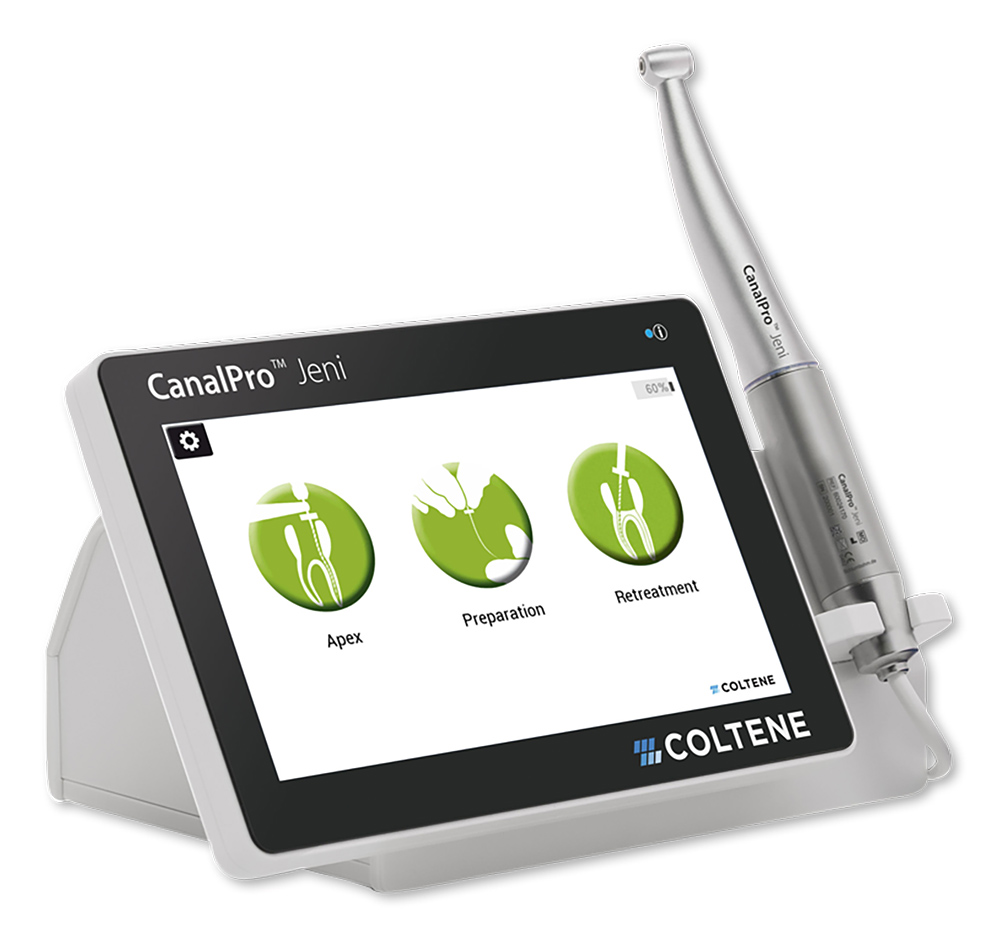
The system consists of a benchtop control unit with a 7-inch color touchscreen in landscape format, a corded micromotor handpiece carrying an apex measuring contact, a fully insulated 1:1 contra-angle handpiece, and a wireless Bluetooth foot switch. That configuration matters when comparing the Jeni with cordless rivals, because the handpiece remains tethered to the control unit and the unit itself occupies bench or cart space.
The hardware is competent and conventional. The distinguishing element is the software layer that Coltene describes as a digital assistance system, documented in detail on the official CanalPro Jeni product page. Functionally, that layer operates as a closed-loop control system for file movement.
Where The Jeni Sits In The Coltene Endodontic Range
Coltene positions the Jeni at the top of the CanalPro motor family, and understanding the range helps clarify what the premium actually buys.
CanalPro CL2i, a conventional torque-controlled motor without adaptive kinematics
CanalPro X-Move, a cordless motor with an integrated apex locator and standard torque and speed control
CanalPro Jeni, the only motor in the range that runs Jeni motion
The Jeni also serves as the hardware anchor for the wider Coltene endodontic ecosystem, covering HyFlex CM and HyFlex EDM alongside the MicroMega instruments One Curve and 2Shape, all of which originate within the same corporate group.
How Jeni Motion Works
Most product literature describes Jeni motion in broad terms, so a precise account is useful for clinicians deciding whether the mechanism justifies the price.
A conventional rotary motor runs a file at a fixed speed under a fixed torque ceiling. When torque exceeds that ceiling the motor reverses, stops, or sounds an alert, which is the familiar auto-reverse behavior. A reciprocating motor runs fixed angular sequences, for example 150 degrees counterclockwise followed by 30 degrees clockwise. In both cases the parameters are chosen before the file enters the canal and remain unchanged while it is inside.
Jeni motion works on a different principle. The motor continuously measures the electrical current drawn by the micromotor, which serves as a direct proxy for the torsional stress the instrument is experiencing at that instant. That reading feeds a control algorithm that revises the movement in millisecond intervals, altering rotation direction, angle of rotation, and speed as the file advances. The instrument starts in clockwise rotation and the motion changes continuously in response to load.
The Shift In Operator Technique
The mechanical change carries a direct consequence for how the clinician holds and advances the file, and this is the part that surprises experienced operators.
Because the motor generates the variation in movement, pecking and brushing become unnecessary. The recommended technique is a slow, continuous advance from coronal to apical under light pressure, allowing the motor to decide how the instrument negotiates each section of the canal. In a wide, straight coronal third the file behaves much like continuous rotation. As it enters a curvature or a constriction and torsional load rises, the movement shifts toward an oscillating pattern that relieves stress on the instrument.
Two consequences follow. Cognitive load falls, because there is no torque table to recall and no per-file speed to set. Control also transfers away from the operator, because Jeni motion is a preset kinematic that cannot be tuned. Clinicians with strong preferences for specific torque and speed values on specific instruments will find themselves working in the Doctor’s Choice mode described later in this review.
The Three Assistance Layers
Jeni motion is only one of three assistive behaviors, and the other two arguably carry more weight in a busy clinical day.
Irrigation prompts form the first layer. The motor tracks progress through the file sequence and emits an acoustic signal when irrigation is due between instruments. Chemical debridement performs most of the disinfection work in endodontics, and irrigation intervals are exactly the step that slips when a clinician is running behind schedule. An audible prompt that the assistant also hears converts an easily skipped step into a shared, externally cued one.
File fracture early warning forms the second layer. The same current-draw data that drives the kinematics feeds a fatigue detection routine. When the software judges that an instrument is approaching failure, a distinct acoustic signal recommends a file change. Coltene states clearly that file fracture cannot be eliminated entirely, so the feature belongs in the category of risk reduction rather than guarantee.
Continuous working length measurement forms the third layer, and it receives detailed treatment in the next section.
Key Features Of The CanalPro Jeni
The following features define the clinical experience of the device, and several of them differentiate the Jeni from every competing endodontic motor currently on the market.
Integrated Apex Locator With Continuous Measurement
The apex locator is built into the motor circuit through the apex measuring contact on the handpiece and the fully insulated contra-angle, which changes how length control fits into the shaping sequence.
Because the contra-angle is insulated along its length, the measurement circuit remains stable while the file is rotating under load. Working length therefore appears continuously during preparation rather than only when the instrument is stationary. The practical effects are worth stating plainly.
Working length is verified in real time, at the moment the file sits at its deepest point
Once an instrument reaches working length, the clinician steps up to the next file and the display confirms position again immediately
The number of separate measurement stops in a case falls, which accounts for much of the time saving clinicians report
Standard limitations for all electronic apex locators still apply. Accuracy degrades when excess electroconductive irrigant floods the pulp chamber, in immature apices with wide open foramina, in the presence of perforation or resorptive defects, and where a file contacts a metallic restoration. Radiographic confirmation with digital sensors or phosphor plates remains necessary whenever the clinical picture is uncertain.
Pre-Programmed File Systems
Six nickel-titanium systems are factory programmed for Jeni motion, and selecting one takes a single tap on the touchscreen.
HyFlex CM
HyFlex EDM, including the newer OGSF sequence delivered through a software update
HyFlex Remover
MicroMega One Curve
MicroMega 2Shape
MicroMega Remover
Inclusion of both Remover systems matters for practices handling retreatment, because the automated kinematic logic then extends to gutta-percha removal rather than covering primary shaping alone. Coltene has documented the HyFlex EDM OGSF sequence and its Jeni software update separately.
Ecosystem dependency is the obvious constraint. Practices that run ProTaper Ultimate, ProTaper Gold, or Reciproc Blue as a primary sequence will not access the headline feature of this motor in its intended form.
Doctor's Choice Function
The Doctor’s Choice function provides the flexibility valve for clinicians who work outside the pre-programmed sequences, and it carries one detail that buyers should verify before signing an order.
Up to eight additional file sequences can be programmed and stored with conventional movement parameters, including reciprocating systems. Entries can be renamed to match in-house terminology, which becomes genuinely useful when several clinicians share one operatory.
The nuance concerns whether custom sequences run in Jeni motion. Original launch material stated that Doctor’s Choice operated without Jeni mode, meaning custom sequences ran with conventional user-set kinematics and received neither irrigation announcements nor fracture warnings. Later Coltene software releases indicate that files entered under Doctor’s Choice will operate in Jeni motion unless parameters are explicitly changed. The practical guidance is simple: confirm the behavior on the exact firmware version quoted, and ask the representative to demonstrate it on the demo unit rather than relying on a brochure claim.
Touchscreen, Foot Switch, And Software Updates
Interface design receives less attention than kinematics in most reviews, yet it shapes the daily experience of the device more than any single technical specification.
The 7-inch high-contrast color touchscreen in landscape format is generous by dental device standards and readable across the operatory, which helps when the assistant is the person watching for the irrigation prompt. The wireless Bluetooth foot switch pairs automatically with the control unit, and Coltene has issued at least one update specifically improving Bluetooth stability between motor and foot switch, which suggests early units carried some pairing friction.
Software updates load through a microSD card. That mechanism is unglamorous, yet it has kept the platform current, delivering both the HyFlex EDM OGSF sequence and the revised Doctor’s Choice behavior years after launch. For a capital purchase with a service life measured in years, an upgrade path that avoids new hardware carries real value, a point worth weighing alongside the broader question of how to assess device reliability before any equipment purchase. The trade-off is that updates depend on the practice actively checking for them, since no over-the-air mechanism exists.
What Is Included In The Set
The standard set carries manufacturer reference 60023659 and arrives with everything needed to begin treatment except the files themselves.
Component | Quantity |
|---|---|
Control unit with 7-inch touchscreen | 1 |
Motor handpiece with apex measuring contact | 1 |
Fully insulated 1:1 contra-angle handpiece | 1 |
Bluetooth foot switch | 1 |
Power supply | 1 |
Apex cable set | 1 |
Retaining bracket for apex cable | 1 |
Individual components carry their own reference numbers, which helps multi-surgery practices and replacement planning.
60023660, base unit with touchscreen
60023661, fully insulated contra-angle
60023787, power supply
60023788, apex cable set
60023789, measuring cable for lip clip
60023790, lip clips
Nickel-titanium files are sold separately, so budget for HyFlex or MicroMega sequences alongside the motor. Several distributors bundle a starter file pack, which is worth requesting during negotiation and is a routine consideration in any dental equipment purchase.
Clinical Workflow With The CanalPro Jeni
The sequence below represents a typical clinical application and does not replace the manufacturer instructions for use, which always take precedence.
Access and canal location proceed unchanged. The Jeni contributes nothing until an instrument sits inside a canal.
Scouting and glide path preparation remain mandatory. No algorithm compensates for a canal that has not been negotiated, so patency and a reproducible glide path with hand files come first.
Select the file sequence on the touchscreen, choosing HyFlex EDM OGSF, One Curve, 2Shape, or a stored custom sequence.
Attach the lip clip and confirm the apex locator is reading. Measurement then runs continuously.
Advance the file slowly from coronal to apical under light, continuous pressure, allowing the motor to modulate the movement.
Irrigate when the motor signals, change the instrument when the fatigue warning sounds, and step up when the display confirms working length.
Determine final apical size conventionally. The motor reports where the file tip sits, not how large the foramen has become.
Complete irrigation, activation, and obturation as normal, since these steps still determine the majority of long-term outcomes.
Isolation quality, magnification, and sealer selection all continue to shape the result. Practices reviewing their endodontic protocol alongside a new motor purchase often revisit rubber dam technique, loupe and headlight choice, and bioceramic options such as BioRoot RCS or BioRoot Flow at the same time.
The Learning Curve
Adaptation to the device is short but genuine, and understanding where the friction lies prevents early frustration.
Most clinicians report settling into the technique within five to fifteen cases. The difficulty sits almost entirely in suppressing the pecking motion. Operators trained on continuous rotation carry a deeply ingrained in-and-out rhythm, and applying that rhythm on top of Jeni motion works against the algorithm, because the motor interprets each withdrawal as a load change and adjusts accordingly. The resulting stuttering feel is frequently misread as the motor being slow.
Experienced users advise trusting the light, continuous advance completely for the first several cases, ideally on straightforward single-rooted teeth or extracted-tooth practice, before forming a judgment about the device.
What The Research Says
For a capital purchase of this size, the claim that matters is safety, meaning fewer separated instruments and less iatrogenic damage. The following summarizes what peer-reviewed work currently supports and where it stops short.
Apical Debris Extrusion
Debris pushed beyond the apical foramen is associated with postoperative pain and delayed healing, which makes it a meaningful outcome measure for any new kinematic.
A 2023 study published in Odontology compared five kinematics using the same One Curve single-file system in mandibular first molars, testing Jeni motion, Optimum Torque Reverse, TF Adaptive, reciprocation, and continuous rotation. All five extruded some debris apically. The investigators reported that Jeni motion produced significantly less extruded debris than TF Adaptive, reciprocation, and continuous rotation, while remaining statistically indistinguishable from Optimum Torque Reverse. Preparation time did not differ significantly between kinematics.
The clinical relevance connects directly to patient experience, since extrusion contributes to flare-up and to postoperative discomfort after root canal treatment. The measurement took place in a laboratory model rather than in symptomatic patients, which limits how far the finding can be extended.
Instrument Behavior Across Endodontic Motors
One study took the unusual step of holding the instrument constant and treating the motor as the variable, which makes it the most directly relevant evidence available for this device.
A 2023 comparative study in BDJ Open tested six endodontic motors, including the CanalPro Jeni and the CanalPro CL2i alongside devices from MicroMega, Woodpecker, and VDW, on a traction and compression bench shaping resin blocks, measuring penetration and removal forces to characterize cutting and screwing effects. The authors concluded that endodontic motors do influence the mechanical behavior of instruments, that the effect is most pronounced during reciprocating motion, and that the Jeni was the only motor tested capable of adapting One Curve kinematics according to torsional stress, which they identified as the likely reason it achieved the best results in continuous rotation. They also noted that the CanalPro CL2i was the only device to reach maximum torque limits during shaping, chiefly in the middle and apical thirds.
This finding supports the core mechanism claim. The motor demonstrably behaves differently, and the difference runs in the direction of lower instrument stress.
Retreatment Applications
Retreatment subjects instruments to unusually high stress, so the extension of Jeni motion to the Remover sequences deserves separate consideration.
A 2023 paper in the Australian Endodontic Journal evaluated apical debris extrusion and procedure time across 144 single-rooted teeth, comparing continuous rotation against Jeni motion for filling material removal under different obturation techniques and irrigation protocols. The authors described the hybrid kinematics as monitoring torsional stress through the current required to advance the file, then adapting instrument motion accordingly.
Limitations Of The Current Evidence
Three caveats belong in any professional assessment of this device, and clinicians should weigh them before treating the safety claim as settled.
Almost all published work is laboratory based, using resin blocks, extracted teeth, and mechanical benches. No substantial body of randomized clinical evidence demonstrates that Jeni motion reduces file separation in patients, shortens real appointment times, or improves periapical healing rates. The mechanistic case is strong. The clinical outcome case has not yet been made.
Conflict of interest transparency also matters. Professor Pedulla developed Jeni motion and appears as an author on endodontic literature in this field. That situation is entirely normal in dental device research and does not invalidate the work, though independent replication carries more weight, which is why the BDJ Open study from a French university group with no Coltene affiliation is the more persuasive data point.
Sample sizes are small. Groups of ten to fifteen specimens are standard in this literature yet constrain generalizability, so effect sizes should be read as directional rather than precise.
How The CanalPro Jeni Compares To Other Endo Motors
Direct comparison clarifies where the premium is justified and where a less expensive device would serve equally well.
Feature | CanalPro Jeni | Morita TriAuto ZX2+ | CanalPro X-Move |
|---|---|---|---|
Format | Benchtop unit, corded handpiece | Cordless handpiece | Cordless handpiece |
Apex locator | Integrated, continuous | Integrated, continuous | Integrated |
Adaptive kinematics | Yes, load responsive | Optimum Torque Reverse | No |
Reciprocation | Yes, via Doctor's Choice | Yes | Yes |
Irrigation prompts | Yes, acoustic | No | No |
Fracture early warning | Yes | Auto apical slow-down | Auto-reverse |
Custom file memory | 8 sequences | Yes | Yes |
Display | 7-inch color touchscreen | Handpiece display | Handpiece display |
Best suited to | Coltene and MicroMega users | Clinicians wanting cordless freedom | Budget-conscious buyers |
The honest positioning is straightforward. Jeni motion and the workflow prompts are the differentiators, and nothing else in the mainstream market currently combines automated kinematics, continuous measurement, irrigation cueing, and fatigue warning in one device. The clearest structural disadvantage against the TriAuto ZX2+ and the X-Move is form factor, since a corded handpiece tethered to a benchtop unit offers less freedom than a cordless design, and the footprint becomes a real consideration in a compact operatory.
For practices committed to another manufacturer file ecosystem, the calculation changes sharply. Purchasing a Jeni to run other sequences through Doctor’s Choice means paying a premium for capability that may go partly unused.
Maintenance, Sterilization, And Service
Long-term performance depends more on routine care than on any specification in the brochure, and two components deserve particular attention.
Contra-angle, autoclavable according to the instructions for use and lubricated on schedule, with the same principles that apply to oiling any dental handpiece
Insulation integrity, critical to apex locator accuracy, so inspect the contra-angle regularly and replace it rather than tolerating erratic readings
Motor handpiece, wipe disinfected and never immersed, with the apex measuring contact protected from irrigant ingress
Lip clips and measuring cables, consumables with finite life, since unstable readings far more often indicate a failing cable than a failing device
Control unit, surface disinfected with agents compatible with the touchscreen, following established sterilization and infection control protocols
Software, checked periodically for microSD updates, since these have added meaningful functionality after launch
Service terms deserve scrutiny before purchase. Confirm the warranty period, the loaner unit policy, and typical turnaround times with the distributor. For a device this central to the endodontic workflow, a strong downtime policy is worth more than a modest discount on list price.
Pricing And Return On Investment
Coltene does not publish a global list price, and figures vary considerably by market and distributor, so the numbers below serve as orientation rather than quotation.
European dealer listings have shown the full set at roughly 3,600 to 3,700 euros excluding VAT, with promotional pricing falling toward 2,900 euros. Pricing in the United States, the United Kingdom, and the Middle East differs, and distributor bundles covering file packs, extended warranty, or trade-in allowances form a meaningful part of the negotiation. Coltene operates a formal demonstration booking program through its CanalPro Jeni information page, and a live demonstration should precede any commitment.
Return on investment for a general practice rests on three factors rather than on raw speed.
Avoided separated instruments, since a single fractured file in a curved molar canal can cost an hour of chair time, a referral, a remake, or a goodwill write-off
Consolidated equipment, because the integrated apex locator removes the need for a separate standalone unit and compresses the appointment
Consistency across operators, since an automated kinematic narrows the performance gap between the most and least endodontically confident clinicians in a group setting
Practices modeling the numbers should weigh the purchase against typical root canal treatment fees and against wider goals for clinical efficiency. Documenting the endodontic phase clearly also matters, and a structured dental treatment plan helps patients understand why instrumentation quality justifies the fee attached to it.
For a specialist endodontist working at high volume, the case rests more on ergonomics, workflow prompts, and instrument economy. Practices weighing budget alternatives may also wish to review guidance on buying used dental equipment before committing to a new unit at full price.
Who Should Buy The CanalPro Jeni
Fit matters more than quality with this device, and the following profiles capture where the investment makes the most sense.
The strongest candidates are practices already working with HyFlex or MicroMega files, multi-clinician practices where endodontic confidence varies between operators, and clinicians who want maximum procedural automation with built-in workflow cueing. Practices handling regular retreatment also benefit, since both Remover sequences run under the same automated logic.
The weakest candidates are clinicians committed to another manufacturer file system, practices requiring a cordless handpiece for space or ergonomic reasons, and experienced endodontists who already produce predictable shapes with a conventional motor they know well.
The Coltene CanalPro Jeni represents a different design philosophy rather than an incremental improvement on a conventional endodontic motor. File kinematics, working length measurement, and irrigation timing all become responsibilities of the device rather than items the clinician must remember, and the underlying mechanism withstands independent laboratory scrutiny.
Purchase it for a practice working inside the Coltene and MicroMega ecosystem, for a group setting that would benefit from levelling endodontic performance across several operators, or where reducing separated file risk justifies the capital outlay. Look elsewhere when committed to another file system, when a cordless handpiece is essential, or when a familiar motor already delivers predictable results.
Book a demonstration before deciding. Jeni motion feels genuinely unfamiliar in the hand, and no written review substitutes for ten minutes with a file in a canal.
Bottom Line
The Coltene CanalPro Jeni represents a different design philosophy rather than an incremental improvement on a conventional endodontic motor. File kinematics, working length measurement, and irrigation timing all become responsibilities of the device rather than items the clinician must remember, and the underlying mechanism withstands independent laboratory scrutiny.
Purchase it for a practice working inside the Coltene and MicroMega ecosystem, for a group setting that would benefit from levelling endodontic performance across several operators, or where reducing separated file risk justifies the capital outlay. Look elsewhere when committed to another file system, when a cordless handpiece is essential, or when a familiar motor already delivers predictable results.
Book a demonstration before deciding. Jeni motion feels genuinely unfamiliar in the hand, and no written review substitutes for ten minutes with a file in a canal.
Verdict
<p>Weighing the mechanism, the published evidence, and the daily clinical experience, the CanalPro Jeni earns a qualified recommendation, and the qualification concerns fit rather than quality.</p><p>Coltene has built a device that removes decision-making from the moments when decision-making most often goes wrong. Torque settings, rotational strategy, and irrigation intervals are the three variables a busy clinician quietly compromises on when running twenty minutes behind, and the Jeni takes all three off the table. Continuous apex measurement remains the underrated feature, because knowing precisely where the file tip sits at the instant it is deepest changes how confidently a clinician approaches the apical third.</p><p>The reservations are equally real. Supporting evidence is mechanistically strong yet almost entirely laboratory based, so the safety claim should be treated as well founded rather than clinically proven. The corded benchtop format feels dated beside cordless rivals. Value collapses for practices that do not use Coltene or MicroMega files.</p><p>The device performs excellently for HyFlex and MicroMega users, and for practices where several clinicians of differing endodontic confidence share one motor. It is considerably less compelling for committed users of other file systems, and unnecessary for the specialist who already shapes predictably with a conventional motor.</p>
Frequently Asked Questions
What is the Coltene CanalPro Jeni?
The CanalPro Jeni is a benchtop endodontic motor with an integrated apex locator, manufactured in Germany by Coltene. Its defining feature is Jeni motion, a patented digital assistance system that automatically adjusts rotation direction, angle, and speed in millisecond intervals according to the torsional stress the instrument is experiencing.
How does Jeni motion differ from continuous rotation or reciprocation?
Continuous rotation and reciprocation both use parameters fixed before the file enters the canal. Jeni motion continuously measures the current the motor draws, which serves as a proxy for instrument load, then modifies the movement in real time, shifting between rotational and oscillating behavior as canal conditions change.
Does the CanalPro Jeni have a built-in apex locator?
Yes. Length measurement is integrated into the motor circuit, and the fully insulated contra-angle allows continuous working length display while the file rotates under load, rather than only when the instrument is stationary.
Which file systems work in Jeni mode?
Six systems are factory programmed: HyFlex CM, HyFlex EDM including the OGSF sequence, HyFlex Remover, MicroMega One Curve, MicroMega 2Shape, and MicroMega Remover.
Can non-Coltene files be used with the CanalPro Jeni?
Yes, through the Doctor's Choice function, which stores up to eight custom sequences including reciprocating systems. Whether those sequences run in Jeni motion or in conventional user-set kinematics has varied across firmware versions, so confirm the behavior on the software revision being purchased.
Does the CanalPro Jeni support reciprocating files?
Yes. Reciprocating systems can be programmed and stored under the Doctor's Choice function.
Is a glide path still necessary?
Yes. Scouting, patency confirmation, and glide path preparation with hand files remain mandatory. The motor optimizes how an instrument behaves in a canal that has already been negotiated, and it does not negotiate the canal on the clinician behalf.
Will the CanalPro Jeni prevent file separation?
No device can. The fatigue early warning system reduces risk through flagging instruments approaching failure, and laboratory data support lower instrument stress under Jeni motion, though Coltene states plainly that file breakage cannot be completely eliminated.
Is the CanalPro Jeni cordless?
No. The system comprises a benchtop control unit with a 7-inch touchscreen and a corded motor handpiece. Only the foot switch is wireless, connecting through Bluetooth. Clinicians who require a cordless format should compare the Coltene CanalPro X-Move or the Morita TriAuto ZX2+.
How long does the learning curve take?
Most clinicians adapt within five to fifteen cases. The principal adjustment involves abandoning the pecking motion in favor of a slow, continuous, light-pressure advance from coronal to apical.
Does the motor work for retreatment?
Yes. Both HyFlex Remover and MicroMega Remover sequences are pre-programmed, and published laboratory work has specifically evaluated Jeni kinematics in retreatment scenarios.
How much does the CanalPro Jeni cost?
Pricing depends on market and distributor. European dealer listings have indicated roughly 3,600 to 3,700 euros excluding VAT for the full set, with promotional pricing lower. Current local quotations should be requested directly, along with details of file bundles and trade-in allowances.
What is included in the standard set?
The set contains a control unit, motor handpiece with apex measuring contact, fully insulated 1:1 contra-angle, Bluetooth foot switch, power supply, apex cable set, and retaining bracket. Nickel-titanium files are sold separately.
How are software updates installed?
Updates load through a microSD card. Coltene has released meaningful post-launch updates using this route, including support for the HyFlex EDM OGSF sequence and revised foot switch connectivity.
Is there clinical evidence supporting the CanalPro Jeni?
Credible laboratory evidence exists, including a 2023 Odontology study reporting significantly lower apical debris extrusion with Jeni motion than with TF Adaptive, reciprocation, and continuous rotation, and a 2023 BDJ Open motor comparison concluding that the Jeni was the only motor tested that adapted kinematics to torsional stress. Randomized clinical outcome data in patients remain limited.
Who should buy the CanalPro Jeni?
Practices already using HyFlex or MicroMega files, multi-clinician practices where endodontic experience varies between operators, and clinicians seeking maximum procedural automation with workflow cueing. The fit is weaker for those committed to another file ecosystem or those requiring a cordless motor.