Rating: 4.4/5
ProTaper Gold Rotary Files: What Every Dentist Needs to Know
The ProTaper Gold rotary file system represents one of the most significant advancements in endodontic instrumentation over the past decade. Developed by Dentsply Sirona and...
Reviewed by Mantas Petraitis
Pros
- 24% enhanced flexibility over ProTaper Universal allows better navigation of curved canals
- 2.4 times greater cyclic fatigue resistance significantly reduces file separation risk
- Temperature stability maintains consistent mechanical properties at body temperature
- Familiar technique uses the same sequence as ProTaper Universal for seamless transition
- Reduced canal transportation preserves original canal anatomy more effectively
- Comprehensive system includes matched obturation materials for complete workflow
- Extensive research base with hundreds of peer-reviewed studies supporting clinical use
- Shorter 11mm handle improves posterior access in limited spaces
- Non-cutting tip design allows safer canal navigation
- Global clinical support with widespread training resources available
Cons
- Higher cost compared to ProTaper Universal and third-party alternatives
- Not suitable for severe or sudden apical curvatures per manufacturer warnings
- Multiple file sequence requires more instruments than single-file systems
- Glide path establishment demands thorough hand file preparation before rotary use
- Learning curve exists for practitioners new to the ProTaper system
- Single-patient use recommended increases per-case costs
- Superseded by ProTaper Ultimate which offers additional improvements
- More apical transportation in S-curved canals compared to some newer systems
- Longer preparation time than reciprocating single-file systems for routine cases
- Requires torque-controlled motor and appropriate equipment investment
The ProTaper Gold rotary file system represents one of the most significant advancements in endodontic instrumentation over the past decade. Developed by Dentsply Sirona and building upon the globally recognized ProTaper Universal platform, this system combines familiar geometry with revolutionary Gold wire metallurgy to deliver enhanced clinical performance.
Since its introduction in 2014, ProTaper Gold has become the most widely used rotary system among North American endodontists and continues to be extensively taught in dental schools worldwide. The system's success stems from its ability to produce predictable, reproducible canal shapes while offering meaningful improvements in flexibility and fatigue resistance compared to its predecessor.
This comprehensive review examines the ProTaper Gold system from a clinical perspective, covering technical specifications, evidence-based performance advantages, proper technique protocols, and practical solutions to the most common problems dentists encounter. Whether you are considering transitioning from ProTaper Universal or evaluating ProTaper Gold against competing systems, this guide provides the information you need to make informed decisions and optimize your clinical outcomes.
ProTaper Gold System Overview And Specifications
Understanding the design philosophy and technical specifications of ProTaper Gold provides the foundation for effective clinical use. The system maintains the proven ProTaper geometry while incorporating advanced metallurgical processing that fundamentally changes how the files perform in challenging canal anatomies.
Design Features
ProTaper Gold files feature a convex triangular cross-section that enhances cutting action while reducing rotational friction between the blade and dentin. This geometry allows for efficient debris removal and maintains the smooth, predictable cutting behavior that made the original ProTaper system popular.
The progressive taper design means that each file has multiple tapers along its cutting length rather than a single fixed taper. This approach allows different portions of each file to perform specific functions, with the coronal sections providing aggressive bulk removal while apical sections maintain more conservative enlargement.
A non-cutting tip design allows each instrument to safely follow the secured portion of the canal while a small flat area on the tip enhances its ability to navigate through soft tissue and debris. The shorter 11mm handle length compared to previous ProTaper files improves accessibility to posterior teeth where space is limited.
File Sequence And Sizes
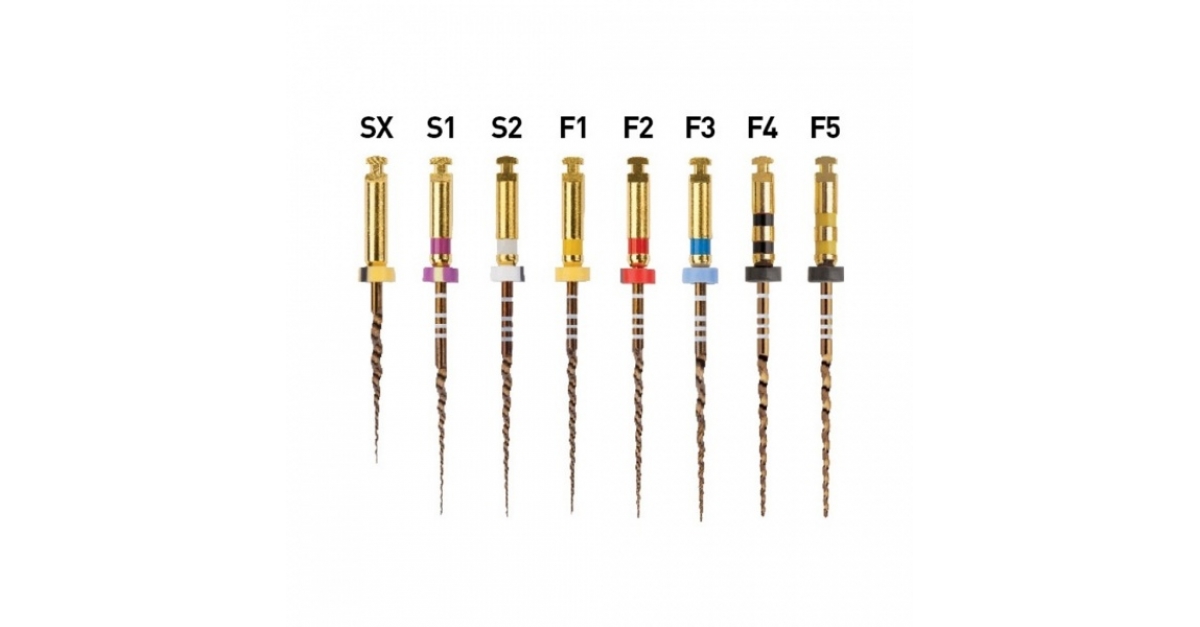
The ProTaper Gold system includes both shaping and finishing files that work together to create the signature ProTaper canal preparation.
Shaping files:
SX: 0.04v taper with 0.19mm tip diameter at 19mm working length
S1: 0.02 taper with 0.18mm tip diameter
S2: 0.04 taper with 0.20mm tip diameter
Finishing files:
F1: 0.07v taper with 0.20mm tip diameter
F2: 0.08v taper with 0.25mm tip diameter
F3: 0.09v taper with 0.30mm tip diameter
F4: 0.06v taper with 0.40mm tip diameter
F5: 0.05v taper with 0.50mm tip diameter
Working lengths for S1 through F5 are available in 21mm, 25mm, and 31mm configurations.
Gold Wire Metallurgy
The defining characteristic of ProTaper Gold is its proprietary post-manufacturing heat treatment that creates the distinctive gold coloration. This process involves repeatedly heating and slowly cooling the instruments after machining, resulting in a titanium oxide layer that gives the files their characteristic appearance.
More importantly, this thermal processing fundamentally alters the metallurgical properties of the nickel-titanium alloy. Research demonstrates that ProTaper Gold exhibits two-stage phase transformation behavior with a high austenite finish temperature similar to controlled memory wires. The presence of R-phase at room temperature contributes to the enhanced flexibility that clinicians immediately notice when handling these instruments.
Clinical Performance Advantages
The Gold wire metallurgy translates into measurable clinical benefits that impact everyday endodontic practice. Understanding these advantages helps clinicians appreciate why proper technique matters and where ProTaper Gold excels compared to other systems.
Enhanced Flexibility
ProTaper Gold files demonstrate 24% increased flexibility compared to ProTaper Universal according to manufacturer testing. This improvement becomes particularly evident in the finishing files when navigating challenging curves in the apical region.
The clinical significance extends beyond simply being easier to use. Greater flexibility means the files can better follow existing canal anatomy rather than imposing their own path, reducing the risk of transportation and ledging. Micro-CT studies confirm that ProTaper Gold maintains canal centricity more effectively than conventional NiTi systems in moderately curved canals.
Superior Cyclic Fatigue Resistance
Cyclic fatigue represents the leading cause of rotary file separation during clinical use. When files rotate within curved canals, they undergo repeated cycles of tension and compression that eventually lead to metal fatigue and fracture.
ProTaper Gold provides 2.4 times greater resistance to cyclic fatigue compared to ProTaper Universal. This substantial improvement directly translates to reduced fracture risk during instrumentation of curved canals.
Importantly, research by Plotino and colleagues demonstrated that intracanal temperature does not negatively affect ProTaper Gold fatigue life, unlike conventional NiTi instruments that show reduced fatigue resistance at body temperature. This temperature stability means the enhanced safety margins remain consistent during actual clinical use.
Reduced Canal Transportation
Canal transportation occurs when instrumentation removes more dentin from one side of the canal than the other, shifting the prepared canal away from its original position. This can compromise cleaning effectiveness and create difficulties during obturation.
Studies using simulated curved canals demonstrate that ProTaper Gold produces significantly less canal transportation in curved portions compared to ProTaper Universal. The enhanced flexibility of the Gold wire allows the files to better maintain the original canal path rather than straightening curved anatomy.
Micro-CT research comparing ProTaper Gold, ProTaper Next, and ProTaper Universal found that both newer systems produced less transportation and maintained more dentin than ProTaper Universal while still achieving adequate canal preparation.
Improved Torsional Resistance
Torsional failure occurs when the tip of a file becomes locked in a canal while the shank continues to rotate, creating twisting forces that can cause fracture. This mechanism differs from cyclic fatigue but represents another significant cause of instrument separation.
Finite element analysis studies confirm that the thermomechanical treatment of ProTaper Gold increases torsional resistance compared to ProTaper Universal. The altered metallurgical properties distribute stress more effectively throughout the instrument structure.
Recommended Technique And Protocol
Proper technique remains essential for achieving optimal results with ProTaper Gold. While the enhanced metallurgy provides greater safety margins, following established protocols maximizes the benefits while minimizing complications.
Pre-Instrumentation Requirements
Successful canal preparation begins with thorough preoperative assessment. Review radiographs from multiple horizontal angulations to determine canal width, length, and curvature. Identify potential challenges such as calcifications, abrupt curvatures, or unusual anatomy before beginning treatment.
Create straight-line access to canal orifices with emphasis on proper flaring, flattening, and finishing of the access cavity. Inadequate access compromises visibility, restricts instrument movement, and increases the stress placed on rotary files during navigation.
Glide Path Establishment
The glide path represents the most critical step in rotary instrumentation. A smooth, reproducible pathway from orifice to apex allows rotary files to follow existing anatomy rather than creating their own path, dramatically reducing the risk of ledging, blockage, and file separation.
In the presence of a viscous chelating agent such as Glyde File Prep, passively scout the coronal two-thirds of the canal with #10 and #15 hand files. Work these instruments gently until a smooth, reproducible glide path is confirmed to at least ISO #15 size.
Alternatively, mechanized glide path files such as ProGlider may be used after establishing initial hand file patency. The ProGlider can be used together with ProTaper Gold SX files in one or more passes to expand the glide path before proceeding with shaping files.
Shaping File Technique
The crown-down approach represents the technique of choice for ProTaper Gold rotary instruments. This method removes coronal interferences progressively, allowing subsequent files to work more efficiently and with less stress.
Begin with the S1 file in the presence of sodium hypochlorite. Float the S1 in the canal and passively follow the glide path. Before light resistance is encountered, laterally brush and cut dentin on the outstroke to improve straight-line access and apical progression. Always brush away from the furcation to avoid strip perforation.
Continue shaping with S1 as described until the depth of the #15 hand file is reached. Use the S2 exactly as described for S1 until the established glide path depth is reached.
The SX file serves specific purposes rather than routine use. Apply SX after S1 and S2 to optimally shape canals in shorter roots, relocate the coronal aspect of canals away from furcation concavities, or expand the shape as desired for improved access.
Finishing File Technique
Finishing files require a different technique than shaping files. After confirming working length and verifying the presence of a smooth reproducible glide path through the apical third with #10 and #15 hand files, proceed with finishing.
Use Finishing File F1 in a non-brushing action with each insertion deeper than the previous insertion until working length is reached. The manufacturer specifically recommends taking any ProTaper Gold finishing instrument to length only one time and for no more than one second to avoid transportation.
Gauge the foramen with a #20 hand file. If the instrument is snug at length, the canal is shaped and ready for obturation. If the #20 hand file is loose at length, proceed to F2 and when necessary F3, F4, and F5 with the same non-brushing motion to working length, gauging after each finishing file with appropriately sized hand files.
Motor Settings And Irrigation
Recommended motor settings for ProTaper Gold include speeds between 250 and 350 RPM with 300 RPM representing the typical recommendation. Torque settings range from 1.5 to 5.2 Ncm depending on the specific file being used.
Irrigation protocol integration is essential throughout instrumentation. Irrigate copiously with sodium hypochlorite between each file. Recapitulate with a #10 K-file after removing each rotary file to maintain apical patency and prevent debris accumulation. Reconfirm working length and re-irrigate especially in curved canals where debris tends to accumulate.
Common Problems And Clinical Solutions
Even with proper technique, clinicians encounter challenging situations that require troubleshooting. Understanding the causes of common problems and their solutions helps minimize complications and improve outcomes.
File Separation
File separation represents the most concerning complication in rotary endodontics. While ProTaper Gold's enhanced fatigue resistance reduces this risk, understanding the causes helps prevent occurrences.
Common causes include:
Inadequate or absent glide path before rotary instrumentation
Excessive apical pressure forcing files through resistant anatomy
Reuse of files beyond their safe working life
Failure to inspect files between canals for signs of distortion
Use in canals with severe or sudden apical curvatures
Solutions and prevention:
Always establish a confirmed glide path to at least ISO #15 before introducing rotary files
Use a light pencil grip and allow the file to do the work rather than applying downward pressure
Consider single-patient use for maximum safety
Inspect file flutes after every canal and discard at the first sign of unwinding or distortion
Never force files that encounter resistance, instead withdraw and recapitulate with hand files
Avoid severe apical curvatures or consider alternative instrumentation approaches for these anatomies
The ProTaper Gold files may appear slightly curved due to the manufacturing process. This is not a manufacturing defect and straightening before use is not necessary. Once inside the canal, the file will follow the anatomy.
Canal Ledging
Ledging occurs when the instrument creates a false pathway in the canal wall rather than following the original anatomy. This complication can prevent access to the apical portion of the canal and compromise treatment outcomes.
Common causes include:
Failure to establish or maintain a proper glide path
Excessive apical pressure with rotary files
Skipping files in the recommended sequence
Insufficient recapitulation between instruments
Solutions:
Return to small hand files (#08 or #10) with pre-curved tips
Use a watch-winding motion to attempt bypassing the ledge
Apply copious EDTA lubrication to facilitate negotiation
Once the ledge is bypassed, re-establish the glide path thoroughly before returning to rotary instrumentation
Use the SX file to improve coronal access and reduce the deflection forces on subsequent files
Research demonstrates that canal deviation including apical transportation and ledging is more pronounced with ProTaper Universal than ProTaper Gold, likely due to the increased flexibility of the Gold wire system.
Canal Transportation
Transportation occurs when the prepared canal deviates from its original position, typically toward the outer wall of curvatures. While ProTaper Gold produces less transportation than conventional systems, technique still matters.
Common causes include:
Aggressive apical instrumentation with excessive passes
Over-enlargement by selecting finishing files that are too large
Inadequate coronal flaring creating excessive file deflection
Solutions:
Take finishing files to length only once and hold for no more than one second
Gauge with appropriate hand files to determine the correct finishing file size
Use the SX file to relocate the coronal aspect of the canal away from danger zones
Consider using a smaller finishing file in narrow or severely curved roots
Increase coronal flaring to reduce the angle at which files approach curvatures
Canal Blockage
Blockage occurs when debris accumulates in the apical portion of the canal, preventing instruments from reaching working length. This can lead to inadequate cleaning and obturation short of the apex.
Common causes include:
Inadequate irrigation between instruments
Insufficient recapitulation to maintain patency
Debris compaction from aggressive instrumentation
Loss of working length verification
Solutions:
Irrigate copiously after every file with at least 2ml of irrigant
Recapitulate with a #10 K-file to working length after each rotary instrument
Use more frequent recapitulation in curved canals where debris accumulates more readily
Reconfirm working length if resistance suddenly increases during instrumentation
Apply chelating agents such as 17% EDTA to help dissolve calcific debris
Difficulty Reaching Working Length
Some canals present challenges in advancing files to the established working length despite proper technique. This can result from anatomical variations or instrumentation complications.
Common causes include:
Calcified or severely narrow canals
Coronal interference restricting instrument movement
Inadequate glide path preparation
Tight apical anatomy resistant to enlargement
Solutions:
Extend glide path preparation with hand files before returning to rotary instrumentation
Use the SX file for additional coronal pre-flaring to reduce resistance
Make progressive passes rather than forcing files to length in a single attempt
Apply 17% EDTA to help negotiate through calcifications
Consider a hybrid technique using ProTaper Gold coronally then transitioning to smaller fixed-taper files apically
One clinician described her approach to calcified canals by using copious irrigation with 6% sodium hypochlorite and switching to 17% EDTA when encountering calcification, then proceeding with ProTaper Gold once the glide path was established.
Poor Cone Fit After Preparation
Achieving proper cone fit is essential for successful obturation. Difficulties with cone fit often indicate issues with the preparation itself.
Common causes include:
Inconsistent preparation shape from technique variations
Under-instrumentation leaving the canal too narrow
Debris remaining in the apical third
Using non-matched gutta-percha cones
Solutions:
Verify that dentin is present in the apical flutes of the finishing file after instrumentation
Perform a final gauge with hand files to confirm the preparation size matches your selected cone
Complete a final irrigation flush with EDTA followed by sodium hypochlorite
Use ProTaper Gold Conform Fit gutta-percha cones that are specifically designed to match ProTaper Gold preparations
ProTaper Gold Compared To Other Systems
Understanding how ProTaper Gold compares to competing systems helps clinicians make informed decisions about instrument selection for different clinical situations.
ProTaper Gold Versus ProTaper Universal
ProTaper Gold and ProTaper Universal share identical geometry but differ fundamentally in their metallurgy. The Gold heat treatment produces measurable improvements including 24% increased flexibility and 2.4 times greater cyclic fatigue resistance.
Clinicians transitioning from ProTaper Universal to ProTaper Gold can use the same technique and sequence they already know. The enhanced flexibility becomes immediately apparent, particularly when navigating curved canals in the apical region. Studies confirm that ProTaper Gold produces less canal transportation than ProTaper Universal while maintaining equivalent shaping ability.
The temperature stability of ProTaper Gold provides an additional advantage. Unlike ProTaper Universal, which shows reduced fatigue resistance at body temperature, ProTaper Gold maintains its enhanced mechanical properties during actual clinical use.
ProTaper Gold Versus WaveOne Gold
The comparison between ProTaper Gold and WaveOne Gold often arises because both systems utilize Gold heat treatment technology from the same manufacturer. However, they represent fundamentally different instrumentation philosophies.
ProTaper Gold is a rotary file system based on a multiple file sequence that uses continuous clockwise rotation. WaveOne Gold is a reciprocating file system based on a single file sequence that uses alternating clockwise and counterclockwise motion.
ProTaper Gold offers more gradual, controlled shaping through its multi-file approach, allowing clinicians to assess progress at each step. WaveOne Gold may provide faster instrumentation with its single-file concept. Research comparing these systems in challenging S-shaped canals found that WaveOne Gold removed less resin at certain levels, suggesting more conservative preparation, though both systems performed adequately.
The choice between these systems often comes down to clinician preference and case selection. Many practitioners use both systems in their practices, selecting the most appropriate approach for each clinical situation.
ProTaper Gold Versus ProTaper Ultimate
ProTaper Ultimate represents the newest generation in the ProTaper family, offering additional improvements beyond ProTaper Gold. The Ultimate system provides 30% greater cyclic fatigue resistance for the F2 file compared to ProTaper Gold F2 and incorporates a simplified sequence with a new Slider file for glide path management.
ProTaper Ultimate utilizes file-specific heat treatments including M-wire, Gold-wire, and Blue-wire technology depending on the instrument. The system also claims to be 32% faster for glide path and shaping compared to ProGlider and ProTaper Gold up to F2.
ProTaper Gold remains an excellent choice for practitioners familiar with the system and satisfied with its performance. Those seeking the latest advancements may consider transitioning to ProTaper Ultimate while maintaining the familiar ProTaper philosophy and similar technique.
Expert Clinical Tips
Experienced clinicians who have extensively used ProTaper Gold offer practical insights that can improve outcomes for all users.
Technique Pearls
Dr. John West, co-inventor of the ProTaper system, emphasizes that the index finger is the most dangerous finger in rotary shaping because it wants to push. This pushing tendency leads to breakage, blocks, ledges, transportation, and perforations. Restraining the natural urge to apply apical pressure allows the file to work more safely and effectively.
Inspecting file flutes for dentin debris confirms that shaping is complete. When the apical flutes of a finishing file show dentin, you have verification that the preparation has been achieved. This simple check prevents under-instrumentation and provides confidence before proceeding to obturation.
Using the SX file strategically rather than routinely optimizes its benefits. The SX excels at protecting furcation areas by relocating the coronal canal position away from danger zones. It also provides additional coronal shape when needed for improved access or visibility.
Copious irrigation is non-negotiable for successful endodontics regardless of the file system being used. The mechanical action of files alone cannot achieve adequate disinfection. Maintain a continuous irrigation protocol throughout instrumentation to remove debris, lubricate files, and deliver antimicrobial agents to the canal system.
Case Selection Guidance
ProTaper Gold performs excellently in routine cases with straightforward to moderately challenging anatomy. Most single and multi-rooted teeth with typical curvatures can be instrumented effectively with proper technique.
Exercise caution with severe or abrupt apical hooks where even the enhanced flexibility may be insufficient to prevent transportation or file stress. Extremely narrow or calcified canals may require extended hand file preparation before rotary instrumentation can proceed safely.
Consider alternative systems for specific challenging anatomies. Reciprocating files may perform better in certain S-curved canals, while adaptive motion systems can handle complex three-dimensional curvatures. Having multiple instrumentation options available allows selection of the optimal approach for each clinical situation.
Bottom Line
ProTaper Gold represents a meaningful advancement over ProTaper Universal through its Gold heat treatment metallurgy. The 24% improvement in flexibility and 2.4 times greater cyclic fatigue resistance translate directly to enhanced clinical safety and performance, particularly in curved canals.
The system maintains the familiar ProTaper geometry and technique that practitioners worldwide have trusted for over two decades. Clinicians already experienced with ProTaper Universal can transition seamlessly while immediately benefiting from the improved mechanical properties.
Proper technique remains essential for optimal outcomes. Glide path establishment before rotary instrumentation, appropriate irrigation protocols, and respect for the manufacturer's guidelines regarding file use all contribute to successful treatment. The enhanced safety margins of ProTaper Gold do not eliminate the need for careful, thoughtful instrumentation.
Most problems encountered with ProTaper Gold can be prevented through proper technique or resolved through systematic troubleshooting. Understanding the causes of complications such as file separation, ledging, transportation, and blockage allows clinicians to avoid these issues and address them effectively when they occur.
The comprehensive ProTaper Gold system including matched obturation materials, paper points, and obturators provides a complete workflow solution that simplifies case management. This integrated approach ensures compatibility throughout the endodontic procedure from shaping through obturation.
Verdict
<p>ProTaper Gold earns a strong recommendation for general dentists and endodontists seeking a reliable, well-documented rotary file system with meaningful safety advantages over conventional NiTi instruments.</p><p><strong>Recommended for:</strong></p><ul class="list-disc pl-4 space-y-1"><li><p>General practitioners performing routine endodontics</p></li><li><p>Clinicians transitioning from ProTaper Universal seeking improved safety</p></li><li><p>Practitioners who value extensive research documentation and clinical evidence</p></li><li><p>Those wanting a complete system with matched obturation components</p></li></ul><p><strong>Consider alternatives for:</strong></p><ul class="list-disc pl-4 space-y-1"><li><p>Severely curved or S-shaped canals where reciprocating systems may excel</p></li><li><p>Practitioners preferring single-file concepts for efficiency</p></li><li><p>Those seeking the newest technology (ProTaper Ultimate offers additional improvements)</p></li></ul><p><strong>Overall rating:</strong> ProTaper Gold delivers on its promises of enhanced flexibility and fatigue resistance while maintaining the predictable shaping performance that made ProTaper the global standard. The extensive research base and clinical track record provide confidence that outcomes will match expectations when proper technique is followed.</p>
Frequently Asked Questions
What is the difference between ProTaper Gold and ProTaper Universal?
ProTaper Gold and ProTaper Universal share identical geometry and use the same clinical technique. The key difference is the Gold heat treatment applied to ProTaper Gold after manufacturing, which produces 24% increased flexibility and 2.4 times greater resistance to cyclic fatigue compared to ProTaper Universal.
How many times can I reuse ProTaper Gold files?
While research suggests ProTaper files may be safely reused up to four times, the manufacturer and most experts recommend single-patient use for maximum safety. Multiple disinfection and re-sterilization cycles may lead to increased risk of file separation.
What speed and torque settings should I use for ProTaper Gold?
The recommended speed range is 250 to 350 RPM with 300 RPM being the standard recommendation. Torque settings vary by file size, ranging from approximately 1.5 to 5.2 Ncm. Always consult the manufacturer's specific recommendations for each file type.
Can ProTaper Gold be used in severely curved canals?
ProTaper Gold's enhanced flexibility makes it more suitable for curved canals than ProTaper Universal. However, the manufacturer specifically notes that ProTaper Gold files should not be used in cases of severe and sudden apical curvatures due to heightened risk of separation.
Why do my ProTaper Gold files appear bent out of the package?
ProTaper Gold files are manufactured with a process that may result in files appearing slightly curved. This is not a manufacturing defect. While the file can be easily straightened using your fingers, it is not necessary to do so before use. Once inside the canal, the ProTaper Gold file will follow the anatomy.
Should I use ProTaper Gold or WaveOne Gold?
ProTaper Gold is a rotary multiple-file system using continuous rotation, while WaveOne Gold is a reciprocating single-file system. Both use Gold heat treatment. ProTaper Gold offers more controlled, gradual shaping while WaveOne Gold may be faster. Many clinicians use both systems, selecting based on the specific case requirements.
How do I prevent file separation with ProTaper Gold?
Prevent file separation by always establishing a confirmed glide path before rotary instrumentation, avoiding excessive apical pressure, inspecting files after every canal for signs of distortion, following the recommended sequence, and considering single-patient use. Never force files through resistant anatomy.
What causes canal blockage and how do I resolve it?
Canal blockage typically results from inadequate irrigation or recapitulation during instrumentation. Resolve blockage by copious irrigation with sodium hypochlorite, recapitulation with a #10 K-file, and application of 17% EDTA to dissolve calcific debris. Prevention through consistent irrigation protocols is preferable to attempting resolution.
Is ProTaper Gold compatible with other obturation systems?
While ProTaper Gold works best with matched Dentsply Sirona obturation products including Conform Fit gutta-percha and Thermafil obturators, canals prepared with ProTaper Gold can be obturated using various techniques and materials. Matched products provide the most predictable fit.
Should I upgrade from ProTaper Gold to ProTaper Ultimate?
ProTaper Ultimate offers additional improvements including 30% greater cyclic fatigue resistance for F2 files and a simplified sequence. Clinicians satisfied with ProTaper Gold performance may continue using it successfully. Those seeking the latest technology and simplified workflows may benefit from transitioning to ProTaper Ultimate.