Rating: 3.9/5
PerioDT Review
PerioDT is a topical debridement medicament that dries out subgingival biofilm so instruments can lift it more easily. Young Specialties launched it in late 2023. This review...
Reviewed by Agnes Markovic
Pros
- Physical mechanism rather than antimicrobial, so no resistance pathway exists and antibiotic stewardship concerns do not apply
- Non-systemic, with no prescribing decision and no drug interaction to screen for
- Acts in under a minute, adding negligible time to an appointment
- Softens tenacious supragingival and subgingival calculus, measurably reducing instrumentation effort
- Hemostatic effect improves the working field on heavy bleeders
- Red tint confirms placement and stains deposits, improving subgingival visibility
- Safe across dentin, enamel, cementum, porcelain, titanium, and other metals
- Genuine ergonomic benefit, reported consistently by hygienists carrying heavy periodontal caseloads
- Broad indication set spanning periodontal, endodontic, restorative, and peri-implant procedures
- Supported by randomized controlled trials on the underlying chemistry, including one with twelve-month follow-up
- Room-temperature storage, two-year shelf life, no capital outlay and no maintenance contract
Cons
- Patients consistently dislike the taste, which is the single most repeated criticism from clinicians
- Recurring per-patient consumable cost that scales directly with case volume
- Evidence base is small-sample, short-follow-up, and largely split-mouth, with no category-level meta-analysis
- Highly technique-sensitive, since dilution by blood or saliva undermines the effect and a dry field is mandatory
- Stains clothing permanently pink and can damage fabric
- Contraindicated with sulfur allergy and with calcium hydroxide contact
- Can affect healthy tissue when applied outside indicated sites
- Clinician education and training support lag the product, according to evaluating clinicians
- Adjunctive only, with no capacity to replace competent instrumentation or indicated surgery
PerioDT is a topical debridement medicament that dries out subgingival biofilm so instruments can lift it more easily. Young Specialties launched it in late 2023. This review covers the mechanism, the published evidence, chairside performance, cost per arch, and the contraindications that matter before a first case.
TL;DR
PerioDT desiccates subgingival biofilm and calculus in under a minute, softening deposits and cutting bleeding during instrumentation
Randomized trials of the same chemistry, sold in other markets as HybenX, report better probing depth and attachment level than scaling and root planing alone, though sample sizes stay small
Chairside use delivers faster removal of tenacious calculus and better subgingival visibility, at the cost of a taste patients consistently dislike
Sulfur allergy, contact with calcium hydroxide, and any dilution of the product rule it out
What Is PerioDT?
PerioDT sits in an unusual regulatory and clinical category, which is part of why clinicians struggle to place it against the adjuncts they already know. This section covers what the product actually is before the mechanism section explains how it behaves.
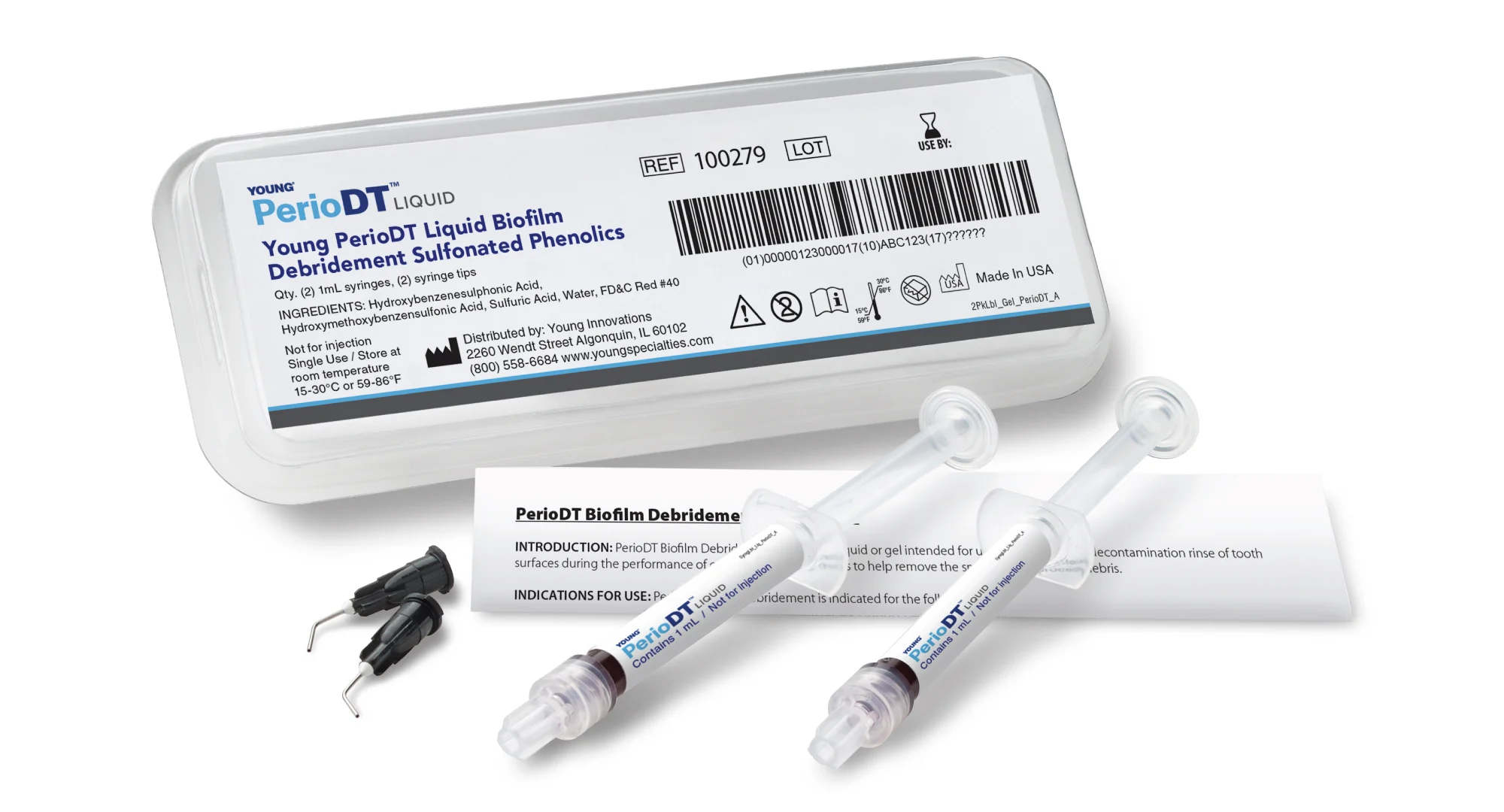
PerioDT is a topical dental debridement medicament manufactured by Young Specialties, a Young Innovations brand based in Algonquin, Illinois. The company introduced it in late 2023 as an adjunctive decontamination rinse for tooth and prosthetic surfaces. The name is a compression of Periodontal Desiccation Technology, which describes the mechanism rather than the chemistry.
The product ships as a red-tinted liquid or gel in a 1 mL single-patient-use syringe fitted with a standard Luer-lock curved dispensing tip. One syringe carries enough material to treat a full arch when applied both before and after scaling and root planing. Sale is restricted to licensed dental professionals, and orders placed without valid credentials get canceled.
Two attributes separate PerioDT from most adjuncts on the market. It is non-systemic, so nothing enters circulation and no prescribing decision is involved. It is also non-antibiotic, which removes the resistance question that shadows locally delivered antimicrobials such as minocycline microspheres and doxycycline gel. For practices building antibiotic stewardship into their dental treatment plan protocols, that distinction carries real weight in case documentation.
The comparison most clinicians reach for first is chlorhexidine, and the comparison does not hold. Chlorhexidine is a bactericidal agent applied over days or weeks. PerioDT acts physically, in one contact, during a single appointment, and gets rinsed away before the patient leaves the chair.
How Desiccation Technology Works
Understanding the mechanism explains most of the product's behavior at the chair, including why it stops working when it gets diluted and why leaving it in place longer changes nothing.
Desiccation is a physical process. The formulation is hygroscopic, meaning it pulls water out of whatever it contacts. Applied to a periodontal pocket, it strips water from the biofilm matrix, from necrotic cellular debris, and from the other macromolecules that accumulate around tooth and prosthetic surfaces. The structures holding that material together collapse. What remains is far easier for a curette or an ultrasonic scaler to lift off the root surface.
The manufacturer places the effect at under one minute from contact. In practice, the change is visible faster than that, usually within the first fifteen to twenty seconds, as the tissue blanches slightly and pulls back from the root surface.
Composition matters here, and the product name obscures it. PerioDT combines aromatic phenolics, sulfuric acid, and water. The SKU description reads "sulfonated phenolics," which tells a purchasing clinician almost nothing and worries some of them unnecessarily. The concentrated sulfonic and sulfuric acid mixture is the active element, and it behaves as a desiccant rather than as a caustic agent at the contact times specified in the instructions for use.
Set that against the two adjunct categories most practices already run. Antimicrobials work by killing organisms, which means dose, contact time, and resistance all become variables. Dental lasers work through thermal and photonic effects, requiring capital investment and operator training. Desiccation sidesteps both models. Nothing is killed pharmacologically, so no resistance pathway exists, and no equipment purchase is involved.
One consequence of a physical mechanism surprises clinicians trained on antimicrobials. Dilution destroys the effect. Blood, saliva, and crevicular fluid all provide water, and a hygroscopic agent that has already absorbed water has nothing left to pull. That single fact drives the entire application protocol.
PerioDT Vs. HybenX: The Same Chemistry Under Two Labels
This relationship goes unaddressed on nearly every page that discusses the product, and it matters enormously for any clinician trying to evaluate the evidence.
PerioDT is the dental-channel product built on the desiccation chemistry marketed elsewhere as HybenX Oral Tissue Decontaminant, produced by EPIEN Medical of Saint Paul, Minnesota. Both rest on the same concentrated sulfonic and sulfuric acid formulation, applied for the same 30 to 60 seconds, for the same indications.
The practical implication is that essentially the entire peer-reviewed literature on this technology is published under the HybenX name. A clinician searching PubMed for PerioDT finds close to nothing and reasonably concludes the product is unstudied. Searching for HybenX returns randomized controlled trials going back to 2017, plus a narrative review examining desiccants as an alternative to adjunctive antibiotics in periodontal therapy.
Anyone evaluating PerioDT should read the HybenX literature as the relevant evidence base. Anyone citing that literature in support of PerioDT should say plainly which product the trials actually tested.
What The Clinical Evidence Actually Shows
Four bodies of evidence bear on this product, and they point in a consistent direction while stopping well short of the language used in the marketing material.
The most cited trial comes from Isola and colleagues, published in Clinical Oral Investigations. Thirty-six patients with chronic periodontitis were treated in a split-mouth design, with maxillary quadrants randomly assigned to scaling and root planing plus desiccant or to scaling and root planing alone, then followed for a full year. The desiccant arm produced significantly greater reductions in probing depth and greater gains in clinical attachment level, alongside reductions in red-complex bacteria and in gingival crevicular fluid inflammatory mediators. A twelve-month follow-up is unusually long for this kind of adjunct study, which is what gives the paper its weight.
A later randomized trial looked specifically at stage III periodontitis, reported in the Saudi Dental Journal. Twenty-five patients had maxillary quadrants allocated to scaling and root planing with or without the desiccant, with measurements at one, three, and six months. Both arms improved significantly against baseline across every clinical parameter measured. Clinicians reading that result should note what it does and does not establish, since great within-group improvement in both arms is the expected outcome of competent instrumentation and says little on its own about the adjunct. Anyone unfamiliar with how these cases get classified will find the perio staging and grading framework useful context for interpreting the sample.
The most clinically actionable finding appeared more recently in Antibiotics, in a randomized controlled trial comparing application frequency. Quadrants with pockets of 5 mm or deeper were assigned to ultrasonic debridement alone, to a single desiccant application, or to three desiccant applications across separate sessions. Between-group differences in probing pocket depth and clinical attachment level reached significance at 45 days. The three-application group achieved greater reduction in periodontal pathogens than either the control or the single-application group, across nearly every species tested, even though clinical outcomes between the two desiccant protocols looked similar.
That last result changes how the product should be scheduled. Applying PerioDT once at initial therapy captures part of the benefit. Repeating it at re-evaluation and at maintenance intervals appears to capture more of the microbiological effect, which is an argument for building it into a recall protocol rather than treating it as a one-time intervention.
Two smaller lines of evidence round out the picture. A prospective randomized study presented in the Journal of Clinical Periodontology examined desiccant use in peri-implant mucositis alongside manual debridement, an area where treatment protocols remain unpredictable. A separate trial published in the European Journal of Dentistry compared the desiccant against laser irradiation as adjuncts to mechanical debridement, and reported an advantage for the desiccant on pocket disinfection and tissue healing, with no adverse effects recorded. A pilot study in the Journal of Clinical Medicine extended the approach to severe periodontitis with subgingival mechanical instrumentation.
Now, the limitations that the manufacturer materials do not discuss. Sample sizes across this literature run from twelve to thirty-six patients. Split-mouth designs carry a known risk that treatment effects migrate between quadrants in the same mouth, which tends to shrink apparent differences. Follow-up periods range from 45 days to a year, so nothing here speaks to multi-year attachment stability. Protocols differ between studies on application count, dwell time, and instrumentation method, which makes pooling difficult. Several of these trials carry industry involvement. Desiccants as a category have not been subjected to the kind of systematic review and meta-analysis that exists for locally delivered antimicrobials, so the effect size remains loosely bounded.
A fair reading is that desiccation produces a measurable adjunctive benefit in the studies conducted so far, and that the magnitude and durability of that benefit are not yet well characterized.
Chairside Evaluation: Six Weeks On A Working Hygiene Schedule
Published trials describe outcomes at 45 days and beyond. They say very little about what the material does in the hand during a booked appointment, which is where most purchasing decisions are actually settled. The observations below come from a structured evaluation across a general practice hygiene schedule.
The first thing that registers is the speed. Applied to a lower anterior sextant with the ringed, tenacious calculus that resists a power scaler tip, the deposit changes character within about twenty seconds. It does not dissolve. It loses the glassy hardness that makes those deposits skip an instrument edge, and the working edge of a dental curette engages instead of sliding across. Removal that would normally involve repeated passes and escalating lateral pressure came off in noticeably fewer strokes.
The visibility gain was less expected and turned out to matter more. The red tint stains biofilm and subgingival calculus pink, and the tissue contracts slightly away from the root surface as water leaves it. Together, those two effects open a working view of the cementoenamel junction and line angles that simply is not available on a bleeding pocket. In furcations, the difference was the most pronounced of anywhere in the mouth.
Hemostasis is the third effect, and on heavy bleeders it changes the appointment. A patient presenting with spontaneous bleeding on instrumentation, the kind of case where the field floods faster than it can be cleared, stayed workable after application. Instrument control improved because the field stayed visible.
Patients noticed the taste, without exception. Descriptions ranged from sour to metallic, and several asked what had been used. None of them asked to stop, and the complaint resolved the moment the field was rinsed, which puts it in the same category as an etchant rather than anything that threatens case acceptance. Warning patients before application worked better than explaining afterward. A single sentence, along the lines of a solution that tastes sharp for about thirty seconds and then rinses away, removed the surprise entirely.
Two technique problems showed up early, and both trace to the same cause. The first was applying to a wet field. In the initial cases, the material went onto tissue that had been rinsed but not dried, and the effect was noticeably weaker. Drying with gauze or a short blast of air before application fixed it. The second was under-application on heavy bleeders, where a conservative amount simply got diluted by the blood it was meant to displace. Applying liberally enough to push the fluid out of the way is what the instructions for use call for, and it is the opposite of the instinct most clinicians bring from working with antimicrobials.
The staining warning is not theoretical. A dropped applicator tip put a permanent pink mark on a scrub top during the second week. Bibs on every patient, and care in the transfer between assistant and operator, are worth the small friction they add to infection control setup.
The most durable impression after six weeks had nothing to do with clinical outcomes. Appointments that had historically run long on tenacious quadrants stopped running long. That reclaimed time went into oral hygiene instruction and home care conversation, which is the part of a periodontal appointment most likely to get compressed when instrumentation overruns.
Clinical Applications And Indications
The labeled indications are narrower than the range of uses clinicians report, and the two lists are worth separating.
Three indications appear in the manufacturer's documentation. The first covers caries restoration procedures, where PerioDT acts as an adjunctive rinse of exposed dentin surfaces in cavity preparations to help remove contaminated debris and the microbial smear layer. The second covers periodontitis and gingivitis treatment, where it serves as an adjunctive rinse of tooth surfaces during debridement to clear contaminated debris from the sulcus. The third covers root canal cleansing, as an adjunctive rinse of the canal system and adjacent surfaces to enhance removal of post-instrumentation dentinal debris and smear layer.
Beyond those, the manufacturer documents a wider set of procedures where the product can be used for oral debridement.
General prophylaxis in areas of gingivitis or heavy plaque and biofilm accumulation
Pre-restoration cleansing of excavated caries and crown preparations
Cleaning of abscessed tissue sites
Pre- and post-mucosal surgery
Peri-implant mucositis and peri-implantitis
Cleaning of fixed and removable prosthetics and orthodontic fixtures
Endodontic treatment
Material compatibility deserves its own note, because it determines whether the product can be used freely in restored and implanted mouths. PerioDT is documented as safe on dentin, enamel, and cementum, and on porcelain, titanium, and other metals. That range covers essentially every surface encountered during periodontal maintenance, which removes the need to work around existing restorations. Practices running structured implant maintenance protocols will find titanium compatibility the operative detail.
One application deserves specific mention. Patients who need surgical periodontal therapy but cannot access it, whether for financial, medical, or geographic reasons, represent a real population in most practices. Clinicians working in underserved communities report using PerioDT to push non-surgical outcomes further in exactly those cases. That is a reasonable use of an adjunct and should not be confused with a claim that it substitutes for surgery.
How To Apply PerioDT Correctly
Technique determines results with this product more than with most adjuncts, and the errors that undermine it are consistent enough to list. The sequence below follows the manufacturer's instructions for use.
Step one: Dry the tissue surfaces with cotton gauze or compressed air before application. A wet field dilutes a hygroscopic agent and blunts the effect before it starts.
Step two: Apply liberally where bleeding is heavy, using enough volume to displace blood and crevicular fluid rather than mixing into it. Conservative application on a bleeding pocket wastes the material.
Step three: Allow the material to sit for 30 to 60 seconds. Never leave it in place longer than 60 seconds.
Step four: Remove with high-volume evacuation, rinse thoroughly, then follow with the saliva ejector.
Step five: Instrument the quadrant. A second application after scaling and root planing addresses residual biofilm, and a 1 mL syringe holds enough for a full arch treated both before and after.
One principle runs against clinical instinct and should be stated directly. Using more product, or leaving it in longer, does not improve the result. The beneficial action is close to instantaneous, and extended contact adds risk without adding benefit. Clinicians who have spent years titrating antimicrobial dose and contact time need to unlearn that habit here.
Staff training is worth doing properly rather than by demonstration on a live case. The dry field requirement, the 60-second ceiling, and the liberal application on bleeders are three points that fail quietly when a new operator improvises. Instruments matter too, since the softened deposit still needs a sharp working edge, and practices using sharpen-free instruments will get more consistent engagement than those working with a tired curette.
Gel Vs. Liquid: Which Viscosity To Stock
Both forms appear on the same product page, and clinicians frequently assume the difference is chemical. It is not.
The two viscosities share identical active ingredients. The gel contains a small quantity of silica to thicken it, and nothing else differs. Both thin out as they warm toward body temperature, so the distinction narrows during a long appointment.
Choice comes down to whether the material needs to stay put. The gel resists flowing away from the treatment site, which suits caries and crown preparation cleansing where the target is an open surface rather than a confined space. The liquid is the more common choice for peri-implantitis and endodontic work, where the material needs to reach into a canal system or around implant threads. Practices doing a broad mix of procedures often stock both, and clinicians treating mostly periodontal cases can work comfortably from either.
Safety, Contraindications, And Handling
This section is where a review earns or loses its usefulness, since the contraindications are specific and at least one of them is routinely misunderstood.
Sulfur allergy is a contraindication, sulfa allergy is not. The distinction is pharmacological, and it is not a technicality. Sulfa refers to sulfonamide antibiotics, a drug class dating to the 1930s. Sulfur is element 16 on the periodic table, and PerioDT carries properties of sulfates derived from it. Sulfates and sulfonamide antibiotics are structurally unrelated. Sulfate allergies are extremely rare, and no clinical evidence establishes cross-reactivity between sulfonamide antibiotics and sulfonamide non-antibiotics. A patient reporting a sulfa allergy on a medical history does not need to be excluded from treatment on that basis alone. Verifying which the patient means is a reasonable thirty seconds of chair time.
Calcium hydroxide contact is contraindicated. This matters most in endodontic sequencing, where calcium hydroxide is a common interappointment medicament. Any protocol combining the two needs the exposure ruled out.
The product must never be diluted. Adding water or combining it with another agent renders it ineffective or potentially harmful. Nothing about this product improves through mixing.
Healthy tissue deserves attention. The formulation is designed to spare it, and the manufacturer states that plainly, while also noting that the agent is hygroscopic and that tissue response varies between patients. An interaction can occur. Application should be limited to indicated sites, meaning inflamed and bleeding periodontal pockets and areas of heavy calculus and biofilm. Clinicians treating gingival swelling of uncertain origin should establish the diagnosis before reaching for a desiccant.
Extraoral contact is low risk. Desiccation acts very slowly on intact non-mucosal skin and accidental contact generally produces no effect. Rinse immediately. Prolonged contact can produce a mild warming sensation.
Clothing is the practical hazard. The material stains pink and can damage fabric, and the staining is permanent. Bibs on patients and awareness during instrument transfer prevent most of it.
Storage requires nothing unusual. Room temperature is appropriate, refrigeration is not needed, and the shelf life is two years from manufacture. The expiration date printed on the label governs. Anything safety-critical should be checked against the current manufacturer instructions for use and safety data sheet rather than against this article.
Cost And Practice Economics
Sticker price is the wrong number to evaluate. What matters is cost per arch measured against the fee for the procedure it supports.
As verified in August 2026, the manufacturer listed a PerioDT configuration at $152.99, with a per-unit price band around $10.69 depending on form and pack quantity. Pricing varies by viscosity and pack size and changes over time, so the current SKU should be confirmed before any budget decision rests on these figures.
The arithmetic that matters is straightforward. One 1 mL syringe treats a full arch when used before and after instrumentation. A quadrant of scaling and root planing carries a fee well into the low hundreds of dollars in most United States markets, and the wider picture on what patients pay for deep cleaning puts the consumable cost in perspective quickly. Against that fee, a consumable in the range of ten to fifteen dollars per arch represents a small percentage of production.
Two structural points affect the calculation. Syringes and applicator tips are single-patient-use, so nothing gets reprocessed and cost scales linearly with case volume rather than amortizing like capital equipment. There is also no equipment purchase, no maintenance contract, and no training certification, which distinguishes the economics sharply from a laser adjunct where the capital outlay dominates the first several years.
The offsetting benefit is chair time. Quadrants that consistently overrun stop overrunning, and in a hygiene-driven practice that recovered time has a real value that appears in schedule capacity rather than on an invoice. Quantifying it honestly requires a practice to measure its own appointment lengths before and after, since the size of the gain depends entirely on how much tenacious calculus a given patient population presents with. Practices weighing this against gum surgery costs for the same patients will find the comparison favorable, provided the clinical goals are set realistically.
What Other Clinicians Report
Independent clinician feedback tracks closely with the chairside findings above, with one criticism appearing consistently enough to treat as a known limitation.
The recurring positives cluster around four themes. Deposits that previously required extended instrumentation come off faster, with several hygienists describing reductions in the time spent on large deposits. Hand fatigue drops, and multiple clinicians frame that in terms of career longevity rather than daily comfort. Subgingival visibility improves through the combination of tissue shrinkage and pink-stained deposits. Bleeding control during instrumentation improves the working field on patients who historically flood.
Reported use in specific populations extends beyond periodontal maintenance. Diabetic patients and heavy bleeders come up frequently. Some clinicians apply the material before placing a restoration to clean the preparation. Others report using it to manage localized infections.
The criticisms are narrower and consistent. Taste is the complaint raised most often, and it comes from clinicians reporting patient reaction rather than from patients refusing treatment. The second criticism concerns support, with clinicians noting that professional education and training around the product lag behind its clinical usefulness. That gap is worth factoring into an adoption decision, since a product this technique-sensitive benefits from proper onboarding.
Product evaluation panels in the dental trade press have scored PerioDT highly following multi-week in-practice use. Those evaluations run in advertiser-supported media, which is worth knowing when weighing them, and the specific observations in them align with what independent clinical use produces.
Who Should Add PerioDT, And Who Should Not
Adoption value varies more by practice profile than by clinical philosophy, and the segmentation is fairly clean.
The strongest fit is a practice where periodontal therapy represents a meaningful share of production. High perio volume amplifies every benefit the product offers, from time saved per quadrant to cumulative reduction in hand strain. Community health and underserved settings form the second clear fit, since patients who need surgical intervention but cannot access it get more out of non-surgical therapy when an adjunct extends its reach. Practices running structured implant maintenance programs form a third, given the titanium compatibility and the peri-implant indications. Any hygienist already managing wrist or shoulder symptoms should treat the ergonomic argument as the primary reason to trial it.
The weakest fit is a low-volume restorative practice where periodontal cases arrive occasionally. The per-syringe cost is easy to absorb, and the benefit simply does not compound across enough appointments to change anything. Practices already running a laser protocol or a locally delivered antimicrobial they are satisfied with should identify the specific gap PerioDT would fill before adding another consumable, since layering adjuncts without a clinical rationale adds cost and complexity. Any practice unwilling to train staff properly on the dry-field requirement and the 60-second ceiling will get inconsistent results and reasonably conclude the product does not work.
A reasonable trial looks like two to four weeks of use on the heaviest calculus cases on the schedule, with appointment lengths recorded before and after. That produces a defensible answer for a specific practice faster than any published trial can.
Bottom Line
PerioDT does what the manufacturer says it does, within limits the marketing material does not describe.
The desiccation mechanism produces a visible, repeatable effect at the chair, and the published trials on the underlying chemistry support a real adjunctive benefit on probing depth, attachment level, and bacterial load. That evidence rests on small studies with short follow-up, so the size and durability of the benefit remain open questions. For a practice carrying meaningful periodontal volume, the combination of faster instrumentation, better visibility, and reduced hand strain justifies a trial at a consumable cost that stays small against the associated fee. Patients will complain about the taste. Staff need real training on the dry field. Neither is a reason to skip it.
Verdict
<p>PerioDT earns a qualified recommendation. The mechanism works, and the effect shows up chairside within a minute. Calculus softens, tissue tightens away from the root surface, and bleeding drops enough to improve visibility during instrumentation. Hygienists carrying heavy periodontal caseloads see the largest benefit, and the <a target="_blank" rel="noopener noreferrer nofollow" class="text-primary underline hover:text-primary/80" href="https://dentalreviewed.com/blog/what-is-dental-ergonomics"><u>dental ergonomics</u></a> argument matters more than the clinical numbers suggest, because time not spent fighting tenacious deposits is wrist and shoulder strain that never accumulates.</p><p>The evidence supports an adjunctive claim without proving anything transformative. Randomized trials of the underlying chemistry report statistically significant improvements in probing depth and clinical attachment level over scaling and root planing alone. Those studies remain small, mostly split-mouth in design, and short on follow-up. No large meta-analysis isolates desiccants as a category. PerioDT improves a competent debridement. It will not rescue a poor one, and it does not replace indicated surgery.</p><p>Practical reservations are real and manageable. Patients dislike the taste, the material stains clothing pink, and it must never be diluted or allowed to contact calcium hydroxide. Per-arch cost stays modest against a periodontal therapy fee. Any practice where periodontal therapy forms a meaningful share of production should run a trial before writing standing orders.</p>
Frequently Asked Questions
What is PerioDT and what is it used for?
PerioDT is a topical dental debridement medicament from Young Specialties, used as an adjunctive decontamination rinse during periodontal, endodontic, and restorative procedures. It helps remove the microbial smear layer, biofilm, and contaminated debris from tooth and prosthetic surfaces. Sale is restricted to licensed dental professionals.
How does desiccation technology work?
The formulation is hygroscopic and pulls water out of biofilm, necrotic material, and other macromolecules on contact. Those structures collapse, and the residue lifts off far more easily during instrumentation. The process is physical rather than antimicrobial, and it completes in under a minute.
Is PerioDT the same as HybenX?
Both products are built on the same desiccation chemistry, a concentrated mixture of sulfonic and sulfuric acids. PerioDT is the Young Specialties dental-channel product, while HybenX is produced by EPIEN Medical. Nearly all peer-reviewed research on this technology is published under the HybenX name.
How long should PerioDT stay in the pocket?
Between 30 and 60 seconds, and never longer than 60. The action is close to instantaneous, so extended contact adds no benefit. Remove with high-volume evacuation, rinse thoroughly, and follow with the saliva ejector.
Does PerioDT hurt, and what do patients notice?
Patients report a sharp, sour, or metallic taste rather than pain. The sensation resolves as soon as the field is rinsed. Warning the patient before application rather than explaining afterward removes most of the reaction.
What are the contraindications for PerioDT?
Sulfur allergy is a contraindication, though sulfa allergy is not, since sulfonamide antibiotics and sulfates are unrelated and no cross-reactivity has been established. Contact with calcium hydroxide is contraindicated. The product must never be diluted or combined with another agent, which renders it ineffective or potentially harmful.
Is PerioDT safe around implants, crowns, and titanium?
Yes. The manufacturer documents safety on dentin, enamel, cementum, porcelain, titanium, and other metals. That range covers essentially every surface encountered during periodontal maintenance, including restored and implanted sites.
Should I stock the gel or the liquid?
Both share identical active ingredients, with the gel containing added silica for thickness. The gel stays put on open surfaces such as caries and crown preparations. The liquid flows into canal systems and around implant threads, which suits endodontic and peri-implantitis work.
How many patients does one syringe treat?
One 1 mL syringe holds enough material to treat a full arch when applied both before and after scaling and root planing. Syringes and applicator tips are single-patient-use and cannot be reprocessed.
Does PerioDT replace scaling and root planing?
No. Every indication and every published trial positions it as an adjunct to mechanical instrumentation. It makes deposits easier to remove and improves the working field, and the removal still has to be done with instruments.
Can PerioDT be used for peri-implantitis and peri-implant mucositis?
Yes, both appear in the manufacturer’s documented procedure list, and a prospective study has examined desiccant use in peri-implant mucositis alongside manual debridement. The peri-implant evidence base is thinner than the periodontal one, so expectations should be set accordingly.
Does PerioDT need refrigeration, and what is the shelf life?
No refrigeration is required and room-temperature storage is appropriate. Shelf life is two years, with the expiration date printed on the product label governing in every case.
Does PerioDT contain an antibiotic?
No. The formulation combines aromatic phenolics, sulfuric acid, and water. It is non-antibiotic and non-systemic, which is why it raises no antimicrobial resistance concerns and requires no prescribing decision.
How does PerioDT compare to a chlorhexidine rinse?
The two work on different principles and different timescales. Chlorhexidine is a bactericidal agent used over days or weeks, and clinicians comparing options for gingival inflammation often weigh it against other rinses for gum health. PerioDT acts physically, in a single in-office contact, and gets rinsed away before the patient leaves.
What does PerioDT cost per patient?
As of August 2026 the manufacturer listed a configuration at $152.99, with per-unit pricing around $10.69 depending on form and pack quantity. One syringe treats a full arch, placing the per-arch consumable cost in the range of ten to fifteen dollars. Pricing changes, so the current SKU should be confirmed directly.