Rating: 4.6/5
American Eagle XP Sharpen-Free Instruments Review
Sharpening hand instruments has been a routine part of dental hygiene for over a century. It takes time, requires a practiced hand, and produces inconsistent results even among...
Reviewed by Agnes Markovic
Pros
- Truly sharpen-free throughout the instrument’s usable lifespan, eliminating daily maintenance time
- Sharpest factory edge available in the industry, according to the manufacturer’s independent stroke testing
- Thinnest blade design on the market, improving access to tight periodontal pockets and interproximal spaces
- Reduced hand and wrist fatigue due to lighter pressure requirements and lightweight EagleLite handle options
- Improved patient comfort with less tissue trauma, less noise, and a smoother scaling experience
- Enhanced tactile sensitivity from lighter grip pressure, making it easier to detect residual deposits and root irregularities
- Comprehensive product line covering scalers, universal curettes, Gracey curettes, Pro Thin instruments, and Quik-Tip modular tips
- Made in the USA in Missoula, Montana, with US-sourced steel and hand-honed by skilled craftsmen
- 30-day satisfaction guarantee and limited lifetime warranty against defects in materials and workmanship
- Autoclave safe up to 350°F with no degradation of the XP-enhanced surface
Cons
- Higher upfront cost at approximately $80 per instrument compared to $30–$50 for basic stainless steel alternatives
- Cannot be resharpened when the blade eventually reaches end of life, requiring full replacement
- Technique adjustment needed when transitioning from conventional instruments, particularly for clinicians who habitually use heavy lateral pressure
- Not recommended for margin trimming or overhang removal, limiting versatility compared to some traditional instruments
- Ongoing industry debate about whether XP technology is a true metallurgic change or a coating, which may create uncertainty for some buyers
- Thinner blade feel may take time to get used to for clinicians accustomed to the heft of conventional stainless steel working ends
Sharpening hand instruments has been a routine part of dental hygiene for over a century. It takes time, requires a practiced hand, and produces inconsistent results even among experienced clinicians. American Eagle Instruments introduced XP Sharpen-Free technology to address that exact problem, and the product line has generated strong opinions across the profession ever since.
The appeal is easy to understand. Dull instruments force clinicians to apply more lateral pressure, increase the risk of tissue trauma, accelerate hand and wrist fatigue, and ultimately compromise both patient comfort and clinical outcomes. A consistently sharp instrument solves all of those problems simultaneously, which is why the idea of a permanently sharp blade has resonated so strongly with dental hygienists and periodontists since XP technology first entered the market.
American Eagle Instruments is a subsidiary of Young Innovations, headquartered in Missoula, Montana. The company traces its roots to 1948, when American Dental Manufacturing was founded as a family-run instrument maker. Today, American Eagle is one of the largest dental hand instrument manufacturers in North America, and its XP Sharpen-Free line has become one of the most discussed product categories in the dental hygiene community.
This review examines what XP Sharpen-Free technology actually is, how the instruments perform in clinical settings, who benefits most from using them, and whether the higher price tag is justified. The information draws on manufacturer specifications, published clinical evaluations, and practitioner feedback from dental hygienists and periodontists who use these instruments daily.
What Is XP Sharpen-Free Technology?
Understanding the metallurgy behind XP Sharpen-Free instruments helps dental professionals evaluate whether the technology delivers on its promises or relies on marketing claims.
XP Sharpen-Free technology is a patented surface engineering process developed by American Eagle Instruments, a subsidiary of Young Innovations based in Missoula, Montana. During manufacturing, titanium nitride and carbon are permeated into high-quality stainless steel under controlled conditions. This process permanently changes the metallurgic composition of the instrument’s surface, creating a material that is significantly harder and more wear-resistant than conventional stainless steel or carbon steel.
American Eagle emphasizes that XP technology is not a coating. Unlike surface treatments that can chip, peel, or wear away with autoclave cycling and clinical use, the XP process embeds the hardening elements within the metal itself. The manufacturer provides close-up microscopy images comparing the smooth, defect-free surface of XP metal against the bumpy, macroparticle-laden surface of non-XP instruments to illustrate this distinction.
According to the manufacturer, independent stroke testing demonstrates that XP technology handles approximately ten times the number of strokes with only one-tenth of the wear compared to standard stainless steel instruments considered the industry benchmark. The resulting edge is razor-sharp from the factory and maintains that sharpness throughout the instrument’s usable lifespan.
How XP Technology Affects Clinical Workflow
The practical impact of a permanently sharp instrument extends beyond the blade itself. It changes how clinicians approach scaling, how much time they spend on maintenance, and how patients experience the procedure.
When instruments never need sharpening, clinicians reclaim the five to ten minutes per day that would otherwise go toward maintaining edges. That time adds up to several hours per month, hours that can be redirected toward patient care or used to reduce end-of-day fatigue. For practices building a comprehensive dental treatment plan for each patient, those extra minutes can make a meaningful difference in the quality and thoroughness of case documentation.
The consistently sharp edge also eliminates a common source of variability in clinical outcomes. With conventional instruments, the quality of scaling depends partly on how recently the instrument was sharpened and how well the clinician performed the sharpening. XP instruments remove that variable entirely, delivering the same cutting performance for the first patient of the day and the last.
XP Sharpen-Free Product Line Overview
American Eagle offers XP Sharpen-Free technology across a comprehensive range of dental hygiene and periodontal instruments. The following sections outline the major categories and their clinical applications.
Scalers
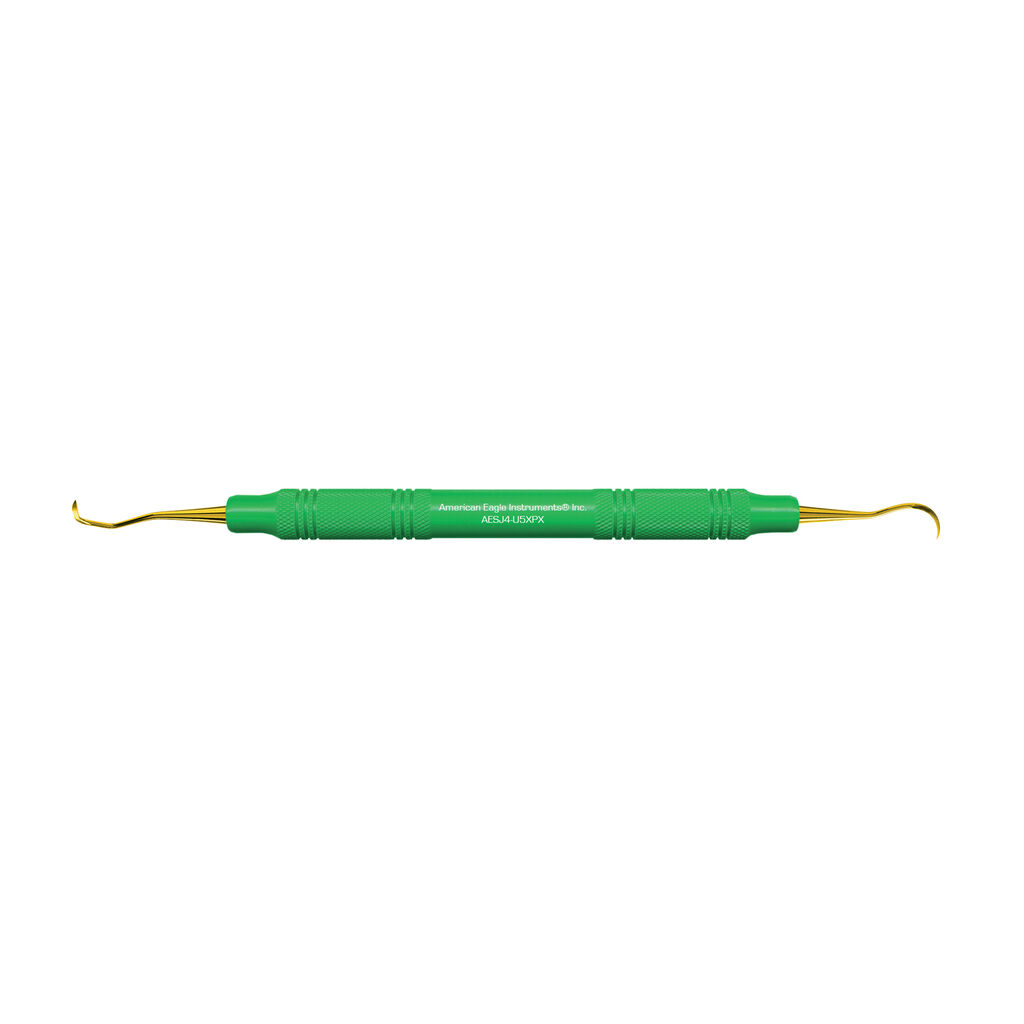
The scaler category includes several of the most popular instruments in the XP lineup. The M23 XP Scaler is a universal option that adapts to mesial and distal line angles on all teeth, effectively replacing an entire tray of posterior and anterior sickle scalers. The 204S XP is designed specifically for supragingival interproximal scaling. The Eagle Claw XP features a contra-angled sickle blade for posterior supragingival and interproximal areas, and the Blackjack universal sickle scaler uses a distinctive contra-angled design that keeps the handle offset from the patient’s face during anterior debridement. Pricing typically starts around $80 per instrument through major dental suppliers such as Safco Dental and Scott’s Dental Supply.
Universal and Gracey Curettes
For periodontal therapy and subgingival debridement, the XP line includes both universal and area-specific options. The Columbia 13-14 XP is a universal dental curette designed for full-dentition scaling and stain removal. The Barnhart 5-6 XP is another versatile choice favored by hygienists who want a single curette that performs reliably across multiple surfaces. Gracey curettes are available in XP versions including models 1-2, 7-8, 11-12, 13-14, and 15-16, along with Gracey Access instruments that feature longer shanks and optimized angulation for deep pockets and furcation areas.
Pro Thin Instruments
The Pro Thin line represents the thinnest blades American Eagle produces. Because XP instruments never need sharpening, the manufacturer does not need to add extra material to the blade to accommodate future maintenance. This allows Pro Thin blades to be fabricated as thin as possible, improving access to narrow periodontal pockets and tight interproximal spaces. The range includes thinner versions of the Blackjack, Barnhart 5-6, M23, and Gracey Access instruments.
In a Dental Products Shopper evaluation, a panel of dental professionals scored the XP Pro Thin Gracey Access instruments at 4.5 out of 5.0. Evaluators consistently praised the sharpen-free feature and the thin blade’s ability to navigate deep pockets with minimal tissue displacement.
Quik-Tip Interchangeable System
The Quik-Tip system takes a modular approach to instrument design. Tips screw into reusable EagleLite handles, allowing clinicians to replace only the worn working end rather than discarding the entire instrument. XP Sharpen-Free tips are available for the platform in scaler, curette, and Gracey configurations. Color-coded handles in seven different colors allow practices to organize instruments by type, treatment room, or clinician preference.
XP2 (XP Squared) Technology
American Eagle has introduced a next-generation advancement called XP2 Technology. The manufacturer describes this as a nano-optimized version of the original XP process, producing instruments that are 59 percent sharper than the original XP technology with even slimmer working ends.
Handle Options
All XP Sharpen-Free instruments are available with two handle styles. The EagleLite resin handle is a lightweight, 3/8-inch diameter option with a knurled grip designed to reduce hand fatigue and improve tactile feedback. The stainless steel handle provides a more traditional, weighted feel. Both are autoclavable up to 350°F and compatible with all standard sterilization methods.
Clinical Performance in Practice
Understanding how XP Sharpen-Free instruments perform in real clinical settings matters more than manufacturer specifications alone. The following sections cover key performance areas based on published evaluations and clinician feedback.
Sharpness Retention
Multiple dental hygienists who have published reviews report that their XP instruments remain effective for months of daily use without any decline in cutting performance. In a firsthand account published in Dental Products Report, a registered dental hygienist described using three XP instruments for eight months with no loss of sharpness. The clinician noted that the experience of removing calculus changed fundamentally, shifting from a fracturing approach to a smooth shaving technique.
Verified customer reviews from dental supply retailers echo this experience. One hygienist noted that XP instruments were still sharp after eight months of daily use and that the lightweight handles reduced hand fatigue significantly. Another described the instruments as excellent for periodontal scaling and root planing, specifically praising the elimination of the sharpening step.
Tactile Sensitivity and Calculus Detection
A sharper instrument provides better tactile feedback, and a lighter grip amplifies the clinician’s ability to detect subtle changes in root surface texture. Because XP blades require minimal lateral pressure, clinicians can use exploratory strokes that reveal residual deposits, rough cementum, and subgingival irregularities more effectively. Several evaluators in the Dental Products Shopper review panel noted improved access to furcation areas and an ability to perform more thorough debridement with less physical effort.
Patient Comfort and Compliance
Sharper blades, thinner profiles, and a smoother metal surface contribute to a noticeably more comfortable experience for patients. The reduced tissue trauma means less bleeding, less post-operative sensitivity, and less of the loud scratching sound that many patients associate with dental cleanings. American Eagle points out that the smooth XP surface produces less auditory discomfort compared to instruments with rougher, macroparticle-laden surfaces. When patients experience gentler hygiene visits, treatment compliance and appointment adherence tend to improve, a benefit that affects practice revenue over time. Proper sterilization equipment is essential for maintaining XP instruments between patients, though the instruments require no special handling beyond standard autoclave protocols.
Ergonomics and Musculoskeletal Health
According to industry surveys, up to 93 percent of dental hygienists report musculoskeletal pain during their careers. Instrument selection plays a direct role in either contributing to or alleviating that burden. XP instruments address the ergonomic challenge from two angles: the sharper blade reduces the lateral pressure needed for effective scaling, and the lightweight EagleLite handle minimizes the weight carried through the hand and wrist during extended procedures. Multiple clinicians have described noticeable reductions in hand and wrist fatigue after switching to XP instruments, even during full-mouth debridement appointments.
The ergonomic benefit compounds over the course of a clinical day. A hygienist performing six to eight scaling appointments uses thousands of individual strokes. When each stroke requires less force, the cumulative reduction in muscle effort is substantial. For clinicians who are already experiencing early signs of carpal tunnel syndrome, tendinitis, or general hand fatigue, switching to a lighter, sharper instrument can be a meaningful quality-of-life improvement that extends career longevity.
Technique Adaptation
Transitioning from conventional stainless steel instruments to XP Sharpen-Free does require a modest change in scaling approach. The manufacturer recommends using lighter, exploratory strokes and a shaving technique rather than heavy lateral pressure. The blade is harder and sharper, so letting it do the work produces better results than forcing it. American Eagle also advises against using XP instruments for trimming restorative margins or removing overhangs, as these tasks fall outside the instrument’s intended purpose. Most clinicians report adapting within a few appointments.
The transition period is typically short. Clinicians who have spent years developing muscle memory around heavier strokes may notice the difference immediately, but the feedback from the sharper blade generally makes the adjustment intuitive. Starting with supragingival scaling allows the clinician to build familiarity with the instrument’s responsiveness before moving to subgingival applications where precision matters most.
Noise Reduction During Scaling
One underappreciated benefit of XP Sharpen-Free instruments relates to the sound produced during scaling. Instruments with rougher, macroparticle-laden surfaces create a louder, more abrasive scratching noise when contacting tooth surfaces. The smooth, defect-free surface of XP metal produces a noticeably quieter scaling experience. For anxious patients, especially those who associate dental visits with unpleasant sounds, this difference can meaningfully reduce stress levels during the appointment.
Reduced noise also benefits the clinician. In a busy hygiene operatory where scaling sounds are constant throughout the day, quieter instruments contribute to a less fatiguing auditory environment. While this factor alone would not justify switching instruments, it adds to the cumulative quality-of-life improvement that XP technology delivers.
Who Should Consider XP Sharpen-Free Instruments
Not every dental professional has the same instrument needs, and understanding which clinical profiles benefit most from XP technology helps practices make targeted purchasing decisions.
Dental Hygienists in High-Volume Practices
Clinicians who see a full schedule of patients daily stand to gain the most from eliminating the sharpening workflow. The time savings accumulate quickly, and the consistent sharpness ensures that the last patient of the day receives the same quality of debridement as the first.
Hygienists Experiencing Hand or Wrist Pain
The lighter pressure requirements and reduced grip force make XP instruments a practical ergonomic intervention for clinicians managing or trying to prevent musculoskeletal disorders. Combined with the lightweight EagleLite handles, the reduction in physical strain can extend a clinician’s career and improve daily comfort.
Periodontists and Periodontal Hygienists
The Pro Thin and Gracey Access instruments provide exceptional access to deep periodontal pockets, furcation areas, and complex root anatomy. For clinicians who specialize in advanced debridement, the thinner blade profile and consistent sharpness offer a tangible clinical advantage over conventional instruments that require frequent sharpening.
Dental Students and New Graduates
Starting a career with sharpen-free instruments eliminates the steep learning curve associated with mastering manual sharpening technique. New graduates can focus on developing their scaling skills and clinical judgment rather than spending time on instrument maintenance. Students enrolled in accredited dental hygiene programs can take advantage of American Eagle’s student pricing to build their first kit with XP instruments from the outset.
Practice Managers Focused on Efficiency
From an operational perspective, eliminating sharpening removes a recurring bottleneck from the hygiene department. The reduction in supply costs, reclaimed clinician time, and more predictable instrument replacement cycles all contribute to improved practice profitability. For practices that prioritize clinical efficiency, XP instruments represent a straightforward process improvement.
Care, Maintenance, and Best Practices
While XP Sharpen-Free instruments eliminate the need for sharpening, proper care remains essential for maximizing their lifespan and clinical performance. The following guidelines reflect manufacturer recommendations and insights from experienced users.
Use light, exploratory strokes and let the blade do the work rather than applying heavy lateral pressure
Adopt a shaving approach to calculus removal instead of a fracturing technique
Avoid using XP instruments for trimming restorative margins, removing overhangs, or contacting restorative materials
Follow standard sterilization protocols, as no special handling is required beyond standard autoclave cycling up to 350°F
Inspect blades visually and through tactile testing on a regular basis, replacing instruments when cutting efficiency declines
When using the Quik-Tip system, apply a thin layer of petroleum jelly or silicone lubricant to the thread before installation and tighten with the designated American Eagle tool
Store instruments properly in cassettes or pouches to protect blade edges from unnecessary contact with other metal surfaces
Proper instrument care is one component of a broader commitment to clinical quality. Maintaining organized, well-stocked instrument cassettes and following consistent replacement schedules ensures that every clinician in the practice has access to sharp, reliable tools at all times.
Longevity, Replacement, and Cost Considerations
Cost is one of the most common concerns dental professionals raise about XP Sharpen-Free instruments. A closer look at the total cost of ownership reveals a more nuanced picture than the sticker price suggests.
American Eagle states that XP instruments last about as long as conventional stainless steel instruments when used and cared for properly. For clinicians who use them daily, annual replacement is generally recommended. The difference is that a conventional instrument requires periodic sharpening to remain functional throughout that lifespan, while the XP instrument maintains its edge autonomously.
At roughly $80 per instrument, XP Sharpen-Free tools cost more per unit than basic stainless steel alternatives in the $30 to $50 range. However, the total cost calculation shifts when factoring in the cost of sharpening stones and guides, the labor cost of a hygienist spending time on maintenance instead of patient care, the inconsistency of manually sharpened edges, and the shorter effective lifespan of instruments that lose blade geometry through repeated sharpening. American Eagle provides an online sharpening calculator that helps practices estimate annual savings.
Consider a practice with two hygienists who each spend five minutes per day sharpening instruments. At an average hourly rate of $45, that adds up to roughly $3,900 per year in labor costs alone. Adding the expense of sharpening stones, testing sticks, and replacement instruments that wear out faster due to altered blade geometry from imperfect sharpening, and the hidden costs of maintaining conventional instruments become much more visible.
The Quik-Tip interchangeable system offers another cost-saving pathway. Rather than replacing an entire instrument when the working end reaches end of life, clinicians replace only the tip. This can reduce per-replacement cost significantly while keeping the same ergonomic handle in service for years.
For practices focused on improving clinical efficiency, eliminating the sharpening workflow removes a recurring bottleneck from the hygiene department’s daily operations.
Industry Context: The Hu-Friedy Debate
Any review of XP Sharpen-Free instruments would be incomplete without addressing the public challenge from Hu-Friedy, the largest dental instrument manufacturer in the world.
Hu-Friedy commissioned independent testing through the Cutlery Allied Trades Research Association (CATRA) and claimed publicly that its EverEdge instruments are 30 percent sharper out of the box than XP scalers. Hu-Friedy also argued that XP technology is essentially a coating and that the instruments cannot be sharpened when they dull.
American Eagle counters with its own metallurgical evidence, including microscopy comparisons and stroke-test data, asserting that XP technology is fundamentally different from a surface coating. The company also argues that the relevant comparison is not initial sharpness alone but sharpness retention over the life of the instrument, where XP technology maintains its edge without intervention.
The debate highlights an important point for dental professionals evaluating either product: sharpness at the moment of purchase matters, but sharpness over the full life of the instrument matters more. An instrument that starts slightly sharper but requires regular maintenance to stay that way may not deliver better clinical outcomes over time than one that starts very sharp and stays that way without intervention. The real-world performance ultimately depends on how the instrument is used, maintained, and how often it is replaced.
For dental professionals caught in the middle of this debate, the most practical approach is to evaluate both products in a clinical setting. Both companies offer satisfaction guarantees, making a trial run relatively low-risk.
Warranty and Satisfaction Guarantee
American Eagle offers a 30-day customer satisfaction guarantee on all instruments. If a clinician is not completely satisfied within the first 30 days, they can contact their dental dealer to request a credit or replacement.
The company also provides a limited lifetime warranty against defects in materials and workmanship. If an instrument experiences corrosion, breakage, or joint failure within its average life expectancy, American Eagle will replace, repair, or credit the full value of the instrument to the original owner with proof of purchase.
Bottom line
XP Sharpen-Free American Eagle Instruments represent a meaningful advancement in hand instrumentation for dental hygiene and periodontal therapy. The technology eliminates sharpening, delivers consistent clinical performance, and addresses the ergonomic challenges that affect clinician longevity. While the upfront investment is real, the total cost of ownership and the quality-of-life benefits for both clinician and patient make these instruments worth serious consideration.
The strongest endorsement for XP technology comes from the clinicians who use it. When dental hygienists describe being unable to go back to conventional instruments after trying XP, when periodontists report that previously difficult furcation areas become more accessible, and when patients comment on how comfortable their hygiene visit was, the product’s value proposition becomes clear. These are not abstract marketing claims but practical outcomes that affect daily clinical practice.
For practices that want to explore XP Sharpen-Free instruments without committing to a full kit, the 30-day satisfaction guarantee and the Quik-Tip system both provide low-risk entry points. Starting with one or two frequently used instruments allows clinicians to evaluate the technology in their own hands. From there, the decision to expand the XP lineup often makes itself. Those looking for guidance on selecting and organizing dental equipment essentials will find useful frameworks for building a modern hygiene operatory.
Verdict
<p>XP Sharpen-Free American Eagle Instruments deliver on their central promise. The blades arrive exceptionally sharp, they stay that way throughout the instrument’s usable life, and they eliminate the entire sharpening workflow from the clinical day. That alone justifies serious consideration for any dental hygienist, periodontist, or practice manager evaluating hand instrument options.</p><p>The clinical benefits extend beyond convenience. Consistent sharpness means consistent debridement quality from the first patient to the last. Lighter pressure requirements reduce hand and wrist strain, addressing one of the profession’s most significant occupational health concerns. Thinner blade profiles improve subgingival access and patient comfort, contributing to better treatment outcomes and stronger appointment compliance.</p><p>The higher per-unit cost is the primary barrier, and it is a legitimate consideration for budget-constrained practices. However, the total cost of ownership, accounting for eliminated sharpening supplies, reclaimed clinician time, and more predictable instrument replacement cycles, makes XP Sharpen-Free instruments a financially sound investment for most practices that commit to them.</p><p>For practices that want to test the waters before a full transition, American Eagle’s 30-day satisfaction guarantee and the modular Quik-Tip system both offer low-risk entry points. Starting with one or two frequently used instruments, such as the M23 scaler or the Barnhart 5-6 curette, allows clinicians to evaluate the technology in their own hands before committing to a full kit.</p>
Frequently Asked Questions
Is XP sharpen-free technology really different from a coating?
According to American Eagle, yes. The manufacturer states that titanium nitride and carbon are permeated into the stainless steel at a molecular level during manufacturing, permanently altering the metal’s composition. This creates an integrated, harder material rather than a removable surface layer. American Eagle provides microscopic comparisons showing the smooth, defect-free XP surface versus the rougher surface of non-XP metals.
How long do XP sharpen-free instruments typically last?
American Eagle states that XP instruments last about as long as conventional stainless steel instruments when used and cared for correctly. For daily-use clinicians, annual replacement is generally recommended. The key difference is that the XP instrument maintains its sharp edge throughout that entire period without requiring sharpening.
Can XP instruments be sharpened if they eventually become dull?
The manufacturer does not recommend sharpening XP instruments. The blades are intentionally designed to be thinner than conventional instruments because no allowance for future sharpening is needed. Attempting to sharpen them could compromise blade geometry and the integrity of the enhanced surface. Replacement is the recommended course of action when the instrument reaches end of life.
Do clinicians need to change their scaling technique when switching to XP instruments?
A slight adjustment is recommended. The sharper, harder blade works best with lighter, exploratory strokes and a shaving approach rather than heavy lateral pressure. Most clinicians adapt within a few appointments and report that the lighter technique actually feels more comfortable and produces better results.
Are XP sharpen-free instruments safe to autoclave?
Yes. All XP Sharpen-Free instruments are fully sterilizable and autoclavable up to 350°F (approximately 177°C). Repeated autoclave cycling does not degrade the XP-enhanced surface. Standard dental sterilization protocols apply without modification.
What handle options are available for XP instruments?
Two handle configurations are offered. The EagleLite resin handle is a lightweight, 3/8-inch diameter option with a knurled grip for improved tactile feedback and reduced fatigue. The stainless steel handle provides a more traditional, weighted feel. The Quik-Tip system also offers color-coded EagleLite handles in seven colors for instrument identification.
How do XP instruments compare to Hu-Friedy EverEdge scalers?
This is a topic of active industry discussion. Hu-Friedy has cited independent CATRA testing claiming that EverEdge instruments are 30 percent sharper out of the box. American Eagle counters that XP technology maintains sharpness over a much longer period without intervention. Both product lines have loyal clinical followings, and the most practical approach is to evaluate both in your own clinical setting.
What types of instruments come with XP sharpen-free technology?
American Eagle offers XP technology across sickle scalers (M23, 204S, H6/H7, Blackjack, Eagle Claw, Eagle Talon), universal curettes (Columbia 13-14, Barnhart 5-6), area-specific Gracey curettes (1-2, 7-8, 11-12, 13-14, 15-16), Gracey Access instruments, Langer curettes, McCall curettes, the full Pro Thin line, and the Quik-Tip interchangeable system.
Does American Eagle offer a satisfaction guarantee?
Yes. The company offers a 30-day customer satisfaction guarantee on all instruments. If a clinician is not completely satisfied within the first 30 days, they can contact their dental dealer to request a credit or replacement. A limited lifetime warranty against defects in materials and workmanship is also included.
Are there discounted options for dental hygiene students?
Yes. American Eagle offers a student pricing program through the Young Innovations website. Dental hygiene students can access reduced pricing on XP Sharpen-Free and other American Eagle instruments.
Where are American Eagle instruments manufactured?
All American Eagle Instruments are designed and manufactured in Missoula, Montana, USA. The company uses US-sourced steel, and each instrument is hand-honed before leaving the facility.
Can XP instruments be used around dental implants?
American Eagle offers specific implant maintenance instruments designed for that purpose. Standard XP scalers and curettes are intended for use on natural tooth structure. Clinicians should select implant-specific instruments to avoid scratching or damaging implant surfaces.