Rating: 4.1/5
BioSonic US200 Ultrasonic Scaler Review
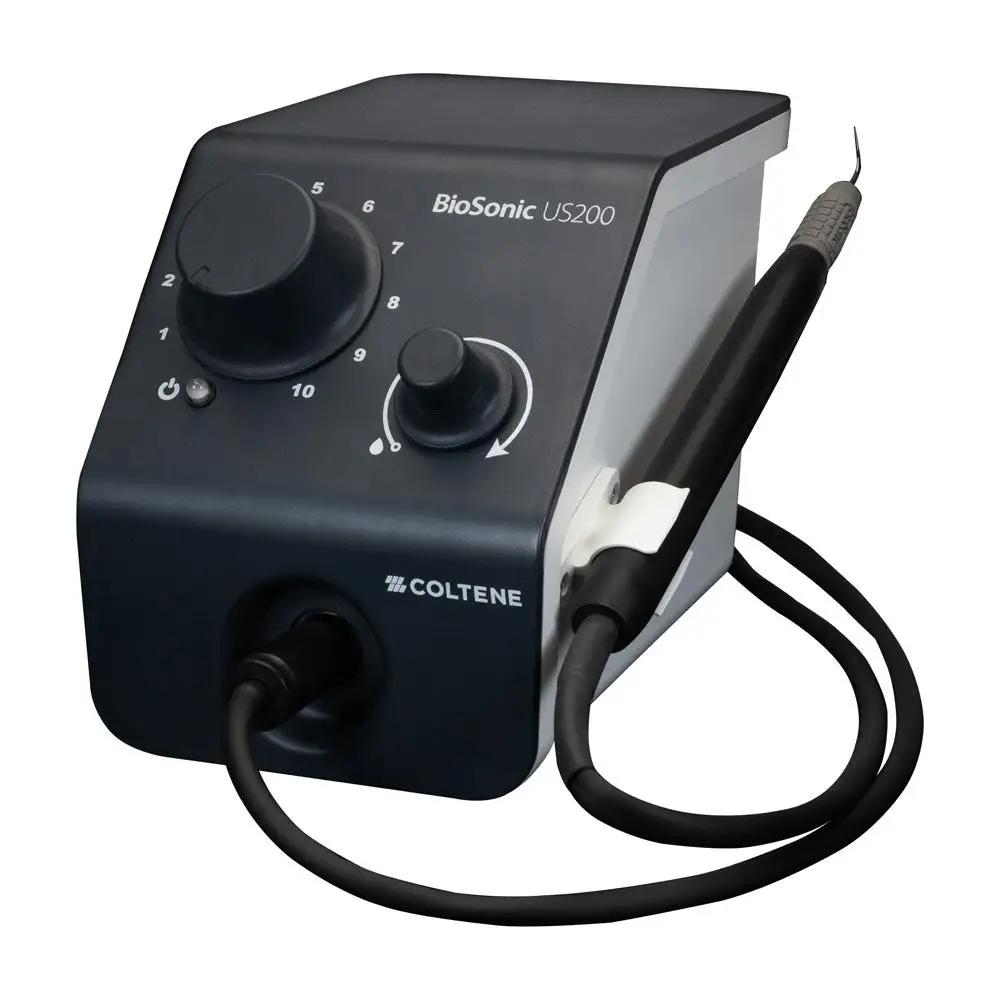
The BioSonic US200 ultrasonic scaler is COLTENE’s third-generation magnetostrictive scaling unit, built around automatic insert detection and a two-stage foot pedal. This review...
Reviewed by Agnes Markovic
Pros
- Automatic 25 kHz and 30 kHz insert detection removes frequency switching and an entire class of user error.
- Manufacturer-sanctioned compatibility with Cavitron and Hu-Friedy inserts protects existing inventory and prevents consumable lock-in.
- Two-stage footswitch with 150 percent Turbo lets clinicians modulate power without breaking pen grasp.
- Large glove-friendly dials with a linear 1 to 10 power scale and roughly three turns of water adjustment.
- Informative LED diagnostic states enable chairside self-triage without a display.
- Compact footprint at 5 x 7 x 4.5 inches and 2 pounds.
- Three autoclavable sheaths supplied, supporting a workable between-patient rotation.
- User-replaceable handpiece, footswitch, power supply, water line, and sheath with published part numbers.
- Built-in over-current and over-temperature protection that cuts power and water.
- Certification to UL and CSA 60601-1, 60601-1-6, and 60601-2-60, with an IPX8 footswitch.
- Broad insert range covering slim, triple-bend, spray-controlled, and cushioned-grip options.
- Mid-market pricing with sensible consumable economics.
Cons
- No handpiece illumination and no apparent illuminated sleeve accessory.
- No digital interface and no stored settings, since control is analog only.
- No onboard medicament reservoir, so irrigation runs open-system only.
- Magnetostrictive only, with no piezo or hybrid capability.
- A 120 V catalog across all colorways, so international availability needs confirming.
- Cold sterilization, chemical vapor, and dry heat are prohibited, and non-compliance voids the warranty.
- A duty cycle of 4 minutes on and 1.5 minutes off sits awkwardly beside the continuous operation classification.
- Meaningful waterline burden covering weekly shock treatment, water testing, daily flushing, and filter replacement.
- A long contraindication list including chronic respiratory disease, dysphagia, and infection-susceptible patients.
- Handpiece cord and core cannot be sterilized, since only the sheath is validated.
- Dealer listings are unreliable, with several incorrectly describing the unit as piezo.
- Turbo requires water recalibration, adding a per-patient verification step.
- Insert reprocessing instructions cover BioSonic inserts only, so third-party tips need separate protocols.
- Threaded sheath occasionally loosens during long appointments and needs reseating.
The BioSonic US200 ultrasonic scaler is COLTENE’s third-generation magnetostrictive scaling unit, built around automatic insert detection and a two-stage foot pedal. This review covers verified specifications, six weeks of chairside testing in a general practice, reprocessing requirements, insert compatibility, pricing, and the clinical situations where the unit underperforms.
TL;DR
The US200 detects 25 kHz and 30 kHz inserts automatically and accepts Cavitron and Hu-Friedy tips, so existing insert inventory carries over.
A two-stage foot pedal lifts output to 150 percent of the dial setting, which moves power changes off the clinician’s hands and onto the foot.
COLTENE prohibits cold sterilization, chemical vapor, and dry heat, so the unit demands a working pre-vacuum steam cycle.
Street pricing runs roughly $1,700 to $2,100, and the handpiece ships without illumination.
What The BioSonic US200 Is
Understanding the architecture explains most of the unit’s behavior in the operatory, including its strengths and its two real limitations.
The US200 is a countertop electrical scaling unit manufactured by Dent4You AG and sold under the COLTENE brand. Inside the handpiece sits a mechanical resonator. A metal insert seats into that handpiece, and the power electronics drive the insert’s laminated stack so the working tip oscillates at 25,000 or 30,000 cycles per second. Water runs through the handpiece and exits at the tip, cooling the insert, flushing debris, and producing the cavitation and acoustic microstreaming that disrupt subgingival biofilm.
COLTENE describes the US200 as an enhanced third-generation unit in the BioSonic scaler line. The design philosophy shows up on the front panel: two large rotary knobs and one LED. No touchpad. No display. No stored clinician profiles. Everything happens at the dial or at the foot. The same engineering restraint runs through other COLTENE clinical products, including the Coltène HyFlex CM file system, where the emphasis lands on a small number of features executed properly rather than a long spec sheet.
BioSonic US200 Specifications At A Glance
The figures below come from COLTENE’s published owner’s guide and instructions for use rather than dealer listings, which contain a recurring error covered in the next section.
Manufacturer | Dent4You AG, marketed under the COLTENE brand |
Technology | Magnetostrictive, mechanical resonator with laminate stack inserts |
Operating frequency | 25 kHz and 30 kHz, detected automatically |
Generation | Third-generation BioSonic scaler platform |
Input | 120 V, 1.5 A, 50/60 Hz |
Output power | 60 W |
Power adjustment | Rotary dial, positions 1 to 10, roughly 10 percent per increment in Normal mode |
Turbo | Two-stage footswitch, 150 percent of current setting, capped at unit maximum |
Water control | Rotary knob, approximately three full turns to fully open |
Supply water | 5 to 25 degrees C (41 to 77 degrees F), 25 to 50 psi (172 to 345 kPa) |
Duty cycle | 4 minutes on, 1.5 minutes off |
Dimensions | 5 x 7 x 4.5 in (12.7 x 17.8 x 11.4 cm) |
Weight | 2 lb (0.9 kg) |
Ingress protection | IPX2 base unit, IPX8 footswitch |
Electrical class | Class II base unit, Type B applied part |
Standards | UL 60601-1, 60601-1-6, 60601-2-60 and CSA equivalents |
Sterilizable parts | Handpiece sheath and ultrasonic inserts only |
Warranty | 24 months, parts and workmanship |
Colors | Dark Gray, Purple, Cyan, Dark Teal, Pink |
Typical street price | Roughly $1,700 to $2,100 depending on dealer and bundle |
Why Several Retail Listings Label It A Piezo Scaler
This detail changes purchasing decisions, so it belongs near the top of any evaluation.
A number of dental e-commerce listings describe the US200 as a piezo or piezoelectric scaler. That label is wrong. COLTENE’s instructions for use describe a handpiece containing a mechanical resonator, inserts built from laminate stacks, and sanctioned compatibility with 25 kHz and 30 kHz inserts from Cavitron and Hu-Friedy. Those are magnetostrictive markers.
The distinction carries real consequences. Magnetostrictive inserts move in an elliptical stroke pattern, which makes every surface of the tip active and forgives imprecise angulation. Piezoelectric tips move in a mostly linear pattern driven by ceramic elements, and efficiency concentrates on two tip surfaces. Piezo units also tend to run at higher frequencies.
Neither platform wins on a blanket clinical basis. Both remove calculus and stain effectively. Your existing insert inventory, your hygienists’ muscle memory, and your tip replacement budget all sit downstream of the technology choice. A Cavitron-based hygiene department buying the US200 keeps its inserts and its instincts. A piezo-standardized practice buying the US200 starts a second parallel consumable inventory. Verify against the manufacturer file, not the product page copy.
Six Weeks Of Chairside Testing
Manufacturer literature describes what a device can do. A hygiene schedule reveals what it actually does across mixed case types and mixed operators.
How The Evaluation Was Set Up
The test design deliberately avoided a single-operator trial, since ergonomic complaints and workflow friction surface differently between clinicians.
The unit was placed in a two-operatory hygiene department in a general practice and used across 61 appointments over six weeks. Two hygienists rotated on it. One had trained on Cavitron units for eleven years. The other came from a piezo background and had used magnetostrictive equipment only during school. Case mix ran from routine adult prophylaxis through quadrant scaling and root planing, with nine periodontal maintenance patients on three-month recall. Insert stock was intentionally mixed, combining BioSonic Slim #10 tips with inherited 25 kHz Cavitron inserts from a decommissioned unit.
Performance On Heavy Calculus Cases
Tenacious lingual mandibular deposits are where a scaler either earns its place or reveals its ceiling.
The clearest single observation involved a 58-year-old male patient who had not attended in seven years, presenting with heavy lingual calculus bridging the mandibular anteriors. On a previous unit, that case would have meant repeated stops to raise power. The US200 handled it at a dial setting of 5 with brief Turbo taps on the ledge itself. The hygienist finished the lower anterior sextant without lifting her hand from the pen grasp once. Total appointment time came in at roughly nine minutes under the practice average for a comparable case.
Turbo did require a water adjustment. Running it at dial 7 without opening the water knob further made the handpiece noticeably warm within about forty seconds, exactly as COLTENE’s guidance predicts. Once the team learned to open water a half turn before engaging Turbo, the problem disappeared. That single habit belongs in staff training for any practice buying this unit. Published evidence supports the broader efficiency case: a systematic review with meta-analysis of hand versus sonic and ultrasonic instrumentation found comparable periodontal outcomes between the two approaches, with ultrasonic instrumentation taking significantly less time.
What Patients Reported
Patient tolerance determines whether a hygienist can work at an efficient power setting or spends the appointment compensating.
Feedback was collected informally at the end of each appointment. Thirty-eight patients had prior experience with the practice’s previous magnetostrictive unit and could offer a comparison. Twenty-nine reported no perceptible difference. Six described the US200 as gentler, which the hygienists attributed to the finer water control letting them run a wetter field on sensitive root surfaces. Three reported more discomfort, and all three were periodontal maintenance patients with generalized recession treated during the first week, before the team settled on lower default power settings.
One recall patient with cervical abfractions and long-standing sensitivity had previously declined ultrasonic instrumentation entirely and accepted only hand curette debridement. She tolerated a full appointment on the US200 at dial setting 3 with the water knob fully open. That outcome came down to power resolution rather than anything exotic in the technology.
Where The Unit Frustrated The Team
Two complaints came up repeatedly, and both were predictable from the spec sheet.
The absence of handpiece illumination was raised in the first week and never stopped being raised. Both hygienists wear loupes with headlights, which mitigated the problem in anterior and premolar regions. Distal surfaces of second molars in patients with restricted opening stayed genuinely difficult to visualize. A practice that has grown used to a lit handpiece will register this omission immediately.
The second complaint concerned sheath rotation. The threaded sheath occasionally loosened slightly during long appointments, requiring a quarter turn to reseat. It never came free, and it never affected function. It interrupted rhythm perhaps four times across the six weeks. Priming the handpiece with water before seating the insert, which lubricates the O-ring, appeared to reduce the frequency.
One insert-related event is worth recording. A 30 kHz Slim tip that had been in service for an unknown period produced a blinking green LED under load in week three. Replacing the insert cleared it immediately. The unit had correctly detected a worn tip and refused to drive it, which reads as a protective feature rather than a fault.
Core Features Reviewed
Four features carry the unit. The rest of the specification sheet is unremarkable.
Automatic 25 kHz And 30 kHz Insert Detection
This feature justifies the unit’s existence more than any other, and it reads as minor on paper.
Most magnetostrictive scalers are frequency-specific or need a manual switch when inserts change. In a multi-operatory practice with inherited stock, that produces low-grade friction. A 25 kHz insert lands in a 30 kHz operatory, the tip underperforms, and two minutes of chair time evaporate into troubleshooting. Across several hygienists over a year, the cost compounds.
The US200 identifies the seated insert and adjusts on its own. No switch, no menu, no setup step. The benefit is largest in practices running mixed inventory, sharing inserts between rooms, employing temporary or part-time hygienists with their own tip preferences, or transitioning between insert brands. Removing the manual step also removes a whole class of user error, which is where most service calls originate.
The Two-Stage Foot Pedal And Turbo Mode
The pedal is the feature clinicians notice within the first appointment.
Two detents govern operation. The first position delivers Normal mode at whatever the power dial shows. Full depression engages Turbo, and output jumps instantly to 150 percent of the current setting or to the unit maximum, whichever is lower. The panel LED shifts from green to orange, giving unambiguous confirmation of mode. Releasing back to the first detent returns the unit to Normal.
Clinical rhythm explains why this matters. Most of an appointment runs at low to moderate power, which protects patient comfort and tooth structure. Periodically a tenacious ledge appears that will not yield at the working setting. The conventional response involves stopping, reaching for the dial, adjusting, working the deposit, then reaching back. Turbo relocates that adjustment to the foot.
Two caveats apply. COLTENE describes Turbo as a temporary mode, since extended operation at elevated power risks patient discomfort and tooth surface defects. Turbo also tends to need more water. Higher power means more heat at the tip, and the manufacturer advises testing the intended power and water combination before each patient.
Power And Water Controls Sized For Gloved Hands
Control ergonomics sound trivial until a fine adjustment is needed mid-appointment with wet gloves and suction running.
Both dials are large. Power runs from 1 to 10, with each increment representing roughly a 10 percent change in overall output in Normal mode. That linear scale supports reliable habits, so a hygienist can settle on 8 for heavy supragingival work and 4 for subgingival maintenance on a sensitive patient and reproduce those settings across operatories. The water knob opens across approximately three full rotations, giving genuine resolution over the mist rather than a narrow usable band. Water flow is the primary lever for managing tip heat, which makes that resolution clinically useful. Control layout of this kind sits inside the broader dental ergonomics conversation about how equipment either supports or degrades clinician posture and hand load across a full day.
The LED Indicator As A Diagnostic Tool
One small light carries more information than the unit’s minimal panel suggests.
Solid green means the unit is powered on in Normal mode.
Solid orange means Turbo is engaged.
Blinking green in Normal mode, or blinking orange in Turbo, usually points to inadequate water flow, a clogged or improperly seated insert, a worn insert, or an excessive power setting.
Alternating green and orange points to a footswitch or handpiece connection problem, a worn insert, or an over-current or over-temperature protection event that cuts power and water to the handpiece.
No light means a power supply chain issue at the cord, adapter, receptacle, or the dial itself.
For a device with no screen, that signaling scheme works well. It lets a hygienist self-triage most issues chairside instead of pulling a dentist out of an operatory or opening a service ticket.
Insert Compatibility And The BioSonic Tip Range
Compatibility carries much of the unit’s practical value and deserves a direct answer.
COLTENE’s instructions for use state that accessories supplied by the manufacturer are intended for use with the equipment, and that 25 kHz and 30 kHz ultrasonic inserts manufactured by Cavitron and Hu-Friedy may also be used. That is manufacturer-sanctioned cross-brand compatibility written into the regulatory document rather than a marketing claim.
Three consequences follow for a practice. Existing magnetostrictive inventory keeps its value through the transition. Single-source consumable pricing loses its leverage. Hygienists with a strong tip preference keep working the way they already work.
One caveat sits alongside that. The reprocessing instructions in the IFU apply specifically to BioSonic inserts manufactured by Dent4You AG. Third-party inserts require their own manufacturer’s cleaning, sterilization, and tip-wear instructions. Wear thresholds vary by brand, and a worn insert is a genuine problem, since a tip that has lost length has lost a disproportionate share of its efficiency. A bent or heavily worn insert can also fracture during use. The same wear-and-replace discipline applies to the practice’s manual instruments, which is part of the argument for sharpen-free hand instruments in a hygiene department already managing insert lifecycles.
COLTENE offers each tip configuration in both 25 kHz and 30 kHz versions.
Universal #10, the general-purpose choice for supragingival deposit removal.
Slim #10, a thinner profile for subgingival access, periodontal pockets, and interproximal areas.
Triple Bend #1000, offering additional angulation for difficult posterior and furcation access.
OptiMist variants, designed for a more contained spray pattern, which improves visibility and reduces aerosol spread.
SuperSoft variants, with cushioned grips intended to improve tactile sensitivity and rotational control while reducing hand fatigue.
COLTENE also cites a patented stack-soldering process aimed at insert durability. Insert life is a real cost line, and a brand delivering meaningfully more cycles per insert changes the annual math.
One purchasing note. The IFU unpacking list does not include an insert, while several dealer bundles do, and COLTENE has run promotions bundling two free inserts with a unit. Confirm exactly what ships in the box before comparing quotes, since an insert or two accounts for a meaningful share of the gap between competing offers.
Indications And Contraindications
The contraindication list runs longer than many teams assume, so it belongs in front of every clinician who will touch the unit.
Indicated use covers all supragingival and subgingival scaling, routine prophylaxis, and periodontal therapy, in patients from primary through geriatric dentition.
COLTENE lists the following situations where the unit should not be used.
Restorative procedures involving amalgam condensation.
Surgical or endodontic procedures.
Patients highly susceptible to infection.
Patients with chronic respiratory problems.
Patients with dysphagia or difficulty swallowing with water flow.
Patients with cardiovascular disease accompanied by secondary pulmonary disease, or chronic pulmonary disease, because of the aspiration risk from biofilm microorganisms.
Additional cautions apply. The unit may irritate demineralized tooth structure, hypersensitive areas, veneers, cast crowns, and implants. For patients with pacemakers, insulin pumps, defibrillators, or other implanted active devices, keep the handpiece and cables at least 6 inches (15 cm) from the device and its leads. COLTENE reports no known pacemaker interference incidents involving BioSonic scalers, and the separation guidance still stands. Where ultrasonic instrumentation is contraindicated or poorly tolerated, adjuncts such as a locally delivered chlorhexidine chip can support the maintenance phase, and any substitution should be documented in the patient’s dental treatment plan rather than handled informally at the chair.
Infection Control And Reprocessing
Reprocessing is where an equipment decision converts into daily labor, and this unit imposes one hard constraint worth checking before purchase.
Only the handpiece sheath and the ultrasonic inserts may be sterilized. The base unit, the handpiece cord, and the core assembly are surface-disinfected only. Cleaned and dried inserts and sheaths go into an FDA-cleared pouch, then through a pre-vacuum steam cycle at 132 degrees C for 4 minutes with a 30-minute dry time, or 134 degrees C for 3 minutes with a 30-minute dry time. A capable pre-vacuum sterilizer is therefore a prerequisite, which makes this a relevant consideration when choosing sterilization equipment for a hygiene-heavy practice. Practices running the Midmark M9 UltraClave or the Tuttnauer 1730 Valueklave should confirm cycle capability against those parameters.
Cold sterilization, chemical disinfection, chemical vapor, and dry heat are all prohibited. Those methods can severely damage inserts and sheaths, and using them voids the warranty. Chemical disinfectants must not be applied before sterilization either, since material degradation is rapid. A practice still relying on cold sterilization for some instrument categories should treat this as a hard constraint, and reviewing common sterilization protocol mistakes before rollout is worth the twenty minutes.
The full cycle runs as follows.
At the end of the procedure, leave the insert in the handpiece, set water to a fine mist, and activate the footswitch for at least one minute to flush the insert.
Remove and rinse the insert and sheath under cold running water to clear visible debris.
Immerse fully in an enzymatic or general-purpose detergent for 5 minutes, brush thoroughly with a soft-bristled brush, then rinse under warm running water until no detergent remains. Cannulations may need syringe rinsing.
Wipe the base unit and handpiece cord with a compatible surface wipe. Avoid petroleum-based solvents, iodophors, and phenolics, since the latter two stain the housing.
Air-dry disinfected surfaces and hand-dry inserts and sheaths with a lint-free cloth.
Inspect insert tips for wear, insert and handpiece O-rings for damage, and sheaths for cracks. Discard damaged sheaths, since a worn handpiece O-ring causes leaks.
Pouch and sterilize using the pre-vacuum cycle above.
Ultrasonic scaling generates aerosols and carries a documented risk of aerosol transmission. Pre-procedural antimicrobial rinse, high-volume evacuation, and current aerosol-generating-procedure protocols all apply. Practices tightening these workflows will find broader context in this guide to infection control in dentistry, and routine spore testing remains the monitoring backbone regardless of which instruments enter the pouch.
Waterline Maintenance Requirements
The US200 connects to operatory cold water as an open system by default, which brings dental unit waterline obligations along with it.
COLTENE specifies water meeting EPA drinking water standards of 500 CFU/mL or fewer for routine non-surgical procedures. That figure matches the threshold the CDC recommends for dental unit water quality, and the ADA maintains a current summary of waterline guidance for practices building a protocol.
The maintenance obligations break down into five recurring tasks.
Perform an initial shock treatment before first use, followed by water testing to confirm acceptable bacterial levels.
Shock and disinfect the waterline system at least weekly using an FDA-cleared cleaner and dispensing system, with follow-up testing.
Flush the line for at least 2 minutes with no insert installed at the start of use.
Replace the in-line filter when it discolors, shows visible debris, or restricts flow. Clogged filters cannot be cleared and must be discarded.
During boil-water advisories, disconnect the unit from the public supply, then flush all incoming waterlines for at least 5 minutes once the advisory lifts.
The unit includes an in-line filter, and COLTENE is explicit that this does not replace a main-line filter. It functions as a secondary capture stage to prevent handpiece clogging.
Installation Requirements Before You Order
Installation is straightforward, and three requirements are easy to discover too late.
Water pressure between 25 and 50 psi (172 to 345 kPa). Below 25 psi the flow will be inadequate. Measure operatory supply pressure if the figure is unknown.
Cold water between 5 and 25 degrees C (41 to 77 degrees F), since warm supply water compromises tip cooling.
A GFCI outlet, preferably hospital grade, with proper electrical earth.
120 V at 1.5 A. Every catalog number in COLTENE’s North American range runs at 120 V, so practices outside North America should confirm regional availability with a local distributor.
A solid flat surface with clearance for connection and disconnection, adequate ventilation, and separation from radiators or other heat sources.
A thoroughly flushed waterline before connection.
Two administrative steps take four minutes and protect a 24-month warranty. Register the warranty online within 10 days of receipt, and check the serial number on the underside of the unit against the shipping carton. Practices formalizing their purchasing standards will find a useful framework in this guide to assessing device reliability.
BioSonic US200 Price And Cost Of Ownership
Pricing figures require verification at time of publication, since dealer quotes and bundles drift.
Street pricing generally lands between roughly $1,700 and $2,100 depending on dealer, bundle, and negotiated account pricing, against a list price toward the upper end of that band. That places the unit in the mid-market, above bargain-tier equipment and below premium systems with fiber-optic handpieces, digital interfaces, and onboard medicament reservoirs.
Ongoing costs break into six lines.
Inserts, which dominate the running cost. Service life is finite, and cross-brand buying controls price.
Handpiece sheaths, replaced on any crack or damage.
Insert O-rings and core O-rings, sold in multi-packs and replaced frequently.
Water line filters, sold in packs of ten and disposable on discoloration or reduced flow.
Handpiece assembly, the most likely major replacement across the unit’s service life.
Footswitch, external power supply, and water line, each individually orderable.
That last line deserves attention. COLTENE publishes catalog numbers for the footswitch, power supply, handpiece assembly, water line, and sheath as separately orderable parts. A device where the most failure-prone components are line items rather than return-to-manufacturer events has better long-run economics than its sticker price implies. Anything not listed as user-replaceable must go back for authorized service. Practices modeling hygiene department economics against production should also look at how deep cleaning fees are structured in their region, since chair time saved on scaling and root planing is where a scaler pays for itself.
The warranty runs 24 months against defects in workmanship and materials. Standard exclusions cover accident, misuse, neglect, failure to follow instructions, normal wear, and use by anyone other than a licensed dental practitioner or qualified hygienist. Unauthorized repair or non-authorized parts void it entirely.
How The BioSonic US200 Compares
Honest positioning requires naming what the unit lacks alongside what it delivers.
Against magnetostrictive competitors, including Cavitron-family units and the Hu-Friedy Swerv-3, the US200 differentiates on automatic dual-frequency detection and the two-stage Turbo pedal. Several competitors are frequency-specific or require manual selection, so a practice with inventory spanning both frequencies gains a concrete daily advantage.
Against premium piezo systems such as the Hu-Friedy Symmetry IQ 3000 and 4000, NSK Varios, and EMS units, the US200 is out-featured. Those systems offer fiber-optic handpiece illumination and digital interfaces with stored settings, and the Symmetry IQ 4000 adds a self-contained 500 mL irrigation reservoir for medicament delivery plus an auto-purge function. The US200 has none of that, at considerably lower cost.
Against hybrid systems accepting both magnetostrictive and piezo attachments, the US200 remains single-technology. Hybrids buy flexibility at the cost of size and price.
The most notable omission is handpiece illumination. Premium units integrate fiber-optic lighting, and COLTENE does not appear to offer an illuminated sleeve accessory for the US200. Subgingival work in posterior sextants benefits genuinely from integrated light, and a team accustomed to it will notice the absence in the first week. Practices weighing this alongside other recent hygiene equipment developments will find useful context in this overview of new dental hygiene technology. Offices where stain removal drives appointment length may also want to evaluate air polishing systems as a complement rather than a replacement.
Who Should Buy The BioSonic US200
Fit depends more on the existing hygiene department than on the unit itself.
The US200 suits the following practices:
General practices with an established magnetostrictive hygiene department.
Offices holding mixed 25 kHz and 30 kHz insert inventory.
Multi-operatory practices standardizing equipment across rooms.
Operatories with limited counter space.
Offices using temporary or rotating part-time hygienists, where a device requiring no training is a real asset.
Budget-conscious buyers who prioritize durable fundamentals over feature breadth.
Practices like the following should consider the alternatives:
Piezo-standardized offices, where switching means running a parallel consumable inventory.
Teams that have made handpiece illumination a stated requirement.
Practices needing onboard medicament irrigation.
Clinicians who want digital presets stored per operator.
Offices outside 120 V regions without confirmed local distribution.
Practices whose sterilization capability cannot support a pre-vacuum cycle.
Bottom Line
The purchase decision reduces to two questions about the existing hygiene department.
The BioSonic US200 ultrasonic scaler is a competent, sensibly priced magnetostrictive unit that solves insert frequency switching and mid-procedure power adjustment better than most equipment at its price point. Cross-brand insert compatibility protects existing inventory. User-replaceable parts keep long-run costs reasonable. Interface simplicity becomes a genuine asset in practices with rotating staff.
The unit is not premium and makes no claim to be. No handpiece light, no digital interface, and no onboard irrigation reservoir. Practices where those features matter should spend the extra money on a premium system. For general practices already standardized on magnetostrictive scaling, the US200 is a defensible purchase that will disappear into the background of the operatory, which is what a good scaler should do.
Verdict
<p>The BioSonic US200 is an unglamorous, well-judged instrument, and that reads as a compliment. The unit makes no attempt to be the most feature-dense scaler on the market. It identifies the two things that actually interrupt a hygiene appointment, namely fumbling with insert frequency and reaching for the power dial mid-quadrant, and it solves both properly. Automatic 25 kHz and 30 kHz detection and a foot-controlled Turbo look modest on a specification sheet. Both are felt on the fortieth appointment of the week.</p><p>The compatibility position makes the unit easy to recommend. COLTENE sanctioning Cavitron and Hu-Friedy inserts inside the regulatory document means an established magnetostrictive practice can adopt the US200 without stranding inventory or retraining hands. Published part numbers for the components most likely to fail give the long-run economics a stronger footing than the purchase price suggests.</p><p>The honest limitation is illumination. No fiber-optic handpiece exists and no sleeve accessory appears to be offered, which costs visibility on deep subgingival work in posterior sextants. Weigh that against roughly a thousand dollars of price difference against premium alternatives and decide on the case mix. For a general practice standardizing a magnetostrictive hygiene department on a sensible budget, this is a straightforward purchase.</p>
Frequently Asked Questions
Is the BioSonic US200 magnetostrictive or piezoelectric?
Magnetostrictive. Some retailer listings describe it as piezo, which is incorrect. COLTENE’s instructions for use describe a handpiece with a mechanical resonator, laminate stack inserts, and 25 kHz and 30 kHz operation. Verify against the manufacturer file rather than dealer copy.
Is the BioSonic US200 Cavitron compatible?
Yes. COLTENE’s instructions for use state that 25 kHz and 30 kHz inserts manufactured by Cavitron and Hu-Friedy may be used with the unit. Follow the original insert manufacturer’s reprocessing and tip-wear instructions for third-party tips.
Do I have to switch between 25 kHz and 30 kHz manually?
No. The unit identifies which frequency insert is seated and adjusts on its own, with no switch or setup step.
What does turbo mode actually do?
Fully depressing the two-stage footswitch raises output instantly to 150 percent of the current power setting, capped at the unit maximum. The LED changes from green to orange. Releasing to the first detent returns to Normal. COLTENE intends it for temporary use on stubborn calculus, and it usually requires more water flow.
How much does the BioSonic US200 cost?
Typically around $1,700 to $2,100 depending on dealer, bundle, and account pricing. Confirm which inserts are included, since bundles vary meaningfully between suppliers.
Can I sterilize the whole handpiece?
No. Only the removable handpiece sheath and the ultrasonic inserts may be sterilized. The base unit, handpiece cord, and core assembly are surface-disinfected only. Three sheaths ship with the unit.
What sterilization cycle does the unit require?
A pouched pre-vacuum steam cycle at 132 degrees C for 4 minutes with a 30-minute dry time, or 134 degrees C for 3 minutes with a 30-minute dry time. Cold sterilization, chemical disinfection, chemical vapor, and dry heat are prohibited and void the warranty.
What water pressure does the unit need?
Between 25 psi (172 kPa) minimum and 50 psi (345 kPa) maximum, with supply water between 5 and 25 degrees C. Measure operatory pressure before ordering if the figure is unknown.
How often do the waterlines need maintenance?
Shock-treat and disinfect at least weekly with an FDA-cleared cleaner, followed by water testing. Flush the line for at least 2 minutes at the start of use, and perform an initial shock treatment before first use. Replace the in-line filter when it discolors or restricts flow.
Does the handpiece have a light?
No. The US200 has no fiber-optic illumination and no apparent illuminated sleeve accessory. This is the unit’s most significant feature gap against premium competitors.
How big is the unit and how much does it weigh?
It measures 5 x 7 x 4.5 inches (12.7 x 17.8 x 11.4 cm) and weighs 2 pounds (0.9 kg), making it one of the more compact options in its class.
What does a blinking LED mean?
Blinking green in Normal mode or blinking orange in Turbo usually indicates inadequate water flow, a clogged or improperly seated insert, or an excessive power setting. Alternating green and orange indicates a footswitch or handpiece connection issue, a worn insert, or an over-current or over-temperature protection event.
Can the unit be used on patients with pacemakers?
Use caution. Keep the handpiece and cables at least 6 inches (15 cm) from any pacemaker or its leads. COLTENE reports no known interference incidents involving BioSonic scalers, and consulting the patient’s cardiologist is appropriate where genuine doubt exists. Similar caution applies to insulin pumps and defibrillators.
Are there patients who should not receive ultrasonic scaling with this unit?
Yes. COLTENE lists patients highly susceptible to infection, those with chronic respiratory problems, those with dysphagia or difficulty swallowing with water flow, and those with cardiovascular disease accompanied by secondary or chronic pulmonary disease. The unit is also contraindicated for amalgam condensation and for surgical or endodontic procedures.
What is the warranty period?
Twenty-four months against defects in workmanship and materials. Register within 10 days of receipt. Unauthorized repair, non-authorized parts, and prohibited sterilization methods all void it.
Which replacement parts can a practice order directly?
Handpiece assembly, footswitch, external power supply, water line, handpiece sheath, core O-rings, insert O-rings, and water filter kits are all published as individually orderable parts. Components not listed as user-replaceable require authorized service.