Rating: 4.7/5
AquaCare Twin Review: A Complete Guide for Dental Professionals
The AquaCare Twin from Velopex International is a dual-chamber air abrasion and air polishing system designed for minimally invasive dentistry. The device allows dental...
Reviewed by Rachel Thompson
Pros
- Dual-chamber system with one-second switching
- Entirely air-driven with no electronics or pumps
- Eliminates heat, vibration, noise, and smell
- Reduces or eliminates the need for local anaesthesia
- Preserves more healthy tooth structure than conventional drilling
- Lightweight, ergonomic, fully autoclavable handpiece
- Disposable tips and feedlines simplify infection control
- Exceptional stain removal and prophylaxis performance
- Compatible with Sylc bioactive glass for desensitising and remineralising
- Broad versatility across 15+ dental disciplines
- Compact footprint and low weight (3.066 kg)
- Future-proof design that accepts new powders without hardware changes
Cons
- Higher upfront cost compared to basic prophylaxis units
- Ongoing consumable costs for tips, feedlines, and powders
- Cannot remove calculus or amalgam restorations
- Learning curve similar to adapting to a new handpiece
- Requires clean, dry compressed air supply (min. 5 bar)
- Must use Velopex-branded consumables only
- Risk of soft tissue damage with incorrect nozzle aim
- Tips may need mid-treatment replacement during long procedures
- Pricing is dealer-dependent, not listed on manufacturer website
The AquaCare Twin from Velopex International is a dual-chamber air abrasion and air polishing system designed for minimally invasive dentistry. The device allows dental professionals to perform cavity preparation, stain removal, surface decontamination, desensitising, and remineralisation through a single, contact-free handpiece. This review covers everything a clinician needs to evaluate before purchasing the AquaCare Twin, from technical specifications and clinical applications to pricing, real-world feedback, and a professional verdict.
What Is the AquaCare Twin?
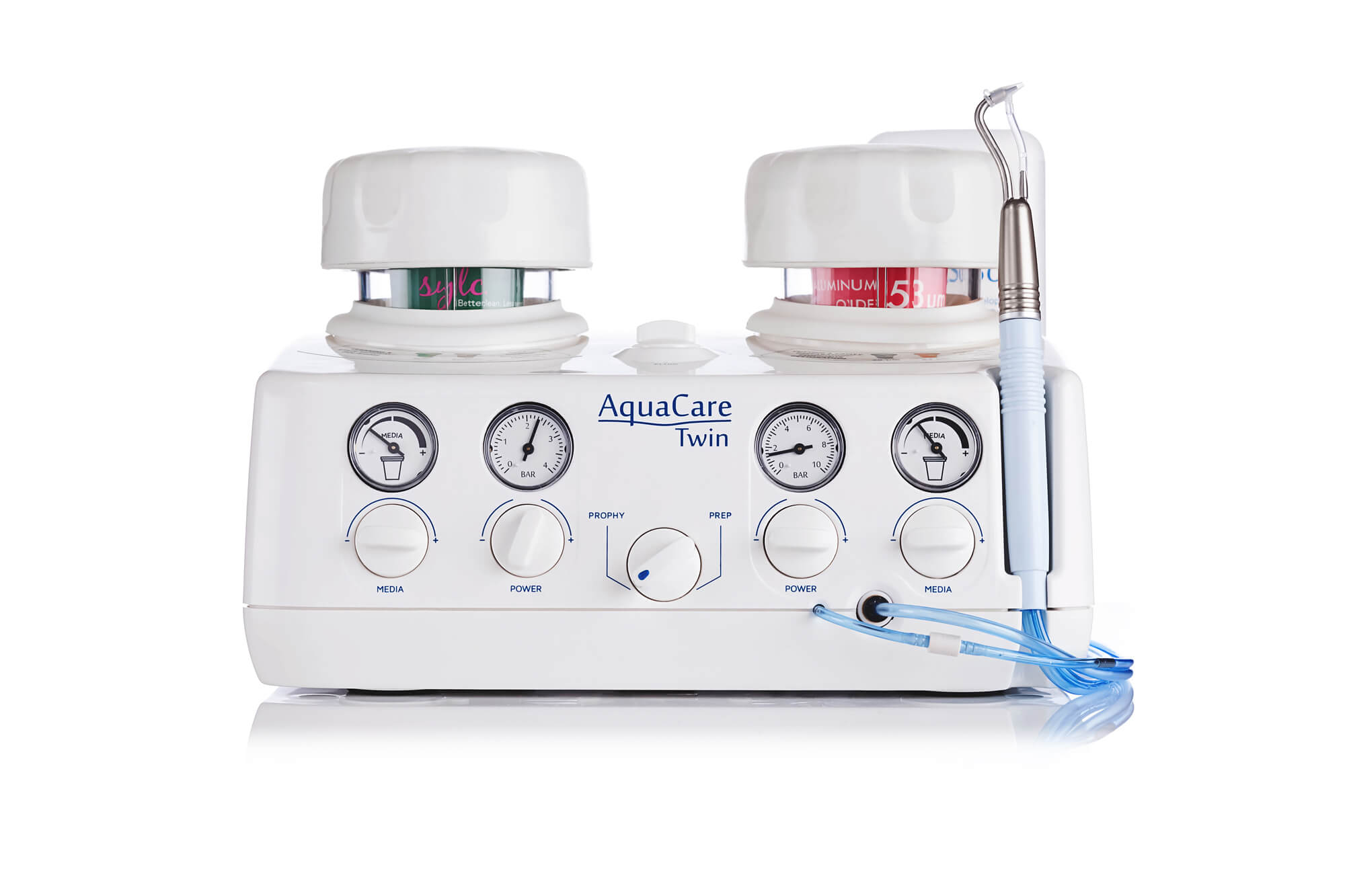
The AquaCare Twin is a Class IIa medical device manufactured in the United Kingdom. It combines air abrasion (for cutting and surface preparation) with air polishing (for prophylaxis, stain removal, and therapeutic treatments) in a single compact unit. Unlike a traditional dental handpiece that relies on rotary contact, the AquaCare Twin directs a precision-controlled stream of abrasive or polishing particles at the target surface. A proprietary fluid shroud called AquaSol encases the particle stream, suppressing airborne dust and improving patient comfort.
The defining feature of the Twin model is its dual-chamber cartridge system. Two separate powder chambers can be loaded with different media and switched in approximately one second, allowing the clinician to transition between treatments without interrupting the procedure. This is the primary advantage over the AquaCare Single, which has one chamber and requires manual cartridge changes.
Who Makes the AquaCare Twin?
Velopex International is a UK-based dental equipment manufacturer with a focus on diagnostic and treatment technologies. The company has invested significantly in particle abrasion research and development, positioning the AquaCare system as the foundation of what it calls “Clean Dentistry.” The AquaCare Twin is distributed globally through major dental supply companies including Henry Schein, Benco Dental, and Optident.
Velopex’s patented delivery system uses Venturi-based single-use tips and the AquaSol fluid shroud to reduce free-borne dust, a common complaint with older dry air abrasion devices. The company also maintains an expanding catalogue of compatible powders, each colour-coded for quick identification, making the system adaptable to future treatment media without hardware changes.
AquaCare Twin Technical Specifications
A thorough understanding of the AquaCare Twin’s technical parameters is essential for any dental professional evaluating the unit. The table below summarises the key specifications.
Specification | Details |
Device classification | Class IIa medical device |
Part number | I/MAC8502F |
Dimensions (H × W × D) | 185 mm × 265 mm × 240 mm |
Weight | 3.066 kg |
Power source | Entirely air-driven, no electrical components |
External air supply | Clean, dry air, 6 mm push-in fitting |
Min. air supply pressure | 5 bar / 72 psi |
Max. air supply pressure | 7 bar / 100 psi |
Dosing chambers | 2 (dual-chamber cartridge system) |
Air abrasion media | 53μm aluminium oxide, 29μm aluminium oxide |
Air polishing media | Sylc bioactive glass, sodium bicarbonate |
Powder rate | 0–6 g/min, infinitely variable |
Handpiece material | Anodised aluminium, fully autoclavable |
Nozzle tips | Stainless steel with tungsten carbide, 0.6 mm (Silver) and 0.8 mm (Gold) |
Foot control | 3-stage: cut, clean, wash/dry |
Tips and feedlines | Single-use disposable, 50 included |
The entirely pneumatic design means no electrical parts, no pumps, and no risk of pump-related leaks. The compact footprint fits easily into any operatory, and the lightweight handpiece reduces clinician fatigue during extended procedures.
Key Design Features
Several engineering choices set the AquaCare Twin apart from competing air abrasion units. The following features are the most clinically relevant.
Dual-Chamber Cartridge System
Each chamber accepts a colour-coded, gamma-irradiated (sterile) powder cartridge. The clinician can load one chamber with aluminium oxide for cutting and the other with Sylc bioactive glass for polishing and desensitisation, then switch between them with a simple dial turn. The inbuilt feed system is designed to prevent blocking, and the sealed cartridge format avoids cross-contamination between powders.
Patented Fluid-Shrouded Handpiece
The AquaCare handpiece delivers a high-speed liquid curtain around the particle stream using AquaSol, a biostatic solution. This fluid shroud suppresses free-borne dust, improves patient comfort, and maintains better visibility of the working area compared to dry air abrasion devices. The handpiece itself is slim, balanced, and free of bulky powder pot attachments, making it easy to manoeuvre in all areas of the mouth.
Three-Stage Foot Pedal
The triple-action foot control enables the clinician to cut (activate the abrasive stream), clean (deliver the fluid wash), and dry (provide air only) through the same handpiece without interruption. An entire preparation, cleaning, and drying sequence can be completed without setting down the instrument or reaching for a separate air-water syringe.
Autoclavable Construction and Disposable Components
The handpiece is fully autoclavable, meeting modern infection control standards. The single-use disposable tips and feedlines (supplied in packs of 50) eliminate the need for complex sterilisation of powder delivery pathways, simplifying turnover between patients.
Clinical Applications
The AquaCare Twin’s versatility is one of its strongest selling points. The device functions across a wide range of dental disciplines, making it a valuable addition to both general and specialist practices. For clinicians building or upgrading their dental equipment setup, the AquaCare Twin covers multiple treatment categories in a single investment.
Restorative Dentistry and Cavity Preparation
In cutting mode, the AquaCare Twin uses aluminium oxide particles (53μm for aggressive cutting, 29μm for fine finishing) to prepare cavities without a traditional drill and, in many cases, without local anaesthesia. The device removes decayed tooth structure conservatively, preserving more healthy enamel and dentine than rotary instruments. It is effective for Class I through Class V cavity preparations, fissure caries treatment, and removal of glass ionomer and composite restorations.
Because the AquaCare Twin does not make direct contact with the tooth, it eliminates the risk of chipping or stress fracturing associated with rotary burs. The particle stream can be adjusted in real time using the power, media volume, and fluid volume controls, allowing the clinician to tailor the cut intensity to each clinical situation. Practitioners who regularly treat fissure caries report that the device’s ability to clear fissures and expose hidden decay – simply by switching from abrasion mode to cleaning mode – adds a diagnostic capability that conventional drilling cannot replicate.
Adhesive Dentistry and Bond Strength
Air particle abrasion is a well-documented surface preparation method in adhesive dentistry. A 2024 scoping review published in Dentistry Journal (MDPI) found that bioactive glass showed higher bond strength and more cohesive failures than alumina, while a 2021 systematic review in Operative Dentistry confirmed that airborne particle abrasion has no negative effects on resin-to-dentine bond strength. The AquaCare Twin’s ability to texture surfaces with aluminium oxide followed by Sylc bioactive glass aligns with these research findings, creating a micro-roughened substrate that improves adhesive outcomes for composite restorations, veneers, and CAD/CAM prosthetics.
Prophylaxis, Stain Removal, and Hygiene
In cleaning mode, the AquaCare Twin operates as an air polishing system using sodium bicarbonate or Sylc. It reaches into pits, fissures, and interproximal areas that rubber cups and paste cannot access. Multiple dental professionals report that the device removes tea, coffee, and tobacco stains more effectively than conventional polishing methods, making it a significant upgrade for hygiene appointments.
For dental hygienists, the AquaCare Twin represents a step change in prophylaxis capability. The ability to switch between abrasion and polishing modes in one second means that biofilm removal, stain removal, and therapeutic desensitisation can happen in a single uninterrupted workflow. This is especially useful during recall appointments where multiple treatment goals need to be addressed within a limited time window. The AquaSol fluid shroud also means less airborne debris than traditional prophy jet systems, creating a cleaner, more comfortable experience for both patient and operator.
Desensitising and Remineralising With Sylc
Sylc is a bioactive glass powder containing 99.95% NovaMin (originally developed by GlaxoSmithKline). When delivered through the AquaCare Twin, Sylc particles interact with saliva to form a hydroxyapatite-like layer over exposed dentine tubules, occluding them and providing immediate relief from dentine hypersensitivity. The remineralising effect continues after the appointment, offering sustained therapeutic benefit.
Orthodontics
The AquaCare Twin is used to etch tooth surfaces before bracket bonding, clean lingual surfaces for incognito bracket placement, and remove residual orthodontic resin after debonding. Sylc powder can remove resin remnants while simultaneously polishing the enamel, combining what is traditionally a multi-step process into a single procedure.
Paediatric Dentistry
The device produces no vibration, heat, turbine noise, or smell, which dramatically reduces the anxiety triggers that affect paediatric patients. In many cases involving shallow cavities, treatment can be completed without local anaesthesia, eliminating the needle that is often the greatest source of fear for children.
Dental practices that specialise in treating young patients have noted that the AquaCare Twin significantly improves case acceptance among both children and their parents. The quiet, spray-like sensation of the device is far less intimidating than the sound and feel of a conventional handpiece, which makes routine restorative procedures feel closer to a cleaning appointment. This can have a long-term positive impact on a child’s attitude toward dental care, reducing the risk of dental avoidance as they grow older.
Endodontics, Periodontics, and Implantology
The AquaCare Twin extends to endodontic access preparation, periodontal pocket decontamination (using sub-gingival tips), and implant surface cleaning. The specialised iTip enables clinicians to manage peri-implant tissues and periodontal pockets with precision that traditional scaling instruments cannot match without risking damage to delicate root surfaces or implant abutments.
Laboratory and Extra-Oral Applications
The unit can also be used outside the mouth for laboratory procedures, including cleaning and abrading dental attachments such as crowns, bridges, and brackets before cementation or bonding.
AquaCare Twin Powder System
The clinical flexibility of the AquaCare Twin is directly tied to its powder ecosystem. Each powder is supplied in a colour-coded, sterile cartridge that slots into the dosing chambers. Understanding the role of each powder is essential for maximising the device’s potential.
Powder | Cartridge Colour | Primary Use |
53μm aluminium oxide (ProCut+) | Red | Aggressive cutting, Class I–V cavity preparation |
29μm aluminium oxide (ProCut) | Blue | Fine finishing, fissure prep, adhesive surface texturing |
Sodium bicarbonate (ProClean) | White/Clear | Biofilm removal, stain removal, soft deposit cleaning |
Sylc bioactive glass (ProSylc) | Green | Cleaning, polishing, desensitising, remineralising |
Velopex continues to develop additional powders, all designed to integrate with the existing AquaCare Twin hardware. This makes the system future-proof, as new treatment media can be adopted without replacing the unit.
53μm Aluminium Oxide (ProCut+)
This is the coarsest abrasive medium available for the AquaCare Twin. It is used for aggressive cutting, including Class I–V cavity preparations where rapid material removal is required. The 53μm particles cut through enamel efficiently while still preserving more healthy tooth structure than a conventional bur. This powder is the primary choice for restorative procedures involving significant decay.
29μm Aluminium Oxide (ProCut)
A finer abrasive powder used for precision finishing, shallow preparations, fissure sealant preparation, and surface texturing for adhesive bonding. Clinical best practice recommends always finishing cavity preparations with 29μm aluminium oxide to create an optimal bonding substrate. This powder is also preferred for conservative treatments in paediatric patients where minimal enamel removal is desirable.
Sodium Bicarbonate (ProClean)
The primary cleaning and prophylaxis powder. Sodium bicarbonate effectively removes biofilm, surface stains, and soft deposits. It is gentle enough for routine hygiene appointments and can also be used to remove soft decay when combined with appropriate pressure settings. Velopex offers both standard and superfine formulations to suit different clinical scenarios.
Sylc Bioactive Glass (ProSylc)
Sylc serves a triple clinical function: cleaning, polishing, and therapeutic desensitisation. The bioactive glass particles contain 99.95% NovaMin, which releases calcium, phosphorus, and sodium ions upon contact with saliva. These ions form a protective hydroxyapatite-like layer on the tooth surface, occluding exposed dentine tubules and providing both immediate and sustained relief from hypersensitivity. Sylc is the recommended finishing medium after aluminium oxide preparation and the preferred powder for sensitivity treatment.
AquaCare Twin vs. AquaCare Single
The primary question for clinicians evaluating the AquaCare range is whether the Twin model is worth the premium over the Single. The answer depends on practice volume, clinical scope, and workflow priorities.
The AquaCare Single has one dosing chamber. Switching powders requires swapping cartridges, purging the lines, and readjusting settings. The AquaCare Twin has two chambers and can switch between them in approximately one second with a dial turn, without removing the handpiece from the patient’s mouth.
For practices that use the unit primarily for prophylaxis, the Single may suffice. For multi-disciplinary practices that perform restorative, adhesive, orthodontic, and hygiene procedures within a single appointment, the Twin is the clear choice. The time savings accumulate rapidly in high-volume practices where clinic efficiency directly impacts revenue.
Consider a common clinical scenario: a patient presents with a fissure lesion and generalised staining. With the Single, the clinician would prepare the cavity with aluminium oxide, then stop to swap cartridges and purge the lines before switching to sodium bicarbonate or Sylc for the cleaning phase. With the Twin, the same clinician simply turns the dial and continues working. Over the course of a full day of patients, these seconds add up to meaningful time savings and a noticeably smoother clinical workflow.
The price premium for the Twin over the Single varies by distributor, but the consensus among practitioners is that the dual-chamber convenience pays for itself relatively quickly in practices that use the device across multiple treatment types.
Clinical Tips for Optimal Use
Maximising the return on the AquaCare Twin requires understanding a few operational nuances. The following tips are drawn from the official operation manual and from experienced clinicians.
Nozzle Position and Technique
Hold the nozzle approximately 1.5 mm from the surface for abrasion, approximately 4 mm for cleaning
Maintain a 30–45 degree angle toward the aspirator to optimise visibility and cutting efficiency
Always aim toward the incisal edge to minimise soft tissue risk
Keep the tip in motion during active abrasion, as holding it stationary increases the depth of cut rapidly
Pressure, Media, and Fluid Control
Start at lower pressure and media settings, then increase gradually as proficiency develops
Use less media and more power for improved visibility of the working area
Use more media and less power for a softer, more controlled cut
For fissure caries, a recommended starting point is 29μm aluminium oxide at 4 bar with media flow at slightly below midway
Cross-Contamination Prevention
Purge the powder lines every time the chamber is switched to prevent cross-contamination
Use short bursts near the pulp or on sensitive dentine to avoid triggering patient discomfort
Practise on the included glass slides and extracted teeth before treating patients
Replace the disposable tip if it shows signs of wear during a prolonged treatment
The learning curve is comparable to adapting to a new high-speed handpiece. Most clinicians report becoming proficient within a few weeks of daily use.
AquaCare Twin Pricing and What’s Included
Pricing for the AquaCare Twin varies by region and distributor. At the time of this review, retail prices range from approximately $2,700 to $6,000 depending on the supplier and available promotions. The unit is available through Henry Schein, Benco Dental, Optident, Pearson Dental, and authorised online retailers. For practices evaluating dental supply options, Dental Reviewed’s comparison of dental supply distributors offers a useful starting point.
The standard package includes the AquaCare Twin unit, both handpieces (0.6 mm Silver and 0.8 mm Gold), a three-position foot pedal, four cartridges (53μm aluminium oxide, 29μm aluminium oxide, sodium bicarbonate, and Sylc), 500 ml AquaSol fluid, 50 disposable tips, 50 disposable feedlines, spare handpiece handles, glass practice slides, a nozzle cleaning wire, an inline air filter, nozzle wash syringes, and a user manual.
Return on Investment Considerations
When evaluating the AquaCare Twin as a capital purchase, dental professionals should consider the cumulative savings and revenue implications beyond the sticker price. The device eliminates or reduces local anaesthetic usage for many procedures, saving both the cost of anaesthetic cartridges and the chair time associated with administering and waiting for the anaesthetic to take effect. For a practice that treats 10–15 patients per day, even a modest reduction in anaesthetic use adds up over the course of a year.
The AquaCare Twin also enables faster treatment cycles. The combination of cutting, cleaning, and drying through a single handpiece with foot-pedal control removes the repeated instrument changes that slow conventional restorative workflows. Practices that have adopted the device report that the cumulative time savings per patient allow them to see additional patients within the same working day, directly increasing production.
Patient satisfaction is another factor with financial implications. Anxious patients who previously declined restorative treatment may accept it when presented with a drill-free, needle-free option. Improved case acceptance translates into completed treatment plans and stronger patient retention, both of which support long-term practice growth. For practices looking to strengthen their patient acquisition strategies, Dental Reviewed’s guide on how to get more dental patients covers complementary approaches.
Patient Experience and Comfort
One of the most frequently cited advantages of the AquaCare Twin is the improvement in patient experience. Traditional restorative dentistry involves sensory triggers that generate anxiety in a significant proportion of patients: the high-pitched whine of a turbine handpiece, the vibration transmitted through the tooth, the heat generated at the cutting surface, and the characteristic smell of cut tooth structure. The AquaCare Twin eliminates all four of these triggers.
Patients who have experienced both conventional drilling and AquaCare treatment consistently describe the air abrasion process as a gentle spray sensation. The absence of direct contact with the tooth means there is no pressure, no vibration, and no thermal discomfort. For many shallow and moderate cavities, no local anaesthesia is needed, which removes the injection – the single most common source of dental fear.
The clinical implication is significant. Anxious patients who have historically avoided or delayed restorative treatment may accept it when offered a drill-free, needle-free alternative. Practices that have integrated the AquaCare Twin into their treatment philosophy report meaningful improvements in case acceptance rates, particularly among patients with dental phobia, children, and elderly patients who are uncomfortable with conventional restorative procedures.
The AquaSol fluid shroud also improves comfort by preventing the gritty, dusty sensation associated with older dry air abrasion units. Patients experience a smooth, controlled spray rather than a dry blast of particles, which contributes to a more relaxed appointment overall.
Infection Control and Maintenance
The AquaCare Twin has been designed with modern sterilisation protocols in mind. The handpiece is fully autoclavable and must be sterilised before first use and between every patient. Tips and feedlines are single-use disposable components, eliminating the need for complex disinfection of powder delivery pathways.
The unit should be turned on and off with the nozzle aimed into the inlet of the evacuation unit to prevent uncontrolled release of powder. When turning the machine off, allow approximately 30 seconds for full depressurisation before removing the dosing chamber lids. Velopex specifies that only its branded consumables (powders, AquaSol fluid, tips, and feedlines) should be used. Using third-party products may damage the unit, alter its performance, or void warranty coverage.
The AquaSol fluid must be a biostatic solution. The unit’s fluid inlet must never be connected to a running water supply, as this would flood the internal mechanism and require a full professional service and rebuild. The entirely pneumatic design (no electrical components, no pumps) means fewer moving parts and lower overall maintenance requirements compared to electronic air abrasion alternatives.
Safety Warnings and Limitations
The AquaCare Twin is a safe, well-engineered device, but dental professionals must be aware of its contraindications and operational boundaries.
Not intended for the removal of calculus (scaling must be performed separately)
Not intended for cutting or removal of amalgam restorations
Only qualified dentists and dental hygienists should operate the device on patients
May cause soft tissue damage if the nozzle is aimed improperly (always aim toward the incisal edge)
Used tips and feedlines must be discarded after each patient
Only Velopex-branded consumables and AquaSol fluid should be used
Produces fine powder dust during use, requiring adequate aspiration
Bottom Line
The AquaCare Twin is a versatile, well-engineered air abrasion and air polishing system that delivers on its promise of minimally invasive, contact-free dentistry. The dual-chamber design, patented fluid-shrouded handpiece, extensive powder compatibility, and entirely mechanical construction make it clinically powerful and operationally reliable. While the upfront cost and consumable expenses are legitimate considerations, the clinical returns – reduced anaesthesia use, faster treatment cycles, improved patient satisfaction, and enhanced adhesive outcomes – justify the investment for forward-thinking practices. For more dental equipment reviews and buying guides, visit the Dental Reviewed equipment categories page.
Verdict
<p>The AquaCare Twin represents a meaningful advancement for clinicians committed to minimally invasive treatment. Evaluated against the criteria that matter most to a working dental professional – clinical efficacy, workflow efficiency, patient comfort, and return on investment – this device earns a strong recommendation.</p><p>The dual-chamber system is a genuine workflow multiplier. Moving from cavity decontamination with aluminium oxide to finishing and desensitisation with Sylc bioactive glass in a single, uninterrupted sequence changes the rhythm of treatment in a way that benefits both the clinician and the patient. The pneumatic design eliminates electronic failure points, and the compact footprint fits comfortably into any operatory.</p><p>Clinically, the AquaCare Twin delivers measurable advantages: improved adhesive bond preparation through microscopic surface texturing, a dramatic reduction in anaesthetic usage, and a patient experience free from vibration, heat, and noise. For paediatric and anxious patients, these benefits translate directly into higher case acceptance and less stressful appointments.</p><p>The limitations are real – the consumable lock-in, the learning curve, and the inability to handle calculus or amalgam are factors that every buyer should weigh. The device does not replace the entire restorative armamentarium. For the practitioner willing to invest in both the hardware and the philosophy of contact-free, conservative treatment, the AquaCare Twin is one of the most rewarding additions to a modern dental surgery.</p><p>What distinguishes the AquaCare Twin from many dental technology purchases is that its value compounds over time. As clinicians become more proficient with the device and integrate it into a broader range of procedures, the per-patient benefit increases. The future-proof powder system means the investment does not become obsolete when new treatment media are developed. This is a device that grows with the practice rather than limiting it.</p>
Frequently Asked Questions
Is the AquaCare Twin painful for patients?
The AquaCare Twin generates no heat, vibration, pressure, or turbine noise. Most patients describe the sensation as a gentle spray on the tooth surface. In many cases, particularly for shallow cavities, no local anaesthetic is required.
Can the AquaCare Twin completely replace a dental drill?
The AquaCare Twin can replace the drill for many routine procedures, including Class I–V cavity preparations, fissure treatment, and surface preparation for bonding. It cannot remove calculus or amalgam, and very deep or extensive restorations may still require conventional rotary instruments. It is best viewed as a powerful complement to the existing armamentarium.
How long does it take to learn to use the AquaCare Twin effectively?
The learning curve is comparable to adapting to a new high-speed handpiece. Most practitioners report becoming proficient within a few weeks of daily use. Practising on the included glass slides and extracted teeth before treating patients is strongly recommended.
What powders are compatible with the AquaCare Twin?
The device currently supports four primary powder types: 53μm aluminium oxide (coarse cutting), 29μm aluminium oxide (fine cutting and finishing), sodium bicarbonate (cleaning and polishing), and Sylc bioactive glass (cleaning, polishing, desensitising, and remineralising). Velopex continues to develop new powders, all designed to work with the existing hardware.
Are the disposable tips and feedlines expensive?
Tips and feedlines are supplied in packs of 50 and are designed for single-patient use. Each unit is inexpensive relative to the overall cost of a dental appointment. The infection control benefits of disposable components outweigh the incremental expense for most practices.
Can the AquaCare Twin be used sub-gingivally?
Yes. Velopex offers a specialised iTip designed for interproximal and sub-gingival use, which is particularly useful for periodontal pocket decontamination and peri-implant maintenance. The iTip is compatible exclusively with the 0.6 mm handpiece.
Does the AquaCare Twin require electrical power?
No. The unit is entirely air-driven with no electrical components. It requires only a clean, dry compressed air supply at 5–7 bar (72–100 psi). The pneumatic design reduces maintenance needs and eliminates the risk of electronic or pump-related failures.
How does the AquaCare Twin compare to other air abrasion units?
The AquaCare Twin differentiates itself through its dual-chamber system, patented fluid-shrouded handpiece, and broad powder compatibility. Few competing devices combine air abrasion and air polishing in a single unit with one-second switching. The AquaSol fluid shroud provides dust suppression that many dry-stream alternatives lack.
Where can dental professionals purchase the AquaCare Twin?
The AquaCare Twin is available through Henry Schein, Benco Dental, Optident, Pearson Dental, and authorised online retailers. Pricing varies by distributor and region, so requesting quotes from multiple suppliers is advisable.
Is the AquaCare Twin suitable for a general dental practice?
Absolutely. The device functions across restorative, adhesive, orthodontic, paediatric, endodontic, periodontal, implant, hygiene, and laboratory applications. It is suitable for both specialist and general practices. For clinicians setting up a new practice, the new dental practice checklist on Dental Reviewed covers the full range of equipment decisions.