Rating: 4.4/5
AquaCare Single Review: A Complete Guide for Dental Professionals
The AquaCare Single is a fluid air abrasion and air polishing unit manufactured by Velopex International, a UK-based dental equipment company that has been developing diagnostic...
Reviewed by Rachel Thompson
Pros
- Completely air-driven with no electrical components, reducing maintenance costs and complexity
- Eliminates the need for anaesthesia in most shallow to moderate cavity preparations
- Generates no heat, vibration, pressure, or noise during treatment
- Preserves maximum healthy tooth structure through conservative, minimally invasive cutting
- Reduces micro-fracturing and chipping risks commonly associated with rotary instruments
- Lightweight, patented autoclavable handpiece weighing under 1 oz for comfortable, fatigue-free handling
- Versatile powder cartridge system compatible with four treatment media and expanding
- Triple-action foot pedal enables cut, clean, wash, and dry through one handpiece without interruption
- AquaSol fluid curtain suppresses free-borne dust particles for a cleaner operatory
- Compact footprint (185 mm × 184 mm × 216 mm) fits into any treatment room
- Applicable across multiple disciplines including restorative, perio, ortho, paediatric, endo, and implantology
- Ideal for anxious patients and paediatric cases due to painless, quiet, contact-free operation
Cons
- Single cartridge chamber requires manual changeover and purging when switching between powders
- Cannot remove metallic restorations such as amalgam or silver fillings
- Not effective on deep or extensive carious lesions, which may still require rotary instrumentation
- Ongoing consumable costs for disposable tips, feedlines, cartridges, and AquaSol fluid
- Requires clean, dry air supply conforming to ISO 8573.1 Class 1.4.1, which may need extra filtration
- Learning curve for new users when controlling pressure, powder volume, and angulation
- One-year manufacturer warranty is shorter than some competing air abrasion units
- Slower cartridge changeover compared to the AquaCare Twin model, which impacts multi-procedure workflows
- Soft tissue exposure to the abrasive stream demands careful technique to avoid irritation
- No built-in suction, so the unit must be paired with external high-volume evacuation
- Limited effectiveness on heavy staining without multiple passes at higher pressure settings
- Higher initial investment compared to basic prophy handpieces or polishing systems
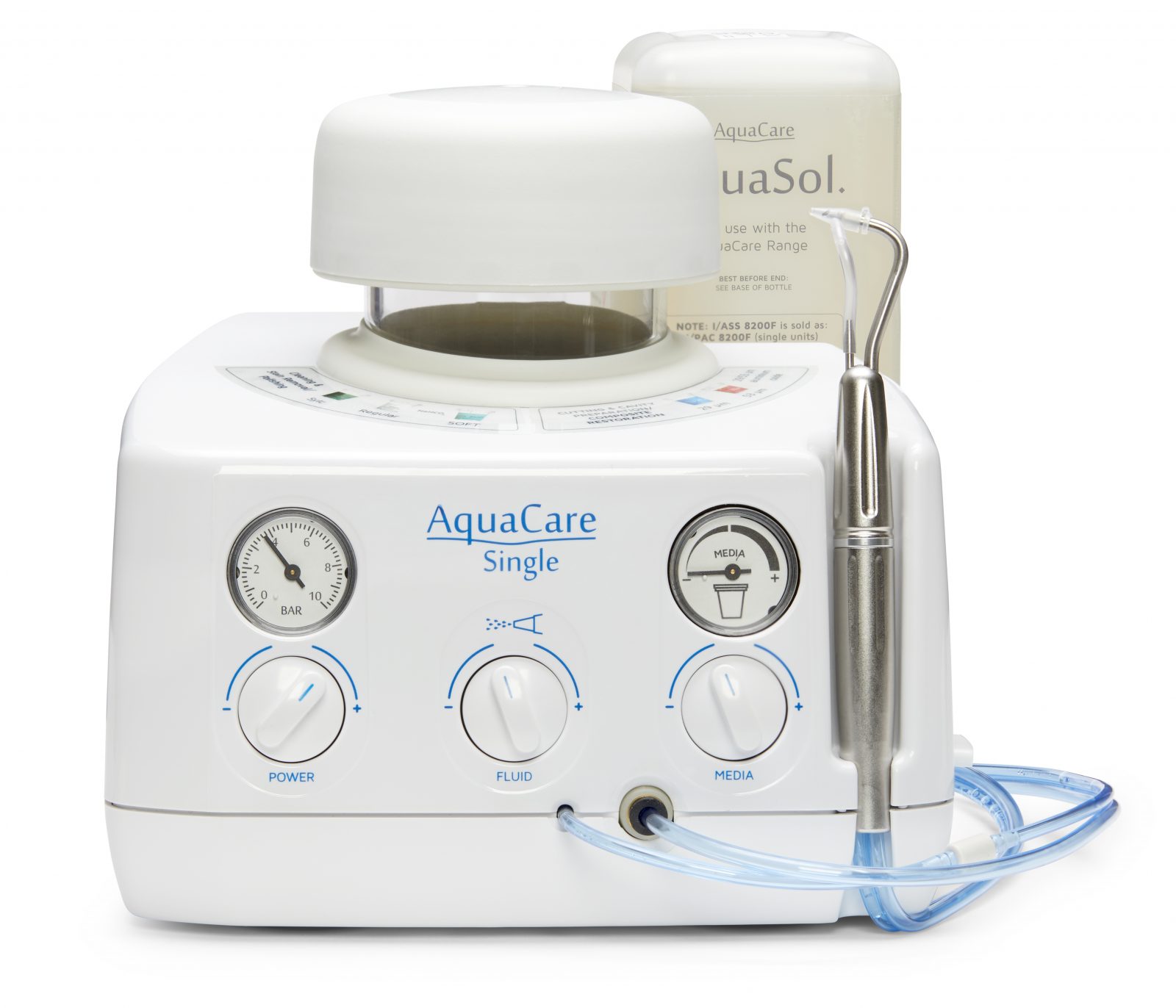
The AquaCare Single is a fluid air abrasion and air polishing unit manufactured by Velopex International, a UK-based dental equipment company that has been developing diagnostic and treatment solutions since 1976. Designed for clinicians and hygienists who want to practise minimally invasive dentistry (MID), the AquaCare Single delivers a controlled stream of air, fluid, and abrasive powder through a patented handpiece to perform contact-free cavity preparation, stain removal, surface texturing, desensitisation, and remineralisation treatments.
This review covers everything a dental professional needs to know before purchasing the AquaCare Single, including technical specifications, clinical applications, the powder ecosystem, handpiece design, maintenance considerations, pricing, pros and cons, a dentist’s verdict, and frequently asked questions.
What Is the AquaCare Single?
The AquaCare Single is a Class IIa medical device that uses kinetic energy to remove tooth structure, biofilm, staining, and old composite restorations. It emits a high-pressure stream of fine abrasive particles mixed with air and a proprietary fluid (AquaSol) through a lightweight handpiece. Because the handpiece never makes physical contact with the tooth, there is no heat generation, vibration, or pressure transfer. This is the fundamental characteristic that separates air abrasion technology from conventional rotary instrumentation.
The “Single” designation refers to the device’s single powder cartridge chamber. Its sibling, the AquaCare Twin, features two chambers that allow one-second switching between different powders. The Single requires a manual cartridge swap and purge cycle to change media. For dental professionals who primarily use one powder per session, such as hygienists focused on prophylaxis or clinicians using the unit mainly for cutting, the Single provides the full clinical capability of the AquaCare platform at a lower price point.
Velopex distributes the AquaCare through authorized partners, including Henry Schein and Optident. The company reports that over 12,000 dentists worldwide currently use AquaCare units in daily practice, and more than 100 key opinion leaders globally advocate for AquaCare-supported treatment protocols.
How the AquaCare Single Works
Understanding the mechanism behind fluid air abrasion helps dental professionals evaluate where this technology fits within their clinical workflow. The AquaCare Single operates on a straightforward principle that has been refined over decades of development in the particle abrasion field.
The unit propels fine abrasive particles (aluminum oxide or sodium bicarbonate) through a narrow nozzle at high velocity using compressed air. These particles strike the tooth surface and dislodge material in a controlled, precise manner. What distinguishes the AquaCare from older dry-air-only systems is the AquaSol fluid delivery. The proprietary fluid creates a liquid curtain around the abrasive stream as it exits the handpiece nozzle, capturing free-borne dust particles and dramatically reducing aerosol scatter in the operatory. Research published in the Journal of Conservative Dentistry confirms that air abrasion provides advantages, including the absence of pain, vibration, noise, and pressure, leading to high patient acceptance and genuine tissue conservation.
The foot pedal offers three modes – Dry, Wash, and Cut/Clean – allowing the clinician to perform an entire procedure through a single handpiece without interruption. Air supply, powder volume, and fluid volume are each adjustable via dedicated controls, giving full command over the treatment parameters.
Technical Specifications
Evaluating technical specifications is an essential step before any dental equipment purchase. The following table summarises the key specifications of the AquaCare Single as listed by the manufacturer.
Specification | Detail |
|---|---|
Device classification | Class IIa medical device |
Manufacturer | Velopex International (Medivance Instruments Ltd) |
Dimensions (H × W × D) | 185 mm × 184 mm × 216 mm |
Weight | 1.900 kg |
Air supply requirement | Clean, dry air to ISO 8573.1 Class 1.4.1 |
Min. air supply pressure | 5 bar (72 psi) |
Max. air supply pressure | 7 bar (100 psi) |
Output pressure range | 0–7 bar, infinitely variable via control knob and gauge |
Powder cartridge chambers | 1 (single cartridge system) |
Handpiece nozzle sizes | 0.6 mm (silver) and 0.8 mm (gold), colour-coded |
Handpiece material | Anodised aluminium, fully autoclavable |
Nozzle tip material | Stainless steel tube with tungsten carbide tip |
Foot pedal | Three-position: Dry, Wash, and Cut/Clean |
Fluid system | AquaSol vanilla-scented fluid (500 ml), 17.5% ethanol |
Compatible powders | 53 µm Al₂O₃, 29 µm Al₂O₃, sodium bicarbonate, Sylc Bioglass |
Powder feed rate | 0–6 g/min, infinitely variable |
Air input connection | 6 mm O/D |
Warranty | 1 year from date of purchase |
The compact dimensions and light weight make the unit easy to position in any operatory. At just under 2 kg, it can be moved between treatment rooms if needed. The entirely air-driven design means there are no electrical components, no pumps, and no risk of fluid leaks from pump-based mechanisms. This translates directly into lower long-term maintenance costs and higher operational reliability, which is a meaningful consideration when evaluating dental equipment essentials for a growing practice.
The Patented Handpiece
The handpiece is often cited as the standout feature of the AquaCare system, and it deserves close examination. Weighing under one ounce (approximately 28 grams), it is one of the lightest air abrasion handpieces on the market, and its slim profile is free from bulky powder pot attachments.
Separate integral channels for powder and fluid run through the handpiece, both controlled via the foot pedal. A high-speed fluid stream creates a liquid curtain around the abrasive medium as it exits the nozzle, capturing dust at the point of delivery. The nozzle tips are made from stainless steel with a tungsten carbide cutting tip, offering long-life durability. Two color-coded sizes are available: silver (0.6 mm) for finer, more precise work and gold (0.8 mm) for broader abrasion tasks. A quick-release system enables rapid changeover between nozzle sizes.
Disposable feedlines and tips are single-use items, discarded after each patient to maintain sterilization standards. The handpiece body itself is fully autoclavable between patients.
Powder Ecosystem and Cartridge System
The AquaCare Single uses Velopex’s proprietary color-coded cartridge system for powder management. Each powder type is supplied in a self-contained, gamma-irradiated cartridge with an integrated feed mechanism designed to eliminate blocking and prevent cross-contamination. The single-chamber design means one cartridge is loaded at a time, and switching to a different powder requires removing the current cartridge, inserting the new one, and performing a brief purge cycle.
Available Powders
Four powder types are currently available, each designed for specific clinical applications. Velopex has indicated that new powders are in ongoing development, and the cartridge system is designed to be forward-compatible with future media.
53 micron aluminum oxide (red cartridge) – the coarser cutting medium, used for heavier cavity preparation, removal of hypomineralised enamel, and more aggressive abrasion tasks
29 micron aluminum oxide (blue cartridge) – the finer cutting powder, suitable for routine cavity preparation, surface texturing to enhance bonding, and more delicate restorative work
Sodium bicarbonate (clear cartridge) – primarily used for cleaning, polishing, and prophylaxis, including biofilm removal, stain removal, and general prophylaxis
Sylc Bioglass (green cartridge) – a bioactive glass powder (BAG 45S5) used for desensitization, remineralization, and cleaning, with published evidence supporting improved bonding performance when used as a pre-treatment
A study in the Journal of Dental Research and Review found that bioactive glass air abrasion creates a suitable surface for adhesive bonding, confirming the dual therapeutic and preparatory value of Sylc-type media. The forward-compatible cartridge design makes the AquaCare Single a future-proof investment for practices building long-term air abrasion workflows.
Clinical Applications
The AquaCare Single is designed to function across a wide range of dental disciplines. Its versatility is a key reason it has gained traction among general practitioners, specialists, and hygienists. The following sections outline the primary clinical applications supported by the device.
Restorative Dentistry and Cavity Preparation
In cutting mode, the AquaCare Single prepares cavities conservatively, removing decayed tissue while preserving healthy tooth structure. The device handles Class I through Class V preparations effectively. Because it generates no heat, vibration, or pressure, the risk of micro-fractures and chipping commonly associated with rotary instruments is eliminated. According to research published in IntechOpen’s interdisciplinary review, the advantages of air abrasion in restorative settings include the absence of pain, vibration, noise, pressure, and heat, leading to high acceptance and minimal sound tissue sacrifice. Many clinicians find that anesthesia is not required for shallow to moderate preparations, which saves chair time and improves the patient experience.
Surface Texturing for Adhesive Bonding
Air abrasion with aluminum oxide creates a micromechanical surface texture that increases the surface area available for resin infiltration, leading to stronger bond strengths. This application is relevant for direct composite restorations, fissure sealant placement, porcelain repair, and orthodontic bracket bonding. A systematic review and meta-analysis published in ScienceDirect found that air abrasion with 50 µm aluminum oxide particles significantly improved the bond strength of resin cements to sound dentine, supporting its use before cementing indirect restorations. Experienced AquaCare users often finish preparations with 29 micron aluminum oxide followed by Sylc Bioglass for optimal results, a protocol supported by the 3M Scotchbond Universal Plus adhesive review discussion on surface pre-treatment and bonding performance.
Prophylaxis and Stain Removal
Using sodium bicarbonate in cleaning mode, the AquaCare Single delivers efficient stain removal from all tooth surfaces, including pits, fissures, and interproximal areas that conventional polishing cups and pastes struggle to reach. It can be used supra-gingivally and sub-gingivally, depending on the tip selected. For hygienists, this replaces multiple steps with a single, faster cleaning process.
Desensitization and Remineralization
When loaded with Sylc Bioglass, the unit delivers desensitization and remineralization treatments during routine cleaning appointments. The bioactive glass releases calcium and phosphate ions that interact with the tooth surface, helping occlude open dentine tubules and providing both immediate and ongoing sensitivity relief. This dual-benefit approach, cleaning and treating simultaneously, enhances patient outcomes without adding separate treatment steps.
Endodontics, Implantology, and Orthodontics
In endodontic applications, the AquaCare can clean and decontaminate access cavities and texture internal surfaces before obturation or post placement. In implantology, the unit is useful for decontaminating implant surfaces during peri-implantitis management, where the contact-free nature of air abrasion avoids scratching titanium surfaces. For orthodontics, the device excels at bracket bonding surface preparation, adhesive remnant removal after debonding, and cleaning around brackets, especially on difficult lingual surfaces.
Paediatric Dentistry
Children and adolescents are among the patient groups that benefit most from AquaCare treatments. The absence of drilling noise, vibration, and the frequent elimination of needles make dental visits dramatically less stressful for young patients, which improves cooperation and reduces the behavioral management challenges that can dominate appointments. For practices focused on pediatric care, the dental equipment buying guide on Dental Reviewed provides additional context on choosing the right treatment tools.
Diagnosis of Hidden Caries
An often-overlooked use of the AquaCare Single is its diagnostic capability. When used in cleaning mode with sodium bicarbonate, it can clear fissures and pits of vegetal plugs and other debris that may be concealing underlying carious lesions. Once the area is visible, the clinician can assess the fissure and, if a lesion is found, switch to cutting medium and begin treatment without removing the handpiece from the oral cavity. This seamless diagnostic-to-treatment workflow is a distinctive advantage of the AquaCare system.
AquaCare Single vs. AquaCare Twin
Choosing between the AquaCare Single and Twin is one of the most common deliberations for dental professionals considering this product line. The core technology, handpiece design, powder compatibility, and clinical capabilities are identical. The fundamental difference lies in the cartridge chamber configuration and the workflow implications that follow.
The Twin features two cartridge chambers, enabling the clinician to have two different powders loaded simultaneously and switch between them in approximately one second. This is invaluable during multi-step procedures, for example, beginning with sodium bicarbonate for diagnostic cleaning and switching to aluminum oxide for cavity preparation in the same appointment.
The Single, with its single chamber, requires a manual cartridge swap and purge to change powders. This adds roughly two to three minutes to the process. For clinicians who predominantly use a single powder per appointment, the Single provides all the clinical capability of the Twin at a significantly lower cost. The Single typically retails around USD 3,900 to EUR 2,985, while the Twin commands approximately USD 5,250 or more.
For practices that anticipate frequent powder switching within a single patient appointment, the Twin offers meaningful time savings. For those with more focused use cases or tighter budgets, the Single is an excellent starting point that delivers the full AquaCare treatment experience.
What Comes in the Box
The AquaCare Single ships with a comprehensive starter kit that includes everything needed to begin using the device immediately. Understanding the contents helps professionals budget for ongoing consumable costs accurately.
1 x AquaCare Single air abrasion unit
1 x silver 0.6 mm handpiece and 1 x gold 0.8 mm handpiece
1 x cartridge each of 53 µm aluminum oxide (red), 29 µm aluminum oxide (blue), sodium bicarbonate (clear), and Sylc Bioglass (green)
1 x AquaSol cleaning fluid (500 ml)
50 x disposable tips and 50 x disposable feedlines
5 x spare handpiece handles
1 x three-position foot pedal
1 x inline air filter
1 x quick-release twin feed tube assembly
5 x glass slides, 1 x nozzle cleaning wire, 1 x 2-metre air input hose, 1 x powder storage pot, 1 x handpiece tube removal tool, 2 x nozzle wash syringes
1 x quick start guide and 1 x user manual
This package means the practitioner can trial all four powder types and both nozzle sizes from day one. The 50 disposable tips and feedlines provide enough consumables for approximately 50 patient appointments before restocking.
Setup, Installation, and Maintenance
Proper installation and routine maintenance are essential for keeping the AquaCare Single performing reliably over the long term. The requirements are straightforward compared to many dental practice equipment categories, largely because the unit has no electrical components.
Installation Requirements
The unit requires clean, dry compressed air operating between 5 and 7 bar (72–100 psi) conforming to ISO 8573.1 Class 1.4.1. Most dental compressor systems will meet this requirement with the addition of a water-removing filter and shut-off valve in the supply line. An inline air filter is included with the unit. The air connection uses a standard 6 mm O/D fitting. Professional installation is recommended, and some distributors include it in the purchase price while others charge separately.
Daily Maintenance
The fluid system should be purged at the start of each day to ensure fresh AquaSol is flowing through the lines. The handpiece must be sterilized before first use and between each patient. Disposable feedlines and tips are single-use and should be discarded after each appointment. AquaSol fluid, with its 17.5% ethanol content, helps sterilize the internal fluid pathways and offers a pleasant vanilla fragrance that patients notice and appreciate.
Powder Management
When changing between powder types, the chamber must be purged to prevent cross-contamination and ensure consistent performance. The purge procedure takes approximately one to two minutes. Velopex strongly recommends using only original Velopex consumable products, as third-party powders may damage the unit or alter its performance characteristics.
Safety Considerations
The AquaCare Single incorporates several safety features, but proper training and adherence to the manufacturer’s guidelines are essential for safe clinical use. Only qualified dentists and dental hygienists should operate the unit on patients.
The aluminum oxide powders are non-toxic, and the particle sizes (29 and 53 microns) are well above the respirable particulate threshold, meaning accidental inhalation does not pose a respiratory hazard. Appropriate personal protective equipment, including eye protection and masks, should still be worn, and high-volume evacuation should be active during all procedures. The foot pedal includes a safety cover that should remain closed when the unit is not in use, and the unit should be depressurized before removing or replacing cartridge lids. The manufacturer advises always aiming towards the incisal edge of the tooth during operation to reduce the risk of soft tissue damage.
Pricing and Value Considerations
The AquaCare Single is positioned as a mid-range air abrasion unit. Typical retail pricing ranges from approximately USD 3,900 to approximately EUR 2,985 (excluding VAT), depending on the distributor and region. When evaluating this investment, dental professionals should factor in ongoing consumable expenses for disposable tips, feedlines, powder cartridges, and AquaSol fluid.
The unit can also generate revenue and savings. Procedures performed with air abrasion can command premium fees in some markets due to the enhanced patient experience. The reduction in anesthetic usage saves material costs and appointment time. Faster, more efficient prophy sessions compared to traditional paste-and-cup polishing can increase patient throughput. Some practices report that offering drill-free dentistry attracts new patients who had previously avoided dental care due to anxiety. Financing options are often available through major distributors, including equipment repayment plans.
The Bottom Line
The AquaCare Single from Velopex International is a well-designed, clinically versatile air abrasion and air polishing unit that delivers genuine value to dental practices committed to minimally invasive, patient-centered care. Its air-driven design ensures low maintenance and high reliability, the patented handpiece and AquaSol fluid system provide comfortable and dust-controlled treatments, and the expanding powder ecosystem covers restorative, prophylactic, desensitizing, and remineralizing applications.
For dental professionals evaluating their first air abrasion unit, the AquaCare Single offers an accessible price point without compromising clinical capability. For established users of air abrasion looking for a secondary unit or a dedicated hygiene-room device, it is equally well-suited. Whether the goal is preparing cavities without a drill, cleaning teeth more efficiently, or delivering desensitization treatments in a single appointment, the AquaCare Single equips clinicians to practice the kind of dentistry that patients appreciate and clinical evidence supports.
Verdict
<p>The AquaCare Single represents a well-engineered entry point into the world of fluid air abrasion. For dental professionals seeking to incorporate minimally invasive preparation, efficient prophylaxis, and contact-free treatment into their workflow, it delivers on its core promises. The handpiece design is genuinely excellent, offering lightweight, ergonomic, and versatile performance, and the AquaSol fluid curtain system effectively addresses the dust and aerosol concerns that plagued earlier generations of air abrasion technology.</p><p>Where the AquaCare Single truly excels is in patient experience. The ability to prepare cavities without a drill, often without anesthesia, and always without the noise and vibration that trigger anxiety is transformative for practices that prioritize patient comfort. In pediatric and nervous adult populations, this advantage alone can justify the investment. The cleaning capabilities are equally impressive, as the unit reaches into fissures and pits that conventional polishing systems cannot access.</p><p>The main consideration before purchasing is an honest assessment of powder-switching needs. Clinicians who routinely need two powders available during a single appointment will find the Twin model’s efficiency more suitable. Clinicians whose usage is more focused, primarily cleaning, primarily cutting, or one powder type per session, will get the same clinical capability from the Single at a lower cost. The AquaCare Single earns a strong recommendation for any practice that is serious about minimally invasive, patient-centered dentistry.</p>
Frequently Asked Questions
What is the AquaCare Single used for in dentistry?
The AquaCare Single is a dental air abrasion and air polishing unit used for minimally invasive cavity preparation, stain removal, biofilm removal, surface texturing for improved bonding, desensitisation, remineralisation, and prophylaxis. It is applicable across restorative, endodontic, periodontal, orthodontic, implant, and paediatric disciplines.
Does the AquaCare Single require anaesthesia?
In most cases involving shallow to moderate cavities, anaesthesia is not required. The device generates no heat, vibration, or pressure, so patient discomfort is minimal. Anaesthesia may still be necessary for deeper preparations or for patients with heightened sensitivity, but the clinician can also reduce air pressure to further minimise discomfort.
What powders are compatible with the AquaCare Single?
The AquaCare Single works with four powders supplied in Velopex’s proprietary cartridge system: 53 micron aluminium oxide (coarser cutting), 29 micron aluminium oxide (fine cutting and texturing), sodium bicarbonate (cleaning and polishing), and Sylc Bioglass (desensitisation and remineralisation). Additional powder types are in development.
What is the difference between the AquaCare Single and the AquaCare Twin?
Both models share the same handpiece, powders, and clinical technology. The Twin has two cartridge chambers allowing one-second switching between powders, while the Single has one chamber requiring manual changeover and purging. The Twin is more efficient for multi-powder procedures, and the Single is more affordable for practitioners who primarily use one powder per session.
Can the AquaCare Single remove amalgam fillings?
No. The AquaCare Single cannot remove metallic restorations such as amalgam or silver fillings. It is designed to remove decay, old composite and glass ionomer restorations, and tooth staining. Metallic restoration removal still requires conventional rotary instrumentation.
How much does the AquaCare Single cost?
Pricing varies by distributor and region. The AquaCare Single typically retails in the range of approximately USD 3,900 to EUR 2,985 (excluding VAT). The purchase includes a comprehensive starter kit. Contact your local authorised distributor for exact pricing and available financing options.
What air supply does the AquaCare Single need?
The unit requires clean, dry compressed air conforming to ISO 8573.1 Class 1.4.1, supplied at 5–7 bar (72–100 psi) with a maximum flow rate of over 70 litres per minute and a 6 mm O/D connection. Most dental compressor systems meet these requirements with the addition of a water-removing filter.
Is the AquaCare handpiece autoclavable?
Yes. The handpiece is fully autoclavable and must be sterilised before first use and between each patient. The disposable feedlines and tips are single-use and should be discarded after each appointment.
What is AquaSol and why is it used?
AquaSol is Velopex’s proprietary cleaning fluid used in the AquaCare fluid delivery system. It contains 17.5% ethanol, which helps sterilise the internal workings of the unit, and has a vanilla fragrance that enhances the patient experience. The fluid creates a liquid curtain around the abrasive stream to capture dust and reduce aerosol.
What warranty does the AquaCare Single come with?
The AquaCare Single is covered by a one-year manufacturer warranty from the date of purchase. For warranty claims and servicing, contact your authorised distributor or Velopex directly.
Is the AquaCare Single suitable for dental hygienists?
Yes. The AquaCare Single is an excellent tool for hygienists, particularly for air polishing and prophylaxis using sodium bicarbonate or Sylc Bioglass. It provides faster, more thorough cleaning than traditional paste-and-cup methods and can treat sensitivity simultaneously when using Sylc.
Can the AquaCare Single be used for orthodontic bracket preparation?
Yes. The unit is effective for preparing tooth surfaces before bracket bonding, texturing enamel to improve adhesive bond strength. It is particularly useful for lingual orthodontic systems where accessing internal surfaces is challenging, and it can also remove adhesive remnants after debonding.