Rating: 4.4/5
3M Scotchbond Universal Plus Adhesive Review for Dental Professionals
Adhesive dentistry has evolved dramatically since the introduction of multi-step bonding protocols in the 1990s. Today, universal dental adhesives allow clinicians to streamline...
Reviewed by Rachel Thompson
Pros
- First universal adhesive with dentin-like radiopacity, reducing misdiagnosis risk on radiographs
- True one-bottle system for all direct and indirect indications, all etching techniques, and all substrates
- BPA-derivative-free formulation addresses growing patient and regulatory concerns
- Virtually no post-operative sensitivity reported across 20,000+ applications
- Integrated silane eliminates the need for separate ceramic primers
- Built-in dual-cure accelerator removes the need for a separate activator bottle
- Consistent bond strength on both moist and dry dentin, with saliva contamination tolerance
- Comparable bond strength on caries-affected and sound dentin
- 100% clinical performance rating at two years from The Dental Advisor
- Quick 35-second adhesive application time
- Top Product award winner from 2021 through 2026
Cons
- Premium price point compared to basic adhesive systems
- Vial must be sealed properly between uses to prevent solvent evaporation
- Can pool at line angles if not thoroughly air-dried
- Some users report a thinner consistency compared to the original Scotchbond Universal
- Long-term independent clinical data beyond two years is still accumulating
- Technique-dependent results, as with all universal adhesives (20-second scrubbing is essential)
Adhesive dentistry has evolved dramatically since the introduction of multi-step bonding protocols in the 1990s. Today, universal dental adhesives allow clinicians to streamline restorative workflows without compromising bond integrity. Among the current generation of bonding agents, the 3M Scotchbond Universal Plus Adhesive has emerged as one of the most widely referenced products in the category, earning recognition from independent evaluators and peer-reviewed researchers alike.
This review examines the Scotchbond Universal Plus adhesive from a clinical perspective, covering its formulation, bonding performance, application technique, advantages and limitations, competitor comparisons, and common questions dental professionals ask before adopting a new adhesive. Whether the goal is to consolidate inventory, improve diagnostic confidence on follow-up radiographs, or adopt a BPA-derivative-free restorative protocol, this guide provides the evidence needed to make an informed decision about this universal dental bonding agent.
The decision to switch adhesive systems is not one that clinicians make lightly. Bonding agents sit at the foundation of virtually every restorative procedure, and a poor choice can cascade into debonds, sensitivity complaints, and premature restoration failures. This review draws on manufacturer data, independent clinical evaluations, peer-reviewed research, and practitioner feedback to present a balanced, evidence-based assessment of what 3M Scotchbond Universal Plus delivers in actual clinical use.
What Is 3M Scotchbond Universal Plus Adhesive?
3M Scotchbond Universal Plus is a light-cured, single-component universal dental adhesive manufactured by Solventum (formerly 3M Oral Care). It is designed for all direct and indirect bonding indications and works with every major etching technique, including total-etch, self-etch, and selective etch. The product is available in 5 mL vial and unit-dose formats.
The formulation builds directly upon the chemistry of the original 3M Scotchbond Universal Adhesive, which was introduced in 2011 as the first truly universal adhesive and has since become one of the most researched bonding systems in dentistry. The Plus version retains the core MDP phosphate monomer and Vitrebond copolymer platform while adding five clinically meaningful enhancements.
Key Features and Formulation Enhancements
Understanding what separates the Scotchbond Universal Plus adhesive from its predecessor and from competitors requires a closer look at the specific changes introduced in this formulation.
Dentin-Like Radiopacity
Scotchbond Universal Plus is the first universal adhesive with dentin-like radiopacity. Traditional adhesives appear dark on radiographs, and any pooling at the base of a cavity preparation can mimic the appearance of secondary caries. This has led to countless unnecessary retreatments over the years. The radiopaque formulation resolves this diagnostic challenge, allowing clinicians to distinguish between adhesive accumulation and actual pathology on follow-up bitewing radiographs.
BPA-Derivative-Free Formulation
The original Scotchbond Universal contained Bis-GMA, a resin derived from bisphenol A. The Plus version replaces Bis-GMA with a new radiopaque resin that eliminates BPA derivatives entirely. When combined with compatible Filtek composites and RelyX cements from the same product family, clinicians can deliver restorative procedures that are completely free of BPA-derivative materials, an increasingly important consideration for patients concerned about chemical exposure.
Integrated Silane for Glass-Ceramic Bonding
Optimized silane coupling agents are built directly into the Scotchbond Universal Plus formulation. This means there is no need for a separate ceramic primer or silane application step when bonding to glass-ceramic restorations such as lithium disilicate. The integrated silane simplifies protocols for cementation, indirect restorations, and intraoral repair of ceramic work.
Built-In Dual-Cure Accelerator
Unlike the original Scotchbond Universal, which required a separate Dual Cure Activator (DCA) bottle for use with self-cure and dual-cure materials, the Plus formulation integrates a dual-cure accelerator directly into the adhesive. This eliminates one more product from the inventory and one more step from indirect restoration protocols, all without compromising bond strength to dual-cure cements and core build-up materials.
Bonding to Caries-Affected Dentin
The adhesive achieves comparable shear bond strength on both sound dentin and caries-affected dentin, forming a well-defined, void-free hybrid layer. This capability directly supports minimally invasive dentistry techniques where selective caries removal preserves maximum tooth structure.
Chemical Composition and How It Works
The clinical behavior of any dental adhesive is a direct consequence of its chemistry. The following components work together to give Scotchbond Universal Plus adhesive its versatility and reliability.
MDP phosphate monomer provides chemical adhesion to hydroxyapatite and metal oxides, delivering high and durable bond strength across substrates
Vitrebond copolymer (polyalkenoic acid) contributes moisture tolerance and creates a chemical bond to calcium in the tooth structure, making the adhesive forgiving across varying dentin moisture conditions
HEMA (2-hydroxyethyl methacrylate) promotes wetting of the dentin surface and helps the resin penetrate into the demineralized collagen network
Radiopaque resin replaces Bis-GMA, simultaneously achieving dentin-like radiopacity and BPA-derivative-free status
Optimized silane coupling agents enable direct bonding to glass-ceramic substrates without separate priming
Dual-cure accelerator allows co-polymerization with dual-cure and self-cure materials without an additional activator
Camphorquinone photoinitiator provides reliable light-cure initiation and gives the uncured adhesive a yellow tint that assists with visual confirmation of surface coverage during application
Water and ethanol solvents facilitate monomer penetration into demineralized dentin and enable the self-etch functionality
Bond Strength Data and Clinical Evidence
Claims about adhesive performance carry little weight without data to support them. The following section summarizes the laboratory and clinical evidence available for Scotchbond Universal Plus adhesive.
Laboratory Performance
According to 3M’s technical product profile, Scotchbond Universal Plus demonstrates significantly higher shear bond strength to etched enamel, etched dentin, and unetched dentin compared to the original Scotchbond Universal. Internal data reports dentin shear bond strength values exceeding 30 MPa.
The adhesive bonds effectively to enamel, dentin (sound and caries-affected), composite resin, porcelain, glass ceramics, zirconia, and metal alloys. Testing has also shown that shear bond strength with pre-application saliva contamination was not statistically different from uncontaminated controls, indicating clinically relevant moisture tolerance.
A comparative study published in the Journal of Clinical Medicine (PMC) evaluated the dentin bond strength of Scotchbond Universal Plus alongside Clearfil SE Bond (Kuraray) and G2-Bond Universal (GC). Results varied depending on etching mode and aging protocol, underscoring the importance of evaluating the totality of evidence rather than any single study when comparing adhesive systems.
Clinical Trial Results
The Dental Advisor published results from an ongoing study in which Scotchbond Universal Plus was used to bond 2,425 restorations, including composites, crowns, and veneers. At the two-year recall of over 2,000 restorations, every evaluated restoration received an excellent rating: zero debonds, zero reports of post-operative sensitivity, and zero marginal discoloration. This earned a 100% clinical performance rating at two years.
A separate study at the University of Iceland used Scotchbond Universal Plus to bond Class II composites in a split-mouth design involving 48 patients. At two years, all restorations were clinically acceptable with no adverse events (source: 3M Dental Blog).
Prior to launch, 3M conducted field evaluations involving over 300 clinicians and more than 20,000 adhesive applications. Of the participating clinicians, 99% reported post-operative sensitivity with Scotchbond Universal Plus was the same as or less than with previously used adhesives.
The Dental Advisor has consistently awarded Scotchbond Universal Plus the Top Product designation from 2021 through 2026, with a 96% clinical rating based on evaluations from 39 dental professionals across more than 1,191 uses. A randomized, controlled, split-mouth clinical trial directly comparing Scotchbond Universal Plus to its predecessor for posterior Class I and II restorations is also underway.
Step-by-Step Application Protocol
Proper technique is essential for achieving reliable results with any universal adhesive. The Scotchbond Universal Plus application protocol requires approximately 35 seconds of total adhesive application time, making it one of the more efficient systems available. The following guide covers the recommended procedure for direct restorations using a selective etch approach, which many clinicians prefer because it maximizes enamel bond strength while preserving dentin integrity. Proper light curing remains critical throughout.
Isolate and prepare the tooth. Rubber dam is preferred, but cotton roll isolation with adequate moisture control is acceptable.
Apply phosphoric acid etchant to enamel margins only for 15 seconds. Rinse thoroughly for at least 15 seconds and gently blot excess moisture without over-drying the dentin.
Apply the adhesive with active scrubbing for 20 seconds. Use a microbrush or applicator tip and agitate the adhesive across the entire preparation. This active application step ensures monomer penetration into the collagen network and is non-negotiable for optimal results.
Air-thin gently for approximately 5 seconds to evaporate solvents and achieve a uniform, glossy film. Avoid pooling at line angles.
Light-cure for 10 seconds using a curing light with minimum 500 mW/cm² output. Curing immediately seals the dentin and maximizes bond strength.
Place the restorative material and cure according to the composite manufacturer’s instructions.
Technique Tips
The yellow camphorquinone tint can be used as a visual aid to confirm complete surface coverage before air-thinning
Chlorhexidine is safe for cavity disinfection prior to adhesive application, but avoid hydrogen peroxide and other radical-forming agents
For indirect restorations with RelyX Universal Resin Cement, the cement can initiate and cure the adhesive, potentially saving the separate light-cure step
The adhesive is compatible with all three etching techniques, making it adaptable to different clinical philosophies and restorative scenarios
Clinical Indications
One of the defining advantages of this adhesive system is its range of supported indications. The following list covers the primary uses recognized in the manufacturer’s instructions for use.
Direct anterior and posterior composite restorations (Class I through Class V)
Bonding and cementation of indirect restorations including inlays, onlays, crowns, bridges, and veneers
Bonding to glass ceramics, zirconia, metal alloys, and composite without separate primers or silane
Bonding with all methacrylate-based light-cure, self-cure, and dual-cure core build-up materials and cements
Intraoral repair of composite, porcelain-fused-to-metal, and all-ceramic restorations
Desensitization of exposed root surfaces and hypersensitive dentin
Sealing of cavity preparations prior to temporary cementation
Minimally invasive preparations where caries-affected dentin is preserved (learn more about minimally invasive dentistry)
Why Radiopacity Matters in Adhesive Dentistry
The clinical significance of radiopacity in a dental adhesive is often underestimated until a practitioner faces the diagnostic dilemma firsthand. Traditional universal adhesives are radiolucent, meaning they appear dark on radiographic images. When even a small amount of adhesive pools at the base of a cavity preparation, something that happens routinely despite careful technique, the resulting dark area on a follow-up bitewing can closely mimic the appearance of recurrent caries beneath the restoration.
This diagnostic ambiguity creates a difficult clinical decision. The clinician must choose between monitoring the area and risking missed secondary decay, or intervening to explore the site and potentially removing an intact, well-bonded restoration. Neither option is ideal. Studies and practitioner surveys have repeatedly highlighted this problem as a source of unnecessary retreatment, patient anxiety, and wasted chair time.
Scotchbond Universal Plus addresses this challenge with a radiopacity level comparable to natural dentin. On a radiograph, any adhesive accumulation beneath a restoration will appear at a similar density to the surrounding tooth structure rather than as a suspicious dark shadow. This means clinicians can confidently evaluate restoration margins and internal interfaces on follow-up diagnostic imaging without the confounding variable of radiolucent adhesive creating false positives.
For practices that rely on periodic radiographic monitoring to track restoration longevity, which includes virtually every general dental office and restorative-focused practice, this single feature can meaningfully reduce unnecessary interventions and improve long-term treatment planning accuracy.
Who Should Consider This Adhesive
Not every adhesive is the right fit for every practice. The following profiles describe the types of dental professionals who are most likely to benefit from incorporating Scotchbond Universal Plus into their clinical protocols.
General practitioners who want a single adhesive that covers the full range of direct and indirect restorative procedures without maintaining multiple product lines
Prosthodontists and restorative specialists who regularly bond to glass ceramics, zirconia, and metal substrates and want to eliminate separate primers and silane steps from their workflows
Clinicians who practice minimally invasive dentistry and need reliable bonding to caries-affected dentin during selective caries removal procedures
Practices that receive frequent patient inquiries about BPA content in dental materials and want to offer a BPA-derivative-free restorative option
Dental offices looking to standardize their bonding protocols across multiple clinicians to reduce technique variability and simplify procurement
Practitioners who have experienced the frustration of ambiguous post-operative radiographs and want radiopaque adhesive to improve diagnostic confidence during follow-up examinations
Practices that primarily use a dedicated etch-and-rinse system like OptiBond FL for high-stress restorations and are satisfied with their current protocol may find less immediate value in switching, though the inventory consolidation benefits could still justify evaluation.
How It Compares to Competing Adhesives
Evaluating a dental adhesive in isolation provides an incomplete picture. The universal adhesive market has become increasingly competitive, with multiple manufacturers offering products that claim broad substrate compatibility and streamlined workflows. The following comparisons highlight how Scotchbond Universal Plus stacks up against several leading alternatives that dental professionals commonly consider when selecting or switching adhesive systems.
Scotchbond Universal Plus vs. Kerr OptiBond FL
OptiBond FL is a three-step, fourth-generation etch-and-rinse system that has long served as the reference standard for maximum bond strength. It creates a thick adhesive layer that acts as a stress absorber under composite. However, it requires strict moisture control, multiple bottles, and a multi-step protocol. Scotchbond Universal Plus provides a single-bottle, multi-technique alternative with radiopacity and BPA-free advantages that OptiBond FL does not offer, making it a more practical choice for practices seeking to streamline their adhesive inventory.
Scotchbond Universal Plus vs. Kuraray Clearfil Universal Bond Quick
Clearfil Universal Bond Quick is a respected MDP-based universal adhesive with fast application and reliable dentin bonding. It lacks radiopacity, and compatibility with certain dual-cure protocols may require an additional activator. The integrated silane and dual-cure accelerator in Scotchbond Universal Plus give it an advantage in protocol simplification, particularly for practices that handle both direct and indirect restorations regularly.
Scotchbond Universal Plus vs. GC G2-Bond Universal
G2-Bond Universal is a HEMA-free alternative that has shown competitive dentin bond strength in some laboratory studies. Its HEMA-free formulation may appeal to practices treating patients with known methacrylate sensitivities. However, it does not offer radiopacity, and its clinical evidence base is considerably smaller than that of the Scotchbond Universal platform, which benefits from more than a decade of peer-reviewed research.
Scotchbond Universal Plus vs. Tokuyama Universal Bond
Tokuyama Universal Bond eliminates the adhesive light-curing step entirely, making it one of the fastest systems to use chairside. This can be attractive in high-volume practices. However, it uses a two-bottle mixing system rather than a true single-bottle approach, requires chemical mixing before application, and lacks radiopacity. For clinicians who prioritize one-bottle simplicity and diagnostic transparency on radiographs, Scotchbond Universal Plus remains the stronger option.
Packaging, Storage, and Shelf Life
Practical considerations such as packaging format and storage requirements play a role in the day-to-day experience of using any adhesive system.
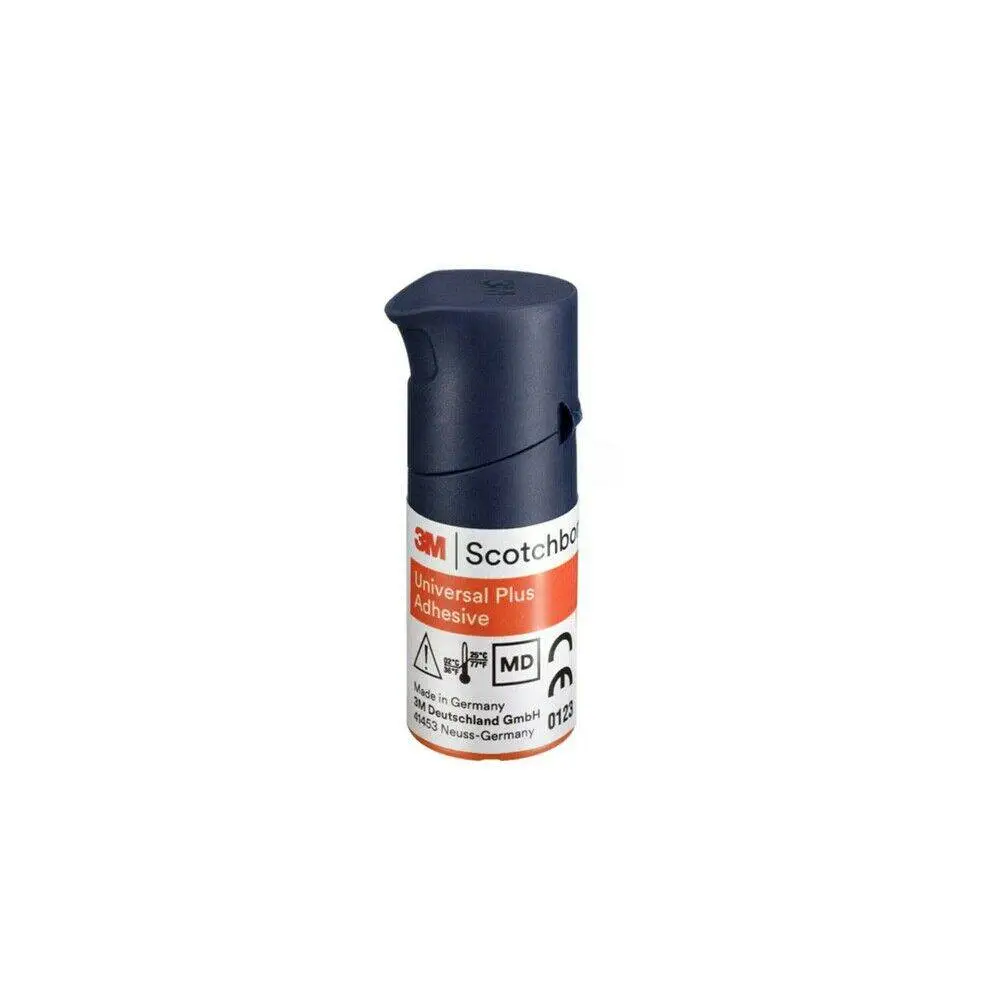
Scotchbond Universal Plus is available as a 5 mL vial with a translucent design that lets clinicians monitor remaining volume while protecting the photoinitiator from light. The flip-top cap supports one-handed dispensing. Unit-dose formats are also available in packs of 50, 100, 200, and 400 for practices that prioritize infection control and want to eliminate cross-contamination risks from shared vials.
The shelf life is up to 36 months at room temperature. The adhesive should be stored in a clean, dry location away from direct light. If refrigerated, it must be allowed to reach room temperature before use. Temperatures routinely exceeding 27°C (80°F) may reduce shelf life. Proper sealing of the vial between uses is critical to prevent solvent evaporation, which can thicken the adhesive and compromise performance over time.
From a procurement perspective, the ability to standardize on a single adhesive product across all bonding indications means practices can reduce the total number of adhesive-related SKUs in their inventory. Eliminating separate silane bottles, ceramic primers, and dual-cure activators not only reduces cost but also simplifies training for new team members and minimizes the risk of protocol errors in busy clinical environments. Practices managing multiple operatories or training associate dentists will find the streamlined inventory particularly beneficial.
Bottom Line
3M Scotchbond Universal Plus Adhesive delivers a compelling combination of clinical performance, workflow efficiency, and diagnostic innovation. The radiopacity feature is genuinely practice-changing for clinicians who have struggled with ambiguous post-operative radiographs. The ability to handle virtually every bonding scenario from a single bottle, without separate primers, silanes, or activators, translates into meaningful time savings and inventory reduction.
Combined with strong clinical evidence, consistently low post-operative sensitivity, and BPA-derivative-free chemistry, this adhesive represents one of the most complete universal bonding solutions currently available. The two-year clinical data from both The Dental Advisor and the University of Iceland provide reassuring early results, and the ongoing randomized controlled trial comparing it directly to its predecessor will further strengthen the evidence base as longer-term data becomes available.
For dental professionals evaluating their adhesive options in 2026, Scotchbond Universal Plus belongs on the shortlist. It is particularly well-suited for practices that value diagnostic clarity, protocol simplification, and the ability to address patient concerns about BPA exposure with a concrete, evidence-backed answer.
Verdict
<p>3M Scotchbond Universal Plus Adhesive has established itself as one of the most reliable and versatile bonding agents available to dental professionals today. The introduction of dentin-like radiopacity alone addresses a diagnostic frustration that has plagued clinicians for years, reducing the risk of unnecessary retreatment when adhesive pooling is mistaken for recurrent caries on follow-up radiographs.</p><p>The BPA-derivative-free formulation, integrated silane for glass-ceramic bonding, built-in dual-cure compatibility, and proven performance on caries-affected dentin collectively strengthen the case for consolidating adhesive inventory to a single bottle. In daily practice, the 35-second application time is efficient, the moisture tolerance is forgiving, and the near-zero post-operative sensitivity means fewer patient callbacks.</p><p>The premium price point is a valid consideration, but it should be weighed against reduced inventory costs, fewer separate primers and activators to manage, and the clinical confidence that comes with radiopaque follow-up imaging. For practices looking for a single adhesive system that reliably handles direct composites, indirect cementation, ceramic bonding, and intraoral repairs, Scotchbond Universal Plus merits serious evaluation as a primary bonding agent. Its track record of Top Product awards from The Dental Advisor across six consecutive years adds further weight to the recommendation.</p>
Frequently Asked Questions
Is 3M Scotchbond Universal Plus the same as the original Scotchbond Universal?
No. Scotchbond Universal Plus is the next-generation successor. It retains the core MDP and Vitrebond copolymer chemistry but adds five enhancements: dentin-like radiopacity, a BPA-derivative-free formulation, optimized silane for glass-ceramic bonding, a built-in dual-cure accelerator, and proven bonding to caries-affected dentin.
What etching techniques are compatible with this adhesive?
All three major techniques are supported: total-etch, self-etch, and selective etch. Many clinicians prefer selective etch because it optimizes enamel bond strength through phosphoric acid etching while allowing the adhesive to work in self-etch mode on dentin.
Do I need a separate silane or primer when bonding to glass ceramics?
No. Optimized silane coupling agents are included directly in the formulation. The adhesive bonds to glass-ceramic restorations such as lithium disilicate without an additional silane or ceramic primer step.
Is a separate dual-cure activator required?
No. Unlike the original Scotchbond Universal, the Plus formulation includes a built-in dual-cure accelerator. Full dual-cure and self-cure compatibility is achieved from the single bottle, with no additional components.
Is Scotchbond Universal Plus free of BPA?
The formulation is free of BPA derivatives like Bis-GMA. When combined with compatible Filtek composites and RelyX cements, clinicians can deliver entirely BPA-derivative-free restorative procedures.
How long does the adhesive application take?
Approximately 35 seconds: 20 seconds of active scrubbing, 5 seconds of air-thinning, and 10 seconds of light curing. If a selective or total-etch technique is used, the etching step adds time prior to adhesive application.
Can it be used for desensitization of exposed dentin?
Yes. The adhesive seals dentinal tubules and forms a hybrid layer that effectively reduces sensitivity when applied to exposed root surfaces or hypersensitive dentin.
What curing light specifications are recommended?
A curing light with a minimum output of 500 mW/cm² is recommended, with a 10-second curing time per application. The selection of an appropriate curing light is essential for achieving reliable polymerization.
Can chlorhexidine be used before applying this adhesive?
Yes. Chlorhexidine solutions are compatible and safe for cavity disinfection prior to adhesive application. Avoid hydrogen peroxide and similar radical-forming disinfectants, as these can interfere with polymerization.
What is the shelf life?
Up to 36 months at room temperature when stored in a clean, dry location away from direct light. If refrigerated, the adhesive must reach room temperature before use. Temperatures routinely above 27°C (80°F) may reduce shelf life.
Is it safe for use on primary teeth in pediatric patients?
Yes. The adhesive is suitable for both primary and permanent teeth. Bond strength testing has been conducted on primary teeth with favorable results, and the BPA-derivative-free formulation may be particularly reassuring for parents.
How does the viscosity compare to the original Scotchbond Universal?
Some clinicians have noted a slightly thinner consistency in the Plus formulation. This difference is subtle and does not affect clinical performance. Some practitioners find the thinner viscosity makes application and air-thinning easier, while others prefer the original feel. In both cases, the material stays in place during application and produces consistent results when technique guidelines are followed.