Rating: 4.3/5
GC Fuji II LC Review
This GC Fuji II LC review covers a resin-modified glass ionomer that has appeared in published clinical trials since the mid-1990s. Fuji II LC still earns a place in cervical and...
Reviewed by Rachel Thompson
Pros
- Retention close to 100% in short- to medium-term Class V trials
- Chemical bond to enamel and dentin without a separate adhesive
- Rechargeable fluoride release for high-risk and elderly patients
- Works in a slightly moist field, useful near the gingiva
- Command set in 20 seconds with finishing in the same visit
- About 2.5 times the flexural strength of Fuji IX GP in lab testing
- Capsule delivery removes ratio errors and reaches small cavities easily
- Radiopaque, with 10 to 11 Vita-based shades depending on format
Cons
- Surface texture worsens faster than composite
- Color match and polish fall short in high-esthetic areas
- Not suited to stress-bearing posterior restorations in adults
- Depth of cure of only 1.8 mm, so deeper cavities need layering
- Contains HEMA, a contact allergen and possible pulp irritant
- Needs a curing light, a capsule mixer and an applier
- Weaker long-term results reported in some general-practice settings
This GC Fuji II LC review covers a resin-modified glass ionomer that has appeared in published clinical trials since the mid-1990s. Fuji II LC still earns a place in cervical and pediatric dentistry, and the trial data show both why and where it falls short.
TL;DR
Fuji II LC holds well in Class V lesions, with 100% retention at one year in a randomized trial and a 1.8% loss rate in a 2023 Class V study
Its surface roughens and its color drifts faster than composite, so keep it away from high-esthetic and load-bearing sites
Cure it in 1.8 mm layers for 20 seconds each and coat the finished surface to protect it while it matures
Use Fuji IX instead for bulk-filled primary molars and ART cases where no curing light is available
What GC Fuji II LC Is and How It Sets
GC Fuji II LC is a radiopaque, light-cured, resin-reinforced glass ionomer restorative from GC Corporation. GC's European catalogue describes it as a multipurpose material whose primary job is restoring Class III, Class V and primary-tooth cavities. Lining and core build-up appear as secondary uses.
Setting Chemistry
Two reactions run side by side once the capsule is mixed. The classic acid-base reaction starts first, as polyacrylic acid attacks the fluoroaluminosilicate glass and the released metal ions crosslink the polyacid chains into a salt matrix. That reaction keeps maturing for days. Hydrophilic monomers, mainly HEMA, polymerize under the curing light and give the material its command set. GC's Fuji II LC leaflet reports compressive strength data for both light-cured and self-cured specimens, which matters in shadowed areas the light never fully reaches.
Sidhu and Nicholson's review of glass-ionomer cements explains why this hybrid behaves differently from a compomer. The ionomer reaction still sets the material even if no light reaches it, which is the property that defines a true resin-modified glass ionomer.
Adhesion and Fluoride
The bond to tooth structure forms through ion exchange with hydroxyapatite, without a separate etch-and-bond step. GC recommends removing the smear layer first with GC Cavity Conditioner, a 20% polyacrylic acid. The result is an interdiffusion zone that tolerates a slightly moist surface far better than a resin hybrid layer does.
Fluoride leaves the set cement continuously and the material takes fluoride back up from toothpaste and varnish. The Journal of the Canadian Dental Association review of glass ionomer restorations notes that some resin-modified materials release at least as much fluoride as conventional cements, with the caveat that clinical proof of a caries-preventive effect is still limited.
Capsule and Powder/Liquid Formats
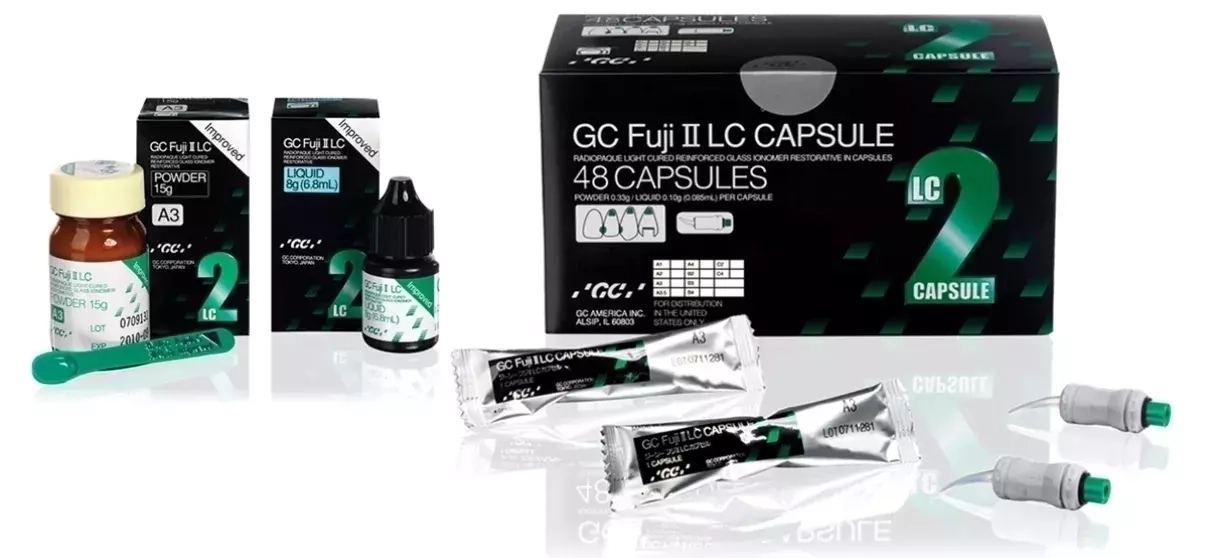
GC sells Fuji II LC in two delivery formats, and the choice affects consistency more than most clinicians expect. The capsule holds 0.33 g of powder and 0.085 mL of liquid according to the FDA's AccessGUDID device record, so the powder-to-liquid ratio is fixed at the factory. The capsule version comes in 10 Vita-based shades in the US instructions for use, and GC Asia also lists a D2 capsule.
The hand-mixed GC Fuji II LC Improved adds a D2 shade for 11 in total and has a 3-year shelf life against 2 years for capsules, per GC's powder/liquid instructions for use. For most offices the capsule is the better buy, because ratio errors are one of the most common reasons glass ionomers underperform.
Fuji II LC Technical Specifications
The figures below come from GC's capsule instructions for use, tested to ISO 9917-2 at 23 °C and 50% relative humidity. The working time and depth of cure are the two numbers that shape technique most.
Property | GC Fuji II LC Capsule |
|---|---|
Material class | Light-cured resin-modified glass ionomer, ISO 9917-2 Type I |
Powder/liquid per capsule | 0.33 g / 0.10 g |
Mixing | 10 seconds at about 4,000 rpm |
Working time at 23 °C | 3 min 15 s from start of mix |
Light-curing time | 20 seconds per increment, 470 nm light |
Depth of cure, shade A2 | 1.8 mm |
Shades | 10 to 11 Vita-based, depending on format and market |
Storage | 4–25 °C, cool and dark |
Shelf life | 2 years for capsules, 3 years for powder/liquid |
Surface protection | GC Fuji Varnish, GC Fuji Coat LC or G-Coat Plus |
Laboratory data put the material well ahead of conventional cements in bending. A 2015 study in the Brazilian Journal of Oral Sciences measured flexural strength of about 50 MPa for Fuji II LC Improved, against roughly 20 MPa for Fuji IX GP and 17 MPa for conventional Fuji II. Its shear bond strength to dentin, about 11.6 MPa, was also the highest of the group.
GC Fuji II LC Indications
The official GC Fuji II LC indications list six uses, and the only listed contraindication is pulp capping. Daily practice stretches the material into a few more roles, some of which deserve more caution than others.
Manufacturer-Listed Indications
The table pairs each labeled indication with the clinical context where it tends to perform best.
Indication | Clinical context |
|---|---|
Class III, Class V and limited Class I restorations | Cervical lesions are the core use. Small occlusal cavities only where load is light. |
Primary teeth | Short chair time and moisture tolerance suit young children. |
Core build-up | Possible with enough remaining tooth structure. GC also sells the dedicated Fuji II LC CORE. |
Cases needing radiopacity | Easier to tell the restoration from recurrent caries on bitewings. |
Geriatric patients | Root caries and dry mouth make fluoride release and moisture tolerance useful. |
Base or liner | Under composite in closed or open sandwich restorations, and under amalgam. |
Fuji II LC in Primary Teeth
Primary teeth are where the forgiving handling of Fuji II LC pays off most. A child who tolerates five minutes of cooperation leaves little room for a multi-step adhesive protocol, and a 20-second cure shortens the riskiest part of the visit.
Small Class I, Class II and Class V cavities in primary molars and incisors all fall within the labeled indications. Larger multi-surface lesions in primary molars tend to do better with a stainless steel crown, and a recent clinical trial comparing treatments for cavities in baby teeth adds useful context on where the Hall technique fits against conventional fillings. When the tooth is due to exfoliate within two years, the shorter lifespan of an ionomer restoration rarely matters.
Extended Uses in Daily Practice
Many clinicians place Fuji II LC as the gingival increment of an open sandwich when a proximal box ends below the cementoenamel junction. That use overlaps with the logic behind deep margin elevation, although composite is more common for that technique today. It also works well as an interim restoration during caries control and as a repair material for root caries at crown margins in older patients.
For patients with xerostomia, the material pairs well with a home routine built on saliva substitutes and high-fluoride toothpaste. These extended uses are common, but they sit outside the label, so case selection rests with the treating dentist.
Contraindications and Poor Fits
GC names pulp capping as a contraindication and directs clinicians to calcium hydroxide instead. Many offices now use a calcium silicate such as Biodentine over exposed or near-exposed pulp and place Fuji II LC above it.
Direct pulp capping, which GC lists as a contraindication
Large Class I and Class II restorations in adult molars
Patients with bruxism or heavy occlusal contacts on the restoration
Anterior work where polish and translucency drive the result
Patients or staff with a known methacrylate or HEMA allergy
Clinical Technique: Placing Fuji II LC Step by Step
Fuji II LC forgives small errors better than composite. Conditioning the dentin and coating the finished surface still decide most outcomes.
Prepare the cavity with standard techniques. Extensive mechanical retention is not needed, and in non-carious lesions a light pass with a bur refreshes sclerotic dentin.
Apply GC Cavity Conditioner for about 10 seconds, then rinse thoroughly.
Blot or gently air the surface until it looks moist and glistening. A chalky, dry surface weakens the bond and raises the risk of sensitivity.
Tap the capsule to loosen the powder, press the plunger flush, click once in the metal GC Capsule Applier and mix for 10 seconds.
Prime with two clicks and extrude from the deepest point outward to avoid trapping air.
Contour with a plastic instrument or a cervical matrix within the 3 minute 15 second working time.
Light-cure for 20 seconds with the tip as close as possible. Layer anything deeper than 1.8 mm.
Finish under water spray with a superfine diamond, silicone points and strips.
Apply GC Fuji Varnish, GC Fuji Coat LC for 10 seconds or G-Coat Plus for 20 seconds.
Chairside Handling Notes
Ambient light is the variable most offices underestimate. In the Australian Dental Journal general-practice study, the practitioner noted that working time under the operatory light varied between mixes. Turning the overhead lamp away from the field until the material is contoured keeps the full 3 minute 15 second window available.
A light that delivers adequate energy at the tip is not optional with this material. Clinicians who have not checked output recently will find the comparison in our VALO Grand curing light review useful when weighing an upgrade.
Using Fuji II LC in the Sandwich Technique
In a closed sandwich, Fuji II LC replaces lost dentin and composite covers it completely. In an open sandwich, the glass ionomer also forms the cervical margin of the proximal box, where it seals dentin or cementum better than most adhesives.
After curing the Fuji II LC layer, the composite bonding step proceeds as usual. The choice between etching approaches over a glass ionomer base is covered in our guide to self-etch vs total-etch vs selective-etch bonding.
Strengths Seen in Clinical Use
Retention in cervical lesions is the strength with the most published support. Fluoride release and moisture tolerance carry the material through cases where composite would struggle.
Retention in Cervical Lesions
Cervical restorations most often fail by falling out, and this is where Fuji II LC performs best. In a randomized trial of 92 non-carious cervical lesions, Fuji II LC kept 100% of its restorations at six months and at one year, while the etch-and-rinse composite group sat at 92.6% after one year. The difference was not statistically significant, but the direction is consistent with older work.
A 1995 study in Quintessence International restored 60 abrasion lesions in 13 patients with three resin-modified glass ionomers and lost none at one year. Fuji II LC showed no significant color change over that period, while Vitremer darkened.
Chemical Adhesion to Sclerotic Dentin
Abfraction and erosion lesions often expose hypermineralized, sclerotic dentin that resists resin infiltration. The ion-exchange bond of a glass ionomer depends far less on a hybrid layer, which explains much of its retention advantage in these lesions.
Fluoride Release for High-Risk Patients
Continuous, rechargeable fluoride release makes Fuji II LC a sensible choice for elderly patients with root caries and patients on medications that dry the mouth. Recharge depends on regular topical exposure, so pairing the restoration with a fluoride varnish at recall visits or a 5,000 ppm prescription toothpaste at home makes clinical sense.
Moisture Tolerance and Command Set
GC's leaflet states that rubber dam is not required, since the material works in a slightly moist field. That is useful for subgingival margins and for children who cannot tolerate long isolation. Offices that prefer some isolation can still use a dental dam, and the 20-second command set lets the dentist contour and finish in one visit.
Limitations to Plan Around
Most Fuji II LC replacements in the literature are cosmetic rather than structural. Surface texture and color are the weak points, followed by depth of cure and load-bearing capacity.
Surface Texture Over Time
The same randomized trial that showed 100% retention also found that Fuji II LC surface texture worsened significantly from baseline to six months and to one year. It scored worse than both comparison materials at every recall, and the authors described the deterioration as quick. A rougher surface holds more plaque, so periodic re-polishing at hygiene visits is a reasonable habit for these restorations.
Color Stability and Masking
Shade matching is acceptable for cervical work but below composite in translucency and polish. In the general-practice study, discolored teeth were harder to mask with Fuji II LC than with a compomer. For an esthetic Class V in a visible smile line, an injectable composite such as GC G-aenial Universal Injectable often gives a better color result, at the cost of a more demanding bonding protocol.
Depth of Cure and Wear
At 1.8 mm in shade A2, a single increment fills a typical cervical lesion but not a deep box. Darker shades cure less deeply. Flexural strength of about 50 MPa is high for an ionomer and still far below modern composites, so Fuji II LC is not a long-term answer for a large Class II in an adult molar.
HEMA, Water Sorption, and Ceramics
Unreacted HEMA is a recognized contact allergen and can irritate the pulp in very deep cavities. A calcium silicate liner under Fuji II LC solves the pulp concern, and nitrile gloves with no-touch handling of uncured material protect staff.
The HEMA-rich matrix also absorbs water after placement. Modest expansion helps the marginal seal, but excessive hygroscopic expansion has been linked to stress on thin walls and on overlying all-ceramic crowns. Clinicians planning glass-ceramic or zirconia vs lithium disilicate restorations over a large Fuji II LC core should keep that in mind.
Long-Term Results Outside Universities
Not every study is favorable. In the Australian general-practice study, one dentist placed 73 Fuji II LC restorations in unprepared non-carious cervical lesions in 61 adults. Median survival was 42 months, and the cumulative survival estimate for Fuji II LC reached zero within five years. Controlled trials report much better numbers, which points to surface preparation, conditioning and case selection as the factors that matter most.
Fuji II LC vs Composite in Class V Lesions
Composite and Fuji II LC compete most directly at the cervical margin. Published trials favor the glass ionomer on retention, and composite wins on surface quality and color.
Franco and colleagues followed restorations in non-carious cervical lesions for five years in Operative Dentistry and found that resin-modified glass ionomer restorations performed better than a one-bottle adhesive with composite, with a significant difference in retention. That trial used a different resin-modified ionomer, so it supports the material class more than this specific product.
Matching the Material to the Lesion
The choice works best lesion by lesion. A shallow, saucer-shaped erosion lesion high in the smile line of a low-risk patient, with enamel at both margins, suits composite and a good adhesive. Fuji II LC earns its place when a notched abfraction lesion runs onto root dentin in a patient with active root caries and a dry mouth, because the gingival margin there sits in dentin or cementum where ionomer adhesion holds up better than resin bonding.
Margin position also changes the plan. Enamel on the coronal side bonds reliably with resin, while the apical margin on the root surface is where most cervical composites start to leak.
Layering Both Materials in One Lesion
Some clinicians combine the two in a single cervical restoration, placing Fuji II LC against the gingival dentin and a thin composite veneer over the coronal half. The root surface gets the retention and fluoride release of the ionomer, and the visible enamel portion gets the polish of composite. The technique adds a bonding step and several minutes of chair time, so it suits esthetic cases in patients with a high caries risk more than routine cervical work.
Fuji II LC vs Fuji IX
In the Fuji II LC vs Fuji IX decision, the chemistry drives the choice. Fuji II LC is a light-cured resin-modified ionomer, and GC Fuji IX GP is a conventional, self-curing, high-viscosity ionomer with a packable consistency. Our full GC Fuji IX review covers that material in more depth.
Feature | GC Fuji II LC | GC Fuji IX GP |
|---|---|---|
Material type | Resin-modified, light-cured with chemical set | Conventional high-viscosity, self-cured |
Consistency | Medium flow, syringed | Packable and condensable |
Working time at 23 °C | 3 min 15 s | About 2 min |
Set | 20-second light cure | Self-sets in about 2.5 min |
Finishing | Right after curing | About 6 min from start of mix |
Flexural strength, lab | About 50 MPa | About 20 MPa |
Bulk placement | Layers above 1.8 mm | Single-step bulk fill |
Curing light needed | Yes | No |
Typical use | Class V, Class III, liner, sandwich base | Primary molars, non-load-bearing Class I and II, ART, interim restorations |
What the Head-to-Head Data Show
The most direct comparison comes from a 2023 retrospective study in Dentistry Journal. Dental students at Western University's Schulich clinic in Canada restored 96 carious Class V lesions with Fuji II LC (57) or Fuji IX (39). Over follow-up of about 2.5 to 3.5 years, Fuji II LC lost 1.8% of its restorations and Fuji IX lost 17.9%.
Color match also favored Fuji II LC. The share rated as an ideal match held at about 73% for Fuji II LC and dropped from 51% to 39% for Fuji IX. The study was retrospective and limited to 36 patients, yet the result lines up with what most clinicians see in cervical lesions.
Choosing Between Them Chairside
Fuji IX makes more sense for pediatric cavity fillings in primary molars and for patients sensitive to HEMA. Cervical lesions in visible areas, along with bases that will be bonded over in the same visit, are where the light-cured material earns its place. Most offices that do a lot of pediatric and geriatric work stock both.
What Patients Notice
Patients mostly notice the shorter appointment, since there is no separate etch and bond and the light cure takes 20 seconds. GC's leaflet claims the material eliminates sensitivity, and sealing exposed cervical dentin with a well-adapted ionomer commonly relieves the sharp, cold-triggered pain that brings many of these patients in.
Cost and Value
At US distributor list prices in late 2026, a box of 48 Fuji II LC capsules runs about $350 to $415, which works out to roughly $7 to $9 per capsule. One capsule fills most single cervical lesions. The lower step count compared with a composite Class V saves chair time, and that saving usually outweighs the per-capsule cost.
Choosing the restorative material is part of the wider dental treatment plan. For patients at high caries risk, recording the material, the recall interval and the fluoride regimen together helps the team re-polish and recharge Fuji II LC restorations on schedule.
Bottom Line
Fuji II LC remains a dependable first choice for cervical lesions, and the trial record behind it now spans three decades. In the 2023 Class V study at Western University, Fuji II LC lost 1.8% of its 57 restorations against 17.9% for Fuji IX. Controlled trials put short- to medium-term retention near 100%, which makes it a sound default for root-surface and abfraction lesions where resin adhesion is least predictable.
The material needs more upkeep than composite. Surface texture declines within the first year, so the hygiene team should plan to re-polish these restorations at recall and recharge them with topical fluoride. Esthetic Class V cases in the smile line, along with anything carrying occlusal load in adult molars, still belong with composite.
Technique decides more of the outcome than the forgiving handling suggests. The Australian general-practice data, with a median survival of 42 months in unprepared lesions, sit far below university trial results, and surface preparation and the final protective coat are the likeliest explanations. Offices adopting Fuji II LC get the most from it when every assistant knows the capsule sequence and the overhead lamp stays off the field until contouring is done.
For practices that treat many children and older adults, stocking Fuji IX alongside Fuji II LC covers most glass ionomer work. Fuji IX takes the bulk-filled primary molars and ART cases, leaving cervical lesions and open-sandwich bases to the light-cured material. At roughly $7 to $9 per capsule, one capsule restores most single cervical lesions.
Verdict
<p>Fuji II LC does a small number of jobs very well. Its best use is the cervical lesion, where the ion-exchange bond keeps restorations in place on sclerotic dentin that defeats many resin adhesives. Trial data put short- to medium-term retention near 100%, and the 2023 Class V comparison found Fuji II LC lost 1.8% of restorations against 17.9% for Fuji IX.</p><p>Add rechargeable fluoride release, tolerance of a slightly moist field and a 20-second command set, and the material suits elderly and high caries-risk patients particularly well, including those with dry mouth. It is equally practical as a liner or open-sandwich base, where sealing the gingival margin matters more than surface polish.</p><p>The weaknesses are predictable. Surface texture deteriorates within the first year, and masking a discolored tooth is harder than with resin-based materials. It should not carry heavy occlusal load in adult posterior teeth.</p><p>Results depend on technique more than the forgiving handling suggests. Conditioning the dentin, avoiding desiccation, respecting the 1.8 mm depth of cure and coating every restoration separate the long-lasting cases from the early replacements.</p>
Frequently Asked Questions
What is GC Fuji II LC used for?
Fuji II LC is a light-cured resin-modified glass ionomer used mainly for Class V and Class III restorations, restorations in primary teeth and as a liner or base. It also serves for small core build-ups and geriatric restorations.
What are the official GC Fuji II LC indications?
GC lists Class III, V and limited Class I restorations, primary teeth, core build-up, cases needing a radiopaque restoration, geriatric use and use as a base or liner. Direct pulp capping is the listed contraindication.
Is Fuji II LC a glass ionomer or a composite?
It is a resin-modified glass ionomer. It sets mainly through the acid-base reaction of a glass ionomer, with a light-activated resin phase added for command set.
Do you need to etch or bond before placing Fuji II LC?
No phosphoric acid etch or adhesive is needed. GC recommends a polyacrylic acid conditioner to remove the smear layer, followed by rinsing and gentle drying without desiccating the dentin.
How long should Fuji II LC be light-cured?
Cure each increment for 20 seconds with a 470 nm light held as close to the surface as possible. Depth of cure is 1.8 mm, so deeper cavities need layering.
What is the working time of Fuji II LC?
The capsule gives 3 minutes 15 seconds from the start of mixing at 23 °C. Warm rooms and bright operatory light shorten it.
Which is better, Fuji II LC or Fuji IX?
Neither is better across the board. Fuji II LC suits cervical lesions and bases, and in one Class V study it lost 1.8% of restorations against 17.9% for Fuji IX. Fuji IX suits bulk-filled primary molars, ART and settings without a curing light.
Can Fuji II LC be used for pulp capping?
No. GC lists pulp capping as a contraindication. Place calcium hydroxide or a calcium silicate cement over the pulp first, then Fuji II LC above it.
Does Fuji II LC need a protective coat?
Yes. GC recommends GC Fuji Varnish, GC Fuji Coat LC or G-Coat Plus after finishing to protect the surface while the ionomer matures.
How should Fuji II LC capsules be stored?
Store them in a cool, dark place between 4 and 25 °C. Capsules keep for 2 years from manufacture, and the powder/liquid version keeps for 3 years.