Zirconia vs. Lithium Disilicate (E.max): Which Material Should You Choose?
Most dentists have a go-to crown material, and most of the time it works. The trouble starts with cases that break the routine, such as a dark stump, a short clinical crown, or a...
Written by Maren Solvik
Read time: 6 min read
Most dentists have a go-to crown material, and most of the time it works. The trouble starts with cases that break the routine, such as a dark stump, a short clinical crown, or a heavy grinder. This guide explains when zirconia or lithium disilicate is the better fit, and how to decide quickly in everyday cases.
TL;DR
Traditional 3Y zirconia offers the highest strength for demanding posterior crowns and selected bridges.
Lithium disilicate provides excellent optics and predictable bonding for veneers and partial-coverage restorations.
Translucent 4Y and 5Y zirconia behave differently from 3Y and need their own strength assumptions.
Restoration design, available thickness, and the product's approved indications should drive the final choice.
Zirconia vs. Lithium Disilicate: Key Differences at a Glance
The two materials behave differently because they are built differently. Once that difference is clear, most clinical rules make sense.
Lithium disilicate is a glass-ceramic:
It is made of crystals held together by glass.
The glass lets light through, so it looks natural.
Hydrofluoric (HF) acid can etch the glass, so it bonds very well.
Zirconia is a polycrystalline ceramic:
It is made almost entirely of tightly packed crystals, with no glass.
That makes it much stronger, but less translucent.
HF acid does not etch it, so bonding needs a different method.
It's important to note that E.max is a brand family, not a material. Ivoclar sells both lithium disilicate (IPS e.max CAD and IPS e.max Press) and zirconia (IPS e.max ZirCAD) under it. On lab slips, write the full product name.
Characteristic | Lithium disilicate | 3Y zirconia | 4Y/5Y zirconia |
|---|---|---|---|
Best known for | Natural look and bonding | Strength | A balance of strength and look |
Strength | Moderate–high | Very high | Varies, lower than 3Y |
Translucency | High, several levels | Lower | Improved, especially 5Y |
Surface treatment | HF etch and silane | Air abrasion and MDP primer | Air abrasion and MDP primer, per product |
Conventional cement | Some retentive crowns | Often, for retentive crowns | Depends on product |
Typical uses | Veneers, inlays, onlays, single crowns | High-load crowns, bridges | Esthetic crowns, selected bridges |
Main limitation | Can fracture if too thin | Can look flat in visible areas | Weaker than 3Y |
Values and indications vary by manufacturer. Always check the product's instructions for use (IFU).
For a wider look at ceramics, metals, and composites, see our guide to choosing dental restorative materials.
Which Material Is Stronger and More Esthetic?
Strength numbers come from lab tests on small, polished samples. Real crowns face saliva, years of chewing, and cemented surfaces. Use lab data to compare materials, not to predict how long a crown will last.
Flexural Strength and Fracture Resistance
Three terms come up in every strength discussion. Here is what each one means in practice.
Term | What it means | Why it matters clinically |
|---|---|---|
Flexural strength | How much bending force a material takes before it breaks | The headline number in marketing |
Fracture toughness | How well a material stops a small crack from spreading | Resistance to chips and cracks |
Fatigue | Gradual weakening from repeated chewing | Explains failures that appear after years |
Here are the reported strength values for each material.
Material | Reported flexural strength | Source |
|---|---|---|
3Y zirconia | Commonly above 1,000 MPa | Widely reported range |
4Y zirconia | 803 ± 233 MPa (average) | |
5Y zirconia | 570 ± 116 MPa (average) | |
IPS e.max CAD | 530 MPa (biaxial) |
Test methods differ between studies, so treat these as rough comparisons.
What these numbers tell you:
3Y zirconia is in a different league, making it the clear choice when strength drives the decision.
5Y zirconia and lithium disilicate are close, so choosing 5Y for strength alone gains little and gives up lithium disilicate's etch-and-bond advantage.
Translucent zirconia is less tough because 4Y and 5Y grades rely far less on the transformation toughening that lets 3Y stop cracks.
Brand matters, as the wide range for 4Y means two "4Y" products can perform quite differently.
Thickness often matters more than the material. A crown's load capacity rises roughly with the square of its thickness. A few tenths of a millimeter lost to under-reduction can matter more than switching brands.
Translucency, Shade Matching, and Masking Ability
A translucent crown takes on the color of what lies beneath it. That works well over a healthy tooth, and badly over a dark one.
What is under the crown | What to expect | Practical approach |
|---|---|---|
Light, natural stump | Translucent materials blend well | High-translucency lithium disilicate or 5Y zirconia |
Mildly discolored stump | Some color shows through | Lower-translucency block and adjusted cement shade |
Dark root, metal post, or titanium abutment | Translucent ceramic can look gray | Masking-level material, more thickness, or both |
Monolithic 3Y zirconia hides dark structures well. However, it can look flat and chalky in the smile zone.
Send a stump shade photo with every esthetic case. Without it, the technician is guessing at what lies under the crown.
Wear Against Opposing Teeth
Zirconia's reputation for wearing down opposing teeth is mostly outdated. It came from older, rough, or porcelain-layered zirconia.
Polished zirconia generally causes low enamel wear in lab studies, often similar to or lower than glass-ceramics.
Adjusted zirconia is the real risk, because grinding leaves a rough, hard surface.
Glaze wears away over time and can expose roughness underneath.
Rule of thumb: If you adjust zirconia, polish it with a zirconia-specific kit before the patient leaves.
When Should Dentists Choose Zirconia or Lithium Disilicate?
Work through six questions in order. Early answers often settle the choice before appearance even comes up.
Step #1: Identify the Restoration Type
The type of restoration narrows your options right away.
Veneers, inlays, and onlays depend on bonding to enamel, which favors lithium disilicate.
Single crowns can be made from either material.
Bridges depend on strong connectors, which favors zirconia.
Step #2: Evaluate Occlusal Forces and Bruxism
Look for signs of heavy loading, not just the patient's answer about grinding. Check for:
Wear facets and fractured cusps
Enlarged masseter muscles
Past restorations that broke
Tooth position, since second molars take the most force
Step #3: Check Available Preparation Thickness
Measure the space you actually have, not the space you planned.
Use a reduction guide or a clearance map on your intraoral scan.
Compare the result with the product's minimum thickness for that restoration and cement type.
Step #4: Evaluate Esthetics and Tooth Color
Appearance matters most where the restoration is visible. Consider:
The patient's smile line
The color of neighboring natural teeth
The stump shade, and any metal or dark structure to hide
A single upper central incisor is the hardest esthetic case to match.
Step #5: Determine Whether Reliable Bonding Is Possible
Bonded restorations need good bonding conditions. Ask yourself:
Is there enough enamel left to bond to?
Is the preparation retentive on its own?
Can you keep the field dry during cementation?
If isolation will be difficult, a retentive preparation with conventional cement may be safer.
Step #6: Confirm the Material's Approved Indications
Always finish with the product's IFU. Indications, minimum thickness, connector size, and cement options vary by brand and grade. A material can suit the case in general and still be outside its approved use.
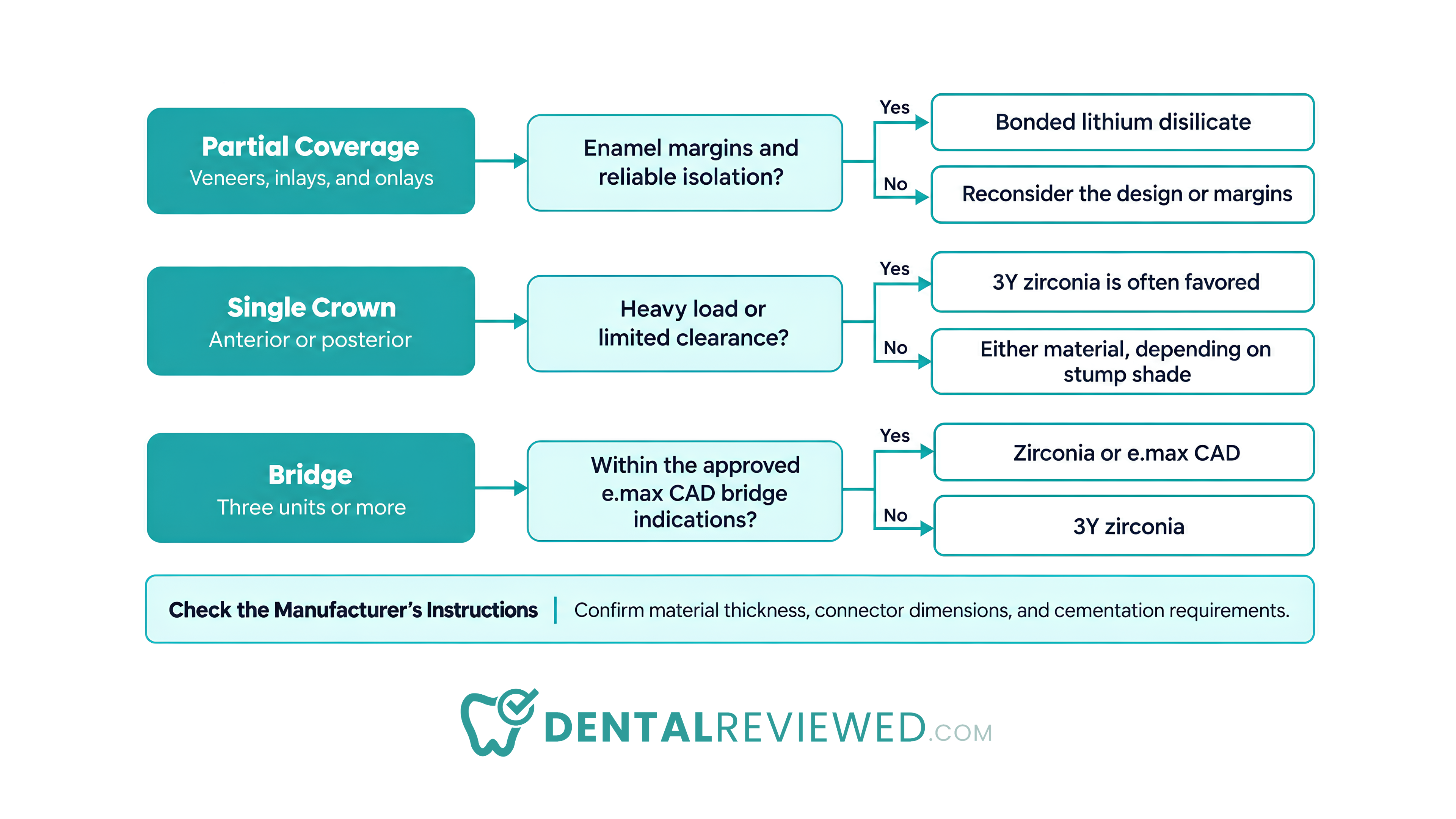
The restoration type chooses the lane. Load, bonding, and approved indications then narrow each lane to a material.
Static Decision Tree Summary
The table below summarizes typical directions. It is an educational framework, not a substitute for clinical examination or product IFUs.
Clinical scenario | Usual direction | Key check before committing |
|---|---|---|
Veneer with good enamel | Lithium disilicate, bonded | Veneer thickness and enamel available for bonding |
Inlay or onlay, enamel margins | Lithium disilicate, bonded | Isolation and cusp coverage design |
Single crown, normal load, visible | Lithium disilicate or 4Y/5Y zirconia | Stump shade and product thickness |
Single crown, posterior, normal load | Either material | Clearance and retention |
Molar crown, heavy load or bruxism | 3Y zirconia frequently considered | Clearance, polish, and opposing dentition |
Crown with compromised retention | Material with reliable adhesive protocol | Bonding feasibility and isolation |
Dark or discolored substrate | Masking-capable material and thickness | Opacity level and cement shade |
Three-unit anterior or premolar bridge | 3Y/4Y zirconia, lithium disilicate only within IFU limits | Connector dimensions and span |
Longer-span or molar bridge | 3Y zirconia | Connector size and approved span |
Case Examples
Each example below takes one patient through the decision steps.
Example: Upper Premolar With a Broken Cusp
A 45-year-old patient breaks the buccal cusp of an upper first premolar. An old amalgam fills most of the remaining tooth. Once it is removed, most margins sit in enamel, and a rubber dam fits well.
What drives the decision:
Only the weakened cusp needs covering, so a full crown would remove healthy tooth for no benefit.
Enamel margins and good isolation make bonding reliable.
Bite forces are normal, so extra strength is not needed.
A bonded lithium disilicate onlay fits this tooth best. It covers the weak cusp, keeps the remaining enamel, and blends in well in a visible area.
Example: Missing Lower First Molar
A 58-year-old with moderate tooth wear has lost a lower first molar. The second premolar and second molar will support a three-unit bridge. Vertical space between the arches is limited.
What drives the decision:
Connectors carry the load in a bridge, and the limited space keeps them small.
A bridge in the molar region falls outside lithium disilicate's approved bridge indications.
A monolithic 3Y zirconia bridge is the safer option here. It tolerates smaller connectors and heavy chewing loads. The choice is settled before appearance is even considered.
Documenting each of these steps in the dental treatment plan helps the whole team and the laboratory follow the same reasoning.
Zirconia vs. Lithium Disilicate for Anterior Crowns
Lithium disilicate is the usual choice for front teeth, often for good reason. But it should not be automatic.
Lithium disilicate often fits when:
The stump is light and healthy.
The patient wants the most lifelike result.
The preparation is short and needs bonding for retention.
High-translucency zirconia often fits when:
The patient has a deep bite or heavy front-tooth function.
Incisal edges have chipped or fractured before.
The preparation is retentive and conventional cement is preferred.
Limited space can also tip the balance toward a stronger zirconia grade.
Example: Dark Upper Front Tooth
A 34-year-old has a dark upper central incisor, root-canal-treated after a childhood injury. The tooth next to it is bright and natural, so any color mismatch will show.
What drives the decision:
A highly translucent crown would let the gray root show through.
The crown needs enough opacity and thickness to hide the dark stump.
Two approaches work well here. One is a masking-level lithium disilicate core, and the other is a more opaque zirconia core. Each is layered with porcelain for a natural surface, and both need enough facial reduction to fit the masking layer.
Internal bleaching before preparation can lighten the stump and make masking easier. Try-in pastes matched to the final cement help confirm the shade before bonding.
Which Is Better for Posterior Crowns and Patients With Bruxism?
Back teeth take the heaviest forces, especially second molars. Here, space and load usually matter more than appearance.
3Y zirconia is often chosen for demanding cases. It handles heavy loads in thinner sections, which helps when space is tight.
Lithium disilicate can still work well on molars. It needs adequate thickness and normal loading. A 2025 overview of lithium disilicate crown outcomes pooled 28 systematic reviews covering about 35,000 crowns. It confirms lithium disilicate as an established crown material.
Zirconia has trade-offs worth remembering:
Short crowns can debond without an adhesive cement.
Root canal access through zirconia is slow and difficult.
Radiographs are harder to read, as zirconia blocks X-rays strongly.
Removing a failed zirconia crown takes longer.
Example: Heavily Restored Second Molar in a Patient Who Grinds
A 52-year-old who grinds at night needs a crown on an upper second molar. The tooth has a large core, short walls, and little space above it. It bites against a natural molar.
What drives the decision:
Heavy grinding forces and tight clearance call for strength in a thin section.
Short walls offer little retention, so the cement must help hold the crown.
Monolithic 3Y zirconia suits this tooth, bonded with an MDP-based adhesive resin cement. Polish the surface after any occlusal adjustment to protect the opposing tooth. A night guard adds further protection against grinding.
Veneers, Onlays, and Bridges: Which Ceramic Fits Each Indication?
Each restoration type relies on something different. Veneers and onlays rely on bonding. Bridges rely on connector strength.
Restoration | What it depends on | Usual choice |
|---|---|---|
Veneers | Bonding to enamel | Lithium disilicate |
Inlays and onlays | Bonding plus cusp coverage | Lithium disilicate |
Occlusal veneers | Bonding in very thin sections | Lithium disilicate, within IFU limits |
Short-span bridges | Connector strength | Zirconia, or lithium disilicate within IFU limits |
Longer bridges | Connector strength | 3Y zirconia |
Veneers and Minimally Invasive Restorations
Veneers succeed or fail on the bond to enamel.
Lithium disilicate has strong long-term evidence, with a 2025 systematic review of ceramic veneers finding about 96.8% survival at 10.4 years.
Long-term evidence for zirconia veneers is still lacking.
Keep preparations in enamel where possible, since exposed dentin weakens the bond.
Inlays, Onlays, and Occlusal Veneers
Partial coverage works best when bonding and design support each other.
Covering weak cusps spreads the load.
Enamel margins give the strongest bond.
If margins sit deep in dentin and isolation is poor, rethink the design first.
Three-Unit and Multi-Unit Bridges
The connector is the weakest point of any all-ceramic bridge. Its size is limited by the available space.
3Y zirconia handles smaller connectors, so it suits more demanding bridges.
Ivoclar allows IPS e.max CAD for restricted three-unit bridges, with set span and connector rules.
Long spans and cantilevers are outside lithium disilicate's safe range.
Preparation Requirements and Cementation Differences
Each product has its own minimum thickness. No single reduction number applies to every crown of either material.
Tooth Reduction and Margin Design
Both materials follow the same basic preparation rules:
Round all internal angles, since sharp corners concentrate stress.
Use a chamfer or rounded shoulder margin, as feather edges tend to chip.
Give the restoration even support, because a thick crown over an uneven core can still fail.
The common "1.5–2 mm reduction" rule for lithium disilicate crowns is not fixed. Ivoclar documents a 1 mm bonded crown option with specific restrictions. Zirconia usually needs less reduction, which helps when space is tight.
Adhesive Bonding vs. Conventional Cementation
The two materials need opposite surface treatments. Mixing them up is a common cause of failure.
Step | Lithium disilicate | Zirconia |
|---|---|---|
Surface treatment | HF acid etch | Alumina air abrasion |
Primer | Silane | MDP-containing primer or cement |
Avoid | Air abrasion, unless the IFU allows it | HF acid, which has no effect |
After try-in | Clean per the manufacturer's protocol | Clean with a zirconia cleaning paste |
Conventional cement possible? | Yes, for some retentive crowns per the IFU | Often, for retentive crowns |
Why clean zirconia after try-in? Saliva leaves phosphates on its surface, and these block the MDP bond. For the full protocol, see our guide to bonding zirconia crowns.
CAD/CAM Workflow, Laboratory Considerations, and Cost
Workflow rarely decides the material, but it can tip a close case.
Workflow step | IPS e.max CAD | Zirconia |
|---|---|---|
Milled in | Pre-crystallized state | Soft, presintered state |
Final step | Crystallization firing | Sintering, with predictable shrinkage |
Same-day option | Yes, with a chairside mill and furnace | Yes, with a speed-sintering furnace |
Our chairside milling guide and overview of dental milling machines cover the equipment side.
Lab skill matters as much as the material. Ask your lab which brands and grades it stocks before promising a result. Learn more about CAD/CAM dentistry and how it improves consistency.
Crown fees depend on location, lab fees, and insurance. Lab costs for the two materials often overlap. See our dental crown cost guide for details.
Bottom Line
Both materials are clinically proven, and neither wins every case.
Choose lithium disilicate when enamel bonding and natural esthetics lead the decision.
Choose 3Y zirconia when loads are high, space is tight, or a bridge connector carries the load.
Consider 4Y or 5Y zirconia for a balance of look and strength, knowing it is weaker than 3Y.
Work through restoration type, load, thickness, esthetics, bonding, and the product IFU in that order. The right material usually becomes clear along the way.
Frequently Asked Questions
Is zirconia stronger than lithium disilicate?
Traditional 3Y zirconia has substantially higher flexural strength and fracture toughness than lithium disilicate. That advantage narrows with translucent grades. 5Y zirconia's reported strength overlaps with lithium disilicate. Laboratory strength also does not directly predict clinical survival, which depends on thickness, design, cementation, and loading.
Is E.max the same as lithium disilicate?
Not exactly. E.max is Ivoclar's brand family. IPS e.max CAD and IPS e.max Press are lithium disilicate products. However, IPS e.max ZirCAD is zirconia. Specify the full product name on lab prescriptions to avoid receiving a different material than intended.
Which looks more natural – zirconia or E.max?
Lithium disilicate generally offers higher translucency and more lifelike depth, especially over light stumps. Translucent 5Y zirconia has closed much of the gap. Over dark or discolored substrates, more opaque materials often look more natural because translucent ceramics let the underlying color show through.
Is zirconia or lithium disilicate better for molar crowns?
Both can work. 3Y zirconia is frequently preferred for second molars, limited clearance, and heavy loading because it tolerates thinner sections. Lithium disilicate performs well on many molars with adequate reduction and normal function. Clearance and load usually decide the case.
Can lithium disilicate crowns be used in patients with bruxism?
They can be used in selected cases, with adequate thickness, good support, and careful occlusal design. A protective night guard is advisable. For severe bruxism, limited clearance, or a history of fractured restorations, many clinicians prefer 3Y zirconia. Check the product IFU, as some list severe parafunction as a limitation.
Does zirconia require less tooth reduction than E.max?
Generally, yes. High-strength zirconia tolerates thinner sections than lithium disilicate. Exact values depend on the product, restoration type, and cementation method. Some lithium disilicate crowns have approved reduced-thickness indications with adhesive cementation. Always confirm minimum thickness in the specific material's instructions for use.