Rating: 4.5/5
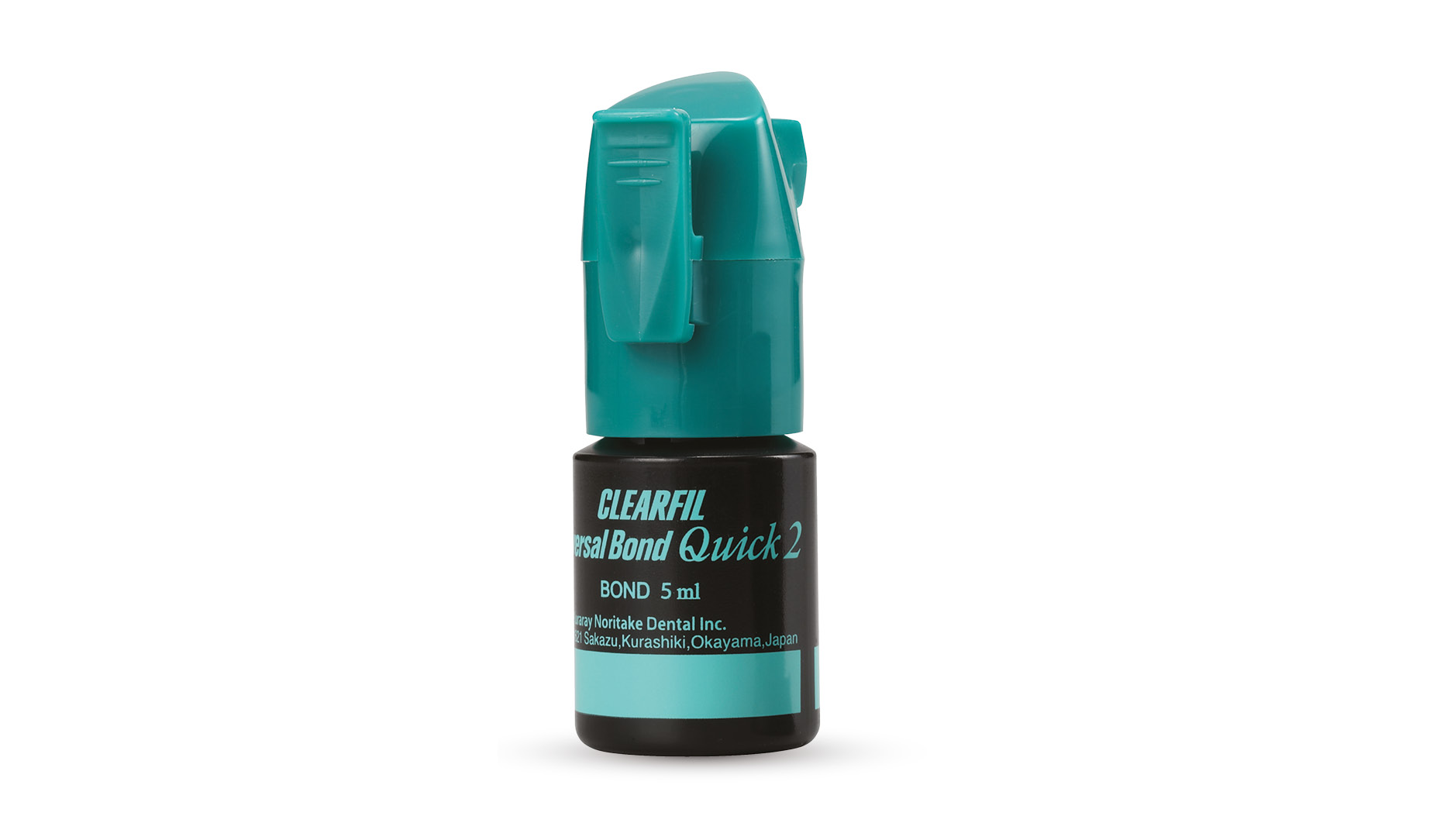
Clearfil Universal Bond Quick 2 Review
Clearfil Universal Bond Quick 2 is Kuraray Noritake's one-bottle universal adhesive, designed to go from brush to curing light with no waiting time. This review examines its...
Reviewed by Mantas Petraitis
Pros
- No waiting time, with roughly 15 to 20 seconds from application to cure
- Thin 3 to 5 µm film that resists pooling at margins and line angles
- Cured film tensile strength of 53.1 MPa in independent testing, above SE Bond 2
- Immediate dentin bond strength statistically equal to SE Bond 2
- Genuine 10-MDP chemistry for tooth, zirconia and nonprecious metal
- Seven indications from one bottle, including posts, cores and cementation
- Touch cure with Kuraray SA cements and DC CORE PLUS, with no activator needed
- Room-temperature storage and a 27-month shelf life
Cons
- Little aged or clinical trial data on Quick 2 itself so far
- The original Quick trailed SE Bond 2 in aged laboratory testing
- Uncut enamel still benefits from separate phosphoric acid etching
- Glass ceramics need a separate silane despite the built-in one
- Unit dose cannot be mixed with DC Activator
- DC Activator is an extra purchase with a 90-second working time
- Contains HEMA and Bis-GMA, so it is unsuitable for methacrylate-allergic patients
- Bottle liquid thickens as ethanol evaporates, so it must be dispensed late and capped promptly
Clearfil Universal Bond Quick 2 is Kuraray Noritake's one-bottle universal adhesive, designed to go from brush to curing light with no waiting time. This review examines its chemistry, clinical protocol, independent bond strength data and limits for restorative dentists deciding whether it belongs in their operatory.
TL;DR
Clearfil Universal Bond Quick 2 drops the waiting step and moves from application to cure in roughly 15 to 20 seconds.
A 2025 Tokushima University study measured dentin bond strength statistically equal to Clearfil SE Bond 2 from a bond layer under 3 µm thick.
Urethane tetramethacrylate raises the cured film's tensile strength to 53.1 MPa, up from 43.8 MPa in the original Quick.
Uncut enamel still bonds better after phosphoric acid, and glass ceramics still need a dedicated silane.
What Clearfil Universal Bond Quick 2 Is
Clearfil Universal Bond Quick 2 is a light-cured, single-component universal adhesive from the company that synthesized the original 10-MDP monomer. Kuraray America introduced it to US dentists at CDA Presents in May 2024, and in Europe it anchors Kuraray's "Universal Excellence" range alongside PANAVIA SA Cement Universal and CLEARFIL MAJESTY ES-2 Universal (Kuraray Noritake).
The full kit pairs the BOND with K-ETCHANT Syringe, a 35% phosphoric acid gel thickened with colloidal silica. Refill bottles and unit doses contain the BOND only. CLEARFIL DC Activator is sold separately and converts the bond to dual cure when it meets another manufacturer's self-cure or dual-cure core material or cement, according to the instructions for use.
Key Specifications
The figures below come from Kuraray's product FAQ and the February 2025 revision of the instructions for use. They are the numbers that shape chairside handling, from how long a dispensed drop stays usable to how long the curing light needs to run.
Property | Clearfil Universal Bond Quick 2 |
|---|---|
Category | One-step universal adhesive, light cure |
Etching modes | Self-etch, selective enamel etch, total etch |
Waiting time | None |
Air drying | Mild air for more than 5 s, until the bond stops moving |
Light curing | 10 s at 800 to 1,400 mW/cm² LED or above 400 mW/cm² halogen, 5 s above 1,500 mW/cm² |
Film thickness | 3 to 5 µm (original Quick: 5 to 10 µm) |
pH | 2.4 |
Solvents | Ethanol and water |
Working time | 7 min under the light-blocking plate, 90 s mixed with DC Activator |
Storage | 2 to 25 °C (36 to 77 °F), no refrigeration needed |
Shelf life | 27 months |
Formats | 5 mL bottle, 3 x 5 mL refill, 50 x 0.1 mL unit dose |
Composition
The instructions for use list Bis-GMA, hydrophilic amide monomers, HEMA, 10-MDP, colloidal silica, urethane tetramethacrylate, ethanol and water as principal ingredients, with camphorquinone and a phosphine oxide photoinitiator, a silane coupling agent and under 0.1% sodium fluoride. HEMA and Bis-GMA mean the product is contraindicated for patients with a documented methacrylate allergy. The built-in silane helps with composite repairs, though Kuraray still recommends a separate silane for glass ceramics.
Advanced Rapid Bond Technology Explained
Kuraray groups the formulation under the name Advanced Rapid Bond Technology. Each of its monomers addresses a separate weakness of one-bottle adhesives, and the trade-offs of the product make more sense once each ingredient's job is clear.
10-MDP Creates The Chemical Bond
10-MDP binds ionically to calcium in hydroxyapatite and forms stable calcium salts that layer at the interface and resist hydrolysis. A mild self-etch adhesive at pH 2.4 leaves hydroxyapatite around the collagen fibrils, which gives MDP something to bond to in dentin. The same phosphate group bonds to metal oxides, so MDP also primes sandblasted zirconia and nonprecious alloys.
The Amide Monomer Removes The Waiting Time
The hydrophilic amide monomer arrived with the first Clearfil Universal Bond Quick. Before curing it wets moist dentin very quickly, and after polymerization it becomes hydrophobic and water resistant. HEMA-based adhesives usually need an active application or a dwell period so monomers can infiltrate the smear layer and demineralized dentin. Tokushima researchers studied this mechanism directly in a 2019 Dental Materials Journal paper on adding an amide monomer to a one-step self-etch adhesive.
The KU Leuven group tested the clinical consequence. In a 2020 Clinical Oral Investigations study, the original Quick applied with no waiting performed as well after six months of water storage as the same adhesive left on dentin for 20 seconds. The longer application raised only the one-week numbers.
Urethane Tetramethacrylate Strengthens The Film
The new ingredient in Quick 2 is a proprietary urethane tetramethacrylate, abbreviated UTM by Kuraray and UTMA in the literature. It carries four methacrylate groups on a urethane backbone, which raises crosslink density in the cured adhesive. Kuraray has not published its structural formula.
Nano-Fillers And A New Dispersion Method
Kuraray changed how the colloidal silica is dispersed, which lowered viscosity without removing the filler. A 2025 Journal of Adhesive Dentistry study from Tokushima University and the University of Bologna tested experimental versions of Quick 2 with one ingredient removed at a time. Taking out the nano-filler cut dentin microtensile bond strength from 78.2 MPa to 55.4 MPa. Taking out the UTMA left bond strength statistically unchanged, while tensile strength of the cured adhesive fell from 53.1 MPa to 34.9 MPa and water sorption rose.
In practical terms the filler supports the hybrid layer and the UTMA reinforces the adhesive film above it. Both matter for a product that leaves such a thin coat.
Why Film Thickness Cuts Both Ways
A thin, even film keeps bond from pooling at the gingival floor of a Class II box and at internal line angles. On indirect work it lets an inlay or onlay seat without a thick resin layer under it. A very thin film is more exposed to oxygen inhibition, which is the concern a KU Leuven team examined when it asked whether universal adhesive film thickness affects dentin bonding. The Tokushima authors noted that a second coat or an extra hydrophobic layer can offset this risk in demanding cases.
What Changed From The Original Clearfil Universal Bond Quick
Quick 2 keeps the MDP and amide chemistry and the no-wait protocol of its predecessor. Kuraray lists four upgrades in its product FAQ: a stronger bonding layer, lower viscosity, room-temperature storage and broader use with other manufacturers' cements.
Feature | Universal Bond Quick | Universal Bond Quick 2 |
|---|---|---|
Functional monomers | MDP and amide | MDP, amide and urethane tetramethacrylate |
Waiting time | None | None |
Film thickness (manufacturer) | 5 to 10 µm | 3 to 5 µm |
Bond layer on flat dentin (JAD 2025) | 4.64 µm | 2.95 µm |
Cured film tensile strength (JAD 2025) | 43.8 MPa | 53.1 MPa |
Dentin µTBS at 24 h (JAD 2025) | 72.7 MPa | 78.2 MPa (not significantly different) |
Room-temperature storage | Not listed as a feature | 2 to 25 °C |
The independent data shows almost no change in immediate dentin bond strength between the generations. The improvement sits in the film itself, which is thinner, stronger once cured and slightly less water absorbent. Those properties influence marginal integrity and aging behavior more than a 24-hour bond test can show.
Clinicians switching from the original need no new technique. The rubbing application, air drying and 10-second cure stay the same.
Indications And Etching Modes
The instructions for use list seven indications, which covers nearly every adhesive step in a general restorative practice.
Direct restorations using light-cured composite resin
Sealing a prepared cavity or abutment tooth before indirect restorations
Treatment of exposed root surfaces
Treatment of hypersensitive teeth
Intraoral repair of fractured restorations
Post cementation and core build-ups
Cementation of indirect restorations
Choosing An Etching Strategy
All three etching modes use an identical bond application, so the choice comes down to the substrate. With a pH of 2.4 the bond conditions dentin well, but it etches uncut enamel far less deeply than phosphoric acid does.
Selective enamel etching suits most direct restorations, with K-ETCHANT on enamel for 10 seconds before the bond
Self-etch mode is required for hypersensitivity treatment and suits cervical and abfraction lesions where dentin dominates
Total etch, with 10 seconds of acid on enamel and dentin, helps on sclerotic dentin but raises the risk of postoperative sensitivity on vital teeth
Non-carious cervical lesions are a good example. An abfraction lesion often presents with sclerotic dentin and a thin enamel margin, so a light phosphoric acid touch on the enamel bevel combined with self-etch dentin bonding uses the strengths of a mild MDP adhesive.
Substrate Pretreatment
Indirect substrates each need a specific pretreatment before the bond goes on. The table follows the manufacturer's recommendations when the restorative material's own instructions give no alternative.
Substrate | Pretreatment before or with the bond |
|---|---|
Zirconia and metal oxides | Alumina blast at 30 to 50 µm, ultrasonic clean, no further step with Kuraray SA cements |
Nonprecious metals | Alumina blast, then bond |
Precious metals | Metal primer such as ALLOY PRIMER before the bond |
Lithium disilicate and porcelain | Hydrofluoric acid etch and a dedicated silane such as CLEARFIL CERAMIC PRIMER PLUS |
Composite repair | Roughen, clean with phosphoric acid for 5 s, then bond |
Glass fiber posts | Phosphoric acid for 5 s, never sandblast |
Lithium disilicate restorations such as an e.max crown are the main exception to the one-bottle promise. Kuraray recommends a separate silane for optimal results even though the bond already contains one, which matches the wider evidence on silane-containing universal adhesives.
Cement And Core Compatibility
Quick 2 touch-cures with CLEARFIL DC CORE PLUS, PANAVIA SA Cement Universal and PANAVIA SA LUTING Multi, so none of these needs the activator. With PANAVIA SA Cement Universal the bond does not have to be light-cured before seating a crown. With DC CORE PLUS it must be light-cured, because polymerization shrinkage stress at the root dentin interface is higher. PANAVIA Veneer LC cures together with the uncured bond through the veneer.
Other manufacturers' self-adhesive resin cements, such as the dual-mode cement in our Kulzer iCEM Universal Plus review, call for the bottle version mixed one to one with DC Activator for some steps. The unit dose cannot be mixed with the activator because of its container design, which limits it to direct work and Kuraray's own cements and cores.
Clinical Protocol Step By Step
The direct protocol below follows the February 2025 instructions for use, with clinical notes added where technique most often goes wrong. Bonding time from brush to cure runs roughly 15 to 20 seconds.
Direct Composite Restoration
A posterior Class II composite is the most common use case and shows where each step earns its place.
Isolate the tooth, ideally with a rubber dam, and avoid ferric sulfate hemostatics because they impair adhesion and can stain margins
Remove infected dentin, rinse and dry without desiccating, and cover any near or actual exposure with hard-setting calcium hydroxide
Etch enamel for 10 seconds with K-ETCHANT, then rinse and dry, or skip this step for self-etch mode
Dispense the bond just before use under the light-blocking plate, or snap the unit dose cap while holding it upright
Rub the bond over every cavity wall with the applicator, with the operating light turned away
Dry with mild air for more than 5 seconds until the film no longer moves, using suction to catch spatter
Light-cure for 10 seconds, or 5 seconds with an LED above 1,500 mW/cm²
Place, cure, finish and polish the composite as usual
A dental dam does more for this adhesive than for most, because the fast protocol leaves no waiting period during which contamination might be noticed. Light output matters too. The instructions specify a 400 to 515 nm emission range with a peak between 450 and 480 nm, and a curing light that has drifted below its rated output will undercure a 3 µm film quickly. Our reviews of the VALO Grand and the Kerr Demi Plus cover output consistency and lens size for posterior access.
Flowable liners pair well with the thin film. Highly filled injectables such as the one in our GC G-aenial Universal Injectable review work as a first increment over Quick 2 in deep boxes.
Immediate Dentin Sealing And Hypersensitivity
Sealing freshly cut dentin before an impression protects the pulp and improves the later bond to an indirect restoration. Apply and cure Quick 2 as above, optionally add a thin layer of flowable composite, and wipe the oxygen-inhibited layer with an alcohol-moistened pellet. If a resin provisional will touch the sealed surface, use a separating medium.
For dentin sensitivity on exposed roots from receding gums, the instructions call for self-etch mode only, followed by removal of the oxygen-inhibited layer. Recording the sealed surfaces and the planned indirect phase in the patient's dental treatment plan keeps the sequence clear for the appointment that follows.
Posts And Cores
Post cementation after root canal treatment is the most technique-sensitive indication because the canal is deep and difficult to dry. With DC CORE PLUS, apply the bond to the post and canal walls with a rubbing motion, dry with mild air, wick out excess with a paper point and light-cure before placing the core. With another brand's dual-cure core, the bottle version is mixed with DC Activator and the mixture is light-cured, because the working time shortens sharply without the light.
Indirect Cementation
With PANAVIA SA Cement Universal, the bond goes on the prepared tooth with a rubbing motion and is air dried until it stops moving. Crowns and bridges can then be seated without curing the bond. Inlays and onlays need the bond light-cured before seating. During tack curing, hold the restoration in place, because the bond accelerates the cement and excess firms up faster than many clinicians expect.
Technique Errors To Avoid
Most failures with any one-step adhesive trace back to the same few handling mistakes. These are the ones the Quick 2 protocol leaves the least room for.
Under-drying, which leaves water and ethanol at the interface, so the stopping point is the moment the film stops moving
Leaving the bottle uncapped, which thickens the liquid and makes a thin, even coat harder to achieve
Using the unit dose with DC Activator or with another brand's dual-cure materials
Skipping phosphoric acid on uncut enamel in esthetic or high-stress restorations
What The Research Shows
Independent laboratory data supports Kuraray's main claims for immediate bonding, and aged or clinical data on Quick 2 itself is still limited. The older literature on the original Quick gives useful context for long-term behavior.
Independent Laboratory Data
The key study is Matsuki and colleagues, from Tokushima University with Lorenzo Breschi of the University of Bologna. The team bonded composite to mid-coronal dentin from human molars with five teeth per group and tested after 24 hours. The experimental variants were prepared in collaboration with Kuraray, which readers should weigh.
Measure | Quick 2 | Original Quick | SE Bond 2 |
|---|---|---|---|
Dentin µTBS (MPa) | 78.2 | 72.7 | 82.8 |
Bond layer thickness (µm) | 2.95 | 4.64 | 23.24 |
Cured film tensile strength (MPa) | 53.1 | 43.8 | 35.7 |
Water sorption (µg/mm³) | 40.7 | 46.4 | 42.9 |
Quick 2 was statistically equivalent to Clearfil SE Bond 2 for dentin bond strength from a layer about one-eighth as thick. Its cured film was the strongest of the commercial products tested and absorbed the least water. The authors flag the main limitation themselves, since all testing was immediate, with no thermocycling or long water storage.
Evidence From The Predecessor
The original Quick shares its core chemistry with Quick 2, so its aging data indicates the starting point the new formula had to improve on. In the 2020 KU Leuven study, the original Quick bonded significantly less well than SE Bond 2, which kept the highest bond strength after six months. A 2019 Journal of Adhesive Dentistry study from the same group placed the original Quick in the middle of the group in etch-and-rinse mode, behind Prime&Bond active, and lower in self-etch mode. An extra hydrophobic bonding layer did not improve it.
Quick 2's stronger and less water-absorbent film targets that aging weakness. Aged and clinical trials will show whether it succeeds.
Manufacturer Data
Kuraray reports notched-edge shear bond strength under ISO 29022 on bovine teeth in self-etch and total-etch modes, with comparisons against the original Quick, Adhese Universal and Scotchbond Universal Plus. It also reports higher shear bond strength when Quick 2 is applied under three competing self-adhesive cements than when those cements are used alone. These results come from Kuraray's own testing and from Japanese conference presentations, so they support the independent findings without replacing them.
Postoperative Sensitivity
No published clinical trial has measured postoperative sensitivity with Quick 2 specifically. Its mild pH and fast dentin sealing favor a low rate, and self-etch mode leaves the smear plugs partly intact. With universal adhesives, sensitivity tracks technique more closely than brand, especially total etching of vital dentin and incomplete drying.
How It Compares With Other Universal Adhesives
Speed is Quick 2's clearest advantage over the field. Most competing universal adhesives instruct an active application period before air drying, while Quick 2 goes straight from brush to air.
On bond strength, Quick 2 sits in the top tier of immediate laboratory data. Prime&Bond active from Dentsply Sirona outperformed the original Quick in the 2019 Leuven study, and that comparison has not yet been repeated with Quick 2. GC G-Premio Bond is HEMA-free, which matters for the small group of patients and staff with methacrylate sensitivity. Two-step self-etch systems such as Clearfil SE Bond 2 still hold the strongest long-term dentin evidence of any adhesive category.
Quick 2 makes the most sense in high-volume general practice, in pediatric and special-needs care where isolation is short-lived, and in practices already using Kuraray's cements and cores. Large, deep, dentin-heavy restorations and HEMA-sensitive patients point toward other choices. More options in the category appear in our dental materials reviews, and the bonding glossary entry covers the patient-facing side of the procedure.
Bottom Line
Clearfil Universal Bond Quick 2 pairs the fastest protocol among mainstream universal adhesives with immediate dentin bond strength that matched Clearfil SE Bond 2 in the 2025 Tokushima study. The bond goes on with a rubbing motion and is ready for the curing light as soon as it stops moving under mild air.
Its upgrade over the original Quick lives in the adhesive film. Thickness on flat dentin fell to 2.95 µm while the cured layer's tensile strength rose to 53.1 MPa, and water sorption dropped slightly. Margins and the cement space under indirect restorations benefit most, since pooled or weak adhesive at those sites tends to fail first.
Reliable results still depend on technique. Uncut enamel bonds better after 10 seconds of phosphoric acid, and lithium disilicate needs its own silane before the bond. Practices cementing with other brands should stock the bottle version with DC Activator, because the unit dose cannot be mixed with it.
Aged and clinical data on Quick 2 itself has not been published yet, and the original Quick trailed SE Bond 2 after six months of water storage in the KU Leuven study. For a practice placing many direct composites and sealing dentin before indirect work, Quick 2 is a sound adhesive to standardize on. Deep, dentin-heavy restorations where longevity outweighs chair time still make a case for keeping a two-step self-etch system in the cabinet.
Verdict
<p>Clearfil Universal Bond Quick 2 earns its place as the everyday adhesive in a general practice.</p><p>Its strongest argument is the protocol. The clinician rubs it in, dries until the film stops moving and cures for 10 seconds, with no timed scrub to cut short when a patient gags or the dam starts to leak. The thinner film shows most on indirect work, where an inlay or onlay seats without a pooled bond line holding it high.</p><p>The chemistry holds up under scrutiny. MDP and the amide monomer carry years of clinical use in Kuraray's earlier adhesives, and the new urethane tetramethacrylate produced the strongest cured film among the commercial adhesives in the 2025 Tokushima study, where immediate dentin bond strength also matched Clearfil SE Bond 2.</p><p>Two limits hold the score below 5. The independent data is immediate rather than aged, and the original Quick trailed SE Bond 2 after six months of water storage. Selective enamel etching and thorough drying remain essential parts of a reliable protocol.</p><p>For direct composites, immediate dentin sealing and cementation with Kuraray's cements, Quick 2 is a strong buy. Deep, dentin-heavy restorations where longevity outweighs chair time still justify keeping a two-step self-etch system in the cabinet.</p>
Frequently Asked Questions
Is there really no waiting time with Clearfil Universal Bond Quick 2?
Yes. The bond is rubbed onto the surface and air dried immediately for more than 5 seconds until it stops moving, then light-cured. Research on the original Quick found that a 20-second application did not improve aged bond strength.
How long should Clearfil Universal Bond Quick 2 be light-cured?
Cure for 10 seconds with an LED of 800 to 1,400 mW/cm² or a halogen light above 400 mW/cm². An LED above 1,500 mW/cm² needs 5 seconds. The light must emit between 400 and 515 nm.
What is the difference between Clearfil Universal Bond Quick and Quick 2?
Quick 2 adds a urethane tetramethacrylate monomer and a new filler dispersion method. It forms a 3 to 5 µm film instead of 5 to 10 µm, has lower viscosity and a stronger cured layer, stores at room temperature and works more widely with other brands' cements. The technique is unchanged.
Which etching mode works best?
Selective enamel etching with 10 seconds of phosphoric acid suits most direct restorations. Self-etch mode is required for hypersensitivity treatment, and total etch can help on sclerotic dentin.
Can it bond to zirconia without a separate primer?
Yes. The MDP bonds chemically to zirconia after alumina blasting and ultrasonic cleaning. With Kuraray's self-adhesive cements no further step is needed, and with other brands' self-adhesive cements the bottle version is mixed with DC Activator and light-cured.
Does lithium disilicate need a separate silane?
Kuraray recommends one. Etch with hydrofluoric acid, then apply a dedicated silane such as CLEARFIL CERAMIC PRIMER PLUS for optimal results.
When is CLEARFIL DC Activator required?
It is needed when the bottle version is used with another manufacturer's dual-cure or self-cure core material, and when pretreating restorations cemented with another brand's self-adhesive cement. Kuraray's DC CORE PLUS, SA cements and PANAVIA Veneer LC do not need it.
Does the bond need curing before a crown is cemented?
Not with PANAVIA SA Cement Universal, which touch-cures it. It should be light-cured before seating inlays and onlays, before core build-up with DC CORE PLUS and before cementing with other brands' self-adhesive cements.
How should it be stored?
Store it at 2 to 25 °C (36 to 77 °F) away from sunlight and heat. Refrigerated stock should sit at room temperature for more than 15 minutes before use. Shelf life is 27 months.
How long does a dispensed drop stay usable?
Up to 7 minutes under the light-blocking plate. Mixed with DC Activator, the working time drops to 90 seconds.
Is Clearfil Universal Bond Quick 2 HEMA-free?
No. It contains HEMA and Bis-GMA and is contraindicated for patients with a known methacrylate allergy.
Does it release fluoride?
Yes. It contains under 0.1% sodium fluoride, and the instructions note a theoretical fluorosis risk in children under 6.
Does it cause postoperative sensitivity?
No clinical trial on Quick 2 specifically has been published. Its mild pH and fast sealing favor low sensitivity, which stays lowest when vital dentin is not etched unnecessarily and the bond is dried thoroughly.