Rating: 4.2/5
Kulzer iCEM Universal Plus Review
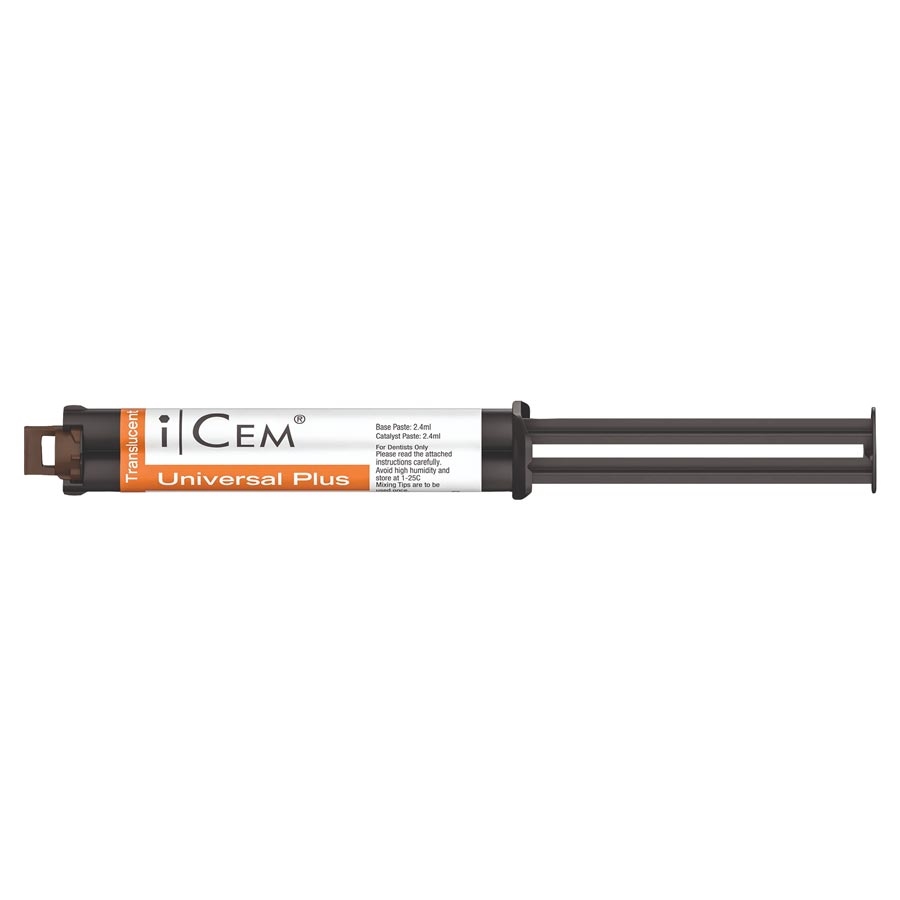
Kulzer iCEM Universal Plus is a dual-cure resin cement that runs in two modes from one syringe. The FDA cleared it on December 19, 2025, and Kulzer presented it to US dentists at...
Reviewed by Rachel Thompson
Pros
- Two modes from one cement, self-adhesive for retentive preps and adhesive with primer for demanding cases
- Broad substrate range including zirconia, lithium disilicate, hybrid ceramics, composite and metal
- No separate silane bottle, since the primer carries an acidic silane
- Dual cure with touch-cure support for deep and opaque areas
- Moisture-reactive initiator that starts bonding before light curing
- Cleared for implant abutments and dental core bonding
- Automix syringe and endo tips for consistent mixing and direct canal injection
- Four shades, including Opaque for masking dark substrates
- Radiopaque, so excess cement shows on bitewings
- FDA 510(k) cleared and stocked by major US dealers
Cons
- No independent long-term clinical studies on this formulation yet
- Self-adhesive mode bonds weakly to uncut enamel, so veneers and onlays need the primer
- No matched try-in pastes found in US catalogs
- Automix tip waste raises the cost of single units
- Color stability under thin veneers is unproven
- Primer is sold separately from the cement refills
- Teams switching from another system need time to learn its gel-phase timing
Kulzer iCEM Universal Plus is a dual-cure resin cement that runs in two modes from one syringe. The FDA cleared it on December 19, 2025, and Kulzer presented it to US dentists at the Chicago Midwinter Meeting in February 2026. This review covers indications, protocols, independent evidence, and where the primer changes the outcome.
TL;DR
Kulzer iCEM Universal Plus seats crowns, bridges, inlays, onlays, and veneers on natural teeth or implant abutments in self-adhesive or adhesive mode.
The optional primer carries an acidic silane, so lithium disilicate and other glass ceramics need no separate silane bottle.
Self-adhesive mode suits retentive zirconia and metal crowns, while onlays and veneers need the primer plus selective enamel etching.
Independent long-term data on this specific cement are not published yet, so start with the trial kit on routine posterior crowns.
What Is Kulzer iCEM Universal Plus
Kulzer describes iCEM Universal Plus as a resin-based adhesive luting material for indirect restorations, prosthetic devices, and dental cores. It ships as an automix cement with a separate primer bottle, and the primer is what turns a quick self-adhesive protocol into a full adhesive one.
The product sits in a crowded category. Most US practices already stock at least one universal cement, so the useful question is where this system fits in the drawer and which cases it should take over.
Regulatory Status And Launch
The regulatory record is short and clean. The FDA cleared the cement under 510(k) K254063 on December 19, 2025, two days after Kulzer, LLC of South Bend, Indiana filed it.
It is a Class II dental cement under 21 CFR 872.3275, product code EMA. The FDA indications for use cover bonding of composite, all-ceramic, and metal restorations. Bonding of crowns, inlays, onlays, bridges, and veneers to cavities, abutment teeth, or implant abutments; and dental core bonding. The NIH device database holds separate records for each shade and for the primer, all published in January 2026. US dealer listings give Japan as the country of origin.
What Comes In The System
Everything is sold as separate refills, plus a trial kit that bundles cement, primer, and tips. The table below lists the US catalog numbers.
Component | Kulzer # | Contents |
|---|---|---|
Cement refill, Opaque | 66101217 | 1 x 9 g automix syringe |
Cement refill, Translucent | 66101218 | 1 x 9 g automix syringe |
Cement refill, White | 66101219 | 1 x 9 g automix syringe |
Cement refill, Yellow | 66101220 | 1 x 9 g automix syringe |
Value pack, Opaque | 66101221 | 2 x 9 g syringes |
Value pack, Translucent | 66101222 | 2 x 9 g syringes |
iCEM Universal Plus Primer | 66101224 | 1 x 5 ml bottle |
Mixing tips | 66101216 | 20 tips |
Endo tips | 66101223 | 20 tips |
Trial kit | 66101226 | Cement, primer and tips |
How The Chemistry Works
A handful of design choices explain how one cement covers so many substrates. The descriptions below come from Kulzer's product literature as published through its US dealers, and none of them has been tested independently yet.
The cement uses a double initiator system with hydrophobic and hydrophilic components. The hydrophilic side reacts with the moisture layer on dentin, so adhesion to the tooth begins before the curing light comes near it. That matters on a molar where the light guide cannot reach the distal margin at a useful angle.
The primer carries an acidic functional monomer that Kulzer calls high-PA technology, designed to penetrate enamel and dentin quickly. It also carries an acidic silane coupling agent. Kulzer claims this silane resists bond degradation better than systems built on more alkaline silanes, which is the reason no separate silane step appears in the protocol for glass ceramics.
Henry Schein's catalog copy adds a touch-cure effect, meaning the primer speeds polymerization of the cement where the two meet, even in deep areas the light misses. GC uses a similar idea in its G-CEM ONE Adhesive Enhancing Primer. For a clinician, the practical effect is a faster, more complete set at the bottom of a post space or under a 2 mm zirconia crown.
Indications And Compatible Restorative Materials
Kulzer lists zirconia, lithium disilicate, glass and hybrid ceramics, alumina, and resin-based materials as compatible, and US catalogs add metals. The table pairs each material with the mode most clinicians would choose. It reflects general adhesive principles rather than a Kulzer chart, so the IFU in the box has the final word on each pretreatment.
Restoration material | Typical cases | Suggested mode | Key pretreatment |
|---|---|---|---|
Zirconia (3Y to 5Y) | Posterior crowns, bridges | Self-adhesive if retentive, adhesive if short | Alumina air abrasion at low pressure, clean, primer |
Lithium disilicate | Anterior and premolar crowns, onlays | Adhesive | Hydrofluoric acid etch, rinse, dry, primer |
Feldspathic ceramic | Veneers, inlays | Adhesive | Hydrofluoric acid etch, primer |
Hybrid ceramic and resin nano-ceramic | CAD/CAM crowns and onlays | Adhesive | Light air abrasion, clean, primer |
Indirect composite | Inlays, onlays | Adhesive | Air abrasion, primer |
Metal and PFM | Crowns, bridges, posts | Self-adhesive if retentive | Air abrasion, primer for extra retention |
Material choice still drives most of the outcome. Our comparison of zirconia vs lithium disilicate walks through when each ceramic makes sense, and that decision should come before the cement decision.
Partial-coverage restorations deserve a specific warning. In a randomized split-mouth trial at the University of Regensburg, CAD/CAM partial ceramic crowns luted with a self-adhesive cement had significantly lower survival at 39 months than those placed with a universal adhesive and a conventional resin cement. The cement in that trial was RelyX Unicem 2, not iCEM, but the mechanism applies to self-adhesive chemistry in general. Onlays and overlays belong in adhesive mode.
Self-Adhesive Mode Vs Adhesive Mode
The same syringe works in both modes, and the clinician decides at the chair. Kulzer recommends self-adhesive mode for retentive preparations with lower adhesive demands and adhesive mode with the primer for less retentive cases that need maximum bond strength.
That flexibility is the reason to buy the system. It also creates a quiet risk, since a cement that works without primer tempts a busy team to skip the primer on the short molar prep where it matters most.
When Self-Adhesive Mode Is Enough
Self-adhesive mode fits full-coverage crowns that hold themselves on. Picture a zirconia first molar crown with 4 mm or more of axial wall height and a total taper close to the textbook 10 to 20 degrees. Mechanical retention does most of the work there, and the cement's job is to seal the margin and stay put.
The predecessor product gives some useful context. In a 2013 randomized trial at the University of Pennsylvania, 88 crowns on vital teeth were cemented with either the original Kulzer iCem self-adhesive cement or a resin-modified glass ionomer. The self-adhesive group reported significantly less sensitivity at day 1, and ice-spray scores stayed lower at every recall through 3 weeks. iCEM Universal Plus is a newer formulation, so those numbers cannot transfer directly. They do suggest the family's self-adhesive chemistry is gentle on vital dentin.
Uncut enamel is the weak point. Self-adhesive cements etch enamel poorly, and an Operative Dentistry study found that a 10-second phosphoric acid etch of enamel raised self-adhesive cement bond strength more than shorter or longer etch times. Keep the acid off dentin when using self-adhesive mode, because etched dentin removes the buffering that keeps these cements kind to the pulp.
When The Primer Earns Its Place
Adhesive mode is the right call whenever retention comes from the bond rather than the prep. That includes short clinical crowns on worn molars, over-tapered preps, lithium disilicate and feldspathic restorations, onlays, and veneers with enamel margins.
In adhesive mode, the primer goes on the tooth and, depending on the IFU, on the intaglio surface. Its acidic monomer conditions enamel and dentin, its acidic silane conditions glass ceramics and composite, and its touch-cure effect firms up the cement at the interface. Practices that already rely on a separate universal bond, such as the ones covered in our All-Bond Universal review, will notice one less bottle on the tray.
A simple rule keeps the team consistent. If the prep is not clearly retentive, or the restoration is a glass ceramic, the primer goes on.
Step-By-Step Clinical Workflow for iCEM Universal Plus
A predictable cementation with iCEM Universal Plus follows the same backbone as any resin cement. The protocol below reflects general adhesive practice and the published evidence, and the exact primer, tack-cure, and final-cure times must come from the IFU in the box.
Before Cementation Day
Good cementation starts at the provisional visit. Eugenol in temporary cement can leave residue in dentin and weaken resin bonds, and a meta-analysis of micro-bond studies found a measurable drop in bond strength after eugenol contact. A eugenol-free temporary cement, or a provisional such as the one in our J-Temp temporary resin review, avoids that problem.
A second systematic review found that temporary cementation lowered bond strength when dentin was sealed late, and that the removal method mattered. Gentle provisional removal helps, and a tool like the one in our TempOff review reduces the urge to lever on fragile margins.
Note the planned cementation mode in the patient's dental treatment plan. When the assistant sees "adhesive mode, primer, selective enamel etch" in the plan, the tray arrives set up correctly, and nobody has to stop mid-appointment.
Restoration Pretreatment
The intaglio surface decides as much of the bond as the tooth does. Each material gets its own preparation before the primer.
Zirconia needs air abrasion with 30 to 50 micron alumina at about 1 to 2 bar if the lab has not done it. Our guide on how to bond zirconia crowns explains why hydrofluoric acid does nothing useful on zirconia, and our explainer on air abrasion in dentistry covers the equipment side.
Try-in contaminates zirconia with saliva, and saliva phosphates bind tightly to the surface. A 2022 systematic review and meta-analysis in the Journal of Adhesive Dentistry found alumina air abrasion to be the most effective cleaning method, with a cleaning paste as a reasonable second choice. Alcohol and phosphoric acid performed no better than water. Many clinicians still wipe zirconia with alcohol after try-in, and the data say that habit does not restore the bond.
Lithium disilicate gets a 20-second etch with 4.5 to 5 percent hydrofluoric acid, a thorough rinse, and a dry surface before primer. Feldspathic porcelain needs a longer etch, usually 60 to 90 seconds.
Tooth Preparation And Isolation
Isolation decides whether the cement ever reaches its potential. A rubber dam is the gold standard, and our Nic Tone rubber dam review covers a practical option. Where a dam is not realistic, the system in our DryShield isolation review, combined with cord or a paste such as the one in our 3M Astringent Retraction Paste review, keeps crevicular fluid off the margins.
Clean the prep with pumice and rinse. In self-adhesive mode, dry gently and leave dentin slightly moist, since the hydrophilic initiator needs that moisture. In adhesive mode, apply the primer to enamel and dentin, agitate, and air-thin as the IFU directs. Selective enamel etching before the primer strengthens enamel margins on veneers and onlays.
Seating, Tack Cure And Cleanup
Gel-phase cleanup is the skill that separates a clean margin from a radiographic surprise. The steps below take about two minutes on a single unit.
Bleed the automix syringe once before attaching a new mixing tip, so both pastes flow evenly.
Load a thin, even layer into the restoration, or inject into a post space with an endo tip from the canal floor upward.
Seat with firm, steady pressure and hold the restoration in place.
Tack cure each surface for a few seconds, until the excess turns to a rubbery gel.
Remove the gel with a scaler or explorer and floss interproximally before the cement hardens fully.
Apply glycerin gel over the margins to block the oxygen-inhibited layer.
Light-cure every surface for the full time in the IFU.
Check occlusion and take a bitewing to confirm no radiopaque cement remains below the margin.
Curing light output matters more here than most teams assume. A light like the one in our VALO Grand curing light review delivers consistent irradiance, and our guide on when to upgrade dental LED curing lights explains how to test an older unit with a radiometer.
Curing Under Opaque Restorations
Light reaching the cement drops fast under thick or opaque ceramics, and dual-cure chemistry exists to cover that shortfall. The evidence shows how much the shortfall can be.
A 2023 laboratory study found that zirconia thicker than 1.5 mm inhibited polymerization of a dual-cured resin cement through light attenuation, leaving more residual monomer and triggering inflammatory responses in cell culture. An earlier study from KU Leuven found that standard yttria-stabilized zirconia still let enough light through to cure the tested cements, while a ceria-based zirconia was too opaque and required self-curing chemistry.
Two practical lessons follow. Cure each surface longer than feels necessary under full-contour zirconia molars, and treat the chemical cure as insurance rather than the plan. The primer's touch-cure effect gives iCEM Universal Plus an edge in adhesive mode here, though no independent degree-of-conversion data on this cement were available at the time of writing.
Shades, Handling And Esthetics
iCEM Universal Plus is built for low technique sensitivity, and the handling reflects that. The automix syringe removes hand-mixing errors and keeps the base-to-catalyst ratio constant.
Each automix tip wastes some material. On single units, that waste adds up, so the real cost per restoration depends on how carefully the team dispenses.
Shade Selection
Four shades cover most clinical needs. The guidance below is general, so a quick check against the actual restoration is worth the time on anterior teeth.
Translucent suits most crowns and lets the restoration's own shade show through.
White brightens high-value anterior restorations and bleached dentitions.
Yellow warms a restoration that reads slightly gray or cool.
Opaque masks discolored abutments, metal posts and cores, or titanium abutments under thin ceramic.
No matching try-in pastes appeared in the US catalogs reviewed for this article. For high-esthetic anterior work, ask a Kulzer representative or use a water-soluble try-in gel from existing stock.
Color Stability On Thin Restorations
Color stability is an open question for veneers. An in vitro study comparing amine-free light-cure and dual-cure resin cements found that light-cure versions held their color best after long-term aging.
Kulzer has not published the initiator details or color data for iCEM Universal Plus. Until it does, a light-cure veneer cement remains the safer pick for thin, highly translucent veneers, and iCEM Universal Plus fits best under restorations thicker than about 1 mm.
Implant Abutments And The Excess Cement Problem
iCEM Universal Plus is cleared for bonding restorations to implant abutments, which makes it a candidate for cement-retained implant crowns. That indication comes with a responsibility, because residual cement around implants is a recognized cause of peri-implant disease.
In a prospective endoscopic study, excess cement was found in 34 of 42 implants showing signs of peri-implant disease, and signs of disease cleared in 74 percent of test implants after the cement was removed. The study tested no iCEM product, but it applies to any cement placed around an implant.
Custom abutments with margins no more than 1 mm below the tissue make cleanup far easier. A minimal amount of cement, ideally loaded with an extraoral copy-abutment technique that squeezes out the excess before seating, keeps most of it out of the sulcus to begin with, and a radiograph after seating catches what the explorer missed, since the radiopaque cement shows clearly on film.
How iCEM Universal Plus Compares With Other Universal Resin Cements
Every major manufacturer now sells a self-adhesive cement with an optional booster. The table compares system concepts rather than lab numbers, since no independent head-to-head data on iCEM Universal Plus exist yet.
Cement system | Maker | Booster for adhesive mode | Separate silane for glass ceramics |
|---|---|---|---|
iCEM Universal Plus | Kulzer | iCEM Universal Plus Primer with acidic silane | No |
RelyX Universal | Solventum (3M) | Scotchbond Universal Plus adhesive | No, with that adhesive |
Panavia SA Cement Universal | Kuraray Noritake | Optional universal bond | No, silane is in the cement |
G-CEM ONE | GC | Adhesive Enhancing Primer | Yes, a ceramic primer is recommended |
RelyX is the cement most US practices will compare against. Our review of RelyX resin cement covers its handling, and our Scotchbond Universal Plus review explains the adhesive it pairs with. For compromised preps that need the strongest adhesive protocol available, our Panavia V5 review describes a dedicated adhesive cement that still outranks most universal systems on evidence.
iCEM Universal Plus stands out for its single primer covering tooth and restoration, along with touch-cure behavior that helps under opaque crowns. The established brands lead on independent bond-strength data and published clinical survival, and some offer matched try-in pastes. Kulzer's own earlier iCEM Self Adhesive was a self-adhesive cement only, so the Plus version adds an adhesive upgrade path that the original never had.
Price And Value
US list prices in October 2026 put a 9 g syringe refill at about $174, a two-syringe value pack at about $318, and the trial kit at about $292. Dealer promotions regularly take 20 percent off those figures, and Kulzer's second-quarter 2026 offer gave a free refill with two trial kits.
Cement is a small line item on a crown that costs patients $900 to $2,500 in the US, according to our breakdown of dental crown cost. A remake caused by debonding or residual cement costs far more than any price difference between cements, so reliability should outweigh a few dollars per syringe. The full range of cements and bonds we have covered sits in our restorative materials reviews.
Bottom Line
Kulzer iCEM Universal Plus suits practices that want one resin cement and one primer to cover most indirect work, from zirconia crowns to lithium disilicate onlays and implant abutments. Its main value is consolidation. A drawer that once held a self-adhesive cement, an adhesive cement, a silane bottle, and a zirconia primer can shrink to a syringe and a 5 ml bottle, and assistants only need to learn one material's handling.
The two modes need a firm rule behind them. Self-adhesive mode works well on retentive full-coverage crowns, especially zirconia and metal, where the prep does most of the holding. Glass ceramics, onlays, veneers, and short or over-tapered preps belong in adhesive mode with the primer, and the Regensburg data on partial ceramic crowns show what happens when that line is ignored.
Evidence is the honest limit. The FDA cleared the cement in December 2025, and the earlier iCem formulation performed well on postoperative sensitivity in a 2013 randomized trial, but no independent clinical study of iCEM Universal Plus itself has been published. Color stability under thin veneers and long-term bond durability on lithium disilicate are the two questions worth watching as data appear.
A sensible rollout starts with the trial kit on a run of retentive posterior crowns in self-adhesive mode. Once the team has the gel-phase timing down, the next step is adhesive mode on lithium disilicate crowns and short preps, while a light-cure cement stays on hand for thin anterior veneers.
Verdict
<p>Kulzer iCEM Universal Plus earns a place as an everyday universal resin cement for general practice. Its two-mode design matches how cementation decisions are made at the chair. A retentive zirconia molar crown goes in self-adhesive, with little sensitivity risk and few steps. A short premolar prep or a lithium disilicate onlay gets the primer, which brings a full adhesive protocol without a separate silane.</p><p>The dual cure with touch-cure support carries the most clinical weight, because under-cured cement beneath an opaque zirconia crown is one of the quiet failures of resin cementation. Radiopacity matters almost as much on implant cases, where excess cement nobody sees can sit in the sulcus until the tissue reacts. The cleared implant-abutment indication adds value for restorative practices that place cement-retained implant crowns.</p><p>The reservation is evidence. FDA clearance and manufacturer claims are not the same as years of independent data, and RelyX Universal and the Panavia line still lead on published clinical performance. For crowns, bridges, onlays, and implant abutments, adopting iCEM Universal Plus with the trial kit is a reasonable move. For thin anterior veneers, a light-cure veneer cement stays the better choice until color-stability data appear.</p>
Frequently Asked Questions
What is Kulzer iCEM Universal Plus used for?
It is a dual-cure resin cement for permanent cementation of indirect restorations. The FDA-cleared indications cover composite, all-ceramic and metal restorations, crowns, inlays, onlays, bridges and veneers on teeth or implant abutments, and dental core bonding.
Is iCEM Universal Plus a self-adhesive cement?
Yes. It works as a self-adhesive resin cement without any primer. Adding iCEM Universal Plus Primer turns it into an adhesive cementation system with higher bond strength.
Do I need a separate silane for e.max with iCEM Universal Plus?
According to Kulzer's product literature, the primer contains an acidic silane coupling agent, so a separate silane step is not required. Lithium disilicate still needs a hydrofluoric acid etch first, and the IFU confirms the exact sequence.
Can iCEM Universal Plus be used for zirconia crowns?
Yes. Zirconia is one of the core substrates. Retentive preps usually do well in self-adhesive mode once the intaglio is air-abraded and cleaned of saliva, and short preps or bridges benefit from the primer.
How do you clean up excess iCEM Universal Plus cement?
Tack cure each surface briefly until the excess turns to a gel, remove it with a scaler or explorer, floss interproximally, then complete the final light cure. The IFU gives the recommended tack-cure time.
What shades does iCEM Universal Plus come in?
Four shades are available: Translucent, White, Yellow and Opaque. Each comes in a 9 g automix syringe.
Is iCEM Universal Plus FDA cleared?
Yes. It received 510(k) clearance K254063 on December 19, 2025, as a Class II dental cement.
Can iCEM Universal Plus be used on implant abutments?
Yes. Bonding prosthetic devices to implant abutments is part of the cleared indications. Remove all excess carefully and confirm with a radiograph, since residual cement around implants is linked to peri-implant disease.
Does iCEM Universal Plus cause postoperative sensitivity?
No sensitivity data have been published for this formulation. A 2013 randomized trial of Kulzer's earlier iCem self-adhesive cement found less sensitivity than a resin-modified glass ionomer, and lingering pain under a new crown has several possible causes, covered in our guide to tooth pain under a crown. A desensitizer such as the one in our Glu/Sense review can help on reactive dentin in adhesive mode.