Rating: 4.1/5
Kettenbach Visalys Bulk Fill And Bulk Flow Review
Visalys Bulk Fill and Visalys Bulk Flow are Kettenbach's matched pair of one-shade composites, each cleared for 4 mm increments. This review covers composition, chairside...
Reviewed by Agnes Markovic
Pros
- Matched flowable and packable materials in one universal shade
- Single 4 mm increments for both materials
- Bulk Fill packs and carves like a conventional posterior composite
- Bulk Flow holds its shape in deep boxes without slumping
- No capping layer required for Bulk Flow, according to Kettenbach
- Low reported water sorption of 9.8 µg/mm³ for Bulk Fill
- Radiopacity above enamel for both materials
- Good masking of stained dentin from about 3 mm
- Bis-GMA-free matrix for patients concerned about BPA
- Bulk Flow tolerates warming up to 68 °C
- Capsules with a metal cannula for easier distal access
Cons
- No clinical trials on either material yet
- Kettenbach has not published mechanical data for Bulk Flow
- Much of the early praise comes from sponsored evaluation programs
- A single shade struggles on very dark teeth and thin anterior layers
- No rapid-cure option to match 3-second systems
- No fluoride release or bioactive claim
- Availability through local distributors varies by market
Visalys Bulk Fill and Visalys Bulk Flow are Kettenbach's matched pair of one-shade composites, each cleared for 4 mm increments. This review covers composition, chairside handling, clinical technique, and the evidence behind them, then closes with a verdict for practices weighing a switch from incremental layering on posterior teeth.
TL;DR
Visalys Bulk Fill and Bulk Flow cure in single 4 mm increments and share one universal shade.
Bulk Fill packs and carves like a conventional posterior composite, and Bulk Flow adapts to deep boxes without slumping.
Kettenbach reports water sorption of 9.8 µg/mm³ for Bulk Fill, far below the ISO 4049 ceiling of 40 µg/mm³.
No clinical trial has tested Visalys yet, so buyers rely on FDA bench data and strong evidence from the wider bulk-fill category.
What Are Visalys Bulk Fill And Visalys Bulk Flow
Kettenbach is a German manufacturer based in Eschenburg, better known to most US dentists for Panasil and Identium impression materials than for direct composites. The Visalys name first appeared on temporary and core materials. The bulk pair is the company's first serious entry into everyday posterior restorative work.
Both products were cleared together by the FDA on March 14, 2025, under 510(k) K250267, with Kulzer's Venus Bulk Flow ONE named as the predicate device. Bulk Fill is the packable, sculptable material meant for the final occlusal surface. Bulk Flow is a thixotropic flowable that Kettenbach positions for bases, deep proximal boxes, cervical lesions, and small preparations, and the company states on its Visalys Bulk Flow product page that it needs no capping layer even at full depth.
The two were designed as one system. They share the same filler size range, the same resin chemistry, and the same universal shade, so a flowable base and a packable top layer bond and blend without the visible line that sometimes appears when two brands are mixed in one restoration.
Visalys Bulk Fill And Bulk Flow Technical Specifications
The figures below come from Kettenbach's FDA filing unless marked as manufacturer data. Values marked as not published were absent from every source reviewed for this article.
Property | Visalys Bulk Fill | Visalys Bulk Flow |
|---|---|---|
Type | Packable nano-hybrid composite | Flowable, thixotropic nano-hybrid composite |
Shade | One universal shade | One universal shade |
Maximum increment | 4 mm | 4 mm |
Inorganic filler by weight | About 82% | About 72% |
Inorganic filler by volume | About 61% | About 47% |
Filler particle size | 0.01–5 µm | 0.01–5 µm |
Radiopaque filler | Ytterbium fluoride | Ytterbium fluoride |
Radiopacity | 2.5 mm Al | 2.0 mm Al |
Resin matrix | Aliphatic dimethacrylates | Aliphatic dimethacrylates |
Volume shrinkage | 2.2% (manufacturer data) | Not published |
Flexural strength | 129 MPa (manufacturer data) | Not published |
Water sorption | 9.8 µg/mm³ (manufacturer data) | Not published |
Capping layer | Not applicable | Not required, per Kettenbach |
Packaging | 4 g syringe, 15 × 0.25 g caps | 2 g syringe, 15 × 0.25 g caps |
FDA status | 510(k) K250267, Class II | 510(k) K250267, Class II |
Filler, radiopacity, and resin data are taken from the 510(k) summary. The shrinkage, flexural strength, and water sorption values for Bulk Fill are published by Kettenbach and have not yet been reproduced by an independent laboratory. One sponsored evaluation described Bulk Flow as 80% filled by volume, which conflicts with the 47% stated in the FDA filing. The regulatory figure is the one to use when comparing materials.
Inside The Formulation
Visalys owes its handling and its 4 mm cure mainly to its resin chemistry and its filler package, with the optical design tuned around both. Each choice has consequences at the chair that are worth understanding before the first syringe is opened.
An Aliphatic Dimethacrylate Matrix
The resin is where Visalys departs most from older posterior composites, and it explains the headline water sorption figure.
Kettenbach describes the polymer base of both materials only as aliphatic dimethacrylates, and UK distributors market Bulk Flow as free of Bis-GMA. Bis-GMA carries hydroxyl groups that attract water, and it is the monomer most often blamed for water uptake in conventional composites. A less hydrophilic matrix is the most plausible reason Kettenbach can report water sorption of 9.8 µg/mm³ for Bulk Fill.
Water sorption matters more in practice than its place on a data sheet suggests. A composite that absorbs water swells slightly, loses surface hardness, and picks up stain from coffee and red wine. Over the years, hydrolysis at the filler and resin interface weakens the margin. A low-sorption matrix should age better on each of those counts, although the benefit has to be shown clinically before anyone can claim it for Visalys specifically.
The formulation also helps with patient conversations. Patients who have read about BPA, or about microplastics and dental materials, now ask what is going into their teeth, and a Bis-GMA-free resin gives the clinician a specific answer. The full formulation is not public, and the FDA still files Visalys under the tooth shade resin regulation, which names Bis-GMA as a typical ingredient of the category. The claim should be presented with that context.
Filler Loading And Radiopacity
Both materials use an identical filler package. The amount of it is what separates a packable composite from a flowable one.
The inorganic filler ranges from 10 nm nanoparticles to 5 µm particles, with ytterbium fluoride as the radiopacifier. Bulk Fill carries about 82% filler by weight and Bulk Flow about 72%. That second figure is high for a flowable. Kulzer's Venus Bulk Flow ONE, the predicate in the FDA filing, is listed at roughly 41% filler by volume against 47% for Visalys Bulk Flow. Higher filler loading generally raises elastic modulus and lowers polymerization shrinkage, which is the technical basis for Kettenbach's position that Bulk Flow can serve as the occlusal surface on its own.
Radiopacity is 2.5 mm aluminum for Bulk Fill and 2.0 mm for Bulk Flow. One millimeter of enamel equals about 2 mm of aluminum, so both materials read brighter than enamel on a bitewing. Overhangs, voids at the gingival floor, and recurrent caries are easier to spot at recall as a result.
One Shade And A 4 mm Cure
Every bulk-fill composite has to balance two optical demands that pull in opposite directions.
The material needs enough translucency for curing light to reach the floor of a 4 mm increment, yet enough opacity to avoid the gray, glassy look that early bulk fills were known for. A literature review from KU Leuven identified increased translucency as the main reason bulk fills cure deeper than conventional composites.
Kettenbach's answer is a single universal shade with a chameleon effect and strong fluorescence. The company also claims Bulk Flow masks well from about 3 mm of thickness, which matters when covering dark dentin under an old amalgam. Single-shade materials borrow color from the surrounding tooth, so the match tends to be best in Class I and II restorations bounded by enamel walls. Very dark teeth and thin anterior layers remain difficult for any one-shade system, a limitation also discussed in the Omnichroma review.
How Visalys Handles Chairside
Handling decides whether a bulk material stays on the tray or ends up at the back of the supply drawer. Both Visalys materials behave in ways that will feel familiar to anyone who places posterior composites every day.
Bulk Fill Packs Like A Conventional Posterior Composite
Plenty of products sold as sculptable bulk fills slump or string once they leave the compule, and Bulk Fill is a welcome exception.
It condenses against the cavity walls with light pressure and holds a carved cusp slope until it is cured. Evaluator feedback published in 2026 rated its stability as its strongest handling attribute. Low stickiness pays off in the deep distal box of a second molar, where a tacky composite tends to lift away from the matrix as the instrument comes out. Bulk Fill can be pressed into the line angles and left there, occlusal anatomy is carved in one pass, and finishing takes less time because there is less excess to remove.
Bulk Flow Stays Where It Is Placed
Thixotropy is the property that sets Bulk Flow apart from most bulk flowables on the market.
The material thins under the pressure of extrusion, then thickens again as soon as it stops moving. In a proximal box, it wets the gingival floor and climbs into the axiogingival line angle without running through a poorly sealed matrix band. Evaluators who used it in Class I and Class V preparations described a flowable that could be shaped with an instrument after placement, which is unusual for the category. Clinicians who prefer a self-leveling liner may find it slightly stiff, and the finer of the two syringe tips works better in narrow fissures.
Delivery Systems And Composite Warming
Kettenbach offers both materials in syringes and in single-use capsules, and the choice affects access as much as cost.
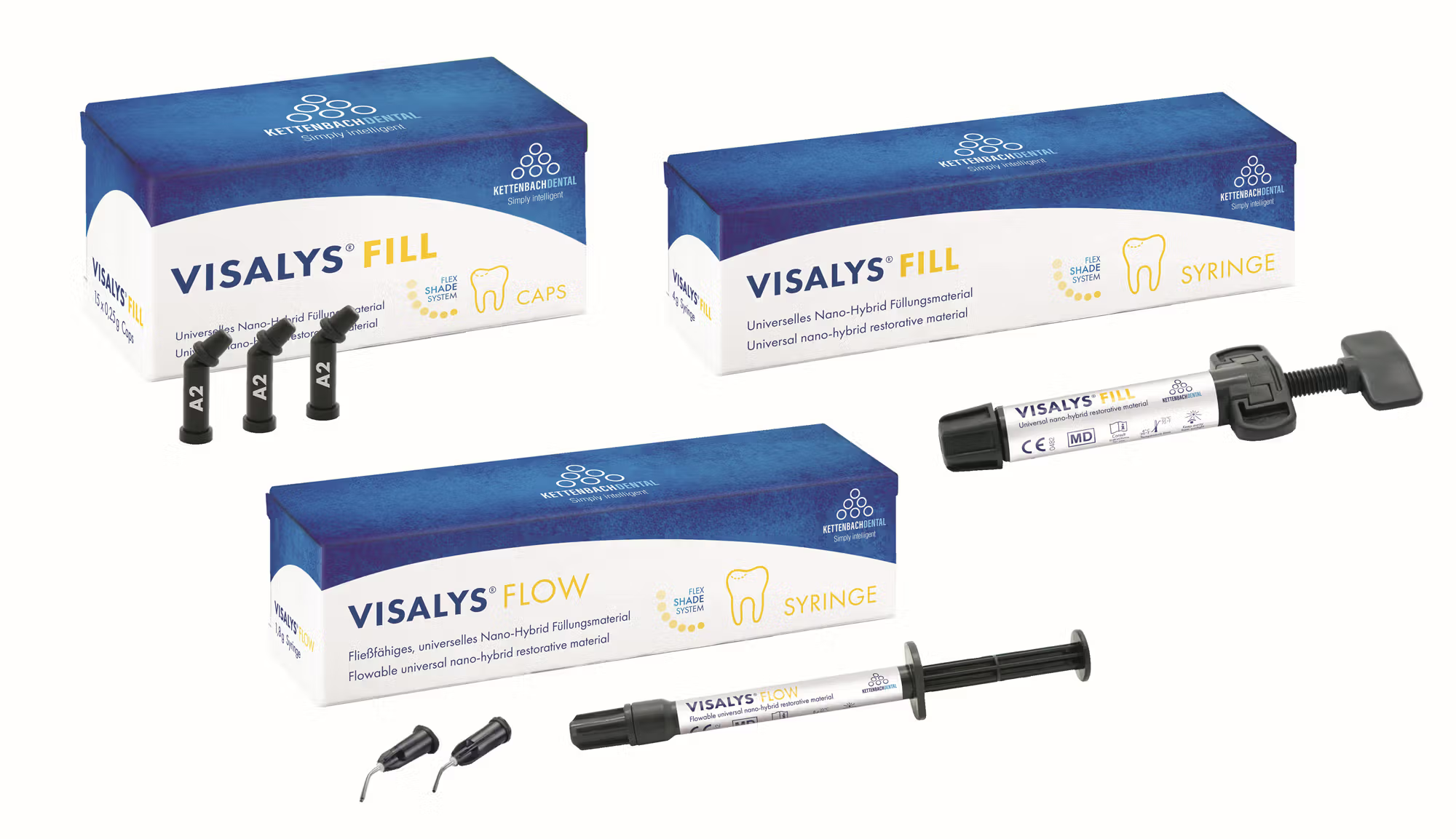
Bulk Fill comes in a 4 g screw syringe and 0.25 g caps. Bulk Flow comes in a 2 g syringe with 0.9 mm and 1.2 mm tips, and in 0.25 g capsules with a fine metal cannula that fits standard composite dispensers. The capsule cannula reaches the distal of a second molar more easily than a syringe tip, and it avoids the cross-contamination concern of a shared syringe.
Published handling data indicate that Bulk Flow can be warmed to 68 °C (154 °F) for up to one hour without loss of material properties. Warming lowers viscosity for tight boxes, and the material still stops moving once it meets cooler tooth structure. Practices that already use a composite warmer can add Bulk Flow to that routine without changing technique.
Step-By-Step Technique For A Class II Restoration
The protocol below follows standard bulk-fill practice adapted to the two Visalys materials. It assumes a moderate to deep Class II in a molar, with good isolation, a sectional matrix, and a light-cured adhesive. Curing times should always be taken from Kettenbach's current instructions for use.
Isolation and matrix choice drive most of the outcome. A rubber dam or an isolation system such as DryShield keeps the field dry, and sectional matrix rings or a system like the Palodent V3 give a tight, anatomic contact. Kettenbach does not restrict the adhesive brand, so universal and etch-and-rinse systems such as All-Bond Universal, Scotchbond Universal Plus, Adhese 2, or Kerr OptiBond all fit the workflow.
Isolate the tooth, remove caries, and finish enamel margins with a fine diamond or hand instrument.
Place a sectional matrix, wedge it firmly, and confirm the band seals at the gingival margin before any adhesive goes on.
Selectively etch enamel for 15 seconds, rinse, apply the adhesive according to its own instructions, and light-cure it.
Inject 1–2 mm of Bulk Flow into the proximal box, keeping the tip buried in the material to avoid bubbles, then cure.
Place a single increment of Bulk Fill of up to 4 mm, condense it against the walls, and carve the occlusal anatomy before curing.
Cure from the occlusal with the light guide as close to the surface as possible, then cure buccal and lingual aspects after matrix removal.
Finish with fine diamonds or carbide burs, polish with a rubber point sequence, and check occlusion in centric and excursions.
Light curing is the most common reason a bulk fill underperforms. A light that reads well at the tip can lose a large share of its irradiance at the floor of a deep box several millimeters away. Monthly radiometer checks and timely replacement of weak units do more for bulk-fill success than any material choice. The guide on when to upgrade LED curing lights lists the warning signs, and wide-lens units such as the VALO Grand or the Kerr Demi Plus make full coverage of a molar easier.
Magnification helps at two points in this sequence: sealing the matrix and inspecting the margin after removal. Good dental loupes make a flash of composite at the gingival margin obvious before it becomes a plaque trap. Check the bite carefully before the patient leaves. A Class II that sits slightly high is one of the most common reasons for a return visit, as covered in the piece on teeth that feel too high after a filling.
Clinical Cases And Patient Response
Published clinical cases with Visalys are still limited, but the ones available show how the two materials behave outside the laboratory. The reviewing clinician's own cases and patient comments are recorded at the end of this section.
Deep Class II in a lower molar. In one evaluator case, Bulk Flow was placed as a 1–2 mm base in the proximal box, and the rest of the preparation was completed with a single increment of Bulk Fill. The flowable adapted to the gingival floor without pooling against the band, and the packable layer was carved cleanly. The radiopacity of both materials keeps that proximal margin visible on every future bitewing.
Cracked upper premolar with a failing amalgam. In a published emergency case, a large disto-occlusal amalgam was removed from a maxillary premolar diagnosed with reversible pulpitis and a visible mesial crack. Bulk Flow went over a universal adhesive as the first layer of a composite build-up. It masked the dark, amalgam-stained dentin in one layer, and the tooth was taken out of occlusion to stabilize the crack before an endodontic consultation. Teeth like this one, discussed further in the guide to cracked tooth syndrome, need a material that seals and hides discoloration while the final dental treatment plan is still being decided.
Class I restorations on lower premolars. Two small occlusal lesions on adjacent mandibular premolars were restored with Bulk Flow alone. The material filled both preparations without running onto the cusp inclines, and the restorations blended with the surrounding enamel at the immediate postoperative check.
Patients rarely notice which material is used, but they do notice time in the chair. Single-increment placement trims several minutes from a two-surface molar restoration. That matters most for children and for adults with limited opening, and it is one reason bulk fills are popular in the cases described in the guide to pediatric cavity filling.
Visalys Bulk Fill Vs Bulk Flow: Choosing The Right Material
Most practices will stock both materials, since Kettenbach built them to work together. The table below shows where each one fits best according to the cleared indications and the material properties.
Clinical situation | Better choice | Reason |
|---|---|---|
Large Class I or II under heavy occlusion | Bulk Fill over a Bulk Flow base | Higher filler load and carvable anatomy |
Deep proximal box | Bulk Flow, 1–2 mm | Flows into line angles at the gingival floor |
Small occlusal Class I | Bulk Flow alone | Fast placement with no capping layer needed |
Class V and cervical lesions | Bulk Flow | Suits shallow, wide lesions with little slump |
Deep margin elevation | Bulk Flow | Adapts closely against a tight matrix |
Core build-up | Either | Both carry the indication |
Liners and undercut block-out | Bulk Flow only | Only Bulk Flow carries these indications |
Restorations in primary molars | Either | Both are indicated for deciduous teeth |
Patients with bruxism deserve a conservative approach. Kettenbach allows flowable-only placement, but a Bulk Fill occlusal layer is the safer choice where wear facets and fractured cusps point to heavy loading. In very large cavities with lost cusps, a fiber-reinforced base such as EverX under Bulk Fill is worth considering.
How Visalys Compares With Other Bulk Fill Composites
Visalys competes on its matched two-viscosity system and its low reported water sorption. Older brands still lead on curing speed and on years of clinical follow-up.
Product | Viscosity | Shading | Capping layer | Key difference |
|---|---|---|---|---|
Visalys Bulk Fill and Bulk Flow | Packable and flowable | One shade | Not needed | Matched pair in one shade and one chemistry |
Kulzer Venus Bulk Flow ONE | Flowable | One shade | Not needed | FDA predicate with lower filler volume |
Coltene BRILLIANT Bulk Fill Flow | Flowable | Adaptive multi-shade | Not needed | 20-second cure for 4 mm increments |
3M Filtek One Bulk Fill | Packable | Several shades | Not needed | Long clinical track record |
Ivoclar Tetric PowerFill and PowerFlow | Packable and flowable | Limited shades | Not needed | 3-second cure with a matching light |
Dentsply Sirona SDR flow+ | Flowable | Several shades | Required | Extensive randomized trial data |
The closest rival in concept is Coltene's flowable, covered in detail in the BRILLIANT Bulk Fill Flow review. Both skip the capping layer and rely on adaptive shading. Visalys stands out for pairing its flowable with a packable material in identical shade and chemistry.
Clinicians who prefer layering a conventional universal composite over a bulk flowable base have strong alternatives. GrandioSO 4U offers 4 mm increments in five shades, and Ceram.x Spectra ST uses spherical filler with a simplified shade system. For a broader view of how material families differ, the guide on how to choose dental materials is a useful starting point.
What The Evidence Supports
No published clinical trial has evaluated Visalys Bulk Fill or Bulk Flow yet. Kettenbach's FDA clearance rested on bench testing, so any judgment on longevity has to draw on the wider bulk-fill literature.
The 510(k) summary lists depth of cure, flexural strength, elastic modulus, water sorption and solubility, color stability, radiopacity, volume shrinkage and shear bond strength, tested under ISO 4049, ISO 17304 and ISO 29022. Biocompatibility was assessed under ISO 10993. The filing states that no clinical data were submitted.
The category evidence is reassuring. A systematic review and meta-analysis published in 2018 found no significant difference in failure rates between bulk-fill and conventional composites over 12 to 72 months, for both flowable and full-body bulk fills. A 5-year randomized controlled trial from the University of Copenhagen of a flowable bulk-fill base under a nano-hybrid cap reported an annual failure rate of 1.1% against 1.3% for conventional 2 mm layering. A separate double-blind 5-year trial found bulk placement comparable to incremental layering, with better marginal results when an etch-and-rinse adhesive was used.
A more recent meta-analysis reached similar conclusions for permanent posterior teeth. A companion review in primary teeth found survival comparable to conventional composites over follow-ups of up to 12 months.
The literature cannot yet confirm whether Kettenbach's low water sorption figure translates into cleaner margins or more stable color in the mouth. That question needs independent laboratory comparison and at least two to three years of clinical follow-up on Visalys itself.
Bottom Line
Visalys Bulk Fill and Bulk Flow are a well-designed answer to the most common posterior job in general practice, the moderate to deep Class II. The flowable seals the gingival floor of the box and the packable material builds the occlusal surface over it, with one universal shade across both. That pairing removes most shade decisions and a good share of the increments from a routine restoration.
The system suits practices with a high volume of posterior composites and teams that want a smaller composite inventory. Pediatric patients and adults with limited opening gain the most from single-increment placement, since every minute saved in the chair counts for them. Clinicians who already warm composite will find Bulk Flow fits that habit without any change in technique.
Clinicians who want several years of clinical data before switching materials have good reason to wait. Kettenbach's FDA clearance rested on bench testing, and the long-term bulk-fill trials published so far involve other brands. Practices built around 3-second curing with a matching high-irradiance light will find no speed advantage here either.
The lowest-risk way to judge the system is the combined intro pack and a month of Class I and II cases, placed with a curing light that has been checked on a radiometer. Restorations under heavy occlusion, especially in patients who grind, should keep a Bulk Fill occlusal layer during that trial, even where the label allows the flowable alone.
Verdict
<p>Visalys Bulk Fill and Bulk Flow form one of the most coherent bulk systems launched in recent years. The flowable behaves with unusual discipline for its category. It wets the gingival floor of a deep box and then stays put, which removes the most common source of voids in Class II work. The packable layer handles like a conventional posterior composite with low stickiness, so carving anatomy in a single 4 mm increment is easy to control.</p><p>The single shade blends well in posterior teeth and masks stained dentin better than many universal shades. The reported water sorption of 9.8 µg/mm³ is the figure most worth watching over time, since it bears directly on margin staining and color stability.</p><p>The main reservation concerns evidence. There are no clinical trials yet, and Kettenbach should publish full mechanical data for Bulk Flow. Large, high-load Class II restorations still deserve a Bulk Fill occlusal layer instead of the flowable alone.</p><p>For practices that want fewer shades on the shelf and shorter posterior appointments, Visalys merits a trial on the next month of Class I and II cases.</p>
Frequently Asked Questions
What is the difference between Visalys Bulk Fill and Visalys Bulk Flow?
Bulk Fill is a packable nano-hybrid composite with about 82% filler by weight, intended for the definitive occlusal surface. Bulk Flow is a flowable, thixotropic nano-hybrid with about 72% filler by weight, intended for bases, deep boxes, small preparations and cervical lesions. Both cure to 4 mm and share one universal shade.
Does Visalys Bulk Flow need a capping layer?
Kettenbach states that it does not, and the FDA summary confirms capping is not necessary. Many clinicians still cap large, high-load Class II restorations with Bulk Fill as a conservative choice.
What is the depth of cure of Visalys Bulk Fill?
Both materials are cleared for increments of up to 4 mm. Reaching that depth depends on the curing light, so output should be verified with a radiometer and exposure times taken from Kettenbach's instructions for use.
How many shades does Visalys come in?
One. Bulk Fill and Bulk Flow each use a single universal shade with a chameleon effect and fluorescence, designed to blend with natural tooth color in posterior restorations.
Is Visalys Bulk Fill free of Bis-GMA?
Kettenbach describes the resin of both materials as aliphatic dimethacrylates, and Bulk Flow is marketed as Bis-GMA free. Clinicians should check the safety data sheet for their market if this is a deciding factor for a patient.
Which adhesive works with Visalys?
Visalys requires a separate light-cured dentin and enamel adhesive. Kettenbach does not restrict the brand, so most universal and etch-and-rinse systems are suitable. Compatibility should be confirmed in the instructions for use.
Can Visalys Bulk Flow be warmed?
Yes. Published handling data indicate both the syringe and the capsule can be warmed to 68 °C (154 °F) for up to one hour without loss of material properties.
Is Visalys suitable for deep margin elevation?
Yes. Cavity floor elevation is a cleared indication for both materials. Bulk Flow is usually easier to adapt against a tight matrix in the proximal box.
Can Visalys be used in children?
Yes. Restorations in deciduous teeth are a cleared indication for both materials, and the shorter placement time helps with young patients.
Is Visalys FDA cleared?
Yes. Both materials were cleared together under 510(k) K250267 on March 14, 2025, as Class II tooth shade resin materials.
Does a bulk fill change what patients pay for a filling?
Fees are usually set by procedure code and surface count, so the material rarely changes the patient's bill. The guide to how much a filling costs breaks down typical US fees by material and region.