Rating: 4.3/5
Ceram.x Spectra ST By Dentsply Sirona Review
Ceram.x Spectra ST is Dentsply Sirona's universal composite built on SphereTEC spherical filler technology. This review covers how the material behaves chairside, how five CLOUD...
Reviewed by Mantas Petraitis
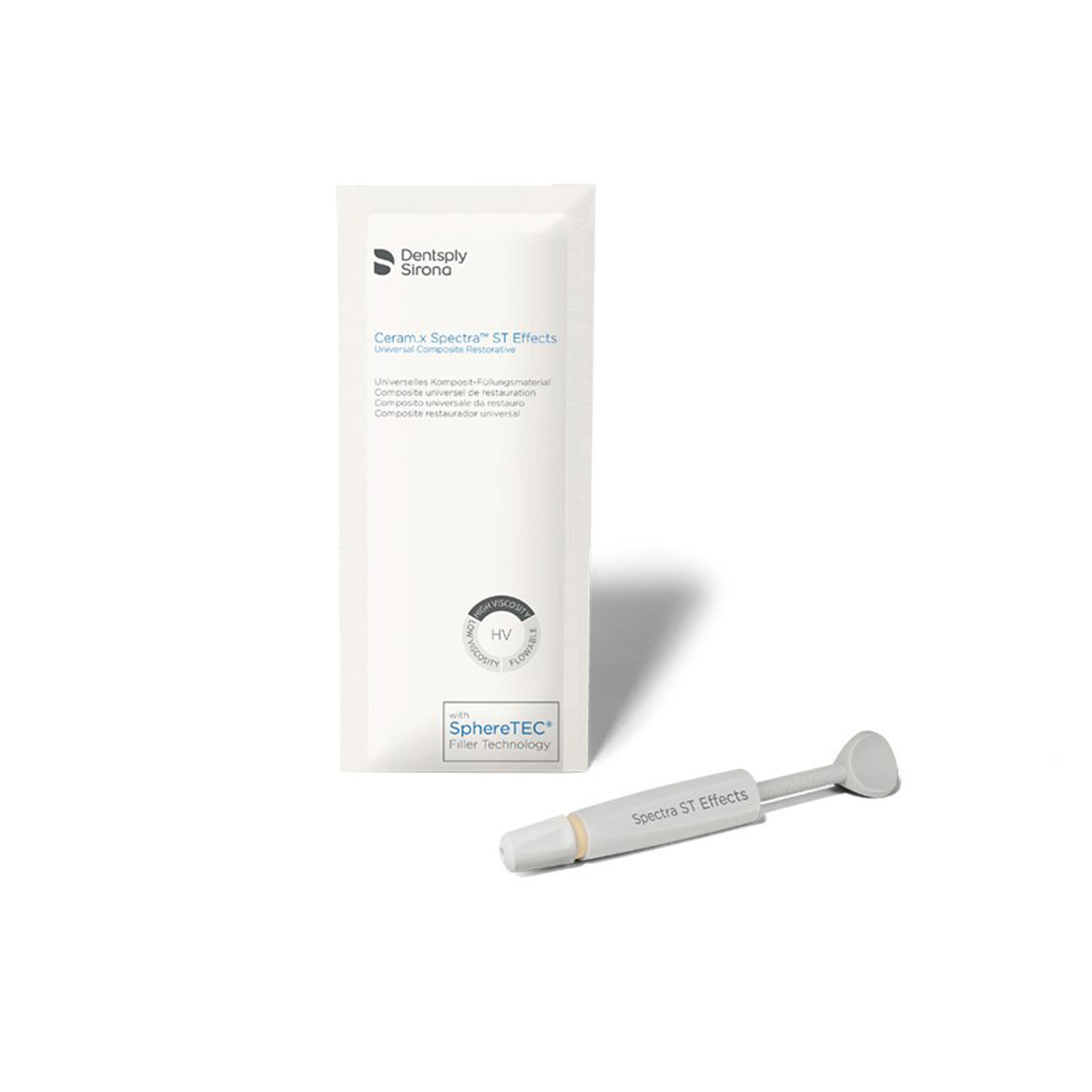
Pros
- Exceptional handling, with genuine non-stick behavior combined with high slump resistance
- Effective chameleon blending across five CLOUD shades covering the full VITA classical range
- Reduced inventory burden, cutting composite stock by roughly two thirds
- Fast polishing to a high luster, with good stain resistance at eight-week review
- Two viscosities allowing the material to match technique rather than the reverse
- Flexural strength above the ISO 4049 threshold for indirect restorations
- Coherent product family with a matching flowable and Effects masses in the same shade language
- Transparent scientific documentation naming external investigators and methodology
- Reliable radiopacity for detecting recurrent caries at margins
Cons
- Not a bulk-fill material, requiring a separate base for deep posterior cavities
- Limited Effects palette of two dentin masses and one enamel mass
- Effects available in HV only, creating a viscosity mismatch for LV users on layered cases
- Shade learning curve of roughly two weeks before selection becomes automatic
- Modest independent evidence base, with most performance data manufacturer-commissioned
- Confusing platform naming across three sibling brands plus a legacy product name
- Premium pricing at the upper end of the mainstream band
- Bleach white shade unavailable in syringe format
- Eugenol and peroxide incompatibility requiring protocol discipline around temporaries and whitening
Ceram.x Spectra ST is Dentsply Sirona's universal composite built on SphereTEC spherical filler technology. This review covers how the material behaves chairside, how five CLOUD shades cover the full VITA range, what the published data supports, and where it falls short against competing universal composites.
TL;DR
SphereTEC spherical fillers keep the composite resin off hand instruments while it holds carved anatomy without slumping.
Five CLOUD shades cover all 16 VITA classical shades, cutting composite stock by roughly two-thirds.
The 2 mm increment limit excludes bulk-fill workflows, so deep posterior cavities need a separate base material.
Chairside testing across 63 restorations produced fast polishing and reliable margin blending, with shade selection taking about two weeks to become automatic.
Ceram.x Spectra ST At A Glance
The table below summarizes the specifications a clinician needs before ordering. Figures come from the manufacturer's Directions for Use.
Attribute | Detail |
|---|---|
Manufacturer | Dentsply Sirona |
Category | Nano-ceramic universal composite restorative, light-cured |
Filler technology | SphereTEC, spherical spray-granulated fillers |
Viscosities | HV (high viscosity, sculptable), LV (low viscosity, creamy) |
Shades | 5 universal CLOUD shades (A1, A2, A3, A3.5, A4) plus bleach white (BW) |
Effects range | D1 and D3 opaque dentin, E1 translucent enamel, HV only |
Total inorganic filler | HV: 72–74 wt%, 50–52 vol%. LV: 71–72 wt%, 48–50 vol% |
Inorganic particle size | 0.1–3.0 µm |
Maximum increment | 2 mm, not a bulk-fill material |
Cure time, A shades | 10 seconds at 800 mW/cm² or above, 20 seconds at 550–800 mW/cm² |
Delivery | Pre-dosed Compules Tips (0.25 g), syringes (3 g) |
Radiopacity | Yes, barium glass and ytterbium fluoride |
Indications | All cavity classes, plus indirect inlays, onlays, and veneers |
What Ceram.x Spectra ST Is
Ceram.x Spectra ST is a light-cured, radiopaque, nano-ceramic universal composite indicated for direct restorations in anterior teeth and posterior teeth, and for the indirect fabrication of inlays, onlays, and veneers.
The resin system combines a methacrylate-modified polysiloxane, an organically modified ceramic, with dimethacrylate resins. Camphorquinone acts as a photoinitiator alongside ethyl-4-(dimethylamino)benzoate and an iodonium salt, which is why the material requires a curing light with its spectral peak between 440 and 480 nm. Barium-aluminum-borosilicate glass and ytterbium fluoride supply radiopacity. Iron oxide and titanium oxide pigments vary with shade.
Clinicians who remember Ceram.x Universal are looking at the same product line. Ceram.x Spectra ST replaced it, and several distributors still list the older name alongside the current one.
Where It Sits In The Spectra ST Platform
Dentsply Sirona sells three composites built on the same SphereTEC core under three different names, which complicates any attempt to research the product properly.
TPH Spectra ST, Ceram.x Spectra ST, and Neo Spectra ST share the underlying filler technology, with branding largely reflecting which heritage Dentsply brand held market share in a given region. Studies published on any of the three carry across to the others, and the manufacturer's scientific documentation covers the family together. A 48-month randomized controlled trial in Scientific Reports followed 64 patients receiving Class I occlusal restorations with Neo Spectra ST or a Bis-GMA-based comparator, finding both materials clinically acceptable under modified USPHS criteria with no statistically significant difference in marginal discoloration or wear.
Anyone comparing across the wider Dentsply Sirona range should treat platform siblings as evidence for the same material.
SphereTEC Filler Technology Explained
Filler geometry is the reason this composite handles the way it does, so the mechanism is worth understanding rather than skimming.
Conventional composite fillers are angular particles produced by grinding glass. SphereTEC fillers are made through a different route. Submicron glass is spray-granulated into well-defined, pre-polymerized spherical particles, giving a filler population with controlled morphology, a specific size distribution, and an engineered surface microstructure.
Why Spherical Fillers Change Handling
Three separate clinical benefits follow from that geometry, and each one is measurable at the chairside.
Spherical particles roll past one another under instrument pressure in a way angular particles cannot. The material adapts readily to cavity walls when pressed, then holds its shape once pressure is released. Slump resistance and easy adaptation normally pull against each other, and the rounded filler geometry is how Dentsply Sirona gets both.
Stickiness drops because the granulated fillers bind more free resin than conventional fillers do. Less unbound resin at the surface means less adhesion to hand instruments. Dentsply Sirona's European user survey of 297 dentists in 2015 found that roughly three-quarters complained about composite handling, with stickiness and poor adaptability leading the list, and SphereTEC was the direct engineering answer to that finding.
Packing efficiency improves when spherical particles of two size ranges are combined. Larger fillers allow high filler loads because their lower surface area needs less resin to wet them, though on their own they degrade gloss when torn out under mechanical strain. Submicron primary particles fill the interstitial space and keep the polished surface intact.
What The Filler Geometry Does For Polish
Surface finish depends on what happens when filler particles are abraded out of the resin matrix during finishing and function.
Submicron primary glass leaves correspondingly small defects when it is removed, which is the mechanism behind the fast, high polish clinicians report. Manufacturer testing by da Costa and Ferracane in 2017 reported the Spectra ST platform reaching 40 gloss units using Enhance finishers followed by Enhance PoGo polishers, in fewer steps than comparator systems. That data used the manufacturer's own polishing protocol, so read the number with appropriate caution while accepting that the underlying materials science holds up.
The CLOUD Shade System
Shade simplification is the feature most likely to decide whether a practice adopts this composite or passes on it.
Ceram.x Spectra ST ships in five universal CLOUD shades of intermediate translucency, named A1, A2, A3, A3.5, and A4. Between them, they cover all sixteen VITA classical shades. A bleach white shade is available separately for patients who have completed whitening.
Each CLOUD shade replaces both dentin and enamel simultaneously. Routine restorations need one shade placed, cured, and left to blend at the margins through the chameleon effect. The manufacturer's shade study reported 91% of evaluations scored as a match by a panel of thirty dental professionals.
How the i-Shade Mapping Works
The conversion between VITA Classical and CLOUD is not intuitive, so Dentsply Sirona supplies a printed i-shade label that maps one onto the other.
VITA Classical Shade | Ceram.x Spectra ST CLOUD Shade |
|---|---|
A1, B1, C1 | A1 |
A2, B2, D2 | A2 |
A3, C2, D3, D4 | A3 |
A3.5, B3, B4, C3 | A3.5 |
A4, C4 | A4 |
The label is designed to be stuck to the back of a VITA classical shade guide so the conversion sits within reach of the chair. Dentsply Sirona recommends starting with A2 for posterior work and most routine cases.
When Five Shades Are Not Enough
Demanding anterior work exposes the limits of five intermediate-translucency masses, which is what the Effects range exists to address.
Ceram.x Spectra ST Effects adds two opaque dentin shades, D1 and D3, and one translucent enamel shade, E1. All three come in high viscosity only. The recommended layering sequence for a large Class IV restoration is to restore the palatal half with the dentin shade, leave room at the incisal edge for the CLOUD shade, place the CLOUD shade along that edge, then cure the completed palatal layer. The facial half follows in the CLOUD shade, with E1 placed along the incisal edge where extra translucency is wanted.
Curing requirements differ sharply for the opaque masses. D1 and D3 need 30 seconds at 800 mW/cm² or 40 seconds at 550–800 mW/cm², because opacity attenuates light transmission. Curing them for the same 10 seconds used on A shades is a genuine failure mode, and one that will not be visible until the restoration debonds.
Technical Specifications
The figures below are drawn from the manufacturer's Directions for Use and scientific documentation.
Specification | HV | LV |
|---|---|---|
Filler system (barium glass, prepolymerized filler, ytterbium fluoride) | 78–80 wt%, 60–62 vol% | 76–78 wt%, 57–60 vol% |
Total inorganic filler | 72–74 wt%, 50–52 vol% | 71–72 wt%, 48–50 vol% |
Inorganic particle size | 0.1–3.0 µm | 0.1–3.0 µm |
Maximum increment thickness | 2 mm | 2 mm |
Radiopaque | Yes | Yes |
Storage temperature | 2–28 °C | 2–28 °C |
Mean flexural strength for the Spectra ST platform exceeds 100 MPa in four-point bending, which is the ISO 4049 threshold for materials indicated for indirect restorations and the reason laboratory-fabricated inlays, onlays, and veneers appear on the indication list. Fatigue testing used a staircase protocol, loading specimens to 10,000 cycles at 0.5 Hz to approximate chewing loads. Wear was assessed through both ACTA and Leinfelder methodologies.
These are manufacturer-generated figures from commissioned university testing rather than independent evaluation. The consistent finding across the wider literature places Spectra ST platform materials comfortably within the normal performance band for high-quality nanohybrid universal composites.
HV Or LV: Choosing A Viscosity
Both viscosities carry the same indication list, so the decision comes down to placement technique rather than performance.
HV is firm and packable. It holds carved anatomy, resists slumping when a cusp is built, and suits clinicians who condense against a sectional matrix and sculpt occlusion directly rather than adjusting after cure. It carries the higher filler load at 72–74 wt% inorganic.
LV is creamy and spreadable, wetting cavity walls under less pressure. Filler load sits marginally lower at 71–72 wt% inorganic, a gap small enough that mechanical properties stay close.
One practical warning applies to practices that standardize on LV. Ceram.x Spectra ST Effects comes in HV only, so a layered Class IV case will involve placing an HV dentin mass beneath an LV body shade. That works, though the handling transition mid-restoration is noticeable and worth rehearsing on a typodont before meeting it in a patient.
Delivery Formats And The Flowable
Both viscosities come in two presentations, and the choice affects cost per gram as much as infection control.
Pre-dosed Compules Tips hold 0.25 g each and are used with the Compules Tips Gun. They eliminate waste, improve cross-infection control, and rotate through 360 degrees for direct intraoral delivery into an awkward box. Syringes hold 3 g and cost less per gram, suiting clinicians who dispense onto a pad and carry material with a hand instrument. The bleach white shade is not offered in syringe form.
Ceram.x Spectra ST flow completes the family. It is a SphereTEC-based flowable in matching CLOUD shades, supplied in 0.25 g Compula Tips or 1.8 g syringes, and it stays where it is placed until instrumentation initiates flow. Indications cover anterior and posterior direct restorations excluding occlusal stress-bearing Class II, blocking undercuts, defect repair, pit and fissure sealing, and cementation of light-transmissible indirect restorations. Dentsply Sirona reports that 96% of clinicians in a user study intended to continue using it after 36 months.
Chairside Testing In Practice
Manufacturer data describes what a material can do under controlled conditions, which is a different question from how it behaves across a full clinical day.
This evaluation ran over eleven weeks in a two-surgery general practice, covering 63 restorations placed by two clinicians working under loupes at 3.5x magnification. The case mix broke down to 38 posterior restorations across Class I and Class II, 19 Class III and Class V anterior restorations, and 6 Class IV cases using the Effects range. HV was used for 44 restorations, LV for the remainder. All cases were isolated with a dental dam and bonded with Prime&Bond Universal.
Handling And Placement
The handling claim is the one that survived contact with real cases most convincingly.
The non-stick behavior registered on the first restoration, an MOD replacement of a fractured amalgam in a lower right first molar on a 34-year-old patient. Composite lifted cleanly off a Ward's carver with no drag-back, which removed the habitual wipe between increments. Across the posterior cases, carved occlusal anatomy held its form from placement through cure without the slow rounding that softer materials show while the operator repositions the curing light.
HV proved firm enough to build a marginal ridge against a Palodent sectional matrix without support, and tight interproximal contacts were achieved in 36 of the 38 posterior cases on first attempt. The two exceptions involved wide mesiodistal boxes where a ring seated poorly, a matrix problem rather than a material one.
LV behaved as expected, wetting cavity walls under light pressure and suiting the Class V cervical cases well. Clinicians moving from a stiff packable composite will find LV closer to familiar territory than HV.
Shade Performance
Shade results split along a clear line between routine work and demanding anterior cases.
A3 covered the majority of posterior cases and blended acceptably at every margin assessed at the two-week review. A2 handled the routine anterior work. The chameleon effect performed best where a reasonable rim of surrounding enamel remained to blend against, and performed worst on a Class IV in a 51-year-old patient with heavily tetracycline-stained dentition, where no single CLOUD shade reproduced the underlying value and the D3 opaque mass was needed to block the substrate.
Shade selection took roughly two weeks to become automatic. The i-shade label was consulted on almost every case during the first fortnight and rarely afterward. Practices switching from a full sixteen-shade system should expect that adjustment period and should not judge the material on the first ten restorations.
Polish And Patient Feedback
Finishing performance and patient response were assessed at placement and again at the two-week and eight-week reviews.
Polishing was quick. A three-step sequence of Enhance, Enhance PoGo, and Prisma Gloss brought restorations to a high luster in under 90 seconds per surface, and the same result was reproducible with generic aluminum-oxide discs on the anterior cases. Two restorations reviewed at eight weeks in a heavy coffee drinker showed no visible marginal staining.
Patient comments centered on appearance rather than comfort. The Class IV patient described the restoration as invisible to her at conversational distance, which is the practical standard most patients apply. Post-operative sensitivity was reported in 3 of 63 cases, all resolving within ten days, a rate consistent with the adhesive protocol rather than the composite. Recording those follow-up findings against each case is straightforward inside a structured dental treatment plan, which makes material performance auditable across a year of restorations instead of resting on impression.
Step-By-Step Clinical Protocol
The sequence below follows the manufacturer's Directions for Use, with the points that most often go wrong flagged.
Clean the tooth with a fluoride-free prophylaxis paste to remove plaque and surface stain, then select the shade while the teeth remain hydrated. Dehydrated enamel reads lighter and will pull the selection toward the wrong value.
Prepare the cavity and isolate. Rubber dam is specified rather than suggested, since the Directions for Use state that contact with saliva, blood, or sulcular fluid during application may cause restoration failure. Rinse and remove rinsing water without desiccating the dentin.
For Class II cases, place a sectional or circumferential matrix and wedge. Burnishing the band improves contact and contour, and pre-wedging or ring placement before preparation is recommended.
Apply a methacrylate-based adhesive following the bonding manufacturer's protocol. Once the surface is conditioned, keep it uncontaminated and place composite immediately.
Fill incrementally with each layer no thicker than 2 mm. A single CLOUD shade covers most restorations. Where two CLOUD shades are blended, cure each individually to form a foundation for the next.
Cure according to the table below, using a light with its spectral peak between 440 and 480 nm.
Shades | Output 550 mW/cm² Or Above | Output 800 mW/cm² or Above |
|---|---|---|
A1–A4, BW | 20 seconds | 10 seconds |
D1, D3 (opaque dentin) | 40 seconds | 30 seconds |
E1 (translucent enamel) | 10 seconds | 10 seconds |
Two interactions deserve protocol discipline. Eugenol-containing and hydrogen-peroxide-containing materials both interfere with polymerization, which rules out zinc oxide eugenol temporaries under a planned Ceram.x Spectra ST restoration and requires adequate delay after in-office bleaching before definitive placement.
Check curing light output with a radiometer rather than trusting the specification on the box. A unit that has drifted below 550 mW/cm² invalidates the entire curing table, and inadequate polymerization at the base of a deep box will not announce itself until the restoration fails.
Material stored in a refrigerator must reach room temperature before use, since cold composite extrudes poorly and adapts badly.
Finishing And Polishing
Surface finish determines both stain resistance and how a restoration ages, so the sequence matters as much as the material.
Contour with finishing burs or diamonds, then refine with Enhance finishing devices. Verify the surface is smooth and free of defects before polishing, because polishing over a marginal deficiency produces a glossy defect rather than a corrected one.
Dentsply Sirona recommends Enhance followed by Enhance PoGo, with Prisma Gloss Regular then Extrafine pastes for maximum luster. That is the protocol behind the published gloss figures. Most clinicians find the material polishes well with whatever system already sits in the operatory, since the submicron primary filler does the majority of the work.
Published Evidence And Performance Data
Evidence for this composite falls into three tiers, and separating them matters when weighing marketing claims against clinical reality.
Manufacturer bench data is unusually detailed and names its external investigators, covering flexural strength and fatigue, ACTA wear, Leinfelder wear, and gloss. That transparency exceeds what most competitors publish. It remains commissioned testing with comparator selection controlled by the sponsor.
Manufacturer user surveys supply the frequently quoted figures, including 91% shade match agreement and a 14% chair-time saving. The chair-time number derives from a 42-respondent survey benchmarked against a 37-minute Class II procedure. Treat these as indicators of user satisfaction rather than clinical outcomes.
Independent peer-reviewed work is thinner and growing. Ceram.x Spectra ST HV served as the conventional sculptable reference material in a study of shrinkage kinetics and degree of conversion in dual-curing bulk-fill composites, which is a mild endorsement in itself, since researchers choose reference materials they consider well characterized. Registered trials have compared Ceram.x Spectra against single-shade competitors for color stability of direct veneers and against Ormocer materials in Class IV restorations.
A fair summary places Ceram.x Spectra ST as a well-characterized universal composite with a credible mechanical profile and a respectable rather than deep independent evidence base. Claims that it outperforms established competitors clinically run ahead of what has been published.
How Ceram.x Spectra ST Compares
Every serious competitor in this category is attacking the same problem of shade inventory, with different tolerances for simplification.
Against 3M Filtek Universal, the closest philosophical rival, Ceram.x Spectra ST takes a more conservative position. Filtek pushes simplification further with fewer shades relying on stronger blending, while five CLOUD shades retain more discrimination at the cost of slightly more stock. Filtek carries more independent longitudinal data.
Against Tokuyama Dental Omnichroma, the comparison is between a single structural-color shade and a five-shade system with opaque and translucent masses available. Omnichroma blends remarkably in ideal circumstances and struggles in large cavities, on discolored substrates, and at the extremes of the value range. Ceram.x Spectra ST keeps a shade decision in the workflow and keeps more tools available when blending alone will not carry the case.
Against the Ivoclar Tetric family, Dentsply Sirona wins on handling and loses on depth of clinical track record. Tetric also extends into bulk-fill, which Ceram.x Spectra ST does not.
Against GC Essentia, the decision turns on whether a clinician prefers handling optimized for sculpting or a system built around aesthetic layering logic. Both are credible.
The bulk-fill gap is the honest limitation. Ceram.x Spectra ST is a 2 mm incremental material, and a posterior workflow built on 4 mm placement will need a separate bulk-fill base such as SDR flow+. Clinicians weighing the wider category will find comparable analysis across the restorative materials reviews library.
Cost, Inventory, And Practice Economics
The commercial argument rests on inventory reduction rather than unit price, which sits in the premium mainstream band.
Stocking five shades instead of sixteen reduces capital tied up in composite and cuts the volume that expires unused. Across a multi-surgery practice, that compounds. Intro kits make the sensible entry point, typically five 3 g syringes covering A1 through A4 with an i-shade label, or 24 to 28 Compules weighted toward A2 and A3 to reflect real usage distribution.
Per-gram pricing places Ceram.x Spectra ST above budget composites and roughly level with Filtek and Tetric. Distributor promotional pricing varies considerably by market, so comparing at least two suppliers before a full changeover is worth the time, and current offers are worth checking against listed dental deals for practices.
The chair-time argument deserves scrutiny. The 14% figure comes from a small self-reported survey. The mechanism behind it is plausible, since fewer shade decisions, less instrument cleaning, and a shorter polish sequence each remove seconds that accumulate across a day of operative work.
Who Should Use Ceram.x Spectra ST
Fit depends far more on case mix and existing workflow than on any single specification.
The material suits general practices wanting one composite for the majority of direct restorations, clinicians frustrated by composite sticking to instruments, practices cutting inventory and expiry waste, and newer graduates who benefit from a forgiving material with fewer shade decisions. Practices already running Prime&Bond, Palodent, Enhance, and SDR will find the workflow integrates without friction.
It suits others poorly. Clinicians whose posterior protocol depends on 4 mm bulk placement should look elsewhere. Aesthetic practices layering with wide shade palettes will find three Effects masses restrictive. Practices already standardized on a single-shade composite and satisfied with it would be moving backward on simplification. Anyone requiring an extensive independent clinical evidence base before adoption will want to wait for more published data.
Bottom Line
Ceram.x Spectra ST works as a general-practice workhorse on the strength of its handling. SphereTEC solves a daily frustration, and the CLOUD system reduces inventory and decision fatigue without going as far as single-shade materials do.
The material will not suit every practice. Posterior workflows built on bulk placement and anterior practices needing extensive layering control should look at other options. General dentists wanting one reliable material that adapts well, sculpts precisely, polishes quickly, and blends convincingly will find this a sound choice, and requesting an intro kit before a full changeover remains the sensible route.
Verdict
<p>Ceram.x Spectra ST earns its place through handling. The SphereTEC filler geometry is more than marketing language, and the effect registers on the first restoration when carved anatomy holds without the composite dragging back onto the instrument. For clinicians who have spent years wiping a condenser between increments, that alone justifies requesting a trial kit.</p><p>The CLOUD shade system is the more debatable feature. Five shades covering sixteen VITA shades worked well across posterior and routine anterior cases in testing, with convincing margin blending wherever surrounding enamel remained to blend against. Large anterior restorations exposed the limits, and the three Effects masses give meaningfully less control than a dedicated layering system offers. Shade selection took about two weeks to become automatic, and the i-shade label was essential throughout that period.</p><p>The 2 mm increment limit feels dated in a market moving toward bulk placement, and it forces a second material into the posterior workflow. The independent evidence base is respectable without being deep, and the manufacturer bench data, transparent as it is, remains manufacturer data.</p><p>Overall assessment: a reliable, well-engineered workhorse composite with excellent handling and a fast, durable polish. An easy recommendation for general practice, a reasonable one for aesthetic work with the Effects range, and the wrong choice where posterior protocol depends on bulk fill.</p>
Frequently Asked Questions
What is SphereTEC filler technology?
SphereTEC is Dentsply Sirona's proprietary filler system. Submicron glass is spray-granulated into well-defined, pre-polymerized spherical particles. The rounded geometry creates a ball-bearing effect that lets the composite adapt to cavity walls under pressure while resisting slump at rest, and the granulated particles bind more free resin than conventional fillers, which prevents sticking to hand instruments.
How many shades does Ceram.x Spectra ST come in?
Five universal CLOUD shades, A1, A2, A3, A3.5, and A4, designed to cover all sixteen VITA classical shades, plus one bleach white shade for bleached teeth. The Effects range adds two opaque dentin shades, D1 and D3, and one translucent enamel shade, E1.
What is the difference between Ceram.x Spectra ST HV and LV?
HV is high viscosity, firm and sculptable, with a slightly higher filler load at 72 to 74 wt% inorganic. LV is low viscosity, creamy and spreadable, at 71 to 72 wt% inorganic. The choice depends on whether a clinician sculpts directly or prefers to flow material into place and refine afterward. Effects masses come in HV only.
Is Ceram.x Spectra ST a bulk-fill composite?
No. It is designed for incremental placement in layers no thicker than 2 mm. Deep posterior cavities require pairing with a dedicated bulk-fill base material.
What is the curing time for Ceram.x Spectra ST?
A1 through A4 and BW need 10 seconds with a light delivering at least 800 mW/cm², or 20 seconds at 550 to 800 mW/cm². Opaque dentin shades D1 and D3 need 30 seconds at 800 mW/cm² or 40 seconds at 550 to 800 mW/cm². E1 needs 10 seconds. Use a light with its spectral peak between 440 and 480 nm.
Which bonding agent should be used with Ceram.x Spectra ST?
Any methacrylate-based dentin and enamel adhesive is compatible. Dentsply Sirona specifies its own Prime&Bond and Xeno ranges as the natural pairing. Follow the adhesive manufacturer's protocol for conditioning and pulp protection.
Can Ceram.x Spectra ST be used for indirect restorations?
Yes. It is indicated for indirect fabrication of inlays, onlays, and veneers, supported by flexural strength exceeding the 100 MPa ISO 4049 threshold for indirect indications.
How should Ceram.x Spectra ST be polished?
Contour with finishing burs or diamonds, refine with Enhance finishing devices, then polish with Enhance PoGo followed by Prisma Gloss Regular and Extrafine pastes. Most general-purpose polishing systems also give good results, since the submicron primary filler does most of the work.
Is Ceram.x Spectra ST the same as Ceram.x Universal?
Ceram.x Spectra ST replaced Ceram.x Universal, and some distributors still list the older name. It also has platform siblings sold as TPH Spectra ST and Neo Spectra ST, sharing the same core SphereTEC technology under different regional branding.
How does Ceram.x Spectra ST compare to Omnichroma?
Omnichroma uses structural color to remove shade selection entirely with one shade. Ceram.x Spectra ST keeps five shades and adds opaque dentin and translucent enamel masses. Omnichroma is simpler to stock, while Ceram.x Spectra ST offers more control on large cavities, discolored substrates, and teeth at the extremes of the value range.
Is Ceram.x Spectra ST radiopaque?
Yes. Barium-aluminum-borosilicate glass and ytterbium fluoride make restorations clearly distinguishable on radiographs, which matters for detecting recurrent caries at margins.
Are there any material interactions to be aware of?
Eugenol-containing and hydrogen-peroxide-containing materials both interfere with polymerization and should not be used in conjunction with this composite. Plan zinc oxide eugenol temporaries and post-bleaching timing accordingly.
How should Ceram.x Spectra ST be stored?
Between 2 and 28 °C, out of direct sunlight, protected from moisture, and never frozen. Refrigerated material must reach room temperature before use, since cold composite extrudes and adapts poorly.
Is Ceram.x Spectra ST suitable for Class II restorations?
Yes. It is indicated for all cavity classes in anterior and posterior teeth, and Dentsply Sirona positions it within a structured Class II protocol using Palodent sectional matrices with pre-wedging or ring placement. The flowable version is not indicated for occlusal stress-bearing Class II cavities.