Rating: 4.3/5
Adhese 2 Review
Adhese 2 is Ivoclar's newest universal adhesive and the first to dispense in dual-cure mode straight from the VivaPen. This review explains how it works, where it fits in...
Reviewed by Marcus Hale
Pros
- One adhesive covers direct composites and dual-cure cementation with no activator bottle
- The blue DC cannula lets the adhesive co-cure with the cement after seating, which prevents pooled, pre-cured adhesive from lifting restorations
- A film thickness of about 10 µm protects the fit of indirect restorations
- Manufacturer data show bond strength above 25 MPa on enamel and dentin in every etching mode
- The integrated desensitizing effect can replace a separate desensitizer under most restorations
- Pen dispensing gives about 187 applications with very little waste
Cons
- No independent clinical trial on Adhese 2 has been published yet
- Published bond data rely on Ivoclar composites and Variolink Esthetic DC
- Picking the wrong cannula removes the dual-cure benefit, so teams need a clear protocol
- DC cannulas and protective sleeves add ongoing consumable cost
- The cannula can break if bent repeatedly or at its base
- The mandatory 20-second scrub can feel slow in small preparations
Adhese 2 is Ivoclar's newest universal adhesive and the first to dispense in dual-cure mode straight from the VivaPen. This review explains how it works, where it fits in restorative and indirect dentistry, what the evidence supports, and how it handled in illustrative chairside cases.
TL;DR
Adhese 2 bonds to dual-cure cements and core materials directly from the VivaPen, using a co-initiator coated on the blue DC cannula tip.
Ivoclar reports bond strength above 25 MPa on enamel and dentin in every etching mode when paired with its own composites and cements.
Selective enamel etch with the black cannula suits most posterior composites, while the blue cannula earns its place in crown and post cementation.
Independent trials on Adhese 2 have not reported yet, so current evidence rests on manufacturer data and its predecessor, Adhese Universal.
Adhese 2 At A Glance
The table below summarizes the specifications Ivoclar publishes on its Adhese 2 product page. All figures come from the manufacturer and refer to the US version of the product.
Specification | Adhese 2 |
|---|---|
Manufacturer | Ivoclar, Schaan, Liechtenstein |
Category | Universal adhesive with light-curing and dual-curing capability |
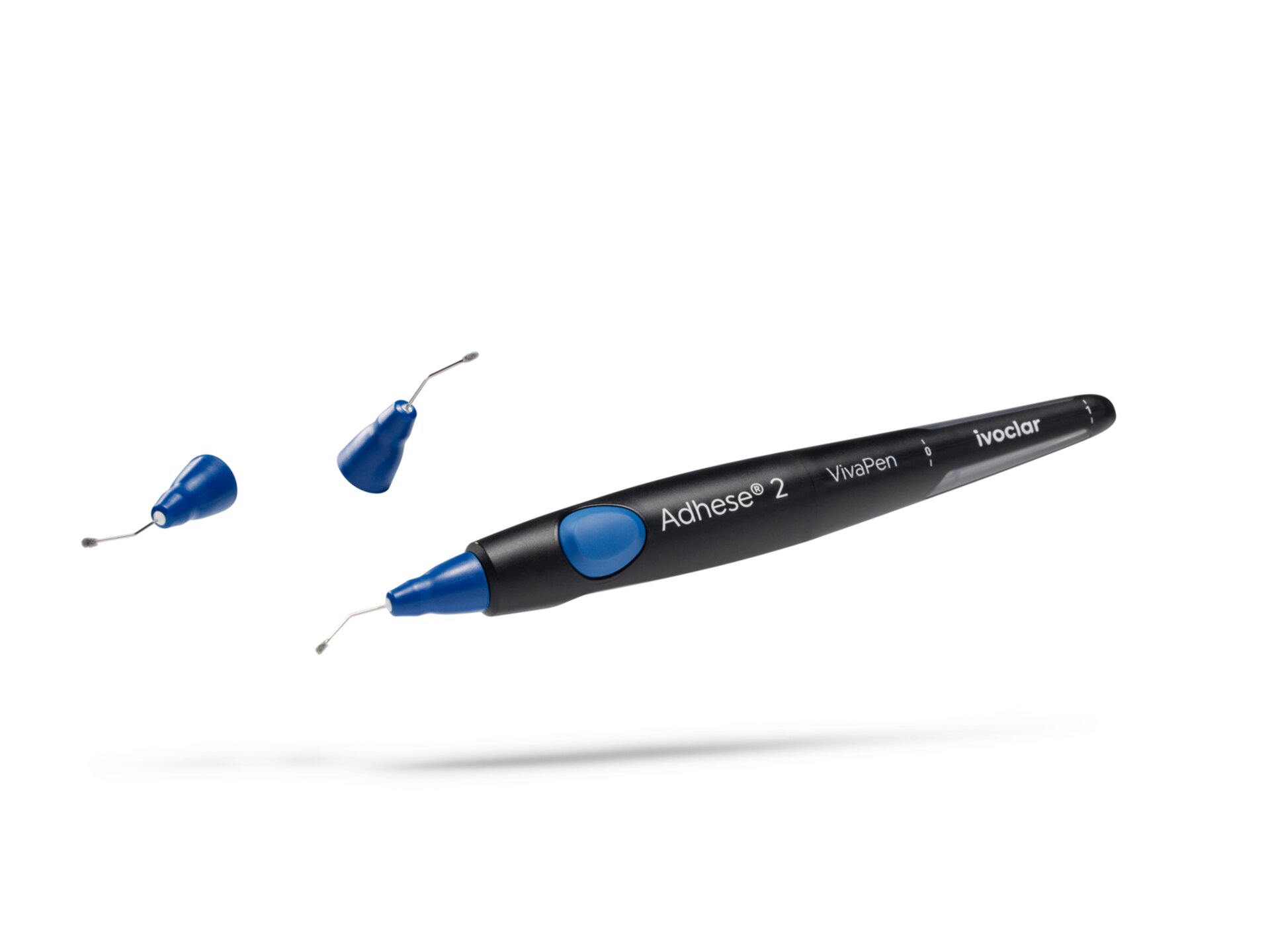
Delivery | VivaPen with a black LC cannula and a blue DC cannula |
Etching techniques | All etching techniques |
Film thickness | Approx. 10 µm after light-curing |
Bond strength | Above 25 MPa on enamel and dentin (manufacturer data) |
Light-curing time | 5 s at 2,000 mW/cm², or 3 s at 3,000 mW/cm² for occlusal curing of Class I and II posterior restorations |
Yield | Approx. 187 single-tooth applications per VivaPen |
US introduction | September 1, 2026 |
Dental Reviewed rating | 4.2 out of 5 |
What Adhese 2 Is And Why It Launched
Ivoclar announced Adhese 2 as a universal adhesive that combines light and dual curing in a single product. The company describes it as the first adhesive that can be applied directly from the VivaPen in dual-cure mode without an additional activator.
Ivoclar introduced Adhese 2 in the VivaPen in the United States on September 1, 2026. The adhesive works with all etching techniques and with both light-cure and dual-cure composites. In practice, the same pen can bond a Class II composite in the morning and prime a lithium disilicate onlay for cementation after lunch.
Ivoclar positions the product for clinical situations where effective light polymerization cannot be ensured. Opaque zirconia crowns and fiber posts seated deep in a canal both fall into that group, and both are common sources of bonding failures that get blamed on the adhesive.
From Adhese Universal To Adhese 2
Adhese 2 builds on Adhese Universal, the single-component adhesive Ivoclar has sold in the VivaPen for years. The predecessor is light-curing, and clinicians cure its layer before seating any indirect restoration.
According to its product page, Adhese Universal already bonds to dual-cure core materials with no activator. It cannot co-cure with a dual-cure luting cement underneath a restoration, so the adhesive has to be light-cured first. That sequence works well when the adhesive film is thin and even. When adhesive pools at an internal line angle, the cured puddle can keep a crown or onlay from seating completely, and the error often shows up only as a high contact or an open margin.
Ivoclar states that Adhese 2 delivers the same bonding performance as Adhese Universal. The change lives in the delivery hardware and the extra curing chemistry available at the cannula tip.
How The Blue DC Cannula Works
The blue DC cannula carries the chemistry that used to come from a second bottle. Ivoclar states that its tip is coated with a co-initiator for self-curing applications, so the adhesive picks it up on the way to the tooth.
Dual curing only happens when the blue cannula and a dual-cure luting or core build-up composite are used together. Ivoclar spells out this condition in the footnotes of the product page. Adhese 2 does not turn into a self-curing adhesive when used alone, and a light-cure composite placed over it still needs full light exposure.
Why Acidic Adhesives Struggle With Dual-Cure Materials
Simplified adhesives and self-cure composites have a well-documented compatibility problem. Suh and colleagues showed that even low concentrations of acidic resin monomers deactivate the tertiary amine that drives chemical curing in self-cure resins.
Manufacturers responded with dual-cure activators, usually sulfinate salts mixed into the adhesive right before use. A recent study on adhesive curing modes describes these co-initiators as the standard workaround for universal adhesives. The activators work, but each one adds a bottle and a mixing step, and an expired activator is easy to miss in a crowded drawer.
Adhese 2 moves the co-initiator onto the cannula. A crown cementation then follows nearly the same workflow as a direct composite, apart from the color of the cannula.
The Black LC Cannula For Direct Work
The black LC cannula handles light-cure-only procedures. Ivoclar recommends it for direct restorations and for any case where adequate light polymerization is certain.
Practices already using Adhese Universal will find the direct workflow familiar. The new habit is choosing the correct cannula color before starting, and a simple team rule that pairs blue with every indirect case removes most of the guesswork.
The cannula system is the weakest link in the Adhese 2 workflow, and the risk sits with the team more than with the chemistry. Blue DC cannulas belong in the crown and post setup, stored apart from the everyday black cannulas. A mix-up at the chair removes the dual-cure benefit without any visible sign, and the problem only surfaces months later as a debond.
Key Performance Claims And What They Mean Chairside
Ivoclar publishes several performance claims for Adhese 2. The sections below explain each claim and note where the supporting data come from.
Bond Strength And Moisture Tolerance
Ivoclar reports bond strength above 25 MPa on enamel and dentin regardless of the etching protocol. The same page credits the adhesive with consistently strong adhesion on both dry and wet dentin.
The footnote deserves attention. Ivoclar measured the 25 MPa figure with its own Tetric plus composites and Variolink Esthetic DC. Results with another brand's adhesive resin cement may differ, and laboratory shear values do not predict clinical longevity on their own.
Once an adhesive clears roughly 20 MPa in shear testing, the number rarely predicts which restorations fail. Isolation and full solvent evaporation decide far more outcomes than a few megapascals on a data sheet. The 25 MPa figure is best read as confirmation that Adhese 2 sits in the same class as other established universal adhesives.
Moisture tolerance has real value in the operatory. Keeping dentin moist but not wet after total etching is hard to repeat from case to case, especially in a deep proximal box under a sectional matrix. An adhesive that tolerates slight over-drying removes one source of variation between operators.
For posterior composites, selective enamel etch is the protocol most restorative clinicians would standardize with Adhese 2. Mild universal adhesives bond less reliably to uncut enamel in self-etch mode, and a few seconds of phosphoric acid on the margins guards against white lines and marginal staining over time. Etching dentin adds little with a mild adhesive and raises the risk of postoperative sensitivity.
Film Thickness And Seating Accuracy
Adhese 2 forms a film of about 10 µm after light-curing, according to Ivoclar. A thin film keeps indirect restorations from seating too high.
Self-cure mode through the blue cannula adds a second benefit. Ivoclar notes that potential pooling no longer affects fit when the adhesive cures together with the cement after seating. Restorations produced through chairside milling are designed with tight internal cement spaces, so any cured adhesive left at a line angle eats into a very small margin for error.
Thin film depends on technique as much as on formula. A strong, steady air stream held for several seconds, with high-volume suction pulling excess from the internal line angles, matters for seating whichever cannula is used. Veneers cemented with a light-cure cement gain nothing from the DC cannula, so thorough air-thinning becomes the main safeguard there.
Desensitizing Effect
Ivoclar says Adhese 2 seals dentin tubules with a mechanical barrier and lowers the risk of postoperative sensitivity. The company presents this as a replacement for a separate desensitizing agent under most restorations.
Desensitization of hypersensitive cervical areas also appears as a standalone indication. A single pen can treat a sensitive root surface at a recall visit without opening another product.
Adhese 2 works well as a first step for isolated cervical sensitivity at a hygiene visit. Sensitivity that returns within a few months usually points to a lesion that needs a restoration, or to an occlusal or dietary cause that sealing alone will not fix.
Curing Time
Ivoclar lists a 5-second cure at 2,000 mW/cm² and a 3-second cure at 3,000 mW/cm² for occlusal curing of Class I and II posterior restorations. Both figures assume the light actually delivers that output at the tip.
Many operatory lights lose output after a few years, and a radiometer check takes less than a minute. The Dental Reviewed guide on when to upgrade LED curing lights covers the warning signs. A practice working with a mid-range curing light should follow the longer IFU times that match its measured output.
Independent research points the same way. A 36-month randomized trial of a universal adhesive in non-carious cervical lesions found that extending the adhesive cure from 10 to 40 seconds at 1,200 mW/cm² raised retention from 73.5% to 94.1% in self-etch mode. The trial did not use Adhese 2, but it shows why short cure times deserve caution with any universal adhesive.
The 3-second protocol is tempting, but the gingival floor of a deep Class II box can sit 6 to 8 mm from the light tip, and irradiance drops quickly with distance. A longer cure aimed at the gingival floor is cheap insurance in deep proximal boxes. The fast protocol suits shallow occlusal preparations far better.
VivaPen Yield And Material Cost
Ivoclar quotes about 187 single-tooth applications per VivaPen and up to four times more applications per milliliter than conventional bottles. These numbers come from a benchmarking study commissioned by the manufacturer.
Intraoral dispensing removes the mixing well, which is where most bottled adhesive ends up in the trash. Practices that track consumables as part of their dental procurement process can divide the pen price by 187 and compare the result with the real yield of their current bottle.
Cost also shows up at the case level. When a dental treatment plan stages several onlays or crowns over consecutive visits, a single adhesive for every bonding step keeps the materials line simple and the fee estimate easier to explain to the patient.
Pen economics favor busy restorative operatories. A low-volume practice should compare the expiry date on each pen with realistic usage before counting on the full 187 applications. One pen per operatory, with the DC cannulas held centrally, keeps both waste and confusion low.
Clinical Indications For Adhese 2
Ivoclar groups the indications into direct and indirect procedures. Both lists appear on the product page and in the instructions for use.
Direct Restorations
Either cannula works for light-cured direct procedures. Ivoclar lists four direct indications.
Direct light-curing composite restorations, including restorations built on a bulk-fill flowable base
Core build-ups with light-cure or dual-cure composites, with no activator needed for dual-cure materials
Repair of fractured composite restorations
Desensitization of hypersensitive cervical areas
Self-etch mode suits shallow cervical lesions and small primary preparations, where a minimally invasive dentistry approach favors keeping phosphoric acid off dentin.
Indirect Restorations And Posts
The blue DC cannula is the correct choice for indirect work with dual-cure luting composites. Ivoclar lists two main indirect uses.
Adhesive cementation of crowns, onlays, inlays, and veneers with light-cure or dual-cure luting composites
Adhesive cementation of root canal posts with dual-cure luting composites
Adhese 2 also serves as a primer for restorations milled from Tetric CAD composite blocks. Post cementation is the strongest match for the product. Light fades quickly with depth in a post space, and debonded fiber posts often trace back to an under-cured adhesive layer at the dentin interface.
Post spaces punish excess adhesive. Adhesive that pools at the apical end of the preparation can stop a post from seating fully or leave a soft, poorly cured zone. Wicking out the excess with paper points should be routine with any adhesive, and it matters even more when the adhesive cures together with the cement.
Clinical Technique Step By Step
The steps below follow the Adhese 2 IFU. Regional versions can differ, so the current IFU for each market always takes priority.
Isolate the field with a rubber dam or a high-volume isolation system. Contamination from saliva or crevicular fluid remains a leading cause of bond failure with any adhesive. For subgingival margins, control the sulcus with gingival retraction before bonding.
Choose the etching protocol. For total etch, the IFU calls for phosphoric acid on enamel for 15 to 30 seconds and on dentin for 10 to 15 seconds, followed by a water rinse of at least 5 seconds. Selective enamel etch keeps the acid on enamel margins only, and self-etch skips phosphoric acid entirely.
Select the cannula. Use black for light-cure direct work and blue for any procedure involving a dual-cure cement or core material. Remove the seal before using the DC cannula. The cannula tube bends up to 90 degrees, but repeated bending or bending at the attachment point can break it.
Fit a protective sleeve over the VivaPen and click until the brush is wet. Ivoclar requires the sleeve for intraoral use, and the pen is reused with a fresh cannula for each patient, in line with standard infection control practice.
Scrub the adhesive into the tooth surface for at least 20 seconds. The IFU states that this time must not be shortened and that simply spreading the adhesive over the surface is not appropriate.
Disperse with oil-free and moisture-free air until a glossy, immobile film remains. Residual solvent weakens the hybrid layer, so this step deserves its full time.
Light-cure the adhesive for direct restorations. For indirect restorations and posts placed with a dual-cure cement through the DC cannula, follow the IFU and the cement instructions for the exact curing sequence.
Avoid eugenol-containing provisional cements before adhesive cementation. The IFU warns that phenolic substances such as eugenol can inhibit polymerization, and a resin-based provisional such as J-Temp sidesteps the issue.
The IFU also describes a bottle presentation with a blue DC applicator. For DC procedures from the bottle, it limits dispensing to one drop in a mixing well and warns against dipping the DC applicator into the adhesive more than twice. Availability of the bottle version varies by market.
The 20-second scrub is the step most often shortened on a busy day, and it has the largest effect on dentin bonding. Counting it aloud or running the curing light timer as a stopwatch keeps the whole team consistent. An assistant who loads the brush while the operator rinses the etchant saves more time than any shortcut in the scrub.
What Independent Research Says About The Adhese Family
No independent clinical trial on Adhese 2 has been published so far. The closest evidence comes from Adhese Universal, which Ivoclar says shares the same bonding performance.
A 2-year randomized clinical trial at University Fernando Pessoa in Porto, Portugal, restored 210 non-carious cervical lesions with several adhesives. Adhese Universal reached a 100% overall success rate in self-etch mode and 96.9% in etch-and-rinse mode at two years. Its self-etch group also performed significantly better than the comparator adhesives tested in the same mode. The authors reported no external funding.
The same paper lists the Adhese Universal safety data sheet ingredients, which include HEMA, Bis-GMA, ethanol, and a methacrylated phosphoric acid ester. The Adhese 2 safety data sheet remains the correct reference for its own formula. Patients with a documented methacrylate allergy should not be treated with either product.
The Porto authors also note that universal adhesive performance is highly product-dependent. Data from Adhese Universal support Adhese 2 only as far as the two formulas truly match, and the first independent trials on the new product will settle that question.
Clinical Evaluation: Illustrative Case Notes
The case notes below describe a representative evaluation scenario built around the Adhese 2 IFU and typical general-practice cases. They show how the material handles chairside and do not represent a controlled study.
The evaluating clinician worked in a four-operatory general practice and used Adhese 2 over five weeks alongside Tetric composites and Variolink Esthetic DC. The practice's older LED light measured about 1,100 mW/cm² on a radiometer, so longer IFU curing times were applied throughout.
Case 1: Class II Composite On A Lower Molar
A 42-year-old patient needed a mesio-occlusal composite on tooth 30, with the gingival margin just above the cementoenamel junction.
The clinician used selective enamel etch and the black LC cannula. Two clicks wet the brush fully, and the fine tip reached the gingival floor of the box without touching the matrix band. The 20-second scrub felt long in a small preparation. At the two-week check, the patient reported no cold sensitivity and said iced coffee no longer made her flinch on that side.
Case 2: Lithium Disilicate Onlay
A 58-year-old patient received a CAD/CAM lithium disilicate onlay on tooth 14, roughly 2 mm thick over the cusps.
The clinician switched to the blue DC cannula and left the adhesive uncured before seating with Variolink Esthetic DC. The onlay seated with no rocking, and the occlusal check needed one light adjustment on the palatal cusp. Excess cement came away cleanly after a brief tack cure. The patient commented that the visit felt shorter than her last crown appointment, although no timing record exists for a fair comparison.
Case 3: Fiber Post And Composite Core
A 35-year-old patient needed a fiber post and composite core on endodontically treated tooth 8 after losing the incisal third in a fall.
Light reaches the apical part of a post space poorly under any protocol. The clinician applied Adhese 2 through the blue cannula and removed the excess from the canal with paper points. A dual-cure luting composite then secured the post. The post stayed firm during core preparation and crown preparation. This case type shows the clearest advantage over a light-cure-only adhesive.
Case 4: Cervical Sensitivity At A Recall Visit
A 61-year-old patient with gingival recession on teeth 5 and 6 reported sharp pain from cold air.
The clinician scrubbed Adhese 2 onto the exposed root surfaces for 20 seconds and light-cured it after air dispersal. The patient rated air-blast sensitivity at 7 out of 10 before treatment and 2 out of 10 right after. One visit says little about how long relief lasts, and the next recall will show whether the seal held.
Across the evaluation, handling complaints centered on the pen rather than the chemistry. The protective sleeve made the grip slightly bulkier. Twice, the black cannula went onto the pen for an indirect case before the assistant caught the mistake. A separate, labeled bin for blue DC cannulas ended the mix-ups by the third week.
Adhese 2 Vs Adhese Universal
Ivoclar states that the two products share bonding performance and film thickness. The table shows where they differ.
Feature | Adhese Universal (VivaPen) | Adhese 2 (VivaPen) |
|---|---|---|
Curing mode | Light-curing | Light-curing and dual-curing |
Cannulas | Standard brush cannula | Black LC and blue DC cannulas |
Dual-cure cements | Compatible, adhesive light-cured before seating | Adhesive co-cures with the cement via the DC cannula |
Film thickness | Approx. 10 µm | Approx. 10 µm |
Bonding performance | Independent 2-year clinical data available | Same performance, per Ivoclar |
Yield per pen | Up to about 190 applications | About 187 applications |
For a practice that places mostly direct composites, the difference is small. Practices with a heavy indirect and post workload gain the most from the upgrade.
Where Adhese 2 Sits Among Universal Adhesives
Several universal adhesives already offer dual-cure compatibility, most often through a separate activator or a cement-specific primer. Adhese 2 differs mainly in where the co-initiator lives.
Dental Reviewed has covered two other universal adhesives in depth: 3M Scotchbond Universal Plus and All-Bond Universal. Clinicians who still treat a multi-step system as their benchmark can compare against the Kerr OptiBond review, which covers OptiBond FL, a long-standing research control. Anyone pairing Adhese 2 with another brand's resin cement should confirm compatibility with both manufacturers first.
Brand loyalty plays a larger role here than with most adhesives, since the published bond data rely on Ivoclar partner materials. Our guide on how to choose dental materials covers how to weigh system compatibility against the cost of switching.
Who Should Buy Adhese 2 And Who Can Skip It
Adhese 2 is a strong fit for some practices and an unnecessary change for others. The breakdown below reflects clinical judgment about where the product earns its cost.
Practices That Benefit Most
These practices will see a clear return from switching.
General practices that cement indirect restorations or fiber posts with dual-cure cements every week
Practices already working with Tetric composites and Variolink Esthetic DC
Offices that keep a separate dual-cure activator on the shelf and want to drop it
Teams running chairside CAD/CAM, where internal fit tolerances are tight
Practices That Can Skip It
Other practices have less reason to change a protocol that already works.
Practices that are satisfied with Adhese Universal for mostly direct work
Offices committed to another manufacturer's cement system with its own primer
Low-volume practices where a pen may expire before it is used up
Clinicians who prefer a multi-step gold-standard adhesive for every case
Bottom Line
Adhese 2 keeps the direct bonding performance of Adhese Universal and adds dual-cure capability without an activator bottle. The blue DC cannula carries the co-initiator, so the adhesive can cure together with a dual-cure cement after the restoration is seated. Practices will notice the change most during indirect and post appointments, where limited light access has always held back light-cure adhesives.
The product fits best in practices that cement indirect restorations and posts every week, especially those already using Tetric composites and Variolink Esthetic DC, since Ivoclar's published bond data come from that pairing. Clinicians who mostly place direct composites with another manufacturer's materials will see a smaller gain, and the switch may not justify new cannula stock and team retraining. A short trial on a handful of indirect cases, with the team agreeing on cannula color beforehand, is a practical way to judge fit.
Evidence remains the open question. Adhese Universal reached a 100% success rate in self-etch mode over two years in an independent cervical lesion trial, and Ivoclar states that Adhese 2 shares its bonding performance. No independent clinical study on Adhese 2 has been reported yet. Until one does, following the IFU curing times and checking the operatory light with a radiometer give clinicians the most control over results.
Verdict
<p>Handling and clinical results score highly, and the rating holds back only for the missing independent data on Adhese 2 itself.</p><p>Adhese 2 solves a specific and long-standing problem in adhesive dentistry. Ivoclar moved the dual-cure activator chemistry onto the cannula tip, so one pen now handles a Class II composite and a zirconia crown cementation with nearly the same steps.</p><p>For direct work, the product behaves like Adhese Universal, which posted strong 2-year results in an independent cervical lesion trial. The real gain appears in indirect and post cementation. Light access is poor in those cases, and pooled, pre-cured adhesive can keep a restoration from seating. Self-cure mode through the blue cannula addresses both problems at once. For posterior composites, selective enamel etch with the black cannula is the protocol worth standardizing across the practice.</p><p>The evidence gap is the main reservation. Bond strength figures come from Ivoclar testing with Ivoclar partner materials, and independent clinical data on Adhese 2 itself have not appeared yet. The pen itself is the weakest part of the design, because correct cannula selection depends entirely on the team. Practices already using Tetric composites and Variolink cements can adopt it with little risk. Practices built around another manufacturer's cement should confirm compatibility before switching.</p>
Frequently Asked Questions
What is Adhese 2 used for?
Adhese 2 bonds direct composite restorations and supports adhesive cementation of indirect restorations and root canal posts. Ivoclar also lists core build-ups, composite repair, desensitization of cervical areas, and priming of Tetric CAD restorations.
Is Adhese 2 a dual-cure adhesive?
Yes, when it is applied with the blue DC cannula together with a dual-cure luting or core build-up composite. With the black LC cannula or with light-cure composites, it works as a light-curing adhesive.
Does Adhese 2 need a separate dual-cure activator?
No. The tip of the blue DC cannula is coated with a co-initiator, which removes the need for an activator with self-cure and dual-cure composites.
How is Adhese 2 different from Adhese Universal?
Ivoclar states that both share the same bonding performance and a film thickness of about 10 µm. Adhese 2 adds dual-cure application straight from the VivaPen, while Adhese Universal is light-cured before indirect restorations are seated.
Which etching techniques work with Adhese 2?
Adhese 2 works with every etching technique. Ivoclar reports bond strength above 25 MPa on enamel and dentin in each mode when used with its partner materials.
How long should Adhese 2 be light-cured?
Ivoclar lists 5 seconds at 2,000 mW/cm² and 3 seconds at 3,000 mW/cm² for occlusal curing of Class I and II posterior restorations. Lights with lower measured output need the longer times given in the IFU.
Can Adhese 2 be used with cements from other manufacturers?
Ivoclar describes Adhese 2 as compatible with light-cure and dual-cure composites in general. Its published bond data use Ivoclar materials, so compatibility with another brand's cement should be confirmed with both manufacturers.
Does Adhese 2 reduce postoperative sensitivity?
Ivoclar reports an integrated desensitizing effect that seals dentin tubules. Correct technique still matters, especially the full 20-second scrub and thorough solvent evaporation.
How many applications does one VivaPen provide?
Ivoclar estimates about 187 single-tooth applications per VivaPen. The company also cites up to four times more applications per milliliter than conventional bottle systems.
Is there independent clinical research on Adhese 2?
Not yet. The strongest independent evidence comes from Adhese Universal, which reached a 100% success rate in self-etch mode in a 2-year randomized trial of cervical restorations.