Rating: 4.1/5
All-Bond Universal Review: A Comprehensive Guide for Dental Professionals
Choosing the right dental adhesive is one of the most consequential decisions a clinician makes in restorative practice. All-Bond Universal by BISCO Inc. has earned a reputation...
Reviewed by Rachel Thompson
Pros
- True single-bottle system with no activator needed for any cure mode or restoration type
- Compatible with total-etch, self-etch, and selective-etch techniques
- Virtually no postoperative sensitivity due to ultra-mild pH (> 3)
- Contains 10-MDP monomer for stable, long-lasting chemical bonding to tooth structure
- Excellent shelf stability, performing reliably after two years at room temperature
- Low film thickness ensures complete seating of indirect restorations
- Hydrophobic cured film resists water degradation in the oral environment
- Bonds to dentin, enamel, metals, zirconia, alumina, lithium disilicate, and composites
- Available in bottle and unit-dose formats for flexible workflow preferences
- Simplifies adhesive inventory, replacing multiple products with one bottle
- Backed by over 30 years of BISCO adhesive research and peer-reviewed evidence
Cons
- Requires two coats with active scrubbing, adding slightly more chair time than single-coat alternatives
- Bottle must be recapped immediately after dispensing, as the ethanol solvent evaporates quickly
- No silane included in the formula, meaning silica-based porcelain veneers require a separate ceramic primer
- Light cure only, so practitioners needing a dual-cure adhesive for deep post preparations should consider BISCO’s Universal Primer instead
- Low viscosity requires gentle pressure when dispensing to avoid expressing too much material
Choosing the right dental adhesive is one of the most consequential decisions a clinician makes in restorative practice. All-Bond Universal by BISCO Inc. has earned a reputation as one of the most trusted single-bottle bonding agents since its original launch in 2012. Designed to combine etching, priming, and bonding in one formula, this universal adhesive works with every etching technique, every cure mode, and virtually every restorative substrate encountered in daily clinical work. This review breaks down the composition, application protocol, bond strength evidence, real-world feedback, pros and cons, and frequently asked questions to help dental professionals make a confident, informed purchasing decision.
Understanding Universal Adhesives in Modern Restorative Dentistry
The evolution of dental adhesive systems has moved through several generations, from early acid-etch techniques to the multi-step total-etch systems that dominated clinical practice for decades. Universal adhesives represent the latest stage of this evolution, offering practitioners the flexibility to choose their preferred etching technique while maintaining compatibility with a wide range of restorative materials and cure modes.
The term “universal” in dental adhesion refers to an adhesive that can be applied using total-etch, self-etch, or selective-etch protocols and that works with light-cured, dual-cured, and self-cured composites and cements. This flexibility is particularly valuable in clinical practice because different restorative situations may call for different etching approaches. A Class II composite in a young patient with thick enamel margins may benefit from selective-etch, while a deep Class V restoration near the cementoenamel junction may perform better with a self-etch approach to minimize sensitivity.
The challenge with many products marketed as “universal” is that they still require a separate dual-cure activator when used with self-cured or dual-cured cements. This means the practitioner needs two bottles rather than one, adding a step and increasing the risk of a protocol error. Truly single-bottle universal adhesives that eliminate the activator requirement represent a genuine workflow improvement, and this is one of the key reasons All-Bond Universal has attracted attention since its launch.
For dental professionals evaluating how to choose dental materials for their practice, understanding the distinction between “universal-labeled” and “truly universal” adhesives is an important purchasing consideration. The sections below examine where All-Bond Universal fits in this landscape.
What Is All-Bond Universal?
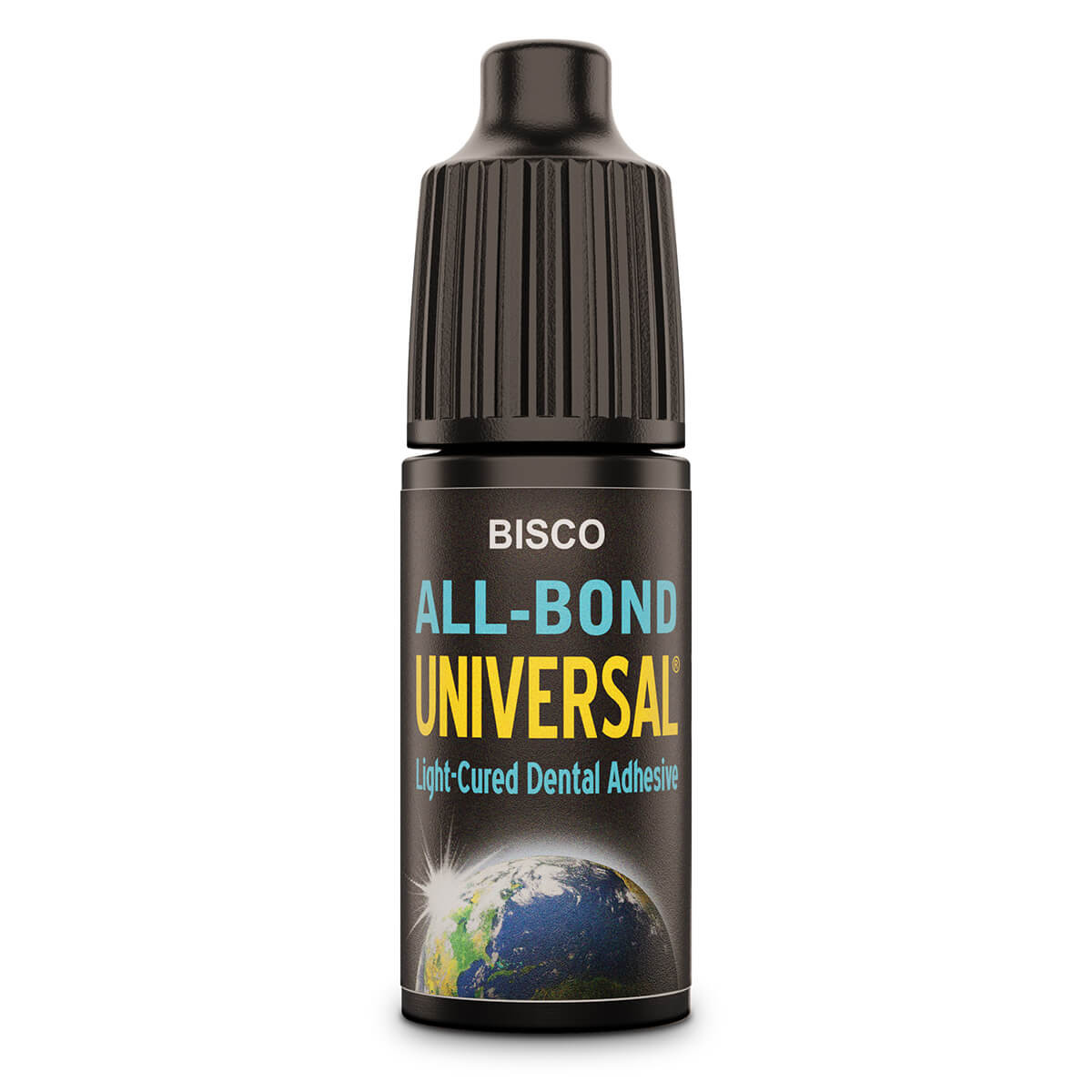
All-Bond Universal is a light-cured, single-component dental bonding agent manufactured by BISCO Inc. in Schaumburg, Illinois. The product represents what BISCO describes as the culmination of over 30 years of adhesive research, and it was developed to function as a truly universal adhesive across all bonding scenarios.
The adhesive is classified as universal because it supports total-etch, self-etch, and selective-etch techniques. It is an ethanol and water-based formula that bonds to dentin, cut enamel, and uncut enamel without requiring a separate primer or activator. A single 6 mL bottle yields approximately 145 restorations, making it an economical option for high-volume practices looking to streamline their dental supply inventory.
Unlike many competing universal adhesives that require a dual-cure activator (DCA) for compatibility with self-cured and dual-cured cements, All-Bond Universal eliminates that extra step entirely. This makes it a true single-bottle system for both direct and indirect restorations.
Key Specifications at a Glance
The table below summarizes the essential technical details that dental professionals should evaluate when considering All-Bond Universal for their adhesive protocol.
Specification | Details |
Manufacturer | BISCO Inc., Schaumburg, IL, USA |
Type | Light-cured, single-component universal dental adhesive |
Active monomer | 10-MDP (methacryloyloxydecyl dihydrogen phosphate) |
Solvent system | Ethanol/water |
pH | > 3 (ultra-mild) |
Cure modes | Compatible with light-, self-, and dual-cured materials |
Etching techniques | Total-etch, self-etch, selective-etch |
Activator required | No (true single-bottle system) |
Packaging | 6 mL bottle (~145 restorations), 4 mL bottle, 0.2 mL unit-dose (100/pack) |
Storage | 2°C–25°C (36°F–77°F), no refrigeration needed |
9 time | 10 seconds |
Film thickness | Low, ensures complete seating of indirect restorations |
Shelf stability | Reliable performance after 2 years at room temperature |
Composition and Chemistry Behind All-Bond Universal
The performance of any dental adhesive comes down to its chemistry. All-Bond Universal’s formula is built around several carefully engineered components that contribute to strong, durable bonding across a wide range of clinical situations.
The Role of 10-MDP Monomer
The 10-MDP monomer (10-methacryloyloxydecyl dihydrogen phosphate) is the adhesive’s primary functional component. When 10-MDP contacts calcium ions in tooth structure, it forms stable MDP-Ca salts that self-assemble into nano-layers at the adhesive interface. These nano-layers resist hydrolytic degradation, which is the primary mechanism of long-term bond failure in resin-based restorations. According to research published in Compendium, thin-film X-ray diffraction studies confirmed that All-Bond Universal produces stronger MDP-Ca salt nano-layers than at least two other commercial MDP-containing adhesives.
Unlike some acidic phosphate monomers that primarily decalcify tooth structure, MDP’s mechanism is adhesion-dominant. It bonds chemically to calcium ions and creates insoluble salts rather than dissolving mineral and relying solely on mechanical interlocking. This dual mechanism of chemical adhesion and micro-mechanical retention explains why MDP-containing adhesives consistently perform well in long-term studies.
Ultra-Mild pH and Its Clinical Advantages
All-Bond Universal has a pH above 3, placing it in the ultra-mild category among self-etch adhesives. This characteristic delivers three practical clinical benefits.
First, ultra-mild adhesives preserve more of the natural smear layer and dentin mineral content, resulting in fewer exposed collagen fibrils at the bonded interface. Fewer unprotected fibrils means less vulnerability to enzymatic degradation from matrix metalloproteinases (MMPs), which translates to a more stable hybrid layer over time.
Second, the ultra-mild acidity is the primary reason practitioners report virtually no postoperative sensitivity with All-Bond Universal. The adhesive does not aggressively open dentinal tubules the way stronger self-etch or total-etch systems can. Evaluating dentists in a Dental Product Shopper evaluation consistently noted a dramatic reduction in sensitivity complaints after switching to this adhesive.
Third, the higher pH contributes to excellent shelf stability. More acidic adhesives degrade faster in storage because the acidic monomers react with other bottle components over time. According to BISCO’s Director of R&D, All-Bond Universal still performs comparably to a freshly opened bottle after two years of room-temperature storage.
Hydrophobic Cured Film
Despite being ethanol and water-based during application (necessary for wetting the hydrophilic tooth surface), All-Bond Universal polymerizes into a hydrophobic film after curing. This matters because adhesive layers that remain hydrophilic post-cure absorb water over time, leading to plasticization and degradation. BISCO highlights the low water solubility of the cured film, meaning the adhesive resists washout in the moist oral environment.
Clinical Indications
All-Bond Universal covers a broad spectrum of restorative scenarios. The following list summarizes the adhesive’s approved indications based on BISCO’s official instructions for use.
All direct restorations, including resin-based composites, resin-modified glass ionomers, compomers, and core build-ups
All indirect restorations, including metal crowns, PFM, all-ceramic (lithium disilicate, zirconia, alumina), and composite inlays/onlays
Veneer cementation with light-cured, dual-cured, and self-cured resin cements, with no separate activator needed
Post cementation procedures
Intraoral repair of fractured porcelain, composite, or metal restorations
Desensitization, as the adhesive’s built-in tubule-sealing properties can reduce or eliminate the need for a separate desensitizing agent
This range of indications allows a practice to consolidate multiple adhesive products into one bottle, simplifying operatory setup, reducing procurement complexity, and lowering the risk of technique errors from managing several different bonding protocols.
How to Apply All-Bond Universal: Step-by-Step Protocol
Proper technique is critical to achieving optimal results with any dental adhesive. The following protocols are based on BISCO’s official instructions for use.
Selective-Etch Technique (Recommended)
BISCO recommends the selective-etch approach as the optimal protocol. Research has confirmed that selectively etching enamel with a universal adhesive improves enamel bond reliability while maintaining the gentler self-etch approach on dentin.
Step #1: Prepare the cavity and wash thoroughly with water spray.
Step #2: Apply 35% phosphoric acid (BISCO recommends Select HV Etch) to enamel margins only for 15 seconds, then rinse thoroughly.
Step #3: Remove excess water with an absorbent pellet or high-volume evacuation for 1–2 seconds. Leave the surface visibly moist without pooled water.
Step #4: Dispense 1–2 drops of All-Bond Universal into a clean well. Replace the cap immediately to prevent solvent evaporation.
Step #5: Apply two separate coats, scrubbing the preparation with a microbrush for 10–15 seconds per coat. Do not light cure between coats.
Step #6: Air-dry thoroughly for at least 10 seconds until there is no visible movement of the material. The surface should have a uniform glossy appearance.
Step #7: If the surface is not uniformly glossy, apply an additional coat and repeat air-drying.
Step #8: Light cure for 10 seconds.
Step #9: Proceed with restorative material placement per manufacturer's instructions.
Self-Etch and Total-Etch Alternatives
For the self-etch protocol, the steps above are followed identically, except that the phosphoric acid etching step is skipped. The adhesive’s acidic monomers handle both etching and priming simultaneously.
For the total-etch protocol, phosphoric acid is applied to both enamel and dentin for 15 seconds, rinsed thoroughly, and blotted before proceeding with adhesive application. While total-etch is fully supported, systematic reviews of universal adhesives have found that the selective-etch technique typically delivers the most reliable combination of enamel and dentin bonding performance.
Indirect Restoration Protocol
For indirect restorations, the adhesive is applied to the tooth preparation using the chosen etching technique. Additionally, All-Bond Universal should be applied to the internal surface of the indirect restoration and light-cured for 10 seconds before cementation. One important note: BISCO recommends using a separate ceramic primer (silane) on silica-based porcelain veneers rather than relying on All-Bond Universal alone. For zirconia, alumina, and metal substrates, the MDP monomer in the adhesive provides adequate bonding.
Bond Strength Performance and Research Evidence
Bond strength is one of the most important performance metrics for any dental adhesive. All-Bond Universal has been evaluated in numerous peer-reviewed studies alongside major competitors.
A study published in the Dentistry Journal evaluated six commercially available universal adhesives, including All-Bond Universal, across the degree of cure, Vickers microhardness, oxygen inhibition layer thickness, dentin demineralization, and shear bond strength. All-Bond Universal demonstrated competitive performance across these metrics, with its conversion and hardness values ranking favorably among the tested products.
A systematic review and meta-analysis published in Polymers found that several strategies improve dentin bonding performance across the universal adhesive category, including prolonged application time, an active scrubbing technique, multiple-layer application, and extended curing time. All-Bond Universal’s standard protocol already incorporates several of these evidence-based strategies, notably the two-coat scrubbing application and the emphasis on thorough solvent evaporation.
Another meta-analysis published in the Journal of Dentistry confirmed that selective enamel etching prior to the application of a mild or ultra-mild universal adhesive is the most advisable strategy for optimizing bonding. Enamel bond strength improves significantly with phosphoric acid pre-treatment, while the effect on dentin is neutral for mild adhesives. This aligns directly with BISCO’s recommendation to use the selective-etch technique.
The low film thickness of All-Bond Universal is another validated advantage. Thinner adhesive films allow indirect restorations to seat completely, preventing occlusal discrepancies and marginal gaps.
Long-Term Performance and Durability Considerations
While immediate bond strength values are important, the long-term durability of the adhesive-tooth interface is what ultimately determines clinical success. Restorations can function in the oral environment for decades, and the bonding agent must withstand continuous mechanical stress from mastication, temperature cycling from hot and cold foods, enzymatic degradation from salivary enzymes, and moisture exposure.
All-Bond Universal addresses these long-term challenges through several formulation features. The MDP monomer creates chemical bonds that form insoluble calcium salts, making the adhesive interface inherently resistant to water dissolution. The hydrophobic post-cure characteristics further protect the bonded interface from water uptake and plasticization, which are major contributors to adhesive degradation in other systems.
Research on universal adhesives has shown that bond strength can be improved through several application modifications. A systematic review in Polymers found that double-layer application, prolonged scrubbing, and extended curing time all contribute to enhanced dentin bonding performance. All-Bond Universal’s standard protocol already recommends two coats with active scrubbing, which aligns with the evidence base for improved bonding durability.
The ultra-mild pH also plays a role in long-term performance. Aggressive etching of dentin creates a thicker demineralized zone with more exposed collagen, which is vulnerable to degradation from matrix metalloproteinases (MMPs). The shallow demineralization pattern created by ultra-mild adhesives results in a more compact and homogeneous hybrid layer where nearly all collagen fibrils are encapsulated in resin, reducing the surface area available for enzymatic attack.
Practitioners who are investing in minimally invasive dentistry approaches will find that All-Bond Universal’s gentle interaction with dentin aligns well with conservative preparation philosophies. Preserving tooth structure and creating reliable, durable bonds are complementary goals, and the adhesive’s design supports both.
Clinical Tips for Maximizing Results
Following the manufacturer’s instructions is essential, but clinical experience and published research offer additional refinements that can improve outcomes with All-Bond Universal.
Use the selective-etch technique whenever possible. Enamel margins benefit from phosphoric acid etching for strong micro-mechanical retention, while dentin receives the gentler self-etch treatment that minimizes sensitivity.
Scrub actively during each coat. Active agitation pushes monomers deeper into the demineralized dentin and collagen network, improving hybrid layer formation.
Air-dry for the full 10 seconds. Inadequate solvent evaporation is one of the most common sources of bond failure with ethanol/water-based adhesives.
Recap the bottle immediately after dispensing. Ethanol evaporates rapidly when exposed to air, and leaving the bottle open compromises the adhesive’s composition.
Keep the preparation moist, not wet. All-Bond Universal bonds in the presence of moisture, but pooled water dilutes the adhesive.
Use Select HV Etch for the selective-etch protocol. Its high viscosity keeps the phosphoric acid on the enamel and prevents inadvertent dentin etching.
Consider unit-dose packaging for infection control. The 0.2 mL unit-dose format eliminates cross-contamination concerns and ensures a fresh dose for every patient.
Apply a separate silane primer for porcelain veneers. While the MDP monomer bonds well to zirconia and metals, silica-based ceramics benefit from a dedicated coupling agent.
Ensure your curing light delivers adequate output. A well-maintained LED curing light operating at recommended intensity ensures complete polymerization of the adhesive film.
How All-Bond Universal Compares to Leading Competitors
The universal adhesive market includes several well-known options. The comparison below highlights key differentiators. Practitioners should verify specific details with each manufacturer’s current instructions, as formulations can change.
Feature | All-Bond Universal (BISCO) | Scotchbond Universal (3M) | Clearfil Universal Bond (Kuraray) |
Activator required | No | DCA for self-cure | DCA for self-cure |
Contains 10-MDP | Yes | Yes | Yes |
pH | > 3 (ultra-mild) | ~2.7 (mild) | ~2.3 (mild) |
True single-bottle | Yes | No | No |
Silane included | No | Yes | No |
Post-op sensitivity | Virtually none | Low | Low |
The most significant differentiator is the activator requirement. All-Bond Universal’s ability to work with all cure modes from a single bottle removes a step that Scotchbond Universal and Clearfil Universal Bond still require for self-cured and dual-cured compatibility. The trade-off is that All-Bond Universal does not include silane in its formula, meaning porcelain veneer cases require an additional ceramic primer.
Who Should Use All-Bond Universal?
All-Bond Universal is designed as a universal solution, and it performs reliably across a wide spectrum of clinical situations. That said, certain practice profiles stand to benefit most.
General practitioners who handle a mix of direct composites, crown and bridge work, and veneers will find that All-Bond Universal simplifies their adhesive protocol and reduces the number of products in the operatory. Cosmetic dentists who prioritize patient comfort will value the ultra-mild formulation and near-elimination of post-treatment sensitivity. High-volume practices benefit from the streamlined workflow, as eliminating multiple adhesive bottles, primers, and activators reduces chair time and training requirements for dental assistants. For clinicians investing in a new practice setup, All-Bond Universal offers a cost-effective way to cover all bonding needs with a single product line.
Practitioners who frequently use dual-cured or self-cured cements for indirect restorations will appreciate the fact that no separate activator is required. This is a genuine workflow differentiator compared to competing universal adhesives, and it eliminates the risk of forgetting to add an activator during a busy clinical day. The time saved per restoration may seem small in isolation, but across hundreds of bonding procedures per year, it adds up to meaningful efficiency gains.
Dental students and recent graduates should also consider All-Bond Universal as a foundational adhesive. Learning one versatile system that covers all clinical bonding scenarios simplifies the transition from academic training to clinical practice and reduces the learning curve associated with managing multiple adhesive protocols. Reviewing recommended dental equipment for students can help new practitioners build a well-rounded supply list from the start.
Packaging Options and Value
All-Bond Universal is available in three configurations to suit different practice needs.
6 mL bottle: the standard option, providing approximately 145 restorations. The dropper bottle allows controlled single-drop dispensing.
4 mL bottle: a smaller option for practices that prefer shorter inventory turnover cycles.
Unit-dose pack (100 x 0.2 mL): individual single-use doses for maximum freshness, reduced cross-contamination risk, and convenient chairside delivery.
The All-Bond Universal Kit includes one 6 mL bottle plus a 5 g syringe of Select HV Etch with benzalkonium chloride, providing everything needed for the recommended selective-etch protocol in a single purchase.
Bottom Line
All-Bond Universal has earned its place as one of the most dependable universal dental adhesives available today. After more than a decade on the market, it carries a substantial track record of clinical success and consistent practitioner satisfaction.
The product delivers on its core promise: one bottle that handles etching, priming, and bonding across virtually every restorative scenario, with no separate activator required. The virtually nonexistent postoperative sensitivity is perhaps its most clinically impactful advantage. Practitioners who switch from other systems consistently report a dramatic decrease in patient complaints. The ultra-mild pH, effective tubule sealing, and hydrophobic cured film all contribute to that outcome.
From a workflow perspective, the ability to consolidate multiple adhesive products into a single bottle simplifies operatory setup, reduces inventory costs, and minimizes the risk of protocol errors. The 6 mL bottle providing roughly 145 restorations offers solid value, and the unit-dose option adds convenience for practitioners who prefer single-use packaging.
The area where All-Bond Universal requires the most attention is technique discipline. Two coats with active scrubbing and thorough solvent evaporation are non-negotiable. Practitioners should also remember that silica-based porcelain veneers need a separate ceramic primer. These are manageable considerations rather than deal-breakers.
Overall, All-Bond Universal earns a strong recommendation as a reliable, versatile, and clinically proven dental bonding agent that belongs in any modern restorative practice.
Verdict
<p>All-Bond Universal stands out in a crowded universal adhesive market for three core reasons: genuine single-bottle simplicity, minimal postoperative sensitivity, and proven long-term bond durability.</p><p>The MDP-based chemistry produces stable nano-layer bonding that holds up over time, while the ultra-mild pH keeps patients comfortable and preserves dentin integrity. Not needing a separate activator for dual-cure or self-cure compatibility is a meaningful operational advantage that competing products have yet to match fully. The excellent shelf stability (two years at room temperature) is a practical benefit that reduces waste and makes inventory management easier.</p><p>The two-coat application protocol adds a small amount of chair time compared to single-coat competitors, and the need for a separate silane on porcelain veneers is worth noting. These are minor trade-offs against the substantial benefits of streamlined inventory, broad compatibility, and a long track record of reliable clinical outcomes. All-Bond Universal deserves a spot on the shortlist for any practice re-evaluating its adhesive protocol.</p>
Frequently Asked Questions
Does All-Bond Universal require a separate activator for dual-cured or self-cured materials?
No. All-Bond Universal is formulated to be compatible with all light-cured, self-cured, and dual-cured composites and resin cements without a separate activator. This distinguishes it from several competing universal adhesives that still require an additional DCA bottle.
What etching technique does BISCO recommend for best results?
BISCO recommends the selective-etch technique, applying phosphoric acid to enamel margins only while allowing the adhesive’s self-etch capability to handle dentin. Systematic reviews support this approach as providing the most reliable combination of enamel and dentin bond strength with minimal postoperative sensitivity.
How many coats should be applied?
Two separate coats should be applied. Each coat should be actively scrubbed onto the preparation with a microbrush for 10–15 seconds. The two coats should not be light cured separately. After both coats, air-dry for at least 10 seconds before light curing once for 10 seconds.
Can All-Bond Universal be used for porcelain veneers?
Yes, with one important caveat. For silica-based ceramic veneers, BISCO recommends applying a separate silane ceramic primer to the veneer’s internal surface rather than relying on All-Bond Universal alone. For zirconia and alumina substrates, the MDP monomer in All-Bond Universal provides effective direct bonding.
Does All-Bond Universal cause postoperative sensitivity?
Postoperative sensitivity with All-Bond Universal is virtually nonexistent according to both BISCO’s clinical data and published practitioner evaluations. The ultra-mild pH avoids aggressive dentin demineralization, and the adhesive seals dentinal tubules effectively.
Does the product need to be refrigerated?
No. All-Bond Universal should be stored between 2°C and 25°C (36°F–77°F), but refrigeration is not required. Its ultra-mild formulation provides strong shelf stability.
How does All-Bond Universal handle moisture on the preparation surface?
All-Bond Universal is designed to bond in the presence of moisture. The preparation should be blotted with an absorbent pellet or high-volume evacuation to remove pooled water, but the dentin should not be desiccated.
Is All-Bond Universal compatible with other BISCO products?
Yes. All-Bond Universal integrates with BISCO’s product ecosystem, including Duo-Link Universal adhesive resin cement, Select HV Etch, Z-Prime Plus (for zirconia/alumina), and Porcelain Primer (for silica-based ceramics). It is also compatible with composites and cements from other manufacturers.
How does All-Bond Universal compare to three-step adhesive systems?
Three-step etch-and-rinse and two-step self-etch adhesives are still considered by many researchers as the laboratory gold standard for bond strength. All-Bond Universal offers clinically comparable performance with significantly fewer technique-sensitive steps, reduced chair time, and a much simpler protocol that reduces the potential for errors.
What should be done if the adhesive surface does not appear glossy after air-drying?
An additional coat of All-Bond Universal should be applied, followed by thorough air-drying. A uniform glossy appearance confirms that sufficient adhesive has been deposited and that the solvent has evaporated adequately. Proceeding without a glossy surface can compromise bond strength.