Rating: 4.5/5
Kerr OptiBond Review
Kerr OptiBond is one of the most studied adhesive families in restorative dentistry. OptiBond FL has served as a research control since its 1995 launch. This review compares each...
Reviewed by Agnes Markovic
Pros
- Deep clinical track record, with OptiBond FL used as a control in long-term randomized trials.
- Consistent GPDM chemistry across the whole range, so switching products does not mean learning a new chemical system.
- A product for every bonding strategy, from three-step etch-and-rinse to single-bottle universal.
- Filled, radiopaque adhesive layer in FL that resists over-thinning and absorbs polymerization stress.
- Broad substrate coverage in Universal 360, including zirconia and metal alloys, without separate primers.
- Dark-cure compatibility in Universal 360 with self-cure and dual-cure resin cements.
- Practical handling features, including a one-handed bottle and Unidose options.
Cons
- OptiBond FL takes more chair time and has more steps where errors can occur.
- The gold standard label is contested, and a meta-analysis found no consistent retention advantage for FL.
- Independent long-term clinical data for Universal 360 is still limited.
- Solvent evaporation is critical, and rushed air-drying weakens the bond.
- Enamel still benefits from selective phosphoric acid etching in self-etch and universal modes.
- FL radiopacity can be mistaken for a void or caries on radiographs.
- Frequent renaming and discontinued products make the portfolio confusing to buy from.
Kerr OptiBond is one of the most studied adhesive families in restorative dentistry. OptiBond FL has served as a research control since its 1995 launch. This review compares each OptiBond product against independent trial data and explains which one fits which clinical situation.
TL;DR
OptiBond FL delivers a filled, three-step etch-and-rinse bond that independent trials still use as their benchmark control.
OptiBond Universal 360 bonds tooth structure, zirconia, metal, and ceramic from one bottle and works with self-cure cements without an activator.
A 2021 meta-analysis found that modern competitors now match FL on cervical retention, so operator technique drives most outcomes.
Stock one universal adhesive for routine work and keep OptiBond FL for enamel-heavy esthetic cases.
What Is Kerr OptiBond?
Kerr OptiBond is a line of light-cure dental adhesives made by Kerr Dental. The name covers several products that span four adhesive generations and every major bonding strategy.
The range runs from a classic three-step etch-and-rinse system to single-bottle universal adhesives that work in self-etch, selective-etch, or total-etch mode. All of them share Kerr's GPDM monomer chemistry. OptiBond FL, the oldest product still sold, appears so often as the control arm in adhesive research that most clinicians recognize the name even if they have never ordered it.
For a practice deciding what to stock, the product name alone says little. The right choice depends on case mix, isolation conditions, the team's preferred etching strategy, and how many technique steps the operators will follow reliably on a busy afternoon. Adhesive selection belongs in the same conversation as any other dental materials decision.
The Chemistry Behind OptiBond
Every OptiBond product builds on a shared chemical platform. Understanding that platform helps explain why the products handle differently and where each one performs best.
The GPDM Monomer
Glycerol phosphate dimethacrylate, usually shortened to GPDM, is the acidic functional monomer at the center of the OptiBond line. It does two jobs at once.
A 2022 review of adhesive bond durability describes OptiBond FL's adhesive as highly hydrophobic and GPDM-based, and notes that GPDM can react chemically with hydroxyapatite in etched and primed enamel and dentin to improve durability. The acidic phosphate group conditions the tooth surface in self-etching formulas. The two methacrylate groups allow cross-linking inside the adhesive film, which produces a stiffer and less permeable layer. Hydrolytic breakdown of the hybrid layer is one of the main reasons bonds degrade over years of service, so a denser adhesive film matters.
MDP Enrichment In Universal 360
The newest product in the line adds a second functional monomer. Kerr describes OptiBond Universal 360 as GPDM-based and enriched with MDP.
MDP, or 10-methacryloyloxydecyl dihydrogen phosphate, is the monomer most closely associated with chemical bonding to zirconia and non-precious metal oxides. It also forms stable calcium salts on hydroxyapatite. Pairing GPDM with MDP is Kerr's route to bonding a wider range of indirect substrates without separate zirconia or metal primers.
Filler Loading And Radiopacity
OptiBond FL stands out among bonding agents for its filler content. Kerr lists a 48% filler load along with high radiopacity.
A filled adhesive leaves a thicker, more uniform film. Air-thinning is less likely to strip it away, and the layer can absorb some of the polymerization stress produced by the overlying composite. The radiopacity has a practical side effect worth teaching every associate. A thick layer of FL on a bitewing can look like a void or recurrent caries to a clinician who does not know the material was used.
Solvent Systems
Solvent choice shapes handling and moisture tolerance. Kerr's universal adhesives use a ternary solvent system that blends water, acetone, and ethanol.
Water ionizes the acidic monomers so they can etch. Acetone evaporates fast and carries residual moisture out of the surface, and ethanol sits between the two for wetting and shelf stability. None of that helps if the solvent stays in the film. Every solvent-based adhesive, OptiBond included, needs full air evaporation before light-curing, and skipping that step is one of the most common causes of weak universal adhesive bonds.
The Kerr OptiBond Product Line
Kerr sells several OptiBond products at once, and the names have changed over the years. The sections below cover each current product and one older product that still turns up in catalogs.
OptiBond FL
OptiBond FL is a fourth-generation, three-step etch-and-rinse adhesive. The clinician applies phosphoric acid etchant, a separate primer, and a separate filled adhesive, then light-cures once.
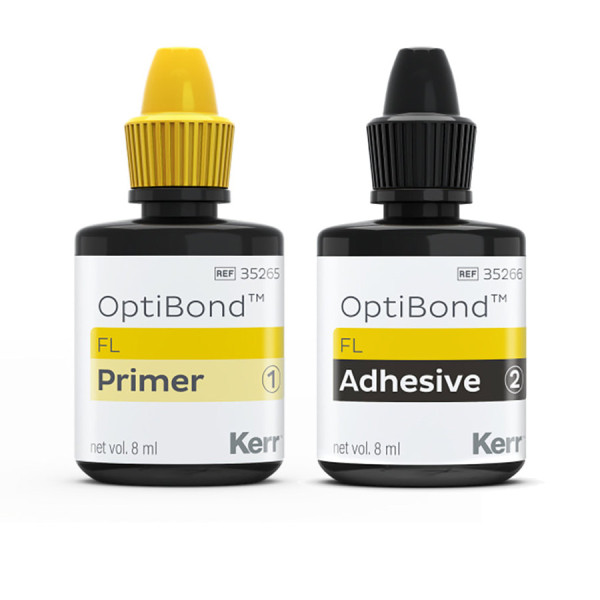
Kerr's product page lists a one-coat primer, a one-coat adhesive, a single light-curing step, and suitability for wet or dry preparations. The standard kit includes an 8 ml primer bottle, an 8 ml adhesive bottle, and a 3 g syringe of gel etchant, and a Unidose version is available. Its reputation in the literature is unusually strong. The 2022 durability review notes that FL was ranked the top adhesive system in a benchmark paper on adhesive dentistry.
FL suits clinicians who want control over each phase of adhesion. It performs well in large anterior composites, Class IV restorations, diastema closures, and cases with a lot of enamel. The cost is time, and every added step is one more chance for an error such as over-drying dentin after rinsing.
OptiBond Solo Plus
OptiBond Solo Plus is a fifth-generation, two-step etch-and-rinse adhesive. It combines primer and adhesive in one bottle and goes on after phosphoric acid etching.
The workflow is shorter than FL's while keeping the familiar total-etch approach and GPDM chemistry. An in vitro study of total-etch adhesives tested both FL and Solo Plus on human dentin and found that pretreating dentin with 50 µm aluminum oxide air abrasion significantly raised microtensile bond strength for both products. Two-step etch-and-rinse adhesives are generally more sensitive to dentin moisture than three-step systems, because the primer and adhesive are no longer applied and dried separately.
OptiBond eXTRa Universal
OptiBond eXTRa Universal, previously sold as OptiBond XTR, is a two-bottle self-etch system. A self-etching primer conditions enamel and dentin without a separate phosphoric acid step, and a hydrophobic adhesive goes on top.
Two-step self-etch systems with a separate adhesive coat are widely regarded as the most durable self-etch design. The hydrophobic top layer reduces water uptake compared with single-bottle products. Kerr markets eXTRa Universal for direct and indirect restorations and for use with self-cure, dual-cure, and light-cure resin cements and core materials. Selective phosphoric acid etching of enamel margins is still a good idea with this system, especially on uncut enamel.
OptiBond Universal 360
OptiBond Universal 360 is Kerr's current flagship single-bottle universal adhesive. It replaced the earlier OptiBond Universal and targets practices that want one adhesive for nearly every indication.
Kerr's product page states that it bonds to all surfaces and substrates with any resin cement, even without light, and works with any etching technique in direct and indirect restorations. The same page explains the dark-cure claim. The formula balances hydrophilic and hydrophobic components to prevent phase separation at the adhesive and resin cement interface, which supports polymerization in total dark cure mode.
That claim targets a real weakness of single-bottle universals. Acidic monomers can interfere with the amine initiators in self-cure and dual-cure cements, and many manufacturers solve this with a separate dual-cure activator. Kerr's approach removes the extra bottle. The adhesive also comes in a redesigned bottle that opens and closes with one hand, and Kerr sells bottle kits, Unidose kits, and refills.
OptiBond All-In-One
OptiBond All-In-One is an older seventh-generation, single-step self-etch adhesive. In many markets, the universal adhesives have replaced it, so availability varies.
It still has a clinical record. A one-year clinical trial in noncarious cervical lesions used OptiBond All-In-One with Herculite XRV Ultra composite under rubber dam isolation without cavity preparation. Practices that find it in a distributor catalog should confirm current availability with Kerr before building a protocol around it.
Kerr OptiBond Products Compared
The table below summarizes the four products most practices will consider. Kit contents and availability vary by region, so check local catalogs before ordering.
Product | Strategy | Components | Etch Mode | Key Feature | Typical Fit |
|---|---|---|---|---|---|
OptiBond FL | 3-step etch-and-rinse | Etchant, primer, adhesive | Total-etch | 48% filled, high radiopacity | Enamel-heavy esthetic work |
OptiBond Solo Plus | 2-step etch-and-rinse | Etchant, one-bottle adhesive | Total-etch | Filled, single bottle | Fast routine total-etch |
OptiBond eXTRa Universal | 2-step self-etch | Self-etch primer, adhesive | Self-etch or selective-etch | Separate hydrophobic coat | Dentin-dominant preps, sensitive patients |
OptiBond Universal 360 | 1-bottle universal | One bottle | Self, selective, or total-etch | GPDM plus MDP, dark-cure capable | Direct and indirect work from one bottle |
Hands-On Clinical Evaluation
Published data only goes so far, so the Dental Reviewed clinical team ran OptiBond FL, OptiBond eXTRa Universal, and OptiBond Universal 360 through a set of routine chairside cases. The cases below are illustrative clinical scenarios drawn from that evaluation. They describe handling and short-term patient response and are not a controlled study.
Case 1: Class IV Composite With OptiBond FL
The first case involved a 34-year-old patient who fractured the mesioincisal corner of tooth #8 on a water bottle. The fracture exposed about 3 mm of enamel and a small band of dentin with no pulpal involvement.
The team placed a rubber dam, beveled the enamel margin, and etched for 15 seconds with enamel first and dentin last. After rinsing, the dentin was blotted until it looked moist rather than chalky. The primer went on with light scrubbing and was air-dried until the surface stopped moving. The filled adhesive formed a visible, even film that resisted thinning under a gentle air stream, which gave the operator more margin for error than an unfilled product. The restoration was layered freehand, starting from a palatal enamel shell.
At the two-week check, the patient reported no cold sensitivity and said the tooth felt "like it was never broken." The margin was invisible under 3.5x dental loupes. Total bonding time, from etch to cure, ran a little over two minutes.
Case 2: Lithium Disilicate Onlay With OptiBond Universal 360
The second case was a lithium disilicate onlay on tooth #30 for a 52-year-old patient with a cracked mesiolingual cusp. The preparation had enamel on the buccal margin and exposed dentin across most of the pulpal floor.
The team immediately sealed the dentin at the preparation appointment with OptiBond Universal 360 in self-etch mode. At seating, the enamel margins were selectively etched with phosphoric acid for 15 seconds. The intaglio of the onlay was etched with hydrofluoric acid according to the ceramic manufacturer's instructions, and the team then relied on Universal 360 without a separate silane, following Kerr's claim that no auxiliary primer is needed. A dual-cure resin cement completed the seat.
The one-handed bottle was easy to work with while the assistant held the retraction. The adhesive spread thin and dried quickly. The patient reported mild biting tenderness for two days, which resolved without adjustment, and no thermal sensitivity at the three-week recall. Some clinicians will still prefer to add a dedicated silane on glass ceramics until more independent data on silane-free protocols is available, and the team would not argue against that choice.
Case 3: Cervical Lesions and Sensitivity With OptiBond eXTRa Universal
The third case involved a 61-year-old patient with three noncarious cervical lesions on the maxillary premolars and a long history of cold sensitivity. Two earlier restorations placed elsewhere with a total-etch system had debonded.
The team chose OptiBond eXTRa Universal in self-etch mode with selective enamel etching at the incisal margins. The self-etch primer was scrubbed for the full recommended time, air-dried, and followed by the adhesive coat. A flowable liner and a nanohybrid composite completed the restorations. Isolation relied on a clamp and cord because the lesions extended close to the gingival margin.
The patient returned at one month and reported that cold water no longer caused discomfort on any of the three teeth. The patient noted this was the first time in years that iced drinks were comfortable on that side. The restorations were intact with no marginal staining. One month says nothing about long-term retention, and cervical restorations need multi-year follow-up before any conclusion about durability.
What The Evaluation Showed
Across the three cases, each product behaved in line with its design. OptiBond FL was the most forgiving on enamel and the most time-consuming.
OptiBond Universal 360 was the fastest and simplified the indirect workflow the most, and it demanded the most attention to solvent evaporation. OptiBond eXTRa Universal gave a thicker adhesive film than the single-bottle universal and produced the best patient comfort in the sensitive cervical case. None of these observations replace clinical trial data, and they should be read alongside the research below.
What The Independent Research Shows
Independent clinical trials give a more reliable picture than manufacturer data or single cases. Most of the long-term evidence concerns OptiBond FL, because researchers use it as a control.
OptiBond FL As The Research Control
Noncarious cervical lesions are the standard model for adhesive trials because they offer no mechanical retention. If the adhesive fails, the restoration falls out.
A 14-year randomized controlled trial restored 267 cervical lesions in 52 patients and compared a HEMA-free one-step self-etch adhesive with OptiBond FL as the gold-standard control. At 14 years, loss of retention accounted for failure in 19.6% of FL restorations and 19.4% of the self-etch group, with a 63% patient recall rate. The two strategies ended up nearly identical, and neither was immune to long-term degradation.
Laboratory work tells a similar story. A micro-computed tomography study used OptiBond FL as the etch-and-rinse control while evaluating internal adaptation of universal adhesives in Class V cavities after thermomechanical loading and four years of water storage.
The Gold Standard Label Under Review
The FL reputation has been tested directly. A systematic review and meta-analysis in Operative Dentistry asked whether cervical restorations bonded with OptiBond FL or Clearfil SE Bond are retained better than those bonded with other brands.
The authors concluded that the randomized trial evidence does not support the belief that these two adhesives outperform competing brands. FL still performs well. The finding means several well-formulated modern adhesives have caught up. Some trials show the opposite of the traditional ranking. A 36-month randomized study found lower cumulative failure rates from 12 months onward for a competing universal adhesive in self-etch and etch-and-rinse modes than for the OptiBond FL control, which reached 16.7%.
Evidence For The Universal Adhesives
OptiBond Universal 360 is a recent product, and independent long-term clinical data is still limited. Most of the published material comes from Kerr, laboratory bond strength testing, and case reports.
Kerr's own case report on Universal 360 describes replacing six PFM crowns on teeth #6 to #11 and states that the author is a paid Kerr consultant. Disclosed consultant reports are common in dental product literature and carry less weight than independent randomized trials. A reasonable position is that Universal 360 has a sound design and encouraging early data, and it will need several years of independent follow-up before its evidence base approaches FL's.
Application Technique
The current instructions for use packaged with each product take priority over any summary, because Kerr updates them. The outlines below follow the typical workflow and explain why each step matters.
OptiBond FL Step-by-Step
OptiBond FL rewards a slow, deliberate sequence. Each step below maps to one phase of adhesion.
Isolate the field, ideally with a rubber dam, because saliva and crevicular fluid contamination cause many bond failures.
Etch enamel and dentin with phosphoric acid gel for about 15 seconds, starting on enamel and finishing on dentin to avoid over-etching.
Rinse thoroughly and remove excess water while leaving dentin moist and glistening, not dry and chalky.
Scrub the primer into the surface with light agitation for about 15 seconds, then air-dry gently to evaporate the solvent.
Apply one uniform coat of the filled adhesive and air-thin lightly so a meaningful film remains.
Light-cure according to the instructions with a unit whose output has been checked recently.
OptiBond Universal 360 Step-By-Step
The universal workflow is shorter, and it concentrates the risk in two steps: etch mode selection and solvent evaporation.
Choose the etch strategy, with selective enamel etching using 37.5% phosphoric acid for 15 seconds on enamel-rich or uncut surfaces.
Shake the bottle for 10 seconds before first use, then briefly before each later use, and dispense 2 to 3 drops into a clean well.
Close the cap right away to limit solvent loss from the bottle.
Scrub the adhesive actively into the surface for the full time listed in the instructions.
Air-dry until the film no longer moves, since trapped water and solvent weaken universal adhesive layers.
Light-cure for direct restorations and follow the instructions for indirect cementation with dual-cure or self-cure cements.
Common Technique Errors
Most bond failures trace back to technique rather than chemistry. The errors below show up across every OptiBond product and every competitor.
Over-drying dentin after etching collapses the collagen network and blocks primer penetration.
Skipping active scrubbing reduces monomer infiltration and self-etching effectiveness.
Short air-drying leaves solvent in the film, which produces a porous, weak layer.
Pooling adhesive in line angles creates thick spots that may cure poorly.
A weak LED curing light delivers less energy than the operator assumes, especially when the tip sits several millimeters from the surface.
Choosing The Right OptiBond For Your Practice
The best OptiBond product depends on the procedures a practice performs most often. Adhesive choice should also fit the wider dental treatment plan, since a patient scheduled for several bonded ceramics and direct composites benefits from a consistent protocol across visits.
Practices focused on direct anterior work and cosmetic dentistry will get the most from OptiBond FL. Its filled layer handles large enamel surfaces well and pairs naturally with layered composites. Offices that rely on single-shade materials such as those covered in the Omnichroma review can use FL or a universal, depending on how much enamel the preparation leaves.
Practices where post-operative sensitivity is a frequent complaint can lean toward OptiBond eXTRa Universal. Self-etch conditioning reduces the risk of over-etching dentin, and the separate adhesive coat gives a more hydrophobic seal. This fits a minimally invasive dentistry approach that preserves as much tooth structure as possible.
Offices doing a lot of indirect work, from chairside milling to veneers and a dental bridge, will find OptiBond Universal 360 the simplest fit. One bottle covers zirconia and glass ceramic surfaces and works with self-cure cements and core materials. It also pairs well with bulk base materials such as the fiber-reinforced composite in this everX review.
Many practices stock two adhesives. A universal handles most routine restorative dentistry, and OptiBond FL stays on hand for demanding esthetic cases and for training new associates in the fundamentals of etch-and-rinse bonding.
OptiBond Vs Competing Bonding Agents
OptiBond competes with adhesives from 3M, Kuraray, Dentsply Sirona, GC, and Ivoclar. Differences between premium products are generally smaller than differences caused by technique.
OptiBond FL and Clearfil SE Bond 2 are the two traditional benchmarks, one etch-and-rinse and one mild two-step self-etch with MDP chemistry. The Operative Dentistry meta-analysis grouped them and found neither consistently better than other brands in cervical retention. Clinicians who prefer total-etch tend to choose FL, and those who prefer mild self-etch tend to choose Clearfil SE Bond 2.
OptiBond Universal 360 competes most directly with Scotchbond Universal Plus and Prime&Bond active. The useful comparison points are compatibility with the cements and core materials the practice already uses, recommended application time, film thickness, and radiopacity. OptiBond eXTRa Universal sits in the same two-step category as G2-Bond Universal, a design that addresses the permeability of thin single-bottle adhesive films. The full range of bonding and restorative products reviewed on the site is listed in the materials reviews category.
Storage, Packaging, And Cost
Handling and purchasing details affect daily use as much as chemistry. These factors are easy to overlook when comparing products on bond strength alone.
Kerr markets OptiBond Universal 360 for room-temperature storage, which simplifies inventory. Other OptiBond products have their own label requirements, and every adhesive should stay away from heat and direct sunlight and be discarded after its expiry date.
Bottles cost less per application, but repeated opening exposes the adhesive to solvent loss and cross-contamination. Unidose delivery costs more per procedure and provides a fresh, correctly balanced dose every time, which also supports infection control protocols. Many offices use bottles in high-volume operatories and Unidose in rooms with lower adhesive use.
Prices vary by region, distributor, and promotion. Cost per application gives a truer comparison than cost per bottle, and a universal that replaces separate primer and activator bottles may cost less overall despite a higher sticker price. Sound dental procurement habits, such as tracking usage per operatory and rotating stock by expiry date, reduce waste. Patients rarely see this cost directly, though adhesive and composite costs feed into what practices charge for a composite filling.
Bottom Line
Kerr OptiBond covers every major bonding strategy with a shared GPDM chemistry and one of the longest research records of any adhesive family. OptiBond FL has been on the market since 1995 and still anchors randomized trials as the etch-and-rinse control. Its filled, radiopaque adhesive layer and three-step sequence make it the most controlled option for enamel-heavy esthetic work, at the cost of extra chair time.
OptiBond Universal 360 fits practices that want one bottle for direct and indirect work. It bonds to zirconia and metal alloys without separate primers and supports self-cure cements without an activator, which trims inventory and lowers the chance of protocol errors between providers. OptiBond eXTRa Universal sits between the two, with a self-etch primer and a separate hydrophobic coat that suit dentin-heavy preparations and patients prone to sensitivity. Independent long-term data on Universal 360 is still thin, so clinicians who want a deep evidence base will keep FL in the drawer for now.
Product choice should follow case mix and the team's technique habits more than brand reputation. The 14-year clinical trial found near-identical retention for FL and a one-step self-etch adhesive, and the Operative Dentistry meta-analysis found no consistent retention advantage for FL over other brands. Isolation quality and complete solvent evaporation shape clinical results with any OptiBond product. A practice with a heavy anterior esthetic load will get more value from FL than one that mostly places posterior composites and bonded onlays.
Verdict
<p>Kerr OptiBond holds up well against both its reputation and its competitors, with a few caveats that matter in daily practice.</p><p>OptiBond FL remains a dependable choice for enamel-dominant esthetic work such as Class IV restorations and diastema closures. The filled adhesive handles predictably and resists over-thinning, and the three-step sequence forces attention to each phase of adhesion. The trade-off is chair time. The independent literature also makes clear that FL no longer outperforms every modern competitor, which the 14-year cervical trial and the Operative Dentistry meta-analysis both support.</p><p>For routine direct and indirect work, OptiBond Universal 360 is the more practical product. One bottle that bonds to dentin, enamel, zirconia, metal, and ceramic and works with self-cure cements without an activator simplifies inventory and reduces protocol mistakes in multi-provider offices. Selective enamel etching and thorough air-drying remain essential with it, because universal adhesives only perform well when the solvent is gone.</p><p>OptiBond eXTRa Universal deserves more attention than it gets, particularly for sensitivity-prone patients and dentin-dominant preparations. The recommended setup for most general practices is a universal for everyday cases with FL kept on hand for demanding esthetic work. Isolation, curing light output, and solvent evaporation will influence outcomes more than the brand chosen.</p><p></p>
Frequently Asked Questions
What is the difference between OptiBond FL and OptiBond Universal 360?
OptiBond FL is a three-step etch-and-rinse adhesive with separate etchant, primer, and filled adhesive, used mainly for direct restorations and core build-ups. OptiBond Universal 360 is a single-bottle universal adhesive that works in any etch mode and bonds to zirconia and metal alloys without separate primers.
Is OptiBond FL still the gold standard adhesive?
OptiBond FL remains a common research control and performs reliably. A systematic review and meta-analysis in Operative Dentistry found that randomized trial evidence does not show it consistently outperforming other commercial adhesives in cervical lesions.
Can OptiBond Universal 360 be used with self-cure resin cements?
Yes. Kerr states that it bonds with any resin cement, even without light, and without a separate dual-cure activator. Always confirm the current instructions for the specific cement in use.
Do I need to etch enamel when using a universal OptiBond adhesive?
Etching is optional, but selective enamel etching with phosphoric acid is widely recommended for uncut enamel and enamel-dominant preparations. Mild self-etch adhesives etch enamel less aggressively than phosphoric acid.
Does OptiBond reduce post-operative sensitivity?
The OptiBond adhesives are formulated to seal dentin, and self-etch modes lower the risk of over-etching. Most sensitivity still comes from technique errors, such as over-drying dentin or incomplete curing.
Why does OptiBond FL look radiopaque on X-rays?
FL has a 48% filler load and high radiopacity. Clinicians should know the material was used so that a thick adhesive layer is not misread as a void or recurrent caries.
Is OptiBond eXTRa Universal the same as OptiBond XTR?
OptiBond eXTRa Universal is the current name for the two-step self-etch system previously sold as OptiBond XTR. It pairs a self-etching primer with a separate adhesive.
Does OptiBond Universal 360 need refrigeration?
Kerr markets OptiBond Universal 360 for room-temperature storage. Other products in the line may have different requirements, so check each label.
Should a practice buy OptiBond in bottles or Unidose?
Unidose gives a fresh, consistent dose every time and supports infection control, at a higher cost per application. Bottles cost less for high-volume use but need prompt capping to limit solvent loss.