Rating: 4.1/5
Filtek Supreme Ultra Review: Is This Composite Still Worth Using?
Filtek Supreme Ultra has been the reference nanocomposite in many restorative operatories since 3M launched it in 2009. This Filtek Supreme Ultra review covers its chemistry,...
Reviewed by Maren Solvik
Pros
- Gloss lasts for years thanks to the nanocluster filler
- Thirty-six shades in four color-coded opacities support every technique from single shade to full layering
- Strength and wear resistance suit load-bearing posterior restorations
- Wear was among the lowest measured, and 96% of restorations showed no wear at up to 15 years
- A clinical record of up to 15 years gives a 96% rating across more than 2,300 restorations
- Radiopacity of 2.4 mm aluminum makes margins easy to read on radiographs
- Natural fluorescence keeps restorations from looking dark under UV light
- Capsules are approved for warming to 70 °C and work for injection molding
Cons
- Premium price compared with most mid-range composites
- Full use of the shade system requires a large inventory
- Incremental placement of 2 mm or less slows deep posterior restorations
- Shrinkage of about 2% with no low-stress monomers
- Firm paste can feel stiff at room temperature
- Shades cure slightly darker and more translucent, so test buttons are advisable
- The lightest enamel bleach shade may not match heavily whitened teeth
Filtek Supreme Ultra has been the reference nanocomposite in many restorative operatories since 3M launched it in 2009. This Filtek Supreme Ultra review covers its chemistry, shade system, handling, cure protocol and clinical record, then weighs it against newer universal composites so dentists can decide where it still belongs on the tray.
TL;DR
Filtek Supreme Ultra offers 36 shades in four opacities for single-shade fills and full anterior layering.
Independent recalls of more than 2,300 restorations gave the material a 96% clinical rating at up to 15 years.
The nanocluster filler keeps its gloss after brushing better than most hybrid and bulk-fill composites in lab tests.
Incremental 2 mm placement and a premium price make it slower and costlier than bulk-fill alternatives.
What Is Filtek Supreme Ultra Universal Restorative
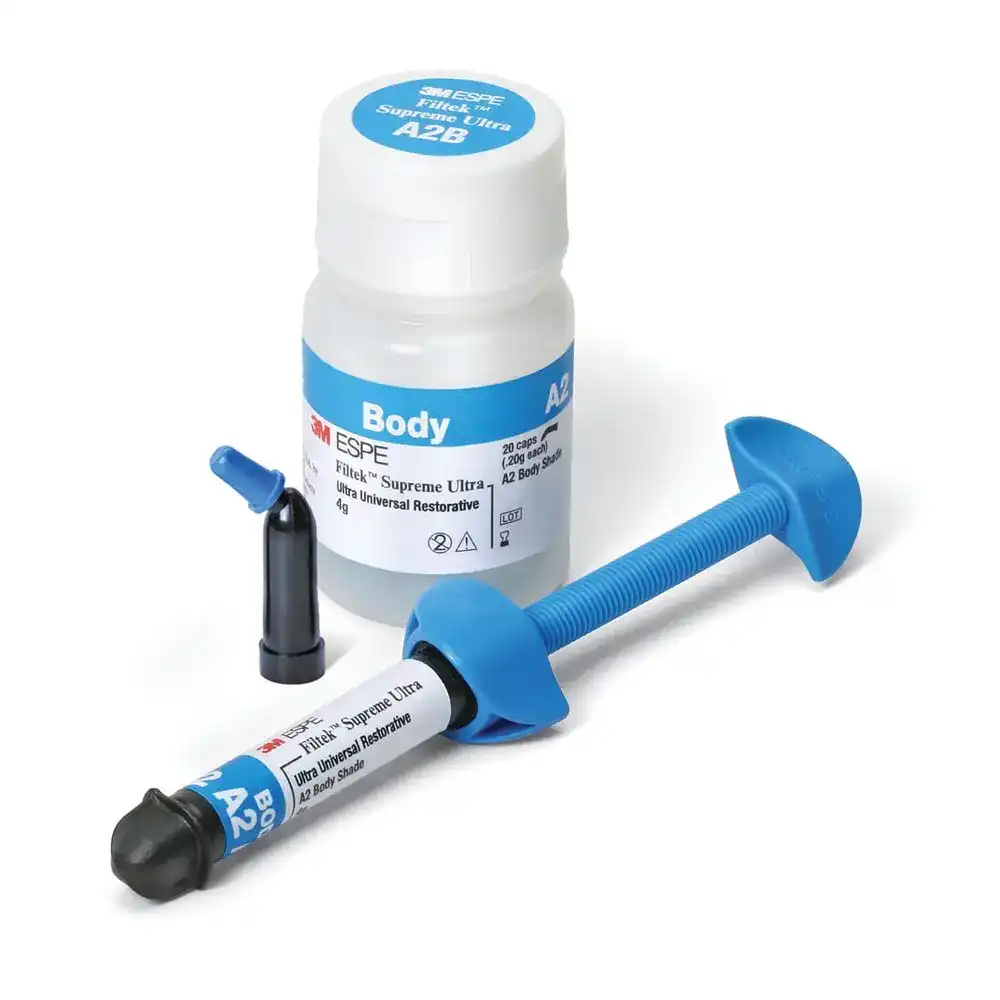
Filtek Supreme Ultra Universal Restorative is a light-cured, nanofilled composite resin indicated for Class I to V restorations in both arches. Solventum, the healthcare company 3M spun off in 2024, now manufactures and sells it. The material is fluorescent and radiopaque, and it comes in 4 g syringes and 0.2 g single-dose capsules.
The line began in 2002, when 3M released Filtek Supreme as the first commercial nanocomposite. Filtek Supreme Plus followed in 2005 and Filtek Supreme Ultra arrived in 2009, according to the 15-year Dental Advisor report published by 3M. Each generation kept the same filler concept. The changes came mainly in shading and in the handling of the translucent shades, which were sticky and soft in Supreme Plus and were reformulated for Ultra.
Regional Names For The Same Material
Dentists who search the literature will find this composite under several labels. Outside North America it is sold as Filtek Supreme XTE, and across Latin America and much of Asia it carries the Filtek Z350 XT name. Studies on any of these products describe the same chemistry, which makes the evidence base far larger than a search for "Filtek Supreme Ultra" alone suggests.
Catalog numbers survived the move to Solventum. Syringes still use the 6028 prefix and capsules use 6029, so an assistant reordering A2 Body capsules looks for 6029A2B whether the box shows the 3M logo or the new one.
How The Nanofill Chemistry Works
Filtek Supreme Ultra contains no ground glass. Every filler particle is nanoscale or is a cluster built from nanoscale particles. In a 2003 paper in the Journal of the American Dental Association, a 3M team led by chemist Sumita Mitra described how they assembled loosely bound clusters from individual silica and zirconia nanoparticles. That design is the reason the material polishes like a microfill while carrying occlusal load like a hybrid.
Filler System
The technical product profile describes discrete 20 nm silica and 4–11 nm zirconia particles dispersed in the resin, alongside clusters assembled from those same particles. The clusters measure 0.6–10 µm in every shade except the translucents, where they reach 0.6–20 µm. All particles are silane treated to bond with the matrix.
Wear behavior explains most of the material's reputation. When a conventional hybrid is brushed, its larger glass particles pluck out and leave pits that scatter light, and the surface turns matte within a few years. A nanocluster sheds individual nanoparticles at roughly the rate the surrounding resin wears, so the surface stays smooth and the restoration keeps its luster.
Shade group | Filler by weight | Filler by volume |
|---|---|---|
Dentin, Body, Enamel | 78.5% | 63.3% |
Translucent | 72.5% | 55.6% |
The translucent shades carry less filler. They feel slightly softer under the instrument, and they shrink more on curing, which matters when they are used in thick incisal layers.
Resin Matrix
The matrix is a conventional methacrylate blend of bis-GMA, UDMA, TEGDMA, PEGDMA and bis-EMA. PEGDMA replaced part of the TEGDMA used in earlier generations to moderate polymerization shrinkage. The formula does not contain the stress-relieving AUDMA and AFM monomers that 3M later introduced in Filtek Universal, a difference with real consequences for deep Class II boxes.
The instructions for use classify the material as ISO 4049 Type 1, Class 2, with a radiopacity of 2.4 mm aluminum in every shade. That figure sits above enamel, so recurrent caries under a Filtek margin reads clearly on bitewing radiographs.
Filtek Supreme Ultra Shades And Opacities
The range of Filtek Supreme Ultra shades is the strongest argument for choosing this composite over simpler universal materials. It offers 36 shades across four opacities keyed to the VITA classical guide, and each opacity has its own colored label so an assistant can pick the right syringe from a drawer at a glance.
Opacity | Role | Shades | Count |
|---|---|---|---|
Dentin (D) | Most opaque, replaces dentin and masks dark substrate | A1D, A2D, A3D, A4D, B3D, C4D, WD | 7 |
Body (B) | Medium opacity, single-shade restorations | A1B, A2B, A3B, A3.5B, A4B, A6B, B1B, B2B, B3B, B5B, C1B, C2B, C3B, D2B, D3B, WB, XWB | 17 |
Enamel (E) | Replaces enamel over dentin shades | A1E, A2E, A3E, B1E, B2E, D2E, WE, XWE | 8 |
Translucent (T) | Incisal effects and occlusal glaze | Clear, Blue, Gray, Amber | 4 |
Bleaching shades cover patients who have whitened, and the dark A6B and B5B body shades exist for cervical root-surface lesions where standard A4 looks too light.
Choosing A Shading Technique
Most restorations need one or two shades. The full layering kit earns its cost on a minority of cases, mainly Class IV fractures and direct veneers.
Single-shade technique: one Body shade fills the cavity, which covers most posterior restorations and small Class III and V lesions.
Dual-shade technique: a Dentin shade goes in first and an Enamel shade covers it, for example A3E over A4D as recommended by 3M.
Body plus translucent: a thin translucent layer on the occlusal surface helps a posterior restoration blend with surrounding enamel.
Full layering: Dentin, Body, Enamel and Translucent shades rebuild mamelons, halo and incisal translucency on demanding anterior cases.
One case published by 3M used A3D, A3.5B and A1E to rebuild a fractured central incisor. That combination is a sensible starting kit for Class IV work in an A3 dentition.
Shade Matching In Practice
Shade selection should happen on a hydrated tooth before isolation, because enamel dries and lightens within minutes under a dam. A cured button placed on the unetched tooth is the most reliable check. Most Filtek Supreme Ultra shades cure slightly darker and more translucent than they look in the syringe, a shift that independent evaluators have also reported.
Deep cavities need a Dentin shade underneath. Without it, light passes through the restoration into the dark pulp chamber and the result looks gray. The whitest enamel bleach shade may still read too dark next to heavily whitened teeth, so XWE deserves a test button before a veneer case.
Handling And Composite Warming
At room temperature the Filtek Supreme Ultra composite is a firm, sculptable paste that holds its shape and releases cleanly from a composite instrument. Clinicians who prefer creamier pastes may find it stiff when adapting to a proximal box. Dental Advisor consultants placed 1,141 Filtek Supreme Ultra restorations in their 2013 evaluation and gave the material a 92% clinical rating, with 91% saying they would recommend it.
Syringes Versus Capsules
The delivery format changes cost per restoration and infection control more than it changes the material.
Format | Size | Best use | Practical notes |
|---|---|---|---|
Syringe | 4 g | Anterior layering and low-volume shades | Lower cost per gram, dispense onto a pad under a light shield |
Capsule | 0.2 g | Posterior fills, warming and injection | Needs a dispenser, single use reduces cross-contamination |
Syringes have a triangular finger plate that makes extrusion easier with gloved hands. Practices that stock the full shade range usually buy Dentin, Enamel and Translucent shades as syringes and keep their two or four most common Body shades in capsules.
What Warming Changes
According to the 3M product page, capsules can be warmed to 70 °C for up to one hour without changing the physical properties. Warming lowers viscosity, which improves wall adaptation and allows injection molding through a clear silicone index, the same technique used with dedicated injectable materials such as G-aenial Universal Injectable.
The laboratory evidence supports the practice. In a 2005 study in the Journal of Dental Research, monomer conversion of a commercial composite rose from 31.6% at 3 °C to 67.3% at 60 °C. A 2006 follow-up found that the composite lost about half its added heat within two minutes of leaving the heater, and that repeated heating cycles did not reduce conversion. A 2023 study in the Brazilian Dental Journal measured Filtek Supreme Ultra conversion at 54.7% at room temperature and 58.1% after preheating.
Warm capsules should go from heater to cavity within seconds, and each increment should be adapted before the paste stiffens.
Physical Properties Of Filtek Supreme Ultra
The Filtek Supreme Ultra composite combines flexural strength above 160 MPa with very low wear and strong gloss retention. The figures below come from the manufacturer's technical product profile, so the independent studies cited after the table carry more weight.
Property | Dentin, Body, Enamel | Translucent |
|---|---|---|
Flexural strength (MPa) | 165 | 158 |
Flexural modulus (GPa) | 11.3 | 9.2 |
Compressive strength (MPa) | 371 | 394 |
Diametral tensile strength (MPa) | 86 | 91 |
Fracture toughness K1c (MPa·m½) | 1.84 | 1.51 |
Volumetric shrinkage (%) | 1.97 | 2.48 |
3-body wear (µm lost) | 5.6 | 6.5 |
Gloss after polishing (gloss units) | 94.8 | 93.8 |
Gloss after 6,000 brushing cycles | 68.6 | 79.7 |
Radiopacity (mm Al) | 2.4 | 2.4 |
Reading The Numbers Chairside
Strength and wear values look good on paper, and independent work largely confirms them. The details below matter most for case selection.
Flexural strength of 165 MPa is roughly double the ISO 4049 minimum for occlusal materials.
Fracture toughness of 1.84 is solid for a nanofill, although 3M reports higher toughness for Filtek Universal.
Shrinkage close to 2% is typical of conventional methacrylates and is the reason for 2 mm increments.
Translucent shades hold gloss better than the opaque shades after brushing, which suits incisal edges.
A wear loss of 5.6 µm was the lowest of the leading composites in the manufacturer comparison.
Independent gloss data tell the same story. A 2012 study in the American Journal of Dentistry brushed nine composites and found the highest gloss values in Filtek Supreme XTE. A 2018 paper from Dalhousie University showed that five bulk-fill composites lost gloss faster than a Filtek Supreme control. A 2023 study in the Journal of Dental Sciences recorded no significant change in roughness or gloss for Filtek Z350 XT until 8,000 brushing cycles. A 2022 literature review of 75 studies concluded that nanofills, suprananofills and microfills share good polishability and polish retention because of their small particles.
Clinical Evidence And Longevity
Filtek Supreme Ultra has one of the longest independent clinical records of any composite. Dental Advisor, an independent clinical testing group in Ann Arbor, began placing Filtek Supreme restorations after the 2002 launch and published 15-year results in 2018. Few composites on the market have a follow-up that long.
Study | Restorations | Follow-up | Key results |
|---|---|---|---|
Dental Advisor, Supreme Plus and Supreme Ultra (2018) | 2,310 recalled | Up to 15 years | 96% clinical rating, 95% free of chipping, 92% free of marginal staining, 96% free of wear |
Dental Advisor, Supreme Ultra (2016) | 598 placed | 6 years | 98% clinical rating, 89% esthetics rated excellent, 97% free of wear |
Journal of Dentistry RCT (2023), Supreme XTE vs Filtek Bulk Fill | 120 Class II | 5 years | Both acceptable, 4 of 60 Supreme XTE restorations replaced |
Operative Dentistry (2013), Supreme XT vs four other composites | 108 posterior | 5 years | 100% retention, best marginal discoloration score of the five materials |
Operative Dentistry (2006), Filtek Supreme in posterior teeth | 148 Class I and II | 1 year | Performance similar to microhybrid and packable composites |
The full 15-year report is available as a 3M-hosted PDF. The Journal of Dentistry split-mouth trial placed load-bearing Class II restorations in 60 patients and assessed them with FDI criteria by blinded evaluators. The 2013 Operative Dentistry study reported 87% Alpha scores for marginal discoloration in the Filtek group, and the earlier 2006 trial found no secondary caries or retention loss at one year. One Dental Advisor consultant described the materials as "reliable and very esthetic restorative composite materials" after 15 years of use.
What The Failures Show
Failure patterns are more useful than headline ratings. In the six-year Dental Advisor evaluation, 8% of restorations were replaced for recurrent decay, 3% for chipping or fracture, 2% for marginal discoloration and 1% for wear. Every wear failure was an incisal edge in a patient with bruxism.
Thirteen restorations debonded, ten of them facial, and the evaluators linked most debonding to the adhesive and technique rather than the composite. These findings point to caries risk and bonding technique as the factors a clinician controls most. Patients with heavy wear facets should leave with a night guard after any large anterior composite case. The ADA's overview of direct restorative materials notes that resin composites now show increasingly long survival, and the Filtek data fit that trend.
Indications And Case Selection
The instructions for use list four indications for Filtek Supreme Ultra.
Direct anterior and posterior restorations, including occlusal surfaces
Core build-ups
Splinting
Indirect restorations, including inlays, onlays and veneers
Where It Earns Its Place
Class IV fractures and diastema closures make the best use of the material, because the separate opacities control how light moves through the restoration. Closing black triangles with warmed body shade and a matrix is another strong use. Splinting with a fiber ribbon such as Ribbond works well because the firm paste stays where it is placed.
Posterior restorations benefit from the low wear and lasting gloss. A single Body shade covers most Class I and II cases, and a translucent occlusal glaze improves the blend on visible premolars. Magnification of 3.5x or more helps with margin finishing, and the Dental Reviewed guide to dental loupes compares the main options.
When Another Material Fits Better
Deep posterior boxes in a busy schedule suit a bulk-fill material such as Visalys Bulk Fill, which can be placed in thicker increments. Large cavities in endodontically treated molars or teeth with cracked tooth syndrome may need a fiber-reinforced base such as everX under the final layer. Subgingival proximal margins call for deep margin elevation before an indirect restoration, a role where a flowable is easier to adapt than a firm paste.
Placement Protocol For Filtek Supreme Ultra
Filtek Supreme Ultra is an incremental composite. Body, Enamel and Translucent shades go in layers of 2 mm or less, and Dentin shades along with A6B and B5B need layers of 1.5 mm or less.
Official Cure Times
The light must deliver at least 400 mW/cm² in the 400–500 nm range, and the tip should sit as close to the composite as possible. These times come from the 3M technique guide.
Shades | Maximum increment | Light 400–1,000 mW/cm² | Light 1,000–2,000 mW/cm² |
|---|---|---|---|
Body, Enamel, Translucent | 2.0 mm | 20 s | 10 s |
Dentin, A6B, B5B | 1.5 mm | 40 s | 20 s |
Opaque shades scatter more light, which is why they need thinner layers and twice the exposure. Aging lamps are a common hidden cause of undercured composite, so the output of any curing light should be checked with a radiometer on a schedule.
Step-By-Step Technique
The sequence below follows the instructions for use with the clinical refinements that matter most for this material.
Clean the tooth with pumice and water, then select the shade on the hydrated tooth.
Isolate the field, ideally with a rubber dam.
Prepare the cavity and bevel enamel margins on anterior esthetic cases.
Place a sectional matrix with a ring and wedge for Class II restorations.
Apply a methacrylate adhesive according to its own instructions, with selective enamel etching where possible.
Place a first 1 mm layer of Body or Dentin shade on the gingival floor of Class II boxes, then build in oblique increments of 2 mm or less.
Cure each increment for the listed time, then add buccal and lingual exposures after matrix removal.
Contour with fine finishing diamonds or carbide burs and finish proximal surfaces with strips.
Check occlusion with articulating paper and adjust.
Polish with graded discs, then rubber polishers or spiral wheels.
Isolation drives bond quality, and a rubber dam remains the most reliable option for long anterior cases. Tight contacts in Class II restorations come more easily with sectional matrix rings. 3M pairs the composite with Scotchbond Universal Plus, and any methacrylate adhesive is compatible. A selective-etch technique improves enamel margins with universal adhesives.
Occlusal adjustment deserves extra care because the material is stiff and polishes to a high shine that hides small contacts. Patients who call to say a tooth feels high after a filling are often describing a premature contact that articulating paper missed on a glossy surface.
Filtek Supreme Ultra Vs Filtek Universal And Other Composites
The table sets Filtek Supreme Ultra against its sibling Filtek Universal and the single-shade category, the two alternatives most practices weigh it against.
Feature | Filtek Supreme Ultra | Filtek Universal | Single-shade composites |
|---|---|---|---|
Filler | Nanoparticles and nanoclusters | Same nanofiller plus ytterbium trifluoride | Spherical supra-nano fillers |
Shades | 36 in 4 opacities | 8 shades, Extra White and Pink Opaquer | 1 plus a blocker |
Layering | Full dentin to translucent | One universal opacity | Minimal |
Low-stress monomers | No | Yes, AUDMA and AFM | Varies |
Handling | Firm and sculptable | Softer and creamier | Varies |
Best fit | Complex anterior work and all-round use | Everyday restorations | Simple cases, small inventory |
Filtek Supreme Ultra Vs Filtek Universal
3M launched Filtek Universal in 2019 with the same patented nanofiller. According to the Filtek Universal FAQ, the two materials have similar physical properties, with Filtek Universal showing higher fracture toughness and radiopacity and lower polymerization stress. The 2023 Brazilian Dental Journal study also measured higher monomer conversion for Filtek Universal, at 64.2% against 54.7% without preheating.
The trade-off is shade control. Filtek Universal has a single opacity close to the Supreme Ultra Body shades and cannot reproduce dentin-enamel layering. Many practices stock both, using Filtek Universal for daily posterior work and a small set of Supreme Ultra Dentin, Enamel and Translucent syringes for esthetic cases.
Filtek Supreme Ultra Vs Omnichroma
The Filtek Supreme Ultra vs Omnichroma decision comes down to how a practice handles shade. Omnichroma contains no color pigments. According to Tokuyama, its uniform 260 nm spherical fillers generate a red-to-yellow structural color that combines with light reflected from the surrounding tooth, so one shade covers the VITA range from A1 to D4.
Feature | Filtek Supreme Ultra composite | Omnichroma |
|---|---|---|
Shade approach | 36 pigmented shades in 4 opacities | 1 structural-color shade plus Blocker |
Filler | Nanoparticles and nanoclusters, 78.5 wt% | 260 nm spherical SiO2-ZrO2, 79 wt% |
Layering | Full dentin to translucent | Blocker on the lingual wall only |
Inventory | Large for full use | One syringe plus Blocker |
Best fit | Class IV, veneers and layered anterior work | Routine Class I, II, III and V |
Omnichroma blends well where tooth structure surrounds the restoration on several walls. It has less to borrow from on a large Class IV with the palatal wall missing, and Tokuyama supplies Omnichroma Blocker for that situation, applied about 0.5 mm thick on the lingual. Filtek Supreme Ultra shades give direct control in those cases, at the cost of shade selection time and a larger drawer.
Many practices use a single-shade material for posterior and small anterior fills and keep Filtek Supreme Ultra for cases where the result depends on layered opacity.
Filtek Supreme Ultra Vs Other Premium Composites
Universal nanohybrids such as Ceram.x Spectra ST and Forma offer fewer shades at a lower price and handle well in posterior cavities. In the 2023 Journal of Dental Sciences brushing study, the nanofilled Filtek Z350 XT finished with lower roughness and higher gloss than both nanohybrids tested.
Against these materials, Filtek Supreme Ultra offers a deeper shade system and one of the longest independent clinical records in the category. For more comparisons, the dental materials reviews on Dental Reviewed cover adhesives and bulk-fill composites in the same depth.
Cost, Inventory And Treatment Planning
Filtek Supreme Ultra sits at the premium end of the composite market. At the time of writing, US dealers listed a 4 g syringe at about $135 to $165, against list prices near $188. Capsules cost more per gram but waste less material and reduce cross-contamination between patients.
Inventory adds to the cost. Stocking all 36 shades ties up several thousand dollars, and low-use shades can expire before they are finished. A lean kit of four to six Body shades, two Dentin shades, two Enamel shades and one Translucent covers most cases. Esthetic work with this material should be priced into the dental treatment plan with chair time for layering and polishing, since a four-shade Class IV takes far longer than a single-shade Class III. Patients comparing options often weigh composite against porcelain, and published data on veneers cost help set expectations.
Bottom Line
Filtek Supreme Ultra suits dentists who do regular anterior esthetic work and want one composite that also performs in posterior teeth. Its nanocluster filler keeps its gloss after years of brushing, and independent recalls of more than 2,300 restorations at up to 15 years produced a 96% clinical rating.
The material makes the most sense in practices that place Class IV restorations or direct veneers several times a month. Those cases use the Dentin, Enamel and Translucent syringes that set it apart from single-shade and limited-shade composites. A practice that rarely layers would leave much of the 36-shade system in a drawer until it expires.
Speed is the main limitation. Each large Class II box needs several 2 mm increments, and the firm paste adapts better when warmed. Practices with heavy posterior schedules often pair it with a bulk-fill material or with Filtek Universal for routine work and reserve the layering shades for esthetic cases.
This Filtek Supreme Ultra review rates the composite 4.1 out of 5. A lean starter kit of about ten syringes, mostly Body shades with a handful of layering shades, is a practical way to trial it before committing to the full range.
Verdict
<p>The Filtek Supreme Ultra composite remains one of the safest choices for a universal restorative. Its independent clinical record is longer than almost any rival can show, and university groups have confirmed much of the lab data. A 96% rating across more than 2,300 restorations followed for up to 15 years is hard to dispute.</p><p>The material is at its best in anterior esthetic work. Class IV fractures and direct veneers benefit from separate dentin, enamel and translucent shades, and the gloss holds up to years of brushing. Posterior restorations gain low wear and a radiopacity that makes recall radiographs easy to read.</p><p>Its weaknesses are practical. The paste is firm without warming and has to go in 2 mm increments. A complete shade kit is also expensive to stock. Practices that place mostly deep Class II restorations may move faster with a bulk-fill composite, and those that want one syringe for most cases may prefer Filtek Universal or a single-shade material.</p><p>The most efficient approach for many practices pairs a core set of Body shades for routine fills with a few Dentin, Enamel and Translucent syringes for esthetic cases. A starter kit along those lines runs to roughly ten syringes.</p>
Frequently Asked Questions
Is Filtek Supreme Ultra a nanofilled or a nanohybrid composite?
It is a nanofilled composite. All of its filler consists of discrete silica and zirconia nanoparticles or clusters built from them. Nanohybrids combine nanoparticles with larger ground glass particles.
What is the difference between Filtek Supreme Ultra and Filtek Supreme XTE?
There is no difference in the material. Filtek Supreme XTE is the name used outside North America, and the same composite is also sold as Filtek Z350 XT in Latin America and much of Asia.
How many shades does Filtek Supreme Ultra have?
It has 36 shades in four opacities, with 7 Dentin, 17 Body, 8 Enamel and 4 Translucent shades based on the VITA classical guide.
What is the cure time for Filtek Supreme Ultra?
Body, Enamel and Translucent shades need 20 seconds per 2 mm increment with a 400–1,000 mW/cm² light or 10 seconds with a 1,000–2,000 mW/cm² LED. Dentin, A6B and B5B shades need 40 or 20 seconds per 1.5 mm increment.
Is Filtek Supreme Ultra better than Omnichroma?
It depends on the case. Filtek Supreme Ultra gives more control on layered anterior work such as Class IV restorations and veneers. Omnichroma simplifies routine posterior and small anterior fills with one structural-color shade, and many practices stock both.
Can Filtek Supreme Ultra be used as a bulk-fill composite?
No. It must be placed in increments of 2 mm or less, or 1.5 mm for Dentin shades. Solventum offers Filtek One Bulk Fill Restorative for bulk placement up to 5 mm.
Can Filtek Supreme Ultra be warmed before placement?
Yes. Capsules can be warmed to 70 °C for up to one hour without changing the physical properties, according to the manufacturer. The paste cools quickly, so it should be placed within seconds of leaving the heater.
Which adhesive works with Filtek Supreme Ultra?
Any methacrylate-based dental adhesive is compatible. The manufacturer recommends Scotchbond Universal Plus, and etch-and-rinse or universal adhesives from other brands also work when used as directed.
Is Filtek Supreme Ultra strong enough for posterior teeth?
Yes. It is indicated for Class I and II restorations, including occlusal surfaces. Flexural strength of about 165 MPa and low wear support posterior use, and a five-year randomized trial in load-bearing Class II cavities found acceptable performance.
How long do Filtek Supreme Ultra restorations last?
Dental Advisor followed more than 2,300 Filtek Supreme Plus and Supreme Ultra restorations for up to 15 years and reported a 96% clinical rating. Longevity still depends on isolation, bonding, occlusion and the patient's caries risk.
Is Filtek Supreme Ultra being replaced by Filtek Universal?
No official replacement has been announced. Filtek Universal is a separate product aimed at faster restorations with fewer shades, and Filtek Supreme Ultra remains the premium layering composite in the Solventum range.
How much does Filtek Supreme Ultra cost?
US dealers listed a 4 g syringe at about $135 to $165 at the time of writing, against list prices near $188. Capsule refills cost more per gram but reduce waste.