Black Triangles Between Teeth: Causes, Bonding, and Treatment Options
Black triangles between teeth are dark spaces near the gumline. They form when the gum no longer fills the gap below the tooth contact. They often appear after braces, aligners,...
Written by Maren Solvik
Read time: 6 min read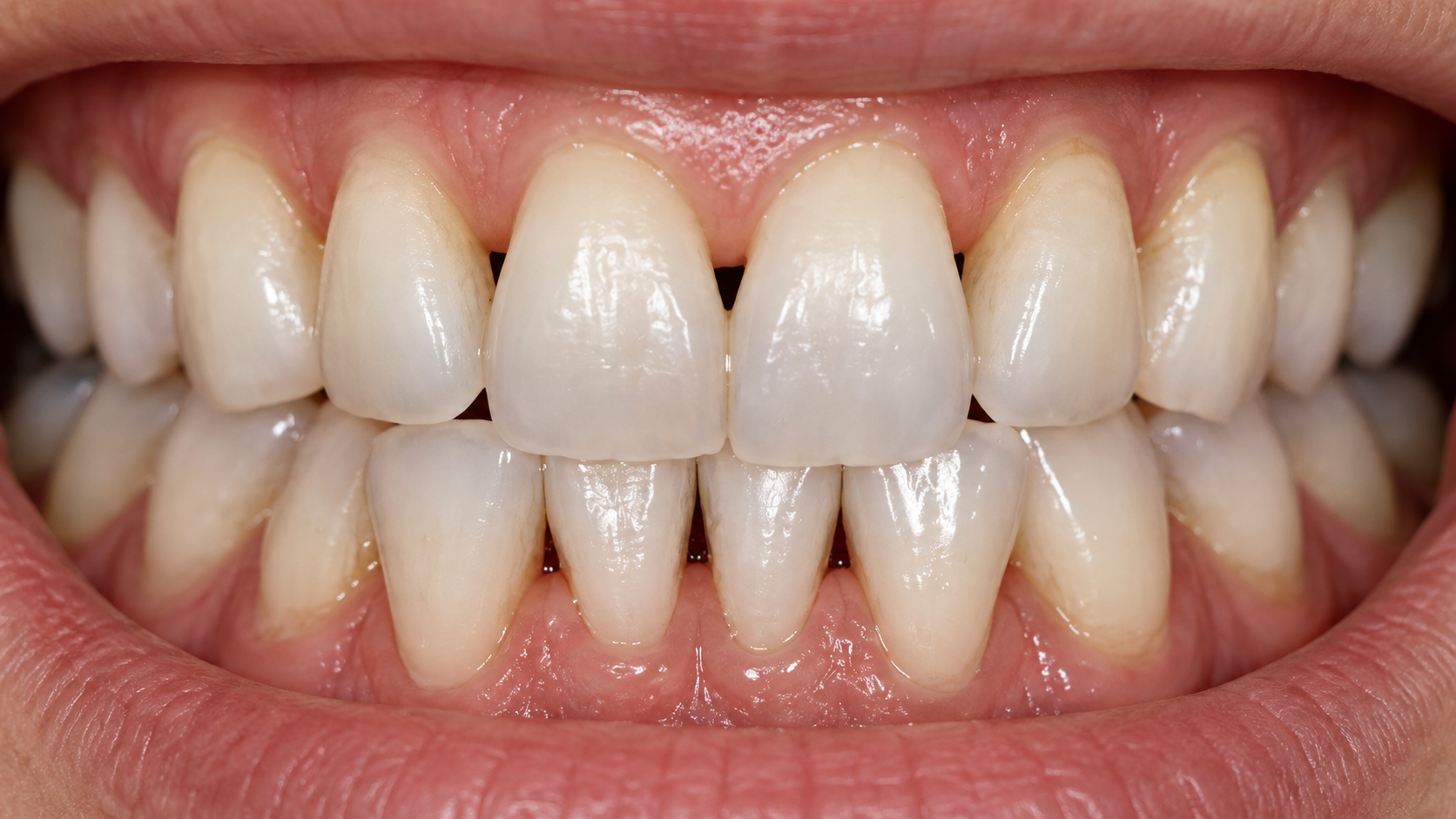
Black triangles between teeth are dark spaces near the gumline. They form when the gum no longer fills the gap below the tooth contact. They often appear after braces, aligners, or gum recession. Some close well with bonding. Others need orthodontic or periodontal care first. The right fix depends on which part of the anatomy changed.
TL;DR
Black triangles form when the contact sits too far above the bone for gum to fill.
Bonding hides the gap by reshaping the teeth, and it does not regrow gum tissue.
Clear aligner patients show more black triangles than fixed-braces patients in published studies.
Rule out active gum disease before any cosmetic treatment.
What Are Black Triangles Between Teeth?
The space between two neighboring teeth below their contact point is called the gingival embrasure. In a healthy mouth, a pointed wedge of gum called the interdental papilla fills it. Sometimes the papilla falls short of the contact. Light then passes through, and the shadow behind it reads as a dark triangle. Dentists call this an open gingival embrasure, or interdental papilla loss.
The enamel itself is not discolored. The dark color is a shadow from the mouth cavity behind the teeth.
A black triangle also differs from a diastema. A diastema is a gap that runs through the contact itself, so the teeth do not touch. With a black triangle, the teeth still touch higher up. The opening sits only near the gumline.
Think of the papilla as a tent. The tooth contact is the tent's peak, the bone crest is the ground, and the gum is the fabric. The fabric only stretches so far. If the peak rises, the ground sinks, or the poles spread apart, the tent no longer reaches the top. That is why a black triangle is a problem of three-dimensional anatomy.
Small triangles are common and can be a normal variation. They become a health question when they appear suddenly, keep growing, or come with bleeding, swelling, or loose teeth.
Why Do Black Triangles Form Between Teeth?
The classic study on this question comes from periodontist Dennis Tarnow in 1992. His team examined 288 sites in 30 patients. They measured the distance from the bottom of the tooth contact to the crest of the bone. The results became one of the most quoted rules in esthetic dentistry.
When the distance was 5 mm or less, the papilla filled the space almost every time. At 6 mm, it filled the space 56% of the time. At 7 mm or more, it filled the space only 27% of the time or less.
The gum is not shrinking at random. Each cause of black triangles either raises the contact, lowers the bone, or widens the space between roots. Wider root spacing also matters, because a broader gap needs more tissue to fill.
Gum disease and bone loss. Periodontitis destroys the bone that supports the papilla. As the crest drops, the papilla follows it down.
Triangular tooth shape. Some incisors are wide at the biting edge and narrow at the neck. Their contact sits close to the edge, far above the bone. A review of the black triangle problem notes that square teeth with long contacts rarely show them. Thin gum tissue makes triangular teeth even more prone to the problem.
Orthodontic treatment. Straightening crowded teeth can uncover spaces that overlapping crowns used to hide.
Age-related changes. Bone and gum levels change slowly over decades. Small triangles often become visible in middle age even in healthy mouths.
Traumatic cleaning. Forcing oversized interdental brushes or toothpicks into tight spaces can injure the papilla.
Restorations and root angle. Crowns with poor contours and roots that tip apart both enlarge the embrasure. Gum recession on the facial surface often appears alongside these changes.
Why Do Black Triangles Sometimes Appear After Braces or Invisalign?
Black triangles after braces or Invisalign are common in adults. A 2023 cohort study compared adults treated with clear aligners and fixed braces. After aligners, 35% had a black triangle between the upper central incisors and 38% between the lower ones. After fixed braces, the figures were 18% and 24%.
Age matters even more. In an Australian study of 80 orthodontic patients, black triangles appeared in 43.7% overall. Among patients over 20, the rate rose to 66.7%. The authors linked the gaps to loss of height at the bone crest.
The triangle usually existed in potential before treatment. Crowded, overlapping incisors hide the space where the papilla never reached. Once the teeth line up, the space becomes visible. Roots that end up tipped apart widen the gap further.
Interproximal reduction (IPR) can help. The orthodontist removes a thin layer of enamel from the sides of triangular teeth. This flattens the contact and moves it toward the gum, then the teeth are closed together. IPR removes tooth structure, so it needs careful planning and suits only selected cases.
A black triangle after Invisalign does not automatically mean the treatment caused gum loss. Often it reveals anatomy that crowding was hiding.
Can Black Triangles Appear After Deep Cleaning?
Yes, and this surprises many patients. Inflamed gums swell. Swollen gums can fill the embrasure and hide bone loss that already happened.
Scaling and root planing removes the tartar and bacteria that drive the swelling. The tissue then tightens and shrinks back to its true level. Black triangles after deep cleaning usually reflect that true level. The cleaning reveals old damage, and the gums are healthier for it.
Patients sometimes ask whether they should have skipped treatment. They should not. Swollen tissue around active periodontitis keeps losing bone. The visible gap is the price of stopping that process.
Cosmetic correction should wait until the gums have stabilized, usually for several months after therapy. Treating the shape of a gap that is still changing wastes time and money.
Are Black Triangles Between Teeth a Health Problem?
Many black triangles are purely cosmetic. Others sit on top of active periodontal disease, or create new hygiene problems.
Open embrasures trap food, a problem called lateral food impaction. Air and saliva can pass through larger gaps and change some speech sounds. Irregular spaces are also harder to clean, so plaque builds up more easily. Hardened tartar buildup in these areas fuels further gum inflammation.
A black triangle does not mean a tooth is doomed. Many people live with small stable gaps for decades.
See a dentist promptly if a new gap appears, an old one grows, or you notice:
Bleeding when brushing or flossing
Swelling or tenderness around the gums
Teeth that feel loose or have shifted
Persistent bad breath or a bad taste
How Do Dentists Determine the Best Treatment?
A good plan starts with diagnosis. Two triangles that look the same in a selfie can have opposite causes.
The periodontal exam comes first. The dentist measures pocket depths, checks for bleeding, and tests whether teeth move. Bleeding sites mean active inflammation, and that must be treated before anything else. Our guide to periodontitis staging and grading explains how these findings are scored.
X-rays then show where the bone crest sits. With a probe, the dentist can also sound through the gum to the bone under local anesthetic. Comparing that level with the contact point gives the Tarnow distance. At 5 mm or less, the existing gum may fill the space once the contact moves down. At 7 mm or more, the gap is mostly a bone problem.
The dentist also looks at tooth shape, contact length, root angle, and gum thickness. Thin gum tends to recede. Thick gum tolerates more manipulation.
The findings decide who should lead the case:
A restorative dentist for gaps caused by tooth shape
An orthodontist for gaps caused by root angle or contact position
A periodontist for gaps caused by bone loss or active disease
Many cases need two of them working together.
How Can Black Triangles Between Teeth Be Fixed?
Every black triangle between teeth treatment works in one of three ways. It reshapes the teeth, moves the teeth, or adds soft tissue. Some cases combine two approaches. The table compares the options.
Treatment | Main mechanism | Most suitable situation | Key limitation |
|---|---|---|---|
Composite bonding | Reshapes the tooth contact | Small to moderate gaps with favorable anatomy | Does not regenerate gum |
Orthodontics | Changes tooth and root positions | Gaps related to alignment or contact position | Cannot reliably replace lost tissue |
Veneers | Changes visible tooth contours | Broader esthetic corrections | More invasive than bonding |
Hyaluronic acid | Temporarily augments papilla volume | Selected soft-tissue deficiencies | Long-term predictability uncertain |
Periodontal surgery | Attempts soft-tissue reconstruction | Selected papilla defects | Technically difficult and unpredictable |
Monitoring | Preserves stable tissues | Small gaps without symptoms | Does not close the space |
Composite Bonding for Black Triangles
Black triangle teeth bonding is the most common fix for gaps caused by tooth shape. The dentist adds tooth-colored composite resin to the sides of the teeth near the gum. This lengthens the contact downward until it meets the papilla. In Tarnow's terms, bonding shortens the contact-to-bone distance from the top.
The older method builds the resin freehand with flat plastic strips. Newer injection-molded techniques use curved, clear matrices and flowable heated composite. A 2023 clinical trial compared the two. The curved-matrix group showed better marginal adaptation on X-rays.
The skill lies in the profile where the bonding meets the gum. The added resin must curve gently out of the gumline, like natural enamel. A bulky ledge traps plaque and inflames the papilla it was meant to support. Floss must still pass through the contact.
Bonding also has a width cost. Every millimeter added to each side makes the tooth wider. Large triangles closed with bonding can leave teeth that look square or oversized. A good dentist will show a mock-up before committing.
Dental bonding can stain at the margins, chip, and lose polish over time. It is repairable, usually in one visit, and needs regular professional polishing. Bonding reshapes teeth. It does not rebuild the papilla.
Orthodontic Treatment and Interproximal Reduction
Orthodontics changes the geometry beneath the contact. Tipping divergent roots back to parallel narrows the space the papilla must fill.
Interproximal reduction then flattens triangular contacts. Closing the small spaces it creates moves the contact toward the gum. The 2024 systematic review of papilla reconstruction included four orthodontic studies and found this approach can improve outcomes.
The limits are real. Orthodontics cannot create bone that periodontitis destroyed. Moving teeth in inflamed gums can speed up bone loss. Patients with past periodontitis need stable gums and close monitoring before and during treatment.
Porcelain Veneers for Black Triangles
Veneers make sense when the patient also wants to change color, length, or overall tooth shape. The ceramist can design longer contacts and fuller necks into each veneer.
Porcelain resists staining better than composite. It usually requires removing some enamel, so the decision is hard to reverse. Repairs are harder than with bonding, and chipped veneers often need replacement.
Veneers are rarely the right choice for one small triangle on otherwise attractive teeth. When bone loss is advanced, some dentists add pink gum-colored ceramic or composite at the neck. This hides the gap without making teeth look too long.
Hyaluronic Acid Injections for Missing Gum Tissue
Hyaluronic acid for black triangles is the newest option. The dentist injects a gel into and around the papilla to add volume.
A 2024 systematic review covered 24 studies and 898 injected papillae. Results were promising, with few adverse reactions. An earlier meta-analysis of 166 papillae puts that promise in scale. Six months after injection, papilla height had increased by about 0.47 mm on average. The authors described it as an option for mild black triangles.
Half a millimeter can matter for a borderline gap. It will not close a large one. Protocols vary, many studies are short, and most patients need several sessions. Hyaluronic acid breaks down naturally, so results may fade. Ask which product will be used and how many sessions the dentist expects.
Gum Grafting and Papilla Reconstruction Surgery
Rebuilding a papilla is far harder than covering a receded root. The papilla is a narrow wedge of tissue with a limited blood supply. A graft placed there has little to feed it. If bone is missing underneath, the graft has little to rest on.
Periodontists use tunneling techniques and connective tissue grafts from the palate to bulk up the area. The 2024 review of 45 studies found this approach had the most robust evidence for longer-term reduction of black triangles. It still judged the evidence insufficient for firm recommendations.
Surgery is best suited to motivated patients with selected defects, treated by an experienced periodontist. Our guide to gum recession treatment covers the related grafting procedures.
Which Treatment Is Best for Your Type of Black Triangle?
The best treatment depends on which part of the anatomy changed. These three common situations show how the reasoning works.
Scenario A: Healthy gums, triangular front teeth, a small gap. Bone levels are normal, and the contact simply sits high. Bonding is usually the first choice, because it moves the contact down to meet healthy gum. If the teeth are also crowded, orthodontics with IPR may achieve the same effect with no added material.
Scenario B: Gaps that appeared after braces or aligners. The dentist first checks root angles on an X-ray. Tipped roots point toward a short orthodontic refinement. Parallel roots with triangular crowns point toward bonding. Many patients finish with a small amount of each.
Scenario C: Receding gums and periodontal bone loss. Disease control comes first, then several months of stability. The contact may now sit 7 mm or more above the bone. At that distance, no injection or graft reliably rebuilds a full papilla. Realistic goals include partial fill, careful bonding, or pink restorative material at the gumline.
Similar-looking gaps can have different causes. The right plan cannot be chosen from a photograph alone.
How Much Does It Cost to Fix Black Triangles Between Teeth?
The cost of black triangle teeth depends on the number of teeth, the technique, and your location. Prices below are recent published US ranges, not quotes.
Treatment | Typical US cost | Unit |
|---|---|---|
Composite bonding | $100–$500 | Per tooth |
Composite veneers | $250–$1,500 | Per tooth |
Porcelain veneers | $925–$2,500 | Per tooth |
Clear aligners, mild case | $1,800–$3,500 | Per treatment course |
Hyaluronic acid injections | No reliable published US data | Per session |
Papilla reconstruction surgery | No reliable published US data | Per site |
Injection-molded bonding usually costs more than freehand bonding because it takes longer and uses special matrices. Closing several triangles often means bonding both teeth on each side of every gap.
Insurance rarely covers cosmetic bonding or veneers. Periodontal therapy is a medical necessity and is often partly covered. See typical deep cleaning costs if gum treatment comes first.
Can Black Triangles Be Fixed Naturally at Home?
No home method can regrow a papilla lost to bone loss. Good cleaning keeps the remaining tissue healthy, and that is still worth a lot.
If the gums are inflamed, better cleaning reduces swelling. The gum may look different afterward, but this is not regrowth. Tissue lost with the bone does not return on its own.
Be wary of these shortcuts:
Oil pulling, supplements or gels marketed to regrow gums
Toothpicks or brushes forced into tight spaces
Home kits for reshaping or filling teeth
Unregulated filler injections from non-dental providers
Interdental brushes are the best tool for open embrasures. Choose the largest size that slides in without force, and use one size per gap if needed. Rubber picks and water flossers suit tender areas. Our guide to home care for receding gums covers safe routines in more detail.
How Can You Prevent Black Triangles From Getting Worse?
You cannot change the shape of your teeth. You can protect the bone and gum that support each papilla.
Keep periodontal inflammation under control with daily interdental cleaning and regular professional care. People with past periodontitis usually need maintenance visits every three to four months. Clean gently, because a bruised papilla shrinks.
Adults starting orthodontics should have a periodontal check first. Ask how the plan handles triangular incisors and whether IPR is included.
Watch for change. A new or growing gap is a reason to book an exam, especially with bleeding or loose teeth. Early treatment preserves bone, and bone is what holds the papilla up.
Bottom Line
Black triangles between teeth form when the tooth contact sits too far above the bone for gum to fill. Tooth shape, alignment, recession, and periodontal bone loss can each create that distance.
Bonding moves the contact down and works well when bone levels are normal. Orthodontics corrects root angles and contact position. Injections and grafts try to add tissue, with modest and less predictable results.
The cause decides the cure. Get a periodontal exam first, stabilize any disease, then choose the cosmetic step.
Frequently Asked Questions
Can black triangles between teeth be fixed permanently?
Some can. Orthodontic correction and well-made bonding can last many years with good care. Bonding needs repolishing and occasional repair. Hyaluronic acid results tend to fade. Gaps caused by large bone loss rarely close completely, so the goal there is improvement.
Does composite bonding work for black triangles?
Yes, especially when bone levels are normal and the teeth are triangular. Bonding lengthens the contact toward the gum. It does not regrow gum tissue. Large gaps closed with bonding can make teeth look too wide, so ask for a mock-up first.
How long does black triangle bonding last?
Bonding often lasts several years before needing repair, depending on your bite, habits, and hygiene. Composite can stain and chip at the edges. Most issues can be fixed with polishing or a small repair in one visit.
Can gums grow back between teeth?
Gum lost along with bone does not grow back on its own. Inflamed gums can tighten and look different after treatment. Grafting and injections can add some volume, but full regrowth over lost bone is unpredictable.
Why did black triangles appear after Invisalign?
Crowded teeth often hide gaps that already existed. Once the teeth straighten, the gaps show. Root angle and triangular crowns also play a role. One 2023 study found that black triangles were more common after aligners than after fixed braces.