LivFresh Toothpaste Review: A Dentist's Verdict On Edathamil Gel
LivFresh toothpaste is a premium gel built on activated edathamil, a chelating agent that loosens plaque from enamel. This review covers what it does, what the ingredients reveal,...
Written by Mantas Petraitis
Read time: 8 min read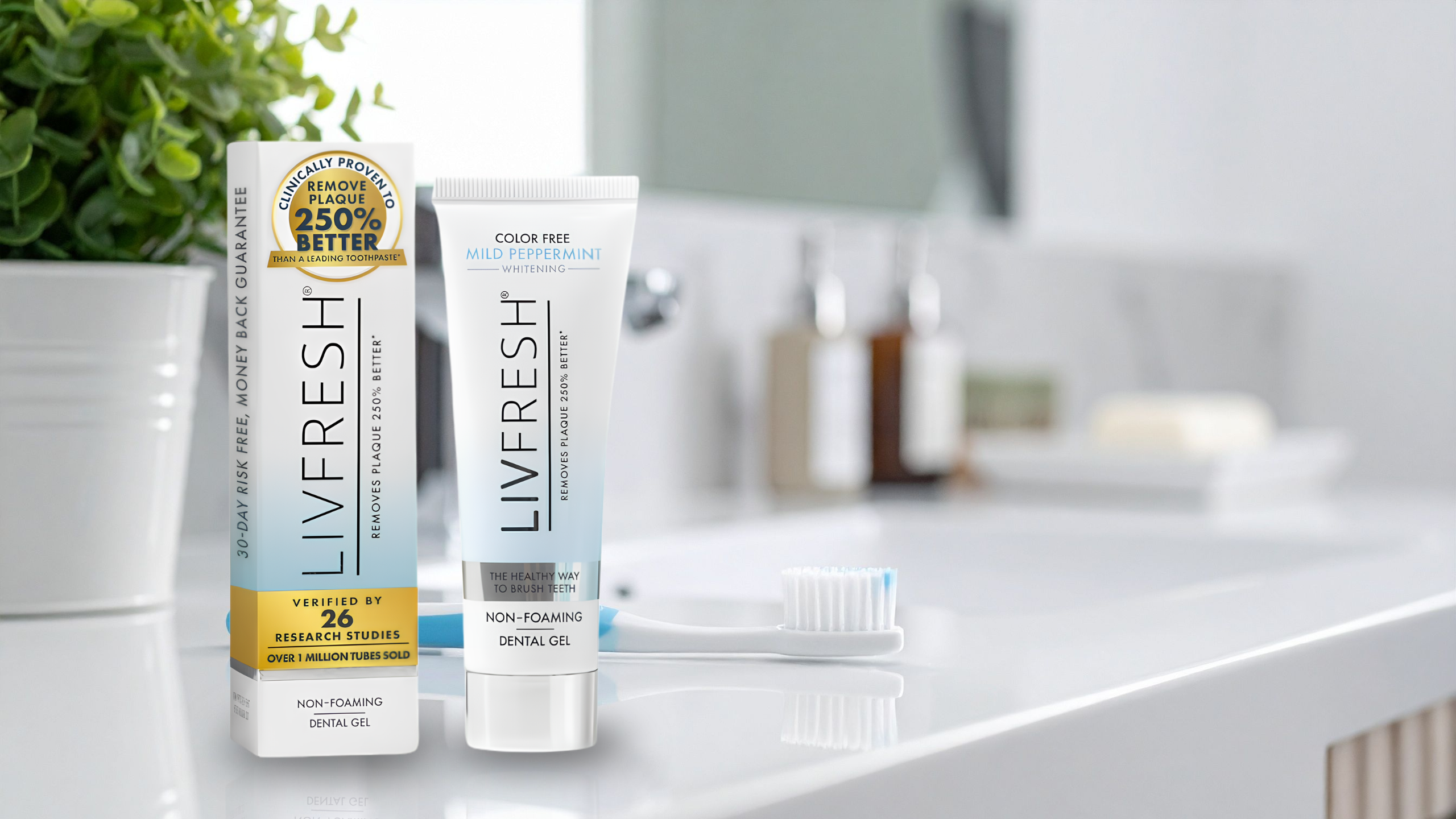
LivFresh toothpaste is a premium gel built on activated edathamil, a chelating agent that loosens plaque from enamel. This review covers what it does, what the ingredients reveal, where the evidence holds up, and where it falls short. The goal is a balanced clinical look beyond brand testimonials.
TL;DR
LivFresh removes plaque through edathamil chemistry, not abrasives, and guards enamel.
Most gingivitis patients see less gum bleeding within four to six weeks.
A tube costs about $20 to $25 and lasts four to six weeks, firmly premium.
A 2021 Journal of Periodontology RCT found that LivFresh produced a 1.18 mm average reduction in periodontal pocket depths vs. 0.93 mm for Crest Pro-Health over 6 months.
LivFresh is well-suited to patients with gingivitis, veneers, braces, or SLS sensitivity, and a poor fit for patients prioritizing cavity prevention or whitening
At $20-25 per tube, annual cost runs $200-300 per person, which is hard to justify outside specific clinical scenarios
LivFresh Toothpaste at a Glance
The snapshot below pulls the formula, pricing, and best-fit patients into one place. Readers who want the verdict fast can stop here, while the rest of the review backs up each line with clinical detail.
Attribute | Detail |
|---|---|
Active ingredient | Activated edathamil. Gum Protect+ adds stannous fluoride 0.454% |
Format | Thixotropic, pressure-released gel, no abrasives |
Fluoride | No, in the original, mild, and wintergreen. Yes, in Gum Protect+ |
Best for | Gingivitis, gum bleeding, braces, veneers, SLS sensitivity |
Price | About $20 to $25 per 3.4 oz tube, roughly $175 to $300 a year |
Where to buy | getlivfresh.com, plus limited Amazon listings |
Made in | United States |
What Is LivFresh Toothpaste?
LivFresh is a clinical gel toothpaste manufactured in the United States and sold primarily through getlivfresh.com. The company markets itself as a dentist-recommended alternative to traditional paste, with formulas centered on a single proprietary active ingredient called activated edathamil.
The product line currently includes four variants. The original peppermint formula serves as the flagship, alongside a milder peppermint version, a wintergreen foaming version, and LivFresh Gum Protect+, which combines the brand's edathamil chemistry with stannous fluoride 0.454% for both biofilm disruption and cavity protection.
A key feature is the gel format itself. Traditional toothpastes rely on abrasives suspended in a thick paste. LivFresh uses a thixotropic, pressure-released gel that thins slightly under brushing pressure and slips into spaces traditional paste cannot reach. The format suits patients with braces, aligners, veneers, or close interproximal contacts. Orthodontic patients in particular tend to benefit, since the thin gel flows around brackets and under wires where thick paste skips. The best toothbrush for braces pairs well with the gel for that group.
The brand positions itself alongside Boka, Dr. Jen's, and Risewell, though its price sits at the higher end. Distribution remains concentrated through the brand's own store, with limited Amazon listings and little drugstore presence. The product is made in the USA, with ingredient sourcing outlined on the brand's website.
The Science: How Does LivFresh Toothpaste Work?
Activated edathamil is a derivative of EDTA, a chelating agent used widely in medicine, food preservation, and industry. The chemistry behind the mechanism is genuine, though the marketing occasionally overstates the magnitude of the difference versus conventional formulations.
The science splits into three parts: the plaque-loosening mechanism, a surface-charge claim, and the published study data. Each one earns separate treatment below, since the credibility varies from strong to modest.
Activated Edathamil Explained
Plaque adheres to enamel through calcium ion bridges. Edathamil binds calcium, which weakens those bridges and allows plaque to be lifted away with less mechanical effort. The 'activated' qualifier and the brand's 40 patents refer to the proprietary delivery system, not a novel molecule.
Dentists already trust the parent compound. EDTA has served as a root canal irrigant for decades, where it softens the smear layer and dissolves mineral debris. LivFresh applies the same calcium-binding behavior to the outer tooth surface during daily brushing, which is the genuine innovation here.
The Negative Zeta Potential Claim
The brand claims LivFresh imparts a negative zeta potential on the tooth surface, repelling bacteria and reducing plaque reattachment. The principle that a negatively charged surface can repel similarly charged bacterial cells is plausible and supported by surface chemistry literature.
The claim holds up in principle, with one caveat. Surface charge effects are well documented in colloid science, so the direction of the argument is sound. The mechanism is not unique to LivFresh, and the size of any real-world plaque benefit from charge alone remains hard to isolate from the chelation effect.
What the Studies Show
The brand cites 26 research studies, university affiliations including UC Irvine, lecturers at Harvard School of Dental Medicine, and U.S. Department of Defense support. The two headline figures, 250% better plaque removal and 190% improvement in gum health, come from studies affiliated with the company.
That affiliation does not automatically invalidate the data, and the underlying chemistry is sound. Brand-funded research is common across oral care, and one peer-reviewed gum-health study on the edathamil gel is available through PubMed Central. Independent replication of the exact 250% and 190% figures remains limited, so readers should treat those numbers as directional rather than precise.
RDA and Abrasiveness
Relative Dentin Abrasivity measures how aggressively a toothpaste wears tooth structure. The American Dental Association recognizes 250 as the safety ceiling, with most commercial pastes ranging from 70 to 150. LivFresh contains no traditional abrasives, placing its functional RDA at the very low end.
Low abrasion is the quiet selling point. Patients with gum recession, veneers, or composite restorations face real wear from gritty pastes over time, and the gel sidesteps that entirely. Those with exposed roots can pair the gel with the best electric toothbrush for receding gums to keep mechanical force gentle.
LivFresh Toothpaste vs. Crest and Nobs
The table below compares LivFresh's original formula against Crest Pro-Health (conventional fluoride toothpaste) and Nobs nano-hydroxyapatite tablets, the three alternatives patients most commonly ask about.
Feature | LivFresh Original | Crest Pro-Health | Nobs tablets |
Active ingredient | Activated edathamil (chelation) | Stannous fluoride + abrasives | 5% nano-hydroxyapatite |
Fluoride | None (Gum Protect+ has 0.454% stannous F) | 1,000-1,500 ppm | None |
RDA (abrasiveness) | ~0 (no abrasives) | 70-150 | ~0 (no abrasives) |
ADA Seal | No | Yes | No |
SLS-free | Yes | No (most formulas) | Yes |
Best published evidence | Journal of Periodontology 2021 RCT: significant pocket-depth and bleeding reduction vs. Crest Pro-Health | Multiple Cochrane-reviewed trials for caries prevention | UT San Antonio in vitro: comparable to 1,100 ppm NaF for demineralization |
Approx. cost/month | $17-25 | $2-5 | $10-15 |
Best suited for | Gingivitis, restorations, braces, SLS sensitivity | Cavity prevention, general daily use | Remineralization, fluoride-free preference |
LivFresh vs. Nobs
Nobs uses 5% nano-hydroxyapatite to remineralize enamel. LivFresh uses edathamil to disrupt plaque adhesion. The two products target different problems. Nobs has one published in vitro study from the University of Texas showing performance comparable to 1,100 ppm fluoride for preventing demineralization. LivFresh has the 2021 Journal of Periodontology RCT in patients with clinical periodontitis. The evidence-based measures different outcomes and are not directly comparable.
LivFresh vs. Crest Pro-Health
Crest Pro-Health contains stannous fluoride at 0.454%, the same concentration as Gum Protect+. It wins on cavity prevention, ADA Seal recognition, retail availability, and price. A tube costs roughly one-fifth of LivFresh per ounce. For cavity-prone patients with no significant gum bleeding, Crest Pro-Health is the stronger starting point.
LivFresh outperforms Crest on plaque-bond disruption and bleeding reduction in patients with established gingivitis, per the 2021 RCT. The choice depends on whether the primary problem is cavities or gum inflammation.
For a wider view, the best toothpaste guide and the prescription Clinpro 5000 review cover stronger fluoride options. Budget-conscious gingivitis patients can also start with a stannous fluoride paste before committing to LivFresh.
LivFresh Ingredients: A Dentist's Breakdown
Understanding what is in a toothpaste matters. The LivFresh panels are short and transparent, which makes the analysis straightforward. The original formula runs on barely ten ingredients, and the fluoride version adds a handful more. That brevity makes it easy to spot what the brand includes, what it leaves out, and the two additives worth a second look.
The Full Ingredient List
The original peppermint non-foaming formula contains aqua, sulfonylbismethane, edathamil, organic stevia root, peppermint, menthol, propylene glycol, FD&C Blue 1, natural gums, and stabilizers. The wintergreen foaming version adds wintergreen flavoring and a foaming agent. LivFresh Gum Protect+ adds stannous fluoride 0.454% as the active, with sodium cocoyl isethionate, carrageenan gum, xanthan gum, sodium hydroxide, and brilliant blue FCF among the inactives.
Edathamil does the heavy lifting in every formula, while MSM, stevia, and the flavor oils round out taste and texture. The Gum Protect+ inactives mostly handle foaming and consistency, so the therapeutic difference between the two lines comes down to fluoride.
What Is Not in the Formula
LivFresh contains no sodium lauryl sulfate, no parabens, no phthalates, no triclosan, no traditional abrasives, and no added sugar. The brand confirms the products are vegan, cruelty-free, and gluten-free, with all ingredients on the FDA's Generally Recognized as Safe list.
The missing SLS carries real clinical weight. SLS exposure correlates with more frequent canker sores, so patients prone to recurrent aphthous ulcers often tolerate an SLS-free paste better. The clean exclusion list also appeals to readers who screen labels for common irritants.
Two Ingredients Worth a Second Look
Propylene glycol functions as a humectant in small, well-tolerated concentrations. FD&C Blue 1 is a permitted color additive that gives the gel its blue tint. Both have substantial safety records and appear in many consumer products.
A 2024 investigation by Lead Safe Mama flagged measurable lead in several toothpaste brands, and LivFresh was not among them. Patients seeking remineralization should still note that LivFresh has no nano-hydroxyapatite, since its strategy targets plaque adhesion rather than enamel mineral chemistry. Those readers can compare the best enamel and gum repair toothpaste.
Does LivFresh Toothpaste Have Fluoride?
The fluoride question is the most important practical decision, and the answer depends on cavity risk. The original, mild, and wintergreen formulas are all fluoride-free, a clearly disclosed choice. LivFresh Gum Protect+ contains stannous fluoride 0.454%, delivering about 1500 ppm fluoride ion, the standard over-the-counter level.
Edathamil addresses plaque adhesion and gum health. It does not remineralize enamel or prevent caries the way fluoride does. That gap matters most for patients with active decay or a history of recurrent cavities, who lose real protection from a fluoride-free paste. Cavity-prone users should choose Gum Protect+ or pair the original with a fluoride rinse, such as the one covered in the ACT fluoride rinse review. The best fluoride toothpaste guide lists stronger cavity protection options.
ADA and FDA Status
The ADA Seal of Acceptance requires fluoride, so the original formulas do not carry it. That reflects a program rule, not a safety judgment. Stannous fluoride is an FDA-monographed active, which is why Gum Protect+ lists it as the active ingredient.
Patients often read the missing seal as a red flag, but the distinction is narrower than it looks. Toothpaste is regulated rather than approved the way prescription drugs are, and the original formulas sit outside the seal program purely because they leave out fluoride, not because of any safety finding.
LivFresh Toothpaste Results: What Clinicians See
Marketing claims and clinical observations often diverge. The themes below reflect patient feedback and hygienist reports across LivFresh users, grouped by the outcomes patients ask about most: plaque, gums, sensitivity, whitening, and breath.
Plaque and Tartar Response
Patients using LivFresh consistently for four or more weeks tend to show less supragingival plaque, with the biggest gains around posterior teeth and the gumline. Existing tartar does not dissolve and still requires professional scaling.
The tartar benefit is preventive, not corrective. LivFresh appears to slow how fast new calculus forms after a cleaning, which helps patients on three- or four-month maintenance hold their results longer. Anyone unclear on the difference between soft plaque and hardened deposits can review what is calculus and tartar.
Gum Health and Bleeding
The clearest result is reduced bleeding on probing in mild-to-moderate gingivitis, often within four to eight weeks of twice-daily use. Gum Protect+ outperforms the original here, in line with stannous fluoride evidence.
The benefit has limits worth stating plainly. Patients with advanced periodontitis should treat LivFresh as an adjunct to scaling and root planing, not a substitute for it. A medicated rinse can support the same goal, as covered in the best dental rinse for gums.
Sensitivity, a Mixed Picture
Some patients report less sensitivity as inflammation calms. Others, including reviewers on Trustpilot, report new sensitivity after several weeks, likely because chelation briefly exposes cleaned dentinal tubules.
The split is predictable once the mechanism is clear. Sensitivity that appears during the early plaque-clearance phase often settles with continued use, though some patients never adapt and stop. Those with known sensitivity should start with the mild peppermint, brush gently, and review the best toothbrush for sensitive teeth.
Whitening and Stain
LivFresh has no peroxide and no abrasives, so dramatic whitening will not happen. Some surface stains lift as plaque clears, though coffee, tea, and wine stains stay put.
Whitening drives a chunk of disappointed reviews, since buyers expect a brightening effect that the formula was never built to deliver. Readers who want visible whitening should review the best OTC teeth whitening strips, along with what to do after removing whitening strips to protect enamel afterward.
Breath, Dry Mouth, and Timeline
Plaque feeds the sulfur compounds behind bad breath, so many users report fresher mornings. A smaller share reports mild dry mouth tied to propylene glycol.
Timelines keep expectations honest. A fair window is four to six weeks for noticeable plaque change and eight to twelve weeks for visible gum improvement at recall. Promotional single-week transformations deserve skepticism, since biology does not move that fast.
LivFresh Toothpaste Pros and Cons
LivFresh earns genuine clinical praise in some areas and real criticism in others. The lists that follow reflect both the underlying chemistry and the patterns that show up across patient feedback and hygienist reports. A balanced read weighs them together rather than treating any single point as decisive.
Pros
The strengths cluster around mechanism, formulation, and gum response. The gel chemistry is plausible and well documented, the ingredient list is clean, and the bleeding improvement shows up reliably in the right patients. The points below summarize where the product delivers.
Real mechanism rooted in established edathamil chemistry
Non-abrasive gel that protects enamel, roots, veneers, and composites
SLS-free, which helps canker-sore-prone patients
Short, transparent ingredient list on the FDA GRAS list
Vegan, cruelty-free, and gluten-free
Consistent drop in gum bleeding within four to eight weeks
Pea-size dosing, so a small tube lasts weeks
Made in the United States with disclosed sourcing
Gum Protect+ combines fluoride with edathamil
60-day guarantee on the official site lowers trial risk
Cons
The drawbacks are mostly about cost, fluoride, and unmet expectations rather than safety. Price is the headline problem. However, the original formula leaves cavity-prone users exposed, and whitening hopes go unmet often enough to fuel negative reviews. The points below capture the substantive limits.
Expensive, about $20 to $25 per tube and $200 to $300 a year
The original formula has no fluoride for cavity-prone users
Some users report new sensitivity after weeks of use
Whitening expectations often go unmet
Headline figures come from brand-affiliated research
Limited retail availability outside the brand site
Amazon listings appear and disappear
Subscription cancellation friction reported by some users
Original formulas lack the ADA Seal
No nano-hydroxyapatite, xylitol, or potassium nitrate
Who Should Use LivFresh Toothpaste
LivFresh fits a defined group well and serves others poorly. Matching the formula to the patient clears up the buying decision quickly, since the mechanism rewards some profiles and shortchanges others.
The strongest candidates share a gum or restorative concern that the gel directly addresses. The poorest fits usually want something the formula does not provide, fluoride protection, whitening, or a low price. The table sorts both groups.
Good candidates | Better served elsewhere |
|---|---|
Chronic gingivitis or gum bleeding | Active decay or high cavity risk, unless using Gum Protect+ |
Periodontal maintenance after scaling | Buyers expecting visible whitening |
Veneers, crowns, composite bonding | Budget-constrained households |
Braces, aligners, expanders | Children under six, who need a kids' fluoride paste |
SLS-sensitive patients | Patients who want hydroxyapatite remineralization |
Pregnant patients face no specific contraindications in the ingredient list, though any change deserves a quick word with the provider. LivFresh should never be used on dogs or cats. A veterinary toothpaste is the only safe option for pets.
How to Use LivFresh Toothpaste
Technique drives results more than most patients expect, and LivFresh depends on contact time with the tooth surface. The gel needs a moment to act on the plaque bond, so how a patient brushes and rinses changes the outcome.
A pea-sized amount on a soft brush is enough. Brush for the full two minutes the ADA recommends, angled at the gumline using the modified Bass technique. A gentle rinse, or no rinse, keeps gel on the gumline longer. Flossing or a water flosser remains essential. For the fluoride-free original, add a fluoride rinse at a different time of day.
Where to Buy LivFresh Toothpaste and How Much It Costs
Channel choice affects both price and authenticity, so where matters as much as what. LivFresh sells through a narrower set of outlets than most toothpastes, which shapes cost and trust in equal measure.
A single tube runs about $20 to $25, with multi-pack and subscription pricing lowering the per-tube cost. The 3.4 oz tube lasts four to six weeks, putting the annual cost near $175 to $300. The official LivFresh site is the most reliable channel and secures the 60-day guarantee. Amazon listings appear inconsistently, so buyers should confirm the official storefront. Walmart, Target, CVS, and Walgreens do not reliably stock it in stores.
Bottom Line: Is LivFresh Toothpaste Worth It?
LivFresh is one of the more interesting OTC toothpastes in recent years. The edathamil chemistry is sound, the gel format helps patients with veneers, braces, or sensitive gums, and the drop in gum bleeding among gingivitis patients shows up consistently.
It earns a strong recommendation as a targeted therapeutic toothpaste for gum bleeding, periodontal maintenance, restorative work, or SLS sensitivity. It earns a cautious recommendation as a daily driver, given the price. Cavity-prone patients should pick Gum Protect+ or pair the original with a fluoride source. Combine any trial with a professional review and a personalized dental treatment plan.
This article is for informational purposes only and does not constitute medical advice. Always consult with qualified healthcare professionals for diagnosis and treatment recommendations specific to your situation.
Frequently Asked Questions
Does LivFresh toothpaste have fluoride?
The original, mild, and wintergreen formulas are fluoride-free. Gum Protect+ contains stannous fluoride 0.454%, the standard cavity-protection level.
Is LivFresh toothpaste worth it?
For gum bleeding, gingivitis, braces, veneers, or SLS sensitivity, the benefit often justifies the price. Cavity-prone or budget shoppers usually do better elsewhere.
Is LivFresh toothpaste FDA-approved?
Toothpaste is regulated, not approved like a prescription drug. LivFresh ingredients sit on the FDA GRAS list, and Gum Protect+ uses stannous fluoride, an FDA-monographed active.
Is LivFresh ADA-approved?
The fluoride-free formulas lack the ADA Seal because the program requires fluoride. The seal is a program rule, not a safety verdict.
Does LivFresh whiten teeth?
Not meaningfully. It has no peroxide or abrasives. Some surface stain lifts as plaque clears, though deep stains stay.
Why does LivFresh cause sensitivity for some users?
Chelation can briefly expose cleaned dentinal tubules during plaque clearance. The effect often resolves with continued use.
Is LivFresh safe for veneers and braces?
Yes. The non-abrasive gel suits veneers, crowns, bonding, and orthodontic appliances, and reaches around brackets well.
Does LivFresh contain lead?
LivFresh was not flagged in the 2024 Lead Safe Mama testing that found lead in several other brands.
Is LivFresh made in the USA or China?
LivFresh is made in the United States, not China, with disclosed sourcing.
How long does a tube of LivFresh last?
About four to six weeks at pea-size, twice-daily use. If you like to use a larger amount of toothpaste, the tube of LivFresh will last two to three weeks.
Where can I buy LivFresh toothpaste?
Mainly getlivfresh.com. Major drugstores do not reliably stock it, and Amazon listings vary.