Rating: 4.5/5
GC G-aenial Universal Injectable Review
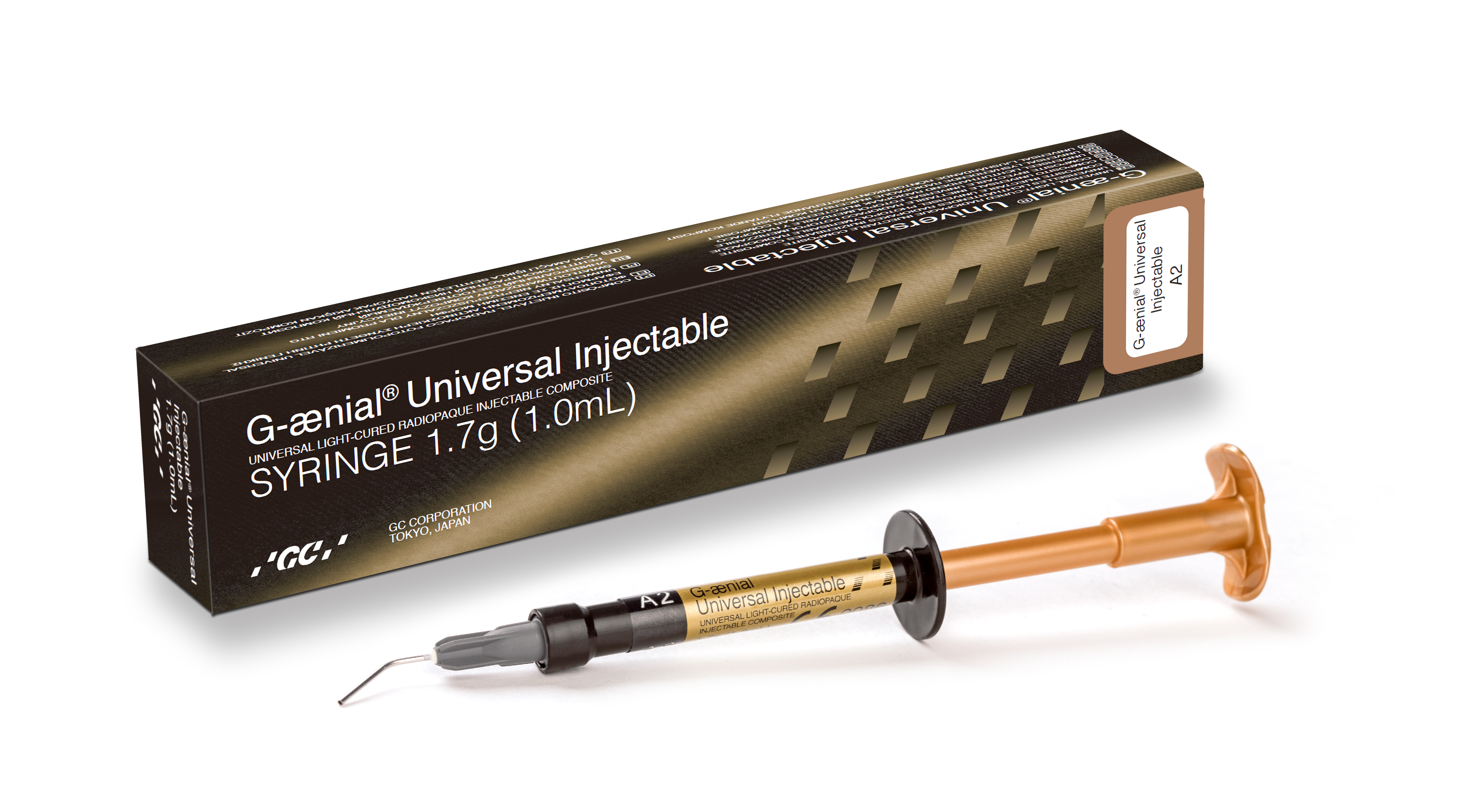
G-aenial Universal Injectable is GC's highly filled flowable composite, sold for every cavity class from a 1 mL syringe. This review sets the manufacturer's claims against...
Reviewed by Rachel Thompson
Pros
- Flexural strength at or above paste level in independent testing
- Lower wear volume loss than a paste and a conventional flowable in the UCL Eastman study
- Non-slumping flow that builds cusps and proximal walls without instruments
- Better two-year gloss and marginal adaptation than a conventional paste in a Class II trial
- Low water sorption and low extrusion force in manufacturer testing
- Eight labeled indications, from sealants to fiber splinting
Cons
- Increments limited to 1.5–2.5 mm depending on shade
- Volumetric shrinkage of about 3.4%, higher than a conventional paste
- Lower elastic modulus and surface hardness than a nanohybrid paste
- No published five-year data for this specific product
- Working time shortens under ambient operatory light
- Sixteen shades mean a larger inventory to manage
G-aenial Universal Injectable is GC's highly filled flowable composite, sold for every cavity class from a 1 mL syringe. This review sets the manufacturer's claims against independent laboratory and clinical data, then marks where the material earns a place on the restorative tray and where a conventional paste still serves the patient better.
TL;DR
G-aenial Universal Injectable delivers paste-level flexural strength and wear resistance from a syringe.
A two-year Class II trial scored it ahead of a conventional paste on surface gloss and marginal adaptation.
Shade-dependent increments of 1.5–2.5 mm and higher shrinkage than a paste limit it in large, high-load restorations.
Clinicians get the most value in moderate posterior restorations and injection-molded anterior work.
What G-aenial Universal Injectable Is And How It Is Built
G-aenial Universal Injectable is a light-cured, radiopaque methacrylate composite carrying 69 wt% filler, according to GC's technical manual. The instructions for use classify it as a Type 1, Class 2 restorative under ISO 4049, the same standard category as a conventional paste composite.
Filler Technology And Full-Coverage Silane Coating
Low-viscosity composites have always traded strength for flow. Early flowables were mostly resin, which let them wet a cavity well but left them prone to wear, so most clinicians kept them for liners and pit-and-fissure work. Pushing more filler into a runny paste is harder than it sounds, because nanoparticles clump into micron-sized clusters and every poorly silanized particle becomes a weak point in the matrix.
GC tackled the problem first with G-aenial Universal Flo in 2010 and then refined the chemistry for G-aenial Universal Injectable. The current material disperses 150 nm barium glass particles that GC coats almost completely with silane, a process the company calls Full-coverage Silane Coating (FSC). GC also moved to a long alkyl-chain silane that makes the filler surface more hydrophobic, and the company gives this as the reason for the material's low water sorption.
At the chair, the paste flows under plunger pressure and holds its position once pressure is released. Rheologists call that thixotropy. In a Class II box it means a cusp incline injected onto a cured base stays at the angle where it was placed, with no instrument propping it up.
Key Specifications
The figures below come from GC's technical manual and the European IFU. Manufacturer bench data deserve a skeptical read, so the independent results later in this review carry more weight.
Property | Value | Source |
|---|---|---|
Filler loading | 69 wt% (about 46 vol%) | Technical manual, IFU |
Filler type and size | Barium glass and silica, 150 nm mean, 0.01–0.5 µm range | Technical manual, IFU |
Resin matrix | Dimethacrylate monomers, 31 wt% | Technical manual |
Flexural strength | 173 MPa (ISO 4049) | Technical manual |
Radiopacity | 252% Al, equal to 2.5–3.0 mm Al | Technical manual, IFU |
Water sorption | 13.9 µg/mm³ | Technical manual |
Volumetric shrinkage | 3.40% | Technical manual |
Extrusion force | About 1.4 kgf | Technical manual |
Maximum increment | 1.5–2.5 mm, depending on shade | IFU |
Curing | 10 s at >1,200 mW/cm² or 20 s at >700 mW/cm², 450–480 nm | IFU |
Storage | 4–25 °C, away from light and heat | IFU |
What The Numbers Mean At The Chair
Shrinkage and stiffness shape day-to-day use more than flexural strength does. GC's own chart puts volumetric shrinkage at 3.40%, close to bulk-fill and conventional flowables and nearly double the 1.84% it lists for Tetric EvoCeram. GC argues that a long pre-gel phase and incremental placement keep shrinkage stress manageable, and the clinical data published so far support that argument when increments stay within the label.
Stiffness sits between flowables and pastes. A lower modulus lets the restoration flex with the tooth, which helps in cervical lesions where cusp flexure loads the margin. In a large, cusp-replacing Class II for a patient with bruxism, a stiffer paste or a short-fiber base such as everX leaves more margin for error.
A radiopacity of 252% Al reads clearly against dentin and enamel on bitewings. GC kept it below some competitors on purpose, to limit burnout artifacts around the restoration.
Indications, Shades And Packaging
The label covers more ground than most clinicians expect from a syringe composite. The IFU revised in January 2024 lists eight indications and only two contraindications, namely direct pulp capping and known methacrylate allergy.
Labeled Indications
GC places no size limit on restorations and does not require a capping layer of paste. The full list of labeled uses reads as follows.
Direct restorations in Class I, II, III, IV and V cavities
Fissure sealing
Sealing hypersensitive areas
Repair of direct and indirect esthetic restorations, provisional crowns and bridges, and defective margins in enamel
Blocking out undercuts
Liner or base
Indirect crowns, bridges, inlays and veneers with GRADIA or GRADIA PLUS components
Splinting combined with fibers such as GC everStick
The sealant indication overlaps with the preventive work covered in our guide to dental sealants for adults. The splinting indication puts it in the same conversation as polyethylene ribbons such as Ribbond, since the low viscosity wets fiber bundles thoroughly.
The 16-Shade System
Sixteen shades across three translucency levels give more control than single-shade flowables, at the cost of more syringes in the cabinet.
Group | Shades | Typical use |
|---|---|---|
Standard (body) | A1, A2, A3, A3.5, A4, B1, B2 | Most posterior and anterior restorations |
Opaque | AO1, AO2, AO3 | Masking, dentin replacement, mamelons |
Enamel | JE, AE | Final layers, proximal walls, incisal edges |
Bleach | BW, XBW | Bleached dentitions |
Cervical | CV, CVD | Class V and cervical lesions |
Shade also sets the maximum increment. A1, A2, A3, B1, B2, JE and AE cure to 2.5 mm, while XBW, BW, A3.5, A4, AO1, AO2, CV and CVD stop at 2.0 mm. AO3 cures to only 1.5 mm, so it works best as a thin masking layer. Most posterior cases need nothing more than a body shade such as A2 or A3 with JE for the occlusal surface.
Delivery Formats
GC sells the material in syringes and single-use unitips, plus a kit built around injection molding. Contents vary slightly by region, per the US sell sheet and the European ordering leaflet.
Syringe of 1.0 mL (1.7 g) with long bendable dispensing tips
US refill packs with two syringes, 10 long tips and 10 short tips
Unitip refills of 15 single-use 0.16 mL capsules
Injection Molding Kit with an EXACLEAR cartridge and syringes in A1, A2 and A3
The metal tip bends by hand to reach the distal surface of a second molar, and every tip is single use. Unitips suit operatories that avoid sharing syringes between patients, a habit in line with current infection control guidance.
Handling And Chairside Performance
Handling drew the strongest comments in structured evaluations. The material wets the cavity floor on contact, while a cusp injected on top keeps its shape, and that combination trims finishing time more than placement time.
What Evaluators Reported Across 432 Placements
The largest structured record of chairside use comes from clinical evaluation, in which 29 consultants placed the material 432 times and rated it 96% overall.
Their comments cluster around adaptation and shape retention. Evaluators noted that cusps held their form without slumping and that restorations came out bubble-free with a high luster. One consultant was surprised by how well it flowed into deep preparations, and another reported that patients were happy with the outcome. The longer, bendable tips drew specific praise for posterior access.
Their practical advice is worth adopting. Give the paste a moment to settle into line angles before curing, then form cuspal inclines with the syringe and refine them with a fine explorer. The material drags out to a feather edge, which makes blending a cervical margin into enamel straightforward.
How The Paste Behaves Under The Tip
GC's bench data put the extrusion force at about 1.4 kgf, against 2.4–3.3 kgf for the competing low-viscosity composites it tested. Over a full quadrant, that lower force reduces thumb fatigue and makes it easier to meter small volumes into a proximal box.
One habit from the IFU changes the finish more than anything else. Once the required amount is in, release pressure on the plunger and lift the tip away perpendicular to the surface. Surface tension then levels the paste and leaves very little to trim.
The IFU flags two errors that compromise the paste. Wiping the tip with excess alcohol can contaminate it, and eugenol-containing temporary materials left under the restoration inhibit the set.
Finishing, Polishing And Gloss Retention
Polish is where the 150 nm filler pays off, both on the day of placement and at recall.
GC's toothbrush-abrasion test ran 12,000 cycles under a 200 g load, and the technical manual reports that G-aenial Universal Injectable kept more of its gloss than the paste and flowable comparators. That is manufacturer data, so the clinical record matters more. In the two-year Erciyes trial, the injectable scored better on surface gloss than a conventional paste, with every group finished the same way using fine finishing burs and discs followed by composite polishing rubbers.
Because the anatomy forms during injection, finishing usually starts with a fine-grit disc along the marginal ridge and a pointed polisher in the fissures. Dental Advisor's evaluators reached a clinically acceptable finish with a single rubber polishing point, which keeps the polishing kit for these cases small.
Class II Workflow Step By Step
The sequence below follows the IFU and the protocol from the two-year Class II trial discussed later in this review. It suits two-surface preparations with gingival margins in enamel.
Isolate the tooth, then place a sectional matrix and wedge.
Selectively etch enamel and apply a light-cured universal adhesive.
Purge air from the tip with the syringe pointing up until paste reaches the opening.
Inject a thin first layer along the gingival floor with the tip kept inside the paste, and let it flow into the line angles.
Build the proximal wall against the matrix in an enamel shade and cure it.
Fill the remaining box as a Class I in a body shade, staying within that shade's increment limit.
Build the occlusal surface cusp by cusp and sharpen fissures with an explorer.
Cure each increment for 10 s above 1,200 mW/cm² or 20 s above 700 mW/cm².
Remove the matrix, cure the proximal surface again, check occlusion and polish.
Matrix choice matters as much as the composite here. Rings with strong separation, such as the Halo sectional matrix rings or Palodent V3, help the injected wall reach a tight contact. For isolation, a rubber dam remains the reference standard, and DryShield is a workable option for cooperative patients with good access.
GC lists its own G-Premio BOND among compatible light-cured adhesives. Universal systems from other makers, such as All-Bond Universal or Scotchbond Universal Plus, follow the same selective-etch logic.
Injection Molding Technique
The injection molding technique, spelled "moulding" in GC's European literature, turns a diagnostic wax-up into composite restorations through a transparent silicone index. GC's injection molding clinical guide built much of the material's reputation on this workflow.
Scan or take an impression and produce a wax-up of the target anatomy.
Copy the wax-up in transparent silicone such as EXACLEAR, using a non-perforated tray.
Drill an injection port over each tooth and a vent where needed.
Isolate alternate teeth with PTFE tape and work on every other tooth first.
Etch enamel, apply adhesive and cure.
Seat the index and inject until excess appears at the vent or margins.
Cure through the silicone, remove the index and trim excess with a scalpel.
Repeat for the remaining teeth, then finish margins with strips and polish.
The technique suits generalized wear and diastema closure, and it handles black triangles between teeth well once periodontal health is stable. GC's guide suggests building mamelons in an opaque shade before injecting the body shade for a more lifelike incisal edge. Patients choosing between direct and indirect options usually find injection-molded composite at the lower end of the price range in our veneers cost breakdown.
Curing And Light Management
Light output is the variable most often blamed when a flowable restoration underperforms, and this material has clear requirements.
The IFU calls for a light covering 450–480 nm at a minimum of 700 mW/cm², and it warns that lower output risks undercure and discoloration. A wide-lens LED such as the VALO Grand handles the 10 s protocol comfortably. Practices running older units should check output against the signs listed in our guide on when to upgrade LED curing lights.
Ambient light shortens working time too. Keeping the light-protective cover on between injections and angling the overhead lamp away during long anterior cases prevents premature gelling at the tip.
What The Clinical Evidence Shows
Independent research now covers two years of Class II performance and several head-to-head bench studies. Longer-term data for this specific product are still accumulating, so the predecessor material fills part of the picture.
Two-Year Class II Results
The most useful study for general dentists comes from Erciyes University in Türkiye, where researchers screened 900 patients to enroll 110.
Hançer Sarıca, Arslan and Balkaya then placed 259 two-surface Class II restorations, comparing G-aenial Universal Injectable against two controls, Clearfil Majesty Posterior and Filtek One Bulk Fill. Every tooth received G-Premio BOND after selective enamel etching, and the injectable went in at 2 mm or less per layer with 20 s of curing.
At one year, the interim results showed no difference between materials. At two years, with 188 restorations still under review, the injectable and bulk-fill groups scored better than the conventional paste on surface gloss, and the injectable also scored better on marginal adaptation. The authors linked the adaptation result to the material's thixotropic flow along the cavity walls.
Reading the paper needs one caution. FDI scores run from 1 for excellent to 5 for poor, so the higher scores reported for the paste group mean worse performance. The study also relied on cotton-roll isolation rather than rubber dam, and it lost 71 restorations to follow-up by the two-year recall.
For a longer horizon, the best proxy is the predecessor. A 36-month randomized trial found no significant difference between G-aenial Universal Flo and Estelite Sigma Quick in mid-size to extensive posterior restorations, with no secondary caries recorded. That result belongs to the older material, but it shows GC's highly filled flowable approach holding up over three years of function.
Laboratory Strength And Wear Data
Two independent 2024 studies place the material at or above paste level on strength, with one consistent caveat on stiffness.
At the UCL Eastman Dental Institute, Rajabi and colleagues found that G-aenial Universal Injectable and Beautifil Flow Plus F00 both had significantly higher flexural strength than Empress Direct and Tetric EvoFlow, along with significantly lower wear volume loss. The two injectables did not differ from each other, and the authors concluded that such materials may suit occlusal, load-bearing areas.
In Jeddah, Basheer and colleagues compared four high-strength flowables with Filtek Z350 XT. All matched the nanohybrid control on flexural strength and surface roughness, while all showed significantly lower elastic modulus and surface hardness. G-aenial Universal Flo outperformed its successor on flexural strength and microleakage in that study, a reminder that bench rankings shift with test design.
GC's March 2025 evidence newsletter summarizes further work on color stability and wear resistance. The summaries are manufacturer-curated, so the original papers deserve a read before they shape a purchasing decision.
Water Sorption And Color Stability
Water uptake drives both discoloration and hydrolytic breakdown of the filler-matrix bond, so it deserves attention in a material sold for esthetic work.
GC's ISO 4049 testing put water sorption at 13.9 µg/mm³, against 32.8 for Filtek Supreme XTE and 22.2 for Tetric EvoCeram, according to the technical manual. GC credits the long alkyl-chain silane for that result and reports lower discoloration after a week in coffee and curry solutions. Independent confirmation is thinner here, although the two-year Erciyes trial recorded no significant change in color match for the injectable, while the bulk-fill group's color-match scores worsened within the first year.
How It Compares With Other Flowable And Injectable Composites
Its closest rivals are Shofu's Beautifil Flow Plus F00 and Kuraray Noritake's Clearfil Majesty ES Flow Universal. Independent strength and wear data put the field close together, so handling and shade range usually decide the choice. Our guide on how to choose dental materials covers the wider selection criteria.
Material | Filler loading | Flexural strength | Shades | Distinguishing feature |
|---|---|---|---|---|
G-aenial Universal Injectable | 69 wt% | 173 MPa (GC data) | 16 | Non-slumping handling, low extrusion force |
Beautifil Flow Plus F00 | Not reported in sources used | No significant difference from GC in Rajabi 2024 | Not reported | Giomer with S-PRG filler and fluoride release |
Clearfil Majesty ES Flow Universal | 75–78 wt% | 151–152 MPa (Kuraray data) | 2 (U, UD) | Light-diffusing two-shade system |
G-aenial Universal Flo | 69 wt% | Higher than successor in Basheer 2024 | Wide range | 36-month RCT data, runnier consistency |
Versus Beautifil Flow Plus F00
The UCL Eastman data found no statistically significant difference between the two on flexural strength or wear. Beautifil's giomer chemistry releases and recharges fluoride, which some clinicians value for root caries and high-risk patients. G-aenial Universal Injectable holds an injected cusp more firmly and offers a wider shade range, and those two traits matter more for freehand posterior anatomy and anterior molding.
Versus Single-Shade, Bulk-Fill And Paste Composites
The better alternative depends on whether the priority is a smaller inventory or a deeper cure per increment.
Single-shade flowables such as Premier MultiMatch Flow Chameleon cut inventory, and universal-shade pastes like Omnichroma push the same idea further. They suit high-volume posterior work where a close match is enough. Bulk-fill flowables such as BRILLIANT Bulk Fill Flow and Visalys Bulk Flow cure 4 mm increments, which G-aenial Universal Injectable cannot do, and GC points deep boxes toward its separate G-aenial BULK Injectable.
For freehand Class I and II work, the injectable usually finishes faster than a sculptable paste such as GrandioSO 4U or Ceram.x Spectra ST, with fewer voids at the gingival floor. A paste still offers higher stiffness and lower shrinkage, and both properties count in very large restorations.
Where It Fits In A Restorative Treatment Plan
Material choice belongs in the dental treatment plan, alongside lesion size and the occlusal load the restoration will carry.
Shallow and moderate Class I and II lesions with intact cusps fit the material well. Cervical abfraction and erosion lesions are another strong match, because the lower modulus works with tooth flexure instead of against it. Repairs of chipped composites and defective enamel margins are quick wins that fit a minimally invasive dentistry philosophy.
Caution belongs with cusp-replacing restorations in heavy bruxists and with teeth whose cracked tooth syndrome findings point toward cuspal coverage. After placement, a careful occlusal check heads off the filling that feels too high complaint, although injected anatomy rarely needs more than minor adjustment. Patient fees follow standard composite codes, outlined in our guide to filling costs.
Bottom Line
G-aenial Universal Injectable gives general dentists paste-level flexural strength and wear resistance from a syringe, and two years of independent Class II data now support its use as a definitive posterior restorative. The Erciyes trial followed 259 restorations and found the injectable performed on par with a conventional paste on most FDI criteria, with better surface gloss and marginal adaptation at the two-year recall.
Its value shows most in moderate Class I and II restorations, where the paste adapts to the gingival floor and holds cusp anatomy without instrument support. Injection-molded anterior work built from a wax-up is the other strong use, because the transparent EXACLEAR index and the material's controlled flow reproduce the planned morphology with short chair time. Finishing stays quick since the anatomy forms during placement, and the 150 nm filler holds its gloss at recall.
The limits are practical and easy to plan around. Increments stop at 2.5 mm in light shades and 1.5 mm in AO3, and volumetric shrinkage runs near 3.4%, higher than a conventional paste. Large cusp-replacing restorations in patients who grind still belong to a stiffer composite or an indirect restoration.
Practices placing a high volume of direct composite will learn the most from a month-long trial across routine posterior and cervical cases. Longer follow-up from the Erciyes cohort and the trials now registered will show whether the two-year advantage at the margins holds into the five-year range.
Verdict
<p>G-aenial Universal Injectable deserves its place as a definitive posterior restorative, provided increments stay within the label.</p><p>Handling sets it apart. The paste wets the gingival floor of a Class II box, then stands up as a proximal wall with no instrument behind it, and most restorations need little beyond a rubber-wheel polish.</p><p>The evidence backs the handling. Independent bench work places its flexural strength and wear resistance at or above paste level, and the Erciyes trial found it ahead of a conventional paste on gloss and marginal adaptation after two years. Five-year data for this exact product have not been published, so long-span expectations still lean on the predecessor's three-year record.</p><p>The limits come down to increment depth and stiffness. Layers top out at 2.5 mm in light shades and 1.5 mm in AO3, and shrinkage runs higher than a paste. Large cusp-replacing restorations in bruxists still call for a stiffer material or an indirect solution.</p><p>For injection molding and cervical lesions, few materials handle better. Practices placing a high volume of direct composite should run a trial pack across a month of routine cases before committing.</p>
Frequently Asked Questions
Is G-aenial Universal Injectable a flowable or a restorative composite?
It has a flowable consistency but is classified as a Type 1 restorative under ISO 4049 and labeled for Class I to V restorations. The literature usually calls it a highly filled flowable or injectable composite to separate it from low-filled liners.
Can it restore Class II cavities without a paste capping layer?
Yes. GC requires no capping layer, and the two-year Erciyes trial placed full Class II restorations with it in layers of 2 mm or less.
What is the maximum increment thickness?
It depends on shade. A1, A2, A3, B1, B2, JE and AE cure to 2.5 mm, most darker and opaque shades to 2.0 mm, and AO3 to 1.5 mm, per the IFU.
Is G-aenial Universal Injectable a bulk-fill material?
No. GC sells G-aenial BULK Injectable separately for increments up to 4 mm.
How strong is G-aenial Universal Injectable?
GC reports 173 MPa flexural strength under ISO 4049. Independent testing found it significantly stronger than Empress Direct and Tetric EvoFlow and comparable to Filtek Z350 XT.
Which adhesive works with it?
Any light-cured bonding system. GC lists G-Premio BOND among compatible adhesives, and the IFU advises against eugenol-containing materials beneath the restoration.
How many shades are available?
Sixteen, split into standard, opaque, enamel, bleach and cervical groups across three translucency levels.
What is the injection molding technique?
A workflow that copies a diagnostic wax-up in transparent silicone, then injects composite through ports in the index onto bonded teeth and cures it through the silicone. GC's clinical guide walks through anterior and posterior cases.
How does it compare with Beautifil Flow Plus F00?
An independent UCL Eastman study found no significant difference in flexural strength or wear. Beautifil adds fluoride release, while G-aenial Universal Injectable holds shape more firmly and offers more shades.
How should it be stored?
In a cool, dark place between 4 and 25 °C, away from heat and direct sunlight, with the light-protective cover kept on during use.