Rating: 4.3/5
Halo™ Sectional Matrix Rings Review
Direct posterior composite has become the everyday workhorse of operative practice, and the matrix system a clinician chooses often decides whether a Class II turns out...
Reviewed by Rachel Thompson
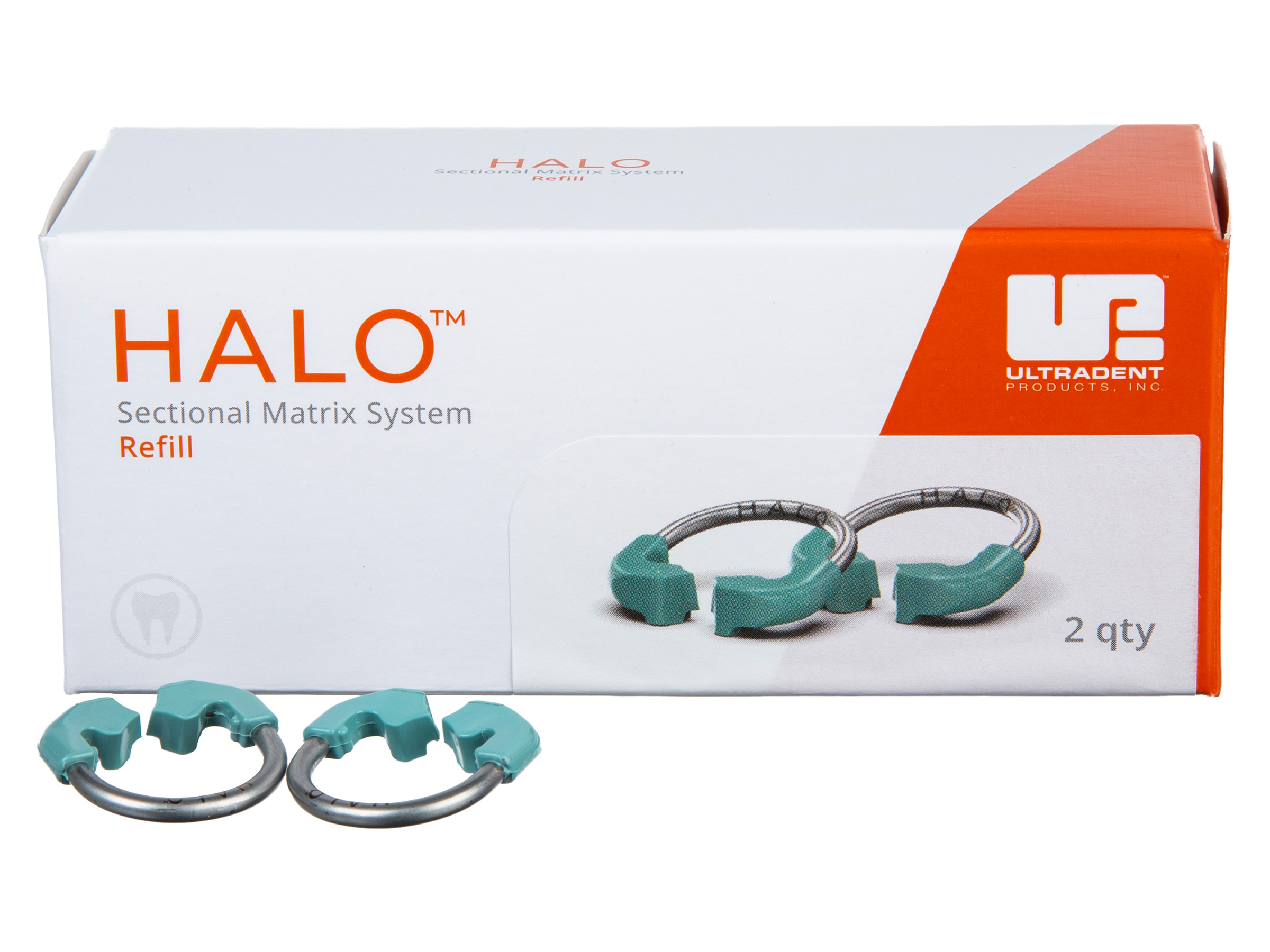
Pros
- Durable nitinol rings engineered to maintain separation force with less fatigue, with a claimed lifespan beyond 1,000 autoclavable uses that keeps cost per use low.
- Rigid glass-filled nylon tines that hold the band securely and preserve an anatomic shape even in large preparations.
- Anatomically contoured bands with an occlusal-embrasure curve that reduce flash and shorten finishing and polishing.
- A universal, stackable ring that covers premolars, molars, MODs, and back-to-back restorations without stocking multiple ring types.
- Two band varieties, Original and Firm, plus a wide range of heights for genuine case-by-case flexibility.
- Active, stackable, collapsible wedges that seal the gingival margin reliably.
- An organized carousel dispenser that speeds selection and reduces waste and spills.
Cons
- Limited independent, peer-reviewed evidence specific to Halo compared with longer-established systems, so most performance claims currently rest on manufacturer data.
- A rigid-tine feel that some clinicians who favor soft-silicone-faced rings will not prefer, particularly on very short or tilted teeth.
- A mid-to-premium upfront kit cost that can deter a small practice testing the waters.
- Real-world nitinol force decay that still requires periodic ring checks and eventual replacement.
- Matched forceps and tweezers sold separately, which adds to the initial outlay.
- A modest learning curve when switching from a different band-and-ring geometry, plus ongoing single-use consumable costs.
Direct posterior composite has become the everyday workhorse of operative practice, and the matrix system a clinician chooses often decides whether a Class II turns out predictably or becomes a remake. A separating ring that loses its spring, a band that slumps at the marginal ridge, or a wedge that fails to seal the gingival floor can turn a routine filling into an open contact and a frustrated patient. The Halo™ sectional matrix system from Ultradent was designed to address exactly these failure points, with the Halo sectional matrix rings serving as the mechanical heart of the system.
This review examines the Halo rings and the wider system from a clinical standpoint. It covers how the rings are engineered, how the components cooperate at the chairside, how the system performs in Class II restorations, how it compares with the established competitors most practices already own, what it costs to run over time, and where its limitations lie. A dentist's verdict, a balanced list of pros and cons, a bottom line, and a professional FAQ round out the picture, so a purchasing decision can rest on more than marketing copy.
What Are Halo™ Sectional Matrix Rings?
Halo sectional matrix rings are reusable separating rings manufactured by Ultradent for Class II direct composite restorations. Each ring works alongside a thin steel matrix band and an interproximal wedge to rebuild a missing proximal wall, seal the gingival margin, and push adjacent teeth apart just enough to leave a tight contact once the restoration is complete.
A sectional ring earns its keep through separation force. Loose or open proximal contacts remain among the most consequential failures in posterior composite work, leading to food impaction, localized inflammation, and eventual periodontal breakdown on the adjacent tooth. The published operative literature is consistent that reliable tooth separation and anatomic band support are the twin jobs a matrix system must accomplish, and the Halo ring is built to deliver both.
Indications And Case Selection
The Halo system targets the situations where a sectional matrix outperforms a circumferential band, so knowing the indications sharpens case selection. It suits conservative, minimally invasive caries management philosophies, where small, precise preparations still demand accurate contacts.
Class II restorations on premolars and molars, where the band rebuilds the proximal wall and the ring restores a tight contact.
Mesio-occluso-distal restorations, where two stacked rings support both proximal boxes at once.
Back-to-back Class II cavities in the same quadrant, restored with paired rings and wedges.
Conservative cusp-replacement cases that still require a defined marginal ridge and contact.
Selected primary-tooth restorations, using the shorter band heights for reduced clinical crowns.
A circumferential Tofflemire-style matrix still has a role in very large, multi-surface build-ups where no adjacent contact is at stake, so the sectional system is best reserved for cases where a tight, anatomic proximal contact is the goal.
Design And Construction Of The Halo Rings
The Halo ring pairs two materials that divide the workload, a super-elastic nitinol frame that generates separation and a set of rigid nylon tines that hold the band. Understanding how each part behaves explains both the strengths clinicians report and the trade-offs discussed later in this review.
The Nitinol Separating Ring
Nitinol, a nickel-titanium alloy, gives the ring its spring. The alloy can open wide to pass over a wedge and adjacent teeth, then return toward its resting shape with steady force, which is what physically separates the teeth.
Ultradent states that the nitinol frame maintains its force with less fatigue over time, so a single ring can be used more than 1,000 times and remains fully autoclavable across those cycles. Separation-force decay is a well-documented problem across the whole ring category, so a frame engineered for fatigue resistance targets a genuine, recurring clinical pain point rather than a marketing talking point.
The Glass-Filled Nylon Tines
The tines are the two arms that straddle the tooth and press the band against the preparation. Halo uses rigid glass-filled nylon rather than the soft silicone facing found on some competing rings, a deliberate design choice with real clinical consequences.
The nylon tines are stiff enough to hold the band securely, yet contoured to the natural curvature of the tooth, so they remain gentle on the interproximal papilla and avoid crushing the band into the box. That anatomic contour also helps the band hold a convex shape from the gingival margin to the marginal ridge, which supports flash reduction and a natural emergence profile.
Universal Geometry And Stackability
Rather than asking clinicians to stock separate premolar and molar rings, Halo is offered as a universal ring intended to cover the posterior range, and the rings are stackable for more complex cases.
Two rings can sit side by side for a mesio-occluso-distal restoration or for back-to-back Class II cavities in the same quadrant, which keeps quadrant dentistry moving without swapping hardware. The single universal ring also simplifies inventory, a practical benefit for busy operatories that run several restorations a day.
The Complete Halo Sectional Matrix System
The rings never work alone, and the clinical result depends on how well the three active components cooperate. The full Halo system comprises nitinol rings, ultra-thin steel bands, active wedges, a carousel dispenser, and dedicated placement instruments.
Matrix Bands: Original And Firm
Halo matrix bands are ultra-thin 0.038 mm stainless steel, anatomically contoured to the tooth, with a curve at the occlusal edge that helps form a natural occlusal embrasure. They come in two personalities to suit different preparations.
Original bands adapt and burnish readily, making them well suited to cases where the clinician wants to hug the tooth for a tight, contoured contact.
Firm bands resist deformation and suit tight interproximal spaces where a softer band might buckle, and they are offered with a color-coded, non-stick coating for faster size selection and clean release.
Band heights span roughly 3.5 mm to 7.5 mm, letting the practitioner match band height to the depth of the gingival box rather than forcing one size onto every prep, which matters for deep boxes and short clinical crowns alike.
Wedges
Wedging is unglamorous work, yet a poorly sealed gingival floor is a leading cause of overhang and recurrent decay, so the wedge design carries real clinical weight.
Halo wedges come in three color-coded sizes with a collapsible center that compresses in tight spaces to adapt the band actively at the gingival margin. They are stackable, so a second wedge can improve the seal on a difficult box, and dedicated holes let them be placed and removed cleanly with the Halo tweezers.
The Carousel Dispenser And Instruments
Alongside the consumables, the system ships with an organizational feature and matched instruments that shape the ergonomics of the whole procedure.
The carousel dispenser holds rings, bands, and wedges in labeled compartments under a clear lid, so components are visible, sorted by size, and unlikely to spill if the unit is bumped. Dedicated Halo forceps open and seat the rings under control, and the Halo tweezers engage the tabs and holes on the bands and wedges for atraumatic handling. Using the matched instruments matters here, since the ring's separation force is high enough that a proper forceps makes placement predictable.
Clinical Performance In Class II Restorations
Design intent is one thing, and chairside behavior another. The following looks at how the Halo system performs where it counts, with an honest note on the current state of the evidence.
Separation And Contact Tightness
The combined force of the nitinol ring and the active wedge produces the separation that leaves a tight contact once the matrix is removed. Because the periodontal ligament allows a small, elastic tooth movement, the ring displaces the adjacent tooth by roughly the thickness of the band during placement, and that tooth springs back against the finished restoration when the hardware comes off. The quality of the final contact therefore depends on generating and holding enough separation for the full working time of the restoration.
The mechanical logic is sound and mirrors the principles that made the modern sectional-ring category successful, and Ultradent describes the system as delivering consistently tight contacts. A fair caveat belongs here for evidence-minded readers. Most independent, peer-reviewed studies of proximal contact tightness have been run on longer-established systems such as Palodent and the Composi-Tight family, and robust third-party trials focused specifically on Halo remain limited because it is a newer entrant. The prudent path is a hands-on trial on representative cases before standardizing a whole practice on it.
Contour, Flash, And Finishing Time
Where clinicians most consistently praise the Halo system is contour and cleanup, which is also where the daily time savings accrue.
The anatomically contoured bands and the occlusal-embrasure curve reproduce a convex proximal wall and a properly dipped marginal ridge, so less sculpting is needed after curing. The rigid tines keep the band adapted, which limits flash and, in reported clinical use, shortens finishing and polishing time. A cleaner proximal contour also translates into a healthier gingival response over time, since well-formed embrasures shed food rather than trapping it. Those saved minutes compound across a full day of operative dentistry, which is the benefit most clinicians feel first.
Soft-Tissue Handling
Comfortable, atraumatic placement protects both the patient and the operative field.
The anatomically contoured tines are shaped to sit gently against the interproximal papilla, which reduces tissue trauma and bleeding during placement. A calmer soft-tissue response helps maintain the dry field that adhesive bonding depends on, which indirectly supports the quality and longevity of the restoration.
Step-By-Step Clinical Workflow
The following sequence reflects the manufacturer's placement guidance and typical clinical practice for a Class II restoration with the Halo system.
Complete the preparation and caries removal, then assess the occlusogingival height of the proximal box to choose an appropriate band.
Seat the band with the Halo tweezers, placing the concave surface toward the tooth being restored and bending the tab as needed for visibility.
Place the wedge that best seals the gingival margin, adding a second stacked wedge when a single wedge does not fully adapt the band.
Establish clean isolation and apply the adhesive per the bonding protocol, keeping the field dry throughout.
Seat the ring with the Halo forceps so the tines straddle the tooth over the wedge, stacking a second ring for an MOD or back-to-back restorations.
Inspect that the band is well adapted to the cavosurface margins and in intimate contact with the adjacent tooth before placing composite.
Place and cure the composite in appropriate increments, remove the matrix components, verify the contact with floss, adjust occlusion, and polish.
Common Placement Pitfalls And How To Avoid Them
Even a well-designed matrix system rewards good handling and punishes shortcuts, so a brief troubleshooting guide helps a team reach consistent results faster. The issues below account for most open contacts and overhangs seen with sectional systems, and each maps to a specific corrective step.
Band slumping at the marginal ridge, which flattens the contour, is best prevented with the correct band height and by burnishing the band against the adjacent tooth before curing.
A ring that lifts or pops off usually signals a tine sitting on unsupported band or an oversized ring for the space, so reseating over the wedge or adding a stacked wedge restores stability.
Open or light contacts often trace back to inadequate separation, which improves with a fresh ring, firm wedging, and pre-cure burnishing of the band.
Gingival overhang points to a poorly sealed floor, corrected with a better-adapted or stacked wedge that closes the gingival cavosurface.
Composite sticking to the band, which can tear the contour on removal, is reduced with the non-stick Firm bands and by fully curing before removing the matrix.
A short calibration period, restoring a handful of representative cases and checking each contact with floss, surfaces most of these issues early and builds the muscle memory that makes the system efficient in daily use.
Durability, Sterilization, And Cost Per Use
For a practice, the economics of a matrix system hinge less on the sticker price of the kit than on the cost per use over its working life, and this is an area the Halo system is designed to win.
The rings are the reusable, capital portion of the system. Ultradent's claim of more than 1,000 autoclave cycles per ring, if it holds up in a given sterilization protocol, spreads the ring cost across a very large number of restorations and drives the per-restoration ring cost toward negligible. Bands and wedges are single-use consumables, so refill packs represent the real recurring spend, and buying bands in 100-count packs by size keeps that cost predictable.
Two honest caveats belong here. Nitinol rings across every brand can lose some separating force over many heat cycles in real-world use, so it is sound practice to check periodically that each ring still opens and springs back crisply and to retire any that feel tired. The manufacturer's usage figures are laboratory-supported claims rather than guarantees, so the same care a clinician gives to any dental autoclave and its cycles applies to reprocessing the rings. On upfront cost, Halo kits sit in the mid-to-premium band for the category, with smaller kits commonly priced around 240 US dollars and fuller kits in the 360 US dollar range, though pricing varies by distributor, configuration, and region. Weighed against reusable rings and reduced finishing time, the total cost of ownership stays competitive, and it compares favorably with what a single filling costs a practice to deliver.
How Halo Compares To Other Sectional Matrix Systems
Most practices evaluating Halo already own a competing system, so the useful question is whether Halo improves on the incumbent for a given case mix. The sectional-ring market is anchored by a handful of established players, each representing a slightly different design philosophy.
Halo Versus Garrison Composi-Tight
The Garrison Composi-Tight family is the most direct competitor and represents the soft-silicone-faced ring philosophy.
Garrison rings use a soft silicone face that molds around the tooth and wedge, and the Composi-Tight 3D XR rings have earned strong marks in independent consultant evaluations for retention, including on short teeth. The core difference comes down to rigid glass-filled nylon tines on the Halo against soft silicone facing on the Garrison. Rigid tines offer secure, predictable band holding and hold shape well in large preparations, while soft silicone can conform intimately to irregular or short teeth. Neither approach is universally superior, and preference tends to track a clinician's technique and case mix.
Halo Versus Palodent
Palodent from Dentsply Sirona is the other giant of the category and the system with the deepest published track record.
The Palodent V3 pairs a nickel-titanium ring with plastic tines and offers accessories such as WedgeGuards that shield the adjacent tooth during preparation. Its design lineage traces back through several generations of separation-ring systems documented in the operative literature, which lends it a long evidentiary pedigree. Halo counters with universal single-ring convenience, carousel organization, and an emphasis on ring longevity and anatomic banding, so the choice often comes down to whether a practice values published pedigree or workflow ergonomics more highly.
Halo Versus Triodent And Bioclear
Two further systems round out the comparison, one a nickel-titanium ring pioneer and one a fundamentally different technique.
The Triodent V-Ring, now part of the Dentsply portfolio, helped pioneer the notched-tine NiTi ring and competes directly with Halo's rigid-tine, high-durability approach. Bioclear takes a different route altogether, built around clear anatomic matrices and heated, injection-overmolded flowable composite rather than a separating ring, and some comparative studies report favorable proximal outcomes for it. A practice weighing Halo against Bioclear is really choosing between two restorative techniques, so the comparison is less like-for-like than the ring-based systems.
Running A Fair Chairside Trial
Because the strongest questions about Halo concern real-world performance rather than design, a structured trial answers them better than any brochure. A simple protocol keeps the comparison honest and quick.
Restore a matched set of cases with the incumbent system and with Halo, ideally a mix of straightforward Class II boxes, at least one wide MOD, and a couple of tight back-to-back contacts. Record separation quality with floss, note flash and finishing time, and track how the rings feel after several sterilization cycles. Comparing those notes across a week or two of typical cases gives a practice its own evidence, which carries more weight than category averages when the published data on a newer system is still thin.
Who Should Consider The Halo System
The Halo system fits some workflows better than others, and matching it to the right practice profile prevents buyer's remorse. All sectional matrix systems are technique-sensitive to place and stabilize, so any adoption benefits from a short calibration period regardless of brand.
General dentists doing high-volume posterior composite, who gain the most from reduced finishing time and the organized carousel workflow.
Practices frustrated by separating-ring fatigue, drawn to the durable nitinol ring and its long claimed service life.
Clinicians who prefer a firm, positively seated ring with rigid tines over a soft-silicone feel.
Offices that value tray organization and want to cut wasted, dropped consumables.
Operators handling the full posterior range, from single Class II boxes to wide MODs and cusp-replacement cases.
When a Class II sits within a larger dental treatment plan spanning several restorations, the system's universal ring and quick component selection help keep a quadrant appointment efficient. The system is also a sensible pick for clinicians building out or upgrading an operatory, whether that is a new owner working through an essential equipment checklist or a graduate assembling a first kit from a student equipment guide.
Bottom Line
The Halo sectional matrix rings pair durable nitinol separation, rigid but tissue-friendly tines, anatomic flash-reducing bands, active stackable wedges, and an organized carousel into a system that respects a clinician's time and produces tight, natural contacts when technique is sound. The strongest reservation is simply the thinner independent evidence base for a newer product, which a short in-practice trial resolves. For a practice that values reliable contacts, reduced finishing, and long-term ring economics, the Halo system is a credible upgrade worth trialing against the current matrix of choice.
Verdict
<p>The Halo sectional matrix system is a thoughtfully engineered, competitive entry in a mature and demanding category, and it handles the everyday Class II with real polish. The nitinol ring delivers dependable separation, the rigid contoured tines hold the band in a natural shape while sparing the soft tissue, and the anatomic bands with their occlusal-embrasure curve trim the flash and finishing that erode a busy schedule. The carousel dispenser quietly improves the ergonomics of the whole procedure, and the reusable rings make the long-run economics attractive for a high-volume operatory. Together, the components reward sound technique with tight, natural-looking contacts.</p><p>Two measured reservations temper an otherwise strong assessment. Independent published evidence specific to Halo remains thinner than for the veteran systems it competes against, so a hands-on trial on representative cases is wiser than a wholesale switch on faith. The rigid-tine feel is also a matter of preference, and clinicians devoted to soft-silicone-faced rings should test it before committing. For most general practices placing volume posterior composite, though, the Halo rings earn a confident recommendation and a place on the shortlist, with a sensible try-before-you-standardize approach.</p>
Frequently Asked Questions
What are Halo sectional matrix rings used for?
They are reusable separating rings for Class II direct composite restorations. Placed over a matrix band and wedge, each ring pushes a tooth apart from its neighbor to offset band thickness, so the finished restoration rebounds into a tight proximal contact. They handle single boxes, MODs, and back-to-back restorations.
What are Halo rings made of, and how long do they last?
Each ring combines a super-elastic nitinol frame with glass-filled nylon tines. Ultradent states the rings maintain force with less fatigue and can be used more than 1,000 times while remaining fully autoclavable. Real-world lifespan depends on handling and sterilization, so periodic checks and timely replacement remain good practice.
Are Halo rings autoclavable and reusable?
Yes. The rings are fully autoclavable and serve as the durable, reusable part of the system, while the matrix bands and wedges are single-use consumables.
Can the Halo system be used for MOD and back-to-back restorations?
Yes. The rings and wedges are stackable, so two rings can be placed at once for MODs or for adjacent restorations, and wedges can be stacked for better gingival adaptation.
What is the difference between Original and Firm Halo bands?
Both are ultra-thin 0.038 mm stainless steel and anatomically contoured. Original bands are more adaptable and burnish easily, while Firm bands resist deformation for tight interproximal spaces and are offered in color-coded, non-stick versions.
How does Halo compare with Palodent or Composi-Tight?
All three are capable premium systems. Halo emphasizes rigid nylon tines, ring durability, universal geometry, and carousel organization. Composi-Tight uses a soft silicone face that conforms around the tooth, and Palodent carries the deepest published evidence base. The best choice depends on technique preference and case mix, so trialing Halo against the current system is the most reliable test.
How much does the Halo system cost?
Kits sit in the mid-to-premium range, with smaller kits commonly around 240 US dollars and fuller kits near 360 US dollars, though pricing varies by distributor, configuration, and region. Because the rings are reusable and finishing time drops, total cost of ownership stays competitive. Confirm current pricing with Ultradent or an authorized dealer.
Is there independent clinical evidence for the Halo system?
The design aligns with the principles the operative literature associates with tight contacts and good contours, yet robust independent trials focused specifically on Halo are still limited because it is a newer product. Much of the current performance data comes from the manufacturer and from clinical usage reports, so an in-practice trial is the recommended way to validate it.