Rating: 4.5/5
An Honest vVardis Curodont Review (2026)
What Is vVardis?vVardis is a name that has been gaining traction in dental conversations across the U.S. and Europe, and dental professionals are right to want a clear, unbiased...
Reviewed by Rachel Thompson
Pros
- Clinically proven with a JADA-published meta-analysis showing strong caries arrest (RR 1.82, NNT 2.8)
- Completely non-invasive with no drilling, no anesthesia, and no pain involved
- Does not stain teeth, which is a critical advantage over SDF for anterior and esthetic-zone lesions
- Fast application protocol that takes under 10 minutes and fits into routine hygiene appointments
- Can be applied by hygienists, freeing dentist chair time for complex procedures
- Single application is generally sufficient per lesion, with remineralization continuing over weeks to months
- Works on all tooth surfaces including buccal, occlusal, and proximal sites
- Suitable for patients aged 4 years and older
- FDA-registered anticaries drug (NDC: 72247-101)
- High patient acceptance rates (60% to 100% reported by clinical evaluators)
- Preserves natural tooth structure and helps avoid the restorative cycle
- Backed by 25+ years of research and 230+ scientific publications
- Available through all major U.S. dental distributors
- Complementary product ecosystem with Protect (prevention) and D’Senz (sensitivity)
Cons
- Limited to non-cavitated lesions only, so it cannot replace restorations for advanced caries
- Insurance reimbursement remains inconsistent as of early 2026
- Higher per-unit material cost compared to SDF or fluoride varnish
- Clinical trials to date are mostly 6 to 12 months in duration, and longer-term data is still needed
- All included studies in the JADA meta-analysis carried elevated risks of bias
- Clinically discernible remineralization takes 4 to 6 months, requiring patient patience and compliance
- Not suitable for chewing-surface pits, fissures, or decalcification around existing restorations
- Teeth whitening procedures should be avoided for six months post-treatment to protect the biomatrix
- Curodont Repair Fluoride Plus is an in-office professional product only, not a take-home treatment
- Relatively new in the U.S. market, and some clinicians may prefer to wait for more long-term data
What Is vVardis?
vVardis is a name that has been gaining traction in dental conversations across the U.S. and Europe, and dental professionals are right to want a clear, unbiased explanation of what the company offers before committing to a new product.
Founded in Zug, Switzerland by Dr. Haley Abivardi and Dr. Goly Abivardi, vVardis is a healthcare company focused entirely on biomimetic dental science. The company develops professional-grade products that mimic the way nature forms and repairs teeth, using proprietary peptide-based technologies to treat early-stage caries, prevent demineralization, and relieve sensitivity. The brand draws its name from Dr. Greene Vardiman Black, widely recognized as the father of modern operative dentistry.
The company’s professional product line is sold under the Curodont brand, while a separate consumer oral care line (toothpastes, serums, and whitening products) is available for home use. For this review, the focus is on the professional Curodont products that dental teams use in clinical settings.
vVardis has scaled rapidly. According to a July 2025 press release, more than one million teeth and over 420,000 patients were treated with Curodont in the United States in just 18 months since January 2024. The product is now available in nearly 12% of U.S. dental offices. The company secured $85 million in financing from OrbiMed, a global healthcare investor, and announced a partnership with Aspen Dental in February 2025 to bring Curodont into one of the country’s largest dental service organizations.
Understanding The Curodont Product Line
The Curodont system consists of three professional products, each addressing a different clinical need. Understanding what each product does, and what it does not do, is essential for any dental professional evaluating whether Curodont belongs in their practice.
Curodont Repair Fluoride Plus
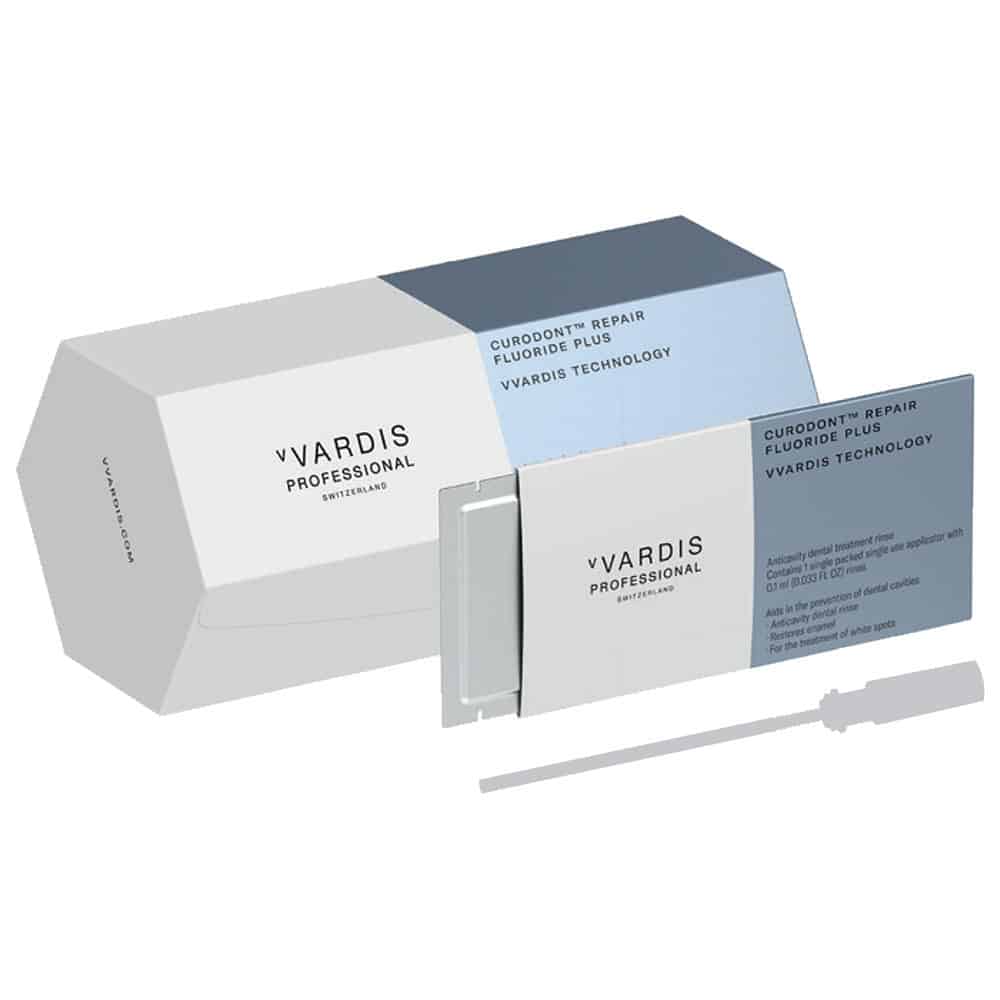
This is the flagship product and the primary subject of this review. Curodont Repair Fluoride Plus is a locally applied, low-viscosity liquid formulation for the in-office treatment of early, non-cavitated carious lesions (commonly called watch areas or white spot lesions). It is registered with the U.S. FDA under the Over-the-Counter Anticaries Drug Monograph (NDC: 72247-101). The formulation contains Oligopeptide-104, sodium fluoride, and chlorhexidine digluconate. When applied to an early lesion, the liquid diffuses throughout the depth of the demineralized enamel. The peptides then self-assemble into a three-dimensional scaffold that attracts calcium and phosphate ions from the patient’s saliva, forming new hydroxyapatite crystals. vVardis refers to this process as Guided Enamel Remineralization.
Each box includes 10 applicator units. One applicator treats one to two lesions, and a single application is generally sufficient per lesion. The entire chair-side process takes under 10 minutes, with no drilling, anesthesia, or pain involved.
Curodont Protect
Curodont Protect is a remineralizing gel built around the Oligo-Peptide 103 technology, enriched with stabilized stannous fluoride. It is designed for both in-office and at-home use. In practice, it works well as a finishing step after professional cleanings, bleaching, or periodontal procedures. Patients can continue applying it at home once or twice per week as part of their oral hygiene routine. It is particularly suited for high-caries-risk patients, orthodontic patients, and those experiencing dry mouth. For a broader look at how remineralizing agents compare to standard fluoride toothpastes, the comparative framework matters. Curodont Protect goes beyond surface remineralization, creating a mineral-rich shield that counteracts the onset of caries and erosion.
Curodont D’Senz
Curodont D’Senz is a sensitivity relief gel that uses the Oligo-Peptide 103 in a polymer matrix formation to occlude open dentinal tubules. Clinical data shows improvement in over 81% of patients, with effects lasting up to three months. It serves as a useful adjunct after cleanings, bleaching, and periodontal treatments.
Does Curodont Work? The Clinical Evidence
This is the central question in any honest review, and it deserves a thorough answer grounded in published, peer-reviewed research rather than manufacturer claims alone.
The JADA Meta-Analysis (2023)
The most authoritative assessment of Curodont’s effectiveness comes from a systematic review and meta-analysis published in the Journal of the American Dental Association (JADA) in 2023 by Keeper et al. This review examined six clinical trials evaluating the P11-4 self-assembling peptide for the treatment of initial caries lesions.
The findings were meaningful. The meta-analysis of caries arrest showed a risk ratio of 1.82 (95% CI, 1.32 to 2.50) when comparing Curodont Repair to no-treatment controls over 6 to 12 months. That translates to a 45% attributable risk, meaning roughly 45% of all arrested lesions in the treatment group were arrested because of the Curodont treatment itself, not natural remineralization. The number needed to treat (NNT) was 2.8, meaning that for approximately every three teeth treated, one additional lesion was arrested that would not have stopped progressing on its own.
Regarding lesion size reduction, the meta-analysis found an average decrease of 32% in lesion surface size relative to baseline. The evidence also suggested a large reduction in cavitation risk (RR 0.32, NNT 6.9), though this finding did not quite reach statistical significance.
The review concluded that Curodont Repair likely produces clinically important effects on caries arrest and lesion size reduction. It is worth noting that all included trials carried some level of bias risk, and the authors recommended longer-term studies.
Individual Clinical Trial Results
A randomized clinical trial by Alkilzy et al. (Journal of Dental Research, 2018) found that after six months, 80% of early caries treated with Curodont Repair plus fluoride varnish became inactive, compared to only 34% treated with fluoride varnish alone. The study also demonstrated 60% less risk for caries progression with Curodont Repair Fluoride Plus compared to sodium fluoride varnish.
Additional studies published in Scientific Reports and Clinical Oral Investigations have corroborated these outcomes. A 2025 randomized controlled clinical trial comparing Curodont Repair Fluoride Plus to CPP-ACP for white spot lesions found that the Curodont group showed superior potential for complete healing of incipient lesions.
In Vitro Evidence
A 2025 in-vitro study conducted by the Dental Advisor showed hydroxyapatite formation throughout the depth of artificial enamel lesions within just two weeks of a single application. A statistically significant average increase of 15% in mineral density was observed (p<0.001), independent of lesion depth. Earlier work by Schmidlin et al. demonstrated that Curodont Repair restored enamel hardness at a depth eight times greater than fluoride varnish alone.
The Evidence Summary
The published science supports the conclusion that Curodont does work for its intended use case. The NNT of 2.8 is strong, the caries inactivation rates above 80% are clinically meaningful, and the in-depth remineralization mechanism differentiates it from surface-only approaches. The main limitations are the relatively short follow-up periods in existing trials (6 to 12 months) and the elevated bias risk across studies. Longer-term, independently funded research would strengthen the evidence further, but what exists today is more robust than what many established treatments had at a comparable adoption stage.
Clinical Application: The Step-By-Step Protocol
One of the strongest practical selling points of Curodont Repair Fluoride Plus is that it integrates seamlessly into existing hygiene workflows. The protocol requires no special dental equipment beyond what a standard operatory already contains, and a hygienist can perform the entire procedure during a routine cleaning appointment.
Tooth Preparation
Clean the treatment area with oral prophylaxis to remove calculus and plaque. Remove the organic pellicle using pumice, prophy paste, an air polisher, or 2% sodium hypochlorite. Rinse and dry. Etch the lesion surface with 35% phosphoric acid for 20 seconds. For interproximal sites, use unwaxed dental floss to distribute the etchant. Rinse and pat dry gently without aggressive air drying. Isolate the area with cotton rolls or dry aids. Rubber dam placement is optional and usually unnecessary.
Product Application
Activate the applicator by immersing the Unit A sponge fully with the Unit B dropper liquid and let it soak for at least two minutes. Apply the saturated sponge directly onto the lesion by squeezing. For interproximal lesions, apply from buccal and lingual sides. Use a Hollenback or plastic instrument to press the sponge against the tooth and twist the applicator to express all liquid onto the enamel. Allow the formulation to sit for five minutes.
Post-Application Instructions
Instruct the patient to avoid rinsing, eating, or drinking for 30 minutes. Optional fluoride varnish may be applied after the five-minute absorption period. Discard the single-use applicator. Reinforce the importance of twice-daily brushing with fluoridated toothpaste and daily interdental cleaning, especially for patients with interproximal lesions.
The total chair time, including preparation and application, typically falls under 10 minutes per lesion. Treating multiple watch areas in the same quadrant adds minimal incremental time.
Curodont Price And Financial Considerations
Pricing is a critical factor for any practice owner evaluating a new product. Understanding the full financial picture, from acquisition cost to patient-facing pricing, helps determine whether the investment makes sense for a specific practice model.
What Dental Practices Pay
Curodont Repair Fluoride Plus is sold in boxes of 10 single-use applicators. Retail pricing from major distributors (Henry Schein, Patterson Dental, Benco Dental) typically ranges from $355 to $440 per box. Several distributors run Buy 4, Get 1 Free promotions, reducing the effective per-unit cost. This puts the per-applicator cost at roughly $35 to $44, with each applicator treating one to two lesions.
What Patients Pay
Practices across the United States generally charge $100 to $200 per tooth for the Curodont professional treatment, with $150 per tooth being a widely reported fee. That positions it at roughly one-third to one-half the cost of a traditional filling, which typically ranges from $150 to $500 depending on the material and number of surfaces involved.
Insurance Coverage
A dedicated ADA CDT code for hydroxyapatite remineralization per tooth was established in January 2024, which is a positive step toward broader reimbursement. However, insurance coverage for Curodont treatment remains inconsistent as of early 2026. Most practices currently offer it as a fee-for-service procedure. The good news is that patient acceptance rates are high. Evaluators for Dental Product Shopper reported 60% to 100% acceptance when the treatment is presented as a painless, drill-free, non-staining alternative to waiting for a cavity to develop.
The Business Case
From a practice economics perspective, the vVardis price per treatment compares favorably to restorative alternatives. The procedure can be performed by a hygienist, freeing the dentist’s chair time for higher-complexity procedures. There is no need for a separate restorative appointment, anesthesia, or lab work. The long-term ROI extends beyond the immediate treatment fee. Preventing the restorative cycle (initial filling, replacement filling, crown, root canal, potential extraction) preserves natural tooth structure and builds patient loyalty. For practices focused on growing their patient base, offering Curodont as a patient-friendly, minimally invasive option can serve as a meaningful differentiator.
Where To Buy vVardis Curodont Products
Sourcing Curodont is straightforward for licensed dental professionals. The product is available through all major distribution channels used by U.S. practices.
Henry Schein Dental (henryschein.com) carries Curodont Repair Fluoride Plus and Curodont Protect
Patterson Dental (pattersondental.com) stocks the full Curodont professional line
Benco Dental (shop.benco.com) offers Curodont Repair Fluoride Plus in standard 10-pack boxes
vVardis Professional US (professional.vvardis.us) provides direct ordering, onboarding resources, training materials, and CE-accredited courses
Specialty suppliers such as Dentira, Pure Life Dental, and Crazy Dental Prices also carry the product and may offer competitive pricing
Curodont Repair Fluoride Plus is classified as a professional product for in-office use only. Consumer vVardis oral care products (toothpaste, serum, whitening) are available through vvardis.com, but the professional treatment line requires purchase through dental supply channels. For direct assistance, vVardis offers a toll-free contact line at 1-800-217-0064.
Curodont vs. Traditional Treatments And Competitors
No product exists in a vacuum. Dental professionals evaluating Curodont need to understand how it compares to the other tools available for managing early-stage caries.
Curodont vs. Fluoride Varnish
Fluoride varnish is the established baseline for preventive remineralization. However, fluoride primarily works on the surface of the enamel. Curodont’s peptide formulation penetrates throughout the depth of the lesion, enabling subsurface remineralization. Clinical data shows that combining Curodont Repair with fluoride varnish achieves approximately 80% caries inactivation versus 34% with fluoride varnish alone. For practices already applying fluoride varnish routinely, Curodont adds meaningful clinical value on top of what fluoride provides.
Curodont vs. Silver Diamine Fluoride (SDF)
SDF is effective and inexpensive, with strong evidence for arresting both cavitated and non-cavitated lesions. Its major limitation is the permanent black staining it leaves on treated surfaces, which significantly limits use on anterior teeth and esthetic zones. Curodont does not stain, has no taste, and produces no discoloration, making it appropriate for visible surfaces where appearance matters. Many clinicians use both products strategically, reserving SDF for posterior cavitated lesions and Curodont for esthetic-zone and early non-cavitated lesions.
Curodont vs. Resin Infiltration (ICON)
Resin infiltration physically fills porous enamel with synthetic resin to block acid penetration. It is effective for masking and stabilizing white spot lesions on smooth surfaces, but it does not regenerate biological enamel. Curodont takes a fundamentally different approach, building new hydroxyapatite using the patient’s own salivary minerals. Curodont also works on all surfaces including interproximal areas, whereas resin infiltration requires specific technique modifications for proximal application.
Curodont vs. Drill And Fill
International consensus guidelines and U.S. clinical practice guidelines consistently state that drilling and filling are not indicated for initial, non-cavitated lesions. Despite this, studies show that 94% of U.S. dentists self-report restoring lesions that are still within the initial range. Curodont provides a genuine alternative to this cycle, treating early decay before it reaches the point where irreversible intervention becomes necessary. The financial comparison also favors early intervention. The cost of a Curodont treatment ($100 to $200 per tooth) is substantially lower than the cumulative cost of the restorative cycle, which typically begins with a filling ($150 to $500) and can escalate to crowns, root canals, and eventual extraction over the life of the tooth.
Bottom Line: Does vVardis Really Work?
Curodont Repair Fluoride Plus represents a credible, evidence-backed advancement in how dental professionals can manage early-stage caries. The product is grounded in 25+ years of biomimetic research, supported by a JADA-published meta-analysis, adopted in over 12% of U.S. dental offices, and designed to fit seamlessly into routine hygiene workflows. It does what it claims to do, which is arrest and remineralize early, non-cavitated carious lesions through guided enamel remineralization.
The product is not a replacement for restorative dentistry when cavitation has already occurred, and the evidence base would benefit from longer-term trials. Insurance coverage is still developing. These are real limitations that every practice should weigh.
That said, for practices committed to early intervention, patient comfort, and preserving natural tooth structure, integrating Curodont into the clinical workflow is a sound, evidence-supported decision. The vVardis price is justified by the clinical outcomes, the patient experience, and the long-term economics of avoiding the restorative cycle. For more dental product reviews written for professionals, continue exploring the latest assessments on Dental Reviewed.
Verdict
<p>After evaluating the clinical evidence, the application workflow, the financial model, and the competitive landscape, Curodont Repair Fluoride Plus earns a strong recommendation for dental practices that prioritize minimally invasive care and early caries intervention.</p><p>Does vVardis work? The evidence says yes, within its intended scope. For early, non-cavitated carious lesions, Curodont demonstrates meaningful improvement in caries arrest rates and lesion regression compared to both no treatment and fluoride varnish alone. The NNT of 2.8 is one of the strongest in this product category. The treatment does not stain, causes no discomfort, requires less than 10 minutes of chair time, and can be performed by a hygienist during a routine cleaning appointment. These practical advantages make it realistic to integrate into daily workflows without disruption.</p><p>The limitations are real but manageable. Curodont will not replace restorations for cavitated lesions, and the evidence base would benefit from longer-term, independently funded trials. Insurance reimbursement is still catching up, meaning most practices will position this as a fee-for-service offering for now. The per-unit cost is higher than SDF or fluoride varnish, but the absence of staining, the patient-friendly experience, and the ability to treat esthetic-zone lesions give Curodont a distinct clinical advantage that justifies the premium.</p><p>For practices committed to preservation-first vVardis dentistry, patient-centered care, and practice differentiation, integrating the Curodont professional treatment into the workflow is a decision supported by credible clinical evidence and sound economics.</p>
Frequently Asked Questions
What is vVardis?
vVardis is a Swiss healthcare company that specializes in biomimetic dental products designed to mimic the way nature builds and repairs teeth. The company was founded by Dr. Haley Abivardi and Dr. Goly Abivardi and is backed by more than 25 years of research. Its professional product line, sold under the Curodont brand, includes treatments for early caries, remineralization, and sensitivity relief. vVardis also offers a consumer oral care line featuring hydroxyapatite-enriched toothpastes and serums.
Does vVardis work?
The clinical evidence supports the effectiveness of vVardis Curodont products for their intended use. A JADA-published meta-analysis found that Curodont Repair produced a statistically significant increase in caries arrest (RR 1.82) and a 32% decrease in lesion size compared to untreated controls. Clinical trials show caries inactivation rates above 80% when Curodont is combined with fluoride varnish, versus approximately 34% with fluoride varnish alone. The product works on early, non-cavitated carious lesions and is not intended for advanced cavitated caries.
Does vVardis really work, or is it just clever marketing?
The science is peer-reviewed and published in respected journals, including the Journal of the American Dental Association, Scientific Reports, and Clinical Oral Investigations. The active self-assembling peptide (P11-4) has been studied in over 230 scientific publications, including multiple randomized controlled trials. Real-world adoption data also supports the product’s credibility, with more than one million teeth treated in the U.S. since early 2024 and the product available in nearly 12% of U.S. dental offices. The main caveat is that existing clinical trials are mostly 6 to 12 months in duration, and all carry some degree of bias risk.
Does Curodont work on cavities?
Curodont Repair Fluoride Plus works on early, non-cavitated carious lesions (ICDAS scores 1 to 3, E1/E2, and select non-cavitated D1 lesions). Once a lesion has progressed to cavitation, traditional restorative treatment is still required. Curodont’s value lies in intercepting decay before it reaches the point where drilling becomes necessary.
What is the Curodont price?
A box of 10 applicators typically costs $355 to $440 from major dental distributors. Promotions such as Buy 4, Get 1 Free can reduce the effective per-unit cost. Most practices charge patients $100 to $200 per tooth, with $150 per tooth being a common price point. This is significantly less than the cost of a filling, which typically ranges from $150 to $500 per tooth.
Where can I buy vVardis Curodont products?
Licensed dental professionals can purchase Curodont through Henry Schein Dental, Patterson Dental, Benco Dental, or directly from the vVardis Professional US website (professional.vvardis.us). Specialty dental suppliers such as Dentira and Pure Life Dental also carry the product. Consumer vVardis products are available at vvardis.com, but the professional Curodont treatment line is restricted to licensed dental professionals.
Is the professional treatment with Curodont covered by dental insurance?
A specific ADA CDT code for hydroxyapatite remineralization per tooth was introduced in January 2024, which is a positive development. However, insurance coverage for Curodont remains inconsistent across carriers as of early 2026. Most practices currently offer it as a fee-for-service treatment. Patient acceptance is generally high because the treatment is fast, painless, and less expensive than a filling.
How long does it take for Curodont to show results?
The peptide biomatrix forms within minutes of application, and the remineralization process begins immediately. However, clinically visible results typically take 4 to 6 months, as the process depends on ongoing mineral deposition from saliva. In-vitro studies have demonstrated hydroxyapatite formation in as little as two weeks. Some clinicians report visible improvement on bitewing radiographs within two to six months.
Can a dental hygienist apply Curodont?
Yes. Curodont Repair Fluoride Plus is designed to be applied by dental professionals, including hygienists, during routine appointments. This is one of its key practical advantages, as it does not require a separate restorative visit with the dentist and generates incremental revenue from hygiene appointments.
How does Curodont compare to silver diamine fluoride (SDF)?
Both are effective noninvasive options, but they serve different clinical situations. SDF is inexpensive and effective for arresting both cavitated and non-cavitated lesions, but it permanently stains treated areas black. Curodont does not stain and is appropriate for esthetic-zone and anterior lesions. SDF has broader indications (including cavitated lesions), while Curodont is limited to non-cavitated lesions. Many clinicians use both products as complementary tools.
Is Curodont safe for children?
Curodont Repair Fluoride Plus is suitable for patients aged 4 years and older. Curodont Protect and D’Senz are suitable for patients 6 years and older. Clinical trials have not reported adverse effects. For children under the recommended age, consulting a dentist or physician is advised.