Rating: 3.9/5
Enamelast Fluoride Varnish Review
Fluoride varnish has become one of the most frequently applied preventive materials in the operatory, valued for its speed, patient tolerance, and a deep evidence base for caries...
Reviewed by Agnes Markovic
Pros
- Excellent retention from a patented adhesion-promoting agent, keeping the varnish on the tooth so fluoride has time to be absorbed
- Smooth, non-gritty texture that patients tolerate well, improving compliance and contact time
- Nearly invisible finish that appeals to adults and esthetically conscious patients
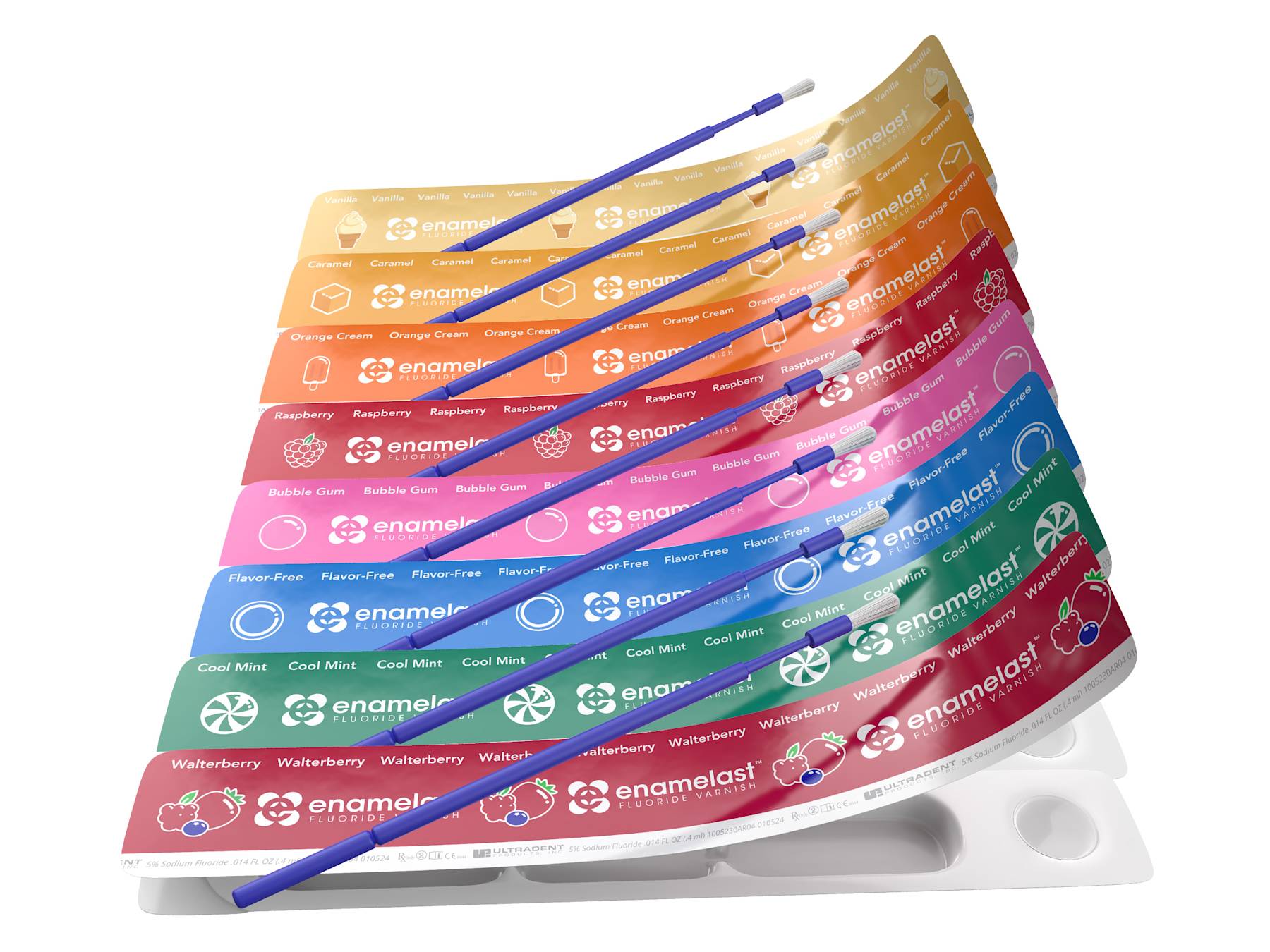
- Wide flavor selection with seven flavors plus flavor-free, including child-friendly non-mint options, all xylitol-sweetened
- Two delivery formats, unit-dose blister packs and a multi-patient syringe, to fit different workflows and institutional requirements
- Clean allergen profile that is nut-free, gluten-free, and free of dyes, soy, and peanuts
- Dual indication for caries prevention and dentin hypersensitivity relief in a single application
- Suitable across the lifespan, including pediatric and orthodontic patients
- Strong track record of independent recognition, including Reality Four-Star Awards and a Dentistry Today Top 100 listing
- Backed by a reputable manufacturer with established support and documentation
Cons
- Premium-to-mid pricing compared with generic 5% sodium fluoride varnishes, so cost-focused practices can find cheaper options
- Syringe format limited to a single flavor, Walterberry, with flavor variety confined to the unit-dose line
- Strongest superiority claims rely partly on in-house data on file, so comparative advantages over other quality varnishes should be read as promising rather than proven
- Rosin and colophony content makes it unsuitable for patients with a rosin allergy, a caveat easy to overlook given the otherwise clean allergen profile
- Occasional flavor and variety-pack stock fluctuations have been reported, which can complicate standardizing on one flavor
- Standard varnish limitations apply, including post-application dietary restrictions, professional-only application, and the usual transient appearance changes
Fluoride varnish has become one of the most frequently applied preventive materials in the operatory, valued for its speed, patient tolerance, and a deep evidence base for caries risk reduction and dentin hypersensitivity relief. Not every varnish behaves the same way on the tooth, and the practical differences in texture, color, retention, taste, and delivery format often decide whether a product earns a permanent place on the tray.
This review takes a close, clinical look at Enamelast fluoride varnish from Ultradent Products, written for dentists, hygienists, and purchasing decision-makers who want reliable information before committing budget. The sections that follow cover the formulation, the mechanism of action, the delivery systems, the flavor range, the clinical claims and their supporting evidence, a step-by-step application protocol, safety and contraindications, pricing and value, a comparison against competing varnishes, an honest list of pros and cons, a concise dentist's verdict, a bottom line, and a full set of FAQs.
Quick Summary: Is Enamelast Worth A Closer Look?
For readers who are short on time, this section distills the essentials before the detailed analysis that follows.
Enamelast is a xylitol-sweetened, 5% sodium fluoride varnish suspended in a resin carrier, distinguished by a patented adhesion-promoting agent that Ultradent credits for the product's retention, fluoride release, and fluoride uptake. In everyday clinical terms, the selling points are a smooth, non-gritty texture, a nearly invisible finish on the teeth, a wide flavor menu, and two delivery formats, namely unit-dose blister packs and a multi-use syringe. The product has collected a string of industry recognitions, including multiple consecutive Reality Four-Star Awards and a Dentistry Today Top 100 listing, and it earns consistently favorable feedback from clinicians on taste and handling.
Enamelast is a professionally applied, in-office product priced at a mid-to-premium point rather than a bargain generic. Some of its strongest superiority claims rest partly on in-house testing, so the marketing language deserves a measured reading. With those caveats noted, Enamelast is a credible, patient-friendly fluoride varnish that suits general, pediatric, orthodontic, and hygiene-focused practices.
What Is Enamelast Fluoride Varnish?
Enamelast is a professional topical fluoride treatment manufactured by Ultradent Products, Inc., a well-established dental manufacturer based in South Jordan, Utah. Like most modern varnishes, it delivers a high concentration of fluoride in a form that clings to enamel and dentin, so the mineral stays in contact with the tooth surface far longer than a rinse or gel could manage.
The active ingredient is 5% sodium fluoride, the standard concentration for professional varnishes, which corresponds to roughly 22,600 ppm of fluoride ion. That fluoride is carried in a resin base rather than the traditional rosin-only carriers of older varnishes, and the whole formulation is sweetened with xylitol rather than sugar. Xylitol is a non-cariogenic sugar alcohol, which is a sensible choice in a product whose entire purpose is prevention.
Two elements set Enamelast apart from a plain 5% sodium fluoride varnish, at least in Ultradent's positioning. The first is a patented adhesion-promoting agent built into the resin and hydrogenated rosin formula, intended to keep the varnish on the tooth for the full working window. The second is the deliberate engineering of the material's feel and appearance, since it is designed to go on smooth and non-gritty and to disappear visually against the enamel, both of which encourage patients to leave it undisturbed so the fluoride has time to work.
Enamelast is indicated as a preventive adjunct to reduce caries risk and as a desensitizing agent for the treatment of dentin hypersensitivity. It is a professional product applied chairside by a dental professional, not a consumer item for home use.
Formulation At A Glance
The following summary captures the core specifications clinicians most often want to confirm before ordering.
Active ingredient: 5% sodium fluoride, approximately 22,600 ppm fluoride
Carrier: resin and hydrogenated rosin base with a patented adhesion-promoting agent
Sweetener: xylitol, which is non-cariogenic
Texture: smooth and non-gritty
Appearance on teeth: nearly invisible and natural
Allergen profile: nut-free and gluten-free, also free of dyes, soy, and peanuts
Formats: unit-dose blister packs and a 1.2 ml syringe
Category: professionally applied topical fluoride varnish
How Enamelast Works: The Mechanism Behind The Varnish
Understanding why a varnish works helps clinicians explain the treatment to patients and choose the right product for each situation. Enamelast operates through the two classic pathways of professional fluoride varnish, described below.
Caries Prevention And Enamel Remineralization
The first pathway addresses caries risk, and it is the reason varnish appears in most preventive protocols.
When fluoride varnish is painted onto the tooth, it forms a temporary reservoir of fluoride at the enamel surface. Saliva slowly dissolves the varnish over the following hours, releasing fluoride ions that are taken up into the enamel, where they promote remineralization of early, non-cavitated lesions and support the formation of more acid-resistant, fluorapatite-like mineral, shifting the demineralization and remineralization balance in the tooth's favor. Because the varnish adheres and dissolves gradually rather than washing away like a rinse, contact time, and therefore fluoride uptake, is extended considerably.
Ultradent emphasizes superior fluoride release and uptake as the payoff of Enamelast's retention chemistry, since the longer the material stays put, the more fluoride the enamel absorbs over time. Both the American Academy of Pediatric Dentistry and the American Dental Association endorse professionally applied fluoride varnish as an effective, evidence-based caries-prevention measure across risk groups, and applying varnish two to four times a year is associated with a meaningful reduction in caries incidence, a finding supported across multiple systematic reviews.
Dentin Hypersensitivity Relief
The second pathway makes Enamelast a dual-purpose material, useful well beyond routine caries prevention.
Exposed, sensitive dentin transmits stimuli through open dentinal tubules. A 5% sodium fluoride varnish helps to reduce dentin hypersensitivity because it covers the dentin surface and produces a mechanical occlusion of those open tubules, physically reducing fluid movement and blunting the sensitivity response. Fluoride is also recognized in the literature as an effective desensitizing agent for dentin hypersensitivity and root-surface protection. In practice, the same application that lowers caries risk can also settle a patient's cold-air or sweet sensitivity, which makes varnish a convenient complement to other in-office options such as laser desensitization therapy.
Key Features And Clinical Benefits
Beyond the mechanism, Enamelast's appeal comes down to handling and patient acceptance. The features below are the ones that tend to matter chairside.
Patented Adhesion And Retention
Retention is the whole game for a varnish, since a material that flakes off in the first half hour cannot deliver its rated fluoride dose. Enamelast's patented adhesion-promoting agent is designed to keep the film on the tooth and let it dissolve slowly rather than shed. Ultradent's in-house clinical hygienist has described retention lasting well beyond a typical day in anecdotal observation, and independent clinician reviewers consistently single out adhesion as a strength. Stronger retention is also the stated basis for the product's higher fluoride-uptake claims.
Smooth, Non-Gritty Texture
Older varnishes earned a reputation for a sandy, filmy mouthfeel that patients disliked and often disturbed with the tongue. Enamelast is formulated to feel smooth and clean on application. That comfort matters clinically, because a material patients tolerate is a material they leave alone, which again feeds back into contact time and fluoride uptake.
Nearly Invisible, Natural Appearance
Many resin varnishes leave a visible yellow or dull film that patients notice for the rest of the day. Enamelast is engineered to appear nearly invisible against the teeth, which is particularly welcome for adult and esthetically conscious patients who prefer to leave the office without an obvious coating.
Broad Flavor Menu, Two Delivery Formats, And A Clean Allergen Profile
Three practical advantages round out the feature set, each of which supports patient cooperation or workflow flexibility.
Flavor variety: a flavor-free option plus a wide range of xylitol-sweetened flavors, useful for matching patient preference and improving cooperation
Format choice: single-use unit-dose blister packs or a multi-patient syringe, so a practice can standardize around its workflow and infection-control needs
Clean allergen profile: nut-free and gluten-free, also free of dyes, soy, and peanuts, which simplifies the safety conversation for many patients
Industry recognition: named a Dentistry Today Top 100 Product and awarded the Reality Four-Star Award in multiple consecutive years, alongside favorable independent clinician evaluations
Delivery Options: Unit-Dose And Syringe
One of Enamelast's practical strengths is that it comes in two mix-free formats, each suited to a different style of practice. The two options are described below.
Unit-Dose Blister Packs, Approximately 0.4 ml
Each blister pack contains a prefilled well of varnish, and unit doses are offered either with an included disposable applicator brush or without, so practices can buy brushes separately or as an all-in-one kit. The clinician dips the brush into the well and paints the varnish onto the teeth. Unit-dose packaging is the natural fit for single-application convenience and is often mandated in hospital and institutional settings, where regulations require unit-dose treatments to have all materials packaged together. The self-contained dose also removes any cross-contamination concern between patients.
Syringe Delivery, 1.2 ml, Two To Four Patients Per Syringe
The syringe format leans into Ultradent's signature direct-delivery approach. Varnish is expressed through a SoftEZ tip, either directly onto the teeth or into a dappen well for brush application, according to clinician preference. Each 1.2 ml syringe holds enough material for roughly two to four patients, which can lower the per-application cost in a higher-volume hygiene department. The main trade-off is flavor, since the syringe is offered in the Walterberry flavor only, while the full flavor variety lives in the unit-dose line.
Choosing between them: unit-dose favors institutional compliance, flavor variety, and the lowest handling friction, while the syringe favors clinician-controlled dispensing and potentially lower cost per patient at volume.
Enamelast Flavors
Flavor is a genuine clinical variable in fluoride varnish, because acceptance drives compliance, and compliance drives retention. Enamelast's unit-dose line has expanded over the years from its original Walterberry flavor into a broad menu, listed below.
Walterberry, Ultradent's signature sweet-tart berry blend, which is also the syringe flavor
Orange cream
Cool mint
Bubble gum
Caramel
Raspberry
Vanilla
Flavor-free, offering a hint of sweetness that fades after a couple of minutes
Clinician feedback frequently notes that pediatric patients gravitate toward the non-mint options, such as bubble gum, Walterberry, and orange cream, because they avoid the spiciness some children dislike in mint, while many adults favor Walterberry or the mint. All Enamelast varnishes are nut-free and gluten-free. Specific flavors and variety packs can move in and out of stock, so it is worth confirming current availability with a distributor before standardizing on a particular flavor.
Clinical Evidence And Manufacturer Claims
For a professional audience, it helps to separate what is well established from what is manufacturer positioning. The evidence falls into two tiers.
Well established, at the category level. The value of professionally applied topical fluoride is not in dispute. Major bodies including the American Dental Association and the American Academy of Pediatric Dentistry support fluoride varnish as an effective caries-preventive adjunct, and the desensitizing action of 5% sodium fluoride varnish through tubule occlusion and fluoride's own anti-sensitivity effect is supported in the peer-reviewed literature. Applying varnish two to four times per year is associated with substantial caries reduction. On these points, Enamelast rests on the same solid foundation as any reputable 5% sodium fluoride varnish.
Product-specific claims, which deserve a measured reading. Ultradent's stronger differentiators, that Enamelast offers superior fluoride release and uptake compared with other leading competitors including the market-leading 3M Vanish, and that its retention outperforms its class, are supported by a mix of published references, independent laboratory testing such as in-vitro flow-model and pH-cycling enamel-uptake studies conducted by a third-party dental testing division, and internal data on file. The independent lab data lend real weight, yet comparative superiority claims that lean partly on in-house data are best read as promising rather than definitively settled. An independent in-vitro study comparing the antibiofilm activity of Enamelast with a competitor found the competitor more effective against Streptococcus mutans in that specific model, a reminder that head-to-head performance can vary by outcome measured. Where a comparative difference is central to a purchasing decision, it is reasonable to ask an Ultradent representative for the specific study reports rather than relying on summary graphs.
The pragmatic takeaway is that Enamelast is very likely at least as effective as its peers on the outcomes that matter, and it may hold a retention and uptake edge, while the size of any real-world advantage over other quality varnishes is modest. The handling and patient-acceptance advantages are the more reliable differentiators.
Application Protocol, Step By Step
Enamelast is straightforward to apply, and both formats are mix-free. A typical protocol follows the steps below, and clinicians should always defer to the current manufacturer Instructions for Use and local infection-control standards.
Perform a prophy if indicated. A prior cleaning is not strictly required for uptake, though many clinicians apply varnish after prophylaxis.
Isolate and lightly dry. Use gauze, cotton rolls, air, or a dedicated isolation system to remove gross saliva. Varnish tolerates a slightly moist surface, which is one of its advantages over some other fluoride formats.
Dispense. For unit-dose, dip the applicator brush into the prefilled well. For the syringe, express varnish through a SoftEZ tip directly onto the teeth or into a dappen dish for brush pickup.
Paint a thin, even film. Apply a thin layer across the enamel surfaces, focusing on caries-prone or sensitive areas. A thin coat is all that is needed, since the material sets on contact with saliva.
Allow it to set. The varnish sets quickly once it meets moisture in the mouth.
Give post-operative instructions. Advise the patient to avoid hot drinks, alcohol including alcohol-containing mouthwash, and hard or crunchy foods for the recommended interval, and to delay brushing and flossing until the next day so the film stays intact and fluoride uptake is maximized.
Recall frequency. The American Academy of Pediatric Dentistry recommends fluoride varnish at least twice a year, and every three to six months for patients at high caries risk. Recording each application within the patient's dental treatment plan supports continuity of preventive care across pediatric, adult, and orthodontic patients.
Who Should Use Enamelast?
Although varnish is sometimes thought of as a pediatric product, the ideal candidates span a much wider range. The groups below benefit most.
Caries-risk patients of every age, since patients at elevated risk benefit regardless of age
Pediatric patients, who cooperate more readily thanks to the flavor variety and smooth texture
Orthodontic patients, who face higher white-spot-lesion risk around brackets and benefit from routine fluoride
Dentin hypersensitivity sufferers, including patients with root exposure or post-periodontal-surgery sensitivity
Esthetically conscious adults, who appreciate the nearly invisible finish
Institutional and hospital settings, where the unit-dose format meets all-materials-packaged-together requirements
Safety, Contraindications, And Precautions
Enamelast has a favorable safety profile as a professional product, though a few points deserve clinician attention before use.
Rosin and colophony sensitivity. The resin carrier is based on hydrogenated rosin, or colophony, so patients with a known rosin allergy should not receive this varnish. This caveat is common to most resin varnishes and is separate from the nut, gluten, and soy-free profile.
General varnish precautions. As with any fluoride varnish, avoid use in patients with ulcerative gingivitis or stomatitis and in anyone with a known hypersensitivity to a component, and review the full Instructions for Use and Safety Data Sheet.
Professional application only. Dosing and application are controlled by the clinician, which inherently limits the risk of fluoride overingestion compared with unsupervised home products.
Post-application diet restrictions. The temporary dietary and oral-hygiene restrictions protect the film and the fluoride dose, so they are part of the protocol rather than an optional extra.
Transient appearance. A temporary change in the look of the teeth immediately after application is normal for resin varnishes and resolves with the next brushing.
Pricing And Value
Enamelast sits in the mid-to-premium tier rather than the bargain-generic tier. Exact pricing varies by distributor, pack configuration, and volume discount, and manufacturer list prices change over time, so any figure should be treated as indicative and confirmed with a supplier.
As a general orientation drawn from manufacturer listings, unit-dose kits are commonly listed in roughly the low-hundreds-of-dollars range depending on pack size, with a smaller unit-dose kit around the high 90-dollar mark and larger-count kits substantially higher, while a single multi-use syringe is listed around a similar mid-range figure and covers two to four patients. Because the syringe stretches across multiple applications, it can bring the per-patient cost down for higher-volume hygiene departments, whereas unit-dose trades a higher per-application cost for convenience and compliance benefits.
Value assessment. For practices that prioritize patient experience, retention, and a clean allergen profile, Enamelast's pricing is easy to justify. Practices whose sole priority is the lowest possible unit cost will find cheaper generic 5% sodium fluoride varnishes, usually with trade-offs in texture, appearance, flavor range, or retention chemistry. The right choice depends on where a practice sits on the value-versus-experience spectrum.
Enamelast Versus Other Fluoride Varnishes
Every 5% sodium fluoride varnish delivers the same active ingredient at the same concentration, so differentiation happens in the carrier, the retention chemistry, and the patient experience. Against the broader field, which includes 3M Vanish, Colgate and GC varnishes, and numerous generic products, Enamelast tends to compete on the points below.
Esthetics, since the nearly invisible finish is a genuine differentiator versus varnishes that leave a visible yellowish film
Texture, since the smooth, non-gritty feel is a recurring point of praise relative to sandier competitors
Flavor range, since the broad flavor menu, including several non-mint options, is wider than many rivals offer
Retention and uptake claims, since Ultradent positions the patented adhesion agent as delivering higher fluoride uptake than competitors, though the strongest comparative claims rest partly on in-house data
Where competitors may win, some generic varnishes undercut Enamelast on price, and clinicians already standardized on a specific competitor's workflow, or who need a particular flavor only that brand offers, may see less reason to switch. The honest summary is that Enamelast ranks near the top of its category on experience and competes favorably on performance, at a mid-premium price, while sharing the same fundamental chemistry as other quality 5% sodium fluoride varnishes. Clinicians comparing options can review related preventive and restorative products among the site's dental materials reviews for additional context.
Bottom Line
Enamelast is a mature, well-supported 5% sodium fluoride varnish that competes at the top of its category on the things patients actually feel, namely texture, appearance, and taste, while resting on the same solid evidence base as any reputable professional fluoride varnish for caries prevention and sensitivity relief. Its patented adhesion chemistry, broad flavor menu, two delivery formats, and clean allergen profile make it a versatile fit for general, pediatric, orthodontic, and hygiene-driven practices. The main reasons to hesitate are price relative to generics, the syringe's single-flavor limitation, and comparative performance claims that lean partly on in-house data. Weighed together, Enamelast is a confident, low-risk choice for practices that want their preventive appointments to be as pleasant as they are effective.
Verdict
<p>Enamelast earns its place as a dependable, patient-friendly workhorse rather than a revolutionary leap, and that is exactly what most practices want from a fluoride varnish. The active ingredient matches any reputable competitor, so the real question is how the material behaves chairside, and here Enamelast delivers. The smooth, non-gritty texture and nearly invisible finish resolve the two complaints patients voice most often about varnish, which improves the odds that the film stays undisturbed long enough to work. The generous flavor range is a genuine asset in pediatric and anxious patients, where cooperation is half the battle. The retention and fluoride-uptake advantages are plausible and partly supported by independent laboratory testing, though the strongest superiority language leans on in-house data and should be weighed accordingly. Pricing is mid-premium, so cost-driven offices may look elsewhere, and the syringe's single-flavor limitation is a minor annoyance. For general, pediatric, orthodontic, and hygiene-focused practices that value patient experience and reliable handling, Enamelast is an easy product to recommend and a safe long-term standardization choice. Overall, it is a strong, well-rounded 5% sodium fluoride varnish that competes at the top of its category on experience and holds its own on performance.</p>
Frequently Asked Questions
What is Enamelast fluoride varnish used for?
Enamelast is a professionally applied topical treatment used to reduce caries risk by delivering fluoride to enamel, and to relieve dentin hypersensitivity by occluding open dentinal tubules. It is applied chairside by a dentist or hygienist as part of a preventive protocol.
What is the fluoride concentration in Enamelast?
Enamelast contains 5% sodium fluoride, the standard concentration for professional varnishes, equivalent to roughly 22,600 ppm fluoride, carried in a resin base and sweetened with xylitol.
How often should Enamelast be applied?
The American Academy of Pediatric Dentistry recommends fluoride varnish at least twice a year, and every three to six months for patients at high caries risk. The recall interval should be tailored to individual risk.
Can orthodontic patients use Enamelast?
Yes. Enamelast can be used on orthodontic patients, who often benefit from routine fluoride application because of the elevated white-spot-lesion risk around brackets and bands.
Is Enamelast safe for patients with allergies?
Enamelast is nut-free, gluten-free, and free of dyes, soy, and peanuts, which makes it suitable for many patients with common food allergies. Its carrier is based on hydrogenated rosin, or colophony, so it should not be used in patients with a known rosin allergy. Always review the current allergen statement and confirm patient allergies before use.
What flavors does Enamelast come in?
Unit-dose applications are available in Walterberry, orange cream, cool mint, bubble gum, caramel, raspberry, and vanilla, plus a flavor-free option. The syringe format is available in Walterberry only, and all flavors are xylitol-sweetened.
What is the difference between the unit-dose and syringe formats?
Unit-dose blister packs are single-use, come with or without an applicator brush, offer the full flavor range, and suit institutional settings that require all-materials-packaged-together treatments. The 1.2 ml syringe holds enough for two to four patients, dispenses through a SoftEZ tip, and can lower per-patient cost at volume, though it is offered only in Walterberry flavor.
Does Enamelast really stay on the teeth better than other varnishes?
Ultradent attributes Enamelast's retention to a patented adhesion-promoting agent, and independent clinician reviewers frequently praise its adhesion. Some comparative superiority claims rest partly on in-house testing, so the retention edge over other quality varnishes is best described as credible but modest.
Does Enamelast treat sensitive teeth?
Yes. In addition to caries prevention, the varnish covers and penetrates open dentinal tubules to reduce dentin hypersensitivity, and fluoride is itself an effective desensitizing agent, which makes Enamelast a dual-purpose material.
What should patients avoid after application?
Patients are generally advised to avoid hot drinks, alcohol and alcohol-containing rinses, and hard or crunchy foods for the recommended period, and to skip brushing and flossing until the following day so the varnish film and its fluoride dose stay intact. Always follow the manufacturer's Instructions for Use.
Is Enamelast available for home use?
No. It is a professionally applied, in-office product, and application is controlled by a dental professional, which is part of what keeps it safe and effective.
How much does Enamelast cost?
Pricing varies by distributor, pack size, and volume discount. Unit-dose kits are commonly in the low-hundreds range depending on count, and a single multi-use syringe covering two to four patients sits at a comparable mid-range price. Confirm current pricing with a supplier, since list prices change.
Who makes Enamelast?
Enamelast is manufactured by Ultradent Products, Inc., a dental manufacturer based in South Jordan, Utah, known across restorative, preventive, and whitening product categories.