Rating: 4/5
Gemini Nova Laser Review
Soft tissue diode lasers have been a fixture of general practice for two decades, and the clinical arguments for them are settled. What remains unsettled is why so many of these...
Reviewed by Rachel Thompson
Pros
- Genuinely cordless base, wand, and foot pedal, with diodes housed in the handpiece so no energy is lost through a delivery fiber.
- Real portability, with a 2.26 lb base, a carry handle, and integrated adapter storage that moves between operatories in seconds.
- Three wavelength modes spanning melanin, hemoglobin, and water absorption profiles from a single device.
- Super-pulsed emission with a fixed 0.06 ms pulse width and a 0.5 to 20 percent duty cycle, giving long thermal relaxation intervals and cleaner incisions.
- Excellent preset system that is categorized, reorderable, editable, savable, wavelength-specific, resettable, and expandable through updates.
- Wireless power adjustment achieved simply by twisting the wand battery mid-procedure.
- Photobiomodulation included and well implemented, with three adapters, real-time dose calculation, and an app-based calculator.
- Sound safety engineering, including immediate cut-off on Bluetooth loss, smart tip detection, a wand-mounted emergency stop, and three shutdown paths.
- Locate function for a misplaced wand or foot pedal, a small feature with disproportionate daily value.
- Strong connectivity and analytics covering procedure tracking, wavelength usage, calibration certificates, and configurable fees for return on investment.
- Substantial documented cybersecurity, including signed firmware, encryption at rest and in transit, and an MDS2 statement on request.
- Backward-compatible consumables, using the same disposable tips as earlier Gemini lasers.
- Two year warranty and a user-replaceable base battery pack.
Cons
- The wand cannot be autoclaved, a step backward from the Gemini EVO and the most consequential drawback of the design.
- Mandatory barrier sleeves for every patient, adding a permanent consumable cost and a permanent compliance requirement.
- Peak power of 20 W rather than 100 W, giving less cutting efficiency than the EVO in dense fibrous tissue.
- Soft tissue only, with explicit caution regarding prolonged exposure near cervical enamel due to pulpal hyperemia risk.
- No haptic feedback on the wand during surgical firing, which is limited to the foot pedal.
- Battery management requires discipline around charging habits, storage levels, and replacement roughly every two years.
- Multi-stage wand sleep behavior, since the wand powers off after 25 minutes of total inactivity and needs a battery reseat.
- Remote interlock kit sold separately despite being necessary for a dedicated laser treatment room.
- Three untethered components to track, charge, and reprocess correctly.
- No published pricing, which complicates budgeting and comparison shopping.
- Foot pedal powered by disposable AA batteries rather than a rechargeable pack.
- Nominal ocular hazard distance exceeding 20 feet for the 25 mm adapter, constraining extraoral photobiomodulation in open bay layouts.
- Full Class IV obligations apply, covering a safety officer, signage, access control, plume evacuation, and eyewear for everyone present.
Soft tissue diode lasers have been a fixture of general practice for two decades, and the clinical arguments for them are settled. What remains unsettled is why so many of these devices spend most of their working life parked in a cupboard or stranded in a single operatory. The Gemini Nova laser, distributed by Ultradent and manufactured by Azena Medical, sets out to answer that question with a fully cordless architecture, placing the diodes inside the handpiece and cutting every cable between the base, the wand, and the foot pedal.
This review examines the Gemini Nova across specifications, clinical indications, chairside workflow, photobiomodulation capability, infection control, safety obligations, and cost of ownership. It draws on the manufacturer’s published instructions for use and product documentation rather than marketing summaries, so that clinicians evaluating a purchase can weigh the genuine trade-offs. Readers new to the category may want to start with a broader primer on what dental lasers are and how they work before reading further.
Gemini Nova Laser At A Glance
The summary below captures the headline figures a purchasing decision usually turns on. Each point is expanded in the sections that follow, and the full specification table appears further down.
Attribute | Detail |
|---|---|
Device | Gemini Nova 810 + 980 soft tissue diode laser |
Manufacturer | Azena Medical, LLC, distributed by Ultradent Products, Inc. |
Category | Class IV soft tissue diode laser |
Wavelengths | 810 nm, 980 nm, and dual mode at a 50/50 split |
Average power | 0.1 W to 2.0 W, adjustable in 0.1 W steps |
Peak power | Up to 10 W single wavelength, up to 20 W dual |
Defining feature | Fully cordless base, wand, and foot pedal |
Weight | Base 2.26 lb (1.03 kg), foot pedal 0.63 lb (0.28 kg) |
Display | 5.5 inch capacitive touchscreen |
Photobiomodulation | Three adapters included, 3 mm, 7 mm, and 25 mm |
Warranty | Two years |
Best suited to | Multi-operatory offices, hygiene-driven practices, mobile clinics, and group practices |
What Is The Gemini Nova Laser?
The Gemini Nova is a cordless, dual-wavelength soft tissue diode laser that emits at 810 nm, 980 nm, or both simultaneously, delivering up to 2.0 watts of average power and up to 20 watts of super-pulsed peak power for incision, excision, coagulation, and photobiomodulation in oral soft tissue.
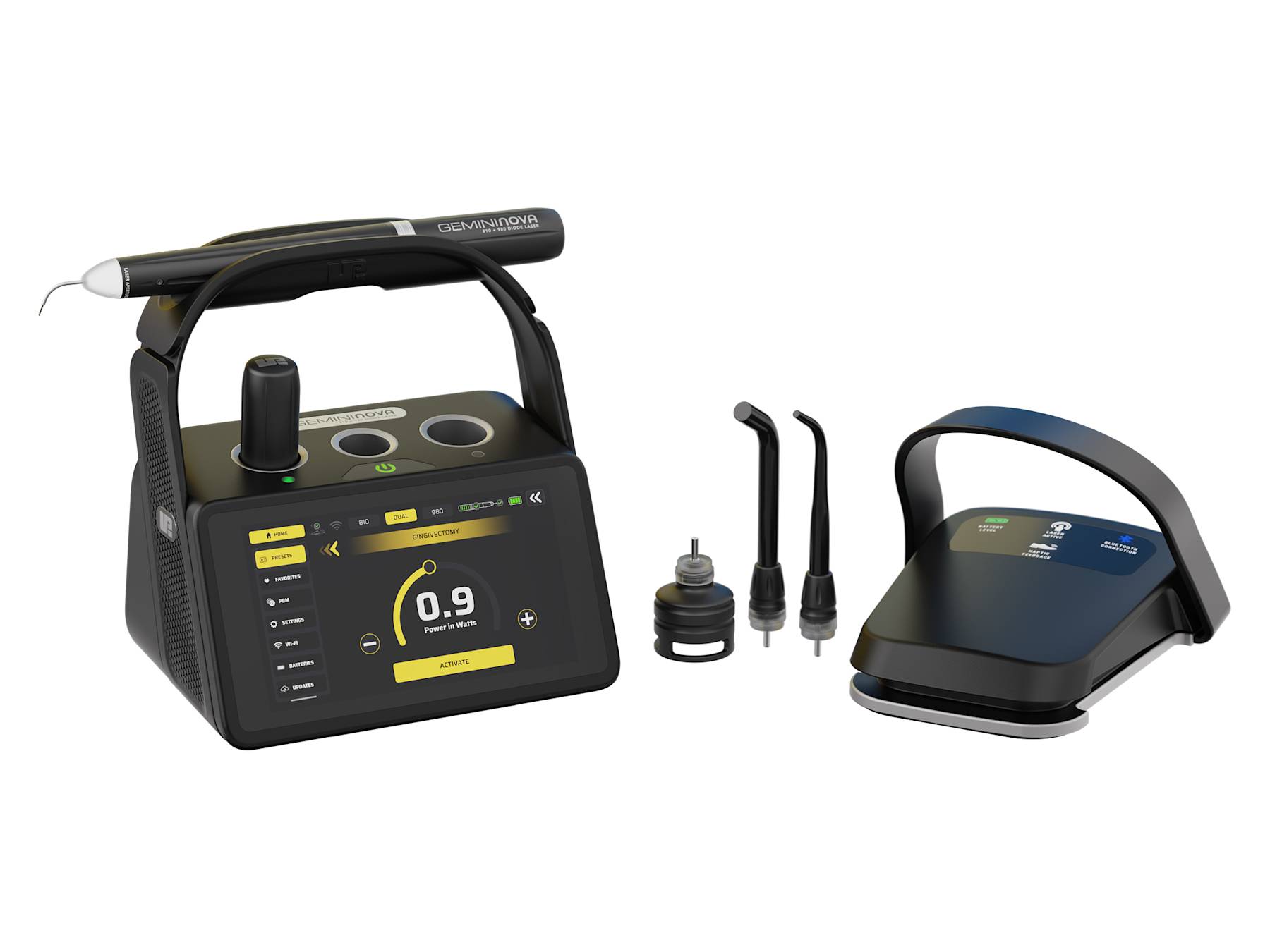
Dual-wavelength output is not new to the range. The original Gemini arrived as the first 810 + 980 dental diode laser sold in the United States, and that architecture has carried through every subsequent model. What distinguishes the Nova is the removal of every cable from the clinical field. The diodes sit inside the wand rather than in the console, so no fiber-optic umbilical runs from a base unit to the clinician’s hand, no power cord tethers the device to a wall outlet during treatment, and no wire connects the console to the foot pedal. All three components communicate over Bluetooth in what Ultradent describes as a triangular connection.
For a practice that has spent years moving a laser console between operatories, unspooling a fiber, and searching for a foot pedal under a cabinet, that change carries more day-to-day weight than an incremental increase in peak power would have done. Utilization, rather than raw output, tends to determine whether a soft tissue laser earns its purchase price.
Where The Nova Sits In The Gemini Family
Ultradent now offers three generations of dental diode laser, and the naming convention obscures the hierarchy. The Nova should not be read as a newer, more powerful successor to the EVO, because the two devices are optimized for different problems.
Gemini 810 + 980 (2016), the original dual-wavelength unit, corded, with 20 W peak power, 2.0 W average power, a transparent electroluminescent display, and 19 preset procedures.
Gemini EVO (2022), the power flagship, corded, with 100 W peak power, 2.0 W average power, an autoclavable handpiece, a guided touch interface, Wi-Fi connectivity, and included photobiomodulation adapters.
Gemini Nova (current), the mobility model, fully cordless, with 20 W peak power, 2.0 W average power, a 5.5 inch touchscreen, reorderable presets, Wi-Fi connectivity, included photobiomodulation adapters, and diodes housed in the wand.
That third bullet carries the single most important buying consideration in this review. The Nova returns to the original Gemini’s 20 W peak power figure, meaning it is a lateral move on cutting output and a substantial advance on portability. Clinicians who require maximum ablation speed in dense fibrous tissue should read the Gemini EVO laser review alongside this one before committing.
Full Technical Specifications
The figures below are drawn from the manufacturer’s instructions for use rather than promotional material, and several of them, particularly duty cycle and pulse width, explain the device’s tissue behavior more accurately than headline wattage does.
Specification | Gemini Nova |
|---|---|
Laser classification | Class IV |
Beam delivery | Diode coupled to optical tip |
Wavelengths | 810 nm plus or minus 10 nm, 980 nm plus or minus 20 nm, dual at 50 percent each |
Maximum average power | 2.0 W plus or minus 20 percent in all three modes |
Peak power | Up to 10 W at 810 nm or 980 nm, up to 20 W in dual mode |
Power range | 0.1 W to 2.0 W average, in 0.1 W increments |
Pulse frequency | 83 Hz to 3,333 Hz |
Pulse width | 0.06 ms, fixed and not user adjustable |
Duty cycle | 0.5 percent to 20.0 percent |
Aiming beam | 650 nm, 1 mW maximum |
Beam divergence | 254 mrad |
Base dimensions | 6.4 by 5.2 by 6.5 inches (16.3 by 13.3 by 16.5 cm) |
Base weight | 2.26 lb (1.03 kg) |
Foot pedal | 6.5 by 4.5 by 4.1 inches, 0.63 lb, two AA alkaline batteries |
Base battery | 7.2 V rechargeable lithium-ion, user replaceable |
Wand battery | 3.7 V rechargeable lithium-ion, two supplied |
Wireless | Bluetooth BLE 4.2 at 2.4 GHz, Wi-Fi 2.4 GHz with WPA2 or WPA-Enterprise |
Display | 5.5 inch capacitive touchscreen |
Operating environment | 10 to 40 degrees C, 95 percent relative humidity or less |
Maximum altitude | 5,000 m (16,404 ft) |
Standards | IEC 60825-1, EN/IEC 60601-1, IEC 60601-1-2, IEC 60601-2-22, 21 CFR 1040.10 and 1040.11, FCC Part 15 |
Recalibration interval | Every 12 months, to hold output accuracy within 20 percent |
The Cordless Architecture And How It Works
The Nova operates as a three-piece wireless system, and understanding how the pieces relate to one another matters for both clinical use and daily reprocessing.
The base is a compact console weighing 2.26 lb, fitted with a carry handle, a 5.5 inch touchscreen, a wand cradle, two wand battery charging bays, and integrated storage for the photobiomodulation adapters. It runs on a removable 7.2 V lithium-ion pack and charges over USB-C from the supplied 60 W medical-grade power supply. The unit is genuinely light enough to move between operatories rather than portable only in the marketing sense.
The wand houses the diodes, which is the engineering decision that defines the product. Placing the laser source in the handpiece removes transmission losses through a delivery fiber and eliminates the cord at the same time. The wand accepts a swappable 3.7 V battery pack and carries a bendable stainless steel tube for the disposable fiber tip, a color-coded LED tip, an emergency stop button, smart tip sensing, and rotational power adjustment. Twisting the battery pack clockwise raises power, counterclockwise lowers it, all without reaching for the console mid-procedure.
The foot pedal runs on two AA alkaline batteries, connects over Bluetooth, and carries overstep protection along with status indicators for battery level, connection, and firing.
One safety behavior deserves particular attention, because it answers the obvious objection to a wireless surgical laser. Any interruption of the Bluetooth link between the pedal or wand and the base during use terminates laser emission immediately. Ultradent also states that the system passed wireless coexistence testing against common dental devices at a minimum separation distance of 30 cm. A further practical touch addresses the inevitable consequence of three untethered components. The Bluetooth settings menu includes a locate function that makes a missing wand or pedal beep, vibrate, and flash its indicator lights until it is found.
Battery Performance In Clinical Terms
Manufacturer battery claims are frequently vague. Ultradent’s figures for the Nova are unusually specific, which makes them easier to plan a clinical day around.
Base battery, unplugged, over four hours of continuous operation under typical conditions, including intermittent firing and simultaneous charging of a seated wand battery.
Wand battery, approximately 10 average procedures per full charge, where average is defined as 1.2 W in dual-wavelength mode for two minutes, equating to roughly 20 to 24 minutes of actual firing time.
Base charge time, about two hours from a depleted state using the supplied USB-C power supply.
Wand charge time, about 1.5 hours for two wand batteries seated in the base.
Unplugged charging capacity, a fully charged base can recharge each wand battery up to two times.
Service life, the lithium-ion packs carry a typical two year lifespan, after which replacement is advised.
With two wand batteries rotating through the base, a standard restorative and hygiene day is comfortably covered, and the base can simply remain plugged in between rooms. The system continues to operate while connected to mains power, so a depleted battery is an inconvenience rather than a canceled procedure.
Two behaviors warrant a written protocol rather than reliance on memory. The wand exits active mode after five minutes of inactivity, drops to sleep mode ten minutes later, and powers down ten minutes after that, at which point the battery must be removed and reattached to wake it. Ultradent also advises against leaving the unit plugged in for more than 48 hours continuously, recommending instead that the pack be allowed to drain to a single bar before recharging, and stored at a medium charge level during extended downtime. That guidance runs contrary to how most practices treat equipment, so it belongs in the operatory checklist.
Dual Wavelength Selection: 810 nm, 980 nm, And Dual Mode
Wavelength choice is the clinical heart of every Gemini device, and the rationale rewards precision rather than repetition of marketing language. Absorption characteristics, not power alone, determine how tissue responds.
Energy at 810 nm is preferentially absorbed by melanin and hemoglobin, which makes it the coagulation-favoring wavelength. It delivers better hemostasis, more efficient interaction with vascular and pigmented tissue, and deeper penetration. Energy at 980 nm is preferentially absorbed by water, making it the ablation-favoring wavelength, with crisper vaporization of hydrated tissue, a more superficial interaction, and less thermal spread into deeper structures. Dual mode splits output evenly and delivers both absorption profiles at once. Comparative work on 810 nm behavior in oral soft tissue therapy is summarized in the peer-reviewed literature on laser applications in oral medicine.
Most clinicians settle into dual mode as a default and select single wavelengths deliberately, choosing 810 nm when a vascular lesion or a bleeding sulcus is the problem, and 980 nm when clean, shallow ablation of well-hydrated tissue is the goal. The Nova makes switching trivial. The interface recolors to match the active mode, showing gray for 810 nm, yellow for dual, and blue for 980 nm, and announces the selection audibly when voice confirmation is enabled.
One clinically important caveat is stated plainly in the instructions for use and under-discussed in laser marketing. Because 810 nm energy is strongly absorbed by melanin, power must be reduced when treating patients with darker pigmented soft tissue, and the same warning is repeated for photobiomodulation. This is a standing adjustment rather than a footnote, and it should form part of the dental treatment plan for every pigmented-tissue case, reinforcing the point that preset settings are a starting position rather than a prescription.
Super-Pulsed Emission And Peak Power
The Nova emits only in pulsed temporal mode, and the relationship between peak power, average power, and duty cycle explains its tissue behavior far better than a single wattage figure.
Pulse width is fixed at 0.06 ms and cannot be adjusted by the operator, who controls wavelength and average power while the device manages the rest. Pulse frequency ranges from 83 Hz to 3,333 Hz, with a duty cycle between 0.5 percent and 20 percent. At typical settings the laser is therefore off considerably more than it is on. Each pulse delivers a high peak power burst, up to 20 W in dual mode, followed by a comparatively long interval during which tissue sheds heat. That thermal relaxation period is the entire point, allowing a diode to cut efficiently without the charring, tissue tagging, and collateral thermal damage that continuous-wave diodes at equivalent average power tend to produce. A systematic review of therapeutic and adverse effects of lasers in dentistry reinforces how closely outcomes track parameter selection and operator learning curve.
Average power is capped at 2.0 W across the original Gemini, the EVO, and the Nova. The difference between models lies in peak power, and therefore in how much energy is packed into each individual pulse. A 100 W peak pulse ablates more aggressively than a 20 W peak pulse, and that gap becomes noticeable in dense fibrous tissue. In routine troughing, sulcular decontamination, and small soft tissue procedures, the difference is far less apparent.
Photobiomodulation Capability
Every Gemini Nova ships with three photobiomodulation adapters, a meaningful inclusion given that photobiomodulation was an optional add-on kit on the original Gemini. The dosimetry implementation is the strongest in the range.
Adapter | Spot size | Average power | Power density | Max time per spot |
|---|---|---|---|---|
3 mm | 0.07 sq cm | 0.3 W | 4,286 mW/sq cm | 50 seconds |
7 mm | 0.38 sq cm | 0.3 W | 780 mW/sq cm | 50 seconds |
25 mm | 4.91 sq cm | 1.0 W | 204 mW/sq cm | 30 seconds |
The 3 mm and 7 mm adapters may be used intraorally. The 25 mm adapter is intended for extraoral fields such as the temporomandibular joint region and requires a disposable spacer for correct focusing. Cleared pain therapy indications cover topical heating for temporary relief of minor muscle and joint pain and stiffness, minor arthritis pain, muscle spasm, minor sprains and strains, and minor muscular back pain, together with temporary increase in local blood circulation and temporary muscle relaxation.
The dosimetry interface is genuinely well designed. The operator selects an adapter, chooses whether to work in energy expressed in joules or dose expressed in joules per square centimeter, and adjusts time either by twisting the wand battery or through the on-screen controls, while the device calculates and displays the resulting dose per spot in real time. The companion mobile app carries a standalone calculator that performs the same arithmetic without occupying the laser. Clinicians standardizing protocols may find the published parameter reviews for laser photobiomodulation useful context, since reported parameters vary widely between studies.
Photobiomodulation Contraindications Every Operator Should Know
The contraindication list in the instructions for use is more substantial than many clinicians assume when adding photobiomodulation to a hygiene workflow, and it deserves a careful read before the first case.
Do not treat pregnant patients, because effects on the fetus are unknown.
Do not treat over known primary malignant carcinoma or secondary metastasis, except in palliative care with informed consent and oncologist permission.
Avoid treatment sites with tattoos.
Avoid direct exposure at implant sites, since implant materials respond differently to laser energy and heat.
Do not apply over clothing or onto open wounds.
Do not apply ointments, creams, lotions, or heating patches at or near the treatment site.
Do not apply pre-treatment therapies that alter body temperature, including ultrasound, ice or heat packs, electrical stimulation, and heating patches.
Reduce treatment time for scar tissue, superficial musculature, excess adipose tissue, inflamed or swollen tissue, and sensitive skin.
A defined escalation applies to adverse response. If the patient reports discomfort or the skin reddens, the operator should defocus the beam a few centimeters, reduce time, or stop. If blistering or a burning sensation occurs, treatment stops immediately, the area is rinsed with cool water or covered with a cold pack for at least five minutes, and burn ointment is applied afterward. The instructions specify that ice should not be used.
Cleared Clinical Indications
The Gemini Nova is cleared for incision, excision, vaporization, ablation, and coagulation of oral soft tissues, including marginal and interdental gingiva and the epithelial lining of free gingiva. The indications group naturally by discipline, which helps when assessing whether the device fits an existing case mix.
Restorative and prosthodontic, gingival troughing for crown impressions, tissue retraction for impressions, soft tissue crown lengthening, gingivoplasty, and hemostasis and coagulation.
Surgical, excisional and incisional biopsies, fibroma removal, frenectomy and frenotomy, gingivectomy, gingival incision and excision, operculectomy, oral papillectomies, vestibuloplasty, lesion removal, incision and drainage of abscess, and reduction of gingival hypertrophy.
Implant, pediatric, and orthodontic, implant recovery, exposure of unerupted teeth, and pulpotomy including as an adjunct to root canal therapy.
Periodontal and hygiene, laser soft tissue curettage, removal of diseased, infected, inflamed, and necrosed soft tissue within the periodontal pocket, removal of highly inflamed edematous tissue affected by bacterial penetration of the pocket lining and junctional epithelium, sulcular debridement to improve gingival index, bleeding index, probing depth, attachment loss and mobility, and reduction of bacterial level.
Mucosal, treatment of canker sores, herpetic and aphthous ulcers, and leukoplakia.
Pain therapy, photobiomodulation for the indications described in the previous section.
The critical exclusion is straightforward. The Gemini Nova carries no hard tissue indication, so enamel and dentin preparation, osseous work, and hard tissue crown lengthening all require an erbium or carbon dioxide system instead. Practices weighing an all-tissue platform should review the Solea all-tissue laser assessment for that comparison. The instructions also caution against prolonged exposure around the cervical areas of the tooth, where thin enamel can allow energy absorption by pulpal hemoglobin, risking pulpal hyperemia and, with extended exposure, possible pulpal necrosis.
Chairside Workflow And Interface
Initial setup takes roughly two hours of charging alongside about ten minutes of configuration. Daily operation moves considerably faster once the team is familiar with the sequence.
Attach a charged wand battery and the correct disposable tip.
Select the wavelength mode, either 810 nm, dual, or 980 nm.
Choose a preset, a saved favorite, or set power manually.
Confirm green check marks for the foot pedal, wand battery, and tip in the top menu.
Tap activate, at which point the aiming beam and tip illumination appear.
Fire using the foot pedal and release to stop.
A 0.25 second delay guards against accidental activation, and touching any control other than the power scroll bar or the plus and minus buttons returns the system to standby. The unit will not enter active mode at all unless the wand, with a tip attached, and the foot pedal are both connected. An electronic key passcode, entered as an up, down, up, down arrow sequence, is required at every power-on.
Preset handling is where the Nova improves noticeably on its predecessors. Procedures are organized into categories with suggested power settings, and the operator can reorder them by frequency of use with a drag handle, edit and save custom power values per procedure, reset individual procedures or entire categories to factory values, and mark any procedure as a favorite. Favorites are wavelength-specific, so a preferred troughing setting saved under 810 nm does not appear under 980 nm, which is a subtle but correct design choice. New presets arrive over time through software updates, a genuine advantage of a connected device.
Feedback during firing merits clarification, because promotional copy tends to blur it. Haptic feedback comes through the foot pedal for all procedures when enabled. On the wand, haptic feedback is available during photobiomodulation procedures and while adjusting power by twisting the battery, though not during surgical or non-surgical firing. Tip illumination color indicates device state, showing blue while pairing, red in standby, green in active or photobiomodulation mode, white when tip illumination is enabled during surgical use, and purple in sleep mode.
Tip Selection And Initiation
Tip handling causes more early-stage user error than any other aspect of diode laser operation, so the distinction below belongs on a laminated card in every operatory that houses the device.
5 mm pre-initiated tips, for procedures that remove tissue, including incision, excision, implant recovery, tooth exposure, operculectomy, gingivoplasty, gingivectomy, frenectomy, and troughing.
7 mm uninitiated tips, for procedures that do not remove tissue, including decontamination and aphthous ulcer treatment.
Initiation refers to the black pigment at the fiber end that concentrates laser energy. To clean a tip without stripping initiation, the operator fires at 1.0 W for one to two seconds and then wipes with isopropyl alcohol. To restore initiation on a tip that has lost pigment, firing at low power while rubbing the tip on articulating film deposits fresh pigment. Removing initiation from a 5 mm tip requires wiping the pigment away with gauze and alcohol before firing. Tips are single use, and a blackened zone larger than 3 to 4 mm risks fiber fracture, so replacement should happen before that point. The supplied bending tool should always be used in place of fingers, and a bending tool that contacts a used tip goes into sharps waste.
Infection Control And Reprocessing
This section carries more weight than reviews of the device usually give it, because the Nova represents a step backward from the Gemini EVO in one specific respect that affects the sterilization workflow every single day.
The Gemini Nova wand cannot be steam sterilized. The EVO handpiece is autoclavable, whereas the Nova handpiece is not, because the diodes and battery are housed inside it. Reprocessing instead follows a wipe protocol. The operator pre-cleans all exposed surfaces with a CaviWipes class towelette for 30 seconds, then wets all surfaces with a fresh towelette and keeps them visibly wet for two minutes at room temperature, re-wiping as needed, inspects for residual debris, and finishes with an isopropyl alcohol wipe to remove disinfectant residue. Cleaning must occur within one hour of the procedure. Disinfectant should never be sprayed directly onto the wand or base, abrasives are prohibited, and no automated cleaning process is permitted.
Because the wand cannot be autoclaved, an FDA-cleared barrier sleeve specific to the Gemini Nova wand is mandatory, applied after the tip or photobiomodulation adapter is attached and discarded after each patient. That sleeve becomes a permanent consumable line item and a permanent training requirement.
Reprocessing rules for the remaining components differ from one another, which is worth documenting formally rather than leaving to recall.
Disposable fiber tips, supplied non-sterile, wiped with isopropyl alcohol before use, single use, discarded to sharps.
3 mm and 7 mm photobiomodulation adapters, autoclavable and required to be sterilized before initial use and after every use, in a single-wrap self-seal pouch, paper side down, nothing stacked on top, at 135 degrees C for a minimum 10 minute cycle with a 30 minute dry time.
25 mm photobiomodulation adapter, must not be autoclaved or submerged, isopropyl wipe only, with glass optics cleaned using the supplied cloth.
25 mm spacers and light adapters, single use, non-sterile, alcohol wiped before use, discarded to sharps, never autoclaved or reused.
Base unit, not routinely contaminated, though the display should be covered with clear adhesive barrier film replaced between patients, with wipes wrung out first so liquid does not enter the console.
None of this is unmanageable. For a practice cross-shopping the Nova against the EVO, however, the sterilization difference represents a real recurring cost and a real workflow burden, and it is the item most likely to receive little attention during a sales demonstration.
Laser Safety And Regulatory Obligations
The Gemini Nova is a Class IV laser device, which brings facility obligations extending well beyond installing a new piece of equipment. Practices adding their first laser should budget time for compliance as well as training.
Protective eyewear is required for everyone present in the operatory, including operator, assistant, patient, and any observer. Eyewear must conform to DIN EN207 Annex II of Directive 89/686/EEC with an optical density of OD+5 across the 800 nm to 1000 nm range, and lenses should be inspected periodically for pitting and cracking. Nominal ocular hazard distances for anyone without eyewear are listed below.
Emission source | Nominal ocular hazard distance |
|---|---|
Fiber optic tip | 87.2 in (221.6 cm) |
3 mm photobiomodulation adapter | 27 in (69 cm) |
7 mm photobiomodulation adapter | 88 in (223.5 cm) |
25 mm photobiomodulation adapter | 244 in (620 cm) |
The 25 mm figure, exceeding 20 feet, is the one most often underestimated, and it explains why extraoral photobiomodulation in an open bay layout is inadvisable.
Facility requirements include appointing a laser safety officer, posting laser-in-use signage at the treatment area entrance, restricting access during operation, using high volume evacuation together with high filtration masks rated at 0.1 micron or finer when vaporizing tissue, shutting off combustible or combustion-supporting gases, and storing flammable chemicals away from the surgical site. The device should not be used in the presence of supplemental therapeutic oxygen. OSHA recognizes ANSI Z136.1 as the reference standard for medical laser safety.
A wireless remote interlock is available, deactivating emission when the treatment room door opens through a wall-mounted Bluetooth hall-effect sensor paired with a magnet on the door. The remote interlock kit is sold separately and is not included, so practices requiring a dedicated laser treatment room should budget accordingly. Emergency shutdown has three independent paths, namely the red stop button on the wand, the power button on the base, and separation of the wand battery from the wand.
Two built-in safeguards deserve credit. Smart tip sensing prevents the laser firing unless a compatible surgical or photobiomodulation tip is properly attached, a sensible protection on a device designed to be carried around. The aiming beam shares the working beam delivery path, so projecting the red spot onto a flat surface serves as a valid daily integrity check, with a dim, absent, or misshapen spot indicating damage or misalignment.
On training and licensure, states generally do not impose specific licensure on dentists using surgical lasers, though many require hygienists to complete lecture and hands-on training with a proficiency examination before laser use. Courses are typically delivered by credentialed Academy of Laser Dentistry instructors. Ultradent’s own position is that users should already be familiar with the relevant procedures using electrosurgery or conventional instruments, and that inexperienced operators should obtain training before clinical treatment. That guidance should be taken at face value, since a laser represents a technique change rather than a simple instrument substitution.
Connectivity, Analytics, And Cybersecurity
The Nova connects to practice Wi-Fi on the 2.4 GHz band using WPA2 or WPA-Enterprise, and pairs with the Gemini Laser app on iOS and Android. Existing Gemini EVO customers sign in with current credentials rather than registering again.
The app and web dashboard provide total procedure counts, lifetime laser usage, preset versus manual procedure ratios, most-used manual power settings, wavelength usage breakdowns, top presets, device vitals, battery health, serial numbers, downloadable calibration certificates, and configurable procedure fees for return on investment tracking. That last capability proves more useful than it first appears. Objective per-operator usage data changes an internal purchasing discussion from anecdote to evidence, and it identifies which team members need additional training rather than additional encouragement.
The app also includes an assistant trained on the Gemini product line for usability and technical questions. Ultradent is appropriately clear that it does not replace clinical judgment, is not a cleared diagnostic or treatment planning tool, and is not a substitute for professional training.
Cybersecurity documentation is stronger than most dental equipment offers, which matters increasingly for networked medical devices in practices subject to HIPAA. The published posture includes TLS 1.2 or higher for communications, cryptographically signed firmware updates that will not install if integrity verification fails, encryption in transit and at rest, device-unique credentials and X.509 certificates, role-based access control, mutual authentication between components, continuous integrity monitoring, automatic disabling of laser activation if security conditions are not met, secure rollback to a previously verified software version, audit logging, a maintained software bill of materials, a coordinated vulnerability disclosure process, and an MDS2 statement available on request. Unused communication interfaces are disabled by default.
Gemini Nova Vs Gemini EVO Vs Gemini 810 + 980
The three current Gemini devices share a wavelength architecture and an average power ceiling, and diverge on power delivery, mobility, and reprocessing. The table below isolates the differences that actually influence a purchasing decision.
Feature | Gemini Nova | Gemini EVO | Gemini 810 + 980 |
|---|---|---|---|
Peak power | 20 W dual | 100 W dual | 20 W dual |
Average power | 2.0 W | 2.0 W | 2.0 W |
Wavelength modes | 810, 980, dual | 810, 980, dual | 810, 980, dual |
Cordless | Yes, all components | No | No |
Diode location | In the wand | In the console | In the console |
Handpiece sterilization | Wipe plus barrier sleeve | Autoclavable | Autoclavable |
Display | 5.5 in touchscreen | Guided touch interface | Electroluminescent |
Presets | Categorized, reorderable, updatable | 16 in three categories | 19 fixed |
PBM adapters included | Yes, three sizes | Yes, three sizes | Optional kit |
App and dashboard | Yes | Yes | No |
Remote interlock | Wireless, sold separately | Wired | Not applicable |
Tip compatibility | Same tips as earlier Gemini lasers | Gemini tips | Gemini tips |
Practices performing high volume soft tissue surgery, working through dense fibrous tissue, or handling larger excisions will find the EVO the stronger clinical instrument, particularly given its autoclavable handpiece. Practices whose limiting factor is access rather than power will find that the Nova solves a problem the EVO cannot. Tip compatibility across the range is quietly significant, since offices already running a Gemini or an EVO can add a Nova without introducing a second consumable inventory.
Which Practices Should Consider The Gemini Nova
Fit depends far more on practice structure and case mix than on any single specification. The profiles below reflect where the cordless design delivers genuine value and where it does not.
Strong Fit
These settings benefit most directly from portability, included photobiomodulation, and connected analytics.
Multi-operatory practices where a corded laser becomes stranded in one room and procedures get deferred rather than performed.
Hygiene-driven practices running sulcular debridement, decontamination, and photobiomodulation across several hygiene chairs.
Mobile, satellite, outreach, and residential care dentistry, where a battery-powered device requiring no outlet changes what is clinically possible.
Practices adding photobiomodulation, given that three adapters, real dosimetry, and app-based dose calculation are included rather than optional.
Group practices and dental service organizations wanting standardized presets, fleet-level usage analytics, and documented cybersecurity.
First-time laser buyers who benefit from structured presets and on-device technique guides.
Poor Fit
Several practice types will be better served by a different device, and recognizing that early avoids an expensive purchase that sits unused.
Any practice requiring hard tissue capability, since the device carries no hard tissue indication.
High volume oral surgery practices that would notice the difference between 20 W and 100 W peak power in dense fibrous tissue.
Offices operating a strict autoclave-everything infection control policy, or where barrier sleeve compliance would be inconsistent.
Practices unwilling to invest in training, since incorrect settings produce charred tissue, delayed healing, and dissatisfied patients.
Cost Of Ownership
Ultradent does not publish Gemini Nova pricing, so a quote through Ultradent or an authorized dealer is required, and demonstration or trade show pricing varies. For category context, the original Gemini 810 + 980 launched at 6,995 US dollars, a figure trade press at the time judged consistent with diode lasers of comparable power and utility.
Acquisition cost represents only part of the picture, and the recurring items below should be modeled before committing.
Disposable fiber tips, single use per patient, in 5 mm initiated and 7 mm uninitiated formats.
Barrier sleeves, mandatory per patient because the wand cannot be autoclaved, representing a recurring cost the EVO does not carry.
Photobiomodulation light adapters and 25 mm spacers, single use for every photobiomodulation procedure.
Protective eyewear rated OD+5 across 800 nm to 1000 nm for operator, assistant, patient, and observers, since only two pairs are supplied.
Annual recalibration, recommended every 12 months and arranged through the distributor.
Battery replacement approximately every two years for both the base and wand lithium-ion packs.
Remote interlock kit, if a dedicated laser treatment room is required.
Training, including Academy of Laser Dentistry courses and hygienist licensure training where state law requires it.
AA alkaline batteries for the foot pedal.
On the revenue side, gingival troughing has long been the procedure practices cite when justifying a diode purchase, since it converts a cord retraction step into a faster and more predictable one. Adding frenectomies, operculectomies, biopsies, implant recovery, and soft tissue crown lengthening that would otherwise be referred out, alongside laser-assisted periodontal therapy and photobiomodulation in hygiene, builds a credible case.
Warranty coverage runs two years from date of shipment against defects in materials and workmanship, excluding consumables, with repair or replacement at the seller’s discretion. Certificates download from the dashboard or mobile app. Returns receive full credit within 30 days with a return authorization number, a 20 percent restocking fee applies between 31 and 60 days, and returns are not accepted after 60 days.
Bottom Line
The Gemini Nova answers a question the dental laser market has largely ignored. Rather than asking how much power can be delivered, it asks why expensive equipment sits unused, and in most practices the answer is friction, meaning cords, consoles, and whichever operatory happens to hold the laser today.
Housing the diodes in the wand and removing every cable has produced the diode laser most likely to be picked up in daily practice. Twenty watts of super-pulsed peak power handles the great majority of soft tissue dentistry competently, the photobiomodulation implementation is the best in the Gemini range, the preset system respects how clinicians actually work, and the safety and cybersecurity engineering sit well above category average.
Loss of wand autoclavability is a real cost, and peak power sits below the EVO. Those factors deserve honest weighing against an individual case mix. For a practice whose soft tissue laser is underused because it is tethered to one room, the Nova is likely to change utilization, and utilization is what converts a capital purchase into a return. Further comparisons across the category are collected in the Dental Reviewed equipment library.
Verdict
<p>The Gemini Nova is the most thoughtfully designed diode laser Ultradent has released, and the purchasing question reduces to one honest trade, exchanging peak power for freedom of movement.</p><p>That trade is defensible, and for most general practices it is the correct one. Twenty watts of super-pulsed peak power is entirely adequate for the procedures that make up the overwhelming majority of soft tissue laser dentistry, including troughing, sulcular debridement, decontamination, small excisions, operculectomies, frenectomies, and implant recovery. The original Gemini built a substantial installed base on exactly that figure. What the Nova adds is the elimination of the single biggest reason lasers go unused, which is that they live in the wrong room. A 2.26 lb battery-powered device carried to the patient is a device clinicians actually pick up, and utilization determines return on investment far more reliably than peak wattage does.</p><p>The engineering supports the concept properly. Housing the diodes in the wand is a real solution rather than a cosmetic one, immediate emission cut-off on loss of Bluetooth is the correct safety answer, smart tip sensing is well judged for a portable Class IV device, and the photobiomodulation dosimetry is the most usable implementation in the Gemini line. The reservation is infection control. Losing the autoclavable handpiece is a genuine regression from the EVO, and the mandatory barrier sleeve is a permanent cost and a permanent compliance point that should be priced and protocolized before purchase.</p>
Frequently Asked Questions
What is the Gemini Nova laser used for?
It is a soft tissue diode laser cleared for incision, excision, vaporization, ablation, and coagulation of oral soft tissue. Typical applications include gingival troughing, gingivectomy, gingivoplasty, frenectomy, operculectomy, biopsies, fibroma removal, implant recovery, exposure of unerupted teeth, pulpotomy, soft tissue crown lengthening, periodontal curettage and sulcular debridement, bacterial decontamination, treatment of aphthous and herpetic ulcers, and photobiomodulation for temporary pain relief.
Is the Gemini Nova laser truly cordless?
Yes. The base, wand, and foot pedal all operate on batteries and communicate over Bluetooth. The diodes sit inside the wand rather than the console, so no delivery fiber is required. The base charges over USB-C and can run while plugged in, though no cable is needed during treatment.
How long does the battery last?
A fully charged wand battery supports roughly 10 average procedures, defined as 1.2 W in dual-wavelength mode for two minutes, equating to about 20 to 24 minutes of firing time. Two wand batteries are supplied. The base battery gives over four hours of continuous operation while also charging a seated wand battery, recharges in about two hours, and refills two wand batteries in about 1.5 hours.
What is the difference between the Gemini Nova and the Gemini EVO?
The Nova is cordless and portable, with 20 W peak power and a wipe-disinfected wand requiring barrier sleeves. The EVO is corded, delivers 100 W peak power, and has an autoclavable handpiece. Both share a 2.0 W maximum average power, the same three wavelength modes, and the same three photobiomodulation adapters. The EVO suits maximum cutting efficiency, while the Nova suits mobility and utilization.
Can the Gemini Nova cut hard tissue?
No. It is a soft tissue diode laser with no hard tissue indication. The instructions also warn against prolonged exposure around cervical areas of the tooth, where energy absorbed by pulpal hemoglobin can cause pulpal hyperemia and, with extended exposure, possible pulpal necrosis. Hard tissue work requires an erbium or carbon dioxide laser.
Can the Gemini Nova wand be autoclaved?
No. The wand is cleaned and disinfected with a CaviWipes class product followed by isopropyl alcohol, and an FDA-cleared barrier sleeve specific to the Nova wand is mandatory for every patient. The 3 mm and 7 mm photobiomodulation adapters are autoclavable at 135 degrees C for a minimum 10 minute cycle with a 30 minute dry time, while the 25 mm adapter must never be autoclaved or submerged.
Which wavelength should be used for which procedure?
Energy at 810 nm favors melanin and hemoglobin absorption, making it preferable for coagulation, hemostasis, and vascular or pigmented tissue. Energy at 980 nm favors water absorption, making it preferable for clean ablation of hydrated tissue with less deep penetration. Dual mode splits output evenly and suits most routine work. Power should be reduced when treating patients with darker pigmented tissue.
What does 20 watts of peak power actually mean?
Peak power describes the instantaneous output of each individual pulse, while average power, capped at 2.0 W, describes what is delivered over time. The Nova fires 0.06 ms pulses at 83 Hz to 3,333 Hz with a duty cycle between 0.5 and 20 percent, so it is off far more than it is on. Those intervals let tissue cool, which allows efficient cutting without the charring associated with continuous-wave diodes.
Is special training required to use it?
Almost certainly. States generally do not license dentists specifically for surgical laser use, though many require hygienists to complete lecture and hands-on training with a proficiency examination. Ultradent recommends that users already be experienced with the relevant procedures using conventional or electrosurgical methods. Academy of Laser Dentistry courses are the standard route.
What safety equipment is required?
Everyone in the operatory needs protective eyewear rated OD+5 across 800 nm to 1000 nm and conforming to DIN EN207 Annex II. Laser-in-use signage, restricted access during treatment, high volume evacuation with masks rated at 0.1 micron or finer, and an appointed laser safety officer are also required, along with shutting off combustible gases.
Does the Gemini Nova include photobiomodulation?
Yes. Three adapters ship with every unit, sized 3 mm at 4,286 mW per square centimeter, 7 mm at 780 mW per square centimeter, and 25 mm at 204 mW per square centimeter. The 3 mm and 7 mm adapters may be used intraorally, while the 25 mm adapter is extraoral and requires a disposable spacer. Maximum time per spot is 50 seconds for the smaller adapters and 30 seconds for the 25 mm.
Are there photobiomodulation contraindications to be aware of?
Yes, several. Treatment should be avoided in pregnancy, over known malignancy except in palliative care with oncologist permission and informed consent, over tattoos, over clothing, and on open wounds. Direct exposure at implant sites should be avoided, creams and heating patches should not be applied nearby, and treatment time should be reduced for scar tissue, superficial musculature, excess adipose tissue, inflamed tissue, and sensitive skin.
Does it use the same tips as an existing Gemini laser?
Yes. Ultradent states that the Nova is compatible with the same disposable tips as previous Gemini lasers, so practices already running a Gemini or Gemini EVO can add a Nova without maintaining a second consumable inventory.
How much does the Gemini Nova laser cost?
Ultradent does not publish pricing, so quotes come through Ultradent or an authorized dealer. For category context, the original Gemini 810 + 980 launched at 6,995 US dollars. Budget additionally for tips, mandatory barrier sleeves, photobiomodulation consumables, eyewear, annual recalibration, battery replacement roughly every two years, the optional remote interlock kit, and training.
How often does the device need calibration?
Recalibration is recommended every 12 months to keep optical output accuracy within 20 percent, arranged through the distributor. Calibration certificates download from the dashboard, which is useful for practices working with government, university, or corporate entities that require documentation.
What warranty coverage applies?
Two years from date of shipment against defects in materials and workmanship, excluding consumables, with repair or replacement at the seller’s discretion. Certificates download from the dashboard or the mobile app.