Rating: 4.3/5
GrandioSO 4U Review
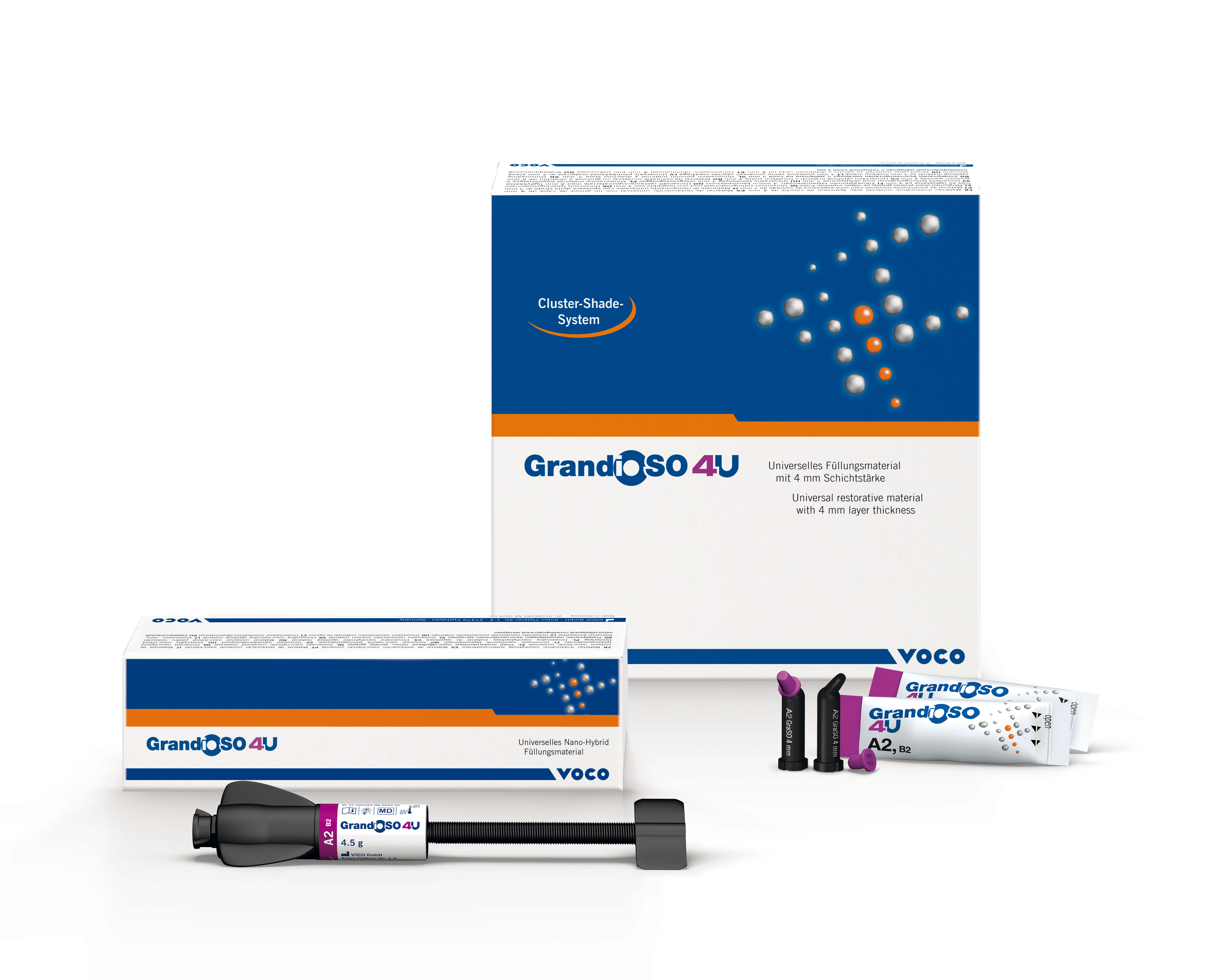
GrandioSO 4U is VOCO’s light-cured nano-hybrid universal composite, built to restore anterior and posterior teeth in 4 mm increments with five shades. This review covers the...
Reviewed by Agnes Markovic
Pros
- One composite covers anterior and posterior restorations, core build-ups, and pediatric work
- 4 mm increments come with anterior-grade esthetics in routine cases
- A 10-second cure per increment for most shades at 1,200 mW/cm² or more
- Five cluster shades cover all 16 VITA classical shades and simplify stock
- High 91% filler load supports wear resistance and strength
- Low 1.44% shrinkage helps protect margins in thick increments
- 900% Al radiopacity makes recall bitewings easier to read
- Non-sticky paste sculpts cleanly without pulling back on instruments
- Works with any light-curing dentin-enamel adhesive already in use
Cons
- No independent long-term clinical trials exist yet for this composite
- Uncured paste cannot be used to check shade
- Lights below 1,200 mW/cm² need double the curing time
- A4 and Opaque need 20 to 40 seconds per 4 mm increment
- No dedicated enamel or effect shades for highly characterized incisors
- Firm paste needs careful adaptation in deep, narrow boxes
- Bleach and Opaque are not included in the caps kit
- Very high radiopacity can partly mask small lesions beneath large restorations
GrandioSO 4U is VOCO’s light-cured nano-hybrid universal composite, built to restore anterior and posterior teeth in 4 mm increments with five shades. This review covers the chemistry, the curing protocol, a chairside test on a Class II and a Class IV case, and where the material falls short.
TL;DR
The short version for clinicians weighing a switch:
GrandioSO 4U cures a 4 mm increment in 10 seconds at 1,200 mW/cm² or more, and A4 and Opaque need 20 seconds.
Five cluster shades cover all 16 VITA classical shades, so a practice can run routine composites from five core syringes.
VOCO reports 91% filler by weight, 1.44% volumetric shrinkage, and 900% Al radiopacity.
Weak curing lights and highly characterized incisors expose the material’s limits.
What Is GrandioSO 4U
GrandioSO 4U is a light-cured, radiopaque nano-hybrid universal composite made by VOCO GmbH in Cuxhaven, Germany. According to the GrandioSO 4U instructions for use, it is indicated for Class I to V restorations and can be applied in layers up to 4 mm thick with any light-curing dentin-enamel adhesive.
The material reached Europe first, in spring 2025, under the name GrandioSO Unlimited. VOCO announced U.S. availability in December 2025 under the GrandioSO 4U name. Some studies reported that the composite followed roughly 10 years of research and development, and it extends a GrandioSO family that, per Dental Economics, has been in continuous clinical use for more than 15 years.
The commercial idea is consolidation. Most offices doing everyday restorative dentistry stock an esthetic layering composite for the anterior and a bulk-fill for posterior speed, often with a long row of shades. GrandioSO 4U is VOCO’s attempt to fold both jobs into one paste, and the rest of this review checks how much of that survives contact with a real schedule.
GrandioSO 4U Specifications At A Glance
The figures below come from VOCO’s product page and instructions for use. They are manufacturer data, and no independent laboratory has published a full property set for this composite yet.
Property | GrandioSO 4U |
|---|---|
Material class | Light-cured, radiopaque nano-hybrid universal composite |
Filler content | 91% by weight, inorganic |
Maximum increment | 4 mm |
Cure time at ≥1,200 mW/cm² (4 mm) | 10 s for A1, A2, A3, A3.5, Bleach and 20 s for A4, Opaque |
Cure time at ≥800 mW/cm² (4 mm) | 20 s for A1, A2, A3, A3.5, Bleach and 40 s for A4, Opaque |
Volumetric shrinkage | 1.44% |
Radiopacity | 900% Al |
Shades | A1, A2, A3, A3.5, A4 (cluster shades), Bleach, Opaque |
Delivery forms | 4.5 g screw syringes and 0.4 g single-use caps |
Adhesive | Any light-curing dentin-enamel bonding agent |
Storage | 4–28 °C (39–82 °F) |
Standard | DIN EN ISO 4049 |
How Visual Transformation Technology Works
Visual Transformation Technology, or VTT, is the feature that lets one paste behave like a bulk-fill during curing and like an esthetic composite afterward. The uncured material is highly translucent, so curing light reaches the floor of a 4 mm increment. During polymerization the translucency drops and opacity rises, and the restoration settles into a shade closer to natural dentin and enamel, as described on the VOCO product page.
VOCO has not published the formulation details behind VTT. The general physics of cure-dependent opacity in composites is well understood. Resin monomers have a lower refractive index than the polymer they become. A filler matched to the uncured resin transmits light well at placement, and once the matrix sets, the mismatch grows and the filler scatters more light. That scattering is what reads as opacity in the mouth.
The practical consequence matters more than the mechanism. Conventional esthetic universals are opaque from the start, which caps their reliable depth of cure near 2 mm. Conventional bulk-fills stay translucent after curing, which is why many of them look gray or glassy when a margin shows. VTT is designed to take the useful half of each behavior.
What VTT Changes Chairside
A few habits need adjusting once the optical shift is part of the material:
Uncured paste is useless for shade checks, because the final color and translucency appear only after light curing.
Shade selection belongs before anesthesia and rubber dam, on a clean tooth, under daylight or room light.
Single-shade anterior restorations become realistic for routine Class III, IV, and V work without a separate enamel layer.
Layering stays available for demanding cases, since VTT removes the depth-of-cure reason to layer and leaves the esthetic option open.
Where VTT Needs Care
The optical shift depends on full polymerization. An undercured increment is weaker and can also look wrong, and the IFU warns that inadequate curing can cause discoloration. Light output and tip distance carry more weight with this composite than with a 2 mm layering material.
Dental Economics author Dr. Sam Simos described the cured material shifting optically and blending into the surrounding tooth in his August 2026 case report. Early reports like that are encouraging, and they come from a small number of clinicians working with manufacturer support.
The GrandioSO 4U Cluster-Shade System
GrandioSO 4U uses five cluster shades to cover all 16 VITA classical shades. Bleach and Opaque are available separately for very light teeth and for masking. The workflow keeps a familiar first step: the clinician takes a VITA shade, then reads the matching GrandioSO 4U shade from the table below, which reproduces the mapping in the instructions for use.
GrandioSO 4U Cluster Shade | VITA Classical Shades Covered |
|---|---|
A1 | A1, B1, C1, D2 |
A2 | A2, B2 |
A3 | A3, B3, D4 |
A3.5 | A3.5, B4, C2, C3, D3 |
A4 | A4, C4 |
The cluster approach sits between a full shade range and a single-shade chameleon composite. It keeps some pigment-based control, which helps on very light or very dark teeth and on large restorations where there is little surrounding tooth for a blending composite to borrow from.
Why The System Saves Time And Money
Shade count drives a surprising share of composite waste. Syringes of rarely used shades expire half full, and teams reorder by habit. Five core shades make stock easy to audit, which fits the approach in this guide to dental procurement. The heavy A2 and A3 weighting in VOCO’s caps kit, 20 and 10 caps out of 45, mirrors how often those shades get used.
Where Five Shades Run Thin
The A3.5 cluster has to cover five VITA shades, including several gray C and D shades. On a chromatic or grayish tooth, that compromise can show in a large Class IV. The cluster system also leaves no dedicated enamel or effect shades, so incisal halos and translucent edges are outside its reach.
Physical Properties And What They Mean Clinically
Most of GrandioSO 4U’s mechanical claims trace back to one formulation choice: as much inorganic filler as possible and as little resin as possible. The sections below separate what that predicts from what has been shown.
91% Filler Load
At 91% filler by weight, GrandioSO 4U carries more filler than its predecessor, which lists at 89%. VOCO says the result is a modulus of elasticity, flexural strength, and thermal expansion close to natural tooth. A restoration that flexes and expands like dentin should stress the adhesive interface less during chewing and hot-cold cycling. That is a reasonable prediction from materials science, and it still needs clinical follow-up to confirm.
Highly filled composites tend to feel stiff. VOCO describes the paste as non-sticky, and early users agree. Stiffness still matters at the floor of a narrow box, where a firm paste can trap a void. Some clinicians place a thin flowable layer first for that reason, and the IFU neither requires nor forbids it.
1.44% Volumetric Shrinkage
Polymerization shrinkage drives marginal leakage, white lines, and postoperative sensitivity. VOCO reports 1.44% for GrandioSO 4U, down from about 1.6% for the original GrandioSO. Low shrinkage carries extra weight here because a 4 mm increment contains twice the contracting volume of a 2 mm layer.
Shrinkage percentage and shrinkage stress are different measurements. Stress also depends on stiffness, cure speed, and the cavity’s configuration factor. A stiff, fast-curing composite can build meaningful stress in a deep Class I despite a low volumetric figure. Independent stress data for GrandioSO 4U had not been published as of October 2026, so high C-factor cavities deserve the same care as with any bulk placement.
900% Al Radiopacity
Radiopacity is expressed against an equal thickness of aluminum. At 900% Al, GrandioSO 4U sits far above enamel and roughly three times the 320% Al for the original GrandioSO. On bitewings, that contrast makes overhangs, voids, and recurrent caries easier to spot, a benefit covered in this overview of radiographic imaging.
Very high radiopacity has one known downside. A dense restoration can partly mask a small lesion directly beneath it. Clinicians reading images from dental phosphor plates or sensors should keep that in mind on recall films.
Color Stability And Wear
Less resin leaves less matrix to absorb pigment, and VOCO claims improved color stability. High filler loading also predicts good wear resistance, which matters most in patients with bruxism. These are manufacturer claims, and multi-year independent wear data does not exist yet for this composite.
GrandioSO 4U Indications And Case Selection
The IFU lists a broad indication range covering nearly every routine direct composite procedure. The only listed contraindication is known hypersensitivity to methacrylates or BHT.
Class I to V restorations
Reconstruction of traumatically damaged anterior teeth
Facings on discolored anterior teeth
Shape and shade corrections
Splinting of loose teeth
Veneer repairs
Restoration of primary teeth
Core build-ups under crowns
Direct and indirect composite inlays
Best-Fit Cases
Moderate posterior Class I and II restorations show the biggest time savings. After the proximal wall is built, many of these boxes close in a single increment. Visible premolar margins avoid the gray band some bulk-fills leave.
In children, the 10-second cure and caps delivery shorten the working window, which helps with any pediatric cavity filling. For adults, direct facings and shape corrections become quicker to plan with five shades, a useful point when patients compare composite veneers against porcelain. Strongly discolored teeth, such as tetracycline-stained teeth, usually need the Opaque shade first.
Class V lesions fit well too. The IFU states that caries-free cervical lesions need only thorough cleaning, which suits a minimally invasive dentistry approach.
Cases That Call For Another Material
Some situations still favor a different composite or an added liner:
Deep, narrow, or undercut preparations where a flowable liner adapts better at the floor
High-end anterior cosmetics with internal characterization, incisal halos, or strong translucency
Distal boxes on second molars where full irradiance at the floor cannot be guaranteed
Patients with a documented methacrylate allergy
Clinical Workflow And Light-Curing Protocol
The sequence below follows the GrandioSO 4U IFU, with practical notes added. Isolation with a dental dam is recommended, and deep areas need pulp protection covered with a stable cement, for example a calcium silicate such as Biodentine. Eugenol-containing materials should stay out of the field because phenolic compounds inhibit composite curing.
Bring the composite to room temperature, clean the tooth, and mark occlusal contacts.
Take a VITA shade before anesthesia and isolation, then map it to a cluster shade.
Prepare minimally and bevel enamel margins on anterior teeth.
Isolate, place a matrix and wedge for proximal cavities, and keep separation small.
Apply pulp protection where needed and avoid zinc oxide eugenol.
Bond with any light-curing dentin-enamel adhesive, following its own etch protocol.
Place increments no thicker than 4 mm and adapt with a suitable instrument.
Light-cure according to shade and light output, with the tip as close as possible.
Finish and polish right after matrix removal with fine diamonds and discs.
Apply fluoride to the tooth after finishing.
Light-Curing Times For A 4 mm Increment
Darker and opaque shades absorb more light, so they need double the exposure. The IFU sets these times:
Light Output (LED Or Halogen) | A1, A2, A3, A3.5, Bleach | A4, Opaque |
|---|---|---|
≥1,200 mW/cm² | 10 s | 20 s |
≥800 mW/cm² | 20 s | 40 s |
Curing Light Checks Before Switching
A 10-second protocol leaves little margin for a tired light. Output falls with age, cracked tips, and resin buildup, and irradiance drops fast with distance from the tip. A radiometer reading below 1,200 mW/cm² means the longer column applies. This guide on when to upgrade LED curing lights covers the warning signs. Magnification also helps when adapting a firm paste at a proximal margin, and this overview of dental loupes explains the options.
After matrix removal, an extra cure from the buccal and lingual sides of a Class II box compensates for the distance at the gingival floor. For indirect inlays, VOCO notes that additional extraoral curing further improves physical properties.
Clinical Test: GrandioSO 4U In Two Routine Appointments
The test used two common cases on the same afternoon schedule. The operator worked with VOCO’s Futurabond U adhesive, sectional matrices, and an LED curing light that read 1,350 mW/cm² on a radiometer that morning.
Case 1: Class II On A Lower First Molar
A 41-year-old patient presented with a mesio-occlusal lesion on tooth #30, about 4.5 mm deep at the gingival floor after caries removal. The shade was taken as VITA A3 before anesthesia, which maps to the A3 cluster shade.
The operator built the mesial wall first with a thin increment against the sectional matrix and cured it for 10 seconds. The remaining box and occlusal portion, roughly 3.5 mm at the deepest point, went in as one increment. The paste stayed on the instrument tip without pulling back, and the occlusal anatomy carved cleanly before curing. After matrix removal, an additional 10-second cure was applied from buccal and lingual.
Total time from bonding to final polish was about six minutes shorter than the operator’s usual 2 mm layering protocol on a similar tooth. The postoperative bitewing showed the restoration clearly against dentin, with a flush mesial margin and no visible voids.
Case 2: Class IV On An Upper Central Incisor
A 28-year-old patient had fractured the mesioincisal corner of tooth #8 in a fall from a bicycle. The shade matched VITA B2, which maps to the A2 cluster shade. A silicone palatal index was made from a quick intraoral mock-up.
Before curing, the A2 paste looked noticeably translucent and slightly gray against the tooth. Ten seconds later it had turned opaque and close to the surrounding enamel. The operator built the palatal shell and the body in two increments of A2 and skipped a separate enamel layer.
Under daylight, the margin was hard to locate at conversational distance. The one visible difference sat at the incisal edge. The natural tooth had a faint translucent band and a thin halo, and the restoration read slightly more uniform there. A dedicated incisal shade from a layering system would have closed that difference.
What The Patients Noticed
The molar patient noticed nothing beyond a shorter appointment and reported no cold sensitivity at the two-week check. The incisor patient checked the tooth in a hand mirror, could not find the line at first, and asked whether the restoration would stain from coffee. The answer given was that polish retention and resin content matter most, and that a recall polish handles surface staining.
Two-Week Recall Findings
Both restorations kept their gloss and showed no marginal staining at two weeks. Two weeks says little about longevity. The meaningful checkpoints for any new composite come at one, three, and five years, and GrandioSO 4U has not been on the market long enough for that data.
How GrandioSO 4U Compares With Other Composite Categories
GrandioSO 4U sits between established categories, so the fairest comparison runs by category rather than by brand. The category columns below show typical ranges, not specific products. This guide on how to choose dental materials covers the wider selection criteria.
Attribute | Esthetic Universal | Sculptable Bulk-Fill | Original GrandioSO | GrandioSO 4U |
|---|---|---|---|---|
Max increment | Usually 2 mm | 4–5 mm | 2 mm | 4 mm |
Anterior use | Yes | Usually posterior only | Yes | Yes |
Shade range | Often 15 or more | 1–4 | Wide | 5 plus Bleach, Opaque |
Filler (wt%) | Often 75–85% | Varies | 89% | 91% |
Shrinkage | Varies | Low, varies | About 1.6% | 1.44% |
Radiopacity | Varies | Varies | About 320% Al | 900% Al |
Versus Esthetic Layering Universals
The main gain is time in posterior teeth, with fewer increments and fewer curing cycles. The main loss is fine control over dentin, enamel, and effect shades. For a general practice, that trade usually favors GrandioSO 4U. A cosmetic-focused practice will likely keep its layering kit for anterior work.
Versus Bulk-Fill Composites
Sculptable bulk-fills match the 4 mm increment and are mostly limited to posterior teeth. GrandioSO 4U extends bulk placement to the anterior. It is a paste and not a flowable, so clinicians who like an injectable base layer will still pair it with a flowable composite.
Versus Single-Shade Composites
Single-shade composites lean on blending to match nearly any tooth from one syringe. GrandioSO 4U keeps five pigmented shades, which should hold up better on very light or dark teeth and in large restorations. The cost is a shade-taking step that single-shade materials skip.
Versus The Original GrandioSO
GrandioSO 4U doubles the increment depth from 2 mm to 4 mm, lowers shrinkage from about 1.6% to 1.44%, and raises radiopacity from about 320% Al to 900% Al. Offices already using GrandioSO will recognize the handling.
Practice Economics And Workflow Fit
A composite change touches scheduling, billing, and stock as much as technique. Shorter posterior appointments free chair time without changing the fee, since CDT codes D2391 to D2394 for posterior resin composites and D2330 to D2335 for anterior ones bill by surfaces, not by increments. This reference on dental codes lists the full set.
Fees stay tied to regional norms, and this breakdown of how much a filling costs shows typical patient prices. Chair time saved on composites can be reassigned in the schedule once the team builds each dental treatment plan with realistic appointment lengths. Practices tracking productivity per hour can fold the change into the measures in this guide to improving dental clinic efficiency.
Packaging, Ordering, And Storage
GrandioSO 4U ships as single-shade syringe refills, single-shade caps refills, and a mixed caps kit. The VOCO America reference numbers below come from the product page.
Shade | Syringe 4.5 g (REF) | Caps 15 × 0.4 g (REF) |
|---|---|---|
A1 | 6284 | 6296 |
A2 | 6285 | 6297 |
A3 | 6286 | 6298 |
A3.5 | 6287 | 6299 |
A4 | 6288 | 6300 |
Opaque | 6289 | 6301 |
Bleach | 6290 | 6302 |
The caps refill kit, REF 6294, holds 45 caps of 0.4 g (9 A1, 20 A2, 10 A3, 4 A3.5, 2 A4) plus a shade guide. Bleach and Opaque are sold only as separate refills. Pricing varies by distributor and region, so cost per restoration is a better comparison than cost per gram.
Storage runs from 4 to 28 °C (39 to 82 °F). Syringes should be closed right after dispensing to avoid light exposure, and caps are single-patient use.
Bottom Line
GrandioSO 4U suits general dentists who place mostly routine direct restorations and want one composite for both posterior bulk placement and anterior esthetics. The five cluster shades shrink a crowded shade drawer to five core syringes, and the 10-second cure trims time from most posterior appointments.
Before switching, every curing light in the office should be checked with a radiometer. A unit reading under 1,200 mW/cm² needs the 20-second protocol or replacement. Shade selection also moves earlier in the appointment, because uncured paste gives no reliable color preview and the VITA shade has to be taken before anesthesia and isolation.
Cosmetic-focused offices will get the most from GrandioSO 4U as a daily workhorse placed alongside a layering kit. Incisal halos and translucent edges still call for dedicated enamel and effect shades that the cluster system does not offer.
The material is new, and its long-term record is still being written. Recall photos and bitewings at one and three years will show whether the low shrinkage and high filler load deliver the longevity VOCO predicts.
Verdict
<p>GrandioSO 4U is a strong default composite for general practice. Its main achievement is putting 4 mm placement and anterior-grade esthetics into the same syringe, and the five-shade system makes it easy to standardize across a team.</p><p>In posterior Class I and II work, the time savings are measurable. A moderate Class II often needs one bulk increment after the proximal wall, cured in 10 seconds. The 91% filler load and 1.44% shrinkage support durable margins, and the 900% Al radiopacity makes every recall bitewing easier to read. In routine anterior Class IV and Class V cases, the cured material blends well without a separate enamel layer.</p><p>The limits are specific. Independent long-term data does not exist yet, so the strength and longevity claims rest on VOCO’s testing and early case reports. The 10-second cure assumes a verified light at 1,200 mW/cm² or more. Highly characterized incisors with translucent edges or halos still look better with a dedicated layering kit.</p><p>For practices that place mostly everyday composites, GrandioSO 4U can replace both the universal and the bulk-fill on the shelf. A cosmetic-heavy office will likely keep a layering system next to it for the most demanding anterior work.</p>
Frequently Asked Questions
What is GrandioSO 4U?
GrandioSO 4U is a light-cured, radiopaque nano-hybrid universal composite from VOCO. It can be placed in increments up to 4 mm in anterior and posterior teeth and uses five cluster shades to cover all 16 VITA classical shades.
Is GrandioSO 4U a bulk-fill composite?
It has bulk-fill capability with 4 mm increments, and VOCO classifies it as a universal composite because it is also indicated for esthetic anterior restorations.
Is GrandioSO 4U the same as GrandioSO Unlimited?
GrandioSO Unlimited is the name VOCO uses in Europe and several other markets for the same 4 mm cluster-shade concept, according to the VOCO GrandioSO Unlimited announcement. Local instructions for use should be checked for regional differences.
How long should GrandioSO 4U be light-cured?
A 4 mm increment needs 10 seconds for A1, A2, A3, A3.5, and Bleach at 1,200 mW/cm² or more, and 20 seconds for A4 and Opaque. At 800 to 1,199 mW/cm², those times double to 20 and 40 seconds.
Can GrandioSO 4U be used in the anterior region?
Yes. The IFU lists Class III, IV, and V restorations, traumatically damaged anterior teeth, facings on discolored teeth, shape and shade corrections, and veneer repairs.
How is the right GrandioSO 4U shade selected?
The clinician takes a VITA classical shade on the clean tooth before anesthesia and rubber dam, in daylight or room light, then maps it to a cluster shade. VITA B2 maps to A2, and VITA C2 maps to A3.5. Uncured paste should not be used to check shade.
Which adhesive works with GrandioSO 4U?
Any light-curing dentin-enamel bonding agent can be used, following that adhesive’s own etching and application instructions. VOCO’s Futurabond U is one option.
Does GrandioSO 4U need a flowable liner?
The IFU does not require one. Some clinicians still place a thin flowable layer in deep or irregular cavities to improve adaptation at the floor, given the firm consistency of a 91%-filled paste.
Is GrandioSO 4U suitable for primary teeth?
Yes. Restoration of primary teeth is a listed indication, and the short curing time and caps delivery help with young patients.
What are the contraindications for GrandioSO 4U?
The composite contains methacrylates and BHT, so it should not be used in patients with a known allergy to these ingredients. Eugenol-containing materials should be avoided alongside it because they interfere with curing.
How should GrandioSO 4U be stored?
Store it between 4 and 28 °C (39 to 82 °F), close syringes immediately after dispensing, and bring the material to room temperature before placement.