Rating: 4.3/5
LuxaCore Z Dual Review: A Reliable Core Buildup Material?
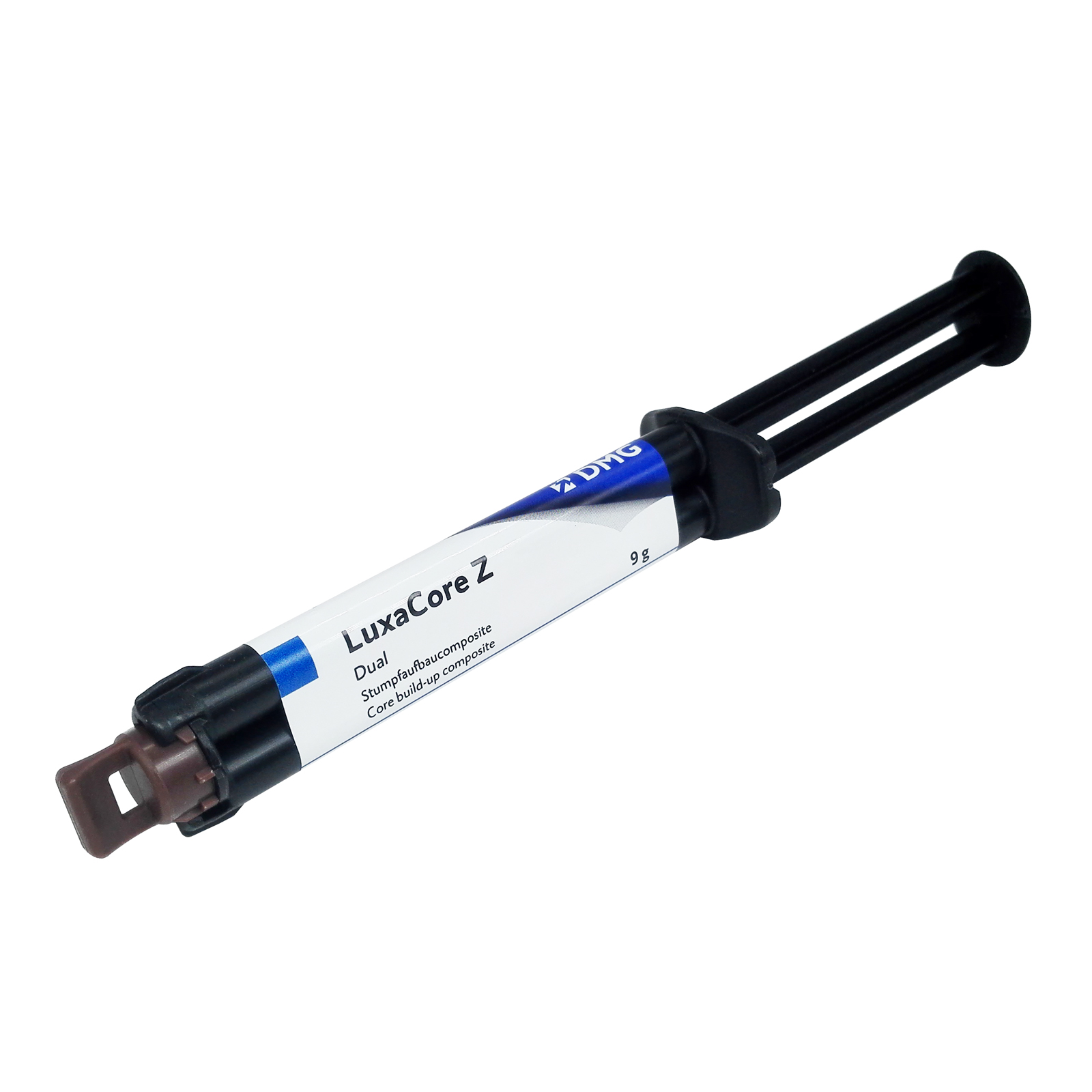
This LuxaCore Z Dual review looks at whether DMG's zirconia-filled dual-cure composite deserves its place in post-endodontic dentistry. The material cements fiber posts and forms...
Reviewed by Maren Solvik
Pros
- One material cements the post and builds the core, which removes an interface
- Dentin-like cutting produces smooth, step-free margins
- About 90 seconds of working time allows calm post seating
- High published compressive and flexural strength for a flowable dual-cure core
- Top ranking for flexural strength and fracture toughness in a 2024 independent four-material study
- Film thickness of 20 to 25 µm suits narrow post spaces
- Blue shade makes the core visible during preparation and retreatment
- Smartmix and Automix formats fit low and high case volumes
Cons
- DMG publishes two different sets of strength figures
- Filler content is not disclosed
- Cutting-rate data comes from DMG's internal testing
- No long-term randomized clinical trial isolates the material
- Self-cure takes about 5 minutes, longer than Core X Flow
- Dentin-like cutting gives less tactile feedback at the margin
- Premium pricing compared with generic dual-cure cores
This LuxaCore Z Dual review looks at whether DMG's zirconia-filled dual-cure composite deserves its place in post-endodontic dentistry. The material cements fiber posts and forms the core in one sequence, and DMG markets it on a cutting feel close to natural dentin. The sections below test those claims against published research and routine chairside use.
TL;DR
LuxaCore Z Dual cements the fiber post and builds the core from one syringe, which removes a material interface from the restoration.
Independent lab studies rank it at or near the top of its test groups for flexural strength and fracture toughness, but no long-term clinical trial isolates it.
Its dentin-like cutting rate gives smooth, step-free margins, so clinicians should choose the Blue shade when they need to see the core outline.
Core X Flow sets faster and has strong independent strength data, while LuxaCore Z Dual gives more working time for seating posts.
Why The Core Material Matters After Root Canal Treatment
A badly broken-down molar that has just had root canal treatment often ends up with a crown sitting on more composite than dentin. Whatever fills that space carries occlusal load for the life of the crown, so the choice of core material has a direct effect on how long the tooth survives.
The American Association of Endodontists advises that posterior teeth with root canal treatment should receive cuspal coverage. That puts a crown, and therefore a core, on most endodontically treated molars and premolars. Biomechanical research adds another constraint. A recent finite element study of post and core restorations notes that a ferrule of 1.5 to 2.0 mm significantly lowers fracture risk compared with no ferrule, and that the ideal post and core material should behave much like dentin.
A core material can fail quietly for years. Microleakage at a debonded core lets bacteria back into the canal system, and that is one reason a root canal can fail years later even when the obturation was sound. Listing the core build-up as its own line item in the dental treatment plan helps patients see why the appointment after endodontics matters, and it keeps the core from being treated as a minor add-on to the crown fee.
When the margin of the remaining wall sits deep, clinicians also have to decide between deep margin elevation and surgical crown lengthening before the core goes in. The core material has to bond well and cut predictably in both scenarios.
What Is LuxaCore Z Dual?
LuxaCore Z Dual is a dual-curing composite from DMG in Hamburg, Germany, indicated for core build-ups, root post cementation and build-up fillings. DMG describes it as an endodontic specialist for the stretch of treatment between the root canal and the crown. It replaced the older LuxaCore Dual, and many practices that used the original moved straight across to the zirconia version.
Composition And The Role Of Zirconia
The "Z" in the name refers to zirconium dioxide added to the filler. DMG combines it with a patented nanotechnology that, according to the company, spreads nanoparticles evenly through the resin matrix and prevents filler clumping. DMG credits that combination with higher compressive strength and a smoother, more flowable paste. The same sell sheet says the material releases fluoride.
DMG does not publish filler content by weight or volume on its product page. That omission has a practical cost. A large in-vitro comparison of core composites found a strong linear link between inorganic filler content and flexural modulus (R² = 0.85), while flexural strength showed no such link. Without a filler figure, clinicians cannot estimate stiffness from the spec sheet alone.
Delivery Systems: Smartmix Vs Automix
LuxaCore Z Dual comes in two delivery formats, and the right one depends mostly on how many post and core cases a practice places each month. Both mix base and catalyst at a 1:1 ratio inside the tip.
Smartmix syringe: two 9 g self-mixing syringes with 10 Smartmix Tips Combi and 10 Smartmix Tips Endo, with no dispenser needed
Automix cartridge: one 48 g cartridge with Automix, Intraoral and Endo tips, used in a Type 25 1:1 dispenser
The used mixing tip stays on the syringe and works as a cap until the next case. In a practice that places one or two cores a week, the Smartmix format keeps waste low and avoids a cartridge sitting half-used past its expiry date.
Shade Options And When To Use Each
DMG offers LuxaCore Z Dual in A3, Blue, and Light Opaque. Shade choice affects more than aesthetics with this product, because its dentin-like cutting removes the tactile signal that usually tells the operator where the core ends and the tooth begins.
A3 suits most cores under zirconia and lithium disilicate crowns
Blue makes the core outline obvious during preparation and during any future retreatment
Light Opaque helps mask darkened dentin under translucent ceramics
Under a thin, high-translucency anterior crown, A3 or Light Opaque is the safer pick. For posterior teeth that will receive a full-contour zirconia crown, the Blue shade costs nothing esthetically and makes margin placement on sound tooth structure much easier to verify.
Companion Products
DMG pairs LuxaCore Z Dual with its pre-silanized, radiopaque LuxaPost glass fiber post and the LuxaBond adhesive line. DMG states that the material works with any pre-silanized post, so practices that already stock another fiber post system do not need to switch.
Technical Specifications
The table below collects the published data for LuxaCore Z Dual. Where DMG's own sources disagree, both figures appear.
Property | LuxaCore Z Dual | Source |
|---|---|---|
Material type | Dual-cure composite with zirconia and nanofillers | DMG |
Shades | A3, Blue, Light Opaque | DMG |
Working time | 1:30 min | Manufacturer data in Spinhayer et al. |
Self-cure setting time | About 5 min | DMG |
Light-curing, layer up to 2 mm | 20 s | DMG |
Light-curing, layer up to 4 mm | 40 s | DMG |
Light-curing, post placement | 20 s | DMG |
Film thickness | Under 25 µm (DMG global), 20 µm (DMG America) | DMG |
Compressive strength | 347 MPa (DMG global), 380 MPa (DMG America) | DMG |
Flexural strength | 125 MPa (DMG global), 150 MPa (DMG America) | DMG |
Filler content | Not published | DMG |
Reading The Conflicting Figures
DMG's global site lists 347 MPa compressive and 125 MPa flexural strength, while DMG America and the manufacturer data reproduced in the 2020 UCLouvain study list 150 MPa flexural strength. Different test batches or protocols are the likely explanation. DMG does not say which.
Neither set changes the clinical picture. Both sit well above the 52–105 MPa flexural strength range the UCLouvain authors cite for dentin. Some distributor sheets also print the flexural modulus as "9.3 MPa," which can only be a unit error for GPa, since no resin core material has a modulus in the megapascal range.
The LuxaCore Z Core Buildup Protocol
The appeal of LuxaCore Z Dual is that one syringe handles post cementation and core formation without a change of material. The protocol below follows DMG's published workflow, and the instructions for use in the current box should always take priority.
Preparing The Post Space
Isolation decides the outcome of a resin post and core more than any brand choice. Saliva or blood in the post space weakens the bond to radicular dentin, and that bond is already the weakest link in the system.
Clinicians should place a rubber dam before removing gutta-percha, and keep it in place through core placement. The post space is then shaped to length while leaving an apical seal of 4 to 5 mm of gutta-percha. Sealer remnants on the canal walls should be removed mechanically. Eugenol-based temporaries or sealers in the canal can inhibit resin polymerization, which is a common hidden cause of soft cores.
Adhesive Selection
DMG's workflow uses LuxaBond Total Etch. Enamel is etched for 20 to 60 seconds and dentin for no longer than 15 seconds, then rinsed for at least 15 seconds before the adhesive goes into the cavity and canal. LuxaBond Universal is the company's alternative.
The rule that matters with any dual-cure core is chemical compatibility. Acidic light-cure-only adhesives can slow or block the self-cure reaction at the bottom of a post space, where light never reaches. Teams weighing a total-etch versus self-etch approach for post spaces should check that the chosen adhesive is rated for dual- or self-cure composites. Products such as 3M Scotchbond Universal Plus and Clearfil Universal Bond Quick 2 each have their own instructions for dual-cure use, and those should be read before pairing them with LuxaCore Z Dual. Excess adhesive is wicked out of the canal with paper points so it does not pool apically.
Cementing The Fiber Post
Post cementation with LuxaCore Z Dual is straightforward once the post has been tried in and checked for length. The working time is long enough that a single operator can manage it without hurrying.
Attach an Endo tip and express a small amount onto a pad to confirm an even mix
Inject material into the post space from the apical end upward, keeping the tip submerged to avoid air pockets
Coat the post, seat it with steady pressure, and hold it until the excess stops extruding
Remove gross excess and light-cure for 20 seconds to fix the post
Building The Core
The core is built straight over the post head with the same material. DMG states that LuxaCore Z Dual flows deep into the root canal while staying stable up to the crown, and in practice the paste holds its shape well enough to stack around a post without a matrix in small cores.
For larger cores, a matrix band or clear crown former keeps the material contained. Each layer is light-cured for 20 seconds up to 2 mm or 40 seconds up to 4 mm. Light-curing is technically optional because the material self-cures in about 5 minutes. Skipping it costs stiffness, as the research section explains. A broad-spectrum, high-output curing light with a large tip shortens this step on molars, where several overlapping exposures would otherwise be needed.
Crown Preparation On A LuxaCore Z Core
The preparation stage is where LuxaCore Z Dual earns most of its reputation. Its cutting rate is close to dentin, so the diamond does not skip or dip at the junction between core and tooth. DMG says this allows groove-free preparations without undercuts.
The result is a continuous axial wall and a clean finish line, which helps both conventional impressions and an intraoral scanner capture a smooth margin. The downside is the loss of tactile feedback. With the A3 shade, the operator has to rely on magnification and color difference to confirm that the margin and a 1.5 to 2 mm ferrule sit on tooth structure and not on composite.
Clinical Performance In Practice
Lab numbers describe a material under controlled loading. Chairside use shows how it behaves with a patient in the chair, a limited working field, and an assistant passing instruments. LuxaCore Z Dual has a long track record here, and its handling profile is consistent from case to case.
Handling And Flow
DMG describes the paste as smoother and creamier than earlier core composites, and that fits how it behaves through a narrow Endo tip. It flows to the bottom of a narrow post space through the Endo tip without excessive syringe pressure. Once expressed onto the post head, it slumps very little.
That combination matters most in premolars with oval canals. A thicker material tends to trap air along the long axis of an oval post space, and voids there are a known source of post debonding. A low-viscosity, self-leveling cement fills those irregular spaces more completely.
Setting Behavior And Chair Time
About 90 seconds of working time leaves enough room to seat the post and clean up excess before the material starts to gel. At body temperature, that window shortens, so the syringe should stay at room temperature until the moment of injection.
When every accessible layer is light-cured, rough crown preparation can begin almost immediately after the core is finished. In single-visit post, core, and preparation appointments, this keeps the overall chair time close to that of a standard crown preparation.
Cutting Feel Under The Bur
The cutting feel is the property clinicians mention most when describing LuxaCore Z Dual. A coarse diamond moves from tooth onto core with no noticeable change in resistance. Fine finishing diamonds leave a surface that looks continuous with the adjacent dentin.
That uniformity reduces the risk of over-reducing soft core material while chasing a margin on harder enamel. It also means burs do not jump into the core at the junction, which is a frequent cause of uneven chamfers on teeth built up with softer flowables.
What Patients Notice
For patients, the main benefit is fewer appointments. When the post and core go in at the same visit as the crown preparation, the patient avoids an extra appointment and another round of local anesthetic.
Patients rarely notice anything about the core itself, and the A3 shade does not show through most crowns. Postoperative sensitivity is uncommon in non-vital teeth, which make up the large majority of post and core cases.
Retreatment Considerations
Removal is the trade-off for dentin-like cutting. If the tooth later needs endodontic retreatment, a tooth-colored core that cuts like dentin is harder to separate from the remaining walls under the microscope.
The Blue shade solves most of this. Endodontists retreating a tooth with a blue core can see exactly what they are removing, which protects the remaining dentin and the ferrule. Practices that refer retreatments out should record the core shade in the patient chart.
What The Research Says
The published evidence for LuxaCore Z Dual is almost entirely in vitro, and it is broadly favorable. The studies below tested the material against named competitors under the same conditions, which makes their rankings more useful than any manufacturer figure.
Flexural Strength And Fracture Toughness
A 2024 study in the Journal of Contemporary Dental Practice tested four core materials in three-point bending with 15 specimens per group. LuxaCore Z recorded the highest flexural strength at 48.65 MPa, compared with 17.90 MPa for a chemically cured composite. It also had the highest fracture toughness of the four. The other materials were Lumiglass DeepCure, a light-cure composite, and Zirconomer Improved, a zirconia-reinforced glass ionomer.
The absolute values sit far below DMG's 125 to 150 MPa. Specimen geometry and loading speed shift flexural results a great deal between labs. The ranking within one study is the reliable part, and LuxaCore Z came out on top.
Why Light-Curing Still Matters
The 2020 UCLouvain study is one of the largest independent comparisons of core composites, and it included both LuxaCore Z Dual and Core X Flow. The researchers made 25 × 2 × 2 mm bars, stored them in water at 37.5 °C for one week, and tested 20 specimens per material in three-point bending.
Across all materials, flexural modulus ranged from 3.9 to 15.5 GPa and flexural strength from 76 to 130.3 MPa. For dual-cure core composites, light-curing significantly increased flexural modulus compared with self-curing in the dark. The authors questioned whether some dual-cure core materials are stiff enough to replace large volumes of dentin, which they place at 18 to 25 GPa.
A 2022 study of four other dual-cure core materials reached a similar conclusion. Light-polymerization produced equal or higher conversion and biaxial flexural strength in almost every material tested. The clinical rule that follows is simple: rely on self-cure only where light cannot reach.
Practitioner Evaluations
DMG reports that Dental Advisor named LuxaCore Z Dual a Preferred Product in the Composite Core Material category in 2023 and 2024, with ease of use and dentin-like trimmability among the reasons. Ratings like these reflect handling across many clinicians and cases. They are not outcome data, and they should not be read as proof of long-term survival.
Where The Evidence Is Thin
Several of DMG's claims rest on its own testing. The dentin-like cutting rate comes from internal substance-removal measurements, and neither fluoride release figures nor filler load have been published.
No randomized clinical trial has followed LuxaCore Z Dual cores against a named competitor over several years. The same is true for nearly every branded core composite, and survival of post and core restorations depends far more on ferrule height, remaining tooth structure, isolation, and occlusal load than on brand.
LuxaCore Z Vs Core X Flow
Core X Flow from Dentsply Sirona is the competitor most often weighed against LuxaCore Z Dual. Both are dual-cure materials indicated for post cementation and core build-up, and the clearest differences between them lie in setting speed and preparation feel.
Feature | LuxaCore Z Dual (DMG) | Core X Flow (Dentsply Sirona) |
|---|---|---|
Indications | Core build-up, post cementation, build-up fillings | Core build-up, fiber post cementation |
Filler system | Zirconia plus nanofillers | Barium boron fluoroaluminosilicate glass in urethane resin |
Delivery | Smartmix 2 × 9 g or Automix 48 g | Dual-barrel syringe, 4 × 4.75 g |
Shades | A3, Blue, Light Opaque | One tooth-colored shade |
Working time | 1:30 min | 1:30 min at 22 °C, 40 s at 37 °C |
Self-cure set | About 5 min | 2–3 min, full hardness at about 10 min |
Light-cure | 20 s per 2 mm, 40 s per 4 mm | 20 s per 3 mm |
Manufacturer flexural strength | 125–150 MPa | 120 MPa |
Working Time And Speed
Timing is the biggest practical difference between the two. Dentsply Sirona's directions for use warn that Core X Flow gives only 40 seconds to seat a post once it is in the canal at body temperature, and it self-cures in 2 to 3 minutes.
LuxaCore Z Dual gives about 90 seconds and sets in about 5 minutes. That extra time helps with multi-rooted teeth that need two posts, and with operators working without a dedicated assistant. Core X Flow suits a fast, well-drilled team that wants the core hard as soon as possible.
Strength Data
Manufacturer figures favor LuxaCore Z Dual on flexural strength, at 125 to 150 MPa against 120 MPa. Brochure numbers come from different labs, so they cannot settle the comparison.
The strongest independent data for Core X Flow comes from the 2022 Munich study, where it showed the highest biaxial flexural strength and Weibull modulus after light-curing among the four materials tested. LuxaCore Z Dual was not part of that study. Both products appeared in the UCLouvain comparison, but their individual results are reported only in the paper's figures.
Cutting And Preparation
LuxaCore Z Dual is designed around dentin-like cutting, and that is its clearest advantage in this comparison. Core X Flow cuts like a typical filled composite core, which gives a little more tactile feedback at the junction.
Clinicians who prioritize a seamless finish line usually prefer LuxaCore Z Dual, while operators who rely on feeling the core boundary through the handpiece often find Core X Flow easier to read.
Which One Fits Your Practice
The choice depends mostly on workflow and existing materials. Neither product has a decisive clinical advantage in the published literature.
Choose LuxaCore Z Dual for longer working time, dentin-like cutting, and a contrasting Blue shade
Choose LuxaCore Z Dual if the practice places many cores and wants a 48 g cartridge
Choose Core X Flow for a faster self-cure and when the practice already uses Dentsply Sirona adhesives
Choose Core X Flow if independent biaxial strength data after light-curing is the deciding factor
For very large cores with little remaining dentin, some clinicians prefer to reinforce the build-up with a short fiber-reinforced composite such as everX or a woven polyethylene ribbon like Ribbond before capping it with a conventional core material.
Crown Cementation Over A Composite Core
A LuxaCore Z Dual core becomes the substrate the crown is cemented to. Fresh composite exposed by preparation bonds well to resin cements, which gives adhesive cementation a sound base.
For zirconia crowns, the bond depends on the crown side as much as the core. Airborne-particle abrasion and an MDP-containing primer are the standard approach, and the details are covered in this guide on how to bond zirconia crowns. The core shade matters more for glass ceramics. Clinicians deciding between zirconia and lithium disilicate for a tooth with a large core should factor in that a Blue core will show through a translucent lithium disilicate crown.
A dual-cure resin cement such as RelyX pairs well with composite cores under opaque crowns. Patients asking about overall fees will usually see the core billed separately, and current dental crown cost figures help frame the full post, core, and crown estimate.
Bottom Line
LuxaCore Z Dual earns its place as a dependable core buildup material for general practice. One syringe cements the fiber post and forms the core, and the 90-second working time gives enough room to seat a post without hurrying.
Its strongest clinical feature shows up at the preparation stage. The bur crosses from composite to dentin with no ledge, which leaves a continuous finish line for the impression or scan. Independent lab work supports the handling story, with LuxaCore Z ranking first for flexural strength and fracture toughness in a 2024 four-material study.
The weak points are mostly about information. DMG publishes two sets of strength figures, keeps the filler load undisclosed, and relies on in-house testing for the cutting claim. No long-term clinical trial compares it head-to-head with Core X Flow or other branded cores, so ferrule height and isolation still decide most outcomes.
Practices that value working time and a smooth preparation will get the most from LuxaCore Z Dual, especially when they light-cure every reachable layer and pick the Blue shade for posterior cores. Teams that want the fastest possible set may lean toward Core X Flow instead.
Verdict
<p>LuxaCore Z Dual is a reliable core buildup material and one of the easiest in its class to handle. Its biggest advantage is workflow. A single syringe cements the fiber post and forms the core, and the 90-second working time lets the operator seat the post without rushing.</p><p>The preparation stage confirms DMG's main claim. The bur crosses from core to dentin without a ledge, and the finish line comes out continuous, which helps both the impression and the lab. Independent studies support the material too. LuxaCore Z ranked first for flexural strength and fracture toughness in a 2024 four-material comparison, and its performance in the larger 2020 UCLouvain study sat within the range of established dual-cure cores.</p><p>The weaknesses are manageable with technique. Every accessible layer should be light-cured, because even dual-cure composites gain stiffness under the light, and the adhesive must be rated for dual-cure chemistry. The Blue shade is the better choice whenever margin visibility or future retreatment matters.</p><p>For general practices placing fiber posts and cores every week, LuxaCore Z Dual is an easy recommendation. Core X Flow remains an equally credible option for teams that want a faster set.</p>
Frequently Asked Questions
What is LuxaCore Z Dual used for?
LuxaCore Z Dual is a dual-cure composite for core build-ups, fiber post cementation and build-up fillings before crowns and other indirect restorations. The same material can cement the post and form the core in one sequence.
What does the Z in LuxaCore Z stand for?
The Z stands for zirconia, or zirconium dioxide, which DMG adds to the filler. DMG says it raises compressive strength and improves flow when combined with the company's nanotechnology.
Is LuxaCore Z Dual self-curing or light-curing?
It does both. The material self-cures in about 5 minutes and can be light-cured for 20 seconds per 2 mm layer or 40 seconds per 4 mm layer. Research on dual-cure cores shows light-curing improves stiffness, so every accessible layer should be cured.
What is the working time of LuxaCore Z Dual?
The manufacturer lists a working time of 1 minute 30 seconds. Warmth shortens it, so the syringe should stay at room temperature until injection.
Can LuxaCore Z Dual cement fiber posts?
Yes. Post cementation is a primary indication. Its film thickness of 20 to 25 µm and the Endo mixing tips allow direct injection into the post space. The post should be pre-silanized or silanized before use.
Which adhesive works with a LuxaCore Z core buildup?
DMG recommends LuxaBond Total Etch or LuxaBond Universal. Any adhesive used should be rated for dual- or self-cure composites, because some light-cure-only adhesives interfere with curing deep in the canal.
Which LuxaCore Z Dual shade should I choose?
A3 suits most cores under opaque crowns. Blue gives high contrast for preparation and future retreatment. Light Opaque helps mask discolored dentin under translucent ceramics.
How does LuxaCore Z compare with Core X Flow?
Both are dual-cure core and post materials. LuxaCore Z Dual gives about 90 seconds of working time, a 5-minute self-cure and dentin-like cutting. Core X Flow sets in 2 to 3 minutes but allows only 40 seconds of working time at body temperature, and it has strong independent strength data after light-curing.
Does LuxaCore Z Dual cut like natural dentin?
DMG's internal testing shows a cutting rate close to dentin, and practitioner evaluations consistently praise its trimming. Independent published data on cutting rate is limited.
Does LuxaCore Z Dual release fluoride?
DMG America states that it releases fluoride but publishes no release figures. Any release from a resin composite is likely to be small and should not be relied on for caries protection.
How long does a LuxaCore Z Dual core last?
No long-term clinical trial has measured LuxaCore Z Dual on its own. Survival of a post and core restoration depends mainly on ferrule height, remaining tooth structure, isolation and adhesive technique.