Rating: 4.4/5
SDR flow+ Review: Is This Bulk-Fill Base Worth Using?
Dentsply Sirona’s SDR flow+ is the second-generation version of the bulk-fill flowable that started the category in 2009. This SDR flow plus review covers its handling under a...
Reviewed by Marcus Hale
Pros
- Low polymerization stress allows a 4 mm increment in deep, high C-factor cavities without a separate liner
- Self-leveling flow adapts to line angles and the gingival floor with no instrumentation
- Randomized trials of SDR technology show annual failure rates of 1.0–1.1% at five and six years
- Fewer increments and cure cycles shorten placement time compared with 2 mm layering
- One material covers bases, box liners, fissure sealants, small Class I, Class III and V, and core build-ups
- Higher filler load and about 20% more radiopacity than the original SDR
- Three A-shades make it usable where the restoration may show
- Compatible with conventional methacrylate adhesives from any manufacturer
Cons
- Requires at least 2 mm of capping composite in Class I and II base use
- A-shades need 40 seconds at 4 mm with standard lights and convert less deeply than Universal
- Semi-translucency can make margins visible and let stained dentin show through
- Flexural strength and hardness trail fiber-reinforced and packable composites
- No multi-year randomized trial of the SDR flow+ formula itself has been published
- Original SDR wore faster than Filtek Bulk Fill Flowable in 3M’s three-body wear test
- Too much force on the compule gun can extrude material suddenly or eject the tip
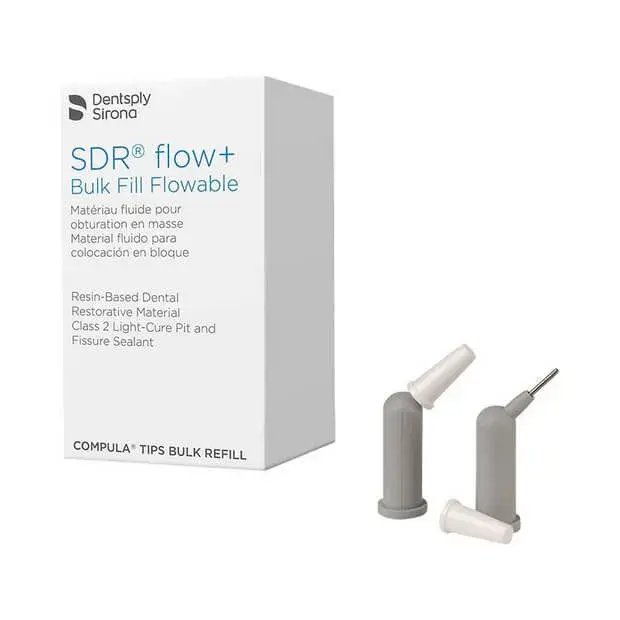
Dentsply Sirona’s SDR flow+ is the second-generation version of the bulk-fill flowable that started the category in 2009. This SDR flow plus review covers its handling under a capping layer, the clinical and laboratory evidence, and how it compares with Filtek Bulk Fill.
TL;DR
SDR flow+ fills Class I and II dentin in 4 mm self-leveling increments with low polymerization stress.
Randomized trials of SDR technology report annual failure rates near 1% at five and six years, matching 2 mm layering.
The Universal shade cures 4 mm in 20 seconds, while A-shades need 40 seconds and convert less deeply.
Filtek Bulk Fill Flowable wears less in 3M’s testing, and SDR shows lower cusp deflection and better dentin margins.
What Is SDR Flow+?
SDR Flow+ is a light-cured, low-viscosity composite designed to replace dentin in bulk. Dentsply Sirona sells it as SDR Flow+ in North America and as SDR Plus in some other markets, and the chemistry is identical.
From SureFil SDR Flow To SDR Flow+
The first SDR product reached clinics in 2009 under the SureFil name. It was the first flowable that could be placed 4 mm deep in one pass, and Dentsply Sirona now reports more than 50 million SDR applications worldwide.
The reformulated SDR flow+ kept the stress-decreasing resin and changed the filler package. According to the SDR Plus Scientific Manual, filler content rose by about 2.5 percentage points, part of the glass was swapped for a stronger filler, and radiopacity climbed roughly 20% to about 2.6 mm Al. Wear resistance was raised to the level of a conventional flowable. Three VITA shades, A1 to A3, joined the original Universal shade, which sits close to B1 on the shade guide.
Higher radiopacity makes the base easier to tell apart from recurrent caries and from the adhesive layer on a bitewing, which helps at every recall.
How The SDR Modulator Lowers Stress
Polymerization stress pulls composite away from a cavity floor more than shrinkage volume does. SDR flow+ controls that stress chemically.
The resin is a modified urethane dimethacrylate with a polymerization modulator built into its backbone. The modulator slows network formation during the early seconds of cure, so the material keeps flowing and relaxing stress before it reaches the gel point. Dentsply Sirona reports about 20% less volumetric shrinkage and close to 80% less polymerization stress than conventional methacrylate resins. That figure explains why the manufacturer allows a 4 mm increment in a deep, high C-factor box without a separate liner.
Lower stress matters most where enamel is thin or absent. A Class II box with its gingival margin on dentin or cementum has little enamel to hold the bond, and a flowable that shrinks gently gives the adhesive a better chance of surviving the first minutes after cure.
Approved Indications
The SDR flow+ instructions for use list six indications. Each one carries its own capping requirement.
Base in Class I and II direct restorations, with a capping layer
Liner under direct restorations, including a Class II box liner
Pit and fissure sealant
Conservative Class I restorations
Core build-up
Class III and V restorations
The only listed contraindication is a known allergy to methacrylate resins. The IFU also warns that data are insufficient for Class I restorations with an isthmus wider than the central groove area, or where a functional cusp is replaced. Those two exclusions define the outer edge of what this material should do on its own.
SDR Flow+ Technical Specifications
Two numbers change chairside behavior more than the rest: the 550 mW/cm² minimum light output and the doubled cure time for A-shades at 4 mm. The remaining figures help when comparing products on paper.
Property | SDR flow+ |
|---|---|
Material type | Light-cured bulk-fill flowable composite |
Maximum increment | 4 mm, all shades |
Shades | Universal (near B1), A1, A2, A3, semi-translucent |
Filler load | 70.5 wt% / 47.4 vol% |
Filler particle range | 20 nm to 10 µm |
Fillers | Barium and strontium glasses, ytterbium fluoride, silica |
Resin | Modified UDMA with SDR modulator, TEGDMA, di- and trimethacrylates |
Photoinitiator | Camphorquinone, light peak 440–480 nm |
Radiopacity | About 2.6 mm Al |
Minimum light output | 550 mW/cm² |
Capping layer in Class I and II base use | At least 2 mm |
Delivery | Compules and syringes, by market |
Storage | 2–24 °C, dry, away from sunlight |
The curing table below comes straight from the IFU. It is printed on the packaging as well, and it is worth taping inside the operatory cabinet door.
Shade | Light output | 2 mm increment | 4 mm increment |
|---|---|---|---|
Universal | 550–1,000 mW/cm² | 20 s | 20 s |
Universal | 1,000–2,000 mW/cm² | 10 s | 10 s |
A1, A2, A3 | 550–1,000 mW/cm² | 20 s | 40 s |
A1, A2, A3 | 1,000–2,000 mW/cm² | 10 s | 25 s |
The IFU tells clinicians not to apply this table to lights above 2,000 mW/cm² because of pulpal heating, and to follow the curing light manufacturer's guidance instead. Dentsply Sirona does not publish flexural strength or shrinkage stress in MPa for SDR flow+ itself, so any third-party figure reflects that lab's own test setup.
How SDR Flow+ Handles In Clinical Use
SDR Flow+ is easy to place and strict about two variables – cure time and capping thickness. Most problems reported with bulk-fill flowables trace back to one of those two.
Placement In A Class II Box
The proximal box is where this material earns its place. A self-leveling flowable reaches the gingival floor and line angles without an instrument, which is difficult to match with a packable composite pressed into a narrow box.
Isolation comes first. A rubber dam keeps sulcular fluid off the gingival margin, and a sectional matrix sealed with a wedge stops the flowable from running past the margin. Systems such as the Palodent V3 sectional matrix or Halo sectional matrix rings give a tight contact and a well-adapted band, which matters more with a material this fluid.
The adhesive can be any conventional methacrylate system. The IFU names compatibility with methacrylate-based dentin and enamel adhesives in general, so clinicians are not tied to Dentsply Sirona bonding agents. Where enamel margins remain, selective etching of enamel improves margin quality, and the trade-offs between approaches are covered in this guide to self-etch, total-etch, and selective-etch bonding.
The compule tip goes to the deepest point of the box first. Keeping the tip submerged while withdrawing it slowly limits trapped air. The material levels within a few seconds. Firm, steady pressure on the gun works best, since the IFU warns that excessive force can extrude material suddenly or eject the tip.
Curing The 4 mm Increment
Depth of cure depends on the light reaching the bottom of the increment, and a 4 mm flowable leaves little margin for a weak or angled light. Light output checks with a radiometer every few months catch a failing unit before it shows up as a soft cavity floor.
The Universal shade needs 20 seconds at 550–1,000 mW/cm² for the full 4 mm. The A-shades need 40 seconds at that output. A mid-range LED such as the Kerr Demi Plus curing light works within the standard row of the table, and higher-output units such as the VALO Grand curing light move the protocol into the 10- and 25-second row. The light guide should sit as close to the occlusal surface as the matrix allows, held perpendicular, with the curing time counted after the tip is stable.
Deeper boxes, common after old amalgam removal, take two increments. Each is cured on its own before the next goes in.
The Capping Layer
SDR flow+ is a dentin replacement. In Class I and II base use, the IFU requires at least 2 mm of a universal or posterior composite over it to rebuild the marginal ridge and occlusal surface.
The capping material sets the wear behavior and the esthetics of the finished restoration. Dentsply Sirona pairs SDR flow+ with its own sculptable composites, and Ceram.x Spectra ST is a common choice. Any methacrylate posterior composite is compatible, including nanofilled options such as Filtek Supreme Ultra. Oblique increments make occlusal anatomy easier to carve.
Thin capping is a common shortcut. Under 2 mm of capping, the flowable base becomes part of the occlusal contact, and its lower wear resistance starts to show at recall. After the restoration is finished, occlusal contacts should be checked carefully, since a high spot is the usual reason a patient calls back with a tooth that feels high after a filling.
Endodontic Access And Core Build-Ups
A pulp chamber is a deep Class I cavity with an extreme C-factor. SDR flow+ handles it well because it flows into chamber anatomy and cures 4 mm at a time.
No capping layer is required when SDR flow+ is used for a core build-up. Dentsply Sirona describes the cured material as easy to shape with a bur, so the core can be prepared for a crown in the same visit. Where most of the coronal tooth is gone, a dedicated dual-cure core material or a fiber post system gives more strength than any flowable.
Primary Molars And Short Appointments
Pediatric dentistry rewards anything that shortens time under isolation. A single 4 mm increment in a primary molar, cured in 20 seconds with the Universal shade, cuts several minutes from a layered technique.
The same compule can seal adjacent fissures, which keeps the tray simple. The material's semi-translucency matters less in primary teeth. The pediatric study discussed below found the darkest shade converted least at depth, so the Universal shade is the sensible default for children as well.
What The Clinical Evidence Shows
The clinical record behind SDR technology is longer than for most bulk-fill flowables. Nearly all of it was collected on the original SureFil SDR flow, so it supports the SDR concept more directly than the SDR flow+ formula itself.
Randomized Trials Of SDR Technology
Jan van Dijken and Ulla Pallesen ran the defining trials. In their six-year study published in the European Journal of Oral Sciences in 2017, 38 adults each received matched pairs of Class I or Class II restorations. One cavity of each pair got SDR in bulk increments up to 4 mm with a nanohybrid cap, and the other got a hybrid composite in 2 mm layers. After six years, 98 restorations were examined. Three Class II molar restorations had failed in each group, giving an annual failure rate of 1.0% for both techniques. Composite fracture was the main reason.
Their five-year trial in the Journal of Dentistry in 2016 enrolled 86 patients with 200 restorations, and 183 were evaluated at five years. Ten restorations failed, all of them Class II, with four in the SDR group and six in the layered group. The annual failure rate was 1.1% for the bulk-filled restorations and 1.3% for the layered ones, a difference that did not reach statistical significance. No patient reported post-operative sensitivity. Tooth fracture and secondary caries caused the failures.
The same authors also published a three-year trial in Dental Materials in 2014, in which the bulk-filled group had no failures, and the layered group had an annual failure rate of 1.3%. A 36-month study by J. Burgess and C. Munoz at the University of Alabama, held as an internal Dentsply Sirona report, found no failures attributable to SDR, but it remains an internal report and carries less weight.
The protocol in these trials is worth noting. Every SDR restoration stopped 2 mm short of the occlusal surface and received a nanohybrid cap. That mirrors exactly how SDR flow+ is meant to be used today, which makes the data more transferable than the formula change alone might suggest.
Marginal Adaptation In The Lab
Laboratory work supports the material's main selling point, adaptation at deep dentin margins. The results depend heavily on whether the margin sits in enamel or dentin.
A Swiss group led by Anne Peutzfeldt restored 39 extracted molars with Class II cavities ending below the cementoenamel junction and aged them artificially. In their 2018 Operative Dentistry study, SDR showed significantly better marginal integrity in dentin than both Filtek Supreme XTE and Filtek Bulk Fill. In enamel, the packable composite outperformed both flowables, and the two flowables did not differ. For a Class II restoration, this supports a flowable base at the deep proximal margin with a packable composite carried to the enamel margins.
An earlier in vitro study by Orłowski and colleagues found that flowable and sonic-activated bulk-fill materials, SDR among them, sealed Class II margins better than a paste-type bulk-fill composite. A 2025 scanning electron microscopy study in the Journal of Pharmacy and Bioallied Sciences ranked SDR and SonicFill ahead of Tetric N-Ceram and Filtek Bulk Fill for marginal adaptation in Class II cavities.
Shade And Depth Of Cure
The A-shades are the most significant addition in SDR flow+, and they come with a cost at depth. One study has tested the four shades directly.
Gennaro Musella and colleagues published an in vitro study in the Journal of Dentistry that cured all four SDR flow+ shades at 2 mm and 4 mm using the IFU times. At the top surface, the degree of conversion was similar across shades, around 70–72%. At 4 mm, it fell to 54.1% for Universal, 52.9% for A1, 51.2% for A2, and 48.1% for A3. Both shade and thickness had a significant effect. The authors wrote with pediatric patients in mind and called for careful curing protocols with darker shades.
Universal belongs in the base whenever it stays hidden under the cap. A-shades are for situations where the material shows, such as a Class V or a visible proximal box, and those cases deserve the full cure time or longer.
Strength Compared With Fiber-Reinforced Bases
Flowables trade strength for adaptation, and SDR flow+ is no exception. This shapes case selection more than any other property.
A 2025 study by Ecehan Hazar compared biaxial flexural strength and microhardness of four dentin replacement materials: SDR flow+, a high-viscosity resin-modified glass ionomer, and two short fiber-reinforced composites, everX Flow and everX Posterior. The author concluded that the fiber-reinforced materials had more favorable microhardness and flexural strength. Large cavities with missing cusps are where that difference counts, and fiber-reinforced bases such as everX are the stronger option there.
SDR Flow Plus Vs Filtek Bulk Fill
The SDR Flow Plus vs. Filtek Bulk Fill decision comes down to small differences between two capable materials. Both cure 4 mm, both come in Universal plus A1 to A3, and both need a capping layer in posterior base use.
Two Products Share The Filtek Name
The name “Filtek Bulk Fill” covers two different materials, and confusing them leads to poor comparisons. Since 2024, both have been sold by Solventum, the company formed from 3M's healthcare business.
Filtek Bulk Fill Flowable Restorative is the direct competitor to SDR Flow+. It is a flowable base that needs a 2 mm cap. Filtek One Bulk Fill Restorative, formerly sold as Filtek Bulk Fill Posterior, is a sculptable paste that 3M rates for placement up to 5 mm without a capping layer. It competes with a complete SDR flow+ restoration including its cap, and the comparison below concerns the flowable only.
Head-To-Head Specifications
On paper, the two flowables are close. The table uses the SDR flow+ IFU and Scientific Manual and the Filtek Bulk Fill Flowable Technical Product Profile.
Attribute | SDR flow+ | Filtek Bulk Fill Flowable |
|---|---|---|
Increment depth | 4 mm | 4 mm |
Shades | Universal, A1, A2, A3 | Universal, A1, A2, A3 |
Capping layer in posterior base use | At least 2 mm | At least 2 mm |
4 mm cure, standard output | Universal 20 s, A-shades 40 s | Universal 20 s, A-shades 40 s |
4 mm cure, about 1,000 mW/cm² or higher | Universal 10 s, A-shades 25 s | Universal 10 s, A-shades 20 s |
Filler load | 70.5 wt% / 47.4 vol% | About 64.5 wt% / 42.5 vol% |
Resin system | Modified UDMA with SDR modulator, TEGDMA | BisGMA, UDMA, BisEMA(6), Procrylat |
Radiopacity | About 2.6 mm Al | 2.4 mm Al |
Delivery | Compules and syringes | Capsules and syringes |
Some current Solventum product images describe the flowable's depth of cure as "up to 3 mm," while 3M's technical literature lists 4 mm. Clinicians should confirm the figure in the IFU supplied in their own market.
What 3M's Own Testing Showed
The cleanest like-for-like numbers come from 3M's technical profile, which tested Filtek Bulk Fill Flowable against the original SDR. These are manufacturer data, and they predate the SDR flow+ reformulation.
Test (3M data) | Filtek Bulk Fill Flowable | Original SDR |
|---|---|---|
Three-body wear, µm per 200,000 cycles (lower is better) | 13.4 | 22.5 |
Flexural strength, MPa | 126.5 | 122.9 |
Flexural modulus, MPa | 4,658 | 6,335 |
Volumetric shrinkage, % | 3.1 | 2.8 |
Cusp deflection at 4 mm, µm (lower is better) | 6.6 | 4.5 |
Radiopacity, mm Al | 2.4 | 2.2 |
Filtek lost about 40% less material in the wear test. Original SDR produced lower shrinkage and about a third less cusp deflection, the property its modulator chemistry is designed to control. SDR flow+ has since closed much of the wear and radiopacity difference, with Dentsply Sirona reporting standard flowable wear and about 2.6 mm Al.
Independent data lean toward SDR at dentin margins. The Peutzfeldt study found significantly better dentin margin integrity for SDR than for Filtek Bulk Fill, with no difference in enamel. No randomized clinical trial has compared the two flowables directly.
Which One Fits The Practice
Neither flowable wins outright, and the better choice usually follows the rest of the restorative system already in use.
SDR flow+ suits clinicians who restore many deep Class II boxes with dentin or cementum margins and want the material with the longest randomized clinical record behind its technology. It also fits naturally into a Dentsply Sirona workflow built around Palodent matrices and Prime&Bond adhesives.
Filtek Bulk Fill Flowable suits practices already working with Filtek composites and 3M Scotchbond Universal Plus adhesive, and clinicians who value its lower published wear for small exposed areas. Practices wanting a single sculptable bulk-fill without a cap should look at Filtek One Bulk Fill instead of either flowable. Other flowable bulk-fills worth comparing include Kettenbach Visalys Bulk Flow and BRILLIANT Bulk Fill Flow, and the full list of restorative materials reviews covers the remaining options.
Where SDR Flow+ Fits In A Treatment Plan
Material choice belongs in the treatment plan alongside cavity size and occlusal load. A bulk-fill base suits some teeth well and others poorly, and documenting that reasoning helps both the patient and the next clinician.
A medium-depth Class II lesion on a premolar with intact cusps is close to the ideal SDR flow+ case. For a molar with an undermined cusp and bruxism wear facets, the plan should move toward cusp coverage or a fiber-reinforced base. Patients with signs of cracked tooth syndrome need that assessment before any direct composite.
Deep subgingival margins raise a separate question. Elevating the margin with a flowable is one option, and this comparison of deep margin elevation and surgical crown lengthening sets out when each approach makes sense. Near-exposures call for a pulp protection step first, with a light-cured liner such as TheraCal LC or a calcium silicate like Biodentine placed before the SDR flow+ base.
Recording these choices inside a structured dental treatment plan makes them easy to explain at case presentation and easy to audit at recall.
Bottom Line
SDR flow+ is worth using for most general practices that place medium to deep Class I and II composites. Its value lies in the base layer, where low stress and self-leveling flow produce dependable adaptation in the part of the cavity that is hardest to restore well.
The evidence is strongest for the SDR concept and thinner for the SDR flow+ formula specifically. The six-year randomized data were collected with the original material under the same capping protocol recommended today, which makes them a reasonable guide. Clinicians who want formula-specific clinical data will need to wait for new trials.
Most of the long-term outcome depends on technique. A 2 mm cap, a measured curing light, the Universal shade for hidden dentin, and good isolation account for most of the difference between a restoration that lasts and one that returns as a fracture or recurrent caries at recall.
Practices choosing between SDR flow+ and Filtek Bulk Fill Flowable can make the decision on workflow and existing materials. Neither has a clinical advantage large enough to justify switching an established protocol that already works.
Verdict
<p>SDR flow+ remains one of the most dependable bulk-fill flowable bases available. Its core job is replacing dentin quickly in Class I and II cavities, with low polymerization stress and adaptation that holds up at deep proximal margins.</p><p>The strongest argument for the material is the randomized evidence behind its technology. In the van Dijken and Pallesen trials, bulk-filled SDR restorations under a nanohybrid cap failed at about 1% per year over five and six years, the same rate as 2 mm layering. The reformulation raises radiopacity by about 20% and adds A-shades while keeping the self-leveling flow that made the original popular.</p><p>SDR flow+ is a base for load-bearing posterior teeth and needs a full 2 mm cap. The A-shades need twice the cure time at 4 mm and still convert less at depth than Universal, which makes Universal the right default for hidden dentin. Cavities with missing cusps call for a stronger base or an indirect restoration.</p><p>Against Filtek Bulk Fill Flowable, the differences are modest. Filtek posts lower wear in 3M’s testing, and SDR shows lower cusp deflection and better dentin margins in independent laboratory work. Either performs well with good isolation and a calibrated curing light.</p>
Frequently Asked Questions
Is SDR flow plus the same as the original SDR?
No. SDR flow+ is the reformulated second generation of SureFil SDR flow. It uses the same stress-decreasing resin with more filler, about 20% higher radiopacity, better wear resistance, three added A-shades, and a wider list of indications.
How deep can SDR flow bulk fill be placed in one increment?
Up to 4 mm for every shade. Deeper cavities take successive 4 mm increments, each cured fully, with at least 2 mm left for the capping composite in Class I and II base use.
Does SDR flow+ need a capping layer?
Yes, when used as a base in Class I and II restorations, where the IFU calls for at least 2 mm of universal or posterior composite. Fissure sealing, conservative Class I, Class III, Class V, and core build-ups need no cap.
How long should SDR flow+ be light cured?
At 550–1,000 mW/cm², Universal needs 20 seconds for 4 mm and A-shades need 40 seconds. At 1,000–2,000 mW/cm², the times drop to 10 seconds for Universal and 25 seconds for A-shades. The IFU table does not apply above 2,000 mW/cm².
Which SDR flow+ shade works best as a base?
Universal, whenever the base stays hidden under the cap. It cures in half the time at 4 mm, and a 2025 study found A3 had the lowest degree of conversion at depth.
Can SDR flow+ be left as the final occlusal surface?
Only in conservative Class I cavities. The IFU advises against it where the isthmus is wider than the central groove area or a functional cusp is replaced.
Which adhesive should be used with SDR flow+?
Any conventional methacrylate-based dentin and enamel adhesive, applied and cured according to its own instructions. Universal adhesives in self-etch or selective-etch mode are common pairings.
Is SDR flow plus better than Filtek Bulk Fill?
Neither is clearly better. SDR technology shows lower cusp deflection and better dentin margin integrity in lab studies, with a longer clinical record behind it. Filtek Bulk Fill Flowable shows lower wear in 3M’s testing. Both cure 4 mm and both need a cap.
Can SDR flow+ be used in primary teeth?
It is widely used in primary molars because a single increment shortens the appointment, and it can also seal fissures. The Universal shade is the safer choice, since darker shades convert less at depth.
Does SDR flow+ release fluoride?
Its glass fillers contain fluoride, but Dentsply Sirona does not market it as a fluoride-releasing material. Caries prevention should rely on other measures.
How should SDR flow+ be stored?
At 2–24 °C, away from sunlight and moisture, and never frozen. Refrigerated material should reach room temperature before use so it flows and levels properly.
Is SDR flow+ suitable for core build-ups?
Yes, in many cases. It fills the pulp chamber 4 mm at a time and needs no cap for this indication. Teeth with very little coronal structure left may need a dedicated core material or a post.