Rating: 4.1/5
Filtek One Bulk Fill Review
This Filtek One Bulk Fill review weighs a sculptable composite sold on one claim, a 5 mm increment with no capping layer. Published follow-up now reaches 60 months, and the curing...
Reviewed by Rachel Thompson
Pros
- Places in increments up to 5 mm in Class II boxes and core build-ups
- Requires no capping layer and can be carried to occlusion
- Combines AFM and AUDMA monomers for stress relief
- Offers higher opacity than earlier bulk-fill composites
- Holds occlusal anatomy before curing
- Produced very low void levels when injected from the capsule
- Reached 97.1% survival at 60 months in one split-mouth trial
- Carries indications that include core build-ups and primary teeth
Cons
- Needs matrix removal and side exposures for 5 mm increments
- Stops at 4 mm in Class I restorations
- Showed a drop in conversion at the base of a 5 mm increment in one study
- Comes in five shades with no separate enamel or dentin opacities
- Requires a dispenser for capsules and generates single-use waste
- Recorded relatively high water sorption in two independent studies
- Wore more than nanohybrid composites in one chewing-simulator study
- Rests many headline performance claims on manufacturer data
This Filtek One Bulk Fill review weighs a sculptable composite sold on one claim, a 5 mm increment with no capping layer. Published follow-up now reaches 60 months, and the curing fine print deserves more attention than the depth figure on the box.
TL;DR
Filtek One cures dependably to 4 mm, and its 5 mm limit applies only to Class II boxes and core build-ups cured from the occlusal surface and both sides
A 30-patient split-mouth trial recorded 97.1% survival at 60 months
Injected capsules left 0.07% internal voids in micro-CT testing, against 1.89% for layered Filtek Universal
Higher opacity tracked with better color match at 24 months, while preheating adds a step with no measured benefit
What Filtek One Bulk Fill Is And Who Makes It
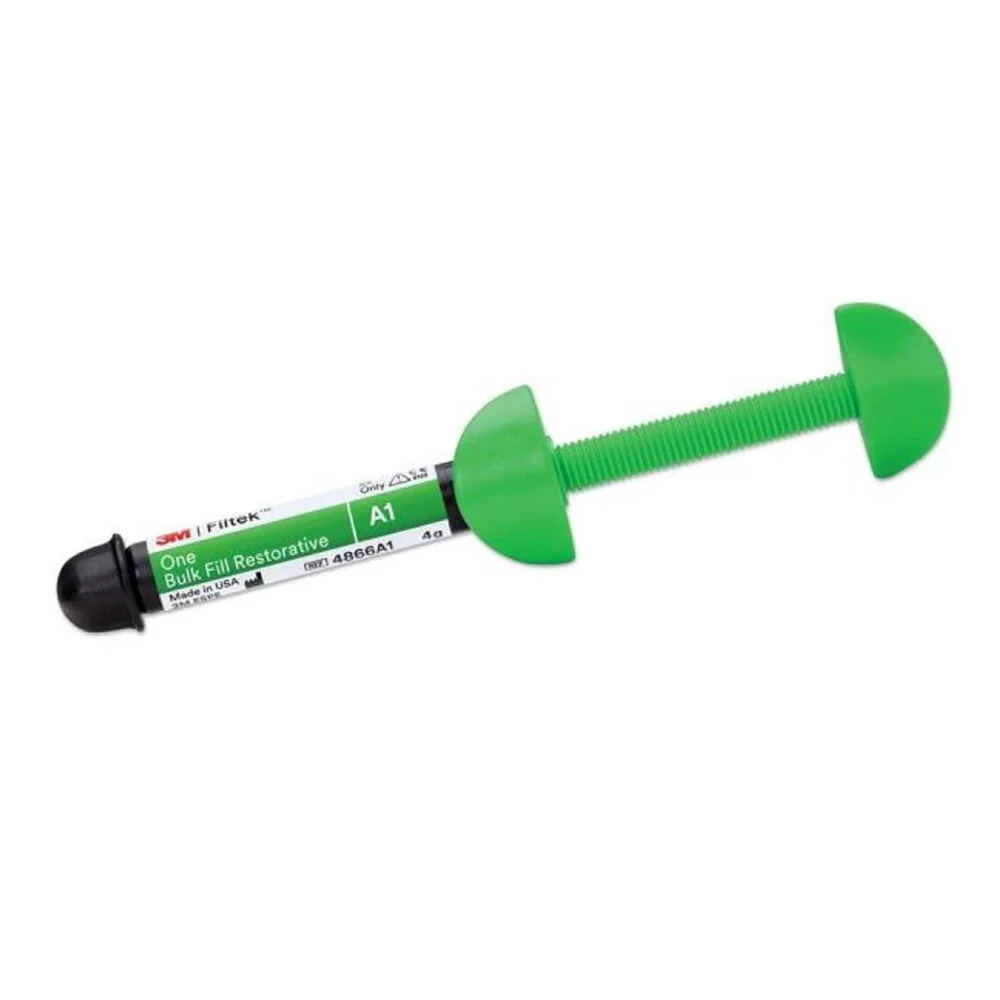
Filtek One Bulk Fill Restorative is a light-cured, high-viscosity nanofilled composite designed for placement in a single increment and carried to occlusion without a capping layer. 3M introduced it as a more opaque replacement for Filtek Bulk Fill Posterior, and Solventum, the company formed from 3M Health Care, now sells it. Older trials name 3M or 3M ESPE as the manufacturer of the same material.
Resin Chemistry: AFM And AUDMA
Two proprietary monomers carry the stress-relief claim. The technical product profile lists AFM, AUDMA, UDMA, and 1,12-dodecane-DMA as the resin components. AFM has a linking group that can split during polymerization, so the forming network rearranges and gives up part of its internal stress. AUDMA takes a different route, since its high molecular weight leaves fewer reactive groups per unit volume.
Thick increments are the setting where this chemistry matters most. Translucency and photoinitiators can solve depth of cure while doing nothing for a contracting mass bonded to cavity walls. Solventum also recommends the material to clinicians who want a restorative free of BPA derivatives, which gives the practice a direct answer when a patient asks about bisphenol A.
Filler Loading: Read The Volume Figure
Filler weight tempts clinicians into the wrong comparison. At 76.5 wt%, this composite looks lightly filled beside Filtek Z250 XT at 84.5 wt%, yet the volume figures sit close together at about 58.5% and 60%. Filler density differs between products, and volume is the number that shows how much resin remains to shrink.
The filler blend combines 20 nm silica, 4 to 11 nm zirconia, zirconia and silica nanoclusters, and 100 nm ytterbium trifluoride agglomerates for radiopacity. Nanoclusters underpin the manufacturer's wear and polish claims, although independent wear data, covered below, tell a more mixed story.
Opacity And Posterior Color
Early bulk-fill composites bought depth with translucency, and large restorations could turn grey against the surrounding tooth. Filtek One records an average contrast ratio of 51 compared with 43 for Filtek Bulk Fill Posterior, which places it inside the band of typical universal composites. Solventum's clinical tips point to the same benefit over stained dentin.
Technical Specifications
The figures below come from the manufacturer's technical profile and instructions for use. Most performance data in those documents are internal, so they work better as a starting point than as proof.
Specification | Detail |
|---|---|
Material type | Light-cured, high-viscosity bulk-fill nanocomposite |
Maximum increment | 5 mm in Class II and core build-ups, 4 mm in other indications |
Capping layer | Not required |
Monomers | AFM, AUDMA, UDMA, 1,12-dodecane-DMA |
Filler load | 76.5 wt%, about 58.5 vol% |
Radiopacity | 3.1 mm aluminum equivalent |
Contrast ratio | 51 average |
Shades | A1, A2, A3, B1, C2 |
Delivery | 4 g syringe or 0.2 g capsule |
Warming | Capsules up to 70 °C for up to 1 hour |
Minimum light output | 550 mW/cm² at 400 to 500 nm |
Shelf life | 36 months at room temperature |
Depth Of Cure In Deep Posterior Cavities
Independent testing supports 4 mm with few reservations, and the 5 mm allowance holds only under a specific curing sequence. Clinicians who treat the depth on the box as a general rule risk an undercured floor that no chairside check will reveal.
The Manufacturer's Curing Protocol
The instructions for use tie exposure time to the indication and the output of the curing light. Halogen and LED units qualify as long as they reach at least 550 mW/cm².
Indication | Increment | 550 to 1000 mW/cm² | 1000 to 2000 mW/cm² |
|---|---|---|---|
Class II direct and core build-up | 5 mm | 20 s from each of occlusal, buccal, lingual | 10 s from each of occlusal, buccal, lingual |
Other listed indications | 4 mm | 40 s | 20 s |
Anterior or shallow Class I | 3 mm or less | 20 s | 10 s |
Class I preparations stop at 4 mm because intact walls block lateral light, and Solventum's tips tell clinicians to place anything deeper in increments. The 5 mm protocol also requires the band to come off before the side exposures, so a contact shaped with a sectional matrix has to survive removal after the proximal box has had only its occlusal exposure.
Side exposure reaches the proximal box. The center of a wide occlusal preparation gets no such help, which is a good reason to reserve 5 mm for the box and keep the occlusal body at 4 mm or less.
Where The Time Saving Comes From
Light-on time turns out to be the smallest part of the saving. 3M's own comparison draws a 5 mm conventional build as three layers cured for 10 seconds each, which comes to 30 seconds. A 5 mm Class II in Filtek One also totals 30 seconds on a light above 1000 mW/cm².
The chair time comes back between exposures. One placement replaces three, and the clinician adapts composite against the matrix once, with far fewer chances to trap a void between layers.
What Independent Testing Found
A University of São Paulo dissertation cured six composites for 30 seconds at 1200 mW/cm², and Filtek One alone kept a bottom-to-top hardness ratio above 80% at 4 mm. A 2026 Queen Mary University of London dissertation measured 5.65 mm on the ISO 4049 test and adequate conversion to 4 mm. At 5 mm, degree of conversion at the bottom surface dropped to 31.84% on FTIR.
Those results can both stand. ISO 4049 scrapes away soft material and halves the remaining length, which can flatter the deepest layer, while FTIR reports chemical conversion at that exact depth. The London record does not say whether side exposures were simulated, and the 5 mm protocol depends on them.
3M's ex vivo slot model, built on an Oregon Health and Science University protocol, reached acceptable hardness at 5 mm in a box 3.5 mm wide. A broad molar box is a harder test than that slot.
Checking The Curing Light
Tip output sets the upper limit on what reaches the gingival floor. Distance and tip angle both subtract from it, and a deep box adds several millimeters before the light meets any composite. The Brazilian trial discussed below checked its unit with a radiometer before each restoration and recorded about 1,200 mW/cm².
LED units lose output slowly and without visible warning, so a regular radiometer check belongs in the weekly routine. A practice buying new equipment should compare tip reach in posterior sites on units such as the VALO Grand, because a light that cannot sit flat over a second molar delivers less at the floor of the box.
Shrinkage Stress And Marginal Adaptation
Laboratory work places the stress produced by a bulk increment of Filtek One in the range of layered composites, and capsule delivery produced very few voids. Marginal figures are good without being better than careful layering.
Stress Compared With Shrinkage
The manufacturer reports volumetric shrinkage equivalent to Filtek Supreme XTE and cusp deflection similar to many incrementally placed universals, on internal data. The São Paulo work found that larger volumes raised stress for Filtek One, while its authors still ranked the material favorably for stress combined with maintained cure.
The study found polymerization shrinkage similar to Tetric PowerFill and the conventional Ceram.x Spectra ST. Stress relief is the stronger claim here, and clinicians should keep it separate from the idea that the material shrinks less.
Internal Voids And Continuous Margins
A 2025 micro-CT study in Materials gives the clearest independent picture of Class II placement. Injected Filtek One showed 0.07% internal voids at 24 °C, compared with 1.89% for incrementally placed Filtek Universal. Continuous margins reached 93.7% in enamel and 87.2% in dentin, figures that did not differ significantly from the layered control.
The capsule protects against porosity more clearly than it improves the margin. The dentin figure also leaves about one-eighth of the margin length without continuous adaptation, which argues against treating any bulk technique as forgiving at a deep gingival floor.
Preheating Capsules
Capsules can be warmed to 70 °C for up to one hour, and Solventum states on internal data that warming lowers extrusion force without changing physical properties. Independent results give little reason to add the step. Warming to 68 °C did not significantly change voids or margins in the micro-CT study, and Karadag and colleagues found no rise in conversion or flexural strength at 39 °C or 55 °C.
One study points the other way on wear. Abdulmajeed and colleagues measured greater volumetric loss after preheating, with color stability unchanged.
Strength And Wear Data
Filtek One leads several independent flexural comparisons, although absolute values vary widely between laboratories. Wear data split according to the comparator, and water sorption is the most consistent weak point.
Flexural Strength And Modulus
The table compares three independent sources. Readers should compare materials within a study, because specimen geometry and storage move these numbers substantially.
Source | Filtek One result | Context |
|---|---|---|
142.5 MPa strength, 4.2 GPa modulus | Significantly higher than Tetric N-Ceram Bulk Fill and Opus Bulk Fill | |
100.70 MPa strength at room temperature | Below Filtek Z250 (145.68 MPa) and EverX Posterior (157.24 MPa) | |
Highest strength and modulus of the materials tested | Ahead of Tetric PowerFill and SDR Plus after aging |
The 42 MPa spread between the first two studies shows how strongly method drives these numbers. Both values clear the 80 MPa ISO 4049 minimum for occlusal materials.
Wear Resistance
Wear results depend heavily on the comparator. Against Filtek Supreme Ultra, Abdulmajeed and colleagues found less volumetric wear with Filtek One after 120,000 chewing-simulator cycles. A 2024 Journal of Esthetic and Restorative Dentistry study grouped materials by filler instead, and nanofilled composites, Filtek One among them, lost significantly more volume than nanohybrid or submicron-filled materials.
Every composite in that second study wore two to three times faster than enamel over 240,000 cycles. Patients with heavy occlusion or a bruxing history therefore deserve a closer look at recall, whichever posterior composite the practice uses.
Water Sorption
Two independent projects flag water uptake. One study recorded 1.16% water absorption and 0.89% acid uptake, the highest of the materials it tested, and Marović and colleagues also placed Filtek One among the higher-sorption composites. No trial has linked this property to clinical failure, although it may matter in patients with frequent acid exposure.
Clinical Performance In Patients
Product-specific follow-up now runs to 60 months, with high survival and no signal of inferiority to layered composite. The cohorts are small, and only some trials use a conventional comparator.
Sixty Months In Regensburg
At the University of Regensburg, 30 patients, 21 women and 9 men, each received one Filtek One restoration and one self-adhesive bulk-fill in Class II cavities. Filtek One went in over Scotchbond Universal in self-etch mode, scrubbed for 20 seconds, in layers of up to 4 mm with 20 seconds of curing per layer. Every patient attended every recall in the first year, and every Filtek One restoration survived.
Surface luster earned the top FDI score in 83.3% of teeth at baseline and 76.7% at 12 months, while color match earned it in 96.7% at 12 months. Marginal staining rose significantly over that first year. Hairline enamel cracks appeared in 53.3% of teeth at 6 and 12 months, a finding the study design cannot attribute to the material.
At 60 months, 25 of the 30 patients returned, and survival stood at 97.1%. All restorations still available scored as clinically acceptable, with luster and marginal adaptation declining over time. 3M Oral Care funded the original study. Clinicians considering the newer Scotchbond Universal Plus should note that this trial used the earlier adhesive.
Twenty-Four Months Against Layering
A double-blind split-mouth trial in Nova Friburgo, Brazil placed 295 Class I and II restorations and evaluated 62 patients at 24 months. Retention ranged from 95.2% to 100%, and no capsule-delivered Filtek One restoration was lost. Bulk-fill groups showed fewer marginal defects than layered Filtek Supreme Ultra, with selective enamel etching outperforming self-etch.
Filtek One capsules showed no color mismatch at 24 months. Interpretation needs care, since the capsule and syringe groups used different products and the design cannot isolate delivery from formulation. Increments stayed at 4 mm or less, and 3M Brazil donated the materials, so these results say little about a true 5 mm placement.
A two-year trial at Erciyes University compared Filtek One with Clearfil Majesty Posterior and G-aenial Universal Injectable in 259 Class II restorations. Marginal adaptation was similar to the conventional composite, although recall fell to 188 restorations. Longer data on the predecessor help here, since Filtek Bulk Fill Posterior matched Filtek Supreme XTE over five years in a split-mouth trial.
What Patients Reported
Sensitivity is the outcome a patient notices first, and these trials recorded very little of it. Regensburg reported no postoperative hypersensitivity at 12 months. In Nova Friburgo, patients logged sensitivity for seven days on numeric and visual scales, and the only restoration replaced for unacceptable sensitivity was a layered composite at 12 months.
The Brazilian authors also noted that minor defects did not change how patients perceived their restorations and could be repolished. A randomized comparison with Surefil One recorded 100% survival at 12 months across 64 restorations, with better esthetic scores for Filtek One.
What The Systematic Reviews Add
Reviews of bulk-fill composites as a class point the same way. Zailai and colleagues pooled 9 randomized trials and 632 restorations and reported a risk ratio for failure of 0.82 (95% CI 0.33 to 2.01). Veloso and colleagues found a nonsignificant risk ratio of 1.89 (95% CI 0.84 to 4.24) for full-body bulk-fills, and Boaro and colleagues reported similar clinical performance across 103 clinical and laboratory articles.
Those confidence intervals are wide enough to hide a modest difference in either direction, and they pool many products. A Filtek One versus Filtek Z250 Class II trial is registered as completed, and this review could not locate published results.
Placement Technique For Posterior Restorations
Technique decides more of the outcome than the product label does. The steps below combine the instructions for use with the protocols from the trials reviewed above.
Capsule Or Syringe
Capsules suit deep Class II boxes, because Solventum's shear-thinning tip lets the paste behave like a flowable during extrusion. A 20-capsule refill holds the same 4 g as one syringe, which makes supplier pricing easy to compare per gram. Syringe material works well for shallow cavities, and it avoids the cost of a dispenser.
Step-By-Step Posterior Placement
Rubber dam isolation is the manufacturer's preferred moisture control, with cotton rolls and suction listed as the alternative. The sequence below assumes a Class II restoration.
Select the shade before placing the dam, while the teeth are hydrated
Prepare the cavity and round the internal line angles
Seat the matrix and wedge, then burnish the band to establish the contact
Measure the box with a probe and plan a second increment beyond 5 mm
Selectively etch enamel, then apply and cure a methacrylate-based adhesive
Start at the deepest point with the tip against the matrix, then withdraw slowly
Keep the tip submerged throughout extrusion to limit trapped air
Overfill slightly and sculpt the occlusal anatomy
Cure from the occlusal surface for the time set by the light output
Remove the matrix and complete the buccal and lingual exposures
Check occlusion, then finish and polish
Magnification helps at the final stage, and dental loupes make residual flash at a gingival margin easier to catch before polishing. Intense operatory light can start polymerization early, so the overhead lamp should stay away from the field until the sculpting is done.
Deep Lesions And Pulp Protection
The IFU allows Vitrebond or Vitrebond Plus under deep excavations, with calcium hydroxide confined to direct pulp exposures. Where little dentin remains, some clinicians place a calcium silicate such as Biodentine under the composite. Any liner consumes part of the increment, so the measured depth should be taken after it has set.
Planning Multiple Restorations
Bulk placement mostly changes appointment arithmetic. A dental treatment plan covering several posterior composites in one quadrant can group them into a single isolated visit, and the chart should record the increment depth and curing sequence. Those two notes make recall easier to interpret, particularly when luster and marginal staining start to change after the first year.
How Filtek One Compares With Other Composites
Filtek One is the balanced option among sculptable bulk-fills, and a flowable or fiber-reinforced base suits some cases better. Much of the published competitive data comes from manufacturers, including Solventum's SonicFill 2 comparison, so the table favors independent sources where they exist.
Material | Placement | Evidence | Best fit |
|---|---|---|---|
Filtek One Bulk Fill | Sculptable, up to 5 mm, no cap | Clinical data to 60 months | General Class I and II work |
Filtek Bulk Fill Posterior | Sculptable predecessor | Contrast ratio 43, more color mismatch at 24 months | Largely superseded |
Tetric PowerFill | Sculptable bulk-fill | Higher conversion at all depths in one dissertation | Practices with a matching high-output light |
SDR flowable | Base with a 2 mm conventional cap | Strong 3-year result with capping | Deep bases and difficult access |
Paste and flowable bulk options | Compare on current manufacturer data | Practices wanting both viscosities | |
Fiber-reinforced base with a 1 to 2 mm cap | Highest flexural value in Karadag et al. | Large MOD cavities, cusp loss | |
2 mm layers | More marginal defects than bulk-fill groups at 24 months | Layered esthetics in visible areas |
Economics also favor predictability. A composite filling typically runs 150 to 400 dollars without insurance, and one remake can cancel the time saved across several bulk placements.
Bottom Line
Filtek One Bulk Fill has moved past the stage where a bulk-fill composite needed to be taken on trust. Regensburg followed 30 patients for five years and recorded 97.1% survival, and a Brazilian split-mouth trial found no retention penalty against layered Filtek Supreme Ultra at 24 months. Neither trial placed routine 5 mm increments, and that detail should temper how the depth claim is read.
The clinical protocols behind those survival numbers stayed at 4 mm or less. Copying those protocols keeps a practice within the evidence. Pushing every box to 5 mm with one occlusal exposure falls outside both the instructions for use and the published follow-up, and the FTIR figure of 31.84% at the base of a 5 mm increment shows what may be at stake.
Purchasing decisions come down to case mix and the curing light in the operatory. Practices placing many Class I and II restorations will recover the most time from capsule delivery, while a clinic with an aging unit should budget for a radiometer check before it changes composite. Water sorption and nanofilled wear remain open questions that only longer recall data can settle.
Five shades and one opacity will not replace a layered system in the smile zone, and the manufacturer's own range includes Filtek Supreme Ultra for that work. For molars and premolars under routine load, this composite reduces placement steps, and its 60-month record rests on a single 30-patient cohort that future trials will need to extend.
Verdict
<p>Filtek One Bulk Fill is a dependable first choice for routine posterior composite work when clinicians respect its curing limits. A sculptable paste with no capping layer and more natural opacity than earlier bulk-fills gives it broad use in general practice. The 97.1% survival figure at 60 months comes from a trial of only 30 patients, so it supports the material without settling the long-term question.</p><p>Treat 4 mm as the working limit. A 5 mm increment belongs only in an accessible Class II box that receives its occlusal exposure and then both side exposures after the band comes off. Independent FTIR data show conversion falling at the base of a 5 mm increment, so a single quick exposure from above is unacceptable.</p><p>Capsules are the better delivery for deep proximal boxes, provided the tip stays submerged. Selective enamel etching has trial support, and preheating does not. Cases that need layered esthetics belong with a universal composite, and a very large cavity with cusp loss may justify a fiber-reinforced base.</p><p>Clear evidence that this material outperforms careful layering over the long term does not exist yet. The available data suggest it matches layering while removing several placement steps, at least at the 4 mm depths those trials used.</p>
Frequently Asked Questions
Is Filtek One Bulk Fill suitable for posterior restorations?
Yes. It is designed mainly for posterior use and is indicated for occlusal surfaces without a capping layer. Trials in Class I and II cavities report high survival at 24 and 60 months.
How deep can Filtek One Bulk Fill be cured?
The limit is 5 mm for Class II restorations and core build-ups, and 4 mm for other listed indications. Independent studies support 4 mm more consistently than 5 mm.
What is the curing time for Filtek One Bulk Fill?
On a light delivering 1000 to 2000 mW/cm², a 5 mm Class II needs 10 seconds from the occlusal surface and 10 seconds from each side. A 4 mm increment needs 20 seconds. Those times double at 550 to 1000 mW/cm².
Does Filtek One Bulk Fill need a capping layer?
No. The manufacturer states that it can be carried to occlusion. Flowable bases such as SDR differ on this point and need a conventional composite cap.
Can it be used in Class I cavities?
Yes, up to 4 mm per increment. Intact walls prevent the side exposures that the 5 mm protocol relies on, so deeper Class I preparations need a second increment.
Is the capsule better than the syringe?
Capsules generally suit deep proximal boxes better, since the tip lowers viscosity during extrusion. Micro-CT testing found very few internal voids with injected capsules. Syringe delivery is adequate for shallow cavities.
Can Filtek One Bulk Fill be preheated?
Solventum allows capsules to be warmed to 70 °C for up to one hour, and its warming guidance does not extend to syringes of this product. Independent studies have not found better conversion or adaptation after preheating.
Which adhesive should be used with Filtek One?
The material needs a methacrylate-based adhesive placed according to that product's instructions. Published trials used Scotchbond Universal and G-Premio Bond Universal, and selective enamel etching gave better marginal adaptation than self-etch in a 24-month trial.
How does Filtek One differ from Filtek Bulk Fill Posterior?
The main difference is opacity, with an average contrast ratio of 51 compared with 43. The manufacturer reports equivalent strength and wear between the two.
Can Filtek One be used on primary teeth?
The instructions list deciduous teeth as an indication. A 2026 meta-analysis of six trials found bulk-fill composites comparable to conventional composites in primary molars, and this review did not identify a pediatric trial specific to Filtek One.
Does Filtek One contain BPA derivatives?
Solventum recommends this composite to clinicians who prefer a BPA-derivative free material. Patients with a known acrylate allergy should avoid it, as the instructions for use advise.
Who manufactures Filtek One Bulk Fill now?
Solventum, the company formed from 3M Health Care, now sells the product. Many product pages still carry 3M branding.