Rating: 4.3/5
Aquasil Ultra+ Review
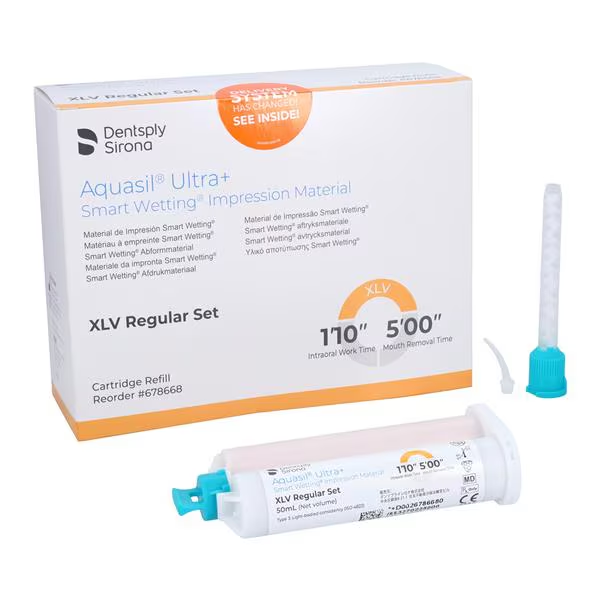
This Aquasil Ultra Plus review checks the material's marketing claims against peer-reviewed data and the manufacturer's own directions. Aquasil Ultra+ recorded far higher tear...
Reviewed by Mantas Petraitis
Pros
- High measured tear strength at removal and at 24 hours
- Low contact angle during placement and after setting
- Clinically acceptable accuracy in a 2024 comparison with polyether
- Fast-set removal at 2 minutes 30 seconds shortens tray time
- Three set speeds cover different case sizes
- Rigid viscosity addresses double-arch tray flexing
- Pour window runs from 30 minutes to 14 days after disinfection
Cons
- Lower flow than polyether at both tested viscosities
- Latex gloves and peroxide-containing materials can inhibit setting
- Most headline data comes from the manufacturer or work it commissioned
- The 35-second fast-set wash window leaves little margin for delay
- Peer-reviewed clinical data on the current formulation remains limited
- Polyether may be preferable for implants angled beyond 15 degrees
- Contraindicated with known peppermint oil hypersensitivity
This Aquasil Ultra Plus review checks the material's marketing claims against peer-reviewed data and the manufacturer's own directions. Aquasil Ultra+ recorded far higher tear strength than a polyether light body in a 2021 Tübingen study, while a 2024 Heidelberg model study found clinically acceptable accuracy with both material classes.
TL;DR
Aquasil Ultra+ XLV reached 3.72 MPa maximum tear strength at removal, against 0.75 MPa for a polyether light body
Impregum outflowed Aquasil in shark fin testing at both light-body and heavy-body viscosity
A 2024 model study produced clinically acceptable accuracy with Aquasil Ultra+ and Impregum
Fast-set wash requires tray seating within 35 seconds of the first intraoral syringing
Aquasil Impression Material: What Changed With Ultra+
Aquasil Ultra+ is the current final impression material in the Aquasil line from Dentsply Sirona, and its reformulation targets tear resistance at thin sections. The manufacturer classifies it as a quadrafunctional hydrophilic addition-reaction silicone indicated for all dental impression techniques. Most of the clinical argument for the product follows from one change to the resin.
The QM-Resin Chemistry
The QM-resin in Aquasil Ultra+ carries four vinyl groups per molecule, twice the number in conventional vinyl polysiloxane resin. Dentsply Sirona's fact file describes a short-chain oligomer blended into long-chain VPS, which raises crosslink density. Under load the long chains stretch first and the short chains take up stress as deformation continues.
The mechanism has a clinical consequence worth watching. A sulcular flange that stretches before it tears has to recover after it leaves the undercut, and the directions specify recovery from deformation of at least 98%. Viscoelastic elastomers recover better after brief strain, so a single decisive removal along the path of insertion suits this material better than rocking the tray loose.
The surfactant package, sold as Smart Wetting, is the second half of the reformulation. VPS is hydrophobic without surfactant, so wetting figures for any silicone describe the additive system as much as the polymer.
Viscosities And Clinical Roles
The range runs from extra-low-viscosity wash to putty, and two of the tray viscosities carry restrictions that are easy to miss. The table draws on the directions for use and the technique guide.
Viscosity | ISO 4823 type | Role | Limits |
|---|---|---|---|
XLV | Type 3 | Wash | Syringed around the preparation |
LV | Type 3 | Wash | Syringed around the preparation |
Medium | Type 2 | Tray or monophase | Acceptable for border molding |
Heavy | Type 2 | Tray | Never injected intraorally |
Rigid | Type 1 | Tray, quadrant only | Never injected, block out severe undercuts, excluded as tray material for full-arch dentate cases |
Soft Putty and Putty | Putty | Tray | Hand mix, with machine-mix soft putty also sold |
Dentsply Sirona positions Rigid to limit the distortion common with double-arch trays. The heavy-body restriction deserves a place on the operatory wall, since the directions state that safety and efficacy of Heavy as an intraoral wash have not been demonstrated.
Delivery Formats
Four dispensing routes are available, and the choice affects waste more than impression quality. Practices that take a handful of crowns each week and those running several operatories will want different formats.
50 mL cartridges with mixing tips for a standard dispensing gun
Single-use digit cartridges for targeted wash delivery
DECA 380 mL cartridges for dynamic mixing machines
Hand-mix putty supplied in jars with scoops
The company reports that digit delivery places the tip up to 34% closer to the prepared tooth. No independent measurement of that figure could be located. DECA material runs in a 5:1 dynamic mixer, so a practice already invested in another manufacturer's machine should check compatibility before ordering.
Working And Setting Times At The Chair
Fast Set reaches minimum removal at 2 minutes 30 seconds and Regular Set at 5 minutes, and the intraoral wash limit is the figure that governs the procedure. These values come from the Aquasil Ultra+ directions for use.
Set speed | Working time at 22 °C | Intraoral wash time at 37 °C, maximum | Minimum removal, from start of mix |
|---|---|---|---|
Fast Set | 1 min 00 s | 35 s | 2 min 30 s |
Regular Set | 2 min 15 s | 1 min 10 s | 5 min 00 s |
Extended Set | 2 min 15 s | 1 min 45 s | 5 min 30 s |
Putty follows its own schedule. The putty technique guide lists 2 minutes of work with a 5-minute removal for Regular Set hand mix, and 1 minute 30 seconds with a 3-minute removal for Soft Putty Fast Set.
How The Clock Runs
Two separate clocks run during a one-step impression, and teams get into trouble when they treat them as one. The tray material's working time counts from the start of its mix at room temperature. The wash limit counts from the first contact with the warm preparation, and the tray must be seated before it expires.
Removal time runs from the start of mix, which means intraoral dwell shrinks when seating is late. A Fast Set tray seated at 55 seconds spends about 1 minute 35 seconds in the mouth before minimum removal. The assistant should start a timer at the mix, since counting from seating overshoots the minimum and adds needless tray time.
Consider a distal margin on a maxillary second molar with cord still in place. Cord removal and a final air blast come first, then wash delivery around a preparation with limited access, and 35 seconds covers only the part after the first syringing. Regular Set buys twice that window at the cost of 2 minutes 30 seconds more with the tray in place.
Matching Set Speed To Case Size
The manufacturer recommends Fast Set for single units and Regular Set for multi-unit work, and the directions add a useful hybrid. Regular Set wash paired with Fast Set tray material needs a minimum of 4 minutes from the start of mix.
That pairing gives the operator the 1 minute 10 second wash window and removes a full minute of tray time. Fast Set tray material has only 1 minute of bench working time, so the assistant should delay loading until the operator is partway around the preparation. Teams new to the product should rehearse this on a model first.
The fast-set predecessor required 3 minutes to removal, so the current 2 minutes 30 seconds is a modest and useful reduction. The older range also included a shorter Super Fast Set option, which makes the change less dramatic for those who used it.
Accuracy: What The Evidence Supports
Aquasil Ultra+ produces clinically acceptable accuracy for tooth-supported work in the available laboratory data. No located study shows it to be clearly more accurate than polyether across an arch. The manufacturer lists linear dimensional change below 0.50% and detail reproduction of 20 microns, figures that confirm ISO compliance and say little about how premium materials rank against each other.
Laboratory Accuracy Against Polyether
The most relevant head-to-head comes from Waldecker and colleagues at University Hospital Heidelberg, who took 15 impressions per group from a partially edentulous mandibular model fitted with precision steel reference balls. Their groups used Aquasil Ultra+ Medium, Aquasil Ultra+ Heavy with XLV, Impregum Penta Soft, and Impregum Penta H DuoSoft with Garant L DuoSoft.
Measure | Result across all groups |
|---|---|
Cross-arch distance, largest global error | Short by 82 to 109 µm |
Crown preparation trueness | Below 10 µm |
Crown preparation precision | Below 12 µm |
Inlay preparation trueness | Below 15 µm |
Inlay preparation precision | Below 26 µm |
Every distance came out short, consistent with contraction toward the tray. The authors concluded that all tested materials and techniques could produce models of clinically acceptable accuracy.
Two details matter for treatment decisions. Inlay surfaces lost accuracy against crown surfaces, which fits the difficulty of recording box forms and internal line angles with any elastomer. A cross-arch error near 100 µm is manageable on a short-span bridge and a larger concern on a rigid full-arch framework. The dry reference model had no saliva or crevicular fluid, so these numbers describe the ceiling of each material.
Clinical Data And Its Limits
The strongest randomized clinical data on this brand predates the Plus reformulation. Rudolph and colleagues impressed tooth 46 three times in each of 96 volunteers, comparing a machine-mixed polyether with Aquasil Ultra LV under standard and altered working times.
At the prepared tooth, mean deviations stayed within 12 µm in either direction for polyether, and reached 19 µm positive and 14 µm negative for the silicone. The distal adjacent tooth showed a wider split, at about 62 µm positive and 40 µm negative for silicone, against about 21 µm positive and 26 µm negative for polyether. Clinicians meet that second finding at try-in, as a proximal contact that needs adjusting.
Both materials met clinical requirements for single-tooth work when the teeth were fully syringed with light body, a condition worth noting for operators who wash only the prepared tooth. Machine mixing of the polyether confounds the comparison.
Clinical evidence specific to Aquasil Ultra+ comes from the manufacturer. Its fact file describes 50 impressions across 5 testing sites, with no remakes reported and over 90% of crowns needing only minor to moderate adjustment. Over 95% of 328 existing Aquasil Ultra users said the product met or exceeded expectations, a sample already loyal to the brand. Investigators are unnamed in both cases.
For scale, a practice-based cohort of single-unit crowns reported clinical acceptability of 97.0% for polyether and 95.5% for PVS as classes, with digital scans at 99.5%. That study did not isolate Aquasil.
Dimensional Stability And Delayed Pours
Findings on stability conflict, and the available studies differ in product generation. An in vitro comparison of monophase Aquasil and Impregum recorded significantly greater dimensional deviation with Aquasil, while Aquasil performed better on the ANSI/ADA surface detail test under moist conditions.
Dentsply Sirona cites a 2019 Heidelberg report finding no significant stability difference between Aquasil Ultra+ and polyether. That report appears in the company's brochure and could not be traced to a peer-reviewed publication.
Logistics favor addition silicone in one respect. The directions allow a pour 30 minutes after disinfection or up to 14 days later, with 60 minutes for epoxy dies. Polyether shares the 14-day limit, and 3M attaches a condition: moist polyether impressions must stay out of sealed plastic bags. Addition silicones absorb little water, so a damp transport bag poses less risk to them.
Wetting On Moist Margins
Hydrophilicity is the property on which the Aquasil impression material family has moved furthest. Dentsply Sirona's own laboratory reports uncured contact angles of 15° for Aquasil Ultra+ and 49° for Impregum.
Huettig and colleagues at Tübingen reached similar values at 19.76° for Aquasil Ultra+ XLV and 54.38° for Impregum Garant L DuoSoft after 20 seconds. Dentsply Sirona's German brochure describes this work as commissioned by the company, so the agreement between the two datasets carries less independent weight than it first appears to.
The set-surface figure may be the more underrated result. After setting, Aquasil measured 12.42° against 58.09° for the polyether, which bears on how die stone wets the impression during the pour. A contact angle is measured with a drop on a flat disc, and a sulcus filled with crevicular fluid behaves differently, so wash still has to displace whatever fluid remains.
Handling: Flow, Tear Strength, And Removal
Aquasil Ultra+ tears less readily than the polyether tested, and it flows less far under pressure. Both results come from the same 14-material Tübingen study, which makes this trade-off the most useful comparison in the literature for clinicians choosing between the two chemistries.
Flow Into The Sulcus
Flow was measured with the shark fin method, which records how far material climbs a narrowing slot under load. Huettig and colleagues averaged results across time points.
Material | Shark fin height, mm | Rank |
|---|---|---|
Impregum Garant L DuoSoft, light body | 15.69 | 1st among light bodies |
Aquasil Ultra+ XLV, light body | 10.67 | 2nd among light bodies |
Impregum Penta H, heavy body | 5.05 | 1st among heavy bodies |
Aquasil Ultra+ Heavy, heavy body | 1.94 | Lower |
XLV ranked second among the light bodies tested, so its flow is strong by silicone standards. The tray comparison explains more about technique. Heavy-body Aquasil at 1.94 mm acts as a piston, and wash that was never placed at the margin is unlikely to be carried there by the tray.
Tissue management decides whether this limitation matters. A well-opened sulcus, whether achieved with cord or astringent retraction paste, lets a syringed XLV reach the finish line directly. Deep, tight margins with little displacement are where polyether's extra flow has the most to offer.
Tear Strength At Thin Margins
Tear strength is the strongest measured argument for this product, and the difference from the polyether tested was large. These are light-body results from the Tübingen study.
Material | Max tear strength at removal, MPa | Max tear strength at 24 h, MPa | Elongation at break at removal, % |
|---|---|---|---|
Aquasil Ultra+ XLV | 3.72 | 5.05 | 197 |
Impregum Garant L DuoSoft | 0.75 | 1.41 | 116 |
Dentsply Sirona's brochure reports the same direction of effect, with 607 PSI against 165 PSI at intraoral removal, cited as data on file. The 24-hour values bear on the laboratory stage, where a stone die has to separate from the impression without tearing a fine flange.
Test method can reverse the ranking. A 2011 Indiana University thesis using a trouser tear test found polyether nearly twice as tear-resistant as the PVS it evaluated, on earlier materials. Marketing language such as highest tear strength should be read as tied to a specific geometry and product generation.
Clinically, the benefit shows up at the thinnest material: subgingival flanges and tight interproximal embrasures. A fragment left in the sulcus creates a periodontal problem as well as a remake, so resistance at these sections has value beyond the impression itself.
Removal Force And Periodontally Involved Teeth
Removal is where polyether's stiffness has its clearest cost. Dentsply Sirona states that polyether needs about twice the removal force of Aquasil Ultra+, and its brochure names no study for that claim.
An independent poster shows the scale of the problem. In a 2013 poster by Hertwig and colleagues, a test machine pulled impressions from a full-dentition polyurethane model, and regular Impregum could not be measured because the holding device broke out of the model after the load passed 1500 N. The same researchers found that Shore A hardness did not reliably predict removal force, so catalog hardness values are a poor guide to what the patient will feel.
Lower stiffness matters most with mobile teeth and open embrasures, particularly around a long-span abutment arrangement. Severe undercuts should be blocked out with either material.
Contamination And Setting Inhibition
The platinum-catalyzed set is the main handling hazard of any addition silicone, and the directions are specific about the sources. An uncured, greasy layer at the margin is the usual sign that one of them has reached the preparation.
Latex and sulfur-containing polymer gloves can interfere with setting
Hand soaps and lotions can do the same
Hydrogen peroxide-containing dental materials may interfere with hardening
Retraction cord should be handled with pliers and the field rinsed thoroughly
Glove choice is the rule most often broken indirectly. A clinician in nitrile can still contaminate a preparation with cord that an assistant placed on a latex-gloved fingertip. Polyether is free of this particular constraint, as 3M lists no specific glove limitations for its material, though the company warns that hemostatic residues can inhibit polyether polymerization.
Tray Adhesive, Disinfection, And Storage
Routine handling is straightforward, with a few details that protect the result. The technique guide calls for a thin layer of tray adhesive, air-dried for 5 minutes, before loading a rigid and well-fitted tray that is kept from overfilling.
Disinfection uses a hospital-level tuberculocidal product by soak or spray for the disinfectant maker's contact time. Listed agents include iodophors, 0.525% sodium hypochlorite, chlorine dioxide, and dual or synergized quaternary ammoniums, with water-based solutions preferred. Dispensing guns can be steam autoclaved at 134 °C, and the cartridges cannot, a distinction worth adding to the autoclave protocol.
Unused material should be stored between 10 °C and 24 °C. The directions also bar mixing with other manufacturers' materials, which rules out pairing Aquasil wash with a different brand's tray material to use up stock.
Clinical Performance By Case Type
The material's advantages vary by indication, and the choice of viscosity and set speed changes with the case. Published evidence is strongest for tooth-supported single units and thinner for everything beyond them.
Single Crowns And Short Spans
Heavy Fast Set tray material with XLV or LV wash is the logical default for a single unit, and this is the indication the manufacturer's Fast Set guidance addresses. XLV suits a well-retracted subgingival margin. LV holds position better on a supragingival preparation, where the wash has less reason to travel.
Resin-bonded restorations raise the stakes on margin capture, since excess or a poorly fitting margin complicates cement cleanup with products such as RelyX resin cement or Kulzer iCEM Universal Plus. Inspection under magnification before disinfection catches a torn or incomplete margin while the patient is still anesthetized.
Multi-Unit Bridges And Full Arch
Regular or Extended Set is the appropriate choice once preparations multiply. Extended Set allows 1 minute 45 seconds of intraoral wash time, which gives an operator a realistic chance of completing several circumferential margins before the tray goes in.
Waldecker's cross-arch contraction argues for a custom tray and a verified try-in on long spans. Monophase Medium simplifies mixing and logistics, and a heavy tray with XLV wash generally gives more seating pressure at the margins. Case records should note the material and set speed used, so the restorative treatment plan template can carry that information forward if a remake is needed.
Double-Arch Impressions
Rigid viscosity is built for this technique and limited by the guide to quadrant trays. Its stiffness resists the flexing of plastic double-arch frames, which is the main source of distortion in closed-bite impressions.
Patients should rehearse closing into maximum intercuspation before the material is loaded. Mounting double-arch casts on an articulator can then reveal whether the bite was fully closed, a check worth asking the laboratory to report back.
Implant Impressions
Published implant data favors neither class consistently, with one exception. A systematic review and meta-analysis in the Journal of Prosthetic Dentistry found PVS and polyether similarly accurate for implant-supported fixed complete dentures in most scenarios, and polyether yielded better outcomes when implants were angled more than 15 degrees.
A small closed-tray study by Stefos and colleagues ran in the opposite direction, with mean framework misfit of about 14.83 µm for Aquasil Ultra Monophase and 39.43 µm for Impregum Penta. Five impressions per material on a single master cast cannot settle the matter, and that study used the older Aquasil formulation.
Angled multi-implant cases such as All-on-4 reconstructions need a verification jig, whatever the impression material. The dental treatment plan should schedule that verification appointment from the start, because a framework misfit discovered at delivery costs far more chair time than an extra try-in.
Edentulous And Functional Impressions
The directions accept Rigid for border molding along with Medium and Heavy, with the final impression in XLV, LV, Medium, or Heavy. Comparative studies of Aquasil Ultra+ for this application are scarce, so clinicians should treat performance here as an extension of its known properties.
Patient Experience And Contraindications
Tray time and flavor shape how patients experience any impression, and Fast Set has the most direct effect on the first of these. Gag-prone patients benefit from every 30 seconds removed from the appointment, particularly with a full-arch tray.
The material contains peppermint oil and is contraindicated in patients with known hypersensitivity to it or to any other component. Impregum also contains mint flavoring, so switching brands does not remove that concern. The directions advise against more than three impressions of the same arch in one sitting to avoid mucosal irritation, a limit that can affect a difficult retake sequence. Use is restricted to intact mucosa, with exposed bone excluded.
Aquasil Ultra Plus Vs Impregum
Impregum flowed further in testing, while Aquasil Ultra+ recorded higher tear strength and lower contact angles, and both reached clinically acceptable accuracy in a recent model study. Impregum came to market under the 3M brand, and Solventum now handles the former 3M healthcare products, so either name may appear on packaging.
Property | Aquasil Ultra+ | Impregum |
|---|---|---|
Chemistry | Addition silicone | Polyether |
Flow, light body | 10.67 mm | 15.69 mm |
Flow, heavy body | 1.94 mm | 5.05 mm |
Contact angle at 20 s, light body | 19.76° | 54.38° |
Contact angle after setting, light body | 12.42° | 58.09° |
Max tear strength at removal, light body | 3.72 MPa | 0.75 MPa |
Max tear strength at 24 h, light body | 5.05 MPa | 1.41 MPa |
Fastest published timing | 35 s wash, 2 min 30 s from start of mix | 45 s working, 2 min 00 s intraoral |
Regular timing, medium body | 2 min 15 s working, 5 min 00 s from start of mix | 2 min 45 s working, 3 min 15 s intraoral |
Glove restriction | Non-latex required | None listed by 3M |
Impression storage | Away from direct sunlight | Dry, away from direct sunlight |
Material properties come from Huettig and colleagues, with timing from the Aquasil Ultra+ directions and the Impregum portfolio overview.
Reading The Setting Times
The published setting figures measure different intervals, and comparing them directly misleads. Aquasil counts removal from the start of mixing. Impregum's portfolio lists intraoral setting time, and 3M's operatory guide gives a separate 6-minute figure from the start of mixing for regular-set material.
Super Quick works differently again. 3M says unused working time does not need to be added to its 2-minute intraoral set, and it publishes no total setting time for that product. A Fast Set Aquasil impression seated at 35 seconds would reach removal after about 1 minute 55 seconds in the mouth, so the two fastest options sit close together in practice.
Temperature behaves differently between the classes too. 3M states that polyether is less temperature sensitive than VPS, with the same working time extraorally and intraorally. That single working time removes one of the two clocks described earlier, which some teams will find easier to manage.
When Each Material Fits
Case mix and existing equipment should drive this decision more than brand preference. A practice's own remake log is the best starting point, because it shows which failure occurs most often.
Aquasil Ultra+ suits practices where
Torn margins or retained material are the recurring failure
Periodontally involved teeth make removal force a concern
Several viscosities and delivery formats from one system are useful
Double-arch quadrant impressions form a large share of the workload
Impregum suits practices where
Incomplete wash flow or voids at deep margins are the recurring failure
A Pentamix unit is already installed for machine-mixed consistency
Implants angled beyond 15 degrees are restored regularly
Impressions reach the laboratory dry and without delay in humid packaging
Retraction chemistry also differs between the two. Current 3M instructions accept aluminum-based and iron sulfate products provided all residue is rinsed away, and older 3M troubleshooting literature was more cautious about ferric salts, so the instructions for the specific product should govern. Aquasil's directions call for a thorough water rinse and verified hemostasis before the impression.
Where Digital Scanning Fits
Elastomers and scanners now compete directly for routine crowns, and the evidence favors scanning modestly on fit. A 2025 meta-analysis of 19 studies found a mean marginal discrepancy about 13.76 µm smaller with digital impressions for all-ceramic restorations, and the authors urged caution because of high heterogeneity.
Practices weighing that shift can start with this intraoral scanner comparison, or read individual reviews of the iTero Lumina, Medit i900, 3Shape TRIOS, and Primescan 2.
Scanners record only visible surfaces. Low-viscosity wash under tray pressure can follow a sulcus and displace tissue, which keeps it useful for deep subgingival margins with limited retraction. A scanning practice that keeps a small stock of Aquasil Ultra+ for those cases should watch expiry dates, since low-volume use leaves material sitting on the shelf.
How To Evaluate Aquasil Ultra+ In Practice
Published data cannot predict how a material behaves with a specific team and laboratory, so a short structured trial is worthwhile before changing stock. Roughly 20 consecutive single-unit cases are enough to expose handling problems, even though the sample cannot produce statistically meaningful results.
Record the current baseline for retakes and laboratory remake requests
Choose one set speed and one tray and wash pairing
Rehearse the timing with the assistant on a model
Keep retraction method and tray type unchanged throughout
Inspect each impression under magnification and log voids, tears, drags, and retained material
Ask the technician to rate margin clarity without knowing the material
Compare try-in adjustment time and remake rate against the baseline
Patient feedback belongs in the log as well. A one-line note on gagging and taste gives the team data that no laboratory study can supply.
Bottom Line
Aquasil Ultra+ earns its place in a restorative practice on tear strength first. At 3.72 MPa at removal in the Tübingen testing, the XLV wash resists one of the margin failures Dentsply Sirona says laboratories see most, and its low contact angle gives it a reasonable chance on a moist preparation.
Accuracy data falls within clinically acceptable limits without showing superiority over polyether. The 2024 Heidelberg study found clinically acceptable results with both materials, the older randomized trial favored machine-mixed polyether at the adjacent tooth, and the Plus formulation still lacks an independent clinical trial of its own.
Timing discipline will determine much of the result. Teams should assign the timer to the assistant, choose Regular Set whenever more than one preparation is involved, and consider the 4-minute hybrid of Regular Set wash with Fast Set tray material for short spans.
Before placing an order, check the current directions in the box and confirm cartridge compatibility, since Dentsply Sirona notes that old and new cartridge systems may overlap in the market. A practice planning a broader change to its restorative workflow can record the decision in its dental treatment plan template for the affected cases.
Verdict
<p>Aquasil Ultra+ is a dependable first-choice VPS for routine crown and bridge dentistry. Laboratory evidence supports its accuracy, and a 2024 model study placed it alongside polyether within clinically acceptable limits, which leaves technique as the larger variable in most cases.</p><p>Durability at thin margins is its most defensible advantage. Maximum tear strength at removal measured nearly five times that of the polyether light body tested at Tübingen, and that difference applies directly to subgingival flanges and tight embrasures. Tray removal should also be easier on periodontally compromised teeth, though the specific twofold force claim rests on company material.</p><p>Limitations deserve equal attention. The 35-second Fast Set wash window requires a rehearsed assistant, and latex contamination remains a practical risk in any office where gloves are mixed. Impregum flowed further at both tested viscosities and has an edge with implants angled beyond 15 degrees. Plus-specific clinical evidence is thin, and much of the marketing depends on testing the company ran or paid for.</p><p>General practices seeing torn margins or difficult removals have a sound reason to adopt it. Practices with reliable polyether results and a Pentamix already installed gain little from switching, and retraction quality will influence their outcomes more than the change of brand.</p>
Frequently Asked Questions
Is Aquasil Ultra+ a good impression material?
Yes, for most routine fixed prosthodontics. Laboratory evidence shows clinically acceptable accuracy and high tear strength. Independent clinical data on the current formulation is limited, so a structured trial in the practice is a sensible next step.
What is the difference between Aquasil Ultra and Aquasil Ultra+?
Aquasil Ultra+ is the updated formulation, with manufacturer-reported improvements in hydrophilicity and tear strength. Its Fast Set removal time is 2 minutes 30 seconds, compared with 3 minutes for the predecessor's fast-set version. Studies of the older product do not transfer automatically.
What is the working time of Aquasil Ultra+?
At 22 °C, working time is 1 minute on Fast Set and 2 minutes 15 seconds on Regular Set. Intraorally, the tray must be seated within 35 seconds on Fast Set, 1 minute 10 seconds on Regular Set, or 1 minute 45 seconds on Extended Set.
Is Aquasil impression material hydrophilic?
Yes. Aquasil impression material relies on surfactants to lower its contact angle, and Aquasil Ultra+ XLV measured about 20° after 20 seconds in the Tübingen study. Moisture control still matters, because wash has to displace fluid physically.
Is Aquasil Ultra Plus better than Impregum?
The answer depends on the failure being addressed. The Aquasil Ultra Plus vs Impregum data credits Aquasil with higher tear strength and better wetting, with Impregum flowing further. Both reached clinically acceptable accuracy in a 2024 model study.
How long can an Aquasil Ultra+ impression be stored before pouring?
The manufacturer allows a pour 30 minutes after disinfection and up to 14 days later. Epoxy dies require a 60-minute delay. Impressions should stay out of direct sunlight and travel in protective packaging.
Can latex gloves be used with Aquasil Ultra+?
No. Latex and sulfur-containing polymer gloves can interfere with the setting reaction. Non-latex gloves are required, and gloved fingers should stay off the preparation and the retraction cord.
Can Aquasil Ultra+ be used for implant impressions?
Yes, the manufacturer indicates it for all impression techniques. Pooled data shows PVS and polyether performing similarly for implant-supported fixed complete dentures in most scenarios, with polyether ahead when implants are angled more than 15 degrees.
How should an Aquasil Ultra+ impression be disinfected?
Soak or spray it with a hospital-level tuberculocidal disinfectant for the contact time its maker recommends, following national and local rules. Iodophors, 0.525% sodium hypochlorite, chlorine dioxide, and dual or synergized quaternary ammoniums are the listed agents.
Should Heavy or Rigid material ever be syringed intraorally?
No. The directions prohibit intraoral injection of both viscosities, and they state that the safety and efficacy of Heavy as an intraoral wash have not been demonstrated. Wash should be XLV or LV.
Is Aquasil Ultra+ still worth using with a scanner in the practice?
It can be, for cases where tissue cannot be displaced enough for a scanner to record the margin. Low-volume stock should be checked against expiry dates and stored between 10 °C and 24 °C.