Rating: 4.5/5
3Shape TRIOS Scanner Review (2026): Every Model Compared
3Shape’s TRIOS lineup has grown from a single scanner in 2011 to a four-model range that spans entry-level wired units to AI-powered wireless flagships. For dental professionals...
Reviewed by Marcus Hale
Pros
- Excellent scan quality and color accuracy across all models, with high-resolution 3D output suitable for restorative, orthodontic, and implant workflows
- Open file export (STL, PLY) ensures compatibility with most dental CAD software and labs, avoiding vendor lock-in
- The 3Shape Unite ecosystem provides robust lab connectivity, cloud storage, and access to a wide range of third-party apps
- Wireless models (TRIOS 5 and TRIOS 6) offer genuine cable-free operation with calibration-free convenience and strong ergonomics
- The TRIOS 6’s Dx Plus AI diagnostics represent a meaningful step forward in chairside diagnostic capability
- The TRIOS Core and refreshed TRIOS 3 give budget-conscious practices access to proven TRIOS scanning technology at significantly lower entry prices
- Patient engagement apps (available on TRIOS 3, 5, and 6) improve case acceptance through visual treatment simulation and monitoring tools
Cons
- Premium pricing across the lineup, especially for the TRIOS 5 and TRIOS 6, which remain among the most expensive intraoral scanners on the market
- The TRIOS 6’s AI diagnostic features carry an additional $199/month subscription, increasing the total cost of ownership over time
- Wireless models are dependent on Wi-Fi network quality, and connectivity issues in some practice environments can cause scanning lag or interruptions
- The TRIOS Core lacks engagement apps, shade measurement, and Invisalign integration, which limits its clinical versatility beyond basic scan-and-send workflows
- Older wired models (TRIOS 3 and Core) are heavier than the wireless TRIOS 5 and TRIOS 6, and the cable connection reduces mobility between operatories
- Replacement tips and accessories add recurring costs beyond the initial purchase price
- Invisalign connection on the TRIOS 3 is not available in the USA, China, or Japan, which limits its appeal in those markets
3Shape’s TRIOS lineup has grown from a single scanner in 2011 to a four-model range that spans entry-level wired units to AI-powered wireless flagships. For dental professionals evaluating their first intraoral scanner or considering an upgrade, the number of options within a single brand can make the decision surprisingly complex.
This guide compares every currently available 3Shape TRIOS scanner, including the TRIOS Core, the TRIOS 3 Wired, the TRIOS 5 Wireless, and the TRIOS 6 Wireless. Each model is evaluated across scan quality, ergonomics, software features, connectivity, pricing, and clinical suitability. The goal is to help clinicians match the right scanner to their practice’s workflow, budget, and long-term digital strategy.
What Is the 3Shape TRIOS Scanner?
3Shape TRIOS is a series of intraoral scanners designed to capture detailed 3D digital impressions of teeth and oral structures. These scanners replace traditional polyvinyl siloxane (PVS) and alginate impression materials with fast, accurate, and patient-friendly digital workflows. TRIOS scanners are used across general dentistry, prosthodontics, orthodontics, restorative dentistry, and implantology.
3Shape, headquartered in Copenhagen, Denmark, launched the original TRIOS in 2011 and has since released multiple generations. The current lineup includes four distinct models: TRIOS Core (2024), TRIOS 3 Wired (refreshed 2024), TRIOS 5 Wireless (2022), and TRIOS 6 Wireless (2025). All models share the same underlying Ultrafast Optical Sectioning scanning technology but differ significantly in connectivity, software access, diagnostic capabilities, and price.
Every TRIOS scanner connects to 3Shape Unite, a cloud-based platform that links practices with dental labs, practice management software, and a growing ecosystem of third-party apps. This open architecture is one of TRIOS’s key competitive advantages, particularly for practices that work with multiple labs or use CAD/CAM workflows from different vendors.
Core Features Shared Across All TRIOS Scanners
Before diving into model-specific differences, it helps to understand what every TRIOS scanner has in common. These shared features form the baseline that has made TRIOS one of the most widely adopted intraoral scanning platforms globally.
High-resolution 3D color imaging. All TRIOS models produce realistic color scans with fine surface detail, supporting diagnostics, restorative planning, orthodontic treatment, and lab communication.
AI-powered scan technology. Every current TRIOS scanner uses AI Scan, which automatically removes soft tissue interferences such as lips, tongue, and cheeks during capture, reducing the need for manual editing.
Real-time stitching. Scanned images are stitched together in real time as the clinician moves the scanner through the arch, allowing full-arch captures in under two minutes with experienced operators.
3Shape Unite integration. All models connect to the Unite platform for case management, lab communication, cloud storage, and access to third-party apps.
Open file export. Scans can be exported in STL, PLY, and DCM formats, ensuring compatibility with most dental CAD software, including Exocad, 3Shape Dental System, and other open platforms.
Shade measurement. Available on the TRIOS 3, TRIOS 5, and TRIOS 6 (not on the TRIOS Core), this feature captures tooth shade data alongside the 3D scan.
TRIOS Scanner Comparison: Specifications at a Glance
The table below summarises the key differences between all four current TRIOS models. Pricing reflects 3Shape’s listed webshop figures as of early 2026 and may vary depending on region and reseller.
Feature | TRIOS Core | TRIOS 3 | TRIOS 5 | TRIOS 6 |
Launch year | 2024 | 2015 / 2024 | 2022 | 2025 |
Connectivity | Wired (USB-C) | Wired (USB-C) | Wireless | Wireless |
Calibration | Required | Required | Calibration-free | Calibration-free |
Weight | 340 g | 340 g | ~280 g | ~280 g |
Engagement apps | No | Yes | Yes | Yes |
Invisalign connection | No | Yes* | Yes | Yes |
7 detection | No | No | No | Yes (Dx Plus) |
AI diagnostics | No | No | ScanAssist | Dx Plus (5 AI tools) |
Haptic feedback | No | No | Yes | Yes |
Starting price | ~$12,800 | ~$18,000 | ~$26,700 | ~$28,800 |
*Invisalign connection on TRIOS 3 is not available in the USA, China, or Japan.
TRIOS Core: The Entry-Level Option
The TRIOS Core is 3Shape’s most affordable scanner, introduced in 2024 as a response to growing price competition from manufacturers like Medit and Shining 3D. It uses the same physical hardware as the TRIOS 3, including the same scanning tip design and 340-gram pen-style body, but ships with a stripped-down feature set focused purely on scan-and-send workflows.
The Core lacks engagement apps (Smile Design, Treatment Simulator, Patient Monitoring), shade measurement, Invisalign integration, and caries detection. It connects via USB-C to a pod, which then links to a laptop. There is no wireless option. For practices that need a reliable scanner for capturing digital impressions and sending them to a lab, the Core delivers solid performance at a price point well below the TRIOS 5 or TRIOS 6. It is best suited for budget-conscious practices entering digital dentistry for the first time, or for clinics that need a secondary scanner in a hygiene operatory.
TRIOS 3 Wired: The Proven Mid-Range Choice
The TRIOS 3 Wired remains one of the most widely used intraoral scanners in the world. Originally launched in 2015, it received a hardware refresh in 2024 that introduced a USB-C connection, a redesigned pod that is 30% lighter and 10% smaller, and an updated twilight titanium shell. The core scanning technology remains unchanged.
Compared to the TRIOS Core, the TRIOS 3 adds engagement apps, shade measurement, and Invisalign compatibility (outside the USA, China, and Japan). These extras make it a more versatile clinical tool, particularly for practices that want patient engagement features and orthodontic referral workflows. The TRIOS 3 remains a wired-only scanner, which means no battery management and no risk of wireless connectivity issues, but it also means the cable can restrict movement between operatories and adds slight ergonomic friction during longer scanning sessions.
At approximately $18,000, the TRIOS 3 occupies a practical middle ground. It offers proven performance, a familiar interface, and enough software features to support most general practice workflows without the premium price tag of the wireless models. For a full analysis, see the detailed TRIOS 3 Wired review.
TRIOS 5 Wireless: The Balanced Flagship
The TRIOS 5 Wireless launched in 2022 and quickly established itself as the most well-rounded scanner in the TRIOS lineup. It introduced several generational improvements over the TRIOS 3 and TRIOS 4, including calibration-free operation, a significantly lighter and more compact body (approximately 280 grams), wireless connectivity, haptic feedback, and ScanAssist, an AI feature that reduces stitching errors during scanning.
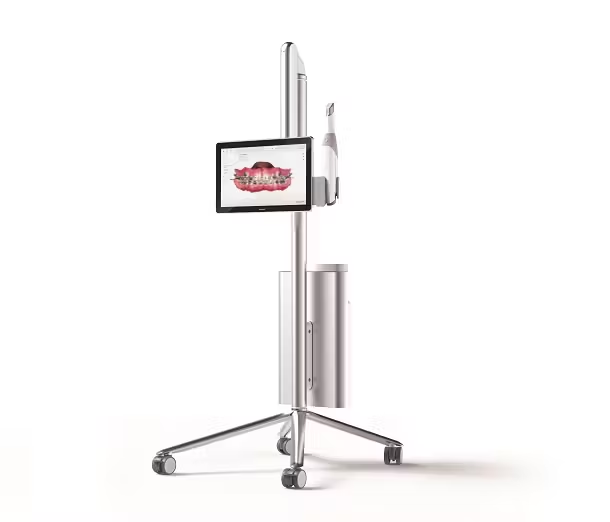
Wireless operation is the TRIOS 5’s defining advantage. The scanner connects to a laptop or the TRIOS MOVE+ cart via Wi-Fi, eliminating the cable entirely. This allows the scanner to move freely between operatories and makes it much easier to delegate scanning to hygienists or assistants. Battery life supports approximately four full-arch scans per charge, which is adequate for most practice days, though high-volume clinics may want a second battery or charging cradle available.
The closed-tip head design improves infection control, and tips can be autoclaved up to 100 times. Single-use TRIOS Ready Tips are also available for practices that prefer disposable options. Scan quality is excellent, with a wider field of view than previous models and high-definition color rendering that supports clear margin identification and patient communication.
At approximately $26,700, the TRIOS 5 represents a significant investment. However, for practices with steady digital scanning volume and a need for wireless flexibility, it remains the most balanced option in the lineup. It offers the best combination of ergonomics, scan quality, and workflow features without the additional subscription costs associated with the TRIOS 6. For the complete assessment, see the TRIOS 5 Wireless review.
TRIOS 6 Wireless: The AI-Powered Diagnostic Platform
The TRIOS 6 Wireless, released in 2025, represents a strategic evolution rather than a hardware revolution. Built on the proven TRIOS 5 platform, it shares the same physical form factor, weight, wireless connectivity, and calibration-free operation. The hardware refinements are modest: a new Arctic Sapphire blue finish, a redesigned remote control button that reduces accidental activations, and what 3Shape describes as a 110% improvement in scanning resolution across the entire scan field.
The real differentiator is software. The TRIOS 6 introduces TRIOS Dx Plus, a diagnostic platform powered by five AI tools that analyze each scan automatically. These include caries detection, tooth wear analysis, gingival recession mapping, periodontal risk assessment, and a general oral health screening. All five analyses run from a single scan capture without requiring the clinician to switch modes or trigger separate workflows. This positions the TRIOS 6 as a diagnostic platform rather than a pure digital impression device.
The TRIOS 6 also introduces hyperspectral scanning technology, capturing data across multiple light sources with each scan. This multi-modal approach provides richer diagnostic data than conventional color scanning and is a notable step toward the kind of chairside diagnostics that have previously required separate devices.
The trade-off is cost. The scanner itself starts at approximately $28,800, and the Dx Plus AI diagnostic features require an additional subscription of $199 per month (or $1,990 annually). This recurring cost changes the economics of scanner ownership and will be a key consideration for practices deciding between the TRIOS 5 and TRIOS 6. Clinics that will actively use the diagnostic features in daily practice stand to gain the most value. Practices that primarily need a reliable scan-and-send workflow may find that the TRIOS 5 delivers equivalent scanning performance at a lower total cost. The full TRIOS 6 Wireless review explores these trade-offs in detail.
Wired vs. Wireless: Which Connection Type Is Right for Your Practice?
One of the most consequential decisions when choosing a TRIOS scanner is the connection type. The TRIOS Core and TRIOS 3 are wired-only models, connecting via USB-C through a pod to a laptop. The TRIOS 5 and TRIOS 6 are wireless-only, connecting via Wi-Fi to a laptop, desktop, or the TRIOS MOVE+ / MOVE Pro cart.
The Case for Wired (TRIOS Core and TRIOS 3)
Wired scanners offer consistent, uninterrupted connectivity with zero dependence on Wi-Fi signal strength. There is no battery to manage, no risk of mid-scan disconnection, and no need to configure wireless networks. For practices with a single operatory or a stable setup where the scanner stays in one room, a wired connection is simple and reliable.
The main limitations are practical. The USB-C cable restricts the scanner’s range of motion and can create ergonomic friction during longer procedures. Moving the scanner between operatories requires disconnecting, relocating the laptop and pod, and reconnecting. Delegation to hygienists becomes less efficient when the equipment is tethered to a single workstation.
The Case for Wireless (TRIOS 5 and TRIOS 6)
Wireless scanners offer freedom of movement that fundamentally changes how scanning fits into a practice’s daily workflow. The scanner can be carried from room to room without any cable management, and scanning can be delegated more easily to trained staff. The TRIOS MOVE+ and MOVE Pro carts provide a mobile workstation with a built-in screen, allowing the scanner and its interface to travel together.
The main considerations are network reliability and battery management. Wireless performance depends on the quality of the practice’s Wi-Fi infrastructure. In buildings with thick walls, signal interference, or congested networks, scanning lag and connectivity drops can occur. 3Shape recommends a dedicated 5 GHz Wi-Fi network for optimal performance. Battery life on both the TRIOS 5 and TRIOS 6 supports roughly four full-arch scans per charge, which may require mid-day charging in high-volume practices.
For multi-operatory practices, group practices, or clinics with high scanning volume, wireless is almost always the better choice. For single-operatory practices on a tighter budget, the wired models deliver the same core scan quality without the wireless premium.
Which TRIOS Scanner Should You Choose?
The right TRIOS scanner depends on clinical needs, budget, and how central digital workflows are to daily operations. The following recommendations reflect the strengths and trade-offs of each model.
TRIOS Core is ideal for practices entering digital dentistry on a budget, clinics that need a secondary scan-and-send unit, or labs looking for a reliable capture device without premium features.
TRIOS 3 Wired suits general practices that want engagement apps, shade measurement, and Invisalign connectivity at a moderate price point, and that do not require wireless mobility.
TRIOS 5 Wireless is the best all-around choice for most practices. It offers the strongest combination of scan quality, ergonomics, and workflow flexibility, without the ongoing subscription costs of the TRIOS 6.
TRIOS 6 Wireless is best for digitally advanced practices that will actively use AI diagnostics in daily clinical workflows, and that are comfortable with a recurring subscription fee on top of the scanner investment.
Practices that scan multiple patients daily and delegate scanning to team members will benefit most from the wireless models. Practices that scan occasionally, primarily for lab cases, will find excellent value in the TRIOS 3 or Core.
3Shape TRIOS vs. iTero vs. Medit: How the Platforms Compare
The TRIOS lineup does not compete in a vacuum. Most practices shortlisting a TRIOS model are also looking at the iTero Lumina and one or more Medit scanners, the three platforms that together account for the majority of new intraoral scanner purchases in 2026. The comparison below focuses on flagship-to-flagship: TRIOS 5 vs. iTero Lumina vs. Medit i900, the models most practices are actually choosing between at this price tier.
Feature | 3Shape TRIOS 5 | iTero Lumina | Medit i900 |
|---|---|---|---|
Starting price | ~$26,000 | ~$30,000 | ~$18,000 |
Connectivity | Wireless | Wireless | Wireless |
Weight | ~280 g | ~350 g | ~245 g |
Mandatory subscription | Care plan required | Care plan required | None |
Caries detection | Fluorescence | NIRI | Not included |
Invisalign integration | Yes | Yes (optimized) | Yes (via link) |
Lab file export | Open (STL/PLY) | STL | Open (STL/PLY/OBJ) |
AI scanning assist | ScanAssist | TimeLapse AI | AI soft-tissue filter |
Offline capability | Yes | Limited | Yes |
Best suited for | Prosthetics/labs | Invisalign-led | Price-sensitive |
Dentist's note
Prices reflect published figures as of early 2026 and vary by region and reseller. Subscription terms differ between platforms: iTero and TRIOS require active care plans for full software access; Medit does not. See individual reviews for full cost breakdowns.
Price and total cost of ownership
Medit sets the price anchor. The i900 starts at around $18,000 with no mandatory subscription, making it the lowest total-cost option of the three over a five-year horizon. The TRIOS 5, at approximately $26,000, sits in the middle, though the required Care plan adds to the annual outlay after the first year. The iTero Lumina is the most expensive of the three at around $30,000 and also carries ongoing subscription costs. For budget-sensitive practices, the gap between Medit and TRIOS is meaningful; the gap between TRIOS 5 and iTero Lumina is smaller but still worth factoring into a multi-year ownership calculation.
Invisalign and orthodontic workflows
iTero has the deepest Invisalign integration of the three. As the scanner developed and validated specifically for Align Technology, the Lumina connects natively to the Invisalign Doctor Site, supports Invisalign Outcome Simulator Pro, and benefits from proprietary scanning modes optimized for aligner case submission. For practices where Invisalign volume drives a significant share of revenue, this native integration is a genuine workflow advantage that neither TRIOS nor Medit fully replicates. TRIOS connects to Invisalign and does so well, but the connection is a certified integration rather than a native one, and is not available in the USA on the TRIOS 3. Medit's Invisalign connection functions via a similar certified pathway. Practices that do not submit significant Invisalign volume will not notice a meaningful difference between the three.
Lab integration and open ecosystem
TRIOS has a clear advantage here. The 3Shape Unite platform connects practices to labs worldwide, supports direct case communication, and integrates with a wide range of third-party apps and CAD platforms. The open STL and PLY export means scans work with virtually any lab software, including Exocad and 3Shape Dental System. Medit is similarly open. The i900 exports in STL, PLY, and OBJ formats and integrates with Medit Link for case management, but its lab ecosystem is less mature than 3Shape Unite. iTero has historically been the most closed of the three, with stronger integration within the Align ecosystem but less flexibility for labs using non-Align platforms. For practices with established lab relationships that use open digital workflows, TRIOS offers the broadest compatibility.
Caries detection
All three platforms approach chairside diagnostics differently. The TRIOS 5 includes fluorescence-based caries detection, which identifies demineralized enamel and bacterial activity using a 405 nm light source. The iTero Lumina uses Near-Infrared Imaging (NIRI) at 850 nm, which penetrates enamel to detect proximal and subsurface lesions, a modality that some clinicians consider more useful for early interproximal caries. The Medit i900 does not include a dedicated caries detection mode in its base configuration. Practices that want caries detection built into the scanning workflow will find both TRIOS and iTero capable tools, though the two technologies detect different things and function best as complements to radiographic diagnosis rather than replacements for it.
Ergonomics and handling
Medit has the lightest scanner of the three. The i900 weighs approximately 245 grams, which is meaningfully lighter than the TRIOS 5 at around 280 grams and the iTero Lumina at around 350 grams. For clinicians who scan multiple patients back to back, or who delegate scanning to hygienists for extended sessions, the weight difference is noticeable over a full day. All three are wireless, so cable management is not a differentiator at this tier. Haptic feedback on the TRIOS 5 and Lumina provides tactile scanning cues; the Medit i900 does not include this feature.
Which platform fits which practice?
The honest answer depends on what you scan, not just how much you want to spend.
Choose TRIOS if your work is prosthetics- or lab-heavy, you value open-ecosystem flexibility, and you want the deepest integration with the widest range of dental labs and CAD platforms. The TRIOS 5 is the strongest all-round choice for this profile.
Choose iTero if Invisalign cases represent a significant share of your clinical work and you want the most integrated, proprietary Invisalign workflow available. The iTero Lumina is the current flagship for this use case, though it carries the highest price of the three.
Choose Medit if cost efficiency and subscription-free ownership matter most, and your lab relationships do not depend on 3Shape Unite or the Align ecosystem. The Medit i900 delivers competitive scan quality at a price point that makes a strong ROI case, particularly for high-volume general practices.
For practices that want a lower-cost entry into Medit's ecosystem, the Medit i700 offers proven scanning performance at a further reduced price point. For practices interested in how all three compare to the cloud-native alternative, the Primescan 2 review covers that angle in detail.
Bottom Line
The 3Shape TRIOS scanner series offers a complete range of intraoral scanning solutions, from the entry-level Core at $12,800 to the AI-equipped TRIOS 6 at $28,800 plus subscription fees. The TRIOS 5 Wireless delivers the best balance of performance, features, and value for the majority of dental practices. The TRIOS 6 adds genuinely useful AI diagnostics for practices ready to pay the ongoing premium. The TRIOS 3 and Core provide affordable, proven access to TRIOS scanning technology for clinics that do not need wireless connectivity or advanced diagnostic tools. Regardless of the model chosen, every TRIOS scanner benefits from 3Shape’s open ecosystem, strong lab integration, and a track record of consistent scanning quality that has earned the trust of tens of thousands of dental professionals worldwide.
Verdict
<p>The 3Shape TRIOS scanner series remains one of the strongest and most comprehensive intraoral scanning platforms available in 2026. The breadth of the lineup, from the budget-friendly Core to the AI-powered TRIOS 6, means that there is a TRIOS model for virtually every practice profile.</p><ul class="list-disc pl-4 space-y-1"><li><p>The <a target="_blank" rel="noopener noreferrer nofollow" class="text-primary underline hover:text-primary/80" href="https://dentalreviewed.com/reviews/3shape-trios-5-wireless-review-complete-guide-troubleshooting-for-dental-professionals"><u>TRIOS 5 Wireless</u></a> stands out as the best overall value for most dental practices. It delivers excellent scan quality, calibration-free convenience, wireless freedom, and access to the full 3Shape software ecosystem, all without the recurring subscription costs of the TRIOS 6. For practices that are ready to invest in a flagship scanner and want a tool they can rely on for years, the TRIOS 5 is the model to beat.</p></li><li><p>The <a target="_blank" rel="noopener noreferrer nofollow" class="text-primary underline hover:text-primary/80" href="https://dentalreviewed.com/reviews/3shape-trios-6-wireless-review-complete-guide-for-dental-professionals"><u>TRIOS 6 Wireless</u></a> is the right choice for practices that see AI-powered diagnostics as a core part of their clinical workflow, not just a nice-to-have. The Dx Plus platform’s caries detection, wear analysis, and periodontal screening tools are well implemented and can genuinely enhance chairside decision-making. The question each practice must answer is whether the diagnostic value justifies the ongoing subscription cost.</p></li><li><p>The <a target="_blank" rel="noopener noreferrer nofollow" class="text-primary underline hover:text-primary/80" href="https://dentalreviewed.com/reviews/3shape-trios-3-wired-review-complete-guide-troubleshooting-for-dental-professionals"><u>TRIOS 3 Wired</u></a> and TRIOS Core continue to serve an important role as accessible entry points into the TRIOS ecosystem. The scan quality on these models is fundamentally the same as what made the TRIOS 3 one of the most trusted scanners in dentistry over the past decade. For practices that prioritize reliability and value over wireless convenience, the wired models remain an excellent investment.</p></li></ul><p>Across all models, the combination of open file export, strong lab connectivity through Unite, and a broad software ecosystem gives TRIOS a competitive edge that extends well beyond the scanner hardware itself. For practices committed to <a target="_blank" rel="noopener noreferrer nofollow" class="text-primary underline hover:text-primary/80" href="https://dentalreviewed.com/blog/what-is-an-intraoral-scanner"><u>digital dentistry</u></a>, 3Shape TRIOS continues to offer a future-ready platform.</p>
Frequently Asked Questions
What is the difference between TRIOS 5 and TRIOS 6?
The TRIOS 6 shares the same physical hardware as the TRIOS 5 but adds AI-powered diagnostic capabilities through the Dx Plus software platform. These include caries detection, tooth wear analysis, gingival recession mapping, periodontal risk assessment, and general oral health screening. The TRIOS 6 also features improved scanning resolution and hyperspectral scanning technology. The main trade-off is cost: the TRIOS 6 is approximately $2,100 more expensive upfront, and the Dx Plus AI features require an additional $199/month subscription.
Is the TRIOS 3 still worth buying in 2026?
The TRIOS 3 remains a reliable and capable scanner with proven scan quality, engagement apps, and Invisalign connectivity (outside the USA, China, and Japan). At approximately $18,000, it offers strong value for practices that do not need wireless operation or AI diagnostics. The 2024 hardware refresh with USB-C connectivity and the redesigned pod keep it relevant for daily clinical use.
Can I use a TRIOS scanner with Invisalign?
The TRIOS 3, TRIOS 5, and TRIOS 6 all support Invisalign connectivity, allowing clinicians to submit digital scans directly for aligner fabrication. The TRIOS Core does not include Invisalign integration. It is also important to note that the Invisalign connection on the TRIOS 3 is not currently available in the USA, China, or Japan.
What are the ongoing costs of owning a TRIOS scanner?
Beyond the initial purchase price, ongoing costs include replacement scanner tips (autoclavable or single-use), TRIOS Care service plans after the first included year, and potential software subscription fees. The TRIOS 6 carries the highest ongoing cost due to the $199/month Dx Plus subscription for AI diagnostic features. The TRIOS 5, TRIOS 3, and Core do not require an additional diagnostic subscription.
Do TRIOS scanners work with non-3Shape lab software?
All current TRIOS models export scans in open STL and PLY formats, ensuring compatibility with most third-party dental CAD software, including Exocad and other widely used lab platforms. This open architecture is one of the key advantages of the TRIOS ecosystem compared to more closed systems.
Which TRIOS scanner is best for a new practice?
For a new practice with moderate scanning volume, the TRIOS 5 Wireless offers the best combination of future-proofing, workflow flexibility, and feature access. Practices with tighter budgets should consider the TRIOS 3 Wired, which delivers the same core scan quality with engagement apps and Invisalign support at a significantly lower price point. The TRIOS Core is suitable only if the practice needs a basic scan-and-send solution without advanced features.
How much does a 3Shape TRIOS scanner cost?
3Shape TRIOS pricing varies by model and region. As a guide, the TRIOS 4 Wireless typically lists around $25,000–$30,000, the TRIOS 5 Wireless around $30,000–$38,000, and the TRIOS 6 at the top of the lineup. A mandatory annual care plan adds roughly $1,800–$3,500/year.
Which 3Shape TRIOS scanner is best for orthodontics?
For orthodontic-only practices, the TRIOS 4 or TRIOS 5 hits the sweet spot — both are wireless, validated for Invisalign and SureSmile, and include caries-detection and shade-measurement tools. The TRIOS 6 adds incremental speed but is rarely necessary for ortho-only workflows.
Do 3Shape TRIOS scanners need a subscription?
Yes. All current TRIOS scanners require an active 3Shape Care subscription to receive software updates, integrations, and support. Without it, the scanner still functions but loses access to the 3Shape Communicate cloud and new features.
Is the 3Shape TRIOS worth it compared to Medit or iTero?
TRIOS leads on color accuracy, lab integration, and software ecosystem, making it the preferred choice for prosthetics-heavy practices. Medit wins on price and no-subscription model, while iTero dominates Invisalign-focused workflows. The right choice depends on case mix and existing lab partnerships.